Marigold Care Guide: Sun, Deadheading & Pests
Tagetes erecta
Marigolds need full sun (5–6+ hours), base watering every 3–5 days, regular deadheading, and moderately fertile well-draining soil. Non-toxic to pets.
Marigold Care Guide: Sun, Deadheading & Pests
Start with wateringThe most common care mistake for MarigoldWatering guide →Marigold care essentials
Light
full sun - 6+ hours of direct sunlight for maximum flowering
Water
Every 3–5 days during warm weather - check top 3–5 cm of soil. Always water at the base, never overhead. Reduce in cool weather.
Soil
Moderately fertile, well-draining mix - standard potting soil with 15 % perlite. Not too rich - excess nitrogen reduces flowers.
Humidity
Low to moderate; excess humidity causes botrytis (grey mould) on flowers
Temperature
18°C to 32°C (65–90°F)
Fertilizer
Use balanced fertilizer or compost tea; phosphorus-rich feed encourages more flowers and stop if the plant is stressed, newly repotted, or not actively growing.
About Marigold
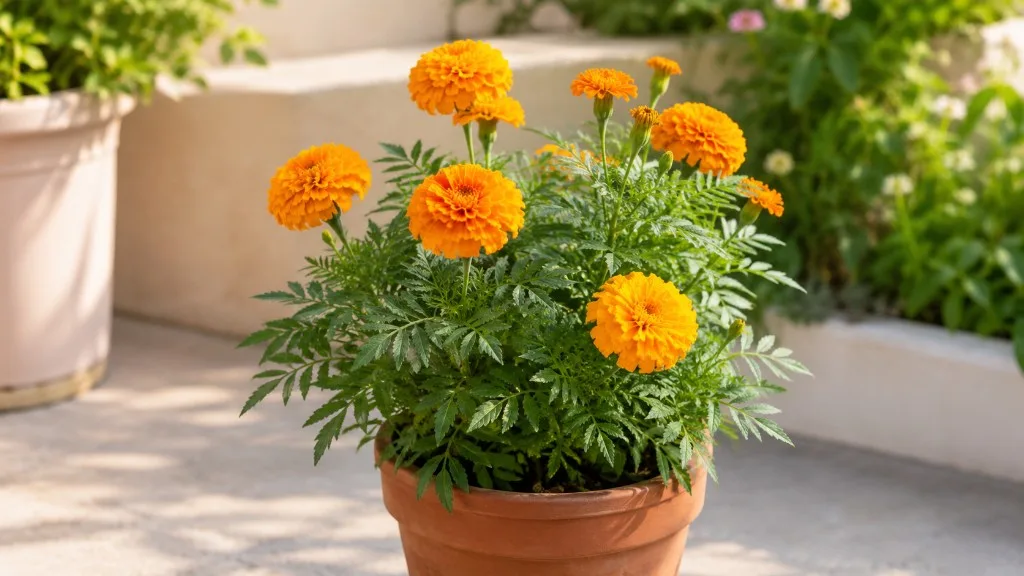
Marigold is native to Mexico and Central America, typically reaches 30–90 cm tall; 30–45 cm wide indoors, with fast - flowers in 6–8 weeks from seed growth. Marigold has a bushy growth habit and part of the Asteraceae family. It is also known as African Marigold, Genda Phool, and Calendula (different species but commonly confused).
| Detail | Information |
|---|---|
| Also known as | African Marigold, Genda Phool, Calendula (different species but commonly confused) |
| Native region | Mexico and Central America |
| Mature size | 30–90 cm tall; 30–45 cm wide |
| Growth rate | Fast - flowers in 6–8 weeks from seed |
| Growth habit | Bushy |
| Scientific name | Tagetes erecta |
| Family | Asteraceae |
Marigold Care Guide: Sun, Deadheading & Pests
Marigolds are the annual bedding plant people reach for when they want color that survives heat, forgives a missed watering, and keeps producing flowers through summer into the first frost. What they are not is interchangeable with every plant called “marigold,” tolerant of shade, or a magic pest shield you can drop between tomato rows and forget. This guide is about Tagetes - the African, French, and Signet marigolds sold as bedding plants worldwide - and the care routine that actually keeps them blooming: Marigold light guide, well-drained soil, base watering, regular deadheading, and realistic pest management.
If you came here because your marigolds look leafy but flowerless, because petals are rotting on the plant, or because you want to know whether marigolds really repel aphids, you are in the right place. By the end you should know which Tagetes type fits your bed or pot, how to water and feed without sabotaging blooms, how to deadhead efficiently, what pests and diseases to watch for, and where companion-planting claims hold up in real research.
What Marigold Actually Is - and What It Is Not
Marigold, in modern gardening, usually means plants in the genus Tagetes, family Asteraceae. They are true annuals in most climates: they germinate, grow, flower, set seed, and finish within one season. Wisconsin Horticulture lists Tagetes as an ornamental annual native to Mexico and Central America, which explains almost everything about what they want - bright sun, warm days, freely draining soil, and a steady but not swampy Marigold watering guide.
The naming is where people get into trouble. Three different plants share the marigold name:
Tagetes spp. - African, French, and Signet marigolds. This is the bedding plant covered here.
Calendula officinalis - pot marigold or garden marigold. Also in Asteraceae, but a different genus with different care expectations and a different toxicity profile. The ASPCA lists Calendula officinalis as non-toxic to cats and dogs. When a seed packet or blog says “marigold” without a botanical name, check which one you actually have.
Caltha palustris - marsh marigold. A wetland perennial in Ranunculaceae, unrelated to Tagetes and unsuitable as a bedding substitute.
In India and South Asia, Tagetes is widely known as Genda Phool and used in garlands and festival decoration. In Mexico, Tagetes erecta is central to Day of the Dead traditions, where petals guide symbolic pathways. Those cultural uses matter because they explain why marigolds are grown in such volume - they are bred to bloom heavily under sun and heat, not to perform as shade houseplants.
The Three Tagetes Marigolds You Will Actually Grow
Close to fifty Tagetes species exist, but three dominate the bedding trade. Iowa State Yard and Garden and University of Minnesota Extension both describe the same basic split: tall African types, compact French types, and fine-textured Signet types. Despite the names, African and French marigolds both originate in the Americas, not Africa or France. The labels come from historical trade routes and breeding history, not native range.
African Marigold (Tagetes erecta)
African marigold - also called Aztec marigold or American marigold - is the tall, upright type. Iowa State lists heights from 10 to 36 inches, with double flowers up to 5 inches across in yellow, gold, orange, and creamy white. Popular series include Antigua, Taishan, Inca II, Crackerjack, and Vanilla. African marigolds are the choice for back-of-border height, cut flowers, and hot, dry positions where smaller types may struggle. Penn State Extension notes they thrive under drought-like conditions once established and struggle in cool, damp weather that invites root rot on Marigold and fungal disease.
African marigolds benefit strongly from deadheading to stay tidy and rebloom. Taller cultivars like Crackerjack may need staking when loaded with large flower heads, especially after rain. UMN Extension recommends spacing African varieties at least a foot apart because of their size.
French Marigold (Tagetes patula)
French marigold is the workhorse bedding plant - the most commonly sold Tagetes in the United States per Iowa State. Plants run 6 to 18 inches tall with flowers typically under 2 inches, often in bold bicolors with maroon, red-brown, or orange combinations. Series such as Bonanza, Durango, Queen Sophia, and Safari cover most garden center racks.
French marigolds are more adaptable to soil moisture than African types and tolerate moist soils better, though they still require drainage. Iowa State notes they do not strictly require deadheading to rebloom, but most gardeners deadhead anyway to prevent spent blooms from rotting in humid weather. French types excel as edging, container fillers, and dense border plantings spaced closely for a hedge effect.
This is also the species most associated with root-knot nematode suppression in research, because French marigold roots release alpha-terthienyl, a compound toxic to nematode eggs. UF IFAS publication NG045 and Wisconsin Horticulture both highlight French marigolds in cover-crop nematode management. Cultivars such as Queen Sophia, Nemagold, and Single Gold have been used in trials, though variety matters and results vary by nematode species and soil temperature.
Signet Marigold (Tagetes tenuifolia)
Signet marigold is the smallest and most delicate of the three - typically under 12 inches, with single or semi-double flowers under an inch and fine, ferny foliage. Lemon Gem, Tangerine Gem, and Red Gem are common cultivars. Wisconsin Horticulture notes Signet flowers are edible and carry a citrus-marigold fragrance distinct from the heavier scent of French and African types.
Signet marigolds work well in containers, herb-garden edges, and rock gardens. Spent flowers often drop cleanly, so deadheading is rarely required. They still need full sun and good drainage, but their smaller blooms dry faster after rain, which reduces botrytis pressure compared with large double African heads.
Light: Full Sun Is Non-Negotiable
If you remember one rule, remember this: marigolds need full sun. Wisconsin Horticulture specifies 6 to 8 hours of direct sun daily. University of Minnesota Extension is blunter: marigolds need full sun all day to provide blooms all season long. Partial shade might keep the plant alive, but flower production drops sharply - leggy stems, fewer buds, and pale color are the usual result.
A practical placement map:
Garden beds and borders: Choose the sunniest section available. Along driveways, south-facing foundation beds, vegetable garden margins, and open lawn edges outperform shaded foundation corners and tree-root competition zones.
Containers and balconies: Put pots where they receive direct sun for most of the day, not just bright reflected light. A marigold on a shaded balcony will survive longer than a fuchsia in full sun, but it will not look like the photos on the seed packet.
Indoors: Tagetes marigolds are poor long-term indoor plants. Without strong supplemental light they stretch, mildew, and stop blooming. Treat them as seasonal outdoor annuals.
Acclimate transplants gradually if they came from a shaded greenhouse bench. A hard move from shade to blazing afternoon sun can scorch leaves. Over 7 to 10 days, increase exposure so the plant hardens off without wilting.
The light test is simple: if new growth is compact, stiff, and flowering steadily, light is adequate. If stems stretch between leaves and buds are scarce, the plant needs more sun - not more fertilizer.
Soil, Drainage, and Bed Placement
Marigolds are not fussy about rich soil. In fact, too much nitrogen is a common reason for leafy plants with few flowers. Wisconsin Horticulture lists Tagetes as low feeders preferring well-drained soil at pH 6 to 7. Iowa State notes most marigolds prefer full sun with well-drained to dry soils and become drought tolerant once established.
A good garden bed preparation routine:
Clear weeds and loosen the top 6 to 8 inches of soil. If you have heavy clay, mix in compost and coarse sand or horticultural grit so water moves through instead of pooling. Marigolds hate sitting in wet soil - especially African types, which Iowa State warns are more vulnerable to root rots in moist soils.
For average garden loam, often no amendment beyond compost is needed. Extremely rich vegetable beds freshly loaded with manure may produce vigorous foliage at the expense of blooms; go lighter on nitrogen if that is your situation.
pH 5.8 to 7.0 covers marigold comfort. Hobbyists rarely need to adjust pH unless a soil test shows a real problem. In containers, use a moderately fertile, well-draining mix - standard potting soil with 15% perlite is a solid baseline. Avoid dense, peat-heavy mixes that stay wet in cool weather.
Spacing depends on species. UMN Extension advises planting French and Signet types fairly close for hedge effects, while African types need at least 12 inches between plants - more for the largest cultivars like Crackerjack.
Growing Marigolds in Containers and on Balconies
Marigolds are excellent container annuals because they tolerate heat, recover from short dry spells, and bloom continuously when deadheaded. UMN Extension notes that all marigold types can grow in garden beds, but Signet marigolds are especially well suited to containers because of their smaller habit.
Container success hinges on three details:
Pot drainage. Use pots with drainage holes. Sealed decorative pots without holes are a fast route to root rot.
Pot size. A 10- to 12-inch pot supports one large African marigold or two to three French marigolds. Crowding is acceptable for French types if you want a full, mound-like display.
Watering frequency. Containers dry faster than in-ground beds. In peak summer you may water every 1 to 2 days on a hot balcony, while in-ground plantings might go 3 to 5 days between drinks. Always check the soil rather than obeying a calendar.
Terracotta dries quickly; plastic retains moisture longer. Match pot material to your habits - underwaterers often do better in plastic, overwaterers in terracotta.
Watering Marigolds Without Inviting Disease
Marigolds want moderate, even moisture while establishing, then tolerate drier conditions once roots are deep. Wisconsin Horticulture says to ensure even moisture but avoid waterlogging. UC IPM lists marigolds as needing moderate to regular water while warning that overhead sprinkling on taller plants can break stems under the weight of water.
The most important watering habit is water at the base, not overhead. UMN Extension and multiple extension sources tie overhead watering to petal rot, botrytis, and leaf spots because wet flower heads decay quickly in humid weather. Early morning base watering gives foliage time to dry if splash occurs.
For established in-ground plants, allowing the soil to dry slightly between waterings then watering thoroughly and deeply is a useful starting point in temperate summer climates. In hot, dry regions or fast-draining containers, you will exceed that; in cool, cloudy stretches, you will water less.
Signs of overwatering on Marigold include yellow lower leaves, soft stems at the base, gray mold on flowers, and sour-smelling soil. Signs of underwatering on Marigold include midday wilting, dry soil to depth, and drooping flower heads that recover after a deep soak.
How to Check Soil Moisture Before You Water
Press your finger into the soil 2 to 3 cm (about an inch) deep. If it feels dry at that depth, water thoroughly until water runs from drainage holes or penetrates deeply in garden beds. If it still feels cool and slightly damp, wait.
Lift containers when possible. A dry pot is noticeably lighter. In garden beds, look at the soil surface color and crack pattern - dusty, pale, and cracked usually means dry; dark and cool means wait.
During cool weather or after flowering slows, reduce frequency. Marigolds use less water when temperatures drop and growth pauses. The dangerous pattern is watering on a summer schedule into autumn rain.
Fertilizer: Low Feed, Bloom Focus
Marigolds are low feeders. Wisconsin Horticulture explicitly lists low fertilization requirements. Iowa State notes nutritional disorders are uncommon in garden soil but can appear in soilless media - nitrogen deficiency causes overall yellowing, phosphorus deficiency can purple lower leaves, and low pH may cause bronze speckling from iron or manganese toxicity.
For most home gardeners:
At planting: Mix a modest amount of compost into the bed, or use potting mix with a starter charge. That is often enough for the season.
During growth: If plants look pale or bloom count drops on poor soil, apply a balanced fertilizer at quarter to half label strength every 3 to 4 weeks during active growth, or use a phosphorus-forward organic feed such as bone meal around the root zone. University of Minnesota Extension notes excess nitrogen pushes leaves instead of flowers; phosphorus-forward feeds support blooming.
When to stop: Do not feed stressed, drought-shocked, or disease-hit plants. Do not load fertilizer onto dry soil. Pause in late season when blooms naturally taper.
If your marigolds are dark green, bushy, and flowerless, suspect too much nitrogen before you suspect too little sun - though both can coexist.
Deadheading for Non-Stop Blooms
Deadheading - removing spent flowers - is the highest-return maintenance task for Tagetes marigolds. UMN Extension states marigolds do not require deadheading but can greatly benefit from it. Removing spent blooms redirects energy from seed production into new buds and keeps plants looking clean.
Why deadheading matters beyond aesthetics:
More flowers. Once a bloom is pollinated and seed set begins, the plant receives a hormonal signal to shift resources. Cutting faded flowers interrupts that pathway.
Less disease. UMN Extension notes marigold blooms rot easily in humid conditions. Spent heads hold moisture and become entry points for Botrytis cinerea (gray mold). UC IPM lists botrytis blight as a primary marigold disease. Removing rotting flowers is disease prevention, not just tidiness.
Longer display. Walking the bed every few days and pinching or snipping faded blooms extends the show until frost.
Technique: follow the stem of the spent flower down to just above the nearest leaf joint or branching point and cut or pinch cleanly. For African marigolds with large heads, remove the entire stem section rather than leaving a naked stalk. For French types in dense plantings, pinching by hand during a quick pass works fine.
Signet marigolds often shed spent blooms themselves; deadheading is optional unless you see mold on lingering petals.
Pinching, Staking, and Mid-Season Renovation
Two early-season actions shape the plant: pinching and spacing.
Pinch young plants when they have several sets of true leaves but before heavy budding. Wisconsin Horticulture, UMN Extension, and Iowa State all recommend pinching tips while plants are still small to promote branching and a bushier habit. A single pinch prevents one long stem with a flower on top - the classic rookie marigold look.
Stake tall African cultivars before heavy rain or wind events. UMN Extension advises staking taller African varieties to support large blossoms. Insert a slim stake at planting time if you grow Crackerjack or similar 24- to 36-inch types.
Mid-season renovation rescues tired beds. If plants look leggy, mildew-speckled, or bloom-sparse in midsummer, cut them back by up to one-third, water deeply, feed lightly, and let fresh growth reflower in a few weeks. This works better on French and Signet types than on towering Africans already woody at the base, but even large types often push new buds after a hard trim if health is otherwise good.
Starting from Seed or Transplants
Marigolds are easy from seed - Iowa State calls them durable annuals ideal for beginners and children. Wisconsin Horticulture gives two paths:
Direct sow outdoors when soil temperatures exceed 65°F (18°C). Seeds germinate quickly in warm soil - often 5 to 7 days at 20 to 25°C - and plants can flower within 6 to 8 weeks under strong sun.
Start indoors about 8 weeks before last frost, then transplant after frost danger passes. Harden off for 7 to 10 days before planting out.
Sow seed barely covered; light aids germination. Keep seed trays moist but not saturated. Leggy indoor seedlings usually mean insufficient light - move trays to a brighter windowsill or add grow lights.
In India and similar warm climates, growers often sow September to October for winter flowering in North India or February for a summer crop in hotter regions, matching marigolds to the cool dry season when they perform best in subtropical conditions.
Transplants from nurseries should be compact, not root-bound, and not in full bloom yet - heavy flowering on a small plug often means the plant was held too long in the pack. Choose plants with buds, not open flowers, for fastest establishment.
Succession planting - sowing a new batch every 10 to 14 days - staggers peak bloom and helps if an early planting succumbs to disease or slugs.
Companion Planting, Nematodes, and Pest Myths
Marigolds have a reputation as vegetable-garden protectors. The science is more specific than the folklore.
What is well supported: French marigolds suppress plant-parasitic nematodes, especially root-knot (Meloidogyne) and lesion (Pratylenchus) nematodes, through root exudates including alpha-terthienyl, which interferes with nematode egg hatching. UF IFAS NG045, Wisconsin Horticulture, and a ScienceDirect review of marigold cover crops document decades of research on this effect. Piedmont Master Gardeners summarize the mechanism clearly: marigold roots release a toxic chemical that interrupts the nematode life cycle.
How to use that effect correctly: Grow marigolds as a dense cover crop in the same soil for at least 2 to 3 months before planting a nematode-susceptible crop. UF IFAS and gardening extension sources emphasize cover cropping ahead of vegetables, not casually interplanting one marigold per tomato and expecting miracles. Variety selection matters - French types generally outperform Africans for nematode work, though cultivars like Crackerjack show suppression in some trials.
What is weak or inconsistent: The idea that marigold scent repels aphids, cabbage worms, or rabbits from neighboring crops. Rutgers research cited by Piedmont Master Gardeners found marigolds failed to repel cabbage, carrot, and onion pests. The USDA lists multiple pests that attack marigolds themselves, including aphids and spider mites. Marigolds may attract beneficial insects and, in some studies, draw pests away from other ornamentals - a trap-crop effect, not a repellent force field.
Deer and rabbits: UMN Extension notes marigolds naturally repel deer and rabbits because mammals find the odor offensive. That is more reliable than insect repelling, though hungry animals in desperate conditions may still browse.
Honest companion planting takeaway: plant marigolds because they bloom all season in sun, tolerate heat, and can clean up nematode problems when used as a cover crop - not because they replace integrated pest management elsewhere in the garden.
Common Pests on Marigolds
Marigolds are not pest-proof. Iowa State lists Japanese beetles, spider mites, aphids, thrips, and other insects as occasional attackers. UC IPM catalogs marigold pests under invertebrate disorders. Commercial marigold production literature from India’s National Horticulture Board notes aphids, red spider mites, leafhoppers, beetles, and whiteflies as recurring issues in flower crops.
Spider mites (Tetranychus urticae) are the classic hot-weather pest. Fine stippling on leaves, bronzing, and webbing on undersides appear during dry, hot spells. Mites thrive when plants are stressed and airflow is poor. Control starts with a strong water rinse on leaf undersides, then insecticidal soap or horticultural oil if populations persist. Fix the environment - mites explode when marigolds are drought-stressed in reflected heat.
Aphids cluster on tender tips and buds, curling leaves and excreting honeydew that leads to sooty mold. Aphids on marigolds are often melon aphid (Aphis gossypii) or green peach aphid (Myzus persicae) in production settings. Blast with water, prune heavily infested tips, and use insecticidal soap. Ant trails on stems mean aphids - control ants if you want long-term relief.
Japanese beetles skeletonize leaves and chew flowers in regions where they are established. Hand-pick in early morning or use row cover on small plantings. Iowa State notes insects rarely destroy marigolds entirely in home landscapes - they make plants ugly for a while.
Thrips and leafhoppers distort foliage and are more common in rainy seasons; French marigolds are considered more susceptible to leafhopper damage per Indian production guides. Remove weeds that harbor populations and improve airflow.
Extension consensus for home gardeners: insecticides are generally not warranted for occasional cosmetic damage on annuals that will finish the season anyway. Intervene when pests prevent blooming, spread to vegetables, or signal a chronic imbalance - usually too little water, too much nitrogen, or not enough sun.
Diseases and Environmental Problems
Botrytis blight (gray mold) is the marquee flower disease. Brown, water-soaked spots on petals become fuzzy gray masses in humid weather. UC IPM lists Botrytis cinerea on marigolds. Prevention: deadhead promptly, water at base, improve spacing for airflow, and avoid evening overhead irrigation.
Root, stem, and crown rots from Pythium and similar fungi hit when soil stays wet - especially on African marigolds in heavy clay. Prevention is drainage; cure is often removal because annuals do not repay heavy fungicide programs.
Aster yellows is a serious but less common problem. Iowa State describes a phytoplasma transmitted by leafhoppers that deforms flowers into green, leaf-like structures. There is no home cure. Remove infected plants immediately so leafhoppers do not spread the pathogen to other Asteraceae - marigolds, coneflowers, asters, and lettuce relatives.
Powdery mildew can appear in crowded, humid plantings with poor airflow. Thin spacing, hit affected leaves with water early in the day, and remove the worst stems.
Nutritional issues in containers: yellow entire plant may mean nitrogen lack; purpling lower leaves can mean phosphorus lack; bronze speckling may indicate low pH toxicity. A single half-strength balanced feed usually clarifies the situation within two weeks if roots are healthy.
Environmental stress shows up as wilting at midday (often temporary in heat - check soil before drowning the plant), bleached petals (too much reflected heat or sudden sun shock), and early collapse after frost (marigolds are frost-sensitive annuals that die when freezing temperatures arrive).
Pet Safety and the Calendula Confusion
Pet owners must separate Tagetes from Calendula.
Tagetes spp. (French and African marigolds): Pet Poison Helpline lists Tagetes species as toxic to dogs and cats at mild severity, causing gastrointestinal upset if ingested and skin irritation from sap contact. The ASPCA maintains a separate entry for Calendula officinalis (garden marigold / pot marigold) as non-toxic - which is why conflicting blog posts exist. If your plant is a bedding Tagetes with the pungent scent and ferny Tagetes foliage, treat it as mildly toxic: vomiting or diarrhea possible, especially with large ingestion. Call your veterinarian or ASPCA Animal Poison Control at 888-426-4435 if a pet eats a significant amount.
Calendula officinalis: Listed non-toxic to cats and dogs by ASPCA. Still not a free pass for pets to eat ornamental plants - stomach upset can occur from volume or pesticides - but the risk profile differs from Tagetes.
Practical placement: keep Tagetes marigolds in raised beds, front-yard borders, or fenced areas if pets chew plants. Use Calendula if you need a marigold-name flower in a pet-accessible herb garden - but verify the botanical name on the label.
Conclusion
Tagetes marigolds earn their place as the default sunny annual because the care is straightforward once you respect what they are: sun-loving, moderately thirsty, low-feeding bloom machines that punish shade, soggy soil, and overhead watering. Choose French types for edging, nematode cover crops, and wetter soils; African types for height and cut flowers in hot, dry beds; Signet types for containers and edible petals. Water at the base, deadhead before flowers rot, pinch young plants for bushiness, and walk the row every few days in August when spider mites and botrytis pressure peak.
Marigolds will not single-handedly save a tomato patch from every insect, but they will bloom until frost when you give them real sun and a honest deadheading habit - and that is usually what gardeners actually wanted when they bought the flat of six-packs in May.
When to use this page vs other Marigold guides
- Marigold overview - Canonical hub for this species - care topics and problems branch from here.
- Marigold problems - Symptom-first path when you already know something is wrong.
Related Marigold guides
How to care for Marigold?
How much light does Marigold need?
full sun - 6+ hours of direct sunlight for maximum flowering
- full sun - 6+ hours of direct sunlight for maximum flowering - full sun - 6+ hours of direct sunlight for maximum flowering.
When should you water Marigold?
Every 3–5 days during warm weather - check top 3–5 cm of soil. Always water at the base, never overhead. Reduce in cool weather.
- Press soil at 2–3 cm depth - water when dry - Every 3–5 days during warm weather - check top 3–5 cm of soil.
- Drain excess water - Always water at the base, never overhead.
What soil works best for Marigold?
Moderately fertile, well-draining mix - standard potting soil with 15 % perlite. Not too rich - excess nitrogen reduces flowers.
- 60% potting soil - Moderately fertile, well-draining mix - standard potting soil with 15 % perlite.
- 20% compost
- 20% coarse sand - Adds weight and drainage; use coarse horticultural sand rather than fine beach sand.
Grower notes for Marigold
What matters most with Marigold
Marigold needs enough light and seasonal rhythm to bloom well. Leaves may stay alive in mediocre light, but flowers usually reveal whether the plant is truly getting what it needs. In practice, the care checkpoint is simple: full sun - 6+ hours of direct sunlight for maximum flowering. Pair that with moderately fertile, well-draining mix - standard potting soil with 15 % perlite. Not too rich - excess nitrogen reduces flowers, and avoid changing water, pot size, and placement all at once.
Best placement in a real home
Marigold belongs where full sun - 6+ hours of direct sunlight for maximum flowering is realistic for most of the day, not only where the pot looks good. Every 3–5 days during warm weather - check top 3–5 cm of soil. Always water at the base, never overhead. Reduce in cool weather. If the pot stays wet longer than expected, move the plant into better light or reassess the mix before watering again. Humidity target: Low to moderate; excess humidity causes botrytis (grey mould) on flowers. Temperature comfort zone: 18°C to 32°C (65–90°F).
Before you buy this plant
Choose Marigold with firm new growth, clean leaf undersides, and soil that does not smell sour or feel compacted. Be cautious if you see leggy-growth, sticky residue, collapsed crowns, or a pot that is wet in poor light. Cosmetic old-leaf damage is less worrying than weak roots or active pests.
First month after bringing it home
Do not repot Marigold on day one unless the mix is failing or pests are obvious. Quarantine it, learn how fast the pot dries, and keep care boring while it adjusts. Watch especially for leggy-growth, yellow-leaves, and brown spots. If problems appear, correct the condition first rather than stacking fertilizer, repotting, and pruning together.
Safety note for Marigold
Marigold is not a plant to keep within reach of pets or children. The database flags it for cats and dogs. Use gloves if sap or plant tissue is irritating, and pick a pet-safe alternative for floor pots or low shelves.
How to tell Marigold is settling in
Also sold as African Marigold, Genda Phool, and Calendula (different species but commonly confused), this plant should be judged by stable new growth rather than label names alone. If you plan to multiply it later, common methods include Seeds and Stem cuttings. Repot only when you see N/A - annual plant. If yellow-leaves shows up early, inspect light, watering, and roots before assuming the plant is permanently weak.
Are marigolds safe for pets?
Marigolds (Tagetes species) are listed as non-toxic to cats and dogs by ASPCA. The pungent scent naturally deters most pets.
ASPCA lists Tagetes species as non-toxic to cats and dogs. Minor gastrointestinal irritation is possible with large ingestion amounts but no serious toxicity is expected.
Watering Marigold
For Marigold, press soil at 2–3 cm depth - water when dry and water every 1–2 days in summer; every 3–4 days in cooler months. Water more frequently during peak summer; reduce after flowering ends.
| Detail | Information |
|---|---|
| How often | Every 1–2 days in summer; every 3–4 days in cooler months |
| How to check | Press soil at 2–3 cm depth - water when dry |
| Seasonal changes | Water more frequently during peak summer; reduce after flowering ends |
Signs of overwatering
- stem rot at base
- grey mould on flowers
- yellow lower leaves
Signs of underwatering
- wilting midday
- dry soil
- flower heads drooping
Soil & potting for Marigold
Use a mix of 60% potting soil, 20% compost, 20% coarse sand for Marigold. Good drainage preferred; tolerates average garden soil. Target soil pH around 5.8–7.0. Repot grown as annual - typically sown directly in final container or garden bed, ideally in sow in September–October for winter flowering; February for summer crop.
| Detail | Information |
|---|---|
| Recommended mix | 60% potting soil, 20% compost, 20% coarse sand |
| Drainage | Good drainage preferred; tolerates average garden soil |
| Soil pH | 5.8–7.0 |
| Repotting frequency | Grown as annual - typically sown directly in final container or garden bed |
| Best season to repot | Sow in September–October for winter flowering; February for summer crop |
Signs it needs repotting
- N/A - annual plant
Humidity & temperature for Marigold
Marigold prefers low to moderate; excess humidity causes botrytis (grey mould) on flowers, though normal home humidity is usually fine. Keep temperatures around 18°C to 32°C (65–90°F).
| Detail | Information |
|---|---|
| Humidity | Low to moderate; excess humidity causes botrytis (grey mould) on flowers - normal home humidity is fine. |
| Ideal temperature | 18°C to 32°C (65–90°F) |
Fertilizer & pruning for Marigold
Use use balanced fertilizer or compost tea; phosphorus-rich feed encourages more flowers and stop if the plant is stressed, newly repotted, or not actively growing. for Marigold.
| Detail | Information |
|---|---|
| Fertilizer type | Use balanced fertilizer or compost tea; phosphorus-rich feed encourages more flowers and stop if the plant is stressed, newly repotted, or not actively growing. |
Common problems on Marigold
Black Spots
MediumLikely cause: Apr 29, 2026 · Seeing black spots on marigold leaves might feel like a setback, but it is simply part of the learning experience of being a gardener. By keeping your foliage dry, ensuring good airflow, and practicing regular cleanup, you ca
Quick fix: Confirm diagnosis on your Marigold, then address the most likely care or pest factor described in current extension guidance.
Full fix guide →Likely cause: Jul 23, 2023 · If you’re wondering how to get rid of ants on your marigold plant , you’ve come to the right place. In this article, we will explore various methods to keep ants away from your marigolds and ensure their healthy growth.
Quick fix: Confirm diagnosis on your Marigold, then address the most likely care or pest factor described in current extension guidance.
Full fix guide →Brown Tips
MediumLikely cause: Apr 30, 2026 · Dealing with marigold leaves turning brown is a common hurdle, but it is one you are now fully equipped to handle. Whether the issue was a hidden colony of spider mites or a simple case of “thirsty roots,” your attentive care
Quick fix: Confirm diagnosis on your Marigold, then address the most likely care or pest factor described in current extension guidance.
Full fix guide →Caterpillars
MediumLikely cause: Jul 7, 2023 · Marigolds are not only beautiful but also serve as natural pest repellents in the garden. However, when caterpillars invade these plants, they can quickly destroy them if left unchecked. In this article, we will explore effect
Quick fix: Confirm diagnosis on your Marigold, then address the most likely care or pest factor described in current extension guidance.
Full fix guide →Cold Damage
MediumLikely cause: Jul 22, 2024 · When frost threatens, protecting Tagetes erecta is crucial to maintain its health through winter. Use frost cloths or burlap sheets to cover the plants, avoiding plastic as it can cause damage . For potted Tagetes erecta , mo
Quick fix: Confirm diagnosis on your Marigold, then address the most likely care or pest factor described in current extension guidance.
Full fix guide →Bacterial Wilt
HighLikely cause: The present investigation entitled “Evaluation of African marigold ( Tagetes erecta L.) hybrids/varieties for yield and resistance to bacterial wilt ” was undertaken at Agricultural Research Station, Mannuthy during the year 2016-17.
Quick fix: Confirm diagnosis on your Marigold, then address the most likely care or pest factor described in current extension guidance.
Full fix guide →Crispy Leaves
MediumLikely cause: Sep 2, 2025 · The fungus attacks the leaf structure, causing spots that enlarge, turn brown, and become crispy as the tissue dies. The solution is to improve air flow around me, water at the base to keep leaves dry, and remove any severely
Quick fix: Confirm diagnosis on your Marigold, then address the most likely care or pest factor described in current extension guidance.
Full fix guide →Compacted Soil
MediumLikely cause: Jul 22, 2024 · Aeration is key; compacted soil suffocates roots. To aerate: Regularly turn the soil gently to avoid compaction . Mix in organic matter such as compost to create a more porous structure. Perform regular soil checks; if water
Quick fix: Confirm diagnosis on your Marigold, then address the most likely care or pest factor described in current extension guidance.
Full fix guide →Blight
MediumLikely cause: May 15, 2023 · Also known as gray mold, botrytis blight infects a wide range of plants. Marigolds are just a few among dozens of species, and unfortunately, this disease can be difficult to prevent and control.
Quick fix: Confirm diagnosis on your Marigold, then address the most likely care or pest factor described in current extension guidance.
Full fix guide →Calcium Deficiency
MediumLikely cause: Aug 11, 2025 · While preparing for a marigold seminar at Cultivate25, the team decided to induce Ca deficiency and sample deficient and complete blooms of African marigold ( Tagetes erecta ) to determine actual concentrations.
Quick fix: Confirm diagnosis on your Marigold, then address the most likely care or pest factor described in current extension guidance.
Full fix guide →Damping Off
HighLikely cause: Damping Off is mostly a disease of indoor seed raising. Growing your seedlings in a well ventilated, cool greenhouse will produce far fewer problems with Damping Off . However, if your climate dictates that you start your seedlings inside t
Quick fix: Confirm diagnosis on your Marigold, then address the most likely care or pest factor described in current extension guidance.
Full fix guide →Downy Mildew
MediumLikely cause: Pot Marigold downy mildew explained. Learn to spot symptoms, treat the disease, and prevent future outbreaks on your Calendula officinalis plants.
Quick fix: Confirm diagnosis on your Marigold, then address the most likely care or pest factor described in current extension guidance.
Full fix guide →Crown Rot
HighLikely cause: Jul 4, 2022 · Solution – Root rot , stem rot, or crown rot is caused when too much water to plants, but the soil does not drain well. Too much moisture causes various severe fungi/bacterial wilting diseases to affect the Marigold.
Quick fix: Confirm diagnosis on your Marigold, then address the most likely care or pest factor described in current extension guidance.
Full fix guide →Likely cause: Grow vibrant marigolds effortlessly, ensuring non-stop flowers all season with proper care, pest control, and thriving plants.
Quick fix: Confirm diagnosis on your Marigold, then address the most likely care or pest factor described in current extension guidance.
Full fix guide →Exposed Roots
MediumLikely cause: Jul 8, 2023 · Marigold plants have a fibrous root system, which means they have many small, branching roots rather than a single taproot. These fibrous roots spread out horizontally in the soil, allowing the plant to maximize its absorption
Quick fix: Confirm diagnosis on your Marigold, then address the most likely care or pest factor described in current extension guidance.
Full fix guide →Flowers Turning Brown
MediumLikely cause: Grow vibrant marigolds effortlessly, ensuring non-stop flowers all season with proper care, pest control, and thriving plants.
Quick fix: Confirm diagnosis on your Marigold, then address the most likely care or pest factor described in current extension guidance.
Full fix guide →Fertilizer Burn
MediumLikely cause: Jan 31, 2026 · Fertilizer burn is a common issue that can occur when marigolds are overfertilized. This is often caused by applying too much fertilizer at once, resulting in an overabundance of nutrients that can scorch the leaves and damag
Quick fix: Confirm diagnosis on your Marigold, then address the most likely care or pest factor described in current extension guidance.
Full fix guide →High Humidity
MediumLikely cause: Jun 14, 2024 · 🌼 Marigolds need 60-70% humidity to avoid crispy leaves and wilting. 💦 Boost humidity with pebble trays, misting, or a humidifier in dry months. 🌡️ Use hygrometers to monitor and adjust for seasonal humidity changes.
Quick fix: Confirm diagnosis on your Marigold, then address the most likely care or pest factor described in current extension guidance.
Full fix guide →Fungus Gnats
LowLikely cause: Jul 16, 2023 · Fortunately, there are several effective methods to get rid of gnats and protect your marigold plants from their infestation. In this article, we will explore these methods and help you maintain healthy marigolds .
Quick fix: Confirm diagnosis on your Marigold, then address the most likely care or pest factor described in current extension guidance.
Full fix guide →Drooping Leaves
MediumLikely cause: Jul 22, 2024 · 💧 Adjust watering to fix droopy Tagetes erecta ; avoid extremes. 🌞 Optimize light and temperature to prevent stress-induced droopiness . 🌱 Ensure soil drainage and root health; inspect and repot as needed.
Quick fix: Confirm diagnosis on your Marigold, then address the most likely care or pest factor described in current extension guidance.
Full fix guide →Leggy Growth
MediumLikely cause: Insufficient direct sun causing stretched sparse growth
Quick fix: Move to full sun; pinch back stems
Full fix guide →Heat Stress
MediumLikely cause: Jan 19, 2016 · This study investigated semi-lethal temperature (LT 50), heat injury index (HII) and 16 physiological indexes closely related to heat stress to evaluate heat tolerance of nine marigold ( Tagetes erecta and T. patula) cultivar
Quick fix: Confirm diagnosis on your Marigold, then address the most likely care or pest factor described in current extension guidance.
Full fix guide →Leggy Seedlings
MediumLikely cause: Apr 29, 2026 · In this guide, we will walk through the exact steps to rescue your stretching plants and ensure your future batches grow thick, sturdy, and full of vibrant blooms. Let’s turn those spindly stems into the lush, bushy marigolds
Quick fix: Confirm diagnosis on your Marigold, then address the most likely care or pest factor described in current extension guidance.
Full fix guide →Magnesium Deficiency
MediumLikely cause: Sep 28, 2025 · The low soil temperature and cooler weather of the fall can cause magnesium deficiency to occur. A little diluted Epsom salt can sometimes nudge plants into producing more flowers and staying...
Quick fix: Confirm diagnosis on your Marigold, then address the most likely care or pest factor described in current extension guidance.
Full fix guide →Mold on Soil
LowLikely cause: Spider mites, botrytis, and summer bloom failure are the three problems that hit marigolds hardest. Learn the mechanism behind each and exactly how to fix them.
Quick fix: Confirm diagnosis on your Marigold, then address the most likely care or pest factor described in current extension guidance.
Full fix guide →Not Enough Light
MediumLikely cause: Learn about proper sunlight requirements for African marigold ( Tagetes erecta ). Discover ideal light conditions, sunlight intensity, and best practices for healthy growth.
Quick fix: Confirm diagnosis on your Marigold, then address the most likely care or pest factor described in current extension guidance.
Full fix guide →Mosaic Virus
MediumLikely cause: In summary, mixed infection of five viruses infecting marigold was identified by deep sequencing, including TuMV and BBWV-2, first reported in marigold, and two new viruses, marigold mosaic virus in the Potyvirus and marigold cryptic virus
Quick fix: Follow extension or botanical guidance for Marigold mosaic virus; adjust care before applying broad treatments.
Full fix guide →Mealybugs
MediumLikely cause: Jul 22, 2024 · Pests can wreak havoc on Tagetes erecta , compromising its health and growth. Spider mites and mealybugs , for example, drain the plant's vital sap, leading to stunted growth and increased susceptibility to diseases.
Quick fix: Confirm diagnosis on your Marigold, then address the most likely care or pest factor described in current extension guidance.
Full fix guide →Nitrogen Deficiency
MediumLikely cause: Feb 27, 2026 · The objective of this study was to determine the effect of different nitrogen concentrations in the nutrient solution on the concentration and accumulation of macronutrients ( N , P, K, Ca, Mg, and S) in different organs (lea
Quick fix: Confirm diagnosis on your Marigold, then address the most likely care or pest factor described in current extension guidance.
Full fix guide →Nutrient Lockout
MediumLikely cause: However, nutrient deficiencies can also stem from improper soil pH, which locks up existing nutrients , or poor soil structure affecting nutrient uptake. Marigolds are generally robust, but their vigorous flowering can deplete soil nutrient
Quick fix: Confirm diagnosis on your Marigold, then address the most likely care or pest factor described in current extension guidance.
Full fix guide →Pale Leaves
MediumLikely cause: Apr 30, 2026 · In this guide, I will show you how to identify marigold foliage with confidence, from the tiny serrated edges to the unique scent they release. You will learn how to distinguish between different varieties and, more important
Quick fix: Confirm diagnosis on your Marigold, then address the most likely care or pest factor described in current extension guidance.
Full fix guide →Potassium Deficiency
MediumLikely cause: While marigolds are generally low-maintenance, providing them with a balanced fertilizer that prioritizes phosphorus and potassium , applied correctly, is key to preventing nutrient deficiency and encouraging a season full of bright, health
Quick fix: Confirm diagnosis on your Marigold, then address the most likely care or pest factor described in current extension guidance.
Full fix guide →Powdery Mildew
HighLikely cause: mildew of oak tree (Quercus serrata). Out of these plants, rhizome extract of Zingiber officinale (at 15% concentration) was found to Fig 3: Powdery mildew
Quick fix: Confirm diagnosis on your Marigold, then address the most likely care or pest factor described in current extension guidance.
Full fix guide →Purple Leaves
MediumLikely cause: You should understand the causes and remedies for marigold leaves turning purple . Your marigolds will continue to landscape all season long.
Quick fix: Confirm diagnosis on your Marigold, then address the most likely care or pest factor described in current extension guidance.
Full fix guide →Salt Build-up
MediumLikely cause: It was further noted that as the salt stress increases the plant performance for all investigated traits decreased significantly. The varieties showed highly different responses for both seed and flowering related attributes.
Quick fix: Confirm diagnosis on your Marigold, then address the most likely care or pest factor described in current extension guidance.
Full fix guide →Seeds Not Germinating
MediumLikely cause: Apr 29, 2026 · It is incredibly frustrating to wait for those first green hooks to emerge, only to realize your marigold seeds not germinating is becoming a real problem. Don’t worry—these flowers are perfect for beginners, and most germina
Quick fix: Confirm diagnosis on your Marigold, then address the most likely care or pest factor described in current extension guidance.
Full fix guide →Root Rot
MediumLikely cause: Waterlogged soil from poor drainage
Quick fix: Repot in well-draining mix; reduce watering
Full fix guide →Scale Insects
MediumLikely cause: Aug 5, 2023 · Scales are small insects that feed on the sap of plants, causing damage and weakening the overall health of the marigold plant. If you notice scales on your marigold plant, it is important to take action to eliminate them and
Quick fix: Confirm diagnosis on your Marigold, then address the most likely care or pest factor described in current extension guidance.
Full fix guide →Soil Too Alkaline
MediumLikely cause: Apr 29, 2026 · The most common and effective material for this is garden lime. Conversely, if your soil is too alkaline , or above 7.5, you need to increase the acidity. Adding organic matter like pine needles, peat moss, or elemental sulfu
Quick fix: Confirm diagnosis on your Marigold, then address the most likely care or pest factor described in current extension guidance.
Full fix guide →Slow Growth
LowLikely cause: Jun 8, 2025 · Discover 11 common marigold - growing problems and how to fix them—avoid stunted growth , pests, and poor blooms with these tips.
Quick fix: Confirm diagnosis on your Marigold, then address the most likely care or pest factor described in current extension guidance.
Full fix guide →Slugs and Snails
MediumLikely cause: Apr 29, 2026 · Dealing with slugs eating marigolds can be frustrating, but it is a manageable part of the gardening journey. By combining physical barriers like copper tape with smart watering habits and encouraging natural predators, you c
Quick fix: Confirm diagnosis on your Marigold, then address the most likely care or pest factor described in current extension guidance.
Full fix guide →Thin Stems
MediumLikely cause: Jul 8, 2023 · The roots and stems of a marigold plant are vital for its growth, stability, and overall health. The fibrous root system ensures efficient water and nutrient uptake, while the herbaceous stems provide structural support and tr
Quick fix: Confirm diagnosis on your Marigold, then address the most likely care or pest factor described in current extension guidance.
Full fix guide →Likely cause: If the entire plant browns in a matter of hours during a heat event, provide deep shade and water immediately, but don't fertilize and don't prune the damaged leaves until new growth is clearly coming in. Stressed plants need their damaged
Quick fix: Confirm diagnosis on your Marigold, then address the most likely care or pest factor described in current extension guidance.
Full fix guide →Transparent Leaves
MediumLikely cause: Are you searching for Marigold Leaves png hd images or vector? Choose from 50+ Marigold Leaves graphic resources and download in the form of PNG, EPS, AI or PSD.
Quick fix: Confirm diagnosis on your Marigold, then address the most likely care or pest factor described in current extension guidance.
Full fix guide →Spider Mites
MediumLikely cause: Apr 12, 2026 · Marigolds are a natural pest control method that can help prevent spider mite infestations . They serve as a trap crop, temporarily distracting the mites from their foliage. To control and prevent spider mites, use safe pest
Quick fix: Confirm diagnosis on your Marigold, then address the most likely care or pest factor described in current extension guidance.
Full fix guide →Water Stress
MediumLikely cause: A pot experiment was conducted to investigate the growth and flowering response of two marigold species (Tagetes erecta and Tagetes patula) to varying water stress levels.
Quick fix: Follow extension or botanical guidance for Marigold water stress; adjust care before applying broad treatments.
Full fix guide →Wrong Soil Mix
MediumLikely cause: Nov 13, 2025 · For vibrant marigolds , choose organic potting mixes like Wonder Soil with coco coir and mycorrhizae, or Miracle-Gro Moisture Control for consistent dampness without saturation. Look for soils with balanced pH (6.0-7.0) and g
Quick fix: Confirm diagnosis on your Marigold, then address the most likely care or pest factor described in current extension guidance.
Full fix guide →Yellow Leaves
MediumLikely cause: Overwatering or root rot in dense soil
Quick fix: Improve drainage; reduce watering
Full fix guide →Wilting
MediumLikely cause: Apr 10, 2025 · The first and one of the most common marigold problems is wilting , caused by a few things. The most common reason leaves wilt is that the soil is too dry. If this occurs, increase your watering frequency. It can be tempting
Quick fix: Follow extension or botanical guidance for Marigold wilting; adjust care before applying broad treatments.
Full fix guide →