Venus Flytrap Care: Light, Water, Soil, Dormancy, Feeding
Dionaea muscipula
Venus Flytrap needs full sun (4+ hours direct), distilled or rainwater only (never tap water), nutrient-free acidic soil, and a 3–5 month cold winter dormancy to survive long-term. It is non-toxic to pets.
Venus Flytrap Care: Light, Water, Soil, Dormancy, Feeding
Start with wateringThe most common care mistake for Venus FlytrapWatering guide →Venus Flytrap care essentials
Light
full sun-minimum 4 hours of direct sun per day
Water
Use only distilled water or rainwater-never tap water. Keep the growing medium consistently moist by standing the pot in 1–2 cm of distilled water (tray method).
Soil
Pure nutrient-free medium-standard potting soil kills this plant. Use pure sphagnum moss or a 1:1 mix of peat moss and perlite (no fertiliser-amended products).
Humidity
50–70%
Temperature
21–35°C (70–95°F) in summer
Fertilizer
Feed never during never fertilize-feed live insects instead. Fertilizer, tap water, and any nutrient-rich additives are fatal to this plant.
About Venus Flytrap
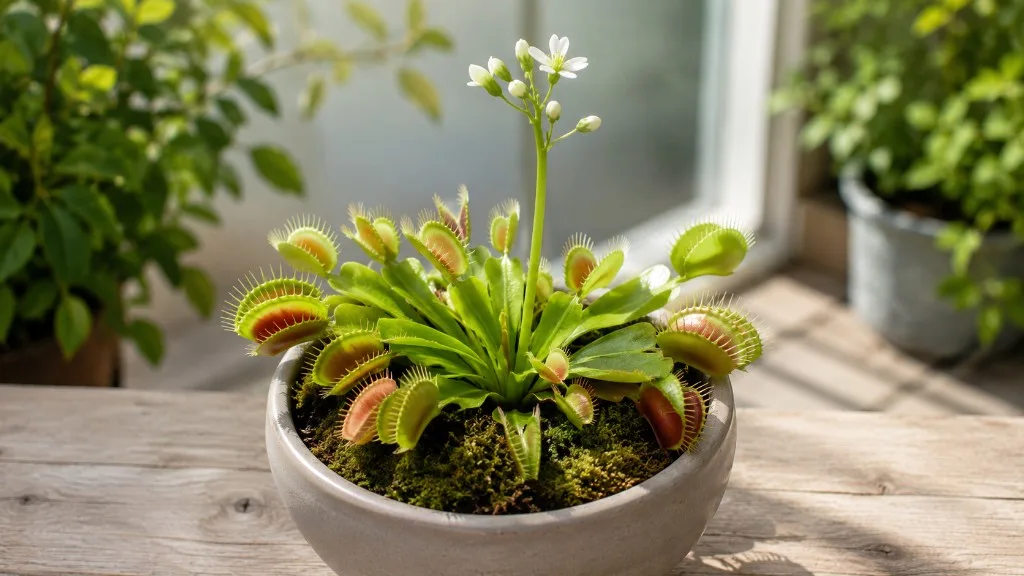
Venus Flytrap is native to North and South Carolina, USA (boggy, nutrient-poor wet savannahs near Wilmington, NC), typically reaches 4–6 inch rosette; traps 0.5–1.5 inches indoors, with slow growth. Venus Flytrap has a rosette growth habit and part of the Droseraceae family. It is also known as Venus Fly Trap, Tippitwitchet, and Catch of Devil.
| Detail | Information |
|---|---|
| Also known as | Venus Fly Trap, Tippitwitchet, Catch of Devil |
| Native region | North and South Carolina, USA (boggy, nutrient-poor wet savannahs near Wilmington, NC) |
| Mature size | 4–6 inch rosette; traps 0.5–1.5 inches |
| Growth rate | Slow |
| Growth habit | Rosette |
| Scientific name | Dionaea muscipula |
| Family | Droseraceae |
Venus Flytrap Care: Light, Water, Soil, Dormancy, Feeding
What Venus Flytrap Actually Is (and Why That Changes Everything)
The Venus flytrap (Dionaea muscipula) is a temperate, carnivorous perennial in the family Droseraceae - the same family as sundews. Charles Darwin called it “one of the most wonderful plants in the world,” and the description still holds. What makes it unusual among houseplants is not the snapping traps; it is the habitat it evolved in.
In the wild, Venus flytrap occupies a tiny, restricted range in the Coastal Plain and Sandhills of North and South Carolina, where it grows in wet, open longleaf pine savannas, sandhill seepages, and the sandy margins of Carolina Bays. These sites share three traits that define every care decision you make at home: Venus Flytrap light guide, permanently moist but not stagnant acidic peat, and nutrient poverty so extreme that the plant captures insects to supplement what its roots cannot absorb. The traps are modified leaves - not flowers, not fruit - and each one costs the plant energy to operate. Treating Dionaea like a tropical foliage plant on a dim windowsill with tap water and bagged potting mix is the fastest route to a dead flytrap, usually within a single growing season.
Understanding the native ecology also matters for conservation. Wild populations have declined from habitat loss, fire suppression, and poaching; North Carolina made wild collection a felony in 2014, and the species is listed on CITES Appendix II, meaning international trade is regulated. Always buy nursery-propagated plants from reputable carnivorous-plant growers. Never collect from the wild, even if you live in the Carolinas.
Venus Flytrap at a Glance
A quick reference card before the deep sections:
- Botanical name: Dionaea muscipula J. Ellis
- Family: Droseraceae (sundew family)
- Type: Temperate carnivorous perennial; basal rosette of toothed snapping traps on flat petioles
- Mature size: Roughly 4–6 inches (10–15 cm) rosette; individual traps 0.5–1.5 inches
- Light: Full direct sun - minimum 6 hours daily outdoors; indoors requires a very bright south-facing window or supplemental grow lights 12–16 hours/day
- Water: Distilled water, rainwater, or reverse-osmosis (RO) water only - never tap, never most bottled/filtered water
- Soil: 1:1 unfertilized sphagnum peat moss and perlite (or peat and horticultural sand); standard potting soil will kill the plant
- Watering method: Tray method - 1–2 cm standing water under the pot during active growth; barely damp in dormancy
- Temperature (active growth): Roughly 70–95 °F (21–35 °C) days; cooler nights acceptable
- Dormancy: Mandatory - 3–4 months at roughly 32–50 °F (0–10 °C) with shortened photoperiod
- Feeding: Live or freshly killed small insects placed inside traps; no fertilizer, ever
- Hardiness: USDA zones 7–10 outdoors in suitable bog conditions (zones 5–6 with winter protection)
- Toxicity to pets: Non-toxic to dogs, cats, and horses (ASPCA)
- Growth rate: Slow; one to several new traps per growing season on a healthy plant
Light: Full Direct Sun Is Non-Negotiable
Venus flytraps need full sun - not bright indirect light, not “a sunny windowsill” in the casual sense, but unfiltered direct sunlight for at least six hours per day, with eight or more being ideal during the active growing season (spring through early autumn). The New York Botanical Garden’s carnivorous plant guide puts it plainly: without strong direct light, the plant deteriorates quickly. Outdoors in USDA zones 7–10 (zones 5–6 with winter protection), an open bog garden or patio tray in full sun is the gold standard.
Indoors, most windowsills fail this test, especially in winter when day length and sun angle drop. Insufficient light produces etiolation: traps sit at the end of long, pale, weak petioles, traps stay small and often lack the red interior pigmentation that signals adequate photosynthesis, and the whole rosette looks stretched and anemic. A healthy flytrap in good light has compact rosettes, firm traps, and often red lining inside the jaws on many common cultivars. If your plant is pale green and leggy, light is the first variable to fix - before water, before Venus Flytrap repotting guide, before anything else.
When natural sun is inadequate, add full-spectrum horticultural LED grow lights positioned close enough to deliver intensity comparable to outdoor sun. A practical starting point for indoor culture is 12–16 hours of artificial light daily during active growth, tapering to 10–12 hours as dormancy approaches. Transition gradually when moving a plant between indoor and outdoor light; sudden jumps from dim indoors to blazing patio sun can scorch traps that have not hardened off.
Water: Distilled or Rainwater Only - Never Tap
Do not use tap water on a Venus flytrap. This is not cautious overkill - it is the single most common cause of slow death in cultivated plants. Dionaea evolved in rainwater-fed bogs where total dissolved solids (TDS) are extremely low. Tap water, and even many bottled or pitcher-filtered waters, carry dissolved minerals - calcium, magnesium, sodium, chlorine residues - that accumulate in the peat over months. The roots cannot excrete these salts the way a desert succulent might tolerate occasional hardness. Mineral buildup raises soil conductivity, burns fine roots, and eventually kills the plant even if everything else looks fine short-term.
Acceptable water sources, in order of universal grower acceptance:
- Distilled water (purchased jugs from a grocery store work; confirm the label says distilled, not “purified” through carbon filtration alone)
- Rainwater collected from a clean roof into a non-metal container (avoid runoff from treated shingles or polluted urban air if possible)
- Reverse-osmosis (RO) water from an home RO unit or aquarium shop
If you want a numeric rule of thumb, carnivorous-plant growers generally aim for TDS below 50 ppm, and many prefer under 20 ppm. You can verify your source with an inexpensive TDS meter in seconds. When in doubt, use distilled until you have confirmed your rainwater or RO reading.
The Tray Method During Active Growth
During the active growing season (roughly March through October in the Northern Hemisphere, adjusted for your local climate), Venus flytraps prefer consistent root-zone moisture delivered by the tray method: set the plastic pot in a shallow saucer and maintain 1–2 cm (about ½ inch) of standing pure water in the tray at all times. The peat wicks moisture upward; you top off the tray rather than flooding from above. Top-watering occasionally to flush the surface is fine, but the tray is the primary rhythm.
The ICPS growing guide notes an important nuance: the crown of the plant should not sit in saturated anaquatic mud. In taller pots (10 cm / 4 inches or deeper), a 1:1 peat-perlite mix with tray watering works well because the water level stays well below the surface. In very shallow pots, lean slightly sandier or water more shallowly to avoid crown rot.
When dormancy arrives, reduce water dramatically. The medium should stay barely damp - not dry as a cactus, but nowhere near summer tray levels. Over-wet cold soil invites fungal rot; bone-dry cold soil risks freeze-drying if the plant is stored outdoors in freezing weather. The seasonal shift from “wet and sunny” to “cool and barely moist” mirrors the Carolina winter rhythm and is not optional.
Soil: Peat-Perlite Mix and Why Potting Soil Kills
Venus flytraps require a nutrient-poor, acidic, mineral-free substrate. Standard bagged potting soil - even “organic” mixes - contains fertilizer, compost, lime, or wetting agents that will poison Dionaea within weeks. Do not use cactus mix, orchid bark, coco coir with added nutrients, or “moisture control” blends.
The standard home recipe is equal parts unfertilized sphagnum peat moss and perlite (1:1). Some growers substitute horticultural silica sand for part or all of the perlite; the ICPS notes that sand-heavy mixes drain faster and suit shorter pots, while perlite is widely used and works well for typical container culture. What matters is that the peat is plain sphagnum peat with no added fertilizer - check the label - and that perlite is horticultural grade, not construction aggregate.
Target pH roughly 4.5–5.5. You rarely need to test if you are using pure peat and pure water. Wet the peat before mixing or potting; dry peat is hydrophobic and repels first waterings, leaving dry pockets around roots. Never add lime, bone meal, slow-release pellets, or compost top-dressing. If someone tells you to feed the soil, they are thinking of a tomato, not a flytrap.
Temperature, Humidity, and Airflow
During active growth, Venus flytraps tolerate warm days well into the 90s °F (32+ °C) if water and light keep pace. Nighttime cooling is natural and beneficial; constant hot stagnation without airflow encourages fungal problems. Most homes sit in an acceptable daytime range for half the year; the harder half is winter, when indoor heating dries air and warm windowsills prevent dormancy.
Humidity is secondary to light and water purity. Flytraps do not need terrarium fogging. Average household humidity (40–60%) is fine. Very dry winter air may encourage spider mites; a humidity tray (pebbles and water below pot level, not touching the pot bottom) or grouping with other plants helps marginally. Do not mist traps - wet foliage in low airflow invites mold, and misting does not fix mineral problems in the soil.
Avoid sudden heat spikes against glass, cold drafts from AC vents blowing directly on the rosette, and placing the pot above a radiators heat plume. Stable conditions beat perfect-but-fragile extremes.
Winter Dormancy: Required for Long-Term Survival
A Venus flytrap must experience winter dormancy to survive more than one or two years. This is not a optional rest for neatness; it is a temperate perennial’s biological requirement. Without roughly three to four months of cold rest at 32–50 °F (0–10 °C), with shorter days and reduced watering, the plant exhausts itself producing traps year-round and dies - often slowly enough that beginners blame the last thing they changed.
Dormancy is triggered naturally by declining daylight and cooler temperatures in late autumn. Traps stop opening vigorously, existing leaves may turn black or brown starting from the edges, and the rosette shrinks to a small resting bud often mistaken for death. It is death-like, and that is normal.
How to Put Your Flytrap Through Dormancy
Outdoor approach (zones 7–10, or zones 5–6 with protection): Many growers keep flytraps in an outdoor bog or tray garden year-round. As nights cool, remove standing water from the tray and let rain provide moisture. Protect from prolonged deep freeze without moisture (freeze-drying) using pine needle mulch or row cover; fully dormant plants can survive brief hard freezes if they are not desiccated.
Indoor / no-yard approach: Move potted plants to an unheated garage, shed, cold frame, or porch that stays between roughly 35–50 °F for most of the winter. Reduce lighting to natural short days or a reduced grow-light timer (10–12 hours). Keep soil barely damp. Trim fully black leaves only after they are completely dead if you prefer a tidy look; living tissue still photosynthesizes weakly on warm spells.
Do not keep the plant on a heated windowsill under 14-hour grow lights all winter unless you accept that it is skipping dormancy - tolerable once for a young plant, harmful as a yearly habit. Holiday-season gift plants arriving in winter may finish one partial season indoors; plan for proper dormancy the following year.
Resume normal tray watering and full light when new growth appears in late winter to early spring (often March in temperate climates).
Feeding Traps: Insects Only, Never Fertilizer
Venus flytraps capture prey to obtain nitrogen and other nutrients absent from their native soil, not because they need “food” in the animal sense daily. Outdoors, they catch their own flies, ants, and spiders. Indoors, feeding is optional for plant health if the plant receives strong light - but a occasional insect can support more robust trap development.
Never apply fertilizer to the soil, traps, or leaves. No balanced houseplant liquid, no orchid feed, no diluted seaweed, no “just a little” experiment. Fertilizer salts damage the sensitive roots the same way tap-water minerals do, only faster. The plant’s entire strategy is growing in sterile peat; nitrogen arrives through digestion inside the trap, not through root uptake of soluble feed.
Acceptable prey items are small, soft-bodied insects: fruit flies, small houseflies, ants (occasionally), small crickets sized to fit comfortably inside the trap. Do not feed hamburger, chicken, egg, cheese, or processed human food - the trap cannot digest it, it rots, and fungal infection follows. One trap digesting one appropriately sized insect is sufficient; feeding every trap on the plant weekly wastes energy and can overwhelm a small rosette.
How to Feed a Trap Without Overdoing It
Choose a trap that opened fully in the last few days. Drop the insect inside with tweezers. If the hairs are not triggered, gently tickle the trigger hairs inside with a toothpick to initiate closure - once, not repeatedly. The trap will seal and digest over 5–12 days, then reopen a hollow shell if successful. Feed at most one trap per plant per week during active growth. Do not feed during dormancy. Do not poke traps shut for entertainment; each false closure costs photosynthate without nutritional return.
Choosing the Right Pot and Repotting
Use plastic pots at least 10 cm (4 inches) deep with drainage holes. Deep pots keep the crown farther from standing tray water and accommodate the surprisingly long white roots flytraps produce. Avoid unglazed terracotta, which wicks unevenly and can leach minerals. Net pots and specialized carnivorous-planters work; aesthetics are secondary to depth and plastic purity.
Repot every one to two years, or when the peat compacts, algae coats the surface heavily, or water runs straight through without absorbing. The best timing is late winter to early spring, just as new growth emerges from dormancy - not mid-summer heat or mid-dormancy unless emergency rot demands it.
Slide the plant out, gently tease away old peat from roots, trim black mushy roots with clean scissors, and replant at the same depth with fresh 1:1 mix. Water from below and keep bright but not blazing for a week while roots settle. Do not feed for several weeks after repotting.
Propagation Methods for Home Growers
Home propagation is rewarding but slower than buying nursery divisions. Common methods:
Leaf pullings (petiole cuttings): During active growth, pull a healthy leaf downward so it includes a small wedge of white rhizome tissue at the base. Lay it on moist peat or upright in peat with the base buried slightly. High humidity and bright light produce plantlets in weeks to months.
Division: Mature clumps occasionally produce offsets. Separate them during spring repotting, ensuring each division has roots and a growth point.
Seed: Fresh Dionaea seed germinates in weeks under bright light and warm tray conditions, but seedlings take three to five years to reach impressive trap size - a patience project, not a quick gift.
Always propagate from healthy plants only. Sterilize tools. Use the same pure water and peat-perlite mix as adult plants.
Growing Indoors vs Outdoors
Outdoors in zones 7–10 in full sun with tray watering is the easiest path to a vigorous, self-feeding plant that receives natural dormancy. A dedicated mini-bog tub on a patio beats a windowsill for trap color, size, and longevity.
Indoors can work, but only with honest light assessment. A south-facing window that receives direct sun most of the day may suffice in summer; most indoor setups need supplemental LEDs. Indoor growers must engineer dormancy deliberately - the plant will not get cold enough on a kitchen windowsill above a radiator.
Year-round warm indoor culture without dormancy produces an attractive plant for 12–18 months, then collapse. If you live in a tropical climate without cool winters, research whether local growers use refrigerator dormancy protocols carefully - possible but advanced, with rot risk if done carelessly.
Common Problems and How to Read Them
Most flytrap problems trace to water purity, light intensity, or dormancy compliance. Pests are secondary.
Mineral burn / chronic tap-water use: Traps fail progressively, new growth is stunted, roots turn black despite “wet” soil. Fix: repot immediately into fresh peat-perlite, switch to distilled water, flush nothing with tap.
root rot on Venus Flytrap from over-wet cold soil: Mushy rhizome, sour-smelling peat during dormancy or in a too-deep water tray. Fix: trim rot, repot, reduce water, improve airflow.
Etiolation from low light: Long thin petioles, small pale traps. Fix: more direct sun or stronger grow lights; acclimate gradually.
Overfeeding or wrong food: Traps blacken from the inside, mold on meat. Fix: remove decaying material, stop feeding until healthy new traps form.
Black Leaves, Weak Traps, and Traps That Won’t Close
Black leaves in late autumn through winter during dormancy are normal. The plant is retracting above-ground tissue to the rhizome. Panic repotting or tap-water “rescue” kills more plants than the dormancy itself.
Black leaves in summer on an actively growing plant suggest rot, mineral damage, or heat stress without adequate water. Check rhizome firmness - a healthy crown is firm and white inside when gently inspected.
Traps that won’t close on an old trap may simply be spent; each trap only closes a limited number of times before becoming a photosynthetic leaf only. New traps should still snap if lightly triggered. If no new traps form, suspect light or water first.
Pet Safety and Ethical Sourcing
The ASPCA lists Venus flytrap as non-toxic to dogs, cats, and horses. A pet might damage the plant more than the plant damages the pet. Traps are not strong enough to harm human fingers, though deliberately triggering them wastes plant energy - a teaching moment for curious children, not a party trick.
Buy only from reputable nurseries that propagate their own stock. Wild poaching remains a threat to remaining Carolina populations despite legal protections. Nursery propagation supports conservation while giving you a plant already acclimated to cultivation.
Where to Place Your Flytrap in a Real Home
The honest best placements:
- Outdoor patio or bog garden in full sun (zones 7–10, or 5–6 with protection) with a distilled-water top-up routine for dry spells
- Indoor grow-light shelf with timer, plastic pot in tray, distilled water jug stored nearby
- Very bright south-facing window plus grow light in winter, with a planned cold dormancy location for November–February
Poor placements that predict failure:
- Bathroom or kitchen with tap-water convenience and low light
- Office desk with fluorescent ceiling lights only
- Terrarium closed tight without sun or with tap misting
- Heated windowsill all winter with no dormancy plan
Match the placement to the season: outdoor summer, cool garage winter - or accept that grow lights and dormancy engineering are your full-time job indoors.
Conclusion
Venus flytrap care collapses to five rules that are simple to state and easy to violate: full direct sun, distilled or rainwater only, 1:1 peat and perlite with zero fertilizer, mandatory winter dormancy around 32–50 °F for three to four months, and feeding traps insects if you feed at all - never the soil. Dionaea muscipula is not difficult because it needs exotic chemistry; it is difficult because it refuses to compromise on conditions that mimic a Carolina pine savanna.
Get those five right and the plant becomes almost routine - compact red-lined traps in summer, an ugly but healthy sleep in winter, fresh growth every spring for years. Violate any one - especially tap water, potting soil, or skipping dormancy - and no amount of trap-poking or “plant rescue” products will matter. Respect the bog, and the flytrap respects you back.
When to use this page vs other Venus Flytrap guides
- Venus Flytrap overview - Canonical hub for this species - care topics and problems branch from here.
- Venus Flytrap problems - Symptom-first path when you already know something is wrong.
Related Venus Flytrap guides
- Venus Flytrap watering
- Venus Flytrap light
- Venus Flytrap soil
- Venus Flytrap propagation
- Venus Flytrap fertilizer
- Venus Flytrap repotting
- Venus Flytrap pruning
- Brown Tips on Venus Flytrap
- Mold on Soil on Venus Flytrap
- Slow Growth on Venus Flytrap
- Crispy Leaves on Venus Flytrap
- No Flowers on Venus Flytrap
How to care for Venus Flytrap?
How much light does Venus Flytrap need?
full sun-minimum 4 hours of direct sun per day
- full sun-minimum 4 hours of direct sun per day - full sun-minimum 4 hours of direct sun per day.
When should you water Venus Flytrap?
Use only distilled water or rainwater-never tap water. Keep the growing medium consistently moist by standing the pot in 1–2 cm of distilled water (tray method).
- Tray should never run completely dry during the growing season - Keep the growing medium consistently moist by standing the pot in 1–2 cm of distilled water (tray method).
- reduce to just barely moist in winter dormancy - Keep the growing medium consistently moist by standing the pot in 1–2 cm of distilled water (tray method).
- Drain excess water - Use only distilled water or rainwater-never tap water.
What soil works best for Venus Flytrap?
Pure nutrient-free medium-standard potting soil kills this plant. Use pure sphagnum moss or a 1:1 mix of peat moss and perlite (no fertiliser-amended products).
- pure long-fibre sphagnum moss - Pure nutrient-free medium-standard potting soil kills this plant.
- or peat moss (unfertilised) with perlite (50%) - Use pure sphagnum moss or a 1:1 mix of peat moss and perlite (no fertiliser-amended products).
Grower notes for Venus Flytrap
What matters most with Venus Flytrap
Venus Flytrap needs enough light and seasonal rhythm to bloom well. Leaves may stay alive in mediocre light, but flowers usually reveal whether the plant is truly getting what it needs. In practice, the care checkpoint is simple: full sun-minimum 4 hours of direct sun per day. Pair that with pure nutrient-free medium-standard potting soil kills this plant. Use pure sphagnum moss or a 1:1 mix of peat moss and perlite (no fertiliser-amended products), and avoid changing water, pot size, and placement all at once.
Best placement in a real home
Venus Flytrap belongs where full sun-minimum 4 hours of direct sun per day is realistic for most of the day, not only where the pot looks good. Use only distilled water or rainwater-never tap water. Keep the growing medium consistently moist by standing the pot in 1–2 cm of distilled water (tray method). If the pot stays wet longer than expected, move the plant into better light or reassess the mix before watering again. Humidity target: 50–70%. Temperature comfort zone: 21–35°C (70–95°F) in summer.
Before you buy this plant
Choose Venus Flytrap with firm new growth, clean leaf undersides, and soil that does not smell sour or feel compacted. Be cautious if you see brown-tips, sticky residue, collapsed crowns, or a pot that is wet in poor light. Cosmetic old-leaf damage is less worrying than weak roots or active pests.
First month after bringing it home
Do not repot Venus Flytrap on day one unless the mix is failing or pests are obvious. Quarantine it, learn how fast the pot dries, and keep care boring while it adjusts. Watch especially for brown-tips, mold-on-soil, and slow-growth. If problems appear, correct the condition first rather than stacking fertilizer, repotting, and pruning together.
Pet-aware note for Venus Flytrap
Venus Flytrap is a better choice for pet-aware homes than toxic ornamentals, but pet safe does not mean the plant should be chewed. Use hanging, shelf, or room placement if pets dig in soil or shred leaves, and choose sturdier plants for high-traffic pet zones.
How to tell Venus Flytrap is settling in
Also sold as Venus Fly Trap, Tippitwitchet, and Catch of Devil, this plant should be judged by stable new growth rather than label names alone. If you plan to multiply it later, common methods include Leaf pullings, Division, and Seed (very slow). Repot only when you see Sphagnum moss decomposing and multiple rhizomes crowding the pot. If mold-on-soil shows up early, inspect light, watering, and roots before assuming the plant is permanently weak.
Is it pet safe?
Venus Flytrap is generally considered pet safe.
Watering Venus Flytrap
For Venus Flytrap, tray should never run completely dry during the growing season; reduce to just barely moist in winter dormancy and water keep tray topped with 1–2 cm distilled water at all times during growing season. During winter dormancy (November–February), keep medium just barely moist-do not use the tray method; allow some drying between waterings.
| Detail | Information |
|---|---|
| How often | Keep tray topped with 1–2 cm distilled water at all times during growing season |
| How to check | Tray should never run completely dry during the growing season; reduce to just barely moist in winter dormancy |
| Seasonal changes | During winter dormancy (November–February), keep medium just barely moist-do not use the tray method; allow some drying between waterings |
Signs of overwatering
- Black traps and rhizome rot from standing in too-deep water
- mould on growing medium
Signs of underwatering
- Traps becoming dry and crispy
- plant wilting
- rhizome drying out
Soil & potting for Venus Flytrap
Use a mix of pure long-fibre sphagnum moss, or peat moss (unfertilised) with perlite (50%) for Venus Flytrap. Retains moisture while staying oxygenated; must be nutrient-free. Target soil pH around 4.5–5.5 (highly acidic). Repot every 2 years in early spring before dormancy ends, ideally in early spring (February–March, before new growth).
| Detail | Information |
|---|---|
| Recommended mix | pure long-fibre sphagnum moss, or peat moss (unfertilised) with perlite (50%) |
| Drainage | Retains moisture while staying oxygenated; must be nutrient-free |
| Soil pH | 4.5–5.5 (highly acidic) |
| Repotting frequency | Every 2 years in early spring before dormancy ends |
| Best season to repot | Early spring (February–March, before new growth) |
Signs it needs repotting
- Sphagnum moss decomposing
- multiple rhizomes crowding the pot
Humidity & temperature for Venus Flytrap
Venus Flytrap prefers 50–70%, though normal home humidity is usually fine. Keep temperatures around 21–35°C (70–95°F) in summer.
| Detail | Information |
|---|---|
| Humidity | 50–70% - normal home humidity is fine. |
| Ideal temperature | 21–35°C (70–95°F) in summer |
Fertilizer & pruning for Venus Flytrap
Use feed never during never fertilize-feed live insects instead. Fertilizer, tap water, and any nutrient-rich additives are fatal to this plant. for Venus Flytrap.
| Detail | Information |
|---|---|
| Fertilizer type | Feed never during never fertilize-feed live insects instead. Fertilizer, tap water, and any nutrient-rich additives are fatal to this plant. |
Common problems on Venus Flytrap
Brown Tips
MediumLikely cause: Tap water minerals or fluoride kill the sensitive roots; also low humidity or insufficient light
Quick fix: Switch immediately to distilled water or rainwater only; never use tap water
Full fix guide →Crispy Leaves
MediumLikely cause: Inadequate moisture, tap water damage, or insufficient humidity
Quick fix: Check tray has distilled water; trim dead traps; ensure at least 50% humidity
Full fix guide →Mold on Soil
MediumLikely cause: Mould on the sphagnum moss surface is common and usually not harmful; can indicate stagnant air
Quick fix: Improve air circulation; remove mouldy moss surface; ensure direct sunlight
Full fix guide →No Flowers
LowLikely cause: Plants under 2–3 years old rarely flower; many growers remove flower spikes to preserve plant energy
Quick fix: If your plant flowers, consider removing the spike-blooming exhausts a small plant; let mature plants flower if healthy
Full fix guide →Slow Growth
LowLikely cause: Venus Flytraps are inherently slow-growing; insufficient sun is the most common cause
Quick fix: Ensure minimum 4 hours direct sun daily; outdoor placement in summer dramatically accelerates growth
Full fix guide →