Leggy Growth on Venus Flytrap: Causes, Checks & Fixes
Quick answer
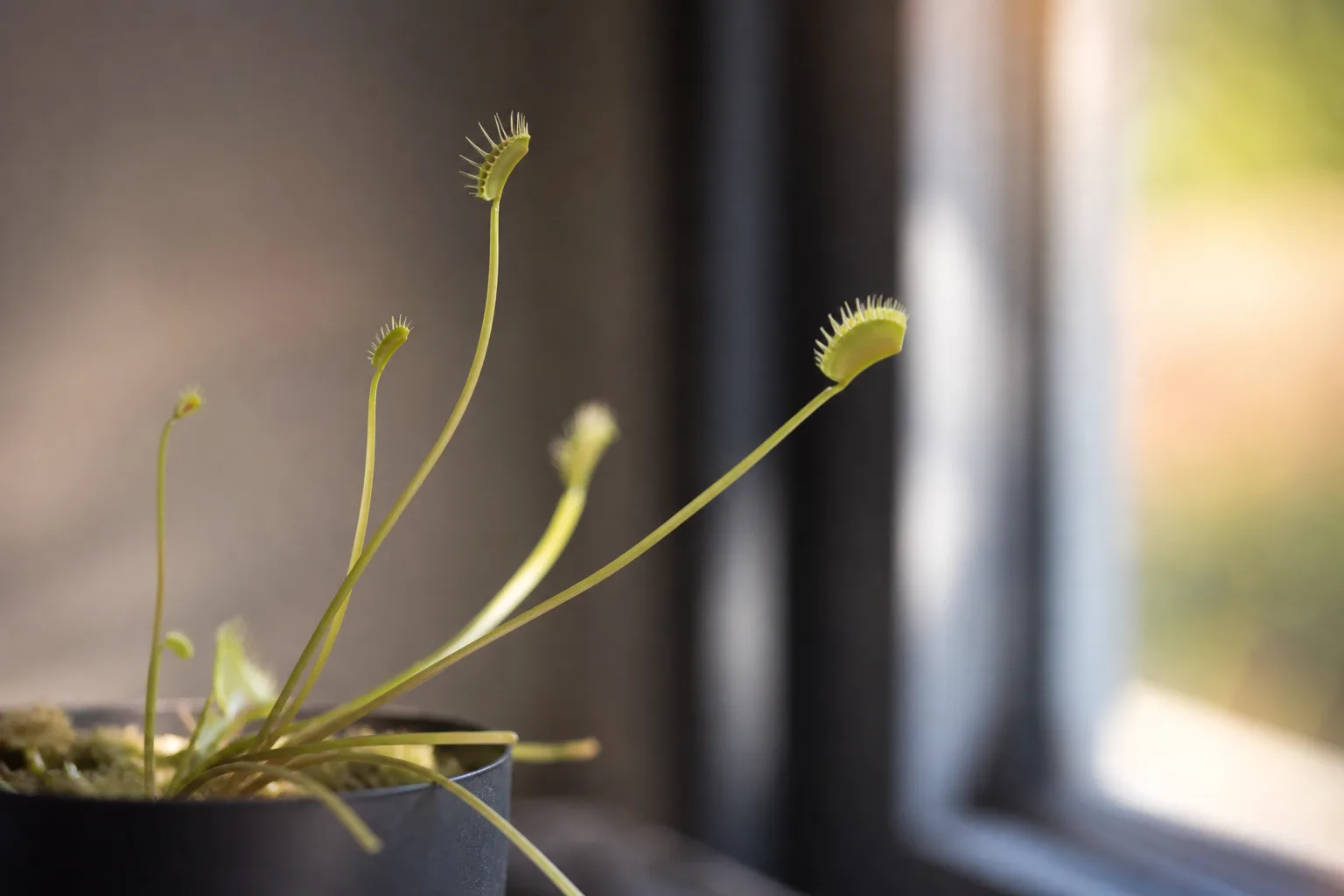
Leggy growth on Venus flytrap is etiolation: long thin pale petioles lifting small traps toward the brightest window, often with faded red interior color. First step: move the plant to at least six hours of direct outdoor sun in a distilled-water tray, or add a white LED at 12–16 hours daily indoors-then judge only traps produced after the change.
Leggy Growth on Venus Flytrap: Causes, Checks & Fixes
This guide covers leggy growth on Venus Flytrap. See also the general Leggy Growth guide, watering, and light pages for this plant.
Leggy Growth on Venus Flytrap: Causes, Checks & Fixes
Quick answer
Leggy growth on Venus flytrap (Dionaea muscipula) is etiolation-the plant stretching toward the brightest available photons because daily light totals are too low. The telltale pattern is long thin pale petioles (leaf stems) lifting small traps far above a loose rosette, often with little or no red interior color on cultivars that should show anthocyanin pigment in strong sun.
First step: increase photons before changing anything else. Move the pot to at least six hours of direct outdoor sun in a tray of distilled or rainwater, or add a white full-spectrum LED running 12–16 hours daily at roughly 15,000–25,000 lux at trap level indoors. Acclimate nursery-shaded plants over 7–14 days so pale stretched traps do not scorch. Keep 1–2 cm tray water; do not fertilize.
Judge recovery only by new traps produced after the light fix-old etiolated leaves will not shorten or regain size. Full species context: Venus flytrap overview.
Scope note: This page answers “why are the petioles so long and the traps so small?” The not-enough-light guide covers placement trials and how much sun to target. The light guide goes deep on grow-light setup, acclimation, and native bog context. Start here when stretch morphology-not trap count pace-is your main concern.
What leggy growth looks like on Venus flytrap
Leggy growth on flytraps is a morphology problem, not a vine-length problem. You are looking at how each leaf is built, not how fast the rosette expands.
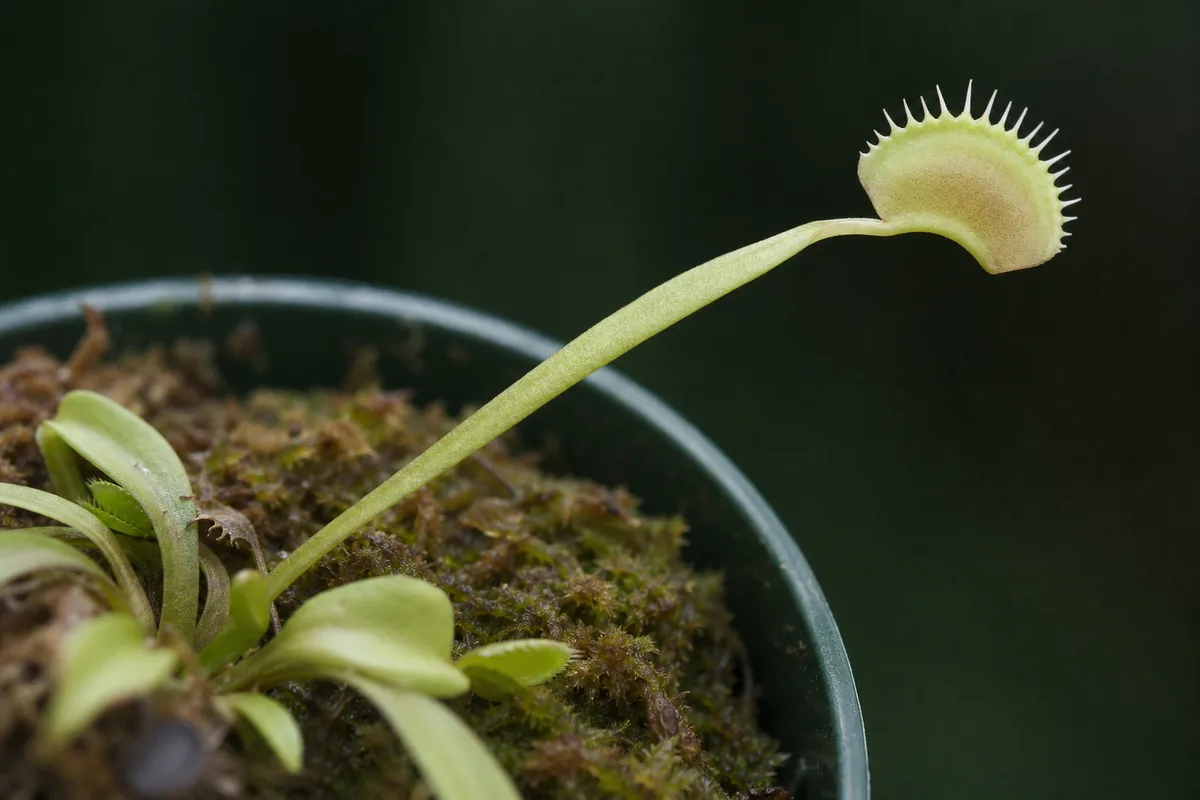
Leggy Growth symptoms on Venus Flytrap - compare with healthy tissue on the same plant.
Classic etiolation pattern (insufficient light):
- Petioles lengthen-the flat leaf-base between rhizome and trap stretches far longer than healthy summer-autumn leaves on the same cultivar
- Traps stay small, often fingernail-sized or smaller on a mature plant that should produce 0.5–1.5 inch traps in strong sun
- Pale green traps with faded or absent red interior lining on red cultivars
- Hard lean toward the brightest window or lamp within one to two weeks of placement
- Floppy leaves that droop toward the soil rather than standing stiff-the carnivorous plant FAQ distinguishes light-starved skinny leaves from normal stiff spring-summer leaves by this droop test
- Slow or weak trap closure on new leaves, sometimes followed quickly by blackening
Healthy summer-autumn leaves (not leggy):
- Wide, short leaf-bases lying close to the ground per seasonal leaf-form guidance
- Firm, upright petioles-not floppy
- Traps often brightly colored red in adequate outdoor sun
- Pattern appears in the correct season, not on every leaf year-round
Normal spring-summer leaves (lookalike, not crisis):
- Long narrow leaf-bases held up in the air with traps at the tip
- Leaves are sturdy and stiff, not pale and floppy
- Appears mainly in early spring as the first leaves of the season
The fork that saves misdiagnosis: floppy + pale + every new leaf skinny regardless of calendar month = etiolation. Stiff long spring leaves on an otherwise compact outdoor plant = seasonal form.
Why Venus flytrap gets leggy growth
Insufficient photons is the dominant cause of leggy growth indoors. Venus flytraps evolved in open Carolina coastal bogs with unfiltered sun most of the day. NC State Extension lists full sun as six or more hours of direct sunlight daily for Dionaea. The ICPS Dionaea checklist states the plant starts declining immediately without enough light-etiolation is an early visible stage of that decline, not a cosmetic quirk.
When photon totals drop, the plant enters survival morphology:
- It lengthens petioles to reach toward the brightest direction (phototropism)
- It builds smaller traps because trap tissue is metabolically expensive
- It reduces anthocyanin pigments in trap interiors when energy is scarce
- It slows replacement of senescing traps, making the rosette look sparse and stretched
Common cultural triggers on Venus Flytrap overview:
Dim windowsills. Human eyes adapt to indoor brightness; flytraps do not. A spot that looks “bright” across the room may deliver too few photons at trap level. The NYBG carnivorous plant guide notes most indoor owners need supplemental artificial light, especially in winter-east, west, and especially north windows rarely sustain compact rosettes without supplemental LEDs.
Distance from glass. A flytrap on the sill receives far more flux than the same plant on a table two feet away that still “looks near the window.”
Seasonal light drop without adjustment. Shorter winter days reduce effective totals on windowsills. A plant that looked acceptable in July may etiolate by January unless you add grow lights or accept dormancy.
Decorative terrariums with weak bulbs. Closed domes with novelty LEDs often trap humidity while starving photons-the worst of both failure modes.
Light-water coupling. Dim plants transpire less and stay wet longer. Chronic soggy peat in low light invites crown rot while etiolation continues-a combination that makes stretch look like a watering problem when photons are the root throttle.
Leggy growth vs. not enough light vs. slow growth
These pages overlap but serve different search intents on the Venus flytrap hub.
| Pattern | Main question | Key visual | Where to go next |
|---|---|---|---|
| Leggy growth (this page) | “Why are petioles so long?” | Long pale stretched petioles, tiny traps reaching for light | Fix morphology here; placement details in not-enough-light |
| Not enough light | ”How much sun does it need?” | Etiolation plus placement uncertainty | Not enough light guide |
| Slow growth | ”Is this pace normal?” | Few or no new traps; static rosette | Slow growth guide |
| Light (care topic) | “How do I set up light long-term?” | Full sun, LEDs, acclimation, lux targets | Light guide |
A single dim windowsill plant can fit all four descriptions. Start on this page when stretch shape is the symptom-then follow the not-enough-light or light guide for sustained placement.
How to confirm the cause
Work through this checklist before Venus Flytrap repotting guide, feeding, or stacking other fixes.
- Petiole length vs. trap size - Measure the flat leaf-base on the newest fully open trap. If petioles are several times longer than trap width and traps stay tiny, etiolation is confirmed.
- Stiff vs. floppy test - Gently lift a new leaf. Light-starved leaves flop toward the soil; normal spring-summer leaves stay stiff and upright.
- Red interior check - On cultivars that redden in sun, is the newest trap interior pale or green despite months of ownership? Anthocyanin loss tracks low light.
- Lean direction - Does the rosette lean hard toward one window or lamp? Phototropism confirms the plant is hunting photons.
- Season fork - Are all new leaves skinny and pale regardless of month? That rules out normal spring leaf form alone.
- Trap senescence fork - Is only one old trap blackening while a new trap on a shorter petiole looks firm? That is normal aging, not systemic legginess. Every new leaf repeating the stretch pattern is light failure.
- Rhizome firmness - Press the white crown at soil level. Firm and white supports a light-first fix. Soft, dark, or sour points to root rot or overwatering compounding dim culture-urgent.
- Light hours audit - Outdoors: confirm six or more hours of unfiltered direct sun on traps. Indoors: note whether a grow light runs 12–16 hours and how close it sits. A north window alone rarely prevents etiolation.
- Two-week photon trial - If the rhizome is firm, increase photons without changing water chemistry, pot, or feeding. Success means the next trap sits on a noticeably shorter petiole.
Stop when etiolation is confirmed and rot is ruled out. Do not prune stretched leaves hoping to force compactness-the plant needs photons, not amputation.
First fix for Venus flytrap
Increase light intensity before any other intervention.
Outdoor path (preferred when climate allows)
Move the pot to open direct sun for at least six hours daily-full sun from spring through fall when temperatures allow. Use a plastic or glazed pot, pure peat-perlite or long-fiber sphagnum mix with no fertilizer, and distilled or rainwater in a 1–2 cm tray per watering guidance.
Acclimate over 7–14 days if the plant arrived from nursery shade or a dim windowsill:
- Days 1–3: morning sun only, or full sun with light shade cloth
- Days 4–7: extend direct hours toward midday
- Days 8–14: full target exposure if traps show firm new growth without bleaching
Indoor path
Add a white full-spectrum LED delivering roughly 15,000–25,000 lux at trap level, 6–12 inches (15–30 cm) above the tallest trap, on a timer for 12–16 hours daily. Keep the pot on the glass of the brightest south-facing window as supplementary light if available-not on a shelf below the frame.
Make one change at a time. Do not simultaneously repot, switch water brands, and jump light exposure-you will not know which variable helped.
Step-by-step recovery
Week 1 - Light increase only
- Move to outdoor full sun (acclimated) or install and timer-set supplemental LED.
- Maintain 1–2 cm distilled tray water; brighter light increases transpiration-check tray level daily.
- Do not fertilize, feed oversized prey, or trigger traps for testing.
- Rotate the pot a quarter turn every few days so new traps develop evenly.
Weeks 2–4 - Evaluate new growth
- Ignore old etiolated leaves; evaluate only traps that open after the light change.
- Look for shorter petioles and larger trap size on the newest leaf.
- If traps bleach or scorch within days, raise the LED or shorten outdoor hours slightly-you increased too fast.
Weeks 4–8 - Stabilize culture
- Once the first compact trap appears, hold light and water steady.
- Optionally feed one small insect in one trap per week during active growth-never soil fertilizer.
- Trim only fully blackened old traps if they crowd the rosette; leave green stretched leaves until they senesce naturally.
If no improvement after six weeks of confirmed strong light and firm rhizome during active season, review water chemistry and soil mineral buildup-but photon deficit remains the leading cause of stretch morphology.
Recovery timeline
Light correction during active growth: First trap on a noticeably shorter petiole often appears within three to six weeks after photons increase. Trap size and red interior color continue improving through subsequent leaf generations over the remainder of the growing season.
Old etiolated tissue: Stretched petioles and small traps do not shorten or enlarge retroactively. They senesce and blacken naturally; only new leaves show correction.
Acclimation setbacks: Sudden full-sun jumps on pale indoor plants may bleach or crisp traps for one to two weeks before recovery resumes-slow the ramp rather than retreating to dim light.
Signs you are on track:
- New petioles shorter than the previous generation
- Traps larger than etiolated predecessors
- Red interior color returning on sun-responsive cultivars
- Firm upright new leaves instead of floppy droop
- Faster tray dry-down (healthy transpiration in brighter light)
Signs the problem is worsening:
- Rhizome softens despite corrected light
- Multiple traps blacken within a week on wet cold peat in a still-dim room
- New leaves continue elongating after six weeks of confirmed strong light-re-check lux at trap level, not room brightness
Lookalike symptoms to rule out
| What you see | Likely cause | Key difference from leggy etiolation |
|---|---|---|
| Long stiff leaves in early spring only | Normal spring-summer leaf form | Stiff upright leaves; seasonal; outdoor plants in adequate sun |
| Long pale floppy petioles; tiny traps year-round | Leggy etiolation (this page) | Every new leaf repeats stretch; lean toward light |
| One old trap blackens; new trap firm | Normal trap senescence | Isolated aging; new growth healthy |
| Long thin center stem, no trap at tip | Flower stalk | Cylindrical scape; see no-flowers guide |
| Limp traps after dry tray week | Drought droop | Opposite of stretch; see wilting |
| Soft rhizome; sour wet peat | Crown / root rot | Blackening from base up; urgent-not fixed by light alone |
| Zero traps Oct–Feb; firm rhizome | Dormancy | Seasonal pause; not etiolation crisis |
| White cottony clusters at crown | Mealybugs | Wax and honeydew; see mealybugs |
Trap senescence vs. systemic light failure
This fork prevents panic pruning and misdiagnosis.
Normal trap senescence:
- One or two older traps blacken after several closures or months of age
- Newer traps remain firm, reasonably sized, and on acceptable petiole length
- Rhizome firm and white; peat smells neutral
- Pattern is isolated, not repeated on every emerging leaf
Systemic light failure (leggy growth):
- Every new trap is small and pale on a long thin petiole
- Closure weakens on new leaves; traps may blacken quickly after triggering
- Rosette leans toward the brightest source
- Problem persists across months and all seasons indoors
If senescence is isolated and new growth looks compact, you do not have a legginess crisis-remove blackened traps only when fully dead.
What not to do
- Do not fertilize a stretched Venus flytrap hoping to bulk up traps. Missouri Botanical Garden warns never to use fertilizer on carnivorous plants-salts damage roots the same way tap-water minerals do.
- Do not prune all long leaves to force a compact shape. The plant needs photons to build shorter leaves; amputation without light correction produces another stretched leaf.
- Do not keep deep-tray watering on a dim cold plant because leaves “look thirsty.” Wet peat plus low light accelerates crown rot.
- Do not stack repotting, feeding, and light changes on the same stressed plant.
- Do not assume 4 hours of “bright room” equals adequate sun. NC State specifies six or more hours of direct sunlight for full sun culture outdoors; indoor windowsills usually need supplemental LEDs.
- Do not trigger traps repeatedly with fingers-each closure spends energy the light-starved plant cannot afford.
Mistakes to avoid
- Confusing spring leaf form with etiolation - check the floppy vs. stiff test and whether stretch appears in every season.
- Judging recovery on old traps - only new growth after the light fix counts.
- Moving a pale windowsill plant to midday July sun without acclimation - scorch looks like failure and tempts retreat to dim light.
- Buying a stronger bulb but leaving it across the room - intensity drops fast with distance; mount 6–12 inches above traps.
- Ignoring tray dry-down after light increase - faster transpiration means adjusting watering rhythm, not keeping the old shallow schedule from a dim room.
- Treating legginess and slow trap count as separate emergencies - both often share one photon fix; see slow growth if pace-not petiole length-is the main worry.
How to prevent leggy growth next time
- Full sun outdoors (six or more direct hours) or 12–16 hours of strong supplemental white LED indoors during active growth-details in the light guide
- Pot on the sill, not across the room from a window
- Weekly rotation a quarter turn so the rosette does not develop permanent one-sided lean before you notice stretch
- Distilled, RO, or rain water only in a 1–2 cm tray during active season-see the watering guide
- Winter grow-light supplement or accept dormancy when windowsill totals drop-do not leave a warm plant on a dim shelf with deep standing water
- Inspect newest trap form weekly during routine care-catch elongation on the first stretched leaf, not the fifth
Prevention on Venus flytrap means treating high light as non-negotiable, not copying a low-light houseplant placement because the pot still looks alive.
When to worry
Lower urgency (fix light, monitor):
- Firm rhizome with pale floppy stretched leaves but no rot smell
- Etiolation on an otherwise clean pot with correct distilled water
- Gradual stretch over weeks on a north or distant windowsill
Higher urgency (act same day):
- Rhizome softens or turns black while peat stays wet in a dim room
- Sour rot smell at soil level
- Multiple traps blacken within a week on soggy cold peat-not isolated senescence
- No improvement in new petiole length after six weeks of confirmed strong light during active season with firm rhizome-re-check lux, water chemistry, and crown health
Conclusion
Leggy growth on Venus flytrap is etiolation-long pale petioles and tiny traps reaching for photons the plant is not receiving. Confirm the pattern with the floppy leaf test and trap senescence fork, then increase light to six or more hours of direct outdoor sun or supplemental LED indoors before repotting, feeding, or fertilizer. Old stretched leaves will not repair; judge recovery only by shorter petioles and larger traps on new growth.
Related Venus flytrap care: Overview · Light · Not enough light · Slow growth · Watering · Soil · Overwatering · Root rot · Wilting · No flowers
When to use this page vs other Venus Flytrap guides
- Venus Flytrap watering guide - Use for routine moisture checks before assuming leggy growth is the main issue.
- Venus Flytrap problems hub - Browse all 18 common issues on this species.
- Not Enough Light on Venus Flytrap - Different entry point when symptoms overlap with leggy growth.
- Slow Growth on Venus Flytrap - Different entry point when symptoms overlap with leggy growth.
- Yellow Leaves on Venus Flytrap - Different entry point when symptoms overlap with leggy growth.