Yellow Leaves on Venus Flytrap: Causes, Checks & Fixes
Quick answer
Yellow traps on Venus flytrap usually mean tap-water minerals, insufficient full sun, normal trap senescence, entering dormancy, or rhizome rot-not a fertilizer shortage. First step: squeeze the rhizome at soil level (firm is good), confirm distilled or rainwater only, and count direct sun hours or grow-light intensity before changing anything else.
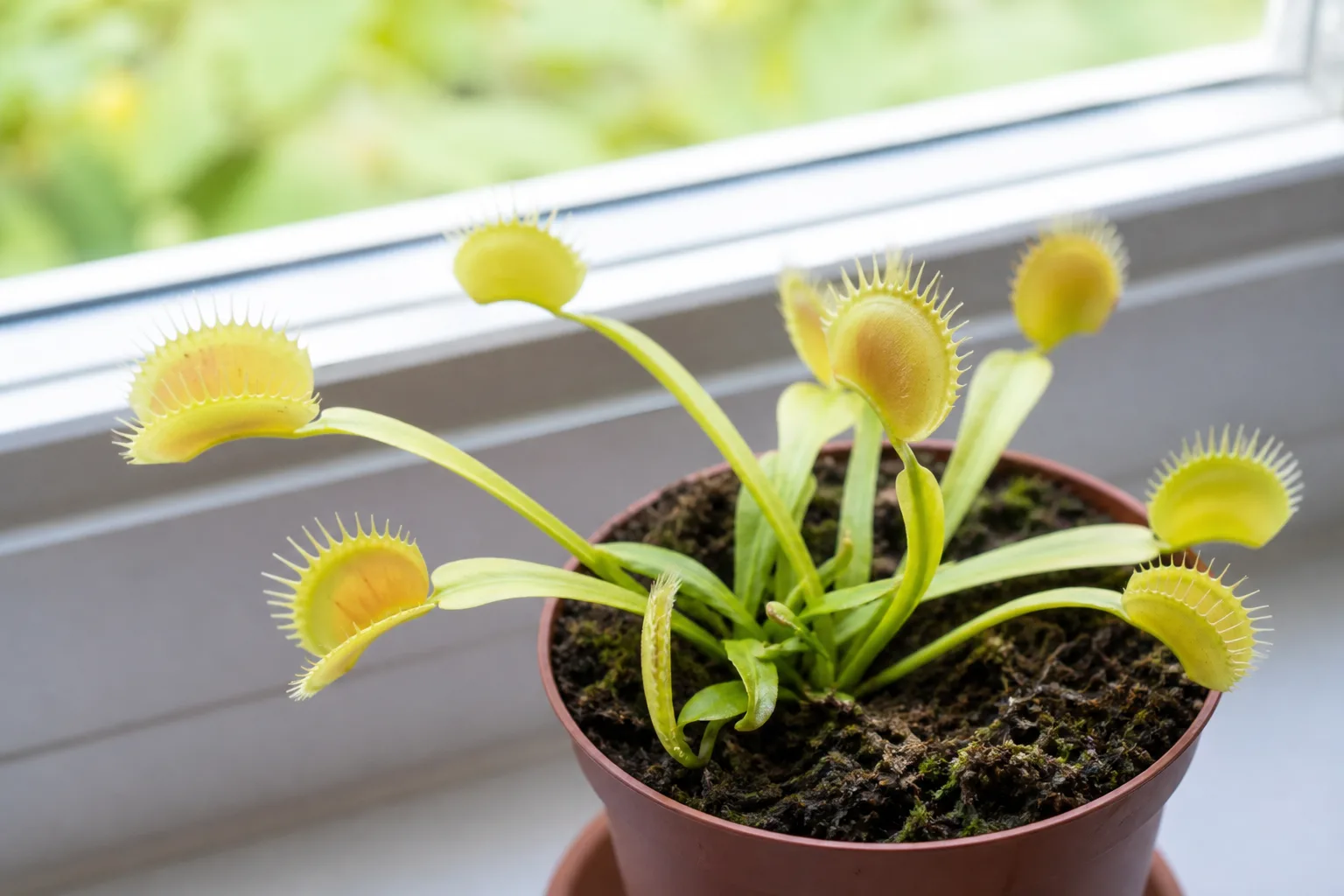
Yellow Leaves on Venus Flytrap: Causes, Checks & Fixes
This guide covers yellow leaves on Venus Flytrap. See also the general Yellow Leaves guide, watering, and light pages for this plant.
Yellow Leaves on Venus Flytrap: Causes, Checks & Fixes
Quick answer
Yellow traps on Venus flytrap (Dionaea muscipula) are not one diagnosis. On this temperate carnivore, yellowing usually traces to tap-water mineral burn, insufficient full sun, normal trap senescence, entering dormancy, or rhizome rot-not a nutrient deficiency you can fix with fertilizer.
The pattern matters more than the color word. A single trap yellowing then blackening while the rhizome stays firm and a replacement trap emerges is often normal aging. Every trap turning pale yellow on long thin petioles in a dim room points to insufficient light. Gradual fade over weeks while using tap water signals mineral damage. Widespread dieback in late fall with a firm rhizome often means dormancy. Yellowing with a mushy, sour-smelling base on wet cold soil is crown rot.
First step: squeeze the rhizome at soil level (firm and white is healthy), confirm you use only distilled, rain, or reverse-osmosis water, and verify at least six hours of direct sun outdoors or strong grow lights indoors. That three-part check separates the five most common causes before you repot, feed traps, or buy a humidifier. Full culture basics live in our Venus flytrap overview.
Why Venus flytraps get yellow leaves
Dionaea evolved in open, nutrient-poor Carolina bogs with constant moisture, mineral-free water, and full sun for most of the day. It photosynthesizes through its traps and petioles while catching insects for supplemental nitrogen. When light, water chemistry, or seasonal rhythm slip out of that bog logic, chlorophyll fades and traps weaken.
Unlike a tropical foliage plant, Venus flytrap must never receive fertilizer. NC State Extension and Missouri Botanical Garden both warn that fertilizer and hard tap water kill the plant. Yellowing on Dionaea is almost always a culture mismatch, not a feed-me signal.
Insufficient light drives pale yellow traps
Venus flytraps need at least six hours of direct sunlight daily outdoors, or strong supplemental lighting indoors. The ICPS Dionaea checklist states the plant starts declining immediately without enough light-a faster timeline than many houseplants.
Weak light produces a recognizable chain: the plant stretches petioles toward the brightest source, builds smaller pale traps with little red interior color, photosynthesizes less, and existing traps yellow as the rosette cannot maintain them. Gift-shop flytraps on kitchen windowsills often show this pattern within weeks. See our light guide for lux targets and grow-light setup.
Tap water and mineral burn
NYBG’s carnivorous plant guide notes that tap water and even bottled or filtered water usually contain too much dissolved salt for Dionaea. Minerals accumulate in peat, burn fine roots, and produce gradual chlorosis-traps fade from green to yellow-green, new traps stay small, and a white crust may appear on the pot rim or peat surface.
This decline is slow enough that owners blame humidity or dormancy until most traps look sick. The fix is immediate switch to distilled, rain, or RO water-not another watering session with tap.
Normal trap senescence
Individual traps have a finite lifespan. NYBG notes traps turn black and die after a few months on healthy plants and are replaced by new ones. A trap that has closed and digested prey several times-or simply aged-often yellows before blackening. The rhizome stays firm, and a new trap emerges from the center. This is turnover, not crisis.
Entering dormancy
Temperate Dionaea requires a winter rest period. NC Cooperative Extension explains that shortening day length in autumn triggers dormancy, reinforced by cooler temperatures roughly 35–50 °F (2–10 °C). Traps yellow and die back from October through February in the northern hemisphere while the rhizome stores energy underground.
Widespread yellowing in fall with slowing growth and a firm rhizome is normal seasonal rhythm-not a reason to fertilize or move the plant to a warm dim shelf.
Rhizome rot from too much water in cool, dim conditions
Standing water in the tray keeps peat wet-but in cool, low-light conditions, roots suffocate and the rhizome rots. Yellowing traps accompany a soft, dark crown and sometimes a sour smell. This overlaps with overwatering and is urgent: a firm rhizome is the difference between recoverable stress and a lost plant.
Overfeeding and trap triggering stress
Feeding every trap-or repeatedly triggering closures without prey-costs energy the plant cannot replace in weak light. Stressed traps may yellow and blacken even without a meal. Focus on sun, pure water, and proper soil before feeding.
What yellow leaves look like on Venus flytrap
Pattern recognition separates causes faster than guessing from trap color alone.
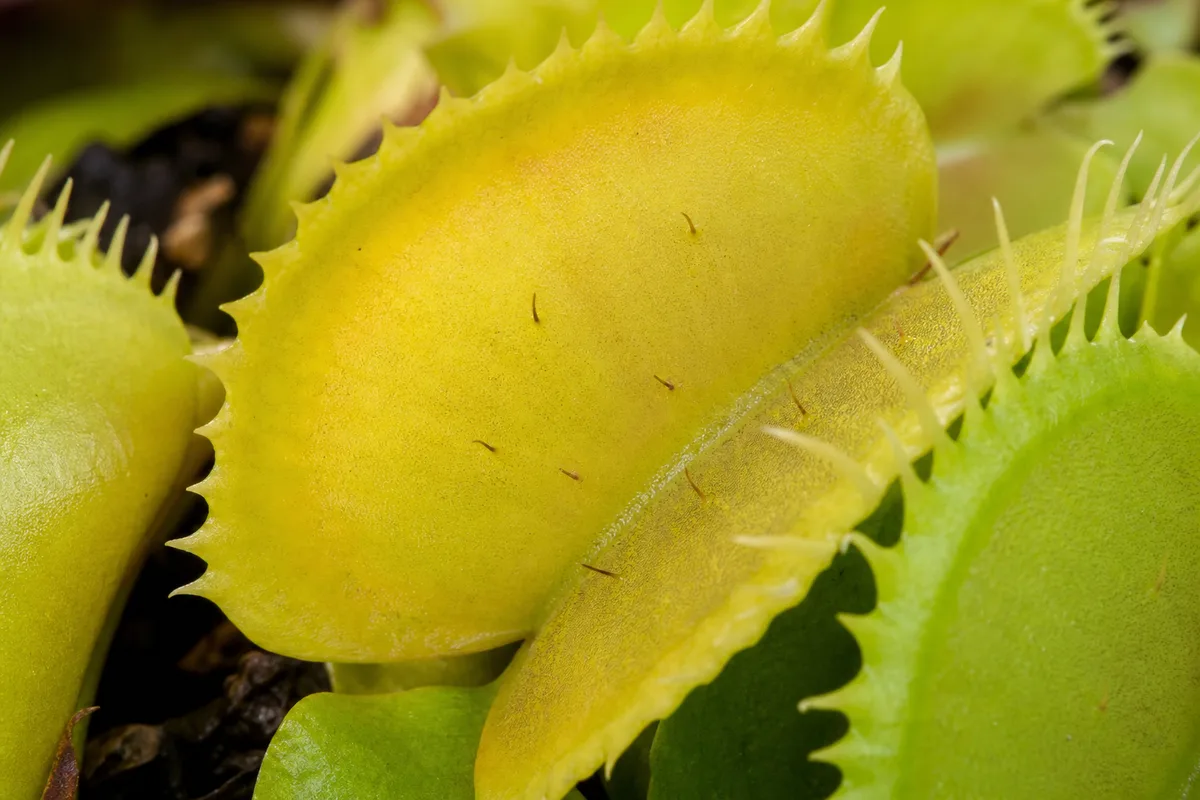
Yellow Leaves symptoms on Venus Flytrap - compare with healthy tissue on the same plant.
Normal trap senescence (single trap)
- One older trap at the edge of the rosette yellows, then turns black over one to two weeks
- Rhizome firm and white when you gently press at soil level
- New trap emerging from the center while the old one declines
- Trap may have closed three or four times or simply reached end of lifespan
- No sour smell; peat moisture normal; water source pure
Insufficient light (whole-plant pale chlorosis)
- Most or all traps pale yellow-green with weak red interior color
- Long, thin petioles reaching toward the window or light fixture
- Traps smaller than a fingernail on an otherwise mature plant
- Decline worsens over weeks on a windowsill without supplemental LED
- Rhizome still firm; water may be correct but growth cannot sustain traps
Tap-water mineral stress (gradual fade)
- Slow decline over weeks to months while using tap or bottled water
- Traps lose vibrancy; new traps stay small and pale
- White mineral crust on pot rim, tray, or peat surface
- No sudden mushy base unless minerals weakened roots first
- Improvement begins only after pure water switch-and sometimes repotting
Rhizome rot (yellowing with soft base)
- Traps yellow, then blacken across multiple leaves within days in summer
- Rhizome soft, dark, or mushy at soil line; sour or fermented smell
- Peat stays saturated in a cool dim room with full tray
- Often follows weeks of tap water, deep tray water, or standard potting mix
- See root rot guide for salvage steps
Entering dormancy (fall widespread yellowing)
- October through February timing in northern hemisphere
- Shorter days and cooler nights; growth slows before dieback
- Traps yellow and blacken throughout the rosette but rhizome stays firm
- Less alarming than summer decline if water is pure and plant had strong summer growth
- Reduce tray water; do not bring indoors to “save” an outdoor plant from normal rest
Cause comparison at a glance
| Symptom pattern | Most likely cause | First fix | Urgency |
|---|---|---|---|
| One trap yellow → black, new trap emerging | Normal senescence | Snip trap when fully black; maintain culture | Low |
| All traps pale, long petioles, small size | Insufficient light | Move to 6+ h direct sun or add grow light | Medium |
| Slow fade over weeks, white crust, tap water used | Mineral burn | Switch to distilled/rainwater; repot if needed | Medium |
| Mushy rhizome, sour smell, wet cold soil | Crown rot | Reduce water, improve light/airflow; repot if salvageable | High |
| Fall dieback, firm rhizome, slowing growth | Dormancy | Reduce water; cool rest 10+ weeks | Low (seasonal) |
| Every trap blackens after overfeeding | Trap stress | Stop feeding; fix light and water first | Medium |
How to confirm the cause
Work through these checks in order. Stop when one path clearly fits.
- Rhizome firmness - Gently press the rhizome through the peat at soil level. Firm and white supports senescence, light stress, dormancy, or mineral damage. Soft, dark, or mushy means rot-investigate moisture and repot immediately.
- Water source - Have you used only distilled, rain, or RO water for the past month? Any tap or filtered bottled water supports mineral burn. Check tray and pot rim for white crust.
- Light hours and intensity - Outdoors: does the pot get six or more hours of direct sun? Indoors: is there a grow light running 12–16 hours at trap level, or only ambient window light? Elongated pale petioles confirm light deficiency before humidity tweaks.
- Season and day length - Is it late fall or winter with shorter days? Firm rhizome plus widespread yellowing likely means dormancy. Summer yellowing on wet cold soil is not dormancy.
- Trap count and age - Is only the oldest trap declining while others look normal? Senescence. Are all traps fading together in active growth season? Light, minerals, or rot.
- Tray depth and soil - Is standing water deeper than 1–2 cm in a cool dim room? Is the mix standard potting soil or fertilized “carnivorous” blend? Both invite rot. Confirm 1:1 peat and perlite with no fertilizer.
- Recent feeding - Did you feed or trigger every trap in the past week? Overfeeding stress mimics decline; pause feeding and fix environment.
- New growth test - After correcting the most likely issue, only traps produced in the next three to four weeks tell you if the fix worked. Old yellow traps will not green up.
First fix by confirmed cause
Make one targeted correction first. Stacking repot, prune, feed, and pesticide on the same day hides what helped.
If tap water is the problem
Switch to distilled, rain, or reverse-osmosis water today. Empty the tray, rinse it, and refill with pure water to 1–2 cm. Do not fertilize. If decline continues after four weeks of pure water, repot into fresh unfertilized peat-perlite mix and flush old minerals.
If light is the problem
Move the pot to full direct sun for at least six hours daily, or add a white full-spectrum LED grow light 12–16 hours daily at roughly 15,000–25,000 lux at trap level per ICPS guidance. Acclimate nursery-shaded plants over 7–14 days before all-day outdoor sun. Details in our light guide.
If one trap is simply aging
Do nothing except maintain correct culture. Snip the trap only when it is fully black, not when merely yellow. The plant is already replacing it.
If dormancy is starting
Let the plant rest. Reduce tray water so peat stays barely moist, not flooded. Provide cool temperatures roughly 35–50 °F for at least 10 weeks if possible. Do not fertilize, overfeed, or move to a warm dim room to “save” it. NC Extension notes dormancy typically runs three to five months.
If rhizome rot is suspected
Reduce standing water immediately and move to brighter, airier conditions. Unpot only if the rhizome is soft-trim black mushy tissue with clean scissors, dust cuts if needed, and replant in fresh mix with a shallow tray. If more than half the rhizome is mush, salvage may not be realistic.
Recovery timeline and what recovery means
Yellow or blackened traps do not turn green again. Recovery means decline stops and new traps emerge firm and properly sized.
- Light correction: new traps with shorter petioles often appear within two to four weeks during active growth
- Pure water after brief tap exposure: improvement may show within one to two weeks if roots are still healthy
- Mineral damage after months of tap water: four to eight weeks after repot into fresh mix before judging failure
- Trap senescence: the replacement trap may be visible within one to two weeks; no old-trap repair needed
- Dormancy: little new growth until March or April in temperate climates-patience is required
- Rot salvage: if firm white rhizome tissue remains after trim, new traps in three to six weeks; mushy entire rhizome is usually fatal
Spreading yellowing on wet soil despite dry-down, or no new traps after six weeks in active season with confirmed good light and water, is worsening-not slow recovery.
What not to do
Do not fertilize a yellowing Venus flytrap. Fertilizer burns roots adapted to nutrient-poor bog soil.
Do not water with tap water hoping to flush minerals without repotting-each pour adds more salts.
Do not deepen the tray because traps look tired in a dim cool room-that accelerates overwatering rot.
Do not trigger traps for fun or feed large prey to every trap while the plant is stressed.
Do not repot, prune all leaves, and change water chemistry on the same day-you will not know which change helped.
Do not interrupt dormancy by moving a healthy outdoor plant to a warm windowsill in November because traps yellowed-that weakens long-term vigor.
Do not assume houseplant yellow-leaf advice (more humidity, balanced fertilizer, Epsom salt) applies to Dionaea.
Prevention by season
Active growth (spring through early fall):
- Distilled, rain, or RO water only; tray 1–2 cm deep
- Six or more hours direct sun outdoors or strong LED indoors
- Mineral-free peat-perlite mix; never standard potting soil
- Feed sparingly-one small insect per trap at most, not every trap at once
- Inspect weekly: rhizome firmness, new trap size, water crust on rim
Dormancy (late fall through winter):
- Allow natural dieback; keep peat barely moist
- Cool rest 35–50 °F when possible for at least 10 weeks
- Reduce or remove standing tray water in cold conditions
- Do not fertilize; do not panic at widespread yellowing if rhizome is firm
Year-round:
- Refresh mix every one to two years via repotting to prevent mineral buildup
- Keep a TDS meter or use only verified pure water sources
- Judge plant health by new trap quality, not old trap color
Conclusion
Yellow leaves on Venus flytrap usually mean wrong water, weak light, normal trap aging, seasonal dormancy, or crown rot-not hunger. Squeeze the rhizome, verify pure water, and count sun hours before repotting or feeding. One yellow trap on a firm plant with new growth emerging is senescence. Pale traps on long stems in a dim room is light. Slow fade with tap water is minerals. Fall dieback with a firm rhizome is rest. Mushy base on wet soil is urgent. Fix the pattern that fits, then judge only the next generation of traps.
Related Venus flytrap care: Overview · Watering · Light · Soil · Repotting · Not enough light · Overwatering · Root rot
When to use this page vs other Venus Flytrap guides
- Venus Flytrap watering guide - Use for routine moisture checks before assuming yellow leaves is the main issue.
- Venus Flytrap problems hub - Browse all 18 common issues on this species.
- Overwatering on Venus Flytrap - Different entry point when symptoms overlap with yellow leaves.
- Underwatering on Venus Flytrap - Different entry point when symptoms overlap with yellow leaves.
- Not Enough Light on Venus Flytrap - Different entry point when symptoms overlap with yellow leaves.