Venus Flytrap Light Needs: Full Sun, Grow Lights
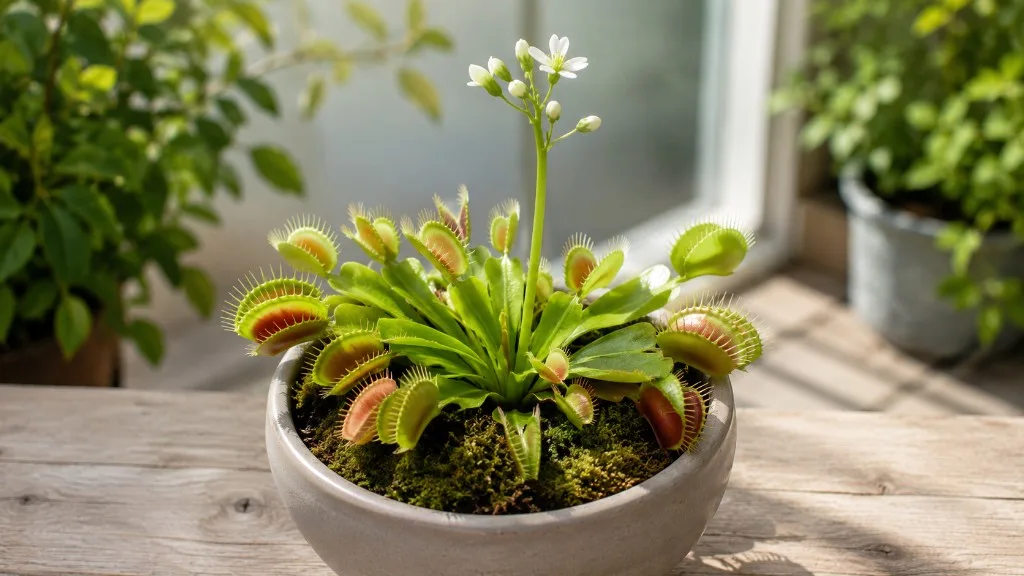
Venus Flytrap Light Needs: Full Sun, Grow Lights, and Warning Signs
Venus Flytrap Light Needs: Full Sun, Grow Lights, and Warning Signs
A Venus flytrap that closes lazily, grows traps the size of a fingernail clipping, and never develops the deep red interior you saw on the nursery tag is almost always a light-starved plant - not a “difficult carnivore” and not a watering puzzle waiting to be solved. Dionaea muscipula evolved in open, nutrient-poor bogs along the coastal plains of North and South Carolina, where it receives unfiltered sun for most of the day and uses that energy to build traps, pigments, and the seasonal rhythm that keeps the plant alive for years. Give it dim shelf light and it may hang on for months, but it will not look or behave like the plant you bought.
The practical target is straightforward. Outdoors, aim for full sun - at least six hours of direct sunlight every day, with more when your climate allows. Indoors, treat bright direct window light as a starting point, not a guarantee, and plan on a full-spectrum LED grow light running 12 to 16 hours daily unless you can verify strong, plant-level intensity at the trap canopy. Low light produces the symptoms growers search for most often: pale traps, weak red coloration, elongated thin leaves, and traps too small to catch anything useful. This guide walks through how much light Venus flytraps actually need, where to place them outside and inside, how to set up supplemental lighting, and how to read warning signs before slow decline becomes a dead rhizome.
How Much Light a Venus Flytrap Actually Needs
Venus flytraps are high-light carnivorous plants, not shade-tolerant novelty desk toys. The International Carnivorous Plant Society states that to do well, the plant needs at least six hours of direct sunlight every day - a threshold that is hard to meet inside most homes without supplemental lighting. (ICPS Dionaea Checklist) North Carolina State Extension classifies the species under full sun, defined as six or more hours of direct sunlight daily, with partial shade acceptable only in the sense of direct sun for part of the day - not deep indoor dimness. (NC State Extension Plant Toolbox)
Outdoors in spring through fall, full sun on a patio, balcony, or bog garden tray is the default recommendation from both botanical references and experienced carnivorous plant growers. Indoors year-round, the ICPS recommends 15,000 to 25,000 lux of white LED lighting - roughly 25 actual watts of white LED per 25 cm (10 inch) diameter growing area - for about 14 hours a day if you want continuous healthy growth and natural-looking color. (ICPS Grow Dionaea) That is substantially more than a typical windowsill delivers, which is why so many gift-shop flytraps fail on kitchen sills despite attentive watering.
Light quantity and light quality both matter for trap form. Strong light supports compact rosettes, firm petioles, traps in the normal 0.5 to 1.5 inch range on mature plants, and the anthocyanin pigments that paint the trap interior red on many cultivars. Weak light forces the plant into survival morphology: it stretches toward the brightest direction, produces smaller traps with less red, and eventually stops replacing traps faster than old ones blacken and die.
The Short Answer for Busy Growers
If you only remember four rules, use these. Outdoors from spring through fall: place the pot where it receives six or more hours of direct sun - open sky, not “bright shade near a sunny yard.” Indoors: put the plant on the glass of your brightest south-facing window and run a white full-spectrum LED 12 to 16 hours daily unless you have measured strong light at leaf level. Judge by new traps: the newest leaves should be firm, reasonably short, and well colored for your cultivar within two to three weeks of any move. Do not confuse normal trap aging with light failure: individual traps blacken and die after several closures - that is senescence. System-wide small pale traps on long thin stems is light deficiency.
Give any placement change 10 to 14 days before deciding it failed. Old traps do not improve after you fix light; only new growth tells the truth.
Understanding Venus Flytrap’s Native Light Environment
Context changes the placement decision from guesswork to logic. In the wild, Venus flytraps grow in wet, acidic, nutrient-poor savannas and Carolina bays with open sky above them for most of the day. The North Carolina Native Plant Society lists the species under “Sun - 6 or more hours of sun per day.” (NC Native Plant Society) There is no forest canopy sheltering them, no terrarium dome diffusing rays, and no north-facing apartment window filtering the photon budget down to houseplant levels.
That native exposure explains three behaviors that confuse new growers. First, the plant expects high daily light totals and builds traps sized for catching prey in bright conditions - not for surviving a dim bookshelf. Second, red trap coloration is partly a light-driven pigment response; anthocyanins accumulate when the plant has enough energy to invest in display and UV protection. Strip the light away and traps stay greener, smaller, and less vivid even if water and soil are perfect. Third, seasonal light changes cue dormancy in temperate climates. Shorter days and cooler nights in fall tell the rhizome to slow trap production - a normal rhythm, not automatically a sign you moved the pot wrong.
Recreating bog conditions does not mean recreating bog shade. It means wet pure medium, mineral-free water, no fertilizer, and lots of sun - the combination that lets the plant photosynthesize aggressively while catching supplemental nitrogen from insects.
Why Light Is the Make-or-Break Factor for Venus Flytraps
Experienced carnivorous plant growers repeat one point until it becomes cliché because it remains true: most beginner Venus flytrap deaths trace back to insufficient light, not exotic pests or mystical bog magic. The ICPS checklist warns that the plant starts declining immediately if it doesn’t get enough light - a faster timeline than many houseplants, which can etiolate for months before collapsing. NC State Extension also notes Venus flytraps do not grow well as houseplants without strong direct light.
Light is the throttle for the entire care system. A brightly lit flytrap uses water faster, tolerates the tray method of standing in shallow distilled water more safely, and replaces traps actively through the growing season. A dim flytrap ** grows slowly, stays wet longer between waterings, and rots more easily** when watered on a schedule copied from a sunny outdoor bench. DiPietro observes that rot “only tends to become an issue when there is insufficient light” even if the medium stays moist - a pattern that surprises growers who blame water first.
Traps themselves are expensive tissue to build. Each leaf modified into a hinged jaw requires structural proteins, turgor pressure, trigger hairs, and digestive glands. Without adequate photosynthesis, the plant downsizes traps rather than building full-size ones it cannot afford to maintain. That is why a flytrap in low light may still ** technically close** if you poke it, but closure is weak, slow, and followed quickly by blackening - the trap was never built for repeated use.
Full Sun Outdoors - The Gold Standard for Healthy Traps
If your climate allows outdoor growing for any part of the year, put the Venus flytrap outside in full sun before investing in elaborate indoor rigs. The ICPS displays healthy specimens growing outside in full sun as the reference image for proper culture, and notes that VFTs grow continuously and look nice indoors only as long as they get enough light and are fed regularly - with outdoor sun as the first choice when available. (ICPS Grow Dionaea)
Outdoor sun delivers higher daily photon totals, natural UV, wind that reduces fungal issues, and seasonal temperature swings that support dormancy. A flytrap on a south-facing patio table or open balcony rail often transforms within three weeks: shorter petioles, larger traps, deeper red interiors, and faster new leaf production. The New York Botanical Garden carnivorous plant guide recommends at least six hours of full, direct sunlight daily - a threshold NC State Extension also lists under full sun.
Use a plastic or glazed pot in full sun to reduce root heating, keep the plant in pure peat and perlite or long-fiber sphagnum with no fertilizer, ever, and water with distilled water, rainwater, or reverse-osmosis water only. Light intensity outdoors often lets you maintain consistent tray moisture without the chronic sogginess that harms dim indoor plants.
Six Hours of Direct Sun Daily and What Full Sun Means
Full sun is not “the area looks bright when I stand near it.” It means unobstructed direct rays hit the trap surfaces for six or more hours on a typical clear day. Morning sun counts. Midday sun counts. Afternoon sun counts. Dappled shade from a tree canopy for half the day does not count as full sun even if the pot never sits in deep shadow.
Place the pot where a shadow cast by the pot itself falls sharply during midday - a quick informal test that the plant is in direct beam, not open shade. In the northern hemisphere, south-facing exposures provide the strongest totals, but east-west open locations can exceed six hours if nothing blocks the horizon. Rotate the pot a quarter turn every few days early in outdoor season so traps develop evenly rather than leaning hard toward one bearing.
If you track intensity with a phone lux meter app (imperfect but useful), outdoor full sun often reads tens of thousands of lux at trap level on a clear day - far above what an unsupplemented indoor sill supplies through glass.
Best Outdoor Spots From Spring Through Fall
Timing matters as much as compass direction. Move plants outside after last frost in your area - USDA zones 7 through 10 allow winter-hardy outdoor culture with protection in marginal zones, while colder regions treat outdoor placement as a warm-season strategy with dormancy moved to an unheated garage, cold frame, or fridge protocol depending on local practice. (NC State Extension Plant Toolbox)
Strong outdoor placements include:
- Open patio or balcony with sun from mid-morning through afternoon
- South-facing garden edge where the pot sits above surrounding mulch and drains freely
- Bog garden tray shared with other carnivores, elevated so crowns stay above constant flood level
- Raised table that keeps pots away from slugs and gives uniform sun on all sides
Avoid sunken spots that stay cool and damp without sun, under dense tree canopies, and inside closed terrarium domes outdoors where heat spikes and stale air cause separate problems. The ICPS explicitly recommends considering LED light instead of assuming a window or terrarium will suffice - a point worth remembering when a decorative glass container tempts you away from the sunny rail.
Bring plants back under protection before hard frost if your zone requires it, but do not pull them into a dim room for winter without a dormancy plan and adequate cool rest light - winter has its own rules, covered briefly in the light-water section below.
Growing Venus Flytraps Indoors Without Starving Them for Light
Indoor growing is possible and many collectors keep display-quality flytraps under lights year-round, but the default home environment underfeeds photons. Human eyes adapt to dim rooms; Dionaea does not. A spot that looks “bright enough” to you may still produce etiolated growth within three weeks - the botanical term for stretching toward a light source the plant cannot reach.
The ICPS states plainly that Venus flytraps “require more light than they can get on a typical house window sill” even though they can look excellent indoors when lit properly. (ICPS Grow Dionaea) Indoor culture works when you treat the window as supplementary and a fixture as primary, or when you have a true sun porch with unobstructed south glass and you keep pots touching the pane.
Keep indoor temperatures in the comfort range for active growth - roughly 21 to 35°C (70 to 95°F) in summer - and remember that window glass amplifies heat. Leaves pressed against hot afternoon glass scorch even when light quantity is finally adequate. Pull the pot back an inch or use a sheer screen during heat waves.
Why Most Windowsills Fall Short
Three physical limits stack against windowsill success. Glass cuts intensity and filters part of the spectrum compared with outdoor sun. Day length through a single window is shorter in effective total photons than open sky because the plant receives light from one direction only, so traps on the shaded side underperform. Interior distance kills usable light fast - a flytrap on the sill receives dramatically more flux than the same plant on a table two feet away that still “looks near the window.”
A south-facing windowsill is the minimum serious attempt indoors, with the pot on the sill itself, as close to the glass as practical, not on a shelf below the frame. East and west windows can work in low-latitude, high-sun locations during growing season but often fail in winter at mid and high latitudes. North windows are unsuitable for long-term vigor without grow lights unless you are supplementing heavily.
The New York Botanical Garden carnivorous plant guide recommends full, direct sunlight from a southern exposure for indoor Venus flytraps and notes that most owners will need supplemental artificial light, especially in winter. If your windowsill cannot deliver hours of direct beam on the traps, accept that you need a lamp - not a different watering brand.
Grow Light Setup for Strong Traps and Deep Red Color
When natural light cannot carry the plant, a white full-spectrum LED is the most reliable upgrade. The ICPS emphasizes you “don’t need special plant lights” - a desk lamp with a standard white LED spotlight works as well as purpose-built horticultural fixtures if output and distance are correct. (ICPS Dionaea Checklist) Purple-only LED plant panels grow flytraps but produce unnatural-looking foliage unless mixed with enough white light to see and evaluate color properly.
Target 15,000 to 25,000 lux at the trap canopy for indoor display culture, using approximately 25 actual watts (not “equivalent” watts) of white LED per 25 cm (10 inch) diameter growing area. (ICPS Grow Dionaea) Run lights 12 to 16 hours daily on a timer so photoperiod stays consistent - the ICPS checklist suggests 12 to 16 hours; the detailed species guide recommends about 14 hours for white LED setups. Either band works if trap form and color respond well.
Mount the fixture so light hits traps from above at a slight angle, mimicking sun, rather than sideways from a distant floor lamp. Group multiple small pots under one panel only if each rosette sits inside the high-intensity cone; flytraps at the edge of a weak beam etiolate while center plants thrive.
LED Wattage, Distance, and Daily Hours
Distance trades intensity against heat. A practical starting range for moderate-output white LED bulbs and small panels is 6 to 12 inches (15 to 30 cm) above the tallest trap, then adjust based on leaf temperature and color response. If traps bleach or show tan scorch patches within a few days, raise the fixture or reduce hours. If new petioles lengthen and traps shrink over two weeks, lower the fixture slightly, upgrade wattage, or extend the timer toward 16 hours.
For purple LED plant lights only, the ICPS notes you can use roughly 12 W per 25 cm growing area instead of 25 W white, but display plants look best with supplemental white light. Seedling racks under pure red-blue panels are a separate use case - functional, not pretty.
Use a digital timer and leave it alone season to season except when you deliberately shorten photoperiod to align with outdoor day length before dormancy. Flickering manual on-off habits stress the plant less than chronic underlighting but more than a stable schedule.
Grow Lights vs Natural Sun Compared
Natural sun remains stronger, fuller-spectrum, and more dynamic than most indoor fixtures. Outdoor full sun can deliver variable but high peaks that drive deep trap red, short petioles, and robust closure speed. Indoor LEDs deliver steady moderate intensity that can maintain excellent flytraps when tuned correctly - the ICPS publishes photos of cultivars like ‘B52’ thriving in terrariums with lights on 15 hours daily, proving display quality is achievable without outdoor space. (ICPS Dionaea Checklist)
Trade-offs are honest. Sun is simpler and cheaper if you have safe outdoor space and correct seasonal protection. LEDs are more controllable for apartment dwellers, winter culture, and collections moved indoors during dormancy transitions. Switching abruptly between outdoor sun and dim indoor shelves mid-season shocks the plant - plan moves with acclimation or match indoor intensity before bringing pots inside.
Neither path forgives decorative weak bulbs in closed terrariums. The ICPS checklist explicitly recommends LED light instead of assuming a window or terrarium will suffice - insufficient photons remain the core failure in most gift-shop setups.
Low-Light Warning Signs - Weak Color, Small Traps, and Leggy Leaves
Low light fails gradually, which makes it dangerous - the plant looks alive while bankruptcy builds in the rhizome. Learn the symptom cluster so you intervene before the crown rots from chronic slow growth paired with overwatering on Venus Flytrap.
Primary insufficient-light signals:
- Long, thin petioles (the leaf stems) lifting traps far above the rosette as the plant searches for photons
- Small traps well below the 0.5 to 1.5 inch mature range despite age and season
- Pale green traps with little or no red interior on cultivars that should show anthocyanin color
- Slow or incomplete trap closure when triggered, followed by rapid blackening
- Reduced new leaf rate - fewer replacements as old traps senesce
- Hard lean toward the brightest window or lamp direction within one to two weeks of placement
- Overall loss of vigor in an otherwise clean pot with proper water and medium
These differ from normal trap death, where individual older traps blacken after several feedings or months of age while newer traps remain firm and well sized. Light failure is systemic and repeated on every new leaf. Pest damage shows spotting, distortion, or sticky residue, not uniform miniaturization.
Pale Traps, Long Petioles, and Slow Closure
Pale traps mean the plant is not producing anthocyanins at full capacity - usually because daily light totals are low, not because you forgot to “feed color fertilizer.” There is no safe fertilizer shortcut; increase photons instead. Long petioles with small traps at the end are classic etiolation - the same response cactus growers see when succulents stretch, except flytraps stretch horizontally toward glass and ** vertically by lengthening leaf stems**.
Slow closure deserves nuance. Traps require turgor and metabolic readiness to snap shut quickly. Light-starved traps may still move, but the motion is sluggish, and the trap often dies immediately after because it lacked reserves. If closure speed drops on new traps after a move to shade, treat it as light stress first.
Use the new-growth test: after improving light, ignore old traps and evaluate only leaves produced after the change. You should see noticeably shorter petioles and larger traps within two to three leaf generations if light was the limiting factor.
Hot Climates and Too-Much-Sun Edge Cases
Full sun is the default, but full sun in a hot, dry desert climate is not identical to full sun on a humid Carolina bog. The ICPS notes that in USDA zone 9 and warmer, flytraps grow best in full sun “if you live in an area that is humid or cool in the summer” - and if where you live is hot and dry, full morning sun followed by part shade is appreciated. (ICPS Grow Dionaea)
Practical hot-climate adjustments:
- Provide morning direct sun and bright indirect or light shade during peak afternoon heat
- Use 10% or 20% shade cloth over full-sun setups if you can source it - the ICPS warns that most retail shade cloth at 50% or more is too shady for flytraps
- Elevate pots on light-colored surfaces to reduce radiated heat onto roots
- Never let pots sit on black asphalt in July without shade intervention - root heat coupled with intense light cooks rhizomes even when traps still look green
- Watch for bleached or tan scorch patches on traps facing the sun; that is too much heat load, not too much light in the abstract - adjust shade before moving the plant to deep dimness
Scorch from sudden exposure jumps also appears when a nursery-shaded plant hits unfiltered west patio sun without acclimation. That is an acclimation error, not proof the species rejects sun.
Acclimating Venus Flytraps to Brighter Light Safely
Plants grown under nursery shade cloth or inside big-box stores arrive softened to lower intensity. Moving them directly to all-day patio sun can bleach or crisp traps even though the species ultimately wants full sun. Acclimate over 7 to 14 days:
- Days 1 to 3: morning direct sun only, or full sun with 20% shade cloth
- Days 4 to 7: increase direct hours toward midday; remove shade cloth if used
- Days 8 to 14: full target exposure if traps show firm new growth without bleaching
When moving outdoors to indoors, reverse the logic - match indoor LED intensity before removing outdoor sun, or accept temporary trap decline while the plant re-equilibrates. When moving indoors to outdoors, never place a long-etiolated windowsill plant into midday July sun without the staged ramp above.
Make one major change at a time. Do not simultaneously repot, change water chemistry, and jump light exposure - you will not know which variable caused the response.
Light Changes and Your Venus Flytrap watering guide
Every light adjustment changes water use. Brighter light increases transpiration and speeds dry-down of peat mixes. When you move a flytrap from a dim sill to a sunny patio or closer LED, check tray water level daily for the first two weeks instead of relying on the old schedule. When light drops heading into dormancy or a dim winter corner, reduce standing water so the rhizome does not sit in cold soggy medium while growth stalls.
The tray method - standing the pot in 1 to 2 cm of distilled water and refilling when the tray empties - works best when photosynthesis matches moisture uptake. ICPS and extension guidance both tie wet, acidic, mineral-free medium to outdoor open-sun culture; the same wetness kills dim plants faster because they cannot process water through growth.
Dormancy brings shorter days and naturally reduced trap production. Lower light in late fall and winter is expected if the plant is cold-resting properly - do not panic at trap slowdown if temperatures and dormancy conditions are correct. Do panic if a warm indoor plant on a dim shelf stops producing viable traps while staying wet - that combination is rhizome rot waiting to happen.
Common Light Mistakes That Kill Venus Flytraps Slowly
These errors account for most “I did everything right” stories:
- Treating Venus flytraps like low-light houseplants on coffee tables, office desks, or bathroom counters away from windows
- Assuming a bright room equals bright plant without direct rays on traps
- Relying on terrarium kits with weak integrated LEDs and closed humidity domes
- Buying “plant grow bulbs” with no measurable output at trap height
- Refusing outdoor summer sun when safe outdoor space exists - the fastest free upgrade available
- Jumping from nursery shade to harsh west afternoon sun without acclimation, then concluding the species ” hates sun” after scorch
- Overwatering dim plants on the same tray schedule as outdoor full-sun pots
- Chasing black traps with Venus Flytrap repotting guide or feeding when new leaves are uniformly small and pale - a light problem masquerading as general decline
- Ignoring winter light drop while keeping the plant actively warm without LED supplementation
Correct the light first in almost every ambiguous case. Water purity, medium, dormancy, and feeding matter - but light is the gate that makes the rest of the system work.
Conclusion
Venus flytraps reward one placement decision above all others: give them real sun outdoors whenever you can - six or more hours of direct light daily - and when you cannot, supplement with bright white LED grow lighting held close enough to deliver 15,000 to 25,000 lux at the traps for 12 to 16 hours a day. Weak color, undersized traps, and long thin leaves are not personality quirks; they are low-light distress signals you can reverse by reading new growth after a deliberate move to stronger exposure.
Start where you are. If the plant already sits outdoors, eliminate shade obstructions and verify six hours of direct beam. If it lives indoors, put it on the glass and add a timer-driven LED rather than hoping ambient room brightness carries the day. Acclimate softened nursery plants gradually, ease shade only in hot dry climates, and sync watering to light intensity so wet roots pair with active photosynthesis. Get light right and Dionaea muscipula stops being a short-lived novelty - it becomes the compact, red-jawed carnivore you actually wanted on the bench.
When to use this page vs other Venus Flytrap guides
- Venus Flytrap overview - Start here for whole-plant context before deep-diving this topic.
- Venus Flytrap problems hub - Jump to symptom-specific fix guides when this care topic does not resolve the issue.
- Not Enough Light on Venus Flytrap - Escalate here when light adjustments are not enough.
- Leggy Growth on Venus Flytrap - Escalate here when light adjustments are not enough.
Related Venus Flytrap guides
- Venus Flytrap overview
- Venus Flytrap watering
- Venus Flytrap soil
- Venus Flytrap propagation
- Venus Flytrap fertilizer
- Venus Flytrap repotting
- Not Enough Light on Venus Flytrap
- Leggy Growth on Venus Flytrap
- Venus Flytrap problems
Related tool
Try the Plant Problem Diagnosis Tool with venus-flytrap pre-selected to estimate needs for your setup.