Venus Flytrap Fertilizer: What to Use Instead
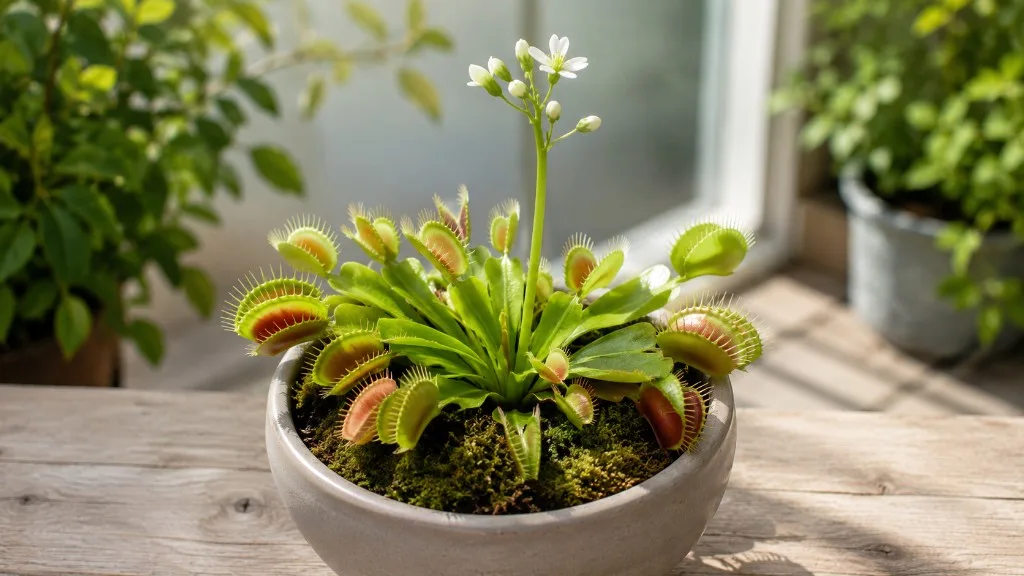
Venus Flytrap Fertilizer: What to Use Instead
Venus Flytrap Fertilizer: What to Use Instead
If you searched Venus flytrap fertilizer hoping to find a bottle to pour on your plant, the answer is blunt: do not use conventional fertilizer. Not diluted, not organic, not “balanced” 10-10-10, not slow-release pellets, and not the enriched peat moss sold at big-box stores. Dionaea muscipula evolved in nutrient-starved pine savannas of the Carolinas, where mineral nitrogen and phosphorus are scarce in the soil and abundant only inside the bodies of insects. The plant’s roots are built for pure water and inert media - not for absorbing dissolved salts. Pour houseplant fertilizer into that system and you risk root burn, rhizome collapse, and death within days.
The correct nutrition strategy is carnivory. Venus flytraps capture prey, digest it with enzymes inside modified leaves called traps, and absorb nitrogen and other minerals through trap tissue - not through roots the way a pothos or philodendron does. For most growers, that means letting traps catch small insects outdoors or hand-feeding appropriate prey a few times per growing season. There is one narrow exception discussed later: MAXSEA 16-16-16 applied as an extremely dilute foliar mist on leaves only, reserved for advanced growers who understand the risks. Beginners should ignore fertilizer entirely and focus on insects, strong light, mineral-free water, and nutrient-poor soil.
How Venus Flytraps Actually Get Nutrients
Understanding where nutrients enter the plant is the whole game. A Venus flytrap is not a hungry houseplant waiting for root uptake. It is a photosynthetic rosette that supplements its diet by eating bugs when soil chemistry cannot supply enough nitrogen or phosphorus for competitive growth. In the wild, that supplementation is the evolutionary advantage that lets carnivorous plants hold territory in bogs and wet savannas where conventional plants struggle.
Trap Digestion and Nitrogen Uptake
When an insect triggers the trap’s sensitive hairs twice within about twenty seconds, the lobes snap shut and seal. The plant then secretes digestive enzymes that liquefy soft tissue over several days. Absorbed nutrients - especially nitrogen and phosphorus - move into the trap and support new leaf production, larger traps, and flowering energy reserves. Research published in New Phytologist (Gao et al., 2015) demonstrated that Dionaea muscipula integrates trap-derived and root-derived nitrogen pathways, but under natural nutrient-poor conditions, prey capture is the dominant route for the minerals that limit growth. The Royal Botanic Gardens, Kew describes Venus flytraps as relying on elaborate snares for food because their native soils are acidic and low in available nutrients.
This biology explains why feeding advice for normal houseplants fails here. You are not trying to enrich the root zone. You are trying to simulate occasional prey capture without poisoning the roots or wasting trap energy on oversized meals. Each trap can only close a limited number of times before it senesces, so feeding is a precision act - not a weekly fertilizer schedule.
Photosynthesis Still Carries the Plant
Insects are a supplement, not the entire energy budget. Venus flytraps produce sugars through photosynthesis like any green plant, and strong light remains non-negotiable for health. A flytrap can survive for months without catching prey if light, water, and dormancy requirements are met - it will simply grow more slowly, produce smaller traps, and show less of the pink or red pigmentation that well-fed specimens display. Indoor growers sometimes panic about nutrition when the real limiting factor is four hours of direct sun on a windowsill that only delivers Venus Flytrap light guide.
Think of insect feeding as a performance booster, not a rescue line for a plant starving in the dark. If your flytrap is pale, elongated, or producing tiny traps, audit light and soil chemistry before reaching for mealworms or foliar sprays. Nutrition cannot compensate for a dim room or Miracle-Gro-amended peat.
Why Regular Fertilizer Kills Venus Flytraps
Houseplant fertilizers are concentrated solutions of mineral salts - nitrogen, phosphorus, potassium, and micronutrients - formulated for species whose roots actively transport those ions from soil water. Venus flytrap roots evolved under the opposite selection pressure: constant rinsing by low-mineral groundwater in coastal plain wetlands near Wilmington, North Carolina. Over millennia, the species lost tolerance for the osmotic and ionic stress that fertilizer imposes.
Root Sensitivity to Mineral Salts
When mineral salts accumulate around carnivorous plant roots, water movement reverses - roots lose moisture to the salty zone instead of taking water up. Cell membranes suffer, fine root hairs die, and the white rhizome (the short stem between roots and leaves) turns brown and mushy. Experienced growers consistently report that even diluted conventional fertilizer can shock a Venus flytrap faster than chronic underwatering on Venus Flytrap. The mechanism is not mysterious: you are applying a product designed for nutrient-avid roots to a plant whose entire survival strategy assumes the soil stays chemically empty.
Foliar feeding with the wrong product is equally dangerous if runoff reaches the media. Liquid dripping off leaves into a peat-perlite mix concentrates salts at the surface where young roots explore. That is why the only foliar exception - MAXSEA - must be applied as a light mist on foliage with zero soil drenching, and even then only by growers who accept plant-loss risk.
Enriched Potting Mix Counts as Fertilizer
Many killed flytraps never see a fertilizer bottle. They die because the owner repotted into Miracle-Gro peat moss, Scott’s enriched blends, or standard potting soil labeled “feeds for six months.” Those products are fertilizer delivery systems baked into the substrate. NC State Extension explicitly warns not to fertilize and to use whole-fiber sphagnum or equal parts peat with coarse sand or perlite - standard potting soil burns sensitive roots quickly.
The standard carnivorous plant (CP) mix - roughly 1:1 peat moss and perlite by volume, with no added lime or fertilizer - is not a preference. It is a chemical firewall that keeps minerals away from sensitive roots. Any “improvement” that adds nutrients violates the plant’s habitat contract.
Insect Feeding as the Correct Nutrition Strategy
Insect feeding replaces fertilizer for Venus flytraps. You are supplying the same nitrogen and phosphorus the plant would extract from wild prey, delivered inside a package its enzymes can process. The goal is modest supplementation during active growth - mimicking occasional catches, not force-feeding a carnivore into obesity.
What to Feed and What to Avoid
Appropriate prey items match what traps naturally capture: small flies, ants, spiders, and caterpillars roughly one-third the size of the trap interior. For hand-feeding indoors, rehydrated freeze-dried bloodworms, live or recently killed mealworms trimmed to fit, and small crickets are common choices. Use clean tweezers to place prey deep enough to contact trigger hairs on both lobes so the trap closes with a seal. One appropriately sized insect per trap is enough; do not stack multiple bugs into a single snare.
Never feed human food, raw meat, hamburger, cheese, egg, or processed snacks. Venus flytrap digestive chemistry targets chitin-rich arthropod tissue, not mammalian fat and protein profiles. Human food rots inside the trap, invites mold, and wastes a finite closure cycle without delivering usable nutrition. The same rule excludes fish food flakes, chicken, and dog treats promoted in ill-informed social posts.
Outdoor plants on a sunny porch often need no hand-feeding at all - flies, gnats, and ants arrive on their own. Indoor desk plants in sealed offices are the main audience for manual feeding. If your traps never catch anything and growth is steady with good color, you may choose to feed rarely or not at all rather than overtrigger traps for entertainment.
How Often to Feed During Active Growth
During the active growing season - roughly March through October in the Northern Hemisphere for most indoor specimens - feeding one trap per plant every two to four weeks is a sensible ceiling. Many experienced growers target one to two feedings per month across the whole rosette, not per trap. A mature plant with eight traps does not need eight meals monthly; rotate which trap you feed so no single leaf bears repeated digestion load.
Overfeeding is a real mistake. Each closure costs energy, and traps that digest constantly senesce faster, leaving the plant with fewer functional snares. If multiple traps on your plant are blackened or permanently closed, you have likely fed too aggressively or used prey too large to digest cleanly. Scale back and let new traps mature before the next meal.
Manual Feeding Step by Step
Hand-feeding is simple once you respect trap mechanics and prey size. Choose a healthy, fully open trap on a plant that has been growing actively for at least two weeks after Venus Flytrap repotting guide or arrival from shipping. Hold the prey with fine tweezers and gently brush it against the trigger hairs on the inner trap surface - at least twice within twenty seconds - until the lobes begin closing. If the insect is too small to trip the hairs reliably, use a toothpick or tweezers tip to simulate the second touch after the first closure begins.
After the trap seals, do not poke it open to check progress. Digestion takes five to ten days depending on temperature and prey size. The trap will reopen partially when finished, often leaving a dry husk of chitin behind. Remove leftover shell fragments with tweezers if mold appears, but otherwise let the plant manage the cycle. Repeat on a different trap after two to four weeks if you want continued supplementation.
For freeze-dried bloodworms, rehydrate briefly in distilled water, squeeze excess moisture, and feed a piece about the size of a grain of rice. Mealworms should be killed or incapacitated before placement so they cannot chew their way out of a partially closed trap - a live worm burrowing through trap tissue causes permanent damage. Crickets must fit comfortably inside the closed lobes with room for enzymes to contact all surfaces.
When Not to Feed Your Venus Flytrap
Certain states make feeding - and any foliar experiment - irresponsible. Do not feed during dormancy, typically late autumn through winter when growth slows, traps shrink, and the plant expects cold-rest conditions. Digestion demands warmth and active metabolism; a semi-dormant flytrap may fail to process prey, leaving rotting material inside traps that blackens the whole leaf.
Skip feeding on newly purchased, shipped, or repotted plants for at least two to three weeks while the rhizome re-establishes. Skip feeding when the plant shows stress signals: widespread blackening, rhizome softness, pest infestation, or obvious dehydration. Skip feeding when fewer than three healthy traps remain - conserve energy for recovery, not digestion. And skip feeding entirely if you are unsure about soil purity; fix the substrate first, because no insect will offset enriched peat killing the roots underneath.
Seedlings and very young tissue-culture plants digest more slowly and tolerate smaller prey. Feed them at most once per month with prey one-quarter trap size, or wait until they develop mature traps before feeding at all. Patience beats enthusiasm on small plants.
MAXSEA Foliar Feeding for Advanced Growers Only
Everything above applies to 99% of Venus flytrap owners: use insects, not fertilizer. The remaining fraction - experienced carnivorous plant growers running controlled setups with pure media, verified water, and strong light - sometimes apply MAXSEA 16-16-16 as a foliar spray at manufacturer-specified extreme dilution. This is optional, risky, and not recommended for beginners. If you are reading this article because you just bought your first flytrap, close this section and feed a mealworm instead.
MAXSEA is a water-soluble seaweed-based fertilizer that the carnivorous plant community adopted because it can be applied to leaves without drenching roots - when used correctly. It is still mineral fertilizer. Misapplication kills plants as surely as Miracle-Gro poured into the pot.
Official Dilution Rates and Application Technique
MAXSEA’s published instructions include a dedicated row for carnivorous plants: ¼ teaspoon per gallon of water, applied every three to four weeks, misting foliage lightly and explicitly not pouring through soil. That rate is drastically lower than houseplant intermittent feeding (two level teaspoons per gallon every seven to fourteen days for indoor containers). The manufacturer further advises moistening soil with pure water before any application and never fertilizing dry plants - guidance that matters doubly for flytraps sitting in peat that dries unevenly at the surface.
Mix only with distilled, reverse osmosis, or rain water - never tap water, which adds calcium and chlorine stress on top of fertilizer salts. Use a fine spray mister to coat leaf surfaces and petioles lightly, avoiding flood-level runoff into the crown and media. Apply in early morning or evening so leaves are not scorched by sun on wet surfaces. Target the growing season only; pause all MAXSEA applications during dormancy the same way you pause insect feeding.
Independent grower experiments - including concentration trials documented by specialist nurseries - reinforce the narrow margin: seedlings showed benefit at quarter-teaspoon-per-gallon intervals, while higher concentrations caused tissue damage and plant loss. Treat MAXSEA as a laboratory-grade tool, not a growth hack for impatient beginners.
Risks and When to Skip MAXSEA Entirely
Skip MAXSEA if you cannot guarantee unenriched media, mineral-free irrigation water, and at least four hours of direct sun daily. Skip it on stressed, recently repotted, or dormant plants. Skip it if you lack a mister that produces fine droplets - coarse streams dump fertilizer into the rhizome zone. Skip it if children or pets might contact freshly sprayed leaves before drying. And skip it if the psychological pull is “make my plant bigger faster” rather than “correct a documented deficiency under controlled conditions.”
Even correct MAXSEA use can fail on individual clones, weak seedlings, or plants already borderline from low light. If leaves blacken within forty-eight hours of spraying, flush the pot with pure water from the top to dilute any runoff that reached soil, move the plant to stable conditions, and do not reapply. Many growers who try foliar feeding once decide insects alone are simpler and safer - that is a reasonable conclusion.
Signs Your Venus Flytrap Is Well-Fed or Underfed
Nutrition status shows up in growth habit more than in a soil test you cannot run anyway. A well-fed Venus flytrap during active season produces traps with strong red interior coloration (when genetics and light support pigmentation), firm upright petioles, and sequential waves of new traps from the rhizome. Trap count increases on mature plants, and individual traps reach the upper end of the cultivar’s size range - often 0.5 to 1.5 inches across on standard forms.
An underfed but otherwise healthy plant stays green, photosynthesizes adequately, and grows slowly with modest trap size. This is normal for indoor plants that catch little and are not hand-fed. Underfeeding is a problem only when combined with poor light or long-term neglect that prevents flowering and division vigor over multiple seasons.
Overfeeding or fertilizer damage looks different: traps blacken from the edges inward during digestion failure, rhizomes turn brown and soft at soil level, new leaves emerge stunted or deformed, and white mineral crust may appear on media if conventional fertilizer was used. A plant that received root-zone fertilizer often collapses suddenly - all traps black within a week - whereas overfed insects typically blacken individual traps while the rhizome stays firm.
Do not confuse natural trap senescence with malnutrition. Each trap lives a finite number of cycles; old traps blacken and die while new ones emerge. Worry when the rhizome or multiple new traps simultaneously fail, not when one old snare expires after three catches.
Common Fertilizer Mistakes and How to Recover
The most common mistake is applying any conventional liquid or granular fertilizer to soil, often because generic houseplant guides recommend half-strength feeding monthly. The second most common mistake is repotting into enriched peat or potting mix. The third is feeding human food or raw meat after a well-meaning relative insists the plant “needs protein.” The fourth is overfeeding insects - three traps fed every week until the plant has no functional leaves left.
If you accidentally applied fertilizer to soil, act immediately. Flush the pot repeatedly with distilled or reverse osmosis water, pouring through until runoff flows clear, over several sessions across a week if needed. Do not feed insects or spray MAXSEA during recovery. Move the plant to appropriate light without additional stress, and expect to wait four to eight weeks before judging survival. Dead rhizome tissue is firm brown or black and mushy - if the core is gone, the plant cannot be saved. If the rhizome stays white and firm with new trap primordia emerging, recovery is underway.
For enriched soil mistakes, repot into pure unenriched peat and perlite as soon as you identify the problem, rinsing all old media from roots under pure water. This is more reliable than flushing enriched commercial mixes that continue releasing fertilizer for months. Recovery timelines match fertilizer flushing - patience and stable conditions, not heroic feeding.
How Feeding Connects to Light, Water, and Soil
Nutrition does not exist in isolation. A perfectly fed flytrap in enriched soil still dies. A flytrap in correct media with distilled water and strong sun often thrives on accidental gnat catches alone. The care triangle for Venus flytraps is light, mineral-free water, and nutrient-poor soil; insect feeding sits on top as optimization.
Light drives the photosynthetic base load and trap coloration. Without adequate direct sun, extra insects or MAXSEA mist cannot produce robust growth - the plant lacks the carbon skeleton to use nitrogen. Water must be low in total dissolved solids; tap water adds minerals that accumulate in peat exactly like fertilizer salts, producing the same root damage over months. Tray watering during the growing season keeps media moist but should use pure water only. Soil must remain unenriched; even correct insect feeding cannot offset daily root exposure to Miracle-Gro peat.
When troubleshooting stunted growth, inspect in this order: soil purity and water source first, then light intensity and duration, then feeding frequency last. Most “nutrient deficiency” diagnoses on Venus flytraps are actually light deficiency or salt toxicity mislabeled.
Seasonal Feeding and Dormancy Rules
Venus flytraps are temperate plants - not tropicals - native to USDA zone 8a conditions with winter chilling requirements. As photoperiod and temperatures drop in late autumn, growth slows, traps shrink, and the plant enters dormancy for roughly three to four months. During this rest period, pause all insect feeding and all MAXSEA foliar applications. The metabolic machinery for digestion is largely offline; prey rots instead of nourishing.
Resume feeding in early spring when new growth accelerates and trap size increases - typically when multiple full-size traps have opened on a firm white rhizome. Outdoor plants waking in a bog garden catch their own first meals; indoor plants may need hand-feeding resumed on the two-to-four-week schedule described earlier. If you forced a flytrap to skip dormancy under grow lights, still reduce feeding during the plant’s slowed winter phase to respect its rhythm.
Flowering in spring consumes energy. Some growers skip feeding traps on blooming plants to let reserves redirect; others feed lightly after flower stalk trimming. Either approach works if light and soil fundamentals stay correct. Do not compensate for a tall flower stalk by pouring fertilizer - cut the stalk if you prefer foliage investment, and let insects supply nitrogen if needed.
Conclusion
Venus flytrap fertilizer in the conventional sense does not exist - at least not as something you should buy or apply. These plants evolved to pull nitrogen and phosphorus from digested insects through their traps while their roots bathe in chemically empty, constantly rinsed soil. Pouring houseplant fertilizer, using enriched peat, or dumping granules into the pot violates that biology and commonly kills the plant faster than most other care errors.
The practical nutrition plan is straightforward: grow in unenriched peat and perlite, irrigate with distilled or reverse osmosis water, provide strong direct light, and feed appropriately sized insects to one trap every two to four weeks during active growth if natural catches are insufficient. Skip all feeding during dormancy and recovery periods. Advanced growers who fully understand the risks may optionally mist MAXSEA 16-16-16 at ¼ teaspoon per gallon every three to four weeks on foliage only, never on roots - but that path is unnecessary for healthy plants and dangerous for beginners.
When in doubt, choose less intervention, not more. A Venus flytrap in correct conditions with occasional bugs will outlive and outperform a heavily fertilized plant in the wrong soil every time. Trust carnivory - it is the entire reason the species exists.
When to use this page vs other Venus Flytrap guides
- Venus Flytrap overview - Start here for whole-plant context before deep-diving this topic.
- Venus Flytrap problems hub - Jump to symptom-specific fix guides when this care topic does not resolve the issue.
- No Flowers on Venus Flytrap - Escalate here when fertilizer adjustments are not enough.
Related Venus Flytrap guides
- Venus Flytrap overview
- Venus Flytrap watering
- Venus Flytrap light
- Venus Flytrap soil
- Venus Flytrap propagation
- Venus Flytrap repotting
- No Flowers on Venus Flytrap
- Venus Flytrap problems
Related tool
Try the Fertilizer Dilution Calculator with venus-flytrap pre-selected to estimate needs for your setup.