Spider Mites on Venus Flytrap: Causes, Checks & Fixes
Quick answer
Spider mites on Venus flytrap show as yellow or tan stippling on trap blades and flat petioles, often with fine silk webbing at petiole bases and the rosette center in warm, dry indoor air. First step: isolate the plant and tap a suspect trap over white paper to confirm slow-moving specks, then rinse the rosette with distilled water-not tap water-before any spray.
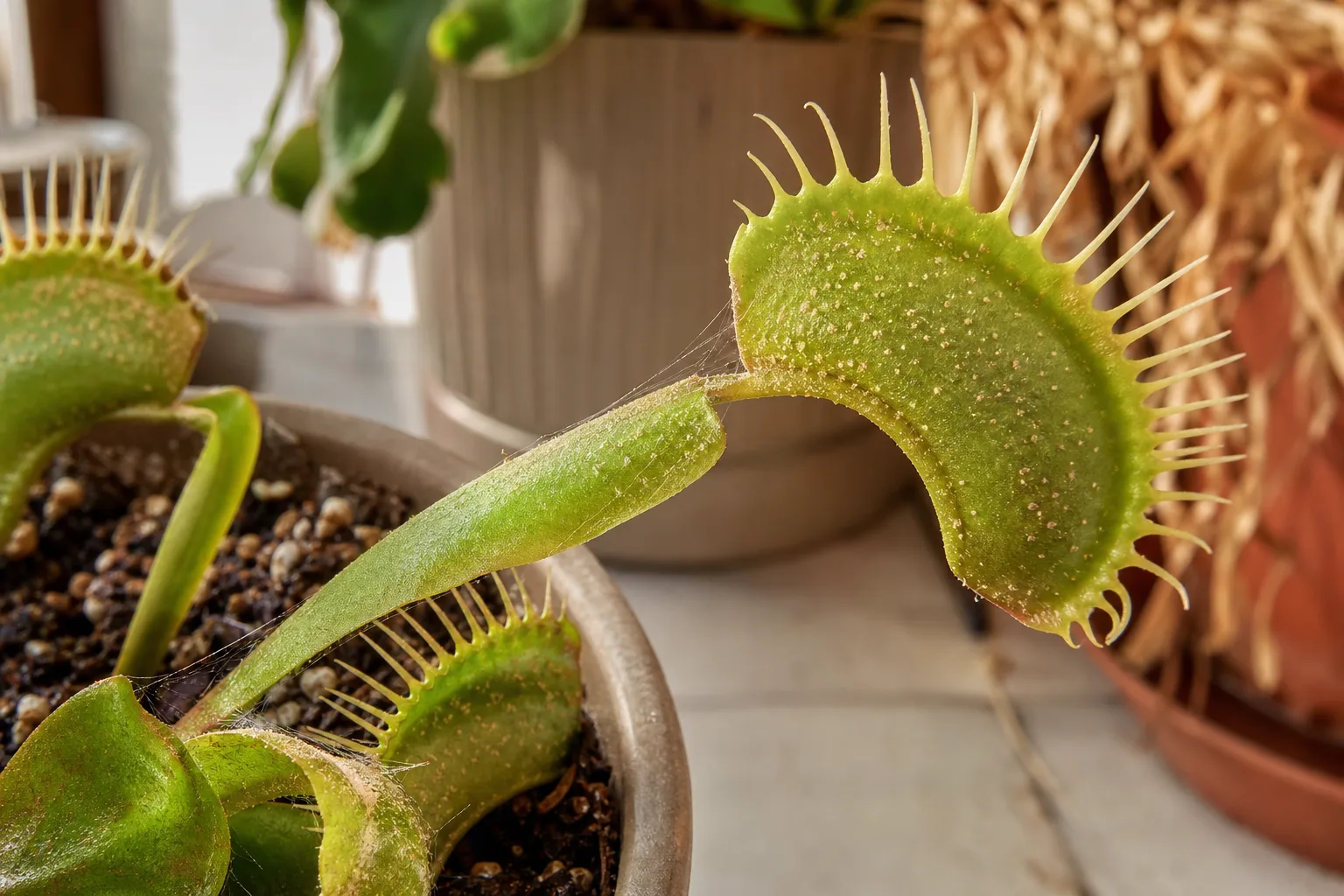
Spider Mites on Venus Flytrap: Causes, Checks & Fixes
This guide covers spider mites on Venus Flytrap. See also the general Spider Mites guide, watering, and light pages for this plant.
Spider Mites on Venus Flytrap: Causes, Checks & Fixes
Quick answer
Spider mites on Venus flytrap (Dionaea muscipula) show up as yellow or tan stippling on trap blades and flat petioles, often with fine silk webbing at petiole bases and the rosette center when indoor air runs warm and dry. They pierce leaf cells and feed on sap, leaving a speckled look that can spread across the rosette before you notice individual mites.
First step: isolate the plant the same day you suspect mites. Move it away from other carnivorous plants, companion houseplants, and shared humidity trays. Then hold white paper under a suspect trap, tap sharply, and watch for slow-moving specks-that confirms active mites before you rinse or spray anything.
Once isolated, rinse the rosette with distilled water or rainwater only-never tap water. A gentle shower knocks down mites on trap surfaces and petioles without the mineral damage tap water causes on carnivorous tissue. Judge recovery by firm new traps without fresh stippling or webbing, not by expecting old damaged blades to look perfect again. Full species context: Venus flytrap overview.
Spider mites vs. mealybugs vs. aphids - which guide to use
Venus flytrap pests share a low rosette growth form, so route to the right guide before you treat:
| What you see | Likely pest | Guide |
|---|---|---|
| Yellow stippling + fine webbing + moving specks on paper | Spider mites | This page |
| White cottony tufts in rhizome crown folds | Mealybugs | Mealybugs guide |
| Soft green/black pear-shaped insects on new growth | Aphids | Aphids guide |
| Tiny flies over wet peat surface | Fungus gnats | Fungus gnats guide |
Spider mites are the only common pest here that combines stippling, webbing, and confirmed movement on a tap test. Mealybugs leave waxy cotton clusters; aphids leave sticky honeydew without silk.
What spider mites look like on Venus flytrap
Early signs hide on flat petioles and trap undersides, so check these patterns together-not just open traps facing the window:
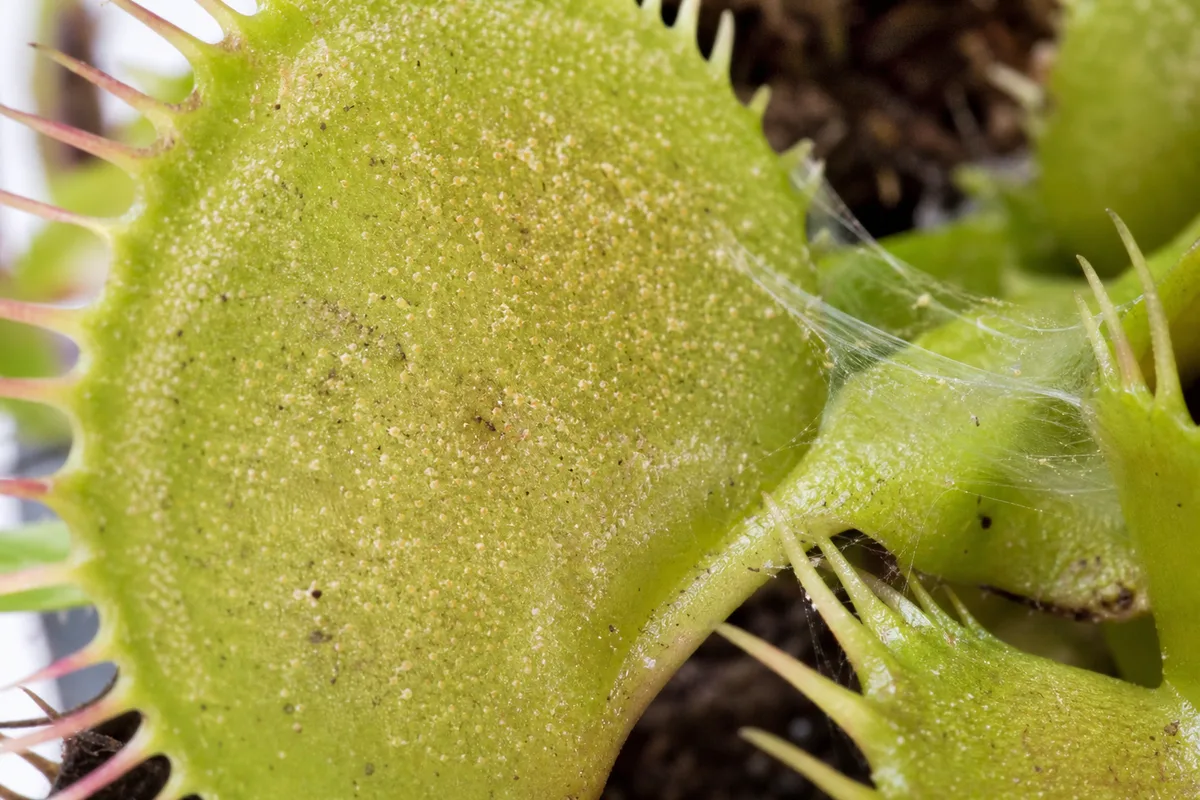
Spider Mites symptoms on Venus Flytrap - compare with healthy tissue on the same plant.
- Yellow, tan, or pale green pinprick stippling on trap blades and flat petioles, often starting at trap margins or edges before spreading inward
- Fine silk webbing at petiole bases, between overlapping traps, and across the rosette center when colonies grow-webbing distinguishes spider mites from aphids and thrips
- Bronzing or dull, bleached traps on heavily infested rosettes; severe feeding can yellow tissue and cause leaf drop
- Slow-moving dust-sized specks on white paper after tapping a suspect trap-mites are about 1/50 inch long and hard to see without a tap test or hand lens
- Traps that close slowly or fail to seal when sap loss and stippling weaken blade tissue-functional traps may still snap, but heavily damaged ones look thin and speckled
- Amber mite eggs, whitish cast skins, or black fecal specks on petiole undersides with magnification
Do not mistake normal aging for mite damage. Venus flytraps naturally blacken outer traps in late fall as dormancy begins, and individual old traps die after several closures. Mite stress shows scattered stippling on multiple active traps, webbing at the rosette center, and moving specks on a tap test-not one black trap on an otherwise clean rosette.
Strong light can redden trap interiors evenly-that is not random yellow pinpricks. Dormancy bronzing affects outer traps progressively; mites often hit center and newest growth in dry indoor heat.
Why Venus flytrap gets spider mites
Spider mites are common on houseplants in warm, dry indoor air. They prefer hot, dusty conditions and reproduce rapidly when temperatures rise-which makes winter heating season and grow-light setups a frequent outbreak window for carnivorous collections kept indoors.
A Venus flytrap grows as a basal rosette of snapping traps on flat petioles from a short white rhizome at the peat surface. That tight rosette traps stale air at the center while the pot sits in a shallow water tray-moist at the roots but often dry above the foliage when a heat register, sunny glass, or lamp dries the microclimate around the traps.
The carnivorous paradox: your flytrap needs distilled water or rainwater in a shallow tray during active growth and full sun-at least six hours of direct light daily, yet mites still thrive in the dry air layer just above the wet peat. Indoor winter rooms with forced heat, low airflow, and neighboring dry houseplants create exactly the dry, warm conditions spider mites favor.
Mites usually arrive on new nursery stock, shared tools, or nearby infested houseplants-not because Venus flytraps are uniquely prone, but because two-spotted spider mites are polyphagous pests especially problematic on indoor plants and have been reported on Dionaea in cultivation surveys. Outdoor bog-grown flytraps in humid conditions see fewer mite issues than windowsill specimens in heated rooms.
Stress makes outbreaks worse. A flytrap on a dim windowsill, recently shipped bare-root, or kept beside a hot air vent loses vigor faster when sap-feeding mites multiply on already weakened traps.
How to confirm the cause
Do not treat from one pale spot on a single trap. Use this inspection order:
- Isolate first - Move the flytrap away from other plants before handling so mites do not walk to neighboring pots or shared water trays on your hands or tools.
- White-paper tap test - Hold plain white paper under a stippled trap or petiole and tap sharply. Slow-moving specks confirm spider mites; dust, perlite, and pollen do not crawl.
- Trap blades and petiole undersides - Check both sides of flat petioles and trap margins with bright light. Mites live mostly on leaf undersurfaces in colonies; Venus flytrap petioles are thin, so stippling shows on top surfaces early.
- Webbing check - Look for fine silk at petiole bases, between overlapping traps, and across the rosette center. Webbing plus stippling strongly indicates mites rather than thrips or mineral spray residue.
- Environment scan - Note heat registers, sunny glass, grow lights, and winter heating that dry air above the tray. Spider mites thrive in dry, warm conditions.
- Neighbor check - Tap-test carnivorous plants and houseplants that shared a windowsill, terrarium, or nursery shipment.
- Rhizome firmness - Gently inspect the white crown at soil level. A firm rhizome with stippling and webbing fits mites. A soft, dark, sour-smelling crown with saturated peat suggests crown rot from overwatering-do not repeatedly drench for mites until you rule that out.
If tap tests show moving specks, stippling spreads across multiple traps, and webbing appears at the rosette center, spider mites fit. If you see cottony wax clusters without movement on paper, switch to the mealybugs guide.
Lookalike symptoms to rule out
| What you see | Likely cause | Key difference |
|---|---|---|
| Stippling + webbing + moving tap-test specks | Spider mites | Silk at petiole bases; mites crawl on paper |
| White cottony tufts in crown folds | Mealybugs | Waxy filaments; pink smear when crushed; no stipple pattern |
| Soft pear-shaped insects on new growth | Aphids | Visible insects; honeydew without fine mite webbing |
| Silvery streaks on trap surfaces | Thrips | Rasping damage; no round stipple dots or mite webbing |
| Tiny flies over wet peat | Fungus gnats | Adults fly when disturbed; larvae in wet moss |
| Even red trap interiors from strong light | Normal coloration | Uniform pigment, not scattered yellow pinpricks |
| Progressive outer-trap browning in late fall | Dormancy | Seasonal pattern; no webbing or moving specks |
First fix for Venus flytrap
Isolate the plant and rinse the rosette with distilled water or rainwater.
That single action knocks mites off trap surfaces and petioles, confirms you are treating an active infestation rather than dust, and respects carnivorous water limits before you commit to sprays. UMN Extension recommends washing leaves and spraying small plants in a sink as a first-line mite control; on Venus flytrap, that wash must use mineral-free water only.
Once isolated:
- Empty the water tray before rinsing so the rhizome is not sitting submerged while foliage stays wet
- Shower or mist the rosette gently, targeting petiole undersides and trap bases where colonies gather
- Tilt the pot so rinse water runs off petioles rather than pooling on the white rhizome crown
- Let the plant dry in bright light the same day-see light requirements-then return to a 1–2 cm tray per watering protocol
- Wash hands and tools after handling; mites spread on hands, clothing, and watering cans
Do not apply insecticidal soap, horticultural oil, or alcohol on day one until you have rinsed and reassessed mite levels. Do not use tap water for any rinse. Do not reach for broad-spectrum insecticides first-UC IPM notes that certain insecticides kill mite predators and can cause spider mite population spikes. Do not fertilize a mite-hit Venus flytrap; this species must never be fertilized.
Step-by-step recovery
After the initial distilled-water rinse:
- Repeat rinses every three to five days for at least two weeks. Mite generations can complete in less than a week in warm weather, so one rinse rarely clears a colony.
- Re-tap test weekly - Hold white paper under traps until no specks move for two consecutive checks.
- Apply dilute insecticidal soap only if stippling and webbing persist after several rinses. Insecticidal soap is effective against spider mites when spray contacts the pests. Test one petiole first; keep the plant out of direct sun for 24 hours; rinse with distilled water a few hours later to remove soap residue and any fertilizer salts in the product.
- Spot-treat isolated clusters with a cotton swab lightly moistened with distilled water, or-only on heavily webbed petiole sections-a brief 70% alcohol touch on the pest itself, not pooled on the rhizome. Carnivorous tissue is sensitive; prefer rinses over alcohol on open traps.
- Increase airflow slightly around the rosette without drying the peat-move the pot away from heat registers and avoid crowding traps against a warm window pane.
- Trim only dead traps that no longer photosynthesize once mites are gone; sterile scissors between cuts if you trim multiple plants.
Keep the flytrap isolated until you see no fresh stippling, no new webbing, and clean tap tests for at least two weeks.
Recovery timeline and what improvement looks like
Distilled rinses can stop spread within one to two weeks when colonies are moderate and you repeat on schedule. A full course with rinses plus optional soap may take three to five weeks across multiple mite generations. Old stippled trap tissue rarely returns to solid green-judge recovery by new traps opening without speckles, no fresh webbing at the rosette center, and a firm white rhizome.
Flytraps rebound faster in bright direct light than on dim windowsills where new growth stays slow. Expect the first clean trap within two to four weeks after mites stop spreading if light and water stay correct.
Signs the problem is getting worse: webbing covers multiple traps, stippling spreads to the newest center growth, tap tests still show many specks after two rinse cycles, or the rhizome softens while peat stays saturated.
What not to do
Do not ignore faint stippling on one trap margin-mites multiply quickly in dry heat. Do not rinse with tap water or leave the crown submerged in a full tray while foliage stays wet. Do not apply undiluted alcohol across open traps or the rhizome.
Do not use neem oil or heavy horticultural oils without a spot test-carnivorous leaves burn easily in direct sun after oil application, and oils should not go on water-stressed plants or when temperatures exceed 90°F. Do not treat with pyrethroid or organophosphate sprays marketed for general insects-they often worsen mite outbreaks by removing predators.
Do not fertilize during active mite treatment. Do not return an isolated plant to a shared carnivorous collection after one rinse. Heavily infested houseplants may need discarding to protect a large collection-replacement Venus flytraps are inexpensive once neighbors are safe.
How to prevent spider mites on Venus flytrap
Scout trap blades, petiole bases, and the rosette center during weekly care-especially in winter heating season when dry indoor air favors mites. Quarantine new carnivorous plants for two to three weeks and tap-test them before placing beside established flytraps.
Keep flytraps in full direct sun during the growing season so rosettes stay vigorous and you notice stippling early. Maintain distilled-water tray rhythm without letting the air above the rosette bake dry beside a heat vent. A light distilled mist on warm mornings can raise humidity around traps without waterlogging the crown-never leave standing water pooled on the rhizome overnight.
Inspect houseplants regularly for insects when bringing outdoor pots indoors or mixing new nursery stock into a display. Wash hands and tools between plants when handling multiple carnivorous specimens.
When to worry
Treat as urgent when webbing covers most of the rosette, new traps stall for more than a week during active growth, tap tests show heavy speck movement after two rinse cycles, or mites appear on multiple carnivorous plants from the same windowsill. Very high mite populations can damage herbaceous plants severely even on otherwise hardy specimens when feeding continues unchecked.
Replace severely declining plants-with a soft dark rhizome, widespread webbing, and no clean new growth-rather than fighting endless reinfestation on a stressed specimen. A single stippled trap with firm rhizome and a few specks on tap test is manageable with isolation and rinses; act within days before colonies spread.
Conclusion
Spider mites on Venus flytrap hide on flat petioles and trap undersides in the tight rosette center, so checking only the traps facing the window is not enough. Isolate first, confirm with a white-paper tap test, rinse with distilled water on a schedule that matches mite generations, and escalate to dilute insecticidal soap only when rinses alone fail. Judge recovery by clean new traps-not old stippled blades-and keep carnivorous water and chemical limits in mind so treatment does not trade one stress for another.
Related Venus flytrap guides: overview · watering · light · mealybugs · aphids · fungus gnats · root rot
When to use this page vs other Venus Flytrap guides
- Venus Flytrap watering guide - Use for routine moisture checks before assuming spider mites is the main issue.
- Venus Flytrap problems hub - Browse all 18 common issues on this species.
- Low Humidity on Venus Flytrap - Different entry point when symptoms overlap with spider mites.
- Slow Growth on Venus Flytrap - Different entry point when symptoms overlap with spider mites.