Fungus Gnats on Venus Flytrap: Causes, Checks & Fixes
Quick answer
Fungus gnats on Venus flytrap mean the sphagnum surface stays wet with algae or decaying organic matter while adults lay eggs in the top layer-larvae can chew fine roots and rhizome tissue. First step: set a yellow sticky trap at the pot rim and reduce tray water to about 1 cm while keeping the rhizome zone moist; do not let the peat dry out completely.
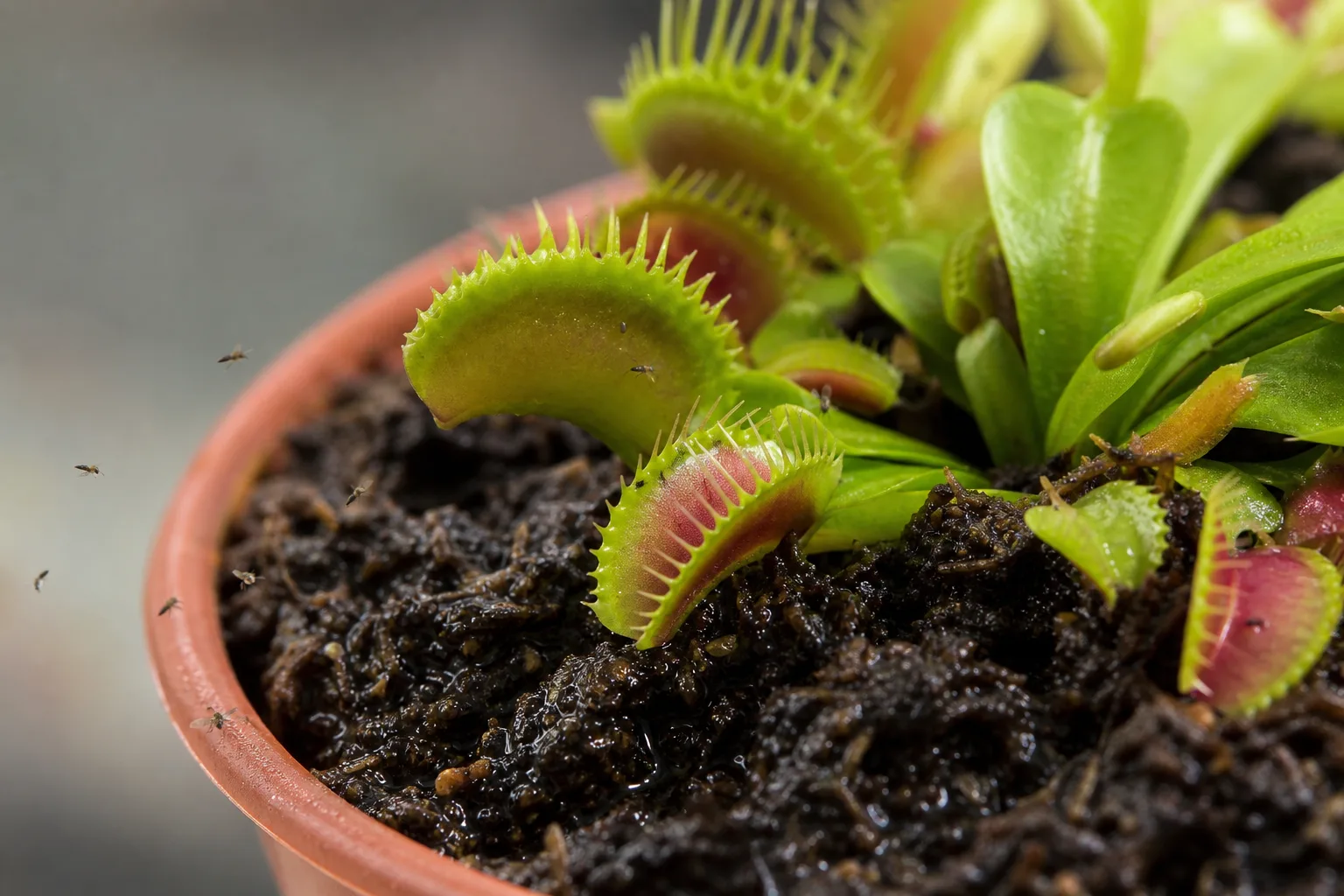
Fungus Gnats on Venus Flytrap: Causes, Checks & Fixes
This guide covers fungus gnats on Venus Flytrap. See also the general Fungus Gnats guide, watering, and light pages for this plant.
Fungus Gnats on Venus Flytrap: Causes, Checks & Fixes
Quick answer
Fungus gnats on Venus flytrap (Dionaea muscipula) almost always mean the sphagnum surface stays wet too long with algae, cyanobacteria, or decaying organic debris-exactly where adult females lay eggs in moist peat-rich media. Adults are tiny dark flies that hover near the pot when you water or walk past. Their larvae live in the damp top layer, feeding on fungi and organic matter-and can damage fine roots and tunnel into stems on small carnivorous plants.
First step: place a yellow sticky trap at the pot rim and reduce tray water to about 1 cm while confirming the rhizome crown stays firm and moist below the surface. Gnats are a soil-surface signal, not a trap disease. Spraying open traps will not reach larvae in peat.
This is not generic houseplant advice. Venus flytraps need consistently moist mineral-free peat at the rhizome zone via the tray method-you cannot “dry the top inch” the way you would on a pothos without risking crown desiccation. Control gnats by tightening tray depth, improving light and airflow, scraping surface algae, and treating larvae-not by starving the plant.
Judge progress by fewer adults on sticky traps, firm white rhizome tissue, and clean new traps emerging-not by expecting old traps to look perfect again. Full species context: Venus flytrap overview.
What fungus gnats look like on Venus flytrap
Adult flies:
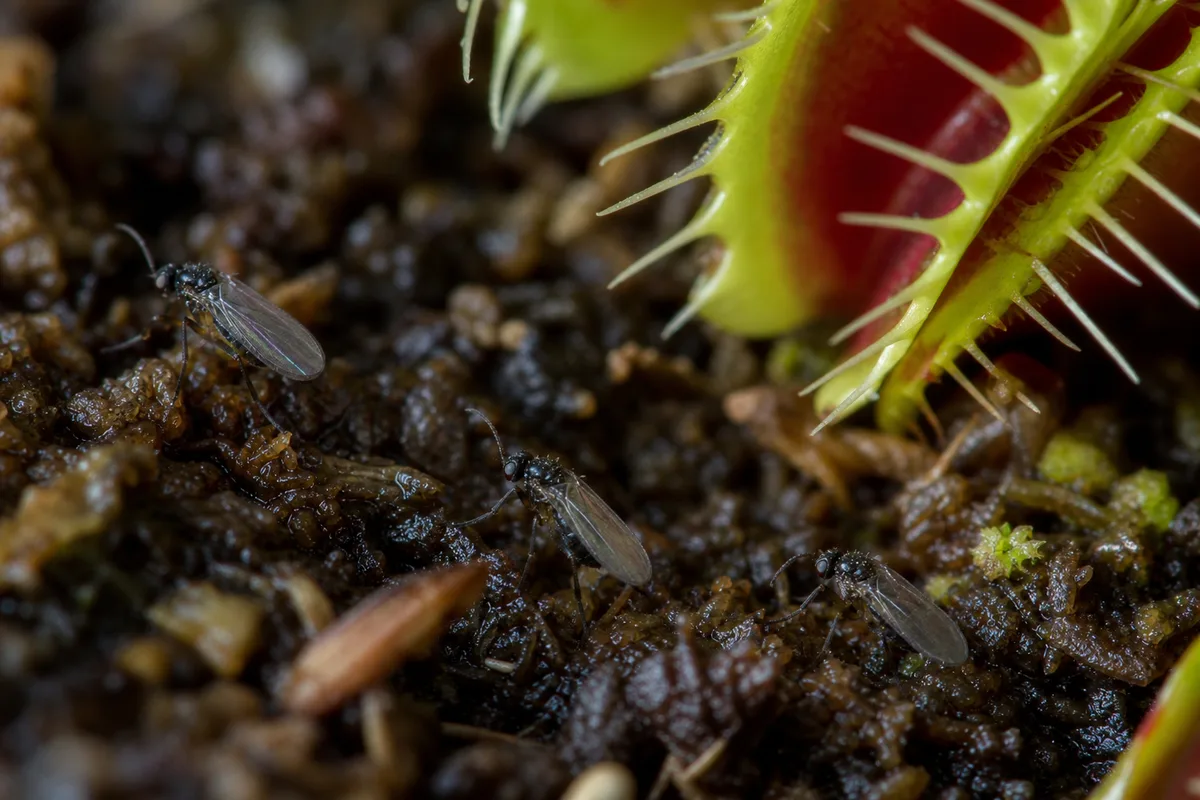
Fungus Gnats symptoms on Venus Flytrap - compare with healthy tissue on the same plant.
- Tiny dark mosquito-like insects, roughly 1/8 inch long, with long legs
- Rise in a cloud when you water, refill the tray, or bump the pot
- Rest on sphagnum surface, pot rim, nearby windows, or lower trap petioles
- Do not bite people or pets
Larval stage in sphagnum:
- Translucent wormlike larvae with dark head capsules in the top inch of wet peat
- Visible when you scrape back surface moss or flip a potato test slice
- Often alongside green algae or cyanobacteria film on constantly wet sphagnum
What you usually will not see on open traps:
- Webbing (spider mites)
- White cottony clusters (mealybugs)
- Sticky honeydew patches (aphids or scale)
- Leaf spots from gnat feeding-damage happens in the peat, not on trap surfaces
Plant symptoms when infestation or overwatering overlap:
- Slow or stalled new trap emergence from root stress
- Individual traps blackening faster than normal seasonal dieback
- Sour or musty smell from anaerobic wet peat at the crown
- Soft rhizome center when overwatering or root rot compounds the gnat problem
On a healthy flytrap in full sun, traps stay firm while gnats annoy you at the soil line. That separation helps confirm you are dealing with a soil pest, not a foliar disease.
Why Venus flytrap gets fungus gnats
Fungus gnats need moist organic growing media to reproduce. Colorado State Extension notes that females lay up to 200 eggs in cracks of peat-rich mix, especially when surface moisture persists. Larvae stay in the top 2 to 3 inches, feeding on fungi, algae, and decaying matter-and chewing roots when populations are high.
Venus flytrap invites this problem through care conditions tied to carnivorous biology:
Wet sphagnum surface with algae or cyanobacteria. The ICPS fungus gnat guide describes the preferred larval habitat as wet peaty soil with fungus and blue-green algae on the surface-the same sphagnum-peat mix flytraps require, minus the algae layer you want to remove.
Over-deep tray or flooded saucer. The tray method calls for 1–2 cm of standing water below the pot during active growth. A saucer kept full to the rim keeps surface moss saturated around the rhizome crown even when roots below are fine-breeding gnats while raising crown rot risk.
Low light slows surface drying. Flytraps need at least six hours of direct sun daily. A dim windowsill or sealed terrarium lets sphagnum surface stay wet for days while the plant uses little water-long enough for multiple gnat generations per CSU Extension’s three-to-four-week life cycle estimate.
Poor airflow in terrariums. Stagnant humid air encourages surface algae and fungus-the organic layer larvae feed on-without the evaporation that bright outdoor culture provides.
New nursery introductions. UC IPM reports fungus gnats commonly arrive on newly purchased or recently repotted houseplants. One infested carnivorous pot can spread adults to every plant on the same shelf.
Gnats rarely mean your traps are infected. They mean the peat surface environment is wrong-and on Venus flytrap, that same environment eventually stresses the rhizome if ignored.
The carnivorous moisture paradox
Here is the tension every flytrap grower hits: the plant needs damp peat at the rhizome, but gnats breed on persistently wet surface moss in low light.
Generic houseplant advice says “let the top inch dry between waterings.” On Dionaea, that dries the rhizome crown-the horizontal stem where every trap attaches-and kills the plant faster than gnats do. The ICPS Dionaea guide expects the pot to sit in pure water while the crown stays above the saturated zone with enough air exchange.
The carnivorous-safe compromise:
| Approach | Safe for flytrap gnat control? | Why |
|---|---|---|
| Reduce tray to ~1 cm; refill when mix approaches dry at depth | Yes | Roots stay moist; less standing water at surface |
| Increase direct sun or supplemental LED | Yes | Faster surface cycling without crown desiccation |
| Scrape surface algae and top moss layer | Yes | Removes larval food and egg-laying sites |
| Add 5 mm coarse horticultural sand top-dress | Yes | ICPS recommends sand barrier to block egg laying |
| BTI drench in distilled water | Yes | Kills larvae in top sphagnum without drying peat |
| Yellow sticky traps at pot rim | Yes | Removes egg-laying females |
| Let entire pot dry out | No | Crown desiccation and rhizome death |
| Deep flooded tray in cool dim room | No | Gnats plus crown rot |
| Tap-water flush or hydrogen peroxide drench | Risky | Mineral damage; unverified on carnivorous rhizomes |
Full tray-depth and TDS rules live in the Venus flytrap watering guide.
How to confirm the cause
Work through these checks in order:
- Flight pattern - Do insects rise when you disturb the pot or refill the tray, not when you touch open traps? Fungus gnats live in soil. Fruit flies hover near kitchen fruit. Springtails hop on wet moss but are harmless and much smaller.
- Surface moisture and algae - Is the top sphagnum green, slimy, or staying wet for days while the tray stays full? Gnat habitat confirmed.
- Potato slice test - CSU Extension recommends inserting 1/4-inch potato wedges into the surface. Check the underside after two to three days for larvae feeding. This confirms larvae in your flytrap peat, not random room flies.
- Sticky trap count - Place a yellow sticky card at the pot rim without touching traps. Catching small dark flies over 24 to 48 hours confirms active adults breeding in that pot.
- Rhizome firmness - Gently press the white rhizome at soil level. Firm tissue with moderate gnats points to surface correction. Soft, dark, sour-smelling crown means rule out root rot before surface-only treatment.
- Tray depth check - Is standing water deeper than 2 cm or pooling above the pot base? Over-deep trays keep surface moss saturated.
- Lookalike surface fuzz - White harmless mould on dry peat differs from green algae in constantly wet moss. See mold on soil for overlap guidance.
If traps stay empty, rhizome feels firm, and flies only appear near the kitchen, your flytrap may not be the source. Check other houseplants and carnivorous pots on the same shelf before treating.
Lookalike symptoms to rule out
| What you see | Likely cause | Key difference |
|---|---|---|
| Tiny dark flies rising from wet sphagnum | Fungus gnats | Mosquito-like; larvae in top peat |
| Flies near fruit bowl, not the pot | Fruit flies | Vinegar traps catch them; not soil-borne |
| Minute jumping specks on wet moss | Springtails | Harmless; no dark fly cloud on watering |
| Stout flies with white spots on wings | Shore flies | Greenhouse pest; shorter antennae |
| White cottony tufts in rhizome crown | Mealybugs | Waxy clusters; not flying insects |
| Green algae film on surface only | Wet surface habitat | Often coexists with gnats; scrape and correct moisture |
First fix for Venus flytrap
Place one yellow sticky trap at the pot rim and reduce tray water to about 1 cm-keeping the rhizome zone moist below the surface, never bone-dry.
That single cultural change hits adults immediately while you stop over-saturating the surface. UMN Extension lists sticky traps and moisture correction as primary fungus gnat tactics; on carnivorous peat, “moisture correction” means shallower tray and better light, not drying the crown.
Do not spray open traps on day one-larvae are not on foliage. Do not repot on day one unless peat is clearly degraded and smells sour. Do not pour hydrogen peroxide or tap-water flushes before adjusting tray depth and light, because mineral injury and waterlogging stress carnivorous rhizomes more than gnats alone.
Position the sticky card at the pot rim where adults walk and fly-high enough to avoid closing traps on the adhesive.
Step-by-step recovery
After the initial trap-and-tray step, work through these in order based on severity:
Light infestation (few flies, firm rhizome)
- Maintain 1 cm tray depth - Refill with distilled, rain, or RO water when the mix approaches dry at root depth per watering protocol. Never let the entire pot desiccate.
- Scrape surface algae - Gently remove green film and the top few millimeters of wet moss with a spoon or tweezers. Discard debris away from other pots.
- Increase direct light - Move to a brighter windowsill or add supplemental LED so the surface cycles faster. See light requirements.
- Replace sticky traps weekly - Monitor whether adult counts drop.
Moderate infestation (daily fly clouds, larvae confirmed)
- Add coarse sand top-dress - Apply a 5 mm layer of medium-coarse horticultural sand over scraped sphagnum to block egg laying. Avoid fine play sand.
- Apply BTI drench - Wisconsin Horticulture Extension recommends products containing Bacillus thuringiensis subsp. israelensis (BTI), such as Mosquito Bits, as soil drenches. Soak bits in distilled water per label, apply enough to reach the top 2 to 3 inches of sphagnum. Repeat every five to seven days for two to three weeks because BTI does not affect eggs or pupae.
- Improve airflow - Crack terrarium lids or add a small fan if plants are enclosed. Stagnant humid air keeps surface moss wet.
Heavy infestation (persistent flies, slow growth, or seedling flytrap)
- Quarantine the pot - Isolate from other carnivorous plants until trap counts fall for two consecutive weeks.
- Repot only if peat is degraded - If sphagnum has broken down, smells sour, or never dries at depth despite shallow tray, repot into fresh unfertilized peat-perlite mix after scraping larvae and trimming any mushy rhizome tissue. Fix tray depth and light before Venus Flytrap repotting guide-not after.
- Address root rot only if confirmed - Soft dark rhizome with sour smell requires root-rot salvage. Gnat treatment alone will not fix rotted crown tissue.
Skip fertilizer entirely-Venus flytraps must never be fertilized. Stressed rhizomes do not need extra salts while recovering from wet peat.
Recovery timeline
You should see fewer adults on sticky traps within one to two weeks once tray depth and surface algae are corrected. Larval generations overlap, so CSU Extension notes the full life cycle can complete in three to four weeks at room temperature-expect two to six weeks of consistent shallow-tray culture plus BTI before counts stay low.
Judge progress by trap counts, firm rhizome tissue, and new traps emerging clean-not by whether every fly disappears overnight. One deep tray refill can restart the cycle.
Old blackened traps from stress will not reopen perfectly, but new growth should emerge firm and wax-free once surface conditions improve. If traps keep failing while peat stays soggy and rhizome softens, inspect for rot rather than adding more gnat products.
During dormancy, reduce tray water naturally-gnat pressure often drops in cool winter conditions, but do not let the rhizome desiccate.
What not to do
Do not let the entire pot dry out to kill gnats-crown desiccation kills Venus flytraps faster than larvae do.
Do not keep a deep flooded tray while only adding sticky traps. Saturated surface moss defeats every other control.
Do not use tap water in BTI drenches or tray refills-minerals accumulate in peat and stress roots. Use distilled, rain, or RO water only.
Do not spray standard houseplant insecticides or neem drenches on day one without verifying carnivorous safety-many products burn traps in direct sun.
Do not assume gnats killed your flytrap if the rhizome is soft and peat smells sour-that pattern is root rot requiring inspection, not fly control alone.
Do not stop treatment after adults disappear for a few days. Pupae in sphagnum can restart the population within a week.
Do not repot into fresh sphagnum on day one without fixing tray depth and light-the new moss will breed gnats again in the same conditions.
How to prevent fungus gnats next time
Match tray depth to season: 1–2 cm during active growth, reduced during cool dormancy. Refill when mix approaches dry at root depth, not when surface looks damp.
Keep six or more hours of direct sun outdoors or strong supplemental LED indoors so sphagnum surface cycles faster. See light guide.
Scrape surface algae during weekly checks before it becomes larval food.
Consider a permanent sand top-dress on mature plants per ICPS guidance-especially in humid terrariums.
Inspect new carnivorous nursery pots before placing them on shared shelves. Treat or isolate any pot that releases flies when bumped.
Use yellow sticky traps as monitors on carnivorous plant shelves-early catches prevent full infestations.
In fall and winter, CSU Extension notes gnats often peak indoors because flytrap growth slows while surface moss stays wet. Reduce tray water during dormancy without drying the rhizome.
Venus flytrap care cross-check during treatment
| Check | Healthy target during gnat treatment | Gnat-friendly mistake |
|---|---|---|
| Tray depth | ~1–2 cm active season; shallower while treating | Saucer flooded to pot rim |
| Water type | Distilled, rain, or RO under 50 ppm TDS | Tap or spring water in tray |
| Light | Six or more hours direct sun or strong LED | Dim terrarium with wet moss |
| Surface | Scraped moss; optional sand barrier | Green algae film left intact |
| Rhizome | Firm and white at soil level | Soft, dark, sour crown |
| Traps | Sticky card at rim only | Adhesive touching open traps |
When to worry - rhizome rot and repot escalation
Standard gnat control is enough when the rhizome feels firm, new traps emerge, and fly counts drop on sticky traps-but no sour peat or widespread blackening beyond normal seasonal dieback.
Treat as urgent when:
- Rhizome center feels soft, dark, or mushy while peat stays saturated
- Sour smell at the crown persists after shallow tray correction
- Trap counts rise weekly despite sand barrier, BTI, and corrected tray depth-suggesting degraded peat or blocked drainage
- Gnats appeared right after repotting into wet heavy mix-inspect rhizome before the problem compounds
- Seedling or tiny flytrap collapses-larvae damage small carnivorous plants faster than mature rosettes
Escalate to root rot salvage when crown tissue softens despite gnat treatment. Flies are the early warning; a mushy rhizome is the alarm.
Conclusion
Fungus gnats on Venus flytrap tell you the sphagnum surface has stayed wet with organic growth-not that your traps are doomed. Confirm flies rise from peat, trap adults, reduce tray depth, scrape algae, and treat larvae with BTI if needed-all while keeping the rhizome zone moist per carnivorous norms. The same shallow-tray and bright-light habits that clear gnats also keep this species out of overwatering and crown rot trouble long term.
Related Venus flytrap guides: overview · watering · light · mold on soil · overwatering · root rot · mealybugs
When to use this page vs other Venus Flytrap guides
- Venus Flytrap watering guide - Use for routine moisture checks before assuming fungus gnats is the main issue.
- Venus Flytrap problems hub - Browse all 18 common issues on this species.
- Overwatering on Venus Flytrap - Different entry point when symptoms overlap with fungus gnats.
- Mold on Soil on Venus Flytrap - Different entry point when symptoms overlap with fungus gnats.
- Root Rot on Venus Flytrap - Different entry point when symptoms overlap with fungus gnats.