Mold on Soil on Venus Flytrap: Causes, Checks & Fixes
Quick answer
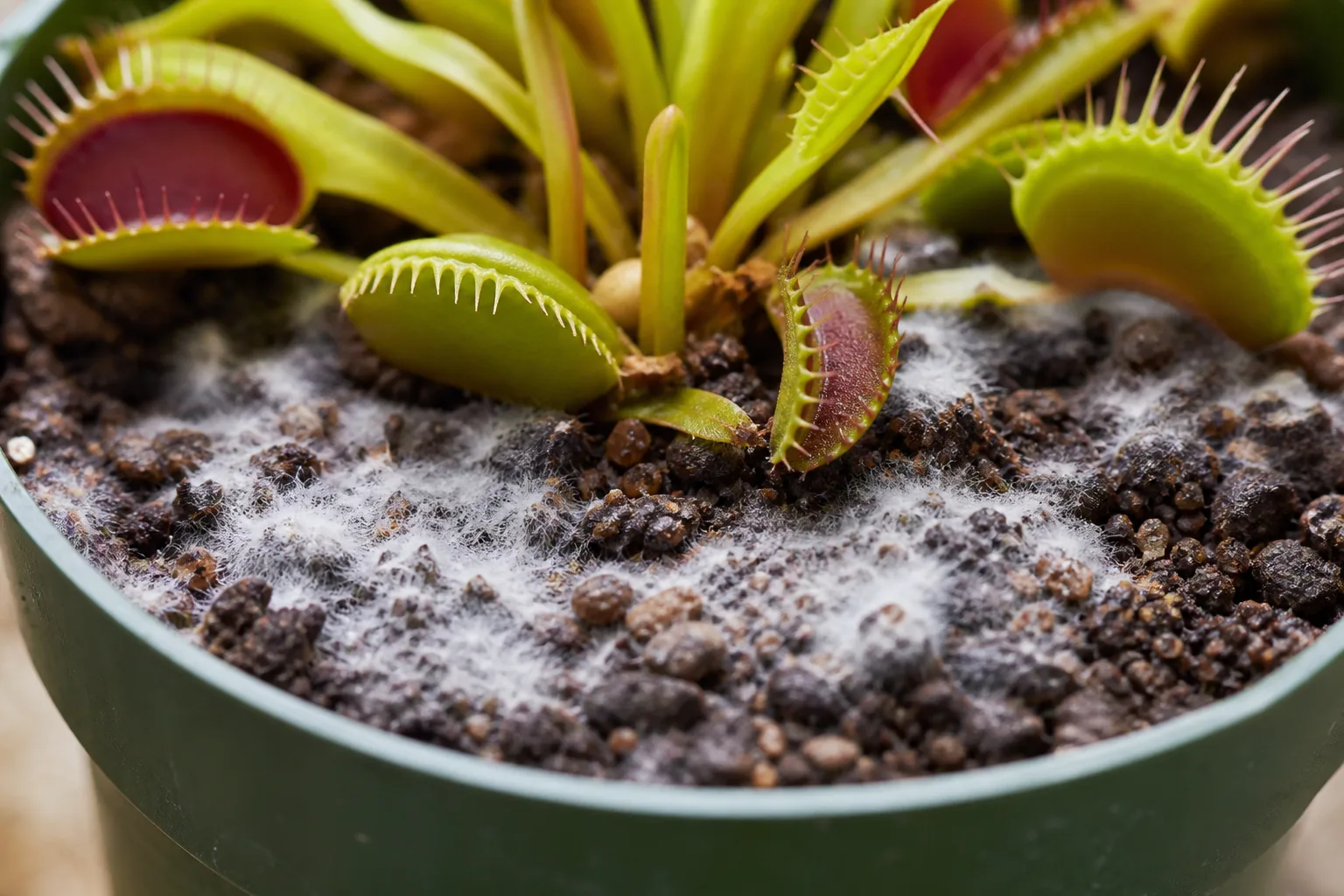
Mold on soil around a Venus flytrap is usually white or gray saprophytic fuzz on live sphagnum-it feeds on dead organic matter and is often harmless when the rhizome crown stays firm and white. Chronic wet moss with thick mold mats signals over-deep tray water or poor airflow. First step: improve airflow around the pot and reduce tray depth to about 1 cm; scrape off only thick harmful mold, not every speck.
Mold on Soil on Venus Flytrap: Causes, Checks & Fixes
This guide covers mold on soil on Venus Flytrap. See also the general Mold on Soil guide, watering, and light pages for this plant.
Mold on Soil on Venus Flytrap: Causes, Checks & Fixes
Quick answer
Mold on soil around Venus flytrap (Dionaea muscipula) is almost always white or gray fuzzy growth on the sphagnum surface-sometimes mixed with green algae when peat stays wet too long. On carnivorous culture, that fuzz is typically a saprophytic fungus feeding on dead organic matter in peat or old trap tissue, not a leaf disease on open traps.
First step: improve airflow around the pot and reduce tray water to about 1 cm while confirming the rhizome crown stays firm and white at soil level. Position a small fan nearby, crack a terrarium lid, or move the pot off a crowded shelf so the moss surface can cycle between damp and slightly drier-not permanently soggy.
Do not panic-scrape every speck. Barry Rice’s carnivorous-plant FAQ distinguishes harmless saprophytic mold on a healthy plant from mold feasting on tissue that is already dying from bad culture. If the rhizome is firm, new traps are emerging, and fuzz sits on peat alone, culture correction beats fungicide.
This page is surface-mold triage on sphagnum-peat tray culture-not fungus gnat lifecycle control, not crown rot salvage. For tray method, TDS limits, and crown-above-saturated-zone setup, see Venus flytrap watering. Species hub: Venus flytrap overview.
What mold on soil looks like on Venus flytrap
Surface mold on Dionaea shows up on peat and live sphagnum, not as powdery patches on trap blades. Check the soil line, pot rim, and rhizome crown together.
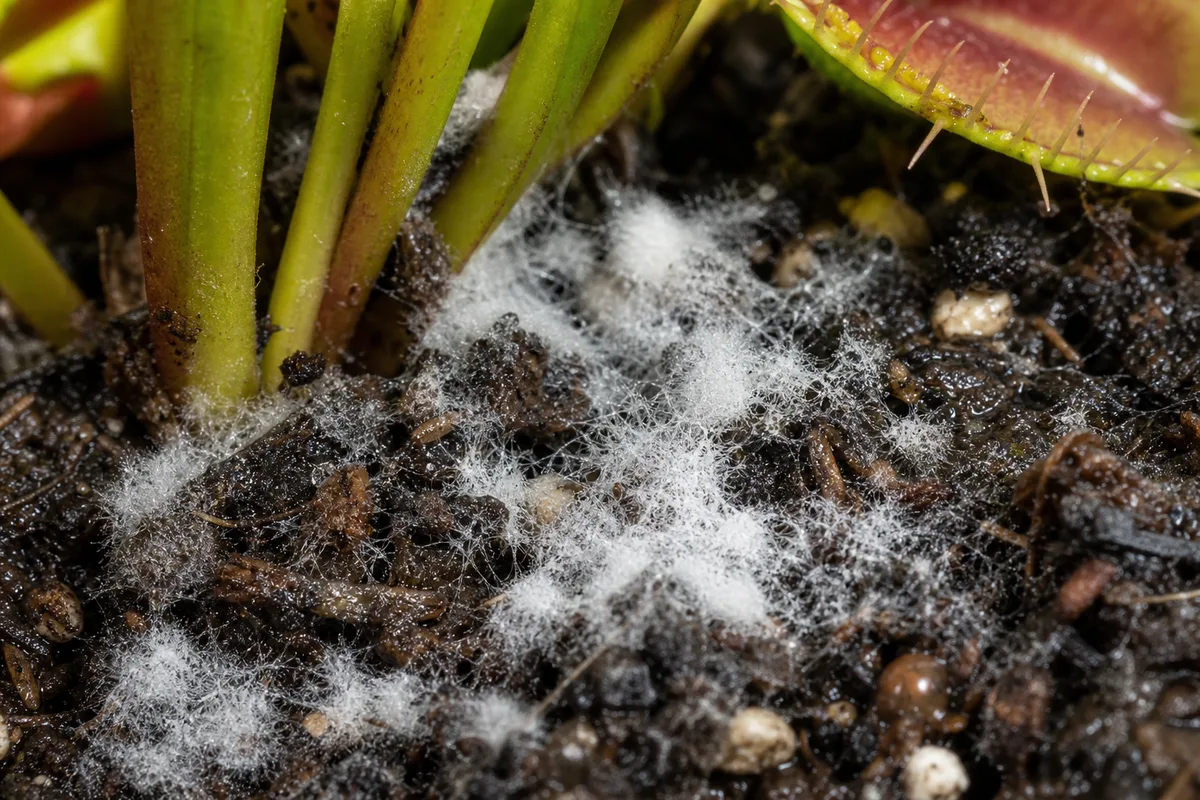
Mold on Soil symptoms on Venus Flytrap - compare with healthy tissue on the same plant.
Harmless cosmetic patterns (firm rhizome)
- Thin white or gray fuzzy threads on top of live or dried sphagnum, like cotton sprinkled on moss
- Fuzz clustered on old blackening trap bases or decaying peat fibers-not climbing healthy green traps
- Small isolated patches on one side of the pot while new traps emerge normally from the center
- Neutral earthy smell; rhizome feels firm and white when you brush peat away gently
Warning patterns (culture stress or rot pathway)
- Thick gray or white mat covering most of the surface while peat stays dark and slick for days
- Green algae or cyanobacteria film under or beside mold on constantly wet moss
- Sour or rotten smell from peat-not the neutral scent of fresh sphagnum
- Multiple petiole bases limp, black, or mushy at once while mold spreads on wet tissue
- Rhizome crown softening when pressed-healthy tissue feels like a small firm potato
- Hydrophobic crust where a dense fungal mat blocks water from soaking in (UF/IFAS notes dense mycelial mats can interfere with water absorption)
What mold is not on Venus flytrap
- Tiny dark flies rising when you water → fungus gnats, not mold alone
- White cottony tufts in rhizome crown folds → mealybugs
- White powder on trap surfaces in dry air → possible powdery mildew, uncommon on Dionaea
- Hard white crust on pot rim without fluff → mineral buildup from tap water; see watering guide-Clemson Extension distinguishes salt crust from saprophytic soil fungi
Why Venus flytrap gets mold on soil
Venus flytraps grow in nutrient-poor acidic peat that is intentionally full of organic matter. Fungal spores are present in peat-rich media and air; when the surface stays moist with poor airflow, saprophytic fungi colonize decaying sphagnum, old traps, and peat fibers. That is normal decomposition-not automatically a plant-killing pathogen.
Over-deep tray water and saturated surface moss
The ICPS growing guide recommends keeping standing water more than 5 cm (2 inches) below the soil surface inside the pot so the crown gets air exchange while roots wick moisture up. A tray filled too high-or never allowed to drop before refill-keeps surface sphagnum permanently wet. UMD Extension notes excessive algal or fungal mats form when growing media surfaces stay moist, and those mats can attract fungus gnats that feed on fungi and decay.
Even with distilled or rain water only, pure water does not prevent mold if the moss surface never dries slightly between tray cycles.
Low light and poor airflow
Flytraps need full sun-at least six hours of direct light daily during active growth. Dim windowsills, sealed terrariums, and humidity domes slow transpiration so the same 1–2 cm tray that works outdoors leaves indoor moss waterlogged for days. Stagnant air lets surface moisture linger-exactly what extension guidance links to fungal growth on potting media.
Dead trap tissue and aging peat
Dionaea naturally sheds outer traps; mold on those dead bases is saprophytic cleanup, not invasion of living traps. Peat also decomposes over one to two years in closed pots, collapsing from airy to dense sludge that holds water at the crown. Old, compacted media encourages chronic surface mold until you repot into fresh peat-perlite.
Terrariums and humidity domes
Enclosed growing raises humidity but cuts airflow. Mold on sphagnum under a dome is a common first sign the enclosure is too wet and still-poke vent holes, remove the lid part-time, or graduate the plant to open-air culture under strong light.
Lookalike symptoms to rule out
| What you see | Rhizome feel | Smell | Likely cause |
|---|---|---|---|
| Thin white fuzz on peat only; firm crown; new traps emerging | Firm, white | Neutral earthy | Surface mold-this page |
| Tiny dark flies; larvae in top moss | Firm or softening | Musty wet peat | Fungus gnats |
| Green slick film on constantly wet sphagnum | Often firm early | Neutral to musty | Algae/cyanobacteria on wet surface-scrape + correct moisture |
| Soft black crown; traps collapse fast | Mushy, dark | Rotten | Root rot-salvage protocol |
| Tray always full; sour peat; slow traps | Softening | Sour | Overwatering-tray reset first |
| White crust on pot rim; no fluff | Firm | Neutral | Tap-water mineral crust-not mold |
| White cottony tufts in crown folds | Firm | Neutral | Mealybugs |
If the rhizome is already mushy, black, and foul-smelling, skip surface scraping and open the root-rot guide.
How to confirm the cause
Work through these checks in order before repotting, peroxide, or fungicide:
- Rhizome firmness - Brush peat gently from the crown. Firm white tissue with only surface fuzz points to cosmetic or culture-fixable mold. Soft, dark, or collapsing tissue means escalate to root rot or overwatering protocols.
- Mold thickness and spread - Isolated thin fuzz on old trap bases or one moss patch fits harmless saprophyte. A thick mat over most of the pot on slick wet peat signals chronic saturation.
- Tray depth and refill habit - Pour out standing water and measure. Is the tray deeper than 1–2 cm during active growth, or refilled before it ever dries? Compare to tray rules.
- Light level - Does the plant get direct sun most of the day, or only bright indirect light behind glass? Low light prolongs surface wetness.
- Air movement - Is the pot in a sealed terrarium, crowded shelf, or under a humidity dome? Stagnant air favors fungal layers on growing media.
- Flying insects - Disturb the pot. If dark flies rise, add fungus gnat checks-mold and gnats often share wet-surface habitat but need different follow-up.
- Smell and peat age - Neutral earthy scent and media less than two years old favor culture tweaks. Sour smell or sludgy compacted peat may need repotting after tray correction.
Confirmed cosmetic mold: firm rhizome, new traps emerging, thin fuzz on peat or dead tissue only, no sour rot smell. Confirmed harmful pathway: softening crown, limb bases collapsing, thick mold on permanently wet moss with declining center growth.
First fix for Venus flytrap
Improve airflow around the pot and reduce tray water to about 1 cm-then wait 48 hours before scraping anything.
That single cultural shift lets the sphagnum surface cycle slightly drier while the rhizome zone below stays moist through wicking. Point a small fan past the pot (not directly blasting traps), open terrarium vents, or space pots on the tray so air moves between them.
Pour off excess standing water until only about 1 cm remains in the saucer during active growth. ICPS recommends the water level stay well below the soil surface inside the pot; shallow tray water achieves that when combined with adequate light.
Do not drench the crown with peroxide or fungicide on day one. There is no point trying to kill the fungus when dead tissue or cultivation error is the driver-new spores germinate on wet peat anyway. Do not repot on day one unless the rhizome is already soft or peat smells sour.
Step-by-step recovery
After airflow and tray correction, branch by severity:
Thin cosmetic fuzz (firm rhizome, healthy new traps)
- Wait one to two weeks after tray and airflow correction-many thin patches stop spreading without scraping.
- Scrape only thick mats - Use a fork, tweezers, or spoon to lift dense fuzzy layers or algae crust; leave thin harmless fuzz if the plant looks vigorous.
- Remove dead trap bases sitting in mold if they pull away easily-living tissue only.
- Increase direct light - Move to a sunnier windowsill or supplemental LED if traps are pale and elongated; more light speeds surface drying without desiccating the crown.
- Refill tray when low, not when full - Let standing water drop before adding distilled or rain water back to 1–2 cm.
Recurring mold on wet moss (firm rhizome, chronic surface growth)
- Scrape top 5–10 mm of wet moss and any green algae film; discard the removed layer.
- Top-dress with coarse horticultural sand (optional 3–5 mm barrier) if algae and mold return quickly-same principle as fungus gnat sand barriers but for surface ecology, not larvae alone.
- Audit perlite ratio - Pure sphagnum in short pots stays wetter at the surface; ICPS notes pure moss in short pots can be too soggy. A standard 1:1 peat:sand mix may dry the surface faster.
- Repot into fresh unfertilized peat-perlite or peat-sand only if moss keeps re-fuzzing on degraded, compacted media after two correction cycles.
Mold with crown softening or sour smell
- Stop tray watering immediately - Pour out all standing water.
- Open overwatering triage - If rhizome is partly firm, 24–48 hour dry tray then shallow refill.
- If crown is mushy and black, switch to root-rot salvage-trim, unpot, fresh media; surface scraping will not save decaying rhizome tissue.
Recovery timeline
Mild cosmetic mold often stabilizes within one to two weeks once tray depth, light, and airflow improve-you may see no new spread before old fuzz dries to invisibility. Thick mats on chronically wet moss may need a surface scrape plus two to four weeks of corrected culture before regrowth stops.
Judge recovery by firm white rhizome, new traps emerging without blackening at the base, and less slick moss at the surface-not by expecting old cosmetic fuzz to vanish overnight. Old blackened traps do not green up again; they are replaced by new growth.
If mold thickens while multiple petiole bases collapse over one to two weeks despite tray correction, assume culture failure or rot-not harmless saprophyte-and escalate.
Mistakes to avoid
Do not scrape every white speck on a healthy flytrap-cosmetic saprophytic mold on dead tissue is normal and killing it does not help the plant. Do not pour hydrogen peroxide, cinnamon, or neem oil over the rhizome hoping to sterilize peat-carnivorous crowns burn easily and live sphagnum dies on contact.
Do not let the entire pot dry out to fight mold-Dionaea needs moist peat at the rhizome; you are correcting surface wetness and tray depth, not desertifying the crown. Do not use tap water in any rinse-minerals compound stress on an already wet culture.
Do not confuse mold triage with fungus gnat treatment-sticky traps and BTI target flies and larvae, not fuzzy mats. Do not fertilize a moldy flytrap; never fertilize Venus flytraps.
Do not keep a deep flooded tray in a cool dormancy room-pure water prevents mineral burn but not anaerobic rot; see watering seasonal rules.
How to prevent mold on soil next time
Match culture to carnivorous biology so the moss surface cycles rather than staying slick:
- Tray depth 1–2 cm during active growth; pour off excess; let the tray drop before refill
- Full direct sun indoors or out-six or more hours daily when possible
- Airflow between pots; avoid permanent humidity domes without vents
- Distilled, rain, or RO water only-never tap
- Scout weekly at the soil line during routine care; scrape thick mats early
- Repot every one to two years before peat collapses into waterlogged sludge
UMD Extension recommends allowing the growing media surface to dry between waterings and maintaining good air circulation-on Venus flytraps, “dry between waterings” means shallower tray cycles and brighter light, not letting the rhizome desiccate.
When to worry
Treat as urgent when petiole bases go limp and black on multiple traps at once, rhizome crown softens, peat smells sour or rotten, or mold thickens while center growth stalls for more than a week during active season. Those signs point to overwatering or root rot, not cosmetic fuzz alone.
A single thin fuzz patch on old trap tissue with firm rhizome and clean new traps is manageable with airflow and tray correction-act within days if wet moss spreads, but do not panic-repot.
Conclusion
Mold on Venus flytrap soil is usually saprophytic fuzz on wet sphagnum-often harmless when the rhizome stays firm and new traps keep emerging. The useful question is not “how do I kill mold?” but whether your tray depth, light, and airflow keep the moss surface cycling or locked in chronic wetness that precedes rot.
Improve airflow, reduce tray water to about 1 cm, add direct light, and scrape only thick harmful mats-not every speck. Escalate to overwatering, root rot, or repotting when the crown softens or peat turns sour. Pair with fungus gnat guidance if flies share the wet surface.
Related Venus flytrap guides: overview · watering · light · soil · repotting · overwatering · root rot · fungus gnats · mealybugs
When to use this page vs other Venus Flytrap guides
- Venus Flytrap watering guide - Use for routine moisture checks before assuming mold on soil is the main issue.
- Venus Flytrap problems hub - Browse all 18 common issues on this species.
- Fungus Gnats on Venus Flytrap - Different entry point when symptoms overlap with mold on soil.
- Overwatering on Venus Flytrap - Different entry point when symptoms overlap with mold on soil.
- Root Rot on Venus Flytrap - Different entry point when symptoms overlap with mold on soil.