How to Prune a Venus Flytrap Without Killing It
How to Prune a Venus Flytrap Without Killing It
How to Prune a Venus Flytrap Without Killing It
Venus flytrap pruning is selective cleanup - not the shaping cuts you would make on a pothos or basil plant. Dionaea muscipula grows as a tight rosette from an underground rhizome, with each leaf ending in a hinged insect trap. Old outer leaves age out and blacken while new ones emerge from the center. Your job is to remove finished tissue, redirect energy away from flowers, and clear debris that blocks light - not to shear the plant for fullness or symmetry.
First action: scan the rosette for leaves that are completely black and dry. If none qualify, put the scissors down. Partially green leaves - even ugly ones with blackened traps - are still feeding the rhizome through photosynthesis. Only dead, brittle tissue gets removed today.
What Pruning Means for a Rosette Carnivore
On most houseplants, pruning redirects hormones and encourages branching from nodes above a cut. Venus flytraps do not branch from cut points. New growth comes only from the crown, and each leaf lives its own lifecycle before dying at the outer edge of the rosette. Trimming here is hygiene and energy management, not horticultural sculpture.
Barry Rice notes in the Carnivorous Plant FAQ that dead leaves can remain on a healthy plant without causing harm - they decompose naturally. Growers remove them anyway because a tidy rosette looks better, accumulated debris can shade inner leaves, and mold on dead tissue becomes a risk when the plant is already stressed. The boundary is simple: black and fully dead only.
Why Houseplant Pruning Rules Do Not Apply
Native to nutrient-poor bogs in North and South Carolina, Venus flytraps catch insects to supplement what their roots cannot absorb from acidic, mineral-free soil. There are no woody stems, no lateral buds that sprout after pinching, and no meaningful response to being “shaped.” Cutting into the living crown or rhizome can kill the plant outright.
Rules like “remove one-third of foliage” or “pinch tips for bushier growth” come from herbaceous and vining houseplants. Applying them here removes photosynthetic surface the plant already runs on tight energy margins - Venus Flytrap light guide demand, pure water, and mandatory winter dormancy. Minimal trimming matches the species’ biology.
What to Check Before You Cut Anything
Before touching any tissue, work through three inspections at the pot in good light.
Leaf color and texture across the whole blade. A trap may blacken first while the flat petiole (leaf stem) stays green for days or weeks. That green petiole is still working. Fully dead leaves are uniformly black or dark brown, papery or crunchy, and often curl downward. If any green, firm tissue remains, the leaf stays.
Trap closure history. Each trap closes roughly half a dozen times before the entire leaf dies - whether or not it ever caught prey. Blackening after several closures is normal end-of-life behavior, not proof the plant is dying. A new leaf should already be emerging from the center.
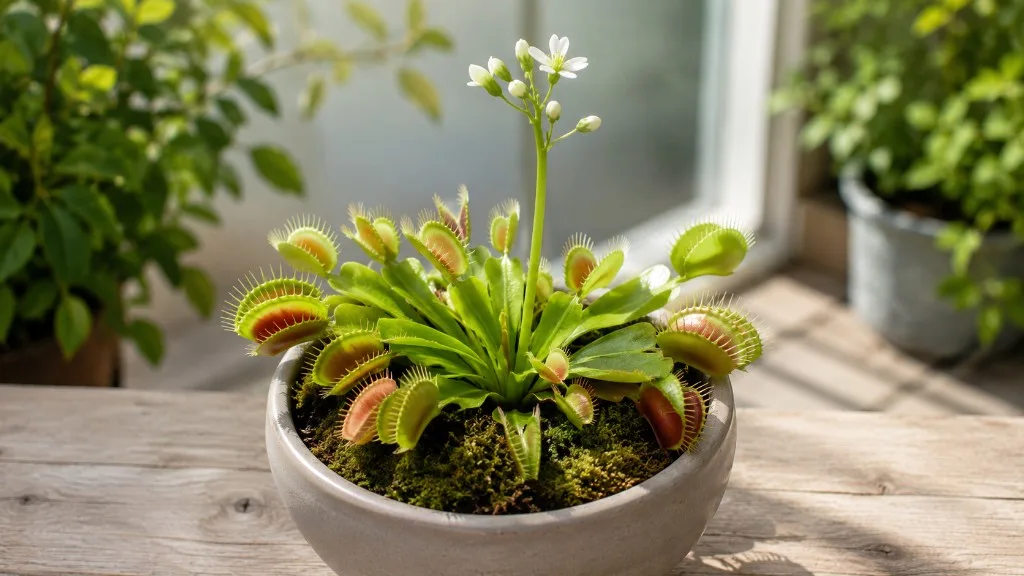
Center of the rosette for a flower stalk. In early spring, mature plants send up a smooth, round, vertical stem without traps - distinct from flat trap-bearing leaves. Catching this structure early is the second most important trim after dead-leaf removal.
Fully Dead vs Still-Green Leaves
The decision test covers the entire leaf, not just the trap mouth. A trap that closed permanently after its last meal may look unsightly while the attached petiole remains green - leave it. Growers sometimes confuse dormancy color change (dull or reddish winter flushing) with death; dormant leaves are not necessarily black and dead.
Mushy black tissue during active growth is different from dry senescence. Soft, rotting leaves signal culture problems - overfeeding, poor drainage, or tap water minerals - not a trimming schedule issue. Remove mushy leaves for hygiene, then review watering, feeding, and light.
Flower Stalk vs New Leaf
Compare side by side: a new leaf primordium opens into a flat blade with a trap tip; a flower stalk stays cylindrical and grows faster on a slender stem. Early stalks look like a tiny green bead at the center. Once elongated, the stalk develops bud nodes at the top. The New York Botanical Garden carnivorous plant guide recommends removing flower stalks before they bloom to preserve plant vigor in container cultivation.
When to Trim a Venus Flytrap
Timing depends on what you are removing.
Black Traps Any Time of Year
Remove fully blackened, dry leaves whenever they appear. There is no narrow seasonal window for dead-trap cleanup the way there is for flower stalks. During active spring and summer growth, new leaves often appear as old ones die - that one-to-one rhythm signals health.
Wait until tissue feels dry and brittle before tugging. A black trap that is still soft may be rotting rather than senescing.
Flower Stalks in Early Spring
Mature plants produce white flowers on a tall stalk as they exit dormancy, typically in early spring. Flowering consumes enormous energy that otherwise goes into trap and leaf production. For most container growers, cut the stalk early - when it is an inch or taller but before buds open. Unless you are deliberately breeding for seed, early removal is the default best practice.
Off-season summer flowering can indicate stress from insufficient light or skipped dormancy. Cut the stalk and correct culture rather than treating it as normal.
Dormancy Dieback and Spring Cleanup
Venus flytraps require annual winter dormancy - roughly November through February in temperate climates - when growth stops and many leaves blacken sequentially. This dieback is normal, not a signal to strip the plant bare.
During dormancy, trim fully black leaves as they appear if you wish, but expect a sparse rosette by late winter. The most important grooming task is spring cleanup after dieback ends - removing accumulated dead material so UV reaches the crown as the plant prepares for vigorous growth.
The First Cut to Make
If a leaf is completely black and dry, grasp it near the base where it meets the rosette and pull gently downward and away from the crown. Fully dead leaves usually release cleanly because connective tissue has already dried. That single pull - on one qualifying leaf - is your starting point.
If no leaf passes the black-and-dry test, your first action shifts to inspection only: look for an emerging flower stalk at the center. If you spot one in spring, that becomes the first cut instead - but never both tasks rushed together on a stressed plant.
How to Remove Black Traps Step by Step
Work when the plant is dry, in good light, with one rule: downward and outward on dead tissue only.
- Identify a leaf that is uniformly black and brittle from base to trap.
- Grasp the dead petiole near the crown - not living traps nearby.
- Pull gently downward and away from the center. Stop if you feel resistance from green tissue.
- Move to the next dead leaf. Work in small sessions rather than stripping the rosette in one pass.
- Sweep fallen debris off the moss surface so it does not hold moisture against the crown.
Move slowly. Venus flytrap traps close when trigger hairs are stimulated, and closing an empty trap wastes substantial energy. Keep fingers on dead petioles only and avoid brushing trigger hairs with tools or knuckles.
Finger Pull vs Scissors
For fully dead, dry leaves, fingers alone are usually best - dead material separates at the natural abscission point without a blade. Scissors become necessary for stubborn dead bases or flower stalk removal, which always requires a cut.
If you use scissors, choose small sharp blades and cut only dead tissue. Sterilize with 70% isopropyl alcohol before and after, especially if you grow multiple carnivorous plants. Fine tweezers help extract broken black fragments wedged between living traps.
Do not apply wound sealants or fungicide where a dead leaf detached. Open air and normal growing conditions handle those sites on a healthy plant.
How to Cut Flower Stalks Before They Bloom
Catch the stalk as early as possible - a small round bud at the center before it reaches several inches.
Use sharp scissors or fine snips. Cut the stalk as close to the base as practical without damaging surrounding green leaves or the crown. One decisive horizontal cut beats several chewed attempts that crush tissue. The remaining stub may brown and dry - that is fine.
After removal, maintain steady full sun (minimum four hours direct daily for strong indoor specimens), keep the peat-perlite or sphagnum mix moist via tray watering with pure water, and avoid hand-feeding for a couple of weeks while the plant reallocates energy. Trap-focused growth should resume within a few weeks on a healthy specimen.
Where to Cut on the Stalk
Cut at the base where the stalk emerges from the crown - surface level, not digging into the rhizome. The stalk is a smooth cylinder without traps; normal leaves have flat petioles with trap tips. If buds have already opened, cutting still helps but the plant has already spent partial reproductive cost - earlier is always better.
How Much You Can Safely Remove
There is no “one-third rule” for Venus flytraps. You can remove every leaf that qualifies as fully black and dry - that is typically a few outer leaves at a time, not bulk green tissue. During dormancy, repeated removal of black outer leaves is expected as dieback progresses.
What you cannot do is remove multiple green leaves hoping to force new trap production. Green leaves are the engine; traps are supplements. A healthy adult maintains roughly five to ten functional traps while older ones cycle out. If the rosette looks sparse after trimming, you likely removed green tissue or trimmed during a stress period.
Pruning cannot compensate for tap water mineral burn, dim windows, skipped dormancy, or root rot on Venus Flytrap. Fix culture first; trim only what dies afterward.
What Never to Cut
Some tissues are permanently off limits:
- Green leaves or traps - if green remains, the leaf still photosynthesizes
- The rhizome or roots - root trimming belongs only in emergency Venus Flytrap repotting guide when removing clearly rotten tissue
- Emerging crown leaves that have not yet opened traps - those are the plant’s future
- The rosette for symmetry - shearing for shape has no benefit and removes working tissue
Do not prune as a response to yellowing from tap water or sun bleaching without fixing the cause first. Symptomatic green tissue may partially recover when conditions improve.
Aftercare and Recovery After Trimming
Routine black-leaf removal needs no special aftercare beyond normal culture: full direct sun, distilled or rainwater via the tray method during active growth, and nutrient-free acidic mix. After flower stalk removal or major spring cleanup, hold steady on light and water rather than compensating with extra feeding.
Hold off on hand-feeding traps for one to two weeks after significant trimming so the plant settles. Resume feeding only healthy traps with appropriately sized prey if indoor catch is insufficient - never feed dormant plants or newly repotted rhizomes.
Recovery signs include new trap leaves emerging from the center within two to four weeks after spring cleanup or stalk removal. For each dead leaf removed during active growth, a replacement should eventually appear. Persistent imbalance - black leaves increasing with no center growth - points to rot, water quality, or light failure, not insufficient trimming.
Common Pruning Mistakes
Removing partially black leaves too early strips photosynthetic petioles the plant still intended to use. The plant grows smaller and slower over the following month.
Triggering empty traps during grooming burns closure counts and accelerates blackening without feeding benefit.
Cutting flower stalks too late - after buds open - wastes the preventive benefit of early removal. Small or recently repotted plants that flower often look stunted all season.
Treating dormancy dieback as plant death leads people to discard living rhizomes or “revive” dormant crowns with fertilizer and heat in winter.
Trimming green leaves for bushiness - Venus flytraps do not respond like stemmy houseplants. Cutting green tissue weakens the rhizome without producing fuller growth.
Using dirty tools near the crown invites infection on any accidental contact with living tissue. Dead-leaf finger pulls rarely need tools; flower stalk cuts do - keep blades clean.
Conclusion
Venus flytrap pruning is selective maintenance: remove fully blackened dry leaves, cut flower stalks in early spring before bloom, and clear dormancy debris when the growing season returns. Leave all green tissue alone, never touch the rhizome in routine grooming, and avoid triggering empty traps while you work. Heavy shaping does not apply to Venus Flytrap overview - patience with natural leaf turnover and early flower stalk removal do far more for trap count than shears ever will.
Three rules cover most situations: black and dry before removal, flower stalks off early, green stays. Sun, pure water, acidic mix, and winter rest determine how often you need the first rule at all.
When to use this page vs other Venus Flytrap guides
- Venus Flytrap overview - Start here for whole-plant context before deep-diving this topic.
- Venus Flytrap problems hub - Jump to symptom-specific fix guides when this care topic does not resolve the issue.
- Leggy Growth on Venus Flytrap - Escalate here when pruning adjustments are not enough.
- Slow Growth on Venus Flytrap - Escalate here when pruning adjustments are not enough.
- Brown Tips on Venus Flytrap - Escalate here when pruning adjustments are not enough.