Birds Nest Fern (Asplenium nidus) Care Guide: Complete
Asplenium nidus
Grow bird's nest fern indoors with bright indirect light, consistent moisture, and 60%+ humidity. Easy to care for with no direct sun.
Birds Nest Fern (Asplenium nidus) Care Guide: Complete Indoor Overview
Start with wateringThe most common care mistake for Bird's Nest FernWatering guide → →Bird's Nest Fern care essentials
Light
medium indirect light
Water
Every 5–7 days summer (top 2–3 cm dry). Water into soil, never the central rosette. Every 7–10 days winter.
Soil
Well-draining potting mix with 20% orchid bark or coco coir for aeration. pH 5.5–7.0.
Humidity
50–70%
Temperature
18–27°C (65–80°F)
Fertilizer
Use half-strength balanced fertilizer; apply to soil edge not crown and stop if the plant is stressed, newly repotted, or not actively growing. Concentrated fertilizer near the crown; fertilizing in winter.
About Bird's Nest Fern
Bird's Nest Fern is native to Tropical Asia, Australia, East Africa, typically reaches 30–90 cm tall and wide indoors, with slow to moderate growth. Bird's Nest Fern has a rosette growth habit and part of the Aspleniaceae family. It is also known as Nest Fern and Crow's Nest Fern.
| Detail | Information |
|---|---|
| Also known as | Nest Fern, Crow's Nest Fern |
| Native region | Tropical Asia, Australia, East Africa |
| Mature size | 30–90 cm tall and wide |
| Growth rate | Slow to moderate |
| Growth habit | Rosette |
| Scientific name | Asplenium nidus |
| Family | Aspleniaceae |
Birds Nest Fern (Asplenium nidus) Care Guide: Complete Indoor Overview
A bird’s nest fern is one of those houseplants that looks effortless until it isn’t. Asplenium nidus arrives in the shop with glossy, wavy fronds arranged in a sculptural rosette, and for a while it sits there looking like living decor. Then the edges crisp, a new frond stalls halfway open, or the center crown turns mushy and the whole plant collapses within weeks. Most of those failures are not mysterious. They come from treating an epiphytic tropical fern like a generic leafy houseplant - watering into the crown, parking it in a dry living room all winter, or assuming that “low light tolerant” means it will thrive in a dim hallway with no humidity support.
This guide is a complete indoor overview of birds nest fern care: what the plant actually is, where it comes from, how to set up light and humidity, how to water without triggering crown rot, what soil and pots work best, when to feed and repot, how propagation really works at home, and how to read the frond signals when something goes wrong. If you understand the plant’s structure first, the daily care stops feeling like guesswork.
For related Bird’s Nest Fern care, see Spider Mites on Bird’s Nest Fern, Mealybugs on Bird’s Nest Fern, Aphids on Bird’s Nest Fern.
What Is a Bird’s Nest Fern?
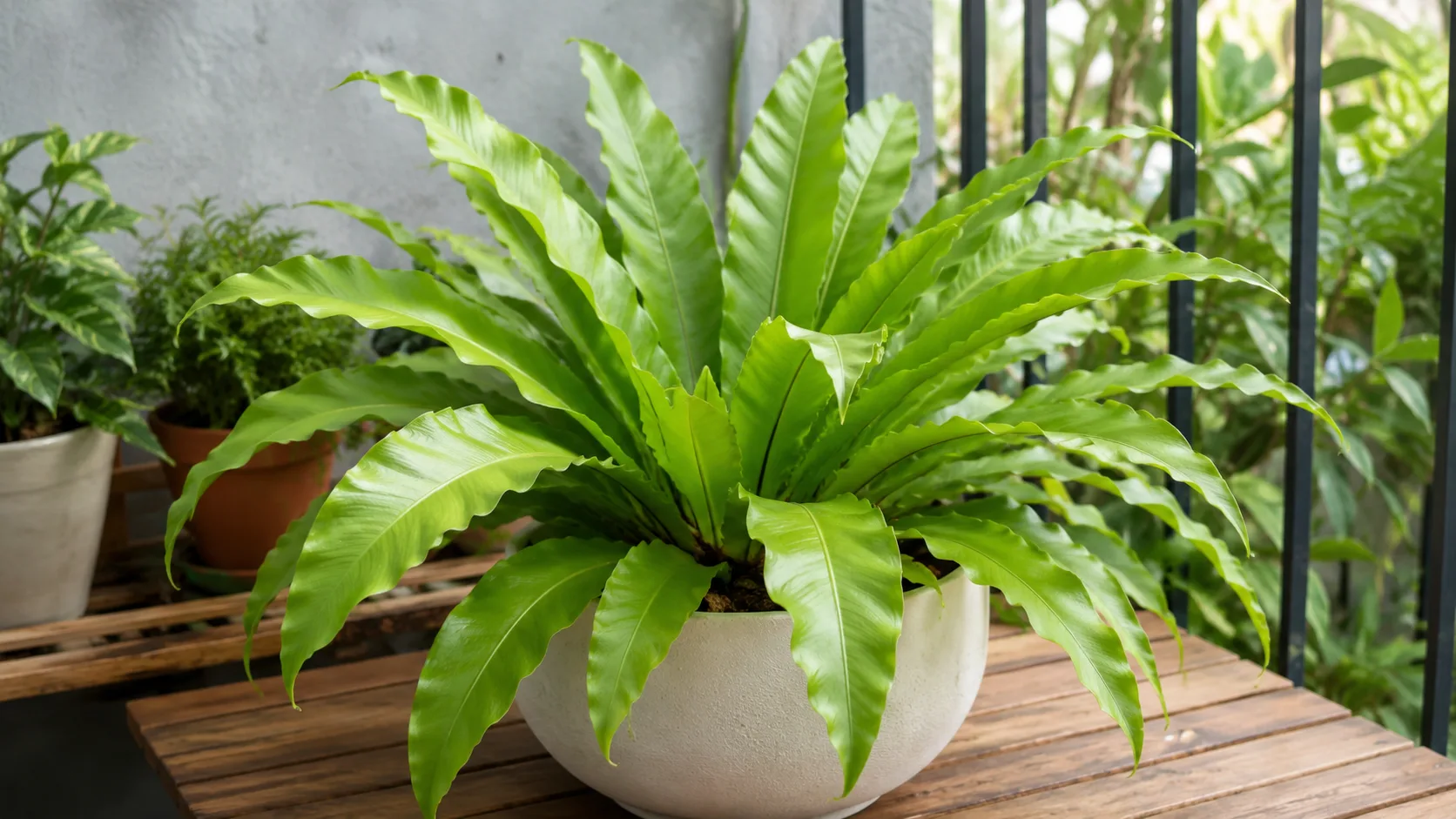
The bird’s nest fern is a tropical fern in the genus Asplenium, species nidus, belonging to the Spleenwort family (Aspleniaceae). It is grown almost exclusively as a foliage houseplant because its appeal is architectural, not floral. Mature plants form a central rosette - the “nest” - from which new fronds unfurl in a tight spiral. Those emerging fronds are often described as resembling bird eggs tucked into a nest, which is where the common name comes from. The fronds themselves are strap-shaped, undivided, and typically bright to deep green with wavy or ruffled margins depending on the cultivar.
Unlike many ferns sold as houseplants, Asplenium nidus does not produce the finely divided, feathery fronds people associate with Boston ferns. Its leaves are whole, leathery, and relatively thick, which changes how it handles light, drought, and handling. Indoors, most specimens reach roughly 30–90 cm tall and wide over time, with individual fronds commonly landing in the 45–60 cm range under typical room conditions. Growth is slow to moderate, which is an advantage if you dislike plants that outgrow their spot every season, but it also means recovery from stress takes patience.
Commerce can be confusing here. Labels may say bird’s nest fern, nest fern, Asplenium antiquum, Osaka fern, Crispy Wave, Victoria, or Leslie. Some of these are distinct species or cultivated varieties; others are marketing names for selections of A. nidus or close relatives. For practical care, they share the same core needs - Bird’s Nest Fern light guide, steady warmth, high humidity, even moisture, and careful crown protection. If your plant came with a botanical tag, keep it. If not, watch how the plant responds to your home and adjust from there.
Botanical Background and Native Range
In the wild, Asplenium nidus is an epiphyte: it grows on tree trunks, branches, and rock surfaces in humid tropical forests rather than rooting in dense ground soil. Clemson University’s Home & Garden Information Center notes that epiphytes absorb water and nutrients from rain, debris, and the surrounding air, and they are not parasitic to their host. (Clemson HGIC) That growth habit explains nearly everything about indoor care. The roots expect loose, airy, organic-rich material that drains fast. The crown expects to stay open to air. The fronds expect filtered light under a forest canopy, not direct afternoon sun on a windowsill.
The native range spans tropical Asia, Australia, the Pacific Islands, and Hawaii, with related populations across parts of East Africa and Southeast Asian archipelagos. Missouri Botanical Garden and NC State Extension both describe it as a tropical species suited to warm, humid environments. (Missouri Botanical Garden) Outdoors, it is hardy only in USDA zones 11–12, which is why most readers outside those zones should think of it strictly as an indoor plant or a summer shade-patio guest brought in before nights drop below about 10°C (50°F) (Clemson HGIC).
Because it evolved in stable tropical warmth, Asplenium nidus has little tolerance for cold drafts, sudden temperature crashes, or the dry air produced by heating systems. It is not a delicate novelty plant, but it is a climate-specific one. Your job indoors is to approximate a shaded tree trunk in a warm rainforest - not perfectly, but consistently enough that the plant is not swinging between extremes.
Why the Crown Shape Changes How You Care for It
The rosette is not just a visual feature. It is the plant’s growth engine and its most vulnerable point. All new fronds emerge from the central crown, where young tissue is soft, densely packed, and slow to dry if water pools there. Experienced growers and extension sources repeatedly warn against pouring water directly into the center of the plant. Clemson HGIC specifically recommends watering along the outer edge of the pot so water does not enter the crown. (Clemson HGIC) Crown rot - a bacterial or fungal breakdown of that central growing point - is the most common catastrophic mistake with this fern, and it is often fatal because it destroys the only meristem that can produce new fronds.
The crown also collects dust, fallen pet hair, and debris in homes. That is not cosmetic. Organic material held against damp young growth invites rot and pests. Gentle cleaning with a soft cloth is fine; just keep the crown dry afterward. When you handle the plant, lift it by the pot, not by the fronds. The fronds can tear at the base, and wounds near the crown heal slowly on a plant that already grows at a measured pace.
Understanding the crown changes your entire watering technique, your Bird’s Nest Fern repotting guide depth, and your propagation expectations. You are not maintaining a bushy clump of independent stems. You are maintaining a single architectural rosette with one primary growth point - or, in rare mature cases, a plant that has produced a natural offset you can separate without slicing through the main crown.
Best Indoor Growing Conditions for Birds Nest Fern
If you remember only four variables for birds nest fern care, make them light, humidity, temperature, and watering technique. Soil and fertilizer matter, but they rarely cause sudden collapse the way crown watering, dry winter air, or hot direct sun do. The plant is more forgiving of minor feeding lapses than of a week spent next to a heating vent in February.
Indoors, think of Asplenium nidus as a bathroom-and-bright-bedroom fern, not a sun-room centerpiece. It wants the kind of filtered brightness you would find on a shaded porch or under tree cover. It also wants the air to carry moisture you can feel, especially when indoor heating is running. When those conditions are stable, the plant rewards you with firm fronds, steady unfurling, and a compact rosette that looks intentionally placed rather than accidentally surviving.
Light Requirements and Window Placement
Bird’s nest fern prefers bright, indirect light for most of the day. In practical home terms, that usually means an east-facing window, a north-facing window, or a spot a few feet back from a west- or south-facing window where direct sun does not strike the fronds. Clemson HGIC recommends rooms with bright indirect light, especially east- or north-facing exposures. (Clemson HGIC) East windows are often ideal because morning sun is gentler and the plant receives steady ambient light afterward.
If you want a placement anchor, think medium to bright indirect light - the kind Clemson HGIC describes for east- or north-facing rooms. That is bright enough for firm new growth but below the threshold where fronds bleach, curl, or develop crisp brown patches. A plant that is too dark will not die overnight. Asplenium nidus can tolerate lower light better than many tropical foliage plants, which is why it appears on lists of ferns for dimmer rooms. But low light slows growth, reduces frond size, and changes watering dynamics because the pot stays wet longer. If new fronds are small, pale, or slow to open, light is probably the limiting factor.
Direct sun is the faster killer. Afternoon sun through glass can scorch fronds in hours, especially if the plant was grown in softer nursery light. If you must move it closer to a brighter window, do so gradually over one to two weeks and watch the newest frond first - it is the most honest sensor. Grow lights work well when natural light is weak. A full-spectrum LED at moderate intensity, running on a consistent photoperiod, can supplement a north room or a dark winter season. Keep fixtures far enough away that the fronds do not heat up.
Temperature and Humidity Targets
Warm, stable temperatures suit Asplenium nidus best. A practical indoor target is 16–27°C (60–80°F) during normal room conditions. The plant can tolerate brief dips, but sustained exposure below about 10–13°C (50–55°F) stresses tissues and can cause frond damage. Avoid placing the pot directly under air-conditioning vents, open winter windows, or radiators. Rapid temperature swings matter as much as absolute numbers because epiphytic roots and crown tissue react to instability with stalled growth and edge browning.
Humidity is the other non-negotiable variable. This fern evolved in forests where ambient moisture is constantly high. Aim for 60–80% relative humidity if you can; 50% is a realistic minimum for many homes if watering and light are otherwise solid. Below that, especially in heated winter air, frond margins brown in a wide, gradual pattern that people often blame on watering alone. A humidifier is the most reliable fix. Pebble trays and plant grouping help at the margins. Misting is temporary and can encourage foliar spotting if water sits on fronds in cool, stagnant air - use it as a supplement, not a strategy.
Bathrooms and kitchens often work well because humidity spikes regularly, provided there is enough light. A fern in a steamy but windowless bathroom will slowly decline unless you add a grow light. The best placements combine usable light plus moisture, not just one or the other.
Choosing the Right Soil and Pot
Because Asplenium nidus is epiphytic, its roots want access to air as much as to moisture. Dense, heavy potting soil that stays saturated for days will suffocate fine roots even if you water carefully. The goal is a mix that holds moisture in the root zone briefly, then releases excess water and retains air pockets. Think orchid culture logic applied to a fern rosette.
Soil Mix Recipe and pH
Clemson HGIC recommends rich, well-drained soil high in organic matter, such as a potting mix labeled for indoor or tropical plants. (Clemson HGIC) A reliable home recipe is 70% high-quality peat- or coco-based potting mix blended with 30% coarse amendments - orchid bark, perlite, and/or coco chips - to keep the structure open. Some growers push bark content toward 40% in humid homes where drying is slow.
Target a slightly acidic to neutral range around pH 5.5–7.0. Exact pH micromanagement is rarely necessary for hobbyists, but avoid alkaline, chalky mixes and untreated hard water patterns that push salts upward over time. Refresh the substrate every one to two years because organic components decompose, collapse, and hold water longer than they did when new.
When repotting or potting up, place the rhizome and crown at or just above the soil surface, not buried deeply. Epiphytic ferns rot when the central growing region is entombed in wet mix. The roots should be covered, but the nest itself should remain visibly open.
Pot Size, Drainage, and Mounting Options
Choose a pot only slightly larger than the root mass. One size up during repotting is enough. Oversized pots hold excess moisture that slow-growing roots cannot use, creating a classic path to root rot on Bird’s Nest Fern after repotting. Drainage holes are mandatory. If you use a decorative cachepot, lift the nursery pot out after watering and empty standing water.
Terracotta dries faster than plastic, which can help in dim, humid rooms but may demand more frequent checks in bright, dry ones. Either material works if you read the soil rather than the calendar. Advanced growers sometimes mount bird’s nest ferns on plaques or in hanging baskets using sphagnum and bark, mimicking epiphytic conditions. That is not required indoors, but it illustrates the principle: roots need air, crown needs dryness, and water should pass through rather than pool.
How to Water a Birds Nest Fern Without Crown Rot
Watering is where birds nest fern care is won or lost. The plant likes even moisture, not alternating floods and droughts, and it likes water delivered to the root zone at the pot edges, not to the central rosette. Clemson HGIC advises watering when the top inch of soil feels dry, watering carefully to avoid wetting leaves, and never letting the pot sit in a saucer of standing water. (Clemson HGIC)
That top-inch rule is a starting point, not a law. In practice, check the top 2–3 cm of mix with a finger or wooden skewer. If it is dry and the pot feels lighter, water thoroughly until excess drains from the bottom. If the deeper mix is still cool and damp, wait. The plant tolerates a modest dry window better than it tolerates a soggy core, though repeated drought will show up as pale, crinkled fronds.
When to Water and How to Check Moisture
Use three signals together: surface dryness, pot weight, and frond texture. Surface dryness tells you when to consider watering. Pot weight confirms whether the root ball is still waterlogged. Frond texture tells you whether the plant is chronically too wet or too dry. Healthy fronds feel firm and flexible, not floppy or leathery-dry.
Water slowly around the outer rim of the pot, circling until the whole root zone is moistened. Avoid showering the crown. If you bottom-water occasionally, do not leave the pot submerged for hours; epiphytic roots still need air in the upper profile. After watering, empty the saucer within 15–30 minutes.
Many care guides suggest intervals like every 7–10 days in summer and every 10–14 days in winter. Those ranges are useful only as reminders to check, not as automatic schedules. A bright, warm room may dry a small pot in four days; a cool north room may take two weeks. Let the plant and pot teach you the rhythm.
Seasonal Watering Adjustments
During active growth - typically late spring through summer - the fern uses water faster and can handle a steadier moisture profile. In autumn and winter, growth slows, light drops, and indoor heating dries the air while slowing soil evaporation in cooler rooms. That combination tricks people into overwatering on Bird’s Nest Fern. Stretch intervals in winter, verify moisture depth before each drink, and pause fertilizer when no new fronds are emerging.
If you run a humidifier all winter, the plant may stay more active and drink more than other houseplants in the same room. That is why seasonal rules are less reliable than pot checks. Change one variable at a time when troubleshooting. If you recently moved the plant, adjust watering only after you know how the new spot dries.
Fertilizing Birds Nest Fern During Active Growth
Asplenium nidus is not a heavy feeder. It needs modest nutrition during active growth and little to none when stalled. Clemson HGIC recommends fertilizing monthly during the growing season from late spring through summer, using a houseplant fertilizer at half the label rate. (Clemson HGIC) A balanced liquid formula such as 10-10-10 or 20-20-20 diluted to quarter- or half-strength works well.
Apply fertilizer to already-moist soil so salts distribute without burning fine roots. Skip feeding on stressed plants - recent repot, pest damage, crown injury, or obvious rot. Skip feeding in winter unless you are supplementing with grow lights and seeing steady new fronds. Over-fertilizing shows up as brown or scorched frond tips, sometimes mistaken for low humidity. If that happens, flush the pot with plain water on the next two watering cycles and reduce strength.
Organic slow-release fertilizers can work in small doses, but salt buildup is harder to diagnose. For most indoor growers, a light monthly liquid feed during the warm months is the simplest path.
Repotting, Pruning, and Routine Maintenance
Routine maintenance on a bird’s nest fern is mostly observational. Weekly, check the crown for debris, inspect frond undersides for pests, and note whether new growth is unfurling cleanly. Monthly, wipe dust from mature fronds with a damp cloth if needed, avoiding torn tissue. Quarterly, reassess whether the pot still dries at a healthy pace.
When and How to Repot
Repot every two to three years, or when roots circle the drainage holes, water runs straight through without soaking in, or the plant is unstable in its container. The best timing is spring, when new growth is starting and the plant has a full warm season to settle. Choose a pot one size larger, refresh the bark-heavy mix, and keep the crown above soil level.
Pruning is limited to removing dead or fully brown fronds at the base with clean scissors. Do not cut partially green fronds hoping to stimulate bushiness - this is a single-rosette fern, not a branching shrub. If the central crown is damaged, partial frond removal will not restore it.
Propagation Options for Home Growers
Home propagation of Asplenium nidus is possible but commonly misunderstood. You cannot take a leaf cutting or slice through a single crown the way you might divide a Boston fern. Most sold plants are solitary rosettes. As University of Hawaiʻi propagation guidance notes, bird’s nest types should only be separated when a natural offset with its own roots is present; otherwise, spores are the botanical route.
Division works only on mature specimens that have produced a separate pup or secondary crown with attached roots. Remove the plant from its pot, tease the root mass gently, and separate only where the plant has already divided naturally. Use a sterilized knife if needed, ensuring each section retains rhizome tissue and roots. Pot offsets in small containers with airy mix, keep humidity high, and expect several weeks before new growth confirms establishment.
Spore propagation is slower but true to how ferns reproduce. Collect brown, powdery sori from mature frond undersides when ripe. Sow spores thinly on sterile, moist peat or sphagnum in a covered tray at warm room temperature with bright indirect light. Maintain high humidity and patience - prothalli appear in weeks, but transplantable seedlings may take months. Sterility matters; casual sowing on open potting soil usually fails from mold.
For most readers, buying a healthy plant or a nursery-produced offset is more practical than home spore culture. Propagation belongs in this overview because searchers ask about it constantly, but honesty saves months of frustration.
Common Problems, Pests, and Fixes
Most birds nest fern problems trace back to environment, not invisible disease. The fronds are large, unprotected sensors. Read them systematically instead of changing five variables at once.
Yellowing, Browning, and Leaf Spot Troubleshooting
Wide brown edges usually mean low humidity, chronic underwatering on Bird’s Nest Fern, or salt and fluoride stress from tap water and fertilizer buildup. Raise humidity first, then review watering depth, then flush the pot if salts are suspected. Sudden bleached patches on sun-facing areas mean too much direct light - move the plant and accept that damaged tissue will not revert to green.
Yellowing fronds can indicate overwatering, poor root oxygen, low light, or natural senescence of older lower fronds. If yellow starts at the base while the crown is firm and new growth continues, older fronds may simply be aging. If yellow spreads while the crown is soft or smells, suspect rot and inspect roots immediately.
Crown rot shows as collapsed new fronds, black mush at the center, and a sour smell. Prevention is the only reliable cure: edge watering, dry crowns, and fast drainage. If the crown is lost, the plant cannot recover because new fronds cannot form.
Pests include scale, mealybugs, fungus gnats, and occasionally slugs on outdoor summer stays. Scale and mealybugs hide along the base of fronds and on the rhizome. Manual removal plus insecticidal soap works if you catch them early. Fungus gnats suggest soil that stays wet on the surface; reduce watering frequency and improve airflow. Clemson HGIC lists nematodes, scale, slugs, and snails as outdoor and greenhouse concerns. (Clemson HGIC)
Leaf spot diseases appear as brown or black lesions on fronds, often worsened by wet foliage and poor airflow. Remove affected fronds, reduce leaf wetting, and avoid crowding plants. Severe recurring spotting may require discarding highly infected plants to protect others.
On pet safety, bird’s nest fern is widely listed as non-toxic to cats and dogs. Clemson HGIC notes ferns in this context are considered non-toxic to pets, and the ASPCA includes Asplenium nidus on its non-toxic plant list. (ASPCA) That does not mean pets should eat houseplants freely - fibrous foliage can still cause mild gastrointestinal upset - but it is a strong choice for pet-conscious homes compared with many popular tropicals.
Conclusion
Bird’s nest fern care indoors comes down to respecting what Asplenium nidus is: a slow-growing, epiphytic tropical rosette that wants filtered light, steady warmth, real humidity, airy soil, and water delivered to the roots - never the crown. Place it where you can provide bright indirect light without direct sun scorch, keep humidity at or above 50% with 60–80% ideal, water when the top of the mix dries while avoiding standing runoff, feed lightly during active growth, and repot only when roots outgrow the container.
When fronds brown, yellow, or stall, check humidity and crown moisture before reaching for fertilizer or a bigger pot. When in doubt, protect the nest. A healthy central rosette can carry Bird’s Nest Fern overview for years with compact, glossy fronds that justify its reputation as one of the most sculptural ferns you can grow indoors.
When to use this page vs other Bird’s Nest Fern guides
- Bird’s Nest Fern overview - Canonical hub for this species - care topics and problems branch from here.
- Bird’s Nest Fern problems - Symptom-first path when you already know something is wrong.
Related Bird’s Nest Fern guides
- Bird’s Nest Fern watering
- Bird’s Nest Fern light
- Bird’s Nest Fern soil
- Bird’s Nest Fern propagation
- Bird’s Nest Fern fertilizer
- Bird’s Nest Fern repotting
- Bird’s Nest Fern pruning
- Brown Tips on Bird’s Nest Fern
- Root Rot on Bird’s Nest Fern
- Yellow Leaves on Bird’s Nest Fern
- Overwatering on Bird’s Nest Fern
- Underwatering on Bird’s Nest Fern
How to care for Bird's Nest Fern?
How much light does Bird's Nest Fern need?
medium indirect light
- medium indirect light - medium indirect light.
When should you water Bird's Nest Fern?
Every 5–7 days summer (top 2–3 cm dry). Water into soil, never the central rosette. Every 7–10 days winter.
- Top 2 cm soil test; water at the edges, never the crown - Water into soil, never the central rosette.
- Drain excess water - Water into soil, never the central rosette.
What soil works best for Bird's Nest Fern?
Well-draining potting mix with 20% orchid bark or coco coir for aeration. pH 5.5–7.0.
- coco coir - Well-draining potting mix with 20% orchid bark or coco coir for aeration.
- perlite - Light white granules that keep soil airy and help prevent compaction.
- potting mix - Well-draining potting mix with 20% orchid bark or coco coir for aeration.
Grower notes for Bird's Nest Fern
What matters most with Bird's Nest Fern
Bird's Nest Fern is less forgiving of dry air and missed watering than tough foliage plants. The trick is steady moisture with oxygen, not a swampy pot. In practice, the care checkpoint is simple: medium indirect light. Pair that with well-draining potting mix with 20% orchid bark or coco coir for aeration; pH 5.5–7.0, and avoid changing water, pot size, and placement all at once.
Best placement in a real home
Bird's Nest Fern belongs where medium indirect light is realistic for most of the day, not only where the pot looks good. Every 5–7 days summer (top 2–3 cm dry). Water into soil, never the central rosette. Every 7–10 days winter. If the pot stays wet longer than expected, move the plant into better light or reassess the mix before watering again. Humidity target: 50–70%. Temperature comfort zone: 18–27°C (65–80°F).
Before you buy this plant
Choose Bird's Nest Fern with firm new growth, clean leaf undersides, and soil that does not smell sour or feel compacted. Be cautious if you see brown-tips, sticky residue, collapsed crowns, or a pot that is wet in poor light. Cosmetic old-leaf damage is less worrying than weak roots or active pests.
First month after bringing it home
Do not repot Bird's Nest Fern on day one unless the mix is failing or pests are obvious. Quarantine it, learn how fast the pot dries, and keep care boring while it adjusts. Watch especially for brown-tips and root-rot. If problems appear, correct the condition first rather than stacking fertilizer, repotting, and pruning together.
Pet-aware note for Bird's Nest Fern
Bird's Nest Fern is a better choice for pet-aware homes than toxic ornamentals, but pet safe does not mean the plant should be chewed. Use hanging, shelf, or room placement if pets dig in soil or shred leaves, and choose sturdier plants for high-traffic pet zones.
How to tell Bird's Nest Fern is settling in
Also sold as Nest Fern and Crow's Nest Fern, this plant should be judged by stable new growth rather than label names alone. If you plan to multiply it later, common methods include Division and Spores. Repot only when you see roots circling base and very rapid drying. If root-rot shows up early, inspect light, watering, and roots before assuming the plant is permanently weak.
Safe for cats, dogs, and humans
Asplenium nidus is non-toxic to cats, dogs, and humans. Excellent pet-safe option.
Watering Bird's Nest Fern
For Bird's Nest Fern, top 2 cm soil test; water at the edges, never the crown and water every 7–10 days in summer; every 10–14 days in winter. Reduce in winter; plant slows significantly.
| Detail | Information |
|---|---|
| How often | Every 7–10 days in summer; every 10–14 days in winter |
| How to check | Top 2 cm soil test; water at the edges, never the crown |
| Seasonal changes | Reduce in winter; plant slows significantly |
Signs of overwatering
- yellowing fronds starting at base
- root rot
- crown rot if watered centrally
Signs of underwatering
- fronds turning pale and dry
- crinkled edges
Soil & potting for Bird's Nest Fern
Use a mix of coco coir, perlite, potting mix for Bird's Nest Fern. Moderate-holds some moisture without being soggy. Target soil pH around 5.0–6.5. Repot every 2 years, ideally in spring.
| Detail | Information |
|---|---|
| Recommended mix | coco coir, perlite, potting mix |
| Drainage | Moderate-holds some moisture without being soggy |
| Soil pH | 5.0–6.5 |
| Repotting frequency | Every 2 years |
| Best season to repot | Spring |
Signs it needs repotting
- roots circling base
- very rapid drying
Humidity & temperature for Bird's Nest Fern
Bird's Nest Fern prefers 50–70%, though normal home humidity is usually fine. Keep temperatures around 18–27°C (65–80°F).
| Detail | Information |
|---|---|
| Humidity | 50–70% - normal home humidity is fine. |
| Ideal temperature | 18–27°C (65–80°F) |
Fertilizer & pruning for Bird's Nest Fern
Use use half-strength balanced fertilizer; apply to soil edge not crown and stop if the plant is stressed, newly repotted, or not actively growing. Concentrated fertilizer near the crown; fertilizing in winter. for Bird's Nest Fern.
| Detail | Information |
|---|---|
| Fertilizer type | Use half-strength balanced fertilizer; apply to soil edge not crown and stop if the plant is stressed, newly repotted, or not actively growing. Concentrated fertilizer near the crown; fertilizing in winter. |
Common problems on Bird's Nest Fern
Brown Tips
MediumLikely cause: Low humidity below 50%, overfeeding, or watering with heavily fluoridated water.
Quick fix: Humidifier 60–80% RH. Use filtered water. Halve fertiliser dose.
Full fix guide →Root Rot
MediumLikely cause: Watering into the central rosette or waterlogged soil causing crown and root rot.
Quick fix: Water around the base of the plant, never into the rosette. Ensure soil drains freely.
Full fix guide →Yellow Leaves
MediumLikely cause: Common on this plant type; confirm with recent watering, light, and root checks.
Quick fix: Inspect the plant and correct the most likely care stressor before stacking treatments.
Full fix guide →Overwatering
MediumLikely cause: Common on this plant type; confirm with recent watering, light, and root checks.
Quick fix: Inspect the plant and correct the most likely care stressor before stacking treatments.
Full fix guide →Underwatering
MediumLikely cause: Common on this plant type; confirm with recent watering, light, and root checks.
Quick fix: Inspect the plant and correct the most likely care stressor before stacking treatments.
Full fix guide →Spider Mites
MediumLikely cause: Common on this plant type; confirm with recent watering, light, and root checks.
Quick fix: Inspect the plant and correct the most likely care stressor before stacking treatments.
Full fix guide →Mealybugs
MediumLikely cause: Common on this plant type; confirm with recent watering, light, and root checks.
Quick fix: Inspect the plant and correct the most likely care stressor before stacking treatments.
Full fix guide →Aphids
MediumLikely cause: Common on this plant type; confirm with recent watering, light, and root checks.
Quick fix: Inspect the plant and correct the most likely care stressor before stacking treatments.
Full fix guide →Leggy Growth
MediumLikely cause: Common on this plant type; confirm with recent watering, light, and root checks.
Quick fix: Inspect the plant and correct the most likely care stressor before stacking treatments.
Full fix guide →Slow Growth
MediumLikely cause: Common on this plant type; confirm with recent watering, light, and root checks.
Quick fix: Inspect the plant and correct the most likely care stressor before stacking treatments.
Full fix guide →Wilting
MediumLikely cause: Common on this plant type; confirm with recent watering, light, and root checks.
Quick fix: Inspect the plant and correct the most likely care stressor before stacking treatments.
Full fix guide →Drooping Leaves
MediumLikely cause: Common on this plant type; confirm with recent watering, light, and root checks.
Quick fix: Inspect the plant and correct the most likely care stressor before stacking treatments.
Full fix guide →Low Humidity
MediumLikely cause: Common on this plant type; confirm with recent watering, light, and root checks.
Quick fix: Inspect the plant and correct the most likely care stressor before stacking treatments.
Full fix guide →Not Enough Light
MediumLikely cause: Common on this plant type; confirm with recent watering, light, and root checks.
Quick fix: Inspect the plant and correct the most likely care stressor before stacking treatments.
Full fix guide →Fungus Gnats
MediumLikely cause: Common on this plant type; confirm with recent watering, light, and root checks.
Quick fix: Inspect the plant and correct the most likely care stressor before stacking treatments.
Full fix guide →Mold on Soil
MediumLikely cause: Common on this plant type; confirm with recent watering, light, and root checks.
Quick fix: Inspect the plant and correct the most likely care stressor before stacking treatments.
Full fix guide →Curling Leaves
MediumLikely cause: Common curling leaves pattern on Bird's Nest Fern under indoor care stress.
Quick fix: Inspect roots, watering, light, and pests; adjust one variable and monitor new growth.
Full fix guide →Brown Leaves
MediumLikely cause: Common brown leaves pattern on Bird's Nest Fern under indoor care stress.
Quick fix: Inspect roots, watering, light, and pests; adjust one variable and monitor new growth.
Full fix guide →Black Spots
MediumLikely cause: Common black spots pattern on Bird's Nest Fern under indoor care stress.
Quick fix: Inspect roots, watering, light, and pests; adjust one variable and monitor new growth.
Full fix guide →Holes in Leaves
MediumLikely cause: Common holes in leaves pattern on Bird's Nest Fern under indoor care stress.
Quick fix: Inspect roots, watering, light, and pests; adjust one variable and monitor new growth.
Full fix guide →Pale Leaves
MediumLikely cause: Common pale leaves pattern on Bird's Nest Fern under indoor care stress.
Quick fix: Inspect roots, watering, light, and pests; adjust one variable and monitor new growth.
Full fix guide →Distorted Leaves
MediumLikely cause: Common distorted leaves pattern on Bird's Nest Fern under indoor care stress.
Quick fix: Inspect roots, watering, light, and pests; adjust one variable and monitor new growth.
Full fix guide →Scale Insects
MediumLikely cause: Common scale insects pattern on Bird's Nest Fern under indoor care stress.
Quick fix: Inspect roots, watering, light, and pests; adjust one variable and monitor new growth.
Full fix guide →Thrips
MediumLikely cause: Common thrips pattern on Bird's Nest Fern under indoor care stress.
Quick fix: Inspect roots, watering, light, and pests; adjust one variable and monitor new growth.
Full fix guide →Whiteflies
MediumLikely cause: Common whiteflies pattern on Bird's Nest Fern under indoor care stress.
Quick fix: Inspect roots, watering, light, and pests; adjust one variable and monitor new growth.
Full fix guide →Leaf Miners
MediumLikely cause: Common leaf miners pattern on Bird's Nest Fern under indoor care stress.
Quick fix: Inspect roots, watering, light, and pests; adjust one variable and monitor new growth.
Full fix guide →Caterpillars
MediumLikely cause: Common caterpillars pattern on Bird's Nest Fern under indoor care stress.
Quick fix: Inspect roots, watering, light, and pests; adjust one variable and monitor new growth.
Full fix guide →Nitrogen Deficiency
MediumLikely cause: Common nitrogen deficiency pattern on Bird's Nest Fern under indoor care stress.
Quick fix: Inspect roots, watering, light, and pests; adjust one variable and monitor new growth.
Full fix guide →Iron Deficiency
MediumLikely cause: Common iron deficiency pattern on Bird's Nest Fern under indoor care stress.
Quick fix: Inspect roots, watering, light, and pests; adjust one variable and monitor new growth.
Full fix guide →Magnesium Deficiency
MediumLikely cause: Common magnesium deficiency pattern on Bird's Nest Fern under indoor care stress.
Quick fix: Inspect roots, watering, light, and pests; adjust one variable and monitor new growth.
Full fix guide →Potassium Deficiency
MediumLikely cause: Common potassium deficiency pattern on Bird's Nest Fern under indoor care stress.
Quick fix: Inspect roots, watering, light, and pests; adjust one variable and monitor new growth.
Full fix guide →Calcium Deficiency
MediumLikely cause: Common calcium deficiency pattern on Bird's Nest Fern under indoor care stress.
Quick fix: Inspect roots, watering, light, and pests; adjust one variable and monitor new growth.
Full fix guide →