Leggy Growth on Bird's Nest Fern: Causes, Checks & Fixes
Quick answer
Leggy Bird's Nest Fern is etiolation: new fronds emerge on long thin stipes with wide gaps in the central rosette because light is too weak or arrives from only one direction. First step: compare spacing on the last two crown fronds and run the shadow test at frond height-then move 12–24 inches closer to your brightest safe window.
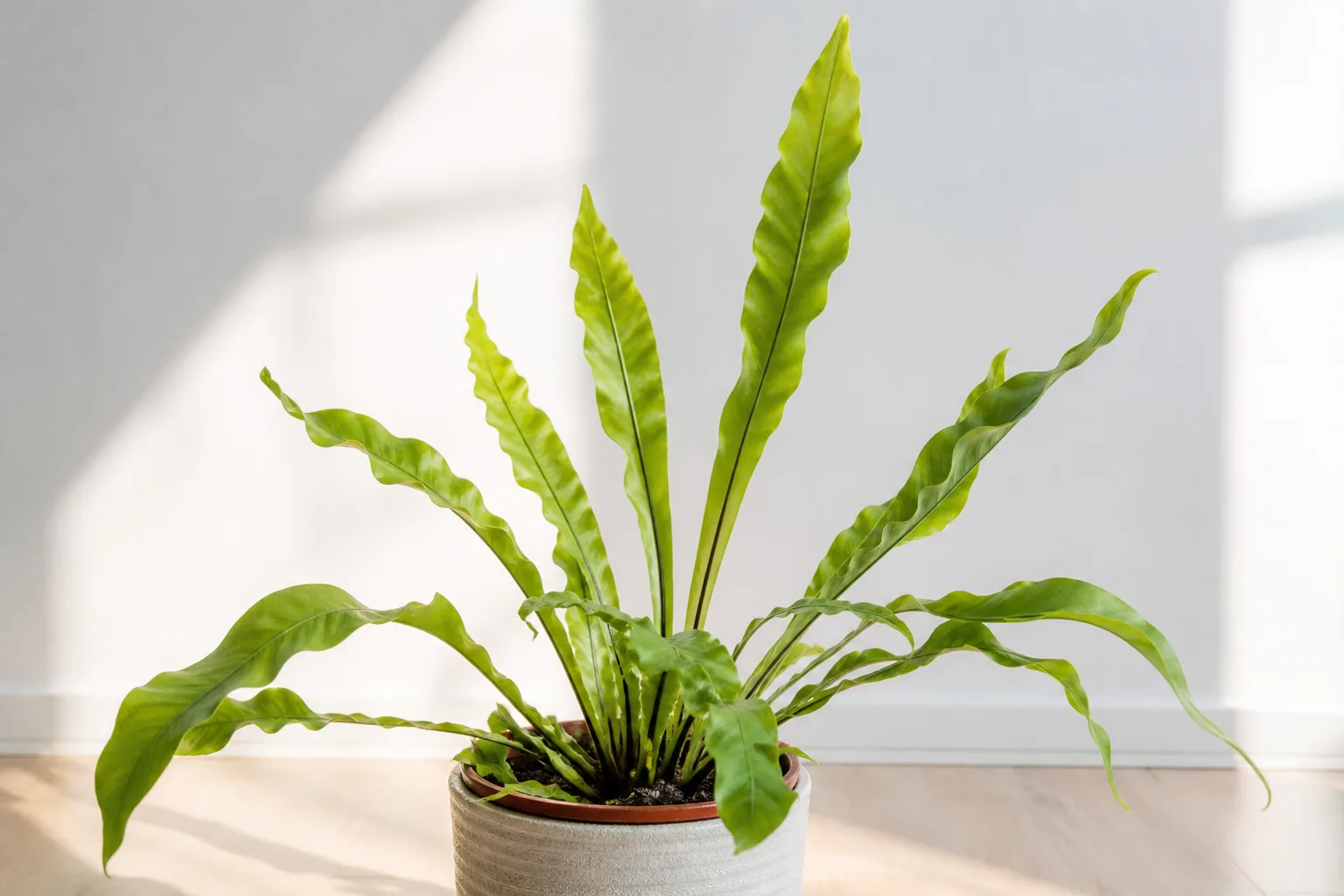
Leggy Growth on Bird's Nest Fern: Causes, Checks & Fixes
This guide covers leggy growth on Bird's Nest Fern. See also the general Leggy Growth guide, watering, and light pages for this plant.
Leggy Growth on Bird's Nest Fern: Causes, Checks & Fixes
Quick answer
Leggy Bird’s Nest Fern (Asplenium nidus) is etiolation-new fronds emerge on long thin stipes with wide gaps in the central rosette because the plant is stretching toward usable light. The species needs bright, filtered indirect light to keep its nest-shaped crown full; in dim corners it survives, then thins into the open, reaching look owners call “leggy.”
First step: compare spacing on the last two crown fronds and run the shadow test at frond height. If gaps are widening and the rosette leans toward the window, light is the primary limiter-move 12–24 inches closer to your brightest safe window today. For the full placement trial, wet-soil trap, and grow-light workflow, see not enough light on Bird’s Nest Fern-this page focuses on stretch diagnosis, rosette spacing, and why old fronds never shorten.
Leggy growth vs not enough light vs slow growth
These Bird’s Nest Fern problem pages overlap, but each answers a different search question:
| What you see | Most likely issue | Start here |
|---|---|---|
| Wide gaps between crown fronds, elongated stipes, lean toward window | Leggy growth (etiolation) | This page |
| Sparse dull fronds overall, slow dry-down, dim placement, winter thinning | Not enough light (broader light deficiency) | Not enough light |
| Little new length for weeks, tight spacing but stalled unfurling, root-bound pot | Slow growth (roots, season, nutrients) | Slow growth |
| Limp fronds, wet or dry soil extremes, crown still firm | Drooping or watering stress | Drooping leaves or overwatering |
Leggy Bird’s Nest Fern still pushes new fronds-often on visibly longer stipes-but each blade sits farther from the last. Slow-growth ferns may look healthy yet barely add crown fronds. Not enough light covers the full sparse-frond picture including dull color and the wet-soil trap; leggy growth zeroes in on rosette spacing and stipe elongation as the signature stretch pattern and the permanent elongation that light correction alone cannot reverse on old tissue.
What leggy growth looks like on Bird’s Nest Fern
Healthy Bird’s Nest Fern forms a compact funnel-shaped rosette of broad, wavy, glossy fronds emerging from a single central crown-NC State Extension describes strap-shaped bright green fronds in a litter-trapping rosette. Leggy etiolation breaks that pattern:
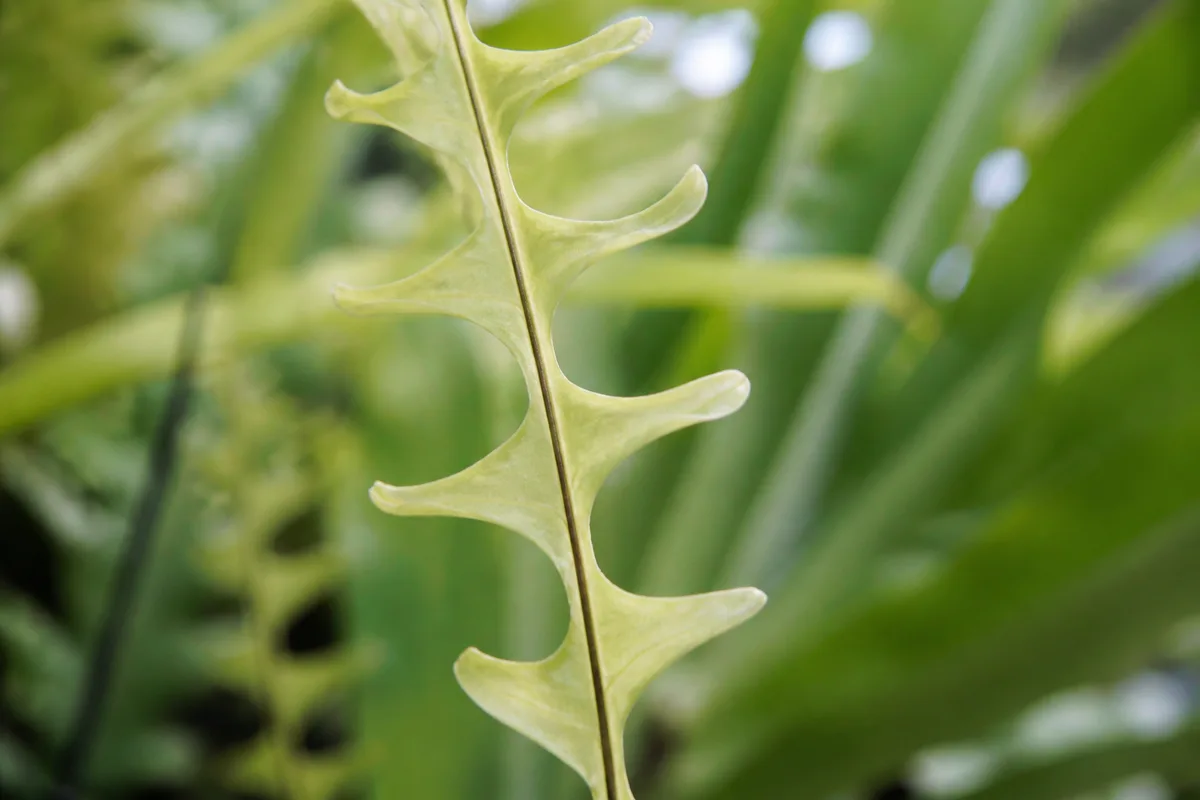
Leggy Growth symptoms on Bird’s Nest Fern - compare with healthy tissue on the same plant.
- Wide gaps between crown fronds - new blades emerge several inches apart instead of in a tight nest
- Long thin stipes - the stalk between crown and wavy blade is noticeably elongated before the frond widens
- Pale, thin, sometimes floppy new blades - tissue looks washed out compared with older, fuller fronds
- Rosette lean - the whole plant tilts toward the brightest window over weeks
- Sparse open center with outer ring of older fronds - older green fronds mask a crown producing weak, widely spaced new growth
- Slow soil dry-down - dim light reduces photosynthesis, so the mix stays wet longer even on your normal watering schedule
- Stretch toward a grow lamp - fronds reach toward a fixture placed too far above the rosette
Compare the last two fronds unfurling from the crown. If spacing has doubled and stipes lengthened, you are looking at etiolation-not the normal arch of mature Bird’s Nest Fern fronds, which can be long while still carrying firm, glossy tissue. Insufficient light causes spindly leggy growth as petioles and stems stretch toward brighter zones.
What leggy usually is not:
- Crispy brown tips only - more often low humidity or fluoride on an otherwise full rosette
- Sudden limp collapse with wet soil - overwatering or root rot, not stretch alone
- Bleached sun-facing patches - too much direct light; see Bird’s Nest Fern light needs
Why Bird’s Nest Fern gets leggy
Bird’s Nest Fern is sold as shade-tolerant, but indoors it is an epiphytic rainforest fern that needs steady photosynthesis to push broad frond growth. When intercepted light falls short, the plant elongates stipes and spaces fronds farther apart-classic etiolation. NC State notes that too much sun may turn the plant yellow or stop growth, but chronic dim placement produces the opposite problem: weak stretch toward the brightest available beam.
Ranked causes on Asplenium nidus:
Low light (most common). Placement too far from windows, north interior corners without supplementation, winter daylight loss, and dirty or curtained glass all cut intensity at frond height. Indoor light drops sharply with distance from the source-a fern that looks fine to your eyes may receive far less usable light than a spot one to three feet from the glass.
The low-light overwatering trap. Dim ferns use less water. Soil that stays wet too long stresses roots, yellows lower fronds, and mimics a watering problem while stretch continues. Fixing water without improving light often fails; the not enough light guide walks through this pairing in detail.
Grow light placed too far. A fixture hung high above a dark room may stop pale growth but still leave the rosette reaching toward the bulb with elongated stipes. Lower the lamp to 12–24 inches above the fronds or add runtime-details on the light guide.
Uneven light exposure. One-sided window light produces leggy stretch on the shaded side while the sunward side stays fuller. Rotation fixes lean but not underlying dim placement.
Heavy fertilizing in dim light. Clemson HGIC recommends dilute monthly feeding during active growth; in low light, excess fertilizer can push pale elongated tissue without tightening rosette spacing.
Bird’s Nest Fern grows only from the central crown-it does not branch from mid-frond cuts. Shearing green fronds cannot restore density. New fronds emerge only from the nest center, which is why recovery depends on better light and patience for the next unfurling frond, not pruning for bushiness.
How to confirm the cause
Work through this stretch-focused checklist before Bird’s Nest Fern repotting guide, fertilizing, or removing green fronds:
- Rosette spacing trend - Compare gaps between the last two crown fronds. Widening spaces strongly suggest etiolation.
- Shadow test at frond height - Hold your hand between the window and the crown around midday. No shadow means likely too dim; a sharp dark shadow means you may be too close to direct sun. Full protocol lives on the not enough light page.
- Lean direction - Consistent tilt toward one window confirms active light-seeking stretch.
- Stipe length on newest frond - Measure or eyeball the stalk before the blade widens. Elongation on consecutive new fronds confirms stretch, not a one-off awkward unfurl.
- Soil dry-down speed - Wet mix for a week or more on your normal schedule pairs with dim, slow-growing ferns.
- Two-week placement trial - Move to brighter indirect light and change nothing else. Tighter frond spacing within two to four weeks confirms light was the main limiter.
Lookalike symptoms to rule out
Not enough light (broader) - Dull sparse fronds, winter thinning, and wet-soil yellowing without obvious stipe elongation may be general light stress. If rosette spacing is the main complaint, stay on this page; if overall sparseness dominates, cross-check not enough light.
Slow growth - Frond spacing stays relatively tight but almost no new fronds appear for weeks; often root-bound pots or cool winter conditions.
Drooping or wilting - Limp fronds with extreme wet or dry soil; crown may still be firm. Stretch and droop can coexist in dim overwatered ferns-address moisture and light together.
Root rot - Yellow clusters, sour-smelling mix, soft crown. Leggy yellow fronds with chronically wet soil need root inspection, not light alone.
Normal mature arch - Older outer fronds naturally arch long while blades stay firm and glossy. Leggy growth shows thin pale blades and wide crown gaps on new fronds, not just long graceful tissue.
First fix for Bird’s Nest Fern
If rosette spacing is widening and the plant leans toward the window: move the fern 12–24 inches closer to bright indirect light today-typically 1–4 feet from an east window, near a bright north window, or several feet back from a south or west window behind a sheer curtain. Do not jump into direct sun; Bird’s Nest Fern fronds scorch in harsh rays.
This single change addresses the most common cause without stacking stressors. Detailed placements, grow-light hours, and acclimation steps are on not enough light on Bird’s Nest Fern.
If a grow light is already running but fronds stretch toward the bulb: lower the fixture to 12–24 inches above the rosette or add one hour of daily runtime, then watch the next unfurling frond. See Bird’s Nest Fern light needs for fixture setup.
Change one variable at a time and read the next crown frond before adding fertilizer, repotting, or removing green tissue.
Step-by-step recovery
After improving light or correcting grow-lamp distance:
- Adjust watering to the new dry-down rate - Brighter light usually means faster moisture use; check the top inch of mix per the Bird’s Nest Fern watering rhythm.
- Rotate the pot weekly - Even growth prevents one-sided lean while new fronds fill in.
- Remove only fully spent fronds - Trim brown or collapsed fronds at the base once the crown is stable. Do not cut green stretched fronds unless they harbor pests-they still photosynthesize.
- Hold fertilizer until new spacing tightens - Feed at half strength only after two to three weeks of improved frond density.
- Re-check placement if spacing stays wide after four weeks in a clearly brighter spot - Inspect roots for bound conditions or rot before repotting.
Recovery timeline
Expect the first sign of improvement-tighter new frond spacing with shorter stipes-within three to four weeks after a meaningful light increase during active growth. Winter recovery can take longer because day length is shorter even after you fix placement.
Old fronds that developed elongated stipes in dim light usually do not regain compact spacing-judge recovery by new growth, not by old fronds. A sparse rosette may take one full growing season to look full again because stretched outer fronds remain until naturally replaced.
Signs recovery is working:
- New fronds emerge closer together with firmer, glossier blades
- Lean stops increasing
- Soil dry-down becomes more predictable
- Crown stays firm and green
Signs the problem is worsening:
- Continued yellowing with wet soil despite less frequent watering
- Crown softening or sour-smelling mix
- New growth still widely spaced after four weeks in a clearly brighter spot-inspect roots
- Bleached fronds after slamming a dim fern into direct south sun-step back behind a sheer curtain
What not to do
Do not shear green fronds hoping to force a compact nest-Bird’s Nest Fern does not branch from mid-frond cuts and loses photosynthetic surface until new crown fronds emerge.
Do not move directly into harsh south or west sun to fix stretch quickly. Direct sunlight damages broad fronds; acclimate gradually behind sheers per the light guide.
Do not over-fertilize a dim, leggy fern to push density. Salt buildup and forced growth stress a plant that still lacks adequate light.
Do not repot, prune heavily, and relocate on the same day unless root rot is confirmed-stacked stress obscures which fix worked.
Do not assume rapid stipe elongation equals healthy vigor. Stretch is weakness, not lush growth.
How to prevent leggy growth next time
Choose placement for the fern’s light needs before décor-an east window at 1–4 feet from the glass, or a filtered south window, keeps rosette spacing tight with less intervention than a dim hallway. Clean window glass seasonally, supplement with a grow light when winter days shorten, and rotate the pot weekly during active growth.
Pair light with stable humidity and correct watering. Bird’s Nest Fern in brighter light transpires more; dry heated air plus new brightness can brown margins if humidity drops. Review Bird’s Nest Fern light needs for window and grow-light guidance year-round.
When to worry
Leggy stretch alone rarely kills Bird’s Nest Fern quickly-it degrades form over months. Worry when the crown softens, soil smells sour, or fronds yellow in clusters while the mix stays wet-those patterns suggest root decline that light alone will not reverse.
If the plant lived in deep shade for many months with almost no new crown fronds, recovery may be slow even after a light upgrade. Patience and stable care matter more than aggressive pruning.
Related Bird’s Nest Fern problems
- Not enough light on Bird’s Nest Fern - shadow test, placement trial, wet-soil trap, and full light recovery workflow
- Slow growth on Bird’s Nest Fern - when spacing stays tight but crown production stalls
- Bird’s Nest Fern light needs - preventive window and grow-light placement
- Overwatering on Bird’s Nest Fern - wet-soil yellowing in dim corners
- Bird’s Nest Fern care overview - humidity, watering, and rosette basics
When to use this page vs other Bird’s Nest Fern guides
- Bird’s Nest Fern watering guide - Use for routine moisture checks before assuming leggy growth is the main issue.
- Bird’s Nest Fern problems hub - Browse all 16 common issues on this species.
- Not Enough Light on Bird’s Nest Fern - Different entry point when symptoms overlap with leggy growth.
- Slow Growth on Bird’s Nest Fern - Different entry point when symptoms overlap with leggy growth.
- Yellow Leaves on Bird’s Nest Fern - Different entry point when symptoms overlap with leggy growth.