Areca Palm Care Guide: Light, Water, Humidity, Brown Tips
Dypsis lutescens
Areca palm indoor care - bright indirect light, even moisture, spider mite prevention, pet-safe growing.
Areca Palm Care Guide: Light, Water, Humidity, Brown Tips, Problems
Start with wateringThe most common care mistake for Areca PalmWatering guide →Areca Palm care essentials
Light
bright indirect light
Water
Water when the top 1–2 inches of soil are dry; areca palms prefer consistent moisture without waterlogging.
Soil
Well-draining, fertile potting mix suitable for palms.
Humidity
50–70%
Temperature
18–27°C (65–80°F)
Fertilizer
About Areca Palm
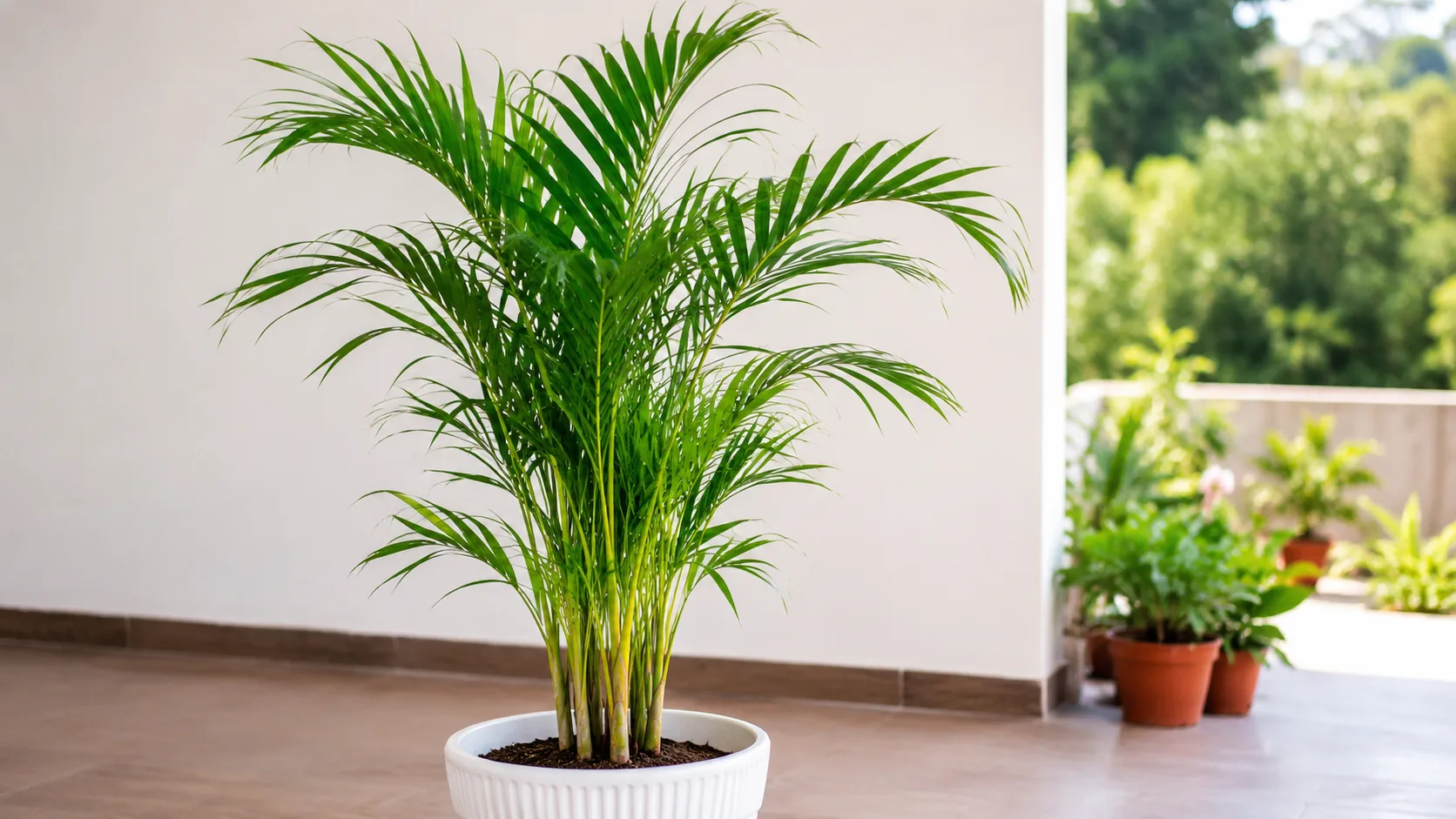
Areca Palm is native to Madagascar, typically reaches 6–8 ft tall indoors; arching yellow-green fronds spreading 3–5 ft indoors, with moderate growth. Areca Palm has a palm like growth habit and part of the Arecaceae family. It is also known as Butterfly Palm, Golden Cane Palm, Yellow Palm, and Bamboo Palm.
| Detail | Information |
|---|---|
| Also known as | Butterfly Palm, Golden Cane Palm, Yellow Palm, Bamboo Palm |
| Native region | Madagascar |
| Mature size | 6–8 ft tall indoors; arching yellow-green fronds spreading 3–5 ft |
| Growth rate | Moderate |
| Growth habit | Palm Like |
| Scientific name | Dypsis lutescens |
| Family | Arecaceae |
Areca Palm Care Guide: Light, Water, Humidity, Brown Tips, Problems
The areca palm is one of those houseplants that looks forgiving and then isn’t. Give it a bright window and a steady Areca Palm watering guide and it will reward you with a tall, feathery canopy. Give it hard tap water, dry air, and a pot two sizes too large, and it will tell you on the tips of every frond. This guide covers everything that actually matters for growing Dypsis lutescens indoors: the right light intensity, the watering rhythm that prevents brown tips, the humidity range it really needs, how to fertilize without burning the roots, and how to read the most common problems before they spread.
What Is the Areca Palm?
The areca palm is a clustering tropical palm sold under a long list of common names - areca palm, bamboo palm, butterfly palm, golden cane palm, yellow palm - all referring to the same species, Dypsis lutescens (formerly Chrysalidocarpus lutescens). It belongs to the family Arecaceae and is, by a comfortable margin, the most popular palm sold as a houseplant worldwide.
Botanical background, origin, and family
Dypsis lutescens is native to moist forest areas in Madagascar, where it grows in the understory and along forest edges in bright, dappled light. The Missouri Botanical Garden Plant Finder entry describes it as a multi-stemmed palm with cane-like, yellow-ringed stems and pinnate, upward-curving, light green fronds that can reach 3 to 6 feet long outdoors, each with 40 to 60 leaflets per side. In habitat it can top 30 feet; in a living room it tops out closer to 6 to 8 feet tall with a 3 to 5 foot spread, and it grows at a moderate pace, pushing out one or two new fronds per cane per active season. Missouri Botanical Garden notes it is winter-hardy only to USDA Zones 10 to 11, which is exactly why almost everyone reading this article is growing it as an indoor plant.
The areca palm is a clustering palm, not a single-trunk species. New stems emerge from the base as offsets (often called “suckers”), and over time a single nursery plant becomes a tight clump of cane-like stems. That growth habit is also the reason the easiest propagation method is division rather than cuttings or air layering, a fact the propagation section will return to. The species is also widely confused in commerce with the majesty palm (Ravenea rivularis), which has similar feathery fronds but far less tolerance for dry indoor air. If the tag says Dypsis lutescens, this guide applies. If it does not, treat any care advice as approximate until you confirm the species.
Light: Bright Indirect, No Harsh Sun
Areca palms want bright, indirect light for most of the day. Multiple indoor palm care sources, including Missouri Botanical Garden, place the plant near a south- or west-facing window indoors, ideally filtered through a sheer curtain, with a hard line against direct midday sun, which scorches the fronds within hours. Missouri Botanical Garden puts it more simply: “houseplants prefer consistent moisture in mostly sunny exposures with high humidity. Direct full sun indoors may scorch the foliage.”
How bright is “bright indirect” and how to acclimate
“Bright indirect” is one of the most slippery phrases in houseplant care, so it helps to put a number on it. Most tropical understory palms - areca included - do best at roughly 1,500 to 3,000 lux for 8 or more hours per day. That maps to a spot 3 to 6 feet back from an unobstructed south- or west-facing window, or right at a window filtered by a sheer curtain, or directly at a bright east-facing window. North-facing windows work in summer in many climates but usually do not provide enough intensity through winter.
A practical test: new growth should be compact, upright, and properly green. Long internodes (visible space between leaflets), pale or floppy fronds, and slow growth all point to too little light. Bleached yellow patches, brown crispy patches, and curled edges point to too much direct sun. The plant does not hide its preferences. Areca palms also do not love being moved. A plant that has spent six months on a dim shelf will drop into shock if it is suddenly placed in a south-facing window in summer. Acclimate it over 7 to 14 days, starting with one to two hours of direct morning sun and extending the window a little each day until it is at the final location. The same rule applies in reverse in autumn, when light drops - moving the plant a foot closer to the window or onto a plant stand can prevent a winter growth stall.
Watering: Evenly Moist, Never Bone Dry or Soggy
If light is the variable people overthink, watering is the variable people get wrong. Areca palms want a steady supply of water but absolutely hate sitting in it. NC State Extension describes the species as preferring soil kept moist but not soggy during the growing season, which captures the rule. The BBC Gardeners’ World areca palm guide phrases it the same way: water thoroughly whenever the top few centimeters of compost are dry, less in winter. As a starting point, that is roughly every 7 to 10 days in active growth and every 14 to 21 days in winter - but those intervals should be confirmed by the actual plant, not the calendar.
How to know when to water
The most reliable method is the finger test. Push a finger 1 to 2 inches into the mix. If the top layer is dry and the deeper mix is approaching dry, water thoroughly until water runs from the drainage holes. If the deeper mix is still cool and damp, wait. Lift the pot: a well-watered areca in a peat-based mix is noticeably heavier than the same pot a day or two before the next watering. When you do water, do it deeply. Light daily watering keeps only the top of the mix moist and leaves the deeper root zone dry, one of the fastest paths to drought stress even in a pot that “got watered yesterday.” Always empty the saucer afterward; a pot sitting in runoff suffocates the lower roots.
Tap water sensitivity - fluoride, chlorine, and salts
This is the single most useful fact in the entire care guide. Areca palms are sensitive to fluoride, chlorine, and the dissolved salts that come with municipal tap water. The BBC Gardeners’ World areca palm guide and multiple palm-care references note that areca palms are sensitive to chemicals in tap water, and that rainwater, distilled water, or purified water is recommended especially in hard-water areas. Fluoride and chloride ions accumulate in the leaf tissue over time, concentrate at the frond tips, and burn the cells - the result is the classic crispy brown tip that has frustrated indoor palm growers for decades.
The practical fix is one of three options, in order of effectiveness: collect rainwater and use it for the palm, switch to distilled water, or install a reverse-osmosis filter at the tap. None of these are mandatory for every home - some municipal water is genuinely low in fluoride and chlorine - but if brown tips keep appearing despite good light and humidity, water quality is the first thing to investigate. A 24-hour open container of tap water will off-gas chlorine but not fluoride, so the “let it sit overnight” trick only solves half the problem. The other half is salt buildup from fertilizer and water. Flush the pot every 3 to 6 months by watering with 3 to 4 times the pot’s volume of clean water and letting it all drain through. If you have ever noticed a white crust on the surface of the mix, that is salt - the same chemistry building in the leaf tips.
Humidity and Temperature
Areca palms evolved in a humid tropical forest. The indoor humidity of most North American and European homes - 30 to 40% in winter, often lower - is genuinely too dry for them. Practical care guides such as PlantSolve recommend 50 to 70% relative humidity as the recommended indoor target, with a survivable lower bound around 40%. Below about 40%, the plant begins to close its stomata to conserve water, growth slows, and the frond tips start to crisp.
Three ways to raise humidity around a single plant, in order of effectiveness: a cool-mist humidifier on a humidistat, grouping the areca with other tropicals on a shared pebble tray (transpiration from multiple plants creates a useful microclimate), and moving it into a naturally humid room such as a bright bathroom. Misting gives a brief spike in humidity only; it is not a long-term solution and wet leaves can invite fungal leaf spot, so it is a band-aid, not a plan.
Temperature is the easier variable. Areca palms are comfortable across the standard indoor range of 65 to 75°F (18 to 24°C) and tolerate brief excursions up to the high 80s. The lower limit is the one that matters. Missouri Botanical Garden notes that houseplants “dislike temperatures that drop below 60 degrees F”, and prolonged exposure below about 55°F will cause cold damage visible as dark, water-soaked patches on the fronds. Keep the plant away from cold drafts - single-pane windows in winter, leaky doorways, direct line of an AC vent in summer - and away from radiators and other dry heat sources. Stable temperature plus steady humidity is the combination that produces a glossy, full-canopied palm.
Soil and Potting Mix
A good areca palm mix is well-draining, moisture-retentive, and slightly acidic. NC State Extension recommends well-drained potting soil kept moist but not soggy during the growing season, which is the practical target. Drainage is non-negotiable. Use a pot with at least one large drainage hole. Terracotta is a useful choice because it wicks excess moisture out through the walls; glazed ceramic and plastic are fine as long as the drainage and the watering rhythm are right.
What the right mix looks like
A practical home mix is roughly two parts peat-based or coco-coir potting mix, one part perlite or pumice, and one part coarse sand or pine bark. The goal is a mix that holds moisture long enough for the fine palm roots to drink but drains fast enough that the same roots never sit in saturated soil. The target pH is mildly acidic, around 6.0 to 6.5, but most commercial palm and houseplant mixes sit in that range already. The two most common soil-related mistakes with areca palms are exactly opposite: a heavy, peat- and garden-soil blend that stays wet for days, and a coarse, gritty cactus mix that dries out before the fine roots can keep up. Either extreme causes root problems, but the symptoms show up in the fronds, which is why growers tend to misdiagnose the cause.
Fertilizer: Slow, Steady, and Slightly Skewed to Nitrogen
Palms are not heavy feeders compared with leafy tropicals, and they use far less phosphorus than flowering plants. UF/IFAS Extension guidance for landscape palms, summarized in ENH-1009/EP261, recommends a slow-release 8-2-12 palm maintenance fertilizer with 4% magnesium for field and container use, with the magnesium and potassium ratio intended to prevent the magnesium lockout that pure high-nitrogen lawn fertilizers can cause. That 3-to-1 nitrogen-to-phosphorus ratio reflects palm biology: palms use phosphorus for root development and cellular energy transfer, not for blooms, and an over-phosphorus fertilizer can actually lock out other nutrients over time.
| Fertilizer option | NPK | Magnesium? | Best for |
|---|---|---|---|
| Palm-specific slow-release granules (e.g., 8-2-12 +4Mg) | 8-2-12 | Yes | Long-term container palms, lowest burn risk |
| Balanced slow-release (e.g., 12-4-12) | 12-4-12 | Often yes | General indoor palm care |
| Balanced water-soluble (e.g., 10-10-10) at half strength | 10-10-10 | No | Quick response, easier to correct mistakes |
| Liquid palm formula (e.g., 3-1-2 or 3-1-3) | varies | Sometimes | Monthly feed during peak growth |
Apply at half the label rate to a plant that is already moist, and only during active growth - typically March through September in the Northern Hemisphere. A schedule of every 4 to 6 weeks with a slow-release granular, or monthly with a diluted liquid, fits most indoor areca palms. Hold off entirely in late fall and winter, when the salts will simply accumulate in the pot. If older fronds are yellowing between the veins while the rest of the plant looks healthy, suspect a magnesium or potassium deficiency and either switch to a palm-specific fertilizer with magnesium or apply a light Epsom salt drench (about 1 tablespoon per gallon, monthly, on moist soil) as a short-term correction.
## Areca Palm repotting guide and Root Health
Areca palms prefer to be a little snug in their pots, which is part of why they are easier to keep alive than many faster-growing tropicals. Repot every 2 to 3 years, in spring, only when there is a real reason. NC State Extension recommends repotting every 2 or 3 years as part of normal houseplant care. The clearest signals are physical, not calendar-based. Roots circling the surface of the mix, roots emerging from the drainage holes, water running straight through the pot without being absorbed, or a plant that has become top-heavy for its container all mean the root system has outgrown the space. A mix that has compacted and started to smell sour, or one that has lost its structure and drains too fast, is also a sign - even if the timing is not on a calendar. When repotting, go up only one pot size (about 1 to 2 inches in diameter). A pot that is too large holds more water than the root system can use, which is the single most common cause of root rot on Areca Palm after a repot. Use fresh, well-draining mix, water lightly for the first week, and hold off on fertilizer for a month to let damaged roots recover.
Propagation: Division of Suckers and Seed
There are two reliable ways to propagate an areca palm, and one almost-certain way to fail. The reliable ways are division of mature clumps and growing from fresh seed. Stem cuttings, leaf cuttings, and air layering do not work - the areca palm lacks the meristematic tissue to root from a cut cane in the way a pothos or a philodendron can.
NC State Extension’s recommended propagation strategies for Areca Palm overview are division and seed, and the BBC Gardeners’ World propagation walkthrough describes the same division method. Wait until the parent plant has at least four to six mature, pencil-thick canes and visible offshoots at the base, ideally in mid-spring. Water the parent well the day before to loosen the root ball. Tip the plant out, shake or rinse the soil from the roots, and identify a clump of 4 to 5 canes with their own attached roots. Cut it away with a clean, sharp knife. Pot the division into fresh, well-draining mix at the same depth it was growing before, water thoroughly, and place it in bright, indirect light with steady warmth (70 to 85°F) and high humidity. New growth typically appears in 6 to 10 weeks.
Seed propagation is possible but slow and finicky. Fresh seeds (green or orange-brown, never dried and packaged) germinate in 3 to 6 weeks at 75 to 85°F in a moist, well-draining seed-starting mix. Expect a single grass-like cotyledon first, then 4 to 6 months before the seedling is large enough to pot up, and 1 to 2 years before it is a recognizable palm. The home grower trade-off is simple: division gives a mature plant fast, seed preserves genetic diversity but costs a year of patience.
Common Problems and What They Mean
Most areca palm problems show up first in the fronds. Reading the symptom correctly is the difference between a 10-minute fix and a six-month recovery.
Brown leaf tips
Crispy brown tips are the most common complaint, and they almost always come from one of five causes: tap water with fluoride or chlorine, low humidity, salt buildup in the pot, dry soil from underwatering on Areca Palm, or sunburn from direct sun. Multiple palm-care references, including BBC Gardeners’ World, place water-quality sensitivity first because it is the most common cause of new brown tips on an otherwise healthy-looking plant. The diagnostic order is: check water source first, then humidity, then soil moisture, then light, then salt buildup (white crust on the surface of the mix). If the cause is water, switch to filtered, distilled, or rainwater and the new growth will come in clean. If the cause is salt, flush the pot with 3 to 4 times its volume of clean water.
When you trim brown tips, follow the natural shape of the leaflet and leave a thin sliver of brown tissue. Cutting into the green part creates a fresh wound that the plant will brown over again, undoing the trim. The Plantsolve care guide and others make this point explicitly: cut only the discolored portion, follow the natural curve, and stop just before the green tissue.
Yellow fronds, spider mites, and root rot
Yellow fronds are a generic stress signal that can mean overwatering on Areca Palm, underwatering, low light, nutrient deficiency, natural older-leaf drop, or pests. The diagnostic is sequential. First, check the moisture: a moisture meter 3 to 4 inches into the pot, or a chopstick left for ten minutes, tells you whether the deeper mix is wet (overwatering, the most common cause) or bone-dry (underwatering, less common). Second, check the light: a plant in a dim corner that has been yellowing for weeks is usually light-starved, not overwatered. Third, inspect the undersides of the fronds and the leaf axils for pests. Spider mites in dry air leave fine webbing and a stippled, dusty look on the leaflets; mealybugs show up as small, white, cottony masses; scale appears as small, hard bumps along the cane and midrib.
Spider mites respond to a strong shower to knock the population down, followed by weekly insecticidal soap or neem oil until the webbing is gone. Mealybugs can be dabbed off with a cotton swab dipped in 70% isopropyl alcohol, then treated the same way. Treat any infestation in isolation: a heavily infested plant should not be near other houseplants until the pests are gone.
Root rot is the most serious diagnosis on the list. A plant with consistently yellowing fronds, a soft base on the canes, and a slightly sour smell from the soil is almost certainly in the early stages of root rot, caused by overwatering, a pot that is too large, or a mix that has compacted and stopped draining. The fix is to unpot the plant, cut away any brown, mushy roots with sterilized shears, dust the cuts with cinnamon or a copper-based fungicide if available, and repot into fresh, well-draining mix in a pot only one size up. Water lightly for the first week and withhold fertilizer for a month.
Pet Safety: Cats, Dogs, and the Sago Palm Mix-up
The ASPCA Animal Poison Control lists Dypsis lutescens - and all of its common names, including areca palm, golden butterfly palm, cane palm, golden feather palm, and yellow palm - as non-toxic to dogs, non-toxic to cats, and non-toxic to horses. That makes it one of the few large, statement-sized houseplants that is genuinely safe in a home with pets. The same ASPCA dog plant list also accepts the older synonym Chrysalidocarpus lutescens for the same plant.
The important caveat is one of confusion, not toxicity. The sago palm (Cycas revoluta) is a different plant, unrelated to true palms, and the ASPCA lists it as toxic to dogs, cats, and horses - ingestion can cause severe liver failure, with up to 50–75% of reported cases resulting in fatalities per the ASPCA Animal Poison Control alert on sago palms. If a plant tag says “palm” and the fronds are stiff, spiky, and arranged in a rosette around a single stout trunk, it is a sago. If the fronds are feathery, arching, and emerging from a cluster of yellow-green canes, it is an areca. The two plants are visually similar at a glance and dramatically different in toxicity. Mild gastrointestinal upset - drooling, loose stool, vomiting - is still possible if a pet chews a significant amount of any non-toxic plant, including areca. The right response is observation and a call to the vet if symptoms persist; it is not an emergency the way sago ingestion is.
The NASA Clean Air Study - What It Does and Does Not Mean
The 1989 NASA Clean Air Study, led by B. C. Wolverton in association with the Associated Landscape Contractors of America, tested whether common houseplants - including Dypsis lutescens - could remove volatile organic compounds such as benzene, formaldehyde, and trichloroethylene from sealed test chambers. The study’s own results, summarized in its published tables, listed the areca palm among the species that showed measurable removal of certain compounds. That finding has been cited for decades as evidence that areca palms “purify the air” in homes and offices.
The honest reading of the same study is more nuanced. The chambers were sealed, the air exchange rate was effectively zero, and the plants were tested individually. Real homes and offices exchange air with the outdoors roughly once per hour, which dilutes airborne pollutants much faster than any plausible number of potted plants can filter them. Subsequent research estimated that achieving NASA-chamber-level VOC removal in a normal room would require 10 to 1,000 plants per square meter of floor space - an absurdly high density for a living space - and that a single potted plant delivers about 0.023 cubic meters of clean air per hour, compared with roughly 5,000 times that for a basic mechanical air purifier.
The practical takeaway for an areca palm owner is honest and balanced. The plant does not meaningfully clean the air of a real home on its own, and it would be a mistake to choose it for that reason alone. What it does deliver, and the reason it is worth keeping, is a tall, full, lush canopy that visibly humidifies a room (one 6-foot areca can release roughly a liter of water per day through transpiration, per the Gardenia.net species page), supports indoor aesthetics and wellbeing, and tolerates a wide range of indoor conditions. The clean-air framing is a 1989 chamber result; the rest is real, and worth choosing the plant for on its actual merits.
Conclusion
A well-grown areca palm is one of the most rewarding large houseplants available: pet-safe, fast-growing for a palm, willing to live in a bright living room corner for years, and visibly responsive to good care. The care itself is not complicated once the framework is clear. Give it bright indirect light, ideally 1,500+ lux for 8 hours a day, near a south- or west-facing window with a sheer curtain or a few feet back from the glass. Water deeply when the top 1 to 2 inches of mix dry out, and always empty the saucer. Use filtered, distilled, or rainwater if your municipal supply is hard or fluoridated, and flush the pot every few months to wash out accumulated salts. Hold humidity at 50 to 60% and temperature at 65 to 75°F. Feed lightly during active growth with a palm-specific or balanced fertilizer that includes magnesium, and stop feeding in winter. Repot only when the roots demand it, going up one size at a time. Propagate by division in spring, never by cane cuttings. Read brown tips as a signal to check water quality and humidity first, yellow fronds as a signal to check moisture and light, and webbing or cottony spots as a signal to start pest treatment immediately. The areca palm is a moderate-maintenance plant that rewards consistency. Get the framework right once and the day-to-day work is just observation and a steady watering rhythm. That is the whole game.
When to use this page vs other Areca Palm guides
- Areca Palm overview - Canonical hub for this species - care topics and problems branch from here.
- Areca Palm problems - Symptom-first path when you already know something is wrong.
Related Areca Palm guides
How to care for Areca Palm?
How much light does Areca Palm need?
bright indirect light
- bright indirect light - bright indirect light.
When should you water Areca Palm?
Water when the top 1–2 inches of soil are dry; areca palms prefer consistent moisture without waterlogging.
- Check the top 1–2 inches of soil - Water when the top 1–2 inches of soil are dry; areca palms prefer consistent moisture without waterlogging.
- fronds begin to droop slightly when thirsty - Water when the top 1–2 inches of soil are dry; areca palms prefer consistent moisture without waterlogging.
- Drain excess water - Water when the top 1–2 inches of soil are dry; areca palms prefer consistent moisture without waterlogging.
What soil works best for Areca Palm?
Well-draining, fertile potting mix suitable for palms.
- palm-specific potting mix or standard compost - Well-draining, fertile potting mix suitable for palms.
- perlite (20%) - Light white granules that keep soil airy and help prevent compaction.
- coarse sand - Adds weight and drainage; use coarse horticultural sand rather than fine beach sand.
Grower notes for Areca Palm
What matters most with Areca Palm
Areca Palm declines slowly, which can hide mistakes for weeks. Watch spear growth, lower fronds, and soil drying speed rather than judging only one yellow leaflet. In practice, the care checkpoint is simple: bright indirect light. Pair that with well-draining, fertile potting mix suitable for palms, and avoid changing water, pot size, and placement all at once.
Best placement in a real home
Areca Palm belongs where bright indirect light is realistic for most of the day, not only where the pot looks good. Water when the top 1–2 inches of soil are dry; areca palms prefer consistent moisture without waterlogging. If the pot stays wet longer than expected, move the plant into better light or reassess the mix before watering again. Humidity target: 50–70%. Temperature comfort zone: 18–27°C (65–80°F).
Before you buy this plant
Choose Areca Palm with firm new growth, clean leaf undersides, and soil that does not smell sour or feel compacted. Be cautious if you see brown-tips, sticky residue, collapsed crowns, or a pot that is wet in poor light. Cosmetic old-leaf damage is less worrying than weak roots or active pests.
First month after bringing it home
Do not repot Areca Palm on day one unless the mix is failing or pests are obvious. Quarantine it, learn how fast the pot dries, and keep care boring while it adjusts. Watch especially for brown-tips, yellow-leaves, and spider-mites. If problems appear, correct the condition first rather than stacking fertilizer, repotting, and pruning together.
Pet-aware note for Areca Palm
Areca Palm is a better choice for pet-aware homes than toxic ornamentals, but pet safe does not mean the plant should be chewed. Use hanging, shelf, or room placement if pets dig in soil or shred leaves, and choose sturdier plants for high-traffic pet zones.
How to tell Areca Palm is settling in
Also sold as Butterfly Palm, Golden Cane Palm, and Yellow Palm, this plant should be judged by stable new growth rather than label names alone. If you plan to multiply it later, common methods include Division of clumping offshoots and Seed (very slow - many months). Repot only when you see Roots circling the base and escaping drainage holes and soil drying very rapidly. If yellow-leaves shows up early, inspect light, watering, and roots before assuming the plant is permanently weak.
Is it pet safe?
Areca Palm is generally considered pet safe.
Watering Areca Palm
For Areca Palm, check the top 1–2 inches of soil; fronds begin to droop slightly when thirsty and water every 7–10 days in summer; every 14–21 days in winter. Reduce watering in winter; increase in summer when actively producing new fronds.
| Detail | Information |
|---|---|
| How often | Every 7–10 days in summer; every 14–21 days in winter |
| How to check | Check the top 1–2 inches of soil; fronds begin to droop slightly when thirsty |
| Seasonal changes | Reduce watering in winter; increase in summer when actively producing new fronds |
Signs of overwatering
- Yellow lower fronds and brown leaf tips
- soggy soil and algae on pot surface
- crown rot at the base
Signs of underwatering
- Brown crispy frond tips
- drooping fronds
- dry compacted soil
Soil & potting for Areca Palm
Use a mix of palm-specific potting mix or standard compost, perlite (20%), coarse sand for Areca Palm. Good drainage essential; palms dislike standing water but need consistent moisture. Target soil pH around 6.0–6.5. Repot every 2–3 years; areca palms prefer to be slightly root-bound, ideally in spring.
| Detail | Information |
|---|---|
| Recommended mix | palm-specific potting mix or standard compost, perlite (20%), coarse sand |
| Drainage | Good drainage essential; palms dislike standing water but need consistent moisture |
| Soil pH | 6.0–6.5 |
| Repotting frequency | Every 2–3 years; areca palms prefer to be slightly root-bound |
| Best season to repot | Spring |
Signs it needs repotting
- Roots circling the base and escaping drainage holes
- soil drying very rapidly
- pot being pushed up or deformed by roots
Humidity & temperature for Areca Palm
Areca Palm prefers 50–70%, though normal home humidity is usually fine. Keep temperatures around 18–27°C (65–80°F).
| Detail | Information |
|---|---|
| Humidity | 50–70% - normal home humidity is fine. |
| Ideal temperature | 18–27°C (65–80°F) |
Fertilizer & pruning for Areca Palm
Common problems on Areca Palm
Brown Tips
LowLikely cause: Low humidity, fluoride in tap water, dry air, or inconsistent watering causes frond tip browning - very common in areca palms
Quick fix: Switch to filtered water, increase humidity, and ensure consistent watering; trim brown tips if desired
Full fix guide →Yellow Leaves
MediumLikely cause: Overwatering, nutrient deficiency (especially magnesium), or low light causes yellowing fronds
Quick fix: Correct watering schedule, apply a palm fertiliser with micronutrients, and move to brighter indirect light
Full fix guide →Spider Mites
MediumLikely cause: Dry, heated indoor air in winter encourages spider mite infestations on frond undersides
Quick fix: Wipe fronds with neem oil solution; increase humidity; isolate infested plant
Full fix guide →Root Rot
HighLikely cause: Overwatering in cool or winter conditions when the palm is not actively growing
Quick fix: Allow soil to dry more between waterings; improve drainage; reduce winter water frequency significantly
Full fix guide →Overwatering
MediumLikely cause: Common on this plant type; confirm with recent watering, light, and root checks.
Quick fix: Inspect the plant and correct the most likely care stressor before stacking treatments.
Full fix guide →Underwatering
MediumLikely cause: Common on this plant type; confirm with recent watering, light, and root checks.
Quick fix: Inspect the plant and correct the most likely care stressor before stacking treatments.
Full fix guide →Mealybugs
MediumLikely cause: Common on this plant type; confirm with recent watering, light, and root checks.
Quick fix: Inspect the plant and correct the most likely care stressor before stacking treatments.
Full fix guide →Aphids
MediumLikely cause: Common on this plant type; confirm with recent watering, light, and root checks.
Quick fix: Inspect the plant and correct the most likely care stressor before stacking treatments.
Full fix guide →Leggy Growth
MediumLikely cause: Common on this plant type; confirm with recent watering, light, and root checks.
Quick fix: Inspect the plant and correct the most likely care stressor before stacking treatments.
Full fix guide →Slow Growth
MediumLikely cause: Common on this plant type; confirm with recent watering, light, and root checks.
Quick fix: Inspect the plant and correct the most likely care stressor before stacking treatments.
Full fix guide →Wilting
MediumLikely cause: Common on this plant type; confirm with recent watering, light, and root checks.
Quick fix: Inspect the plant and correct the most likely care stressor before stacking treatments.
Full fix guide →Drooping Leaves
MediumLikely cause: Common on this plant type; confirm with recent watering, light, and root checks.
Quick fix: Inspect the plant and correct the most likely care stressor before stacking treatments.
Full fix guide →Low Humidity
MediumLikely cause: Common on this plant type; confirm with recent watering, light, and root checks.
Quick fix: Inspect the plant and correct the most likely care stressor before stacking treatments.
Full fix guide →Not Enough Light
MediumLikely cause: Common on this plant type; confirm with recent watering, light, and root checks.
Quick fix: Inspect the plant and correct the most likely care stressor before stacking treatments.
Full fix guide →Fungus Gnats
MediumLikely cause: Common on this plant type; confirm with recent watering, light, and root checks.
Quick fix: Inspect the plant and correct the most likely care stressor before stacking treatments.
Full fix guide →Mold on Soil
MediumLikely cause: Common on this plant type; confirm with recent watering, light, and root checks.
Quick fix: Inspect the plant and correct the most likely care stressor before stacking treatments.
Full fix guide →Curling Leaves
MediumLikely cause: Common curling leaves pattern on Areca Palm under indoor care stress.
Quick fix: Inspect roots, watering, light, and pests; adjust one variable and monitor new growth.
Full fix guide →Brown Leaves
MediumLikely cause: Common brown leaves pattern on Areca Palm under indoor care stress.
Quick fix: Inspect roots, watering, light, and pests; adjust one variable and monitor new growth.
Full fix guide →Black Spots
MediumLikely cause: Common black spots pattern on Areca Palm under indoor care stress.
Quick fix: Inspect roots, watering, light, and pests; adjust one variable and monitor new growth.
Full fix guide →Holes in Leaves
MediumLikely cause: Common holes in leaves pattern on Areca Palm under indoor care stress.
Quick fix: Inspect roots, watering, light, and pests; adjust one variable and monitor new growth.
Full fix guide →Pale Leaves
MediumLikely cause: Common pale leaves pattern on Areca Palm under indoor care stress.
Quick fix: Inspect roots, watering, light, and pests; adjust one variable and monitor new growth.
Full fix guide →Distorted Leaves
MediumLikely cause: Common distorted leaves pattern on Areca Palm under indoor care stress.
Quick fix: Inspect roots, watering, light, and pests; adjust one variable and monitor new growth.
Full fix guide →Scale Insects
MediumLikely cause: Common scale insects pattern on Areca Palm under indoor care stress.
Quick fix: Inspect roots, watering, light, and pests; adjust one variable and monitor new growth.
Full fix guide →Thrips
MediumLikely cause: Common thrips pattern on Areca Palm under indoor care stress.
Quick fix: Inspect roots, watering, light, and pests; adjust one variable and monitor new growth.
Full fix guide →Whiteflies
MediumLikely cause: Common whiteflies pattern on Areca Palm under indoor care stress.
Quick fix: Inspect roots, watering, light, and pests; adjust one variable and monitor new growth.
Full fix guide →Leaf Miners
MediumLikely cause: Common leaf miners pattern on Areca Palm under indoor care stress.
Quick fix: Inspect roots, watering, light, and pests; adjust one variable and monitor new growth.
Full fix guide →Caterpillars
MediumLikely cause: Common caterpillars pattern on Areca Palm under indoor care stress.
Quick fix: Inspect roots, watering, light, and pests; adjust one variable and monitor new growth.
Full fix guide →Nitrogen Deficiency
MediumLikely cause: Common nitrogen deficiency pattern on Areca Palm under indoor care stress.
Quick fix: Inspect roots, watering, light, and pests; adjust one variable and monitor new growth.
Full fix guide →Iron Deficiency
MediumLikely cause: Common iron deficiency pattern on Areca Palm under indoor care stress.
Quick fix: Inspect roots, watering, light, and pests; adjust one variable and monitor new growth.
Full fix guide →Magnesium Deficiency
MediumLikely cause: Common magnesium deficiency pattern on Areca Palm under indoor care stress.
Quick fix: Inspect roots, watering, light, and pests; adjust one variable and monitor new growth.
Full fix guide →Potassium Deficiency
MediumLikely cause: Common potassium deficiency pattern on Areca Palm under indoor care stress.
Quick fix: Inspect roots, watering, light, and pests; adjust one variable and monitor new growth.
Full fix guide →Calcium Deficiency
MediumLikely cause: Common calcium deficiency pattern on Areca Palm under indoor care stress.
Quick fix: Inspect roots, watering, light, and pests; adjust one variable and monitor new growth.
Full fix guide →