Areca Palm Fertilizer: When, How Much, and Mistakes
Areca Palm Fertilizer: When, How Much, and Mistakes
Areca Palm Fertilizer: When, How Much, and Mistakes
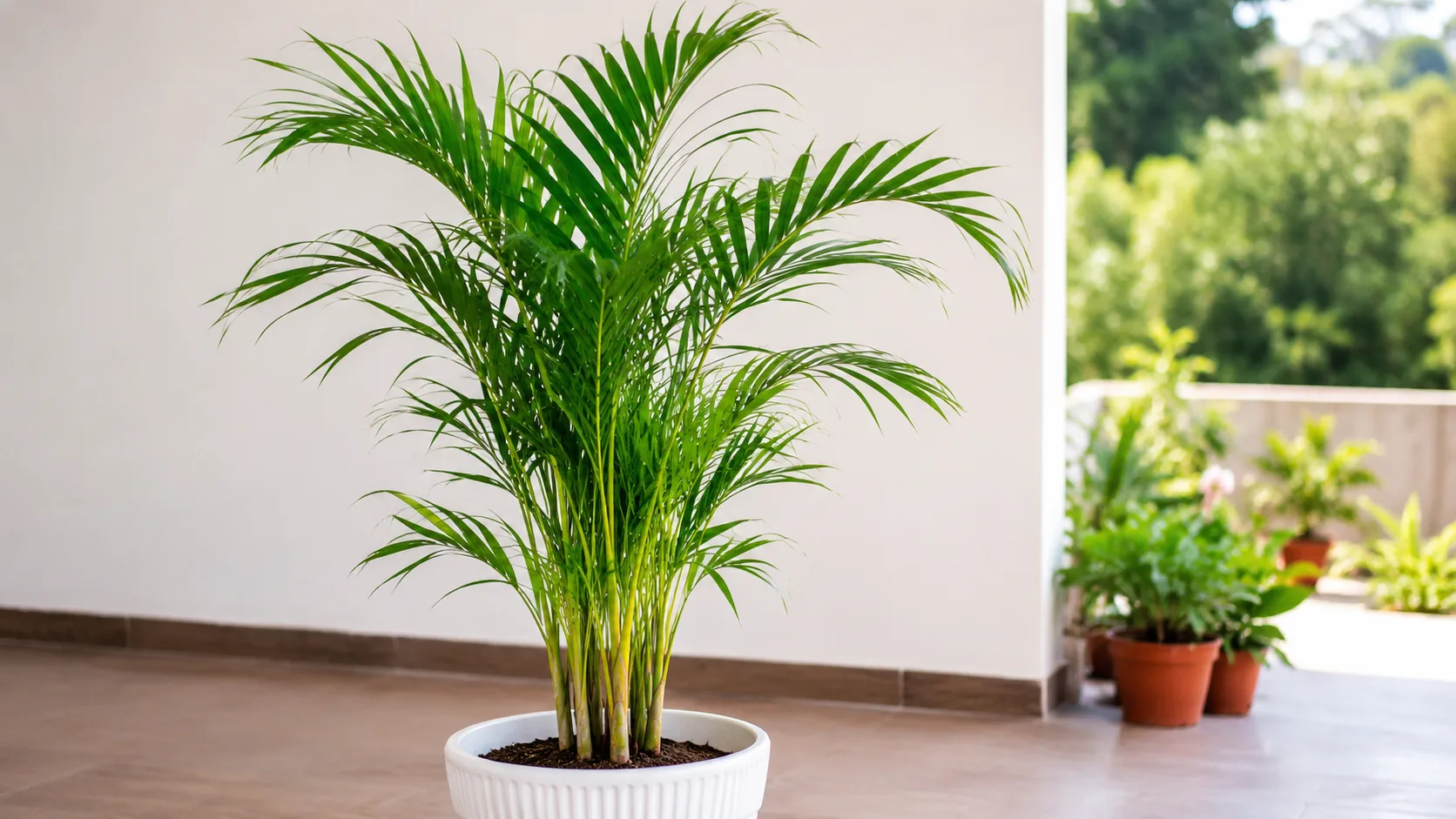
Dypsis lutescens - the plant most people call Areca Palm, Butterfly Palm, or Golden Cane Palm - is one of the few houseplants that genuinely rewards consistent feeding during active growth. Unlike light feeders such as snake plants or ZZ plants, an indoor areca palm pushes out arching fronds from multiple cane stems all season long when light, water, and humidity cooperate. That continuous leaf production consumes nitrogen, potassium, and magnesium faster than a slow-growing succulent ever will. Underfeed it and growth stalls; overfeed it and salt crust appears on the soil before brown tips march up the oldest fronds.
The confusion starts because areca palms also have naturally golden-yellow petioles and leaf bases that look like a deficiency even when the plant is healthy. University of Florida IFAS Extension research on container-grown palms notes that golden-colored petioles on Dypsis lutescens can indicate nitrogen deficiency - but the same coloration is also a normal characteristic of the species. That overlap sends growers chasing fertilizer when the real problem is low humidity, fluoride in tap water, or a pot that never drains. The sections below walk through what to use, how much to dilute it, when to apply it, and how to recover when the dose was too generous.
Why Areca Palms Need More Nutrition Than Most Houseplants
Areca palms are moderate feeders during their active growing season, not heavy feeders year-round and not light feeders you can ignore for six months. Indoors they typically reach 6 to 8 feet in height with a spread of 3 to 5 feet, producing feathery compound fronds from a clump of cane-like stems. Each new frond is a substantial investment in leaf tissue, and a mature clump may carry dozens of fronds at once. Missouri Botanical Garden describes Dypsis lutescens as a clustering palm native to Madagascar that prefers evenly moist, well-drained soil and Areca Palm light guide - conditions that support steady photosynthesis and, therefore, steady nutrient demand.
Container culture changes the math. Every watering leaches minerals from potting mix. Root growth and frond replacement consume what remains. Unlike landscape palms that can draw from a large soil volume, an indoor areca palm in an 8- to 10-inch pot lives in a finite nutrient bank that you must replenish during growth. UF/IFAS Extension notes that nitrogen is the most important limiting element in container palm production because organic potting substrates with high carbon-to-nitrogen ratios cause soil microbes to compete with plant roots for available nitrogen. Areca palms are not starving in rich nursery mix on day one, but after several months of watering without feeding, pale new growth and slowed frond output are common.
The limiting factor is not whether the plant uses nutrients. It is how efficiently those nutrients can be absorbed without salt injury in a confined root zone shared by multiple stems. Fertilizer should follow visible active growth - new spears unfurling, the pot drying slightly faster, fronds holding deep green color - not a rigid calendar divorced from your home’s light and temperature.
Clumping Canes and Constant New Frond Production
An areca palm is not a single trunk. It grows as a clumping palm with many stems arising from one base, each stem capable of producing fronds. That architecture means the root system supports a larger total leaf area than a single-stem houseplant of similar pot size. More leaf area means more transpiration, more photosynthesis when light is adequate, and more ongoing demand for macronutrients during spring and summer.
Palms also have distinct nutrient priorities compared with typical foliage plants. UF/IFAS Extension documents that potassium deficiency is widespread in landscape areca palms, appearing as translucent yellow or orange spotting on the oldest leaflets, often progressing to marginal and tip necrosis. Magnesium deficiency shows as broad chlorotic bands along frond margins while the center stays green, most severe on the oldest leaves. Indoor container palms experience potassium deficiency less often than field-grown specimens, but magnesium can become limiting when potting mix loses its initial dolomite charge after roughly six months in the same container. Understanding palm-specific nutrition explains why a generic “feed all houseplants the same” approach fails here.
The Quick Answer: How to Fertilize Dypsis lutescens
For most established indoor Areca Palms, use a complete balanced liquid houseplant fertilizer at half the label’s indoor rate every two to four weeks during active spring and summer growth, or a palm-specific slow-release granular applied according to label directions at the start of the growing season. Apply liquid feed to already-moist potting mix, water until a little drains from the bottom, discard runoff, and pause feeding from late fall through winter unless the plant is clearly producing new fronds under strong supplemental lighting in a warm room. If you are uncertain about product strength, start at quarter strength for the first one or two applications and watch the next fronds.
There is no universal schedule that overrides the plant. An areca palm in a bright east window pushing new spears monthly can use a modest feed at half strength every three weeks. The same species in moderate office light may need only half-strength applications every six to eight weeks across the entire growing season. UF/IFAS Extension recommends controlled-release fertilizers at the high end of manufacturer rates for container palms, with magnesium supplied through dolomite incorporated into substrate - guidance aimed at nursery production but informative for understanding why palm-specific products include extra potassium and magnesium. For home liquid feeding, half-strength balanced fertilizer on moist soil is the practical default.
| Season | Light level | Suggested approach |
|---|---|---|
| Spring–summer | Bright indirect | Half-strength balanced liquid every 2–4 weeks |
| Spring–summer | Low to moderate | Quarter- to half-strength every 4–6 weeks |
| Fall | Slowing growth | Reduce frequency or stop by late fall |
| Winter | Normal indoor | Pause feeding |
| Winter | Strong grow lights + warmth | Optional quarter-strength every 6–8 weeks if new fronds continue |
Understanding NPK for Areca Palm
Fertilizer labels display three numbers representing the percentage of nitrogen (N), available phosphate (P₂O₅), and soluble potash (K₂O) - commonly shortened to N-P-K. These macronutrients support different plant functions, and palms have a different balance requirement than foliage-focused philodendrons or flowering African violets. The feeding goal for an indoor areca palm is steady frond production, deep green leaflet color, and strong root function without forcing weak, overly soft growth.
Potassium and Magnesium for Palm Fronds
Nitrogen drives chlorophyll production and overall vegetative expansion. Adequate nitrogen keeps new areca palm fronds appropriately sized and green. UF/IFAS research shows that nitrogen-deficient container-grown Dypsis lutescens develops uniformly light green canopy color and reduced growth rate, sometimes with the golden petiole discoloration that overlaps with the plant’s natural coloring. Too much nitrogen without adequate potassium can actually worsen potassium deficiency in palms because high nitrogen pushes growth faster than the root system can supply balanced minerals.
Potassium strengthens fronds, supports water regulation, and helps palms resist environmental stress. On areca palms, potassium deficiency appears first on the oldest fronds as translucent yellow or orange spots, progressing to brown necrotic tips and margins. This pattern - worst on oldest leaves, worst toward leaflet tips - is diagnostic, per the UF/IFAS potassium deficiency primer for palms. Do not confuse it with brown tips caused by fluoride, chlorine, or low humidity, which may affect frond edges regardless of age.
Magnesium is essential for chlorophyll and often becomes limiting in palms held in the same container for extended periods. Magnesium deficiency shows as broad yellow bands along frond margins with the center remaining distinctly green, again most severe on oldest fronds. Magnesium deficiency never causes tip necrosis alone; if tips are necrotic on a magnesium-deficient frond, potassium deficiency is also present. UF/IFAS Extension recommends palm maintenance fertilizers with controlled-release magnesium, such as an 8-2-12+4Mg analysis for landscape palms, because high potassium applications can induce magnesium deficiency when magnesium is not supplied alongside.
Balanced Liquid vs Palm-Specific Formulas
A balanced product such as 10-10-10 or 20-20-20 works well for indoor areca palms when diluted properly. The ratios are identical; the products differ in concentration. One teaspoon of 20-20-20 delivers roughly twice the nutrients of one teaspoon of 10-10-10 in the same volume of water, so follow each label independently.
Palm-specific fertilizers - often labeled for palms, cycads, or tropical landscape plants - typically emphasize potassium and include magnesium. An 8-2-12+4Mg formula reflects what UF/IFAS recommends for field and landscape palm maintenance. Indoor growers rarely need landscape application rates, but choosing a palm-labeled product ensures potassium and magnesium are present rather than relying on a basic balanced formula alone.
Can you use 10-10-10? Yes, if it is labeled for houseplants or you can measure a safe dilution for container culture. For long-term care in the same pot without Areca Palm repotting guide, consider supplementing with occasional Epsom salt flushes or switching to a palm-specific formula that includes magnesium. Granular garden fertilizers designed for broadcast outdoor use are harder to dose accurately in a 10-inch indoor pot. Liquid or water-soluble houseplant products give better control.
Choosing the Best Fertilizer Type
The best fertilizer is one you can measure consistently, dilute accurately, and pause instantly if the plant shows stress. Brand matters less than completeness, clarity of directions, and discipline around concentration.
Liquid vs Slow-Release Granular Fertilizer
Liquid or water-soluble fertilizer is the default recommendation for most indoor areca palm growers. You control the dose per application, reduce strength for a low-light plant, skip a month when growth slows, and stop immediately if salt crust appears. Mix with a measured volume of water - a marked watering can or cap with clear milliliter lines - rather than estimating drops into a partly filled container.
Controlled-release fertilizer (slow-release prills) can work for a stable, warm, brightly lit plant that grows steadily through spring and summer. UF/IFAS research indicates controlled-release fertilizers produce slightly better palm growth response and less nutrient leaching than constant liquid feeding in container production settings. For home use, a single application of palm-specific slow-release granules scratched into the top inch of moist soil at the start of spring may carry the plant through several months. Warm, wet conditions accelerate release; a plant with compromised roots cannot use nutrients just because they are available. Many commercial potting mixes and nursery-grown palms already contain a starter charge. Read the bag before adding another layer.
Organic liquids such as fish emulsion or seaweed blends can be used, but organic labeling does not mean salt-free or impossible to overapply. Check the guaranteed analysis. Seaweed products may supply potassium and trace compounds without a full N-P-K profile. If you choose organic, treat it with the same half-strength mindset and monitor the soil surface for crust.
Complete Micronutrients Matter
Choose a product labeled for houseplants, palms, or indoor foliage that includes micronutrients in addition to the three macronutrients. Iron deficiency in container palms often signals poor root health or compacted, poorly aerated mix rather than absent iron in the fertilizer bottle. Symptoms appear on the newest fronds as uniform yellow-green color or slightly greener veins. Adding more iron without fixing drainage or root rot on Areca Palm does not solve the underlying problem.
A complete fertilizer removes one variable; it does not fix chronic overwatering on Areca Palm. Micronutrients - iron, manganese, zinc, copper, boron, molybdenum - matter in smaller quantities but still affect frond quality. If your areca palm grows in a peat-based mix and receives purified or very low-mineral water, micronutrients become more important because the medium contributes little nutrition on its own.
How Much Fertilizer to Use
Dose control matters more than product selection for Areca Palm. “Half strength” means half the fertilizer quantity in the same final volume of water recommended on the label for houseplants, not half the water with the full product amount. If the label says 1 teaspoon per gallon for indoor plants, half strength is ½ teaspoon per gallon. If you mix a liter at a time, convert proportionally and write the math down once rather than recalculating from memory each month.
Half Strength and Practical Dose Examples
Most credible indoor palm sources recommend 50 percent of label strength as the standard starting point during active growth. Some growers prefer 25 percent (quarter strength) for plants in moderate light, recently purchased nursery specimens, or when the potting mix already contains fertilizer. Quarter strength is the better choice when you are unsure whether the mix already carries a starter charge or controlled-release prills.
Do not combine weak weekly feeding with a separate monthly full dose unless you have calculated total monthly nutrient input. Areca palms should not be watered solely because fertilizer day arrived. Water when the top inch or two of mix feels appropriately dry - roughly every 7 to 10 days in active growth for many homes - and fold feeding into that rhythm rather than overriding it.
Increase concentration only after several successful applications produce normal new fronds with no tip burn, crust, or sudden wilt. Change one variable at a time. Doubling both strength and frequency makes troubleshooting impossible. UF/IFAS Extension notes that liquid fertilization at approximately 200 ppm nitrogen using a 3N-1P-2K complete water-soluble formula is an alternative in production settings; home growers achieve a similar safety margin through half-strength dilution of balanced houseplant products rather than calculating ppm directly.
When to Fertilize Areca Palm
Timing is tied to active growth, not the calendar alone. In many Northern Hemisphere homes, longer days and warmer rooms from mid-spring through summer produce the most new fronds. In equatorial climates, air-conditioned offices, or rooms with grow lights, the calendar may differ. Watch for unfurling spears and firm new petioles rather than assuming March 1 requires fertilizer.
Spring and Summer Feeding Schedule
Begin or resume feeding when the plant shows clear new growth after winter slowdown - unfurling fronds, faster drying pot weight, or brighter new stems. If the plant was recently repotted into mix with a starter nutrient charge, wait several weeks before adding liquid feed unless the label on the mix says otherwise. If the mix is inert and the roots are healthy, a quarter-strength dose can begin once the plant has acclimated.
During active growth, every two to four weeks at half strength is a reliable baseline for a plant in bright indirect light. A plant under strong artificial light that produces fronds year-round may continue on a four- to six-week interval at reduced strength rather than following a hard winter stop.
Never fertilize a dry, wilted, cold, or recently waterlogged plant. Rehydrate with plain water first and let it recover. Fertilizer applied to desiccated roots or damaged tissue increases burn risk. Never feed immediately after discovering root rot, pest infestation, or heat stress - correct the environment first, then resume mild feeding once new growth appears.
Fall and Winter Pause
As day length shortens and indoor temperatures drop, areca palm growth usually slows. Pause fertilizer from late fall through early spring in a typical home without grow lights. The plant’s reduced photosynthetic rate means it cannot use extra nutrients efficiently; unused salts accumulate and damage roots.
Winter feeding is not universally forbidden. If your palm sits under quality grow lights in a room that stays consistently between 65°F and 75°F (18°C to 24°C) and it continues producing full-sized fronds, an optional quarter-strength application every six to eight weeks may be appropriate. The decision follows growth, not guilt about skipping a product. If no new fronds appear for six weeks, plain water is enough.
Step-by-Step Fertilizer Application
Safe feeding is mostly about preparation, concentration, and drainage. Gather a complete liquid fertilizer, a measuring spoon or syringe, a watering can with a narrow spout, and a pot with a drainage hole. Cachepots without drainage trap fertilizer salts at the root zone and should be avoided for routine feeding.
First, check moisture. If the top inch or two of mix is appropriately dry for a normal watering, apply the diluted fertilizer solution evenly across the soil surface rather than pouring one concentrated stream beside the main stems. Water until a small amount exits the drainage hole, then discard the saucer runoff. Never leave the pot standing in fertilizer water that gets reabsorbed.
If the root ball is already moist from a recent plain watering, you may use the fertilizer solution as that watering event - do not pre-saturate and then add another full volume unless drainage and timing justify it. The goal is evenly moist, aerated mix with excess salts carried out, not a prolonged swamp.
Every two to three months during active care, perform a plain-water flush: run several pot volumes of water through the mix and let it drain completely. UF/IFAS Extension and multiple indoor palm guides recommend occasional flushing to dissolve accumulated salts. This matters more in hard-water homes where tap water already contributes mineral deposits before fertilizer adds more dissolved solids.
After repotting, division, or root disturbance, wait until new growth resumes before feeding at reduced strength. Fertilizer does not speed healing of trimmed roots. After pest treatment or heavy pruning of damaged fronds, allow the plant to stabilize. Newly purchased nursery plants may already carry residual controlled-release fertilizer; acclimate for two to four weeks before adding more.
Keep fertilizer off frond surfaces when possible. Wet fertilizer on leaves in direct sun can spot foliage. Routine nutrition should enter through healthy roots, not foliar sprays, which supply negligible amounts of potassium and magnesium relative to what a palm frond requires.
Reading Your Plant’s Response
Healthy response is gradual: new fronds emerge at normal size, leaflets hold deep green color (allowing for the species’ natural golden petioles), stems feel firm, and the clump maintains a full canopy without sudden mass yellowing. Fertilizer rarely produces overnight transformation because the plant must absorb minerals and construct tissue. Judge success by the next two or three fronds, not by expecting old damaged leaflets to revert.
Pale overall color and slow frond production can indicate insufficient nutrition in very old, leached mix, but they also signal low light, root crowding, overwatering, fluoride damage, or cold exposure. Before assuming deficiency, confirm bright indirect light, appropriate watering that allows the top layer to dry, drainage, and firm roots rather than black mush. Then try one reduced application of complete fertilizer and evaluate subsequent fronds.
Use frond age to read deficiency patterns. Problems on the oldest fronds pointing toward potassium or magnesium limitation or salt accumulation. Problems on the newest fronds pointing toward iron deficiency, root dysfunction, or occasionally manganese issues. Problems on all fronds after a recent feed pointing toward fertilizer burn. Problems on tips only with no spotting pattern may reflect water quality or humidity rather than nutrition.
Variegation is not a factor with standard green areca palms, but natural golden petiole color can still mislead beginners. Compare the newest fully expanded frond to one several months old. If older fronds show progressive spotting and necrosis while new growth stays clean, deficiency or salt buildup on aging tissue is likely. If all fronds look uniformly golden at the base with no necrotic progression, you may simply be looking at normal species coloration.
Over-Fertilizing and Salt Recovery
Over-fertilizing is the most common mineral mistake with Areca Palm, and it mimics other problems closely enough to send growers down the wrong path. Typical warning signs include:
- White or tan salt crust on the soil surface or pot rim
- Brown, crisp leaflet tips or margins, sometimes with yellow halos, often worsening on older fronds first
- Sudden frond drop despite moist soil
- Stunted or distorted new frond emergence
- Wilting when roots are damaged by salt concentration even though mix feels wet
If these appear after a recent feed - especially if concentrate was mismeasured or applied to dry soil - stop feeding immediately. Scrape away visible surface crust without damaging shallow roots.
For moderate salt buildup with otherwise healthy roots and good drainage, flush the mix slowly with plain water equal to three to four times the pot volume, allowing complete drainage between passes if the mix drains quickly. Use room-temperature water. Discard all runoff. Do not fertilize again until the plant produces healthy new fronds, typically four to six weeks minimum. Badly burned leaflets will not green up again; recovery shows in new foliage.
For severe overdose, compacted mix, or mushy roots, repot into fresh, well-draining palm-appropriate mix - light, airy, with perlite or coarse components - removing only dead roots. Keep the plant warm with bright indirect light and moderate humidity. Skip fertilizer until established growth returns. If controlled-release prills caused the problem, remove accessible granules during repotting.
Distinguish fertilizer burn from overwatering, which also yellows fronds but usually pairs with a heavy, wet pot, soft stems at the base, and sour-smelling mix. Low humidity and fluoride or chlorine in tap water can brown leaflet tips without any fertilizer involvement; switching to filtered water and raising humidity helps those cases more than stopping feed. Potassium deficiency produces a characteristic spotting pattern on oldest fronds rather than sudden crust after one strong dose. Diagnose the whole care system, not just the last bottle you picked up.
Common Fertilizer Mistakes to Avoid
Feeding at full label strength. Indoor container culture almost always requires reduction for areca palms. Full strength is the fastest route to tip burn and salt crust in a confined pot shared by multiple cane stems.
Applying fertilizer to dry soil. Always moisten a desiccated root ball with plain water before feeding, or apply fertilizer only when the plant is due for a normal watering on already-approaching-dry mix.
Feeding on a calendar regardless of growth. A plant in a dim hallway in February does not need nutrients it cannot use. Feed the growth you see.
Using slow-release prills in every repot without reading the mix label. Double-dosing starter charge plus prills plus monthly liquid feed stacks salts quickly.
Confusing natural golden petioles with nitrogen deficiency. Not every yellow base needs more nitrogen. Look for uniform canopy chlorosis and reduced growth rate before increasing feed.
High nitrogen without adequate potassium. Pushing nitrogen hard on palms can worsen potassium imbalance. Choose complete or palm-specific formulas rather than lawn-grade high-nitrogen products.
Foliar feeding as a shortcut. Routine nutrition should enter through healthy roots. Wet fertilizer on fronds in sun can spot foliage and does not supply the potassium and magnesium volumes palm fronds require.
Doubling up after a missed month. Two half-strength doses in one week is not the same as one skipped month. Resume the normal interval at standard dilution.
Ignoring water quality. Hard tap water with fluoride leaves mineral deposits; fertilizer adds more dissolved solids. Occasional flushing matters more in municipal tap-water homes. Royal Horticultural Society notes that areca palms can be sensitive to chemicals in tap water.
Fertilizing immediately after repotting or division. Wait for functional roots and visible new growth. Disturbed root systems cannot use normal doses efficiently.
Treating every brown tip as a fertilizer problem. Brown tips often reflect humidity, water chemistry, or inconsistent watering. Adding fertilizer to a plant stressed by soggy soil makes recovery harder.
Conclusion
Areca Palm fertilizer success comes down to consistent but restrained feeding matched to real growth. Choose a complete balanced liquid houseplant formula or palm-specific product with adequate potassium and magnesium, dilute it to half strength or lower, and apply it about every two to four weeks during spring and summer while new fronds are forming. Pause in fall and winter unless strong light and warmth keep the plant actively growing. Water before you feed, flush salts every few months, and discard drainage runoff so minerals do not cycle back into the root zone.
Dypsis lutescens rewards balanced care in light, watering, humidity, and drainage far more than aggressive feeding. Measure every dose, read the next fronds for feedback, and when symptoms blur between too much food and too much water, check roots and soil before reaching for the bottle again. That approach keeps the arching, feathery canopy this palm is known for - without the brown tips and salt crust that turn a straightforward feeding routine into an unnecessary rescue mission.
When to use this page vs other Areca Palm guides
- Areca Palm overview - Start here for whole-plant context before deep-diving this topic.
- Areca Palm problems hub - Jump to symptom-specific fix guides when this care topic does not resolve the issue.
Related Areca Palm guides
- Areca Palm overview
- Areca Palm watering
- Areca Palm light
- Areca Palm soil
- Areca Palm propagation
- Areca Palm repotting
- Areca Palm problems
Related tool
Try the Fertilizer Dilution Calculator with areca-palm pre-selected to estimate needs for your setup.