Corn Plant Care: Light, Water, Soil & Tips
Dracaena fragrans
Corn plant tolerates low light and needs watering every 1–2 weeks when the top two inches dry out. Switch to filtered water to prevent fluoride-induced brown tips. Toxic to pets.
Corn Plant Care: Light, Water, Soil & Tips
Start with wateringThe most common care mistake for Corn PlantWatering guide →Corn Plant care essentials
Light
medium to bright indirect light, low light
Water
Water when the top half of soil is dry; very sensitive to fluoride in tap water.
Soil
Well-draining loamy potting mix with perlite.
Humidity
Average household humidity (40–50%)
Temperature
18°C to 27°C (65–80°F)
Fertilizer
Feed lightly during active growth. Use monthly during spring and summer..
About Corn Plant
Corn Plant has a upright growth habit.
| Detail | Information |
|---|---|
| Growth habit | Upright |
| Scientific name | Dracaena fragrans |
Corn Plant Care: Light, Water, Soil & Tips
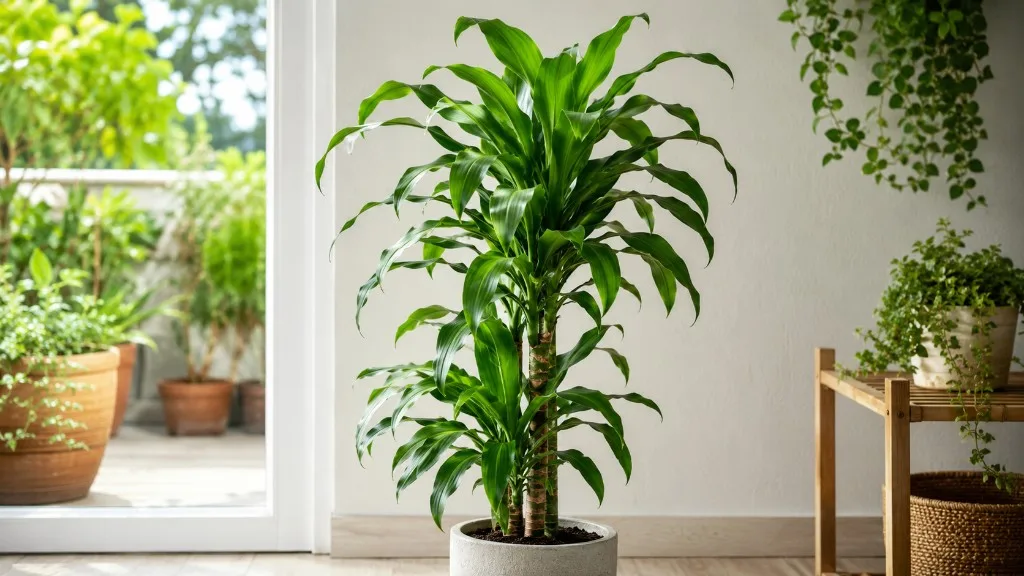
Corn plant is one of those houseplants that looks indestructible until it isn’t. The thick woody canes and broad strap-shaped leaves suggest a plant that can shrug off neglect, and in many ways it can - Dracaena fragrans tolerates low light, irregular watering, and the dry air of heated apartments better than most tropical foliage plants. But that same toughness hides a few non-negotiable needs. Get the water chemistry wrong and the leaf tips crisp within weeks. Keep the roots wet in a dim corner and the cane softens from the inside out. Place it in hot afternoon sun and the variegation that sold you on the plant scorches to brown patches before you figure out what happened.
The useful mental model is simple: corn plant is a montane forest understory plant from tropical Africa, not a desert succulent and not a swamp dweller. It wants filtered light, a real dry-down between waterings, and water that won’t accumulate fluoride and salts at the leaf margins. Match those three facts to your home and the rest of indoor care - feeding, Corn Plant repotting guide, pruning, propagation - becomes straightforward maintenance rather than constant rescue work.
What Is Corn Plant?
Corn plant (Dracaena fragrans) is a slow-growing, cane-forming evergreen shrub in the Asparagaceae family. Its common names - cornstalk dracaena, mass cane, Chinese money tree, fortune plant - all refer to the same basic growth habit: one or more upright, largely unbranched stems topped with a rosette of arching leaves that resemble corn foliage on a thick stalk. In commerce, the yellow-striped cultivar ‘Massangeana’ is so dominant that many people use “mass cane” and “corn plant” interchangeably, even though other cultivars exist with entirely different leaf coloring.
Indoors, corn plant is valued for architectural height, tolerance of office fluorescent lighting, and a polished tropical look that does not demand daily attention. Outdoors, it grows as a hedge plant in frost-free climates across USDA hardiness zones 10–11, but for most readers this is a container houseplant that may live in the same pot for years and gradually become a floor specimen taller than the furniture around it.
Botanical Background and Native Range
Dracaena fragrans is native to tropical Africa, with a range stretching from West Africa through Central and East Africa to Mozambique and Angola. In the wild it grows in the understory of montane forest at elevations between roughly 900 and 2,000 meters (about 3,000–6,600 feet). That origin explains almost everything about its indoor behavior. Montane understory plants receive dappled, indirect light filtered through a canopy. They experience steady warmth without extreme heat, cool nights, and seasonal rainfall patterns where the soil drains freely through leaf litter and organic matter.
The species name fragrans refers to the fragrant night-blooming flowers the plant produces in its native habitat - white to pale purple tubular blooms that open in the evening to attract moths and other nocturnal pollinators. Indoors, flowering is rare and usually requires a mature, well-lit plant that has been stable for many years. Do not buy a corn plant expecting blooms; treat flowering as a bonus, not a baseline.
Mature wild plants can reach 6 meters (about 20 feet) or more in favorable outdoor conditions. Indoor specimens grow far more slowly, typically reaching 4–6 feet within a few years and potentially 6–15 feet over a decade or more in a bright room with consistent care. Growth is upright and largely unbranched unless you prune the cane or propagate sections that sprout side shoots from dormant buds along the stem.
Popular Cultivars and What Changes Indoors
Not every corn plant at the nursery is the same plant. Several cultivars are sold under the Dracaena fragrans umbrella, and the variegation pattern changes how the plant responds to light.
‘Massangeana’ (mass cane) is the classic yellow-centered stripe cultivar. The bright chartreuse band down the middle of each leaf is the reason most people buy Corn Plant overview, and it is also the first feature to fade when light is too dim. In a dark hallway, mass cane survives but the stripe dulls toward solid green and new leaves may emerge smaller and more widely spaced along the cane.
‘Janet Craig’ has solid dark green leaves without the central stripe. It tolerates lower light more gracefully than variegated forms because it is not trying to maintain a chlorophyll-deficient leaf zone that needs brighter exposure to stay vivid.
‘Lemon Lime’ carries yellow-green margins with a darker green center - essentially the inverse color pattern of Massangeana. It tends to want slightly brighter light than solid-green forms to keep the contrast sharp.
‘Compacta’ is a dwarf form with smaller, flatter leaves suited to tabletops and shorter displays. It follows the same care rules but grows more slowly and stays manageable longer.
‘Warneckei’ (sometimes listed under the older name D. deremensis) has gray-green leaves with white stripes and similar light needs to other variegated dracaenas. When you are troubleshooting a struggling plant, confirming which cultivar you have matters because a variegated form in low light will look unhealthy long before a solid-green Janet Craig shows stress.
Best Growing Conditions for Corn Plant
Corn plant care reduces to four environmental decisions that interact constantly: light, water, soil, and temperature. Nail those four and feeding, repotting, and pest management stay minor. Get any one badly wrong - especially water in relation to light - and no amount of fertilizer or leaf polishing fixes the underlying problem.
The plant’s thick cane stores water, which is an adaptation to surviving dry spells in its native forest floor. That storage capacity is why corn plant can look fine for weeks while roots sit in soggy mix, then collapse suddenly when the lower stem rots through. Respect the dry-down. Respect the drainage. The cane is not a license to water on autopilot.
Light Requirements
Corn plant performs best in bright indirect light protected from prolonged direct sun. An east-facing window, a few feet back from a south- or west-facing window, or a north window in a bright room all work well. The target is strong ambient light that reaches the leaf surface without the plant sitting in direct sunbeams for hours at a time.
Bright indirect light produces the firmest new growth, the strongest variegation on Massangeana, and the most predictable Corn Plant watering guide because the plant actively uses moisture. Low light - a dim corner, a hallway with a single ceiling fixture, a fluorescent office with no windows - is survivable for years, which is why corn plant became an office staple. But survival is not thriving. In low light, internodes stretch, leaves thin, variegation fades, and the pot dries so slowly that overwatering on Corn Plant becomes the default risk even for careful growers.
Direct sun is the one exposure corn plant handles poorly without acclimation. Hot afternoon sun through an unfiltered west window scorches leaves to bleached patches and crisp brown edges within days. If you want to move a plant closer to a bright window, do it gradually over one to two weeks and watch the newest leaves for color change before committing to the new spot.
A practical diagnostic: judge light by new growth, not old leaves. Old damage does not heal, but the newest unfurling leaf should be firm, appropriately colored for your cultivar, and attached to a cane that is not leaning dramatically toward the window. Rotate the pot a quarter turn every two to three weeks so the cane grows upright rather than bowing permanently toward the light source.
Temperature and Humidity
Corn plant prefers stable indoor temperatures in the range of 65–80°F (18–27°C) during the day, with slightly cooler nights. It tolerates normal household conditions well, which is one reason it has remained popular since the Victorian era. The problems start at the margins: sustained temperatures below 55°F (13°C) cause chilling injury - dark water-soaked patches on leaves, stalled growth, and increased susceptibility to root problems. Drafts from poorly sealed winter windows, air conditioning vents blowing directly on the foliage, and placement directly above a heat register all create microclimates that look fine to you but stress the plant within hours.
Humidity matters less for corn plant than for true rainforest floor plants like calatheas, but it still affects leaf-tip health. Average household humidity of 40–50% is acceptable. When winter heating drops humidity below 30% for weeks, leaf tips brown faster - especially if fluoride and salt stress are already present. A pebble tray with the pot sitting above the water line, grouping plants together, or a small cool-mist humidifier targeting 45–55% relative humidity all help more reliably than misting, which raises humidity for minutes and can leave wet leaf surfaces that invite fungal spotting.
Soil and Drainage
Use a well-draining loamy potting mix with perlite - roughly 60–70% quality peat- or coco-based potting soil blended with 30–40% perlite, with optional additions of orchid bark or coarse pumice for extra aeration in large pots that dry slowly. The mix should hold enough moisture that roots do not desiccate between waterings, but drain freely enough that water does not pool around the root ball for days.
Every pot needs a drainage hole. Decorative cachepots are fine as long as you empty runoff after watering. Stones at the bottom of a pot do not create a drainage layer; they create a perched water table that keeps the lower root zone wetter than the mix above. Skip the gravel layer and invest in an open mix instead.
Corn plant tolerates a normal houseplant pH range of roughly 6.0–6.5 without fuss. Exact pH adjustment is rarely necessary in home cultivation. What does matter is salt accumulation from tap water minerals and repeated fertilizer application. If white crust forms on the soil surface or leaf tips brown despite good watering habits, flush the pot with plain low-mineral water until runoff flows clear, or refresh the mix at the next repot.
How to Water Corn Plant
The single most important daily care decision for corn plant is when to water, not how much in the abstract. The reliable rule: water when the top 50% of the potting mix is dry - roughly the top 2 inches in a standard indoor container. Check with a finger, a wooden skewer, or pot weight before every watering. If the deeper mix is still cool and damp, wait. If the top half is dry and the pot feels noticeably lighter, water thoroughly until excess runs from the drainage holes, then empty the saucer so the plant is not sitting in standing water.
Corn plant is more drought-tolerant than most people assume and more rot-sensitive than its tough appearance suggests. The wide leaves look thirsty. The thick cane says otherwise. Overwatering - keeping the mix continuously moist, watering on a fixed weekly schedule without checking, or leaving runoff in a cachepot - is the leading cause of yellow leaves, soft canes, and root rot on Corn Plant.
Water Quality and Fluoride Sensitivity
Here is the care detail that separates a good corn plant from a perpetually brown-tipped one: water chemistry. Dracaena species are highly sensitive to fluoride, chlorine, and excess mineral salts commonly found in municipal tap water. Fluoride accumulates at leaf margins and produces the crispy brown tips that generate more corn plant troubleshooting searches than any other symptom. Chlorine causes similar marginal burn over time, and calcium and magnesium salts build up in the soil until even correct watering produces tip damage.
The best water sources, in order of reliability for dracaenas:
- Rainwater collected from a clean surface
- Distilled water or reverse-osmosis filtered water
- Filtered water through a carbon filter that reduces chlorine and some minerals
- Tap water left to stand 24 hours, which off-gasses some chlorine but does not remove fluoride
If you must use tap water and tips keep browning despite correct moisture management, switching water sources is the fix - not more misting, not more fertilizer, not trimming alone. Flush the soil every two to three months by running several pot-volumes of low-mineral water through the mix to wash accumulated salts out of the root zone. Do this in a sink or outdoors and let the pot drain fully before returning it to its spot.
Seasonal Watering Adjustments
Corn plant does not use water at the same rate year-round. During active growth - typically spring through early fall when light is stronger and temperatures are warmer - the pot dries faster and the plant can handle a shorter interval between thorough waterings. During cooler, darker months, growth slows and the same volume of mix may take two to three times longer to dry. Watering on your summer schedule through winter is one of the fastest paths to root rot.
Adjust by checking the soil, not the calendar. A corn plant under a grow light in a heated room may dry quickly even in January. A plant in a dim north-facing room in a cool office may need water only every two to three weeks in summer and even less in winter. Reduce or pause fertilizer during slow-growth periods and never compensate for winter dormancy by watering more often - that is the plant’s way of telling you it is resting, not that it is thirsty.
Watch for the link between light changes and watering. Move a plant from a dim corner to a bright window and the drying rate increases immediately. Move it to lower light and stretch the interval before the next watering, even if the move happened mid-season.
How to Feed Corn Plant
Corn plant is a light feeder. It does not need heavy fertilization to look good, and excess fertilizer causes more problems than deficiency in typical indoor settings. During active growth, apply a balanced water-soluble houseplant fertilizer - something in the range of 10-10-10 or 20-20-20 - at one-quarter to one-half the label dilution rate every four to six weeks. Always apply to already-moist soil so the nutrient solution distributes through the root zone without concentrating and burning fine roots.
If your potting mix includes a slow-release starter charge, hold off on supplemental feeding for the first four to six weeks after repotting. The plant has access to embedded nutrients and its root system may still be recovering from the transplant.
Pause feeding when any of the following apply: the plant is in obvious winter dormancy with no new growth, you have just repotted into fresh mix, the plant is recovering from root rot or a pest infestation, or leaf tips are actively browning from salt stress. Feeding a plant that cannot metabolize nutrients adds salt to an already stressed system. Resume at half strength only when new growth is visible and the watering rhythm has stabilized.
Yellowing on older lower leaves while new growth at the top looks healthy is often normal senescence, not a hunger signal. Do not reflexively fertilize every yellow leaf - check moisture and light first, then consider whether the plant has been in the same depleted mix for more than two years.
Repotting and Root Health
Repot corn plant every one to two years, or when clear physical signs appear: roots circling the drainage holes, roots pushing up through the soil surface, water running straight through the pot without soaking in, or the plant becoming top-heavy and unstable. The best timing is early in the active growing season - spring in the Northern Hemisphere - so the plant has months of warmth and light to re-establish roots before winter slowdown.
Move up only one pot size at a time, typically 1–2 inches wider in diameter. Corn plant roots are relatively compact for the size of the above-ground cane, and an oversized pot holds excess wet mix that the root system cannot use. That unused wet volume is where post-repot root rot begins. Use fresh well-draining mix, maintain the same planting depth - do not bury the cane deeper than it was growing before - and water lightly for the first week while cut or disturbed roots callus over.
Healthy corn plant roots are firm, whitish to tan, and hold the mix in a cohesive ball when you gently remove the pot. Brown, black, mushy, or foul-smelling roots indicate rot and require trimming back to healthy tissue with clean shears, a repot into fresh mix, and a careful dry-down period before resuming normal watering. If the lower cane feels soft and wrinkled when you squeeze it gently, root rot has likely advanced into the stem tissue. Salvage is sometimes possible by taking a firm cane section above the soft zone and propagating it as a cutting, but the original root system may be beyond recovery.
Pruning and Shaping
Corn plant rarely needs frequent pruning, but it responds well to purposeful cuts when height, legginess, or bare cane needs correction. The plant has dormant buds along the cane that can activate after pruning, producing new shoots and leaves below the cut point. That is how a single bare stalk becomes a fuller, multi-headed floor plant over time.
To reduce height, cut the cane at the desired level with clean, sharp pruners. Make the cut just above a leaf scar or node line where you can see a subtle ring on the cane surface. New growth typically emerges from buds near that cut within weeks to months depending on light and season. You can remove individual yellowing or damaged leaves at the base where they attach to the cane - pull gently downward and they usually detach cleanly.
Do not trim brown tips back to green tissue as your only intervention. Snipping the crispy margin removes the cosmetic damage but does not fix fluoride burn, salt buildup, or underwatering on Corn Plant stress. Trim tips if they bother you aesthetically, cutting at an angle that follows the natural leaf shape, but address the water source and watering rhythm simultaneously or the tips will return on every new leaf.
If the plant has grown toward one side, rotation is gentler than pruning. A quarter turn every few weeks produces a straighter cane than reactive pruning after the plant has already leaned permanently.
Propagation Methods for Corn Plant
The most reliable home propagation methods for corn plant are stem cuttings and cane sections. Air layering works on thick canes if you want roots to form before severing, but stem cuttings are simpler for most growers. Division is uncommon because most nursery corn plants are sold as single-caned specimens rather than multi-stem clumps, though mature plants occasionally produce offset shoots at the base that can be separated with their own roots intact.
Always propagate from healthy, firm cane tissue during active growth. Stressed, pest-infested, or rot-compromised material carries those problems into every new plant you create.
Stem Cuttings Step by Step
- Select a firm cane section with healthy leaves at the top. For a tall plant you want to shorten anyway, the top 6–12 inches above a cut becomes your cutting.
- Cut with clean, sharp pruners at a slight angle. If you are also reducing the parent plant’s height, cut the parent cane first and let it sit; new buds will sprout below the cut while you root the top section.
- Optional: take cane sections - 3-inch segments of bare cane with at least one node ring visible - and lay them horizontally in moist mix or stand them vertically with the bottom third buried. Each section with a viable bud can produce a new shoot.
- Root the top cutting in a moist, well-draining medium or in water changed weekly. Water propagation works but transfer to mix once roots reach 1–2 inches, since dracaenas transition more reliably to soil when roots are young.
- Place in bright indirect light with stable warmth. Avoid direct sun on a cutting with no established root system.
- Keep the medium lightly moist, not wet. Rot is the main failure mode. No fertilizer until new growth appears.
- Expect rooting in four to eight weeks during warm, bright conditions. Cool or dim setups may take longer. New leaf growth is the sign that roots are functioning.
Common Corn Plant Problems
Most corn plant problems trace back to a short list of environmental causes. The skill is reading which leaves are affected, how fast symptoms appeared, and what changed recently in light, water, or placement. Randomly adjusting everything at once makes diagnosis harder, not easier.
Brown Tips, Yellow Leaves, and Pests
Brown leaf tips are the signature corn plant complaint. The most common causes, in order of frequency indoors:
- Fluoride and mineral salts in tap water accumulating at leaf margins
- Low humidity combined with existing salt stress, accelerating tip burn in winter
- Inconsistent watering - repeated drought cycles followed by heavy soaking
- Fertilizer salt buildup from overfeeding or feeding on dry soil
- Physical damage from brushing against doorways or moving the plant
Fix brown tips by correcting the cause first, then trimming existing damage for appearance. Switch water sources before buying a humidifier. Flush salts before increasing fertilizer.
Yellow leaves require a different diagnostic path. Lower leaves yellowing one at a time while the top stays green is often normal aging - shed the oldest leaf and move on. Multiple leaves yellowing at once, especially with soft cane tissue or sour-smelling soil, points to overwatering and root rot. Uniform pale yellowing on new growth can indicate too little light or nutrient deficiency in depleted mix. Sudden yellowing after a move may be acclimation stress from light or temperature change.
Pests are less common on corn plant than on softer-leaved tropicals, but dry winter air invites spider mites - look for fine webbing and stippled yellow dots on leaf surfaces. Mealybugs hide in leaf axils and along the cane as white cottony masses. Scale appears as immobile brown bumps on stems. Fungus gnats signal persistently wet surface soil. Inspect weekly, isolate infested plants, and treat early with manual removal, insecticidal soap, or horticultural oil applied to leaf undersides and stem joints according to label directions.
Is Corn Plant Safe for Pets?
No. Corn plant is toxic to cats and dogs. The ASPCA lists Dracaena fragrans as toxic to dogs, cats, and horses. The toxic compounds are saponins, which cause vomiting (occasionally with blood), hypersalivation, loss of appetite, and depression in dogs and cats. Cats may also develop dilated pupils. Larger ingestions can produce weakness and lack of coordination.
Corn plant is moderately toxic, not typically life-threatening in small nibbles, but any confirmed ingestion warrants attention. Contact your veterinarian or the ASPCA Animal Poison Control Center at (888) 426-4435 if your pet has chewed leaves or stems. Do not wait for severe symptoms to appear before seeking guidance.
Practical placement matters more than hope. Keep corn plant on a sturdy stand out of jumping range, in a room pets do not access unsupervised, or behind a physical barrier. Chewing houseplants is a common cat behavior; assuming your pet will “learn to leave it alone” is a gamble with a plant that is on every major toxic plant list.
Conclusion
Corn plant rewards a specific care rhythm more than constant attention. Give it medium to bright indirect light, a well-draining mix that dries halfway down between waterings, low-fluoride water, and stable room temperatures away from cold drafts and heat blasts. Feed lightly during active growth, repot on a modest schedule without oversizing the container, and prune or propagate from firm cane when height needs managing.
When something goes wrong, check water chemistry and soil moisture before anything else - brown tips and yellow leaves both start there more often than beginners expect. Confirm your cultivar so you know whether fading variegation is a light problem or normal behavior for a solid-green form. Keep the plant away from pets because saponin toxicity is real and documented. Get those fundamentals right and Dracaena fragrans becomes one of the most reliable tall foliage plants you can grow indoors - not because it demands perfection, but because it asks for a few specific conditions and holds you accountable when you miss them.
When to use this page vs other Corn Plant guides
- Corn Plant overview - Canonical hub for this species - care topics and problems branch from here.
- Corn Plant problems - Symptom-first path when you already know something is wrong.
Related Corn Plant guides
How to care for Corn Plant?
How much light does Corn Plant need?
medium to bright indirect light, low light
- medium to bright indirect light, low light - medium to bright indirect light, low light.
When should you water Corn Plant?
Water when the top half of soil is dry; very sensitive to fluoride in tap water.
- Check top 2 inches - Water when the top half of soil is dry; very sensitive to fluoride in tap water.
- Drain excess water - Water when the top half of soil is dry; very sensitive to fluoride in tap water.
What soil works best for Corn Plant?
Well-draining loamy potting mix with perlite.
- Well-draining mix - Well-draining loamy potting mix with perlite.
Grower notes for Corn Plant
What matters most with Corn Plant
Corn Plant is easiest to grow when you judge the whole plant: new growth, root-zone moisture, light exposure, and how quickly the pot dries after watering. In practice, the care checkpoint is simple: medium to bright indirect light, low light. Pair that with well-draining loamy potting mix with perlite, and avoid changing water, pot size, and placement all at once.
Best placement in a real home
Corn Plant belongs where medium to bright indirect light, low light is realistic for most of the day, not only where the pot looks good. Water when the top half of soil is dry; very sensitive to fluoride in tap water. If the pot stays wet longer than expected, move the plant into better light or reassess the mix before watering again. Humidity target: Average household humidity (40–50%).. Temperature comfort zone: 18°C to 27°C (65–80°F).
Before you buy this plant
Choose Corn Plant with firm new growth, clean leaf undersides, and soil that does not smell sour or feel compacted. Be cautious if you see brown-tips, sticky residue, collapsed crowns, or a pot that is wet in poor light. Cosmetic old-leaf damage is less worrying than weak roots or active pests.
First month after bringing it home
Do not repot Corn Plant on day one unless the mix is failing or pests are obvious. Quarantine it, learn how fast the pot dries, and keep care boring while it adjusts. Watch especially for brown-tips and yellow-leaves. If problems appear, correct the condition first rather than stacking fertilizer, repotting, and pruning together.
Safety note for Corn Plant
Corn Plant is not a plant to keep within reach of pets or children. Treat it as an inaccessible display plant. Use gloves if sap or plant tissue is irritating, and pick a pet-safe alternative for floor pots or low shelves.
How to tell Corn Plant is settling in
If you plan to multiply it later, common methods include Stem cuttings and Cane sections. If yellow-leaves shows up early, inspect light, watering, and roots before assuming the plant is permanently weak.
Is it pet safe?
Corn Plant is toxic to cats and dogs.
Toxic to cats and dogs; causes vomiting, drooling, and loss of appetite.
Watering Corn Plant
Water when the top half of soil is dry; very sensitive to fluoride in tap water.
Soil & potting for Corn Plant
Well-draining loamy potting mix with perlite.
Humidity & temperature for Corn Plant
Corn Plant prefers average household humidity (40–50%), though normal home humidity is usually fine. Keep temperatures around 18°C to 27°C (65–80°F).
| Detail | Information |
|---|---|
| Humidity | Average household humidity (40–50%) - normal home humidity is fine. |
| Ideal temperature | 18°C to 27°C (65–80°F) |
Fertilizer & pruning for Corn Plant
Use feed lightly during active growth. Use monthly during spring and summer.. for Corn Plant.
| Detail | Information |
|---|---|
| Fertilizer type | Feed lightly during active growth. Use monthly during spring and summer.. |
Common problems on Corn Plant
Brown Tips
HighLikely cause: Fluoride toxicity from tap water or low humidity
Quick fix: Switch to filtered or rainwater and increase humidity
Full fix guide →Yellow Leaves
MediumLikely cause: Overwatering or normal shedding of lower leaves
Quick fix: Allow soil to dry and check root health
Full fix guide →Root Rot
MediumLikely cause: Common on this plant type; confirm with recent watering, light, and root checks.
Quick fix: Inspect the plant and correct the most likely care stressor before stacking treatments.
Full fix guide →Overwatering
MediumLikely cause: Common on this plant type; confirm with recent watering, light, and root checks.
Quick fix: Inspect the plant and correct the most likely care stressor before stacking treatments.
Full fix guide →Underwatering
MediumLikely cause: Common on this plant type; confirm with recent watering, light, and root checks.
Quick fix: Inspect the plant and correct the most likely care stressor before stacking treatments.
Full fix guide →Spider Mites
MediumLikely cause: Common on this plant type; confirm with recent watering, light, and root checks.
Quick fix: Inspect the plant and correct the most likely care stressor before stacking treatments.
Full fix guide →Mealybugs
MediumLikely cause: Common on this plant type; confirm with recent watering, light, and root checks.
Quick fix: Inspect the plant and correct the most likely care stressor before stacking treatments.
Full fix guide →Aphids
MediumLikely cause: Common on this plant type; confirm with recent watering, light, and root checks.
Quick fix: Inspect the plant and correct the most likely care stressor before stacking treatments.
Full fix guide →Leggy Growth
MediumLikely cause: Common on this plant type; confirm with recent watering, light, and root checks.
Quick fix: Inspect the plant and correct the most likely care stressor before stacking treatments.
Full fix guide →Slow Growth
MediumLikely cause: Common on this plant type; confirm with recent watering, light, and root checks.
Quick fix: Inspect the plant and correct the most likely care stressor before stacking treatments.
Full fix guide →Wilting
MediumLikely cause: Common on this plant type; confirm with recent watering, light, and root checks.
Quick fix: Inspect the plant and correct the most likely care stressor before stacking treatments.
Full fix guide →Drooping Leaves
MediumLikely cause: Common on this plant type; confirm with recent watering, light, and root checks.
Quick fix: Inspect the plant and correct the most likely care stressor before stacking treatments.
Full fix guide →Low Humidity
MediumLikely cause: Common on this plant type; confirm with recent watering, light, and root checks.
Quick fix: Inspect the plant and correct the most likely care stressor before stacking treatments.
Full fix guide →Not Enough Light
MediumLikely cause: Common on this plant type; confirm with recent watering, light, and root checks.
Quick fix: Inspect the plant and correct the most likely care stressor before stacking treatments.
Full fix guide →Fungus Gnats
MediumLikely cause: Common on this plant type; confirm with recent watering, light, and root checks.
Quick fix: Inspect the plant and correct the most likely care stressor before stacking treatments.
Full fix guide →Mold on Soil
MediumLikely cause: Common on this plant type; confirm with recent watering, light, and root checks.
Quick fix: Inspect the plant and correct the most likely care stressor before stacking treatments.
Full fix guide →