Spider Mites on Corn Plant: Causes, Checks & Fixes
Quick answer
Spider mites on Corn Plant cause scattered yellow stippling on arching strap leaves and fine webbing at crown whorls, especially near sunny windows and HVAC vents. First step: isolate the plant and rinse every leaf underside with lukewarm water before applying any spray.
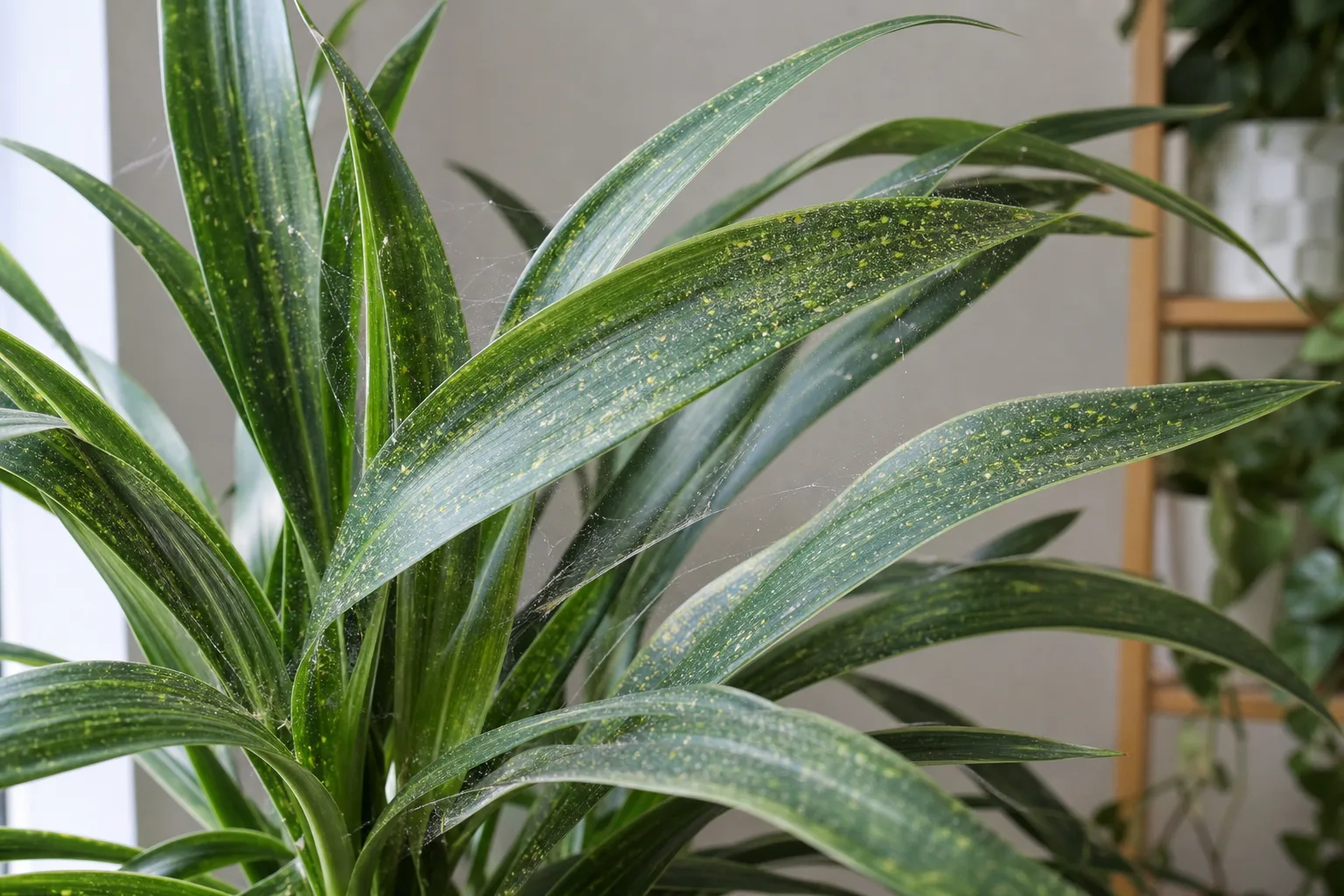
Spider Mites on Corn Plant: Causes, Checks & Fixes
This guide covers spider mites on Corn Plant. See also the general Spider Mites guide, watering, and light pages for this plant.
Spider Mites on Corn Plant: Causes, Checks & Fixes
Quick answer
Spider mites on Corn Plant (Dracaena fragrans-mass cane, Janet Craig, and related cultivars) are tiny sap-feeding arachnids that leave scattered yellow or white stippling on broad strap leaves and spin fine silk webbing at the crown whorl where new foliage emerges. Clemson HGIC lists scale and mites as the main insect pests of dracaena, and on this upright cane plant damage usually appears on the top whorl first, not on the bare woody stems below.
First step: isolate the pot and rinse every strap leaf underside with a forceful stream of lukewarm water. Corn Plant leaves are smooth, arching, and easy to lift for thorough underside coverage-unlike fuzzy or deeply cupped houseplant foliage. Confirm live mites with a tap test over white paper before you reach for sprays. One rinse rarely clears an outbreak, but isolation plus washing is the correct day-one move.
Why Corn Plant gets spider mites
Spider mites pierce individual leaf cells and suck chlorophyll, leaving pale pinprick speckles where feeding occurred. University of Minnesota Extension describes feeding damage as a stippled or mottled appearance that yellows leaves and can trigger drop when populations build in warm, dry indoor air.
Corn Plant tolerates office low light and heated-apartment dry air better than humidity-demanding species like Calathea, but mite risk is placement-specific, not species-fragile. Floor specimens beside sunny south-facing glass, HVAC vents, or space heaters sit in microclimates far drier than the room average. Extension guidance consistently links spider mites to warm, dry indoor environments-exactly the winter conditions around a tall Massangeana in a drafty corner.
Several D. fragrans traits make outbreaks easy to miss early. The plant stores water in its thick cane, so moderate mite feeding can run for weeks before stippling spreads across multiple strap leaves. Owners water at the soil line while colonies hide above eye level in the crown. Lower leaves die off over time on mature canes, leaving bare tan stems-mites stay on live foliage at the top, not on woody tissue below. Multi-cane pots need each crown checked separately because mites walk across touching strap leaves but rarely colonize bare cane between whorls.
Variegated Dracaena fragrans ‘Massangeana’ shows stippling first on the yellow central stripe, where thinner chlorophyll tissue bleaches to pale freckles before solid-green Janet Craig leaves show obvious damage. Dusty strap leaves in dry rooms attract mites faster than clean foliage-UMN yard-and-garden guidance notes that dust on leaves reduces light and attracts spider mites.
What spider mites look like on Corn Plant
Early feeding on strap leaves:
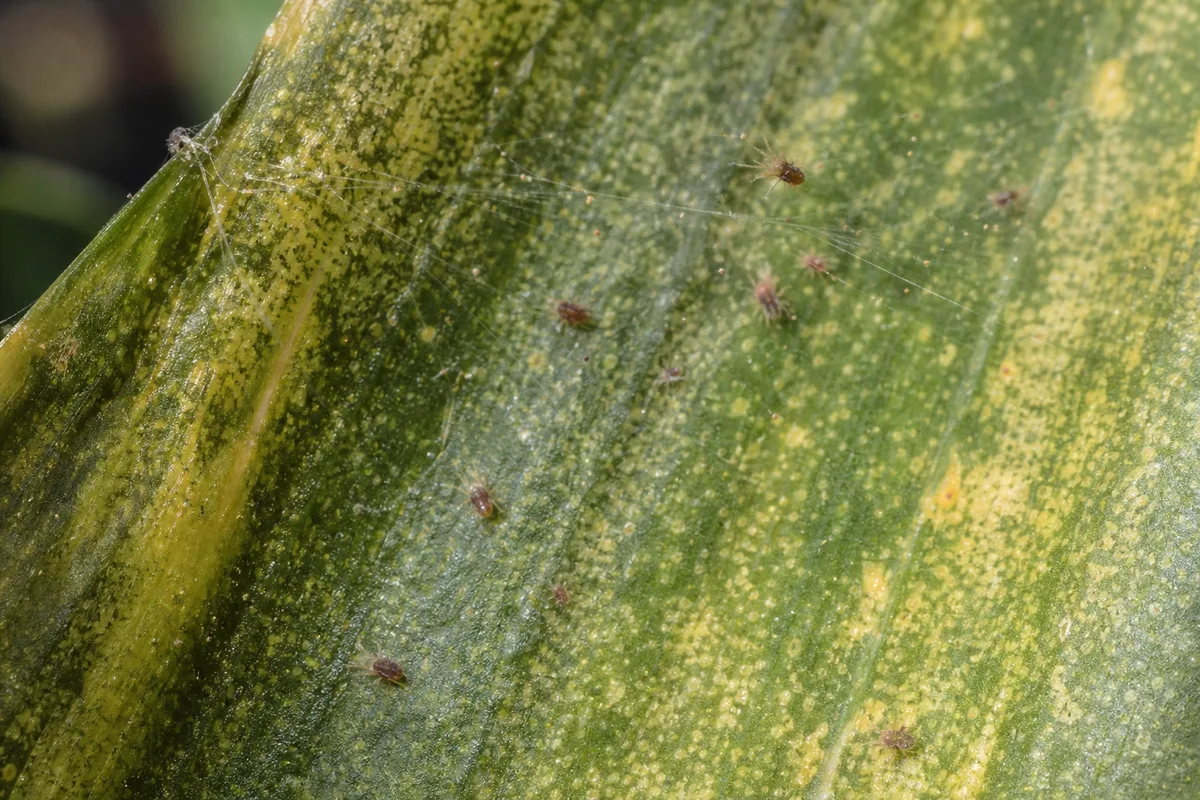
Spider Mites symptoms on Corn Plant - compare with healthy tissue on the same plant.
- Pinpoint yellow or white speckles scattered across the leaf face, often most visible on Massangeana’s chartreuse central band
- Leaves look dull or slightly bronzed before whole sections yellow
- Damage on arching strap leaves may be worse on the side facing the sunniest window
- No webbing yet-easy to confuse with fluoride brown tips or low-humidity stress
Established colonies at the crown whorl:
- Fine silk webbing at leaf bases where strap leaves clasp the cane and at the stem tip rosette
- Stippling merges into larger bleached patches on older strap leaves in the whorl
- Tiny moving dots on undersides-green, yellow, or red depending on species
- Lower strap leaves may yellow and drop while the cane stays firm if roots are healthy
What the mites themselves look like:
Adults are roughly 1/50 inch long and usually need magnification. UMN Extension notes amber eggs, whitish cast skins, and black fecal specks on undersides alongside live mites. To the naked eye they resemble moving dust grains-not the cottony blobs of mealybugs or the hard shields of scale.
Where to look on this plant specifically:
Lift arching strap leaves along each upright cane and inspect the underside from base to tip. Mites cluster where leaves overlap in the crown and along the clasping base where new leaves emerge. Tall floor specimens near forced-air vents often show the worst stippling on the top whorl while lower strap leaves on the same cane still look green-a pattern that reflects hot dry air rising past the crown, not random leaf age.
Lookalike symptoms to rule out
| What you see | Location pattern | Webbing or movement? | Most likely cause | First check |
|---|---|---|---|---|
| Scattered pinprick yellow speckles | Across leaf face, worse on variegated stripe | Webbing at crown; moving dots on tap test | Spider mites | Isolate and rinse undersides |
| Dry crispy brown at tips and margins only | Leaf edges, often older strap leaves | None | Fluoride brown tips | Switch to low-fluoride water |
| Dry tan edges without pinprick dots | Multiple leaves in heated winter room | None | Low humidity | Raise humidity; no miticide yet |
| White cottony masses in leaf axils | Crown crevices and leaf bases | Slow-moving insects, no stippling | Mealybugs | Alcohol swabs on clusters |
| Flat immobile brown bumps | Cane near crown, leaf midribs | None; sticky honeydew possible | Scale | Scrape test; horticultural oil |
| Sticky crown with soft pear-shaped insects | New strap leaves at whorl tip | Insects move slowly; honeydew | Aphids | Shower crown before spray |
| Single yellowing bottom leaf, firm cane | Lowest strap leaf on bare stem | None | Normal aging | No treatment if crown is clean |
Fluoride confusion is the primary corn-plant diagnostic trap. Dracaena fragrans is very sensitive to fluoride, and margin burn from tap water is chronic on this species-unrelated to mites unless stippling and webbing are also present. PNWH notes fluoride accumulates in leaf margins through the transpiration stream, producing uniform tip necrosis rather than scattered chlorotic dots across the leaf blade.
How to confirm the cause
Work through these checks in order before you treat:
- Crown whorl inspection - Part the top rosette on each cane and examine strap leaf undersides and the stem tip with a hand lens. Mites concentrate in the tight clasp where new leaves emerge.
- Tap test - Hold a stippled strap leaf over white paper and tap the underside firmly. Mites dislodged as moving specks confirm the diagnosis. Static dust does not walk.
- Webbing check - Look at leaf bases where arching foliage meets the cane. Fine silk strands that reappear within days after rinsing mean active colonies-not fluoride damage.
- Pattern vs. fluoride - Mite stippling is scattered pinpricks across the leaf face. Fluoride injury starts at tips and margins as dry brown necrosis without random speckling or silk.
- Environmental read - Is the plant near a heating vent, sunny window with dry winter air, or a fan that strips humidity? Mites surge in those microclimates. Check the light placement guide if the warmest side of the pot faces direct afternoon sun.
- Multi-cane scan - Inspect every crown in the same pot separately. Mites spread across touching strap leaves before webbing is obvious on every stem.
- Neighbor plants - Check ficuses, palms, and other dracaenas on the same shelf. Mites walk across contact points and ride air currents on webbing.
- Soil moisture - Push a finger into the top 2 inches of mix. Soggy soil plus stippling suggests overlapping stress. Corn Plant prefers the top half of soil to dry between waterings per the watering guide-do not overwater the cane while chasing humidity for mite prevention.
If you see stippling but no mites, webbing, or movement after two inspections a week apart, revisit water quality and humidity before committing to a spray schedule.
First fix for Corn Plant
Isolate the pot and rinse all strap leaf undersides with lukewarm water in a sink or shower.
Move Corn Plant away from other houseplants immediately. Mites migrate on contact and webbing strands. UMN Extension recommends washing plant foliage with a forceful spray of lukewarm water to reduce populations when repeated. Angle each arching strap leaf upward so water hits the underside along the full length from crown to leaf tip. Protect the pot from soaking; D. fragrans tolerates rinsing but not waterlogged roots.
Let leaves dry in bright indirect light the same day-never in harsh direct sun while wet. Do not apply horticultural oil or soap in the same session as a heavy rinse unless the label allows; start with water alone, then confirm mites are still present 24–48 hours later before spraying.
Do not fertilize, repot, or prune heavily on day one. Do not increase watering to raise humidity-that risks root stress on a cane that already stores moisture. Stressed Dracaena responds better once the pest load drops.
Wear gloves when handling rinsed foliage. Dracaena is toxic to cats and dogs if chewed, and sap can irritate skin. Wipe shower or tub runoff before pets access the area.
Step-by-step recovery
After isolation and the initial rinse:
- Repeat water washes every two to three days for two weeks if colonies were light. Lift each arching strap leaf and target undersides along the full cane length where mites hide.
- Apply insecticidal soap or horticultural oil if mites persist after several rinses. Colorado State Extension notes repeat applications every four to seven days because soaps have no residual activity and do not kill eggs. Cover tops and bottoms of every strap leaf; mites on Corn Plant cluster in crown crevices.
- Run at least three spray cycles on label intervals-one treatment rarely breaks the life cycle. Clemson HGIC advises treating in the early morning or late day and avoiding applications above 90°F or in full sun to prevent leaf burn on variegated Massangeana foliage.
- Raise humidity to 40–60% with a humidifier near the plant-not by overwatering on Corn Plant soil. Higher humidity slows mite reproduction but does not replace contact sprays on an active infestation. See low humidity on corn plant for placement fixes without soggy roots.
- Prune only heavily webbed or bronzed strap leaves once sprays are underway. Removing a few worst leaves in a dense whorl improves coverage. Do not strip the crown bare-Corn Plant recovers slowly from the top down.
- Scout adjacent plants weekly with the tap test. Treat any positive neighbors before mites re-cross the gap.
- Hold fertilizer until new crown growth emerges clean and watering rhythm is stable.
Keep the plant isolated until you see no live mites and no fresh webbing for at least ten days.
Recovery example: A three-cane Massangeana near an office HVAC vent showed stippling only on the top whorl while bare canes below stayed clean. Weekly underside rinses, relocation away from the vent, and three insecticidal soap cycles at five-day intervals produced a clean new strap leaf at the crown in roughly three weeks-old stippled foliage below the whorl stayed bronzed but did not spread further.
Recovery timeline
Light infestations often show fewer new speckles within one week of consistent rinsing. Moderate outbreaks with crown webbing usually need two to three weeks of combined washing and soap or oil on proper intervals before new growth looks clean.
Stippled strap leaves will not regain solid green or variegated color-the damage is permanent on that tissue. Judge success by fresh leaves at the crown whorl: no new stippling, no fresh webbing, and firm arching growth. Because D. fragrans is a slow grower, visible improvement at the crown may take four to six weeks even after mites are eliminated. Old bronzed strap leaves on bare cane below the whorl can remain cosmetic for months.
If stippling returns within days of the last spray, webbing reappears at the crown, or new leaves emerge stunted and pale, the population is still active or neighboring plants are reinfecting your specimen.
Mistakes to avoid
Do not stop after one rinse or one spray-eggs hatch continuously in warm heated rooms.
Do not spray only the tops of strap leaves. Arching Corn Plant foliage hides mites underneath along the full leaf length.
Do not use standard houseplant insecticides aimed at aphids or beetles; many do not control mites. Soaps and horticultural oils are the usual indoor-safe options when label directions allow.
Do not apply horticultural oil in direct sun on variegated Massangeana leaves-oil plus heat burns margins.
Do not overwater the cane while trying to raise humidity for mite prevention. Wet soil weakens Dracaena roots while dry crown air still favors mites-use a humidifier or pebble tray instead.
Do not confuse fluoride margin burn with mite stippling and spray unnecessarily-both are common on this species but need different fixes.
Do not increase feeding to push new crown growth during an active infestation. Fertilizer does not kill mites and can stress roots.
Do not ignore nearby plants that look clean. Mites spread before webbing is obvious on every host.
Do not compost heavily infested prunings indoors or near other containers.
Corn Plant care cross-check
While treating mites, keep baseline care steady so the crown can produce clean new strap leaves:
| Care factor | Mite-relevant target | Why it matters on D. fragrans |
|---|---|---|
| Light | Medium to bright indirect per light guide | Hot direct sun on sunny sills dries crown air faster; deep shade slows recovery |
| Water | Top 50% of mix dry before watering per watering guide | Overwatering weakens cane; drought cycles stress foliage in dry rooms |
| Humidity | 40–60% indoor, especially near HVAC vents | Low humidity favors mite reproduction; raise air moisture without soggy soil |
| Water quality | Low-fluoride irrigation | Fluoride tips mimic some mite confusion-stable water chemistry helps diagnosis |
| Dust | Rinse or wipe strap leaves periodically | Clean foliage supports photosynthesis and removes early mite scouts |
| New plants | Two-week quarantine before shelf placement | Nursery stock can carry low-level mite populations invisible at purchase |
Fixing care stress alone will not eliminate an established colony, but stable conditions help new crown growth stay clean after treatment. Full species context lives in the corn plant overview.
How to prevent spider mites next time
Scout crown whorls and strap leaf undersides monthly-weekly during peak heating season when forced-air vents run. The terminal rosette on each cane is small; inspection takes seconds if you make it part of your watering routine.
Quarantine new Corn Plants for at least two weeks before mixing them with other houseplants. UMN Extension advises monitoring isolated newcomers for pest problems before placing them beside healthy collections.
Keep humidity in a moderate range year-round, not only after an outbreak. Tall floor specimens beside HVAC vents benefit from relocation or a nearby humidifier more than occasional misting alone.
Avoid crowding plants so arching strap leaves touch neighbors on the same shelf.
Rinse foliage occasionally in winter when dust and dry air combine-UMN notes washing houseplants regularly during winter can keep mites at bay.
Inspect plants you move between rooms or bring in from patios-temperature shifts stress dracaena and coincide with mite spikes indoors.
When to worry
Escalate quickly when webbing covers multiple canes in one pot, new crown leaves emerge stunted or bleached, or strap leaves drop in clusters from the whorl despite rinsing. Those signs mean population pressure is high and the plant is losing photosynthetic tissue faster than this slow grower replaces it.
Consider bagging and removing severely defoliated specimens that share a room with other favorites. UMN Extension suggests placing a plastic bag over the plant before removal to limit mites drifting to neighbors when disposal is the pragmatic choice.
Early stippling without webbing is urgent enough to isolate and rinse-but not a reason to panic. Caught at that stage on a firm cane, Corn Plant usually recovers fully at the growing crown.
Dracaena rarely dies from mites alone on an otherwise healthy cane, but heavy chronic feeding can stall the crown for a season. Replace multi-stem specimens only if crowns stop producing new leaves entirely after months of reinfestation.
Conclusion
Spider mites on Corn Plant show up as stippling on arching strap leaves and fine webbing at crown whorls in dry heated homes-not as mysterious fluoride tip burn alone. Isolate first, rinse undersides along every cane, confirm with a tap test, then repeat water washes or labeled soap or oil on short intervals until new crown growth stays clean. Old stippled strap leaves on bare cane below will not revert; a healthy Massangeana or Janet Craig tells you the problem is solved when fresh whorl leaves emerge without speckles or silk.
Related Corn Plant problems
- Brown tips on corn plant - fluoride margin burn lookalike
- Low humidity on corn plant - dry-air stress that favors mites
- Aphids on corn plant - sticky crown pests with different treatment
- Mealybugs on corn plant - waxy cluster lookalike at leaf axils
- Corn plant overview - species hub for care basics
- Corn plant watering - moisture rhythm without overwatering
- Corn plant light - placement and sunny-sill dry-air risk
When to use this page vs other Corn Plant guides
- Corn Plant watering guide - Use for routine moisture checks before assuming spider mites is the main issue.
- Corn Plant problems hub - Browse all 16 common issues on this species.
- Low Humidity on Corn Plant - Different entry point when symptoms overlap with spider mites.
- Slow Growth on Corn Plant - Different entry point when symptoms overlap with spider mites.