Corn Plant Light Needs: Best Window & Warning Signs
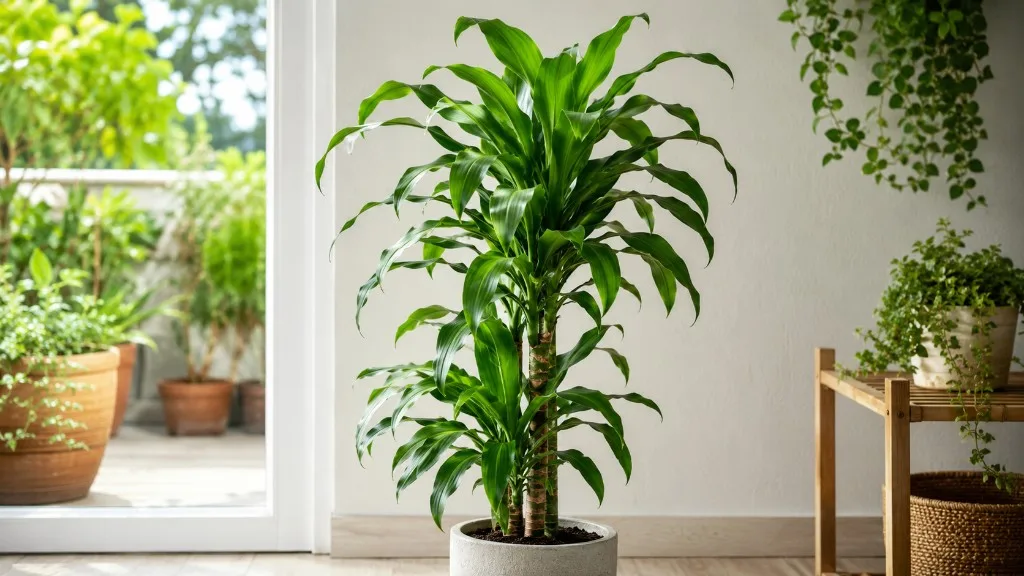
Corn Plant Light Needs: Best Window & Warning Signs
Corn Plant Light Needs: Best Window & Warning Signs
Corn plant light requirements are more forgiving than most houseplant guides admit - and more consequential than the “low-light tolerant” label suggests. Dracaena fragrans, the species sold as corn plant, evolved under the dappled canopy of tropical African forests, where light arrives filtered, steady, and moderate in intensity. Indoors, that translates to bright, indirect light as the target, with genuine tolerance for dimmer conditions when you adjust watering and expectations accordingly. Place the plant correctly and you get upright stems, broad arching leaves, and - on variegated cultivars like ‘Massangeana’ - crisp yellow or lime stripes that stay visible season after season. Place it wrong and the same plant becomes a slow-growing, pale, or scorched specimen that loses its best feature: the foliage.
The practical goal is a spot where the plant grows steadily without burning, new leaves look firm and correctly colored, and you can read warning signs before damage spreads. This guide covers window placement, foot-candle ranges, low-light limits, direct sun boundaries, grow lights, safe moves, and the signs that tell you whether your corn plant wants more light, less light, or time to acclimate.
Why Light Controls How Your Corn Plant Grows
Light is the engine behind every other corn plant care decision. Photosynthesis converts light energy into sugars that fuel root growth, leaf expansion, and the lignified cane structure that gives mature plants their tree-like silhouette. When light is adequate, the plant builds tissue efficiently, uses water at a predictable rate, and replaces older lower leaves on a normal schedule. When light is insufficient, growth slows, internodes stretch, and the root zone stays wet longer because the plant simply is not pulling water through its tissues at the same pace. That slower metabolism is why low-light corn plants are more vulnerable to overwatering on Corn Plant even when you have not changed your Corn Plant watering guide at all.
The Missouri Botanical Garden recommends siting corn plant in bright indirect light locations protected from significant periods of direct sun and drafts, noting that the species tolerates some low light but that too much sun may prevent the best foliage color from developing (Missouri Botanical Garden - Dracaena fragrans). That single sentence captures the entire care philosophy: enough light for color and structure, not so much that leaves bleach or crisp. Draft protection matters because cold air on leaves compounds stress from marginal light, and stressed foliage is slower to recover than healthy tissue.
Corn plant is a long-lived indoor foliage plant. A well-lit specimen holds its form for years; a dim-room plant may survive just as long but look sparse and faded. The difference is almost always placement, not fertilizer or Corn Plant repotting guide.
What Bright Indirect Light Means for Dracaena fragrans
“Bright indirect light” is the most overused phrase in houseplant care because it describes a range, not a single spot on a shelf. For corn plant, bright indirect light means the plant can see the sky - or a large window - for most of the day, but the sun’s direct beam does not land on the leaves for more than a brief early-morning or late-afternoon window. Think of the light under a tree at the edge of a clearing: bright enough to read by, soft enough that you would not squint if you sat there for an hour.
Visually, a corn plant in bright indirect light casts a soft, fuzzy shadow when you hold your hand between the plant and the window at midday. If the shadow has crisp, dark edges, the light is too direct for an unacclimated plant. If you cannot detect any shadow at all, the light is probably too dim for vigorous growth, though the plant may still survive. The sweet spot is a shadow you can see clearly but whose edges are blurred rather than knife-sharp.
Distance matters as much as window direction. A corn plant sitting 3 to 6 feet (about 1 to 2 meters) from an unobstructed east- or west-facing window typically receives the right intensity in most temperate-climate homes. Closer is not always better - within a foot of unfiltered south glass, even an east window in summer can deliver enough direct rays to scorch leaf tips. Farther than 8 feet from the only window in a room, you are usually in low-light territory regardless of what the room feels like to your eyes. Your eyes adapt to dim interiors; the plant does not.
Best Window Placement for Corn Plant
Window orientation sets the daily light curve - how intense the light is, when it peaks, and how long it lasts. Corn plant does not need sun all day; it needs consistent, moderate brightness spread across daylight hours. The best window is the one that delivers that pattern without afternoon scorch or all-day shade.
As a general rule, prioritize east-facing windows first, then filtered west or south exposures, then bright north windows in the Northern Hemisphere. The plant should be close enough to the window that it receives meaningful light - not pushed into a dim corner because the pot looks better there - but not so close that afternoon sun hits the canopy directly. Rotate the pot a quarter turn every two to three weeks if growth leans toward the glass; corn plant will orient new leaves toward the brightest source, and rotation keeps the silhouette balanced.
East-Facing and North-Facing Windows
An east-facing window is the closest thing to a default recommendation for corn plant. Morning sun is low-angle and gentle; by the time the rays strengthen, they have moved off the plant’s canopy. A corn plant on an east sill or 2 to 4 feet back from one typically receives roughly 300 to 600 foot-candles during the morning hours - squarely in the optimal range for Dracaena fragrans. You rarely need a sheer curtain on east glass unless the window is unusually large or the plant sits directly on the sill in a hot climate.
A north-facing window works better than its reputation suggests, especially if the window is unobstructed and the room is not deep. In the Northern Hemisphere, north light is cool and indirect all day - no direct sun, but steady brightness if outdoor obstructions (buildings, trees, awnings) do not block the sky. Place the corn plant directly in front of or within 2 feet of north glass for best results. Expect slower growth than an east-window plant, but healthy color and firm leaves are absolutely achievable. If the north window overlooks a shaded courtyard or sits far from the plant across a wide room, treat it as low light and adjust watering accordingly.
West- and South-Facing Windows
West-facing windows deliver the hardest test for corn plant: weak morning shade followed by strong afternoon sun that can scorch leaves in minutes on a cloudless day. West windows can work, but only with filtering - a sheer curtain, solar film, or placement 4 to 6 feet back from the glass so the plant sits in bright ambient light rather than direct beam. Watch the plant between 2 and 5 p.m.; if leaf edges curl, bleach, or develop dry brown patches on the sun-facing side, pull it back or add filtering.
South-facing windows are the brightest indoor exposure and the most dangerous for unacclimated corn plant. Unfiltered south sun through clear glass can exceed 1,000 foot-candles at the sill - far beyond what Dracaena fragrans handles without damage. If south is your only option, place the plant 5 to 8 feet back from the window or behind a sheer curtain that cuts intensity by roughly half. A corn plant that has spent months in a dim shop and suddenly lands on a south sill will scorch within days; acclimation over two to three weeks is mandatory for any move toward stronger light.
How Much Light Does a Corn Plant Need?
Corn plant performs best with roughly 200 to 600 foot-candles of light for most of the daylight period. That range supports steady cane elongation, full-size leaf development, and strong variegation on striped cultivars. The species can tolerate readings as low as 50 to 100 foot-candles for extended periods - which is why it survives in offices and dim apartments - but growth slows noticeably, new leaves may be smaller, and variegation often fades toward solid green.
Duration matters alongside intensity. A plant that gets 400 foot-candles for six hours will grow less vigorously than one receiving 300 foot-candles for eleven hours. If your only bright period is a short morning window, add supplemental grow lighting rather than pushing the plant closer to harsh direct sun.
Using Foot-Candles and the Hand-Shadow Test
You do not need expensive equipment to assess corn plant light levels, but measurement removes guesswork. A smartphone lux-meter app (search “light meter” in your app store) gives a reasonable estimate when held at leaf height, pointed toward the window. Lux and foot-candles convert at roughly 1 fc = 10.76 lux; an app reading of 3,000 lux at the canopy equals about 280 foot-candles - adequate for maintenance growth.
The hand-shadow test works when you have no app: on a reasonably bright day, hold your hand flat about 12 inches (30 cm) above the spot where the plant sits, between the plant and the window. A fuzzy, visible shadow means bright indirect light - good for corn plant. A sharp, dark shadow means direct or near-direct sun - risky without acclimation. No discernible shadow means low light - survivable, but expect slower growth and possible variegation loss. Run this test at midday and again in late afternoon; a spot that passes in the morning may fail when west sun arrives.
Can Corn Plant Grow in Low Light?
Yes - with conditions attached. Corn plant is one of the more low-light tolerant large houseplants, which is why it survives in office lobbies and north-facing rooms where fiddle-leaf figs fail. It will maintain foliage and produce occasional new leaves, but it will not grow quickly, hold vivid variegation, or forgive overwatering as readily as a brighter-situated specimen.
Low light for corn plant generally means below 150 foot-candles at the canopy for most of the day - typical of a spot more than 8 feet from a single window, a room with small or heavily obstructed glass, or an office relying on overhead fluorescents without window access. The plant adapts by reducing photosynthetic output: smaller new leaves, wider spacing between leaf nodes on the cane, and a gradual shift from striped to solid green on variegated forms. These are survival responses, not diseases.
The trade-off is metabolic. A corn plant in low light uses less water, processes fertilizer more slowly, and replaces damaged tissue more sluggishly. Many “mysterious” corn plant failures in dim rooms trace to overwatering in insufficient light - the roots sit in wet mix because the plant is not transpiring fast enough to dry the pot. If you must keep corn plant in a dim spot, reduce watering frequency, skip fertilizer entirely unless you see active new growth, and accept a slower, simpler-looking plant.
Realistic Expectations in Dim Rooms and Offices
In a typical office with fluorescent ceiling panels and no window, corn plant can survive for years if watering is conservative and the plant is not placed directly under a cold AC vent. Growth will be minimal - perhaps one or two new leaves per year on a mature cane - and variegated cultivars will slowly revert toward green. That is acceptable if the goal is a living vertical accent that requires little attention. It is not acceptable if you bought ‘Massangeana’ specifically for the yellow stripe and expect it to stay vivid.
In a dim apartment, place the plant as close to the largest window as possible and add a full-spectrum LED grow light on a 10- to 12-hour timer if variegation or growth rate matters. Without supplementation, treat it as a low-maintenance survivor rather than an actively growing specimen.
Direct Sun Tolerance and Hard Limits
Corn plant is not a direct-sun plant in the way jade, cactus, or even snake plant can be. Unfiltered midday or afternoon sun through clear glass scorches Dracaena fragrans leaves quickly - often within hours on a hot day - producing bleached patches, brown crispy margins, and sometimes sunken tan spots on the sun-facing side of the blade. The damage is permanent on affected tissue; only new leaves formed after you correct the exposure will look healthy.
There is a narrow exception: early-morning direct sun for 30 to 60 minutes on an east window sill can be tolerated by healthy, established plants, especially in cooler seasons when ray intensity is lower. Some growers deliberately give variegated cultivars a brief morning boost to maintain stripe color. Do not extend this to west or south exposure without filtering and acclimation - the afternoon sun angle and intensity are fundamentally different.
If you want to increase light for a corn plant that has been in low light, never jump straight to a sunny sill. Move it incrementally closer to the window over two to three weeks, watching the newest leaf for bleaching or curling. A plant acclimated over time can handle brighter ambient conditions than one moved suddenly. Even acclimated plants have a ceiling: sustained direct sun above roughly 700 foot-candles on the leaf surface for more than an hour daily will eventually cause marginal burn on most D. fragrans cultivars.
Warning Signs Your Corn Plant Needs More Light
Corn plant communicates insufficient light through growth habit before older leaves show obvious damage. Learning these signals lets you adjust placement before the plant becomes permanently leggy or loses variegation you cannot recover without waiting for new top growth.
Etiolation - stretching toward the window - is the earliest sign. The cane adds length between leaves, new leaves emerge on longer petioles, and the whole plant leans toward the brightest source. Rotate the pot and the plant bends back within days; that lean is not cosmetic, it is the plant spending energy to reach photons. Smaller new leaves at the crown compared to mature leaves below indicate the plant lacks energy to build full-size tissue. Pale or washed-out green on new growth - distinct from the yellow stripe on ‘Massangeana’ - suggests chlorophyll production is insufficient for the cultivar’s normal color.
Variegation fading or disappearing on striped cultivars is one of the most common corn plant light complaints. The yellow or lime band on ‘Massangeana’ and ‘Lemon Lime’ requires more light energy to maintain than solid green tissue; in dim conditions, the plant produces more chlorophyll across the leaf surface, and the stripe narrows or vanishes. Extremely slow or absent new growth over an entire growing season - no fresh leaf from spring through fall - almost always means light is below the plant’s active-growth threshold. Lower leaf yellowing combined with wet soil in a dim corner often means the plant is not using water because it is not photosynthesizing enough, not because you forgot to water.
If you see two or more of these signs, move the plant closer to the window or add a grow light before adjusting fertilizer or repotting. More nutrients in insufficient light will not fix stretching or variegation loss - it may simply salt the soil while the underlying problem persists.
Warning Signs Your Corn Plant Is Getting Too Much Sun
Too much light damage appears faster than too little and often affects sun-facing leaf surfaces first, which makes diagnosis straightforward if you know what to look for. The damage is usually irreversible on affected leaves, so catching exposure problems early saves the newest tissue.
Bleached or whitish patches on leaves - especially on the side facing the window - mean chlorophyll has been destroyed by excess photon flux and heat. The tissue may feel papery or thin compared to healthy green areas. Crisp brown margins and tips that develop suddenly after a move to a brighter spot are classic scorch, distinct from the slow brown-tip creep caused by fluoride in tap water or chronic underwatering on Corn Plant. Sun scorch often appears within days of repositioning; fluoride damage builds over weeks. Leaf curling inward during the brightest hours - with the sun-facing edge drying first - indicates the plant is losing water faster than roots can supply it because transpiration is driven by intense light and heat at the leaf surface.
If scorch appears, move the plant out of direct beam immediately - not gradually - because ongoing exposure will damage more tissue. Place it in bright indirect light 4 to 6 feet from the same window or behind a sheer curtain. Trim severely damaged leaf sections only if more than half the blade is dead; otherwise let the plant reallocate energy from partially damaged leaves. Wait for the next one to two new leaves before judging whether the new spot is correct.
Light Needs for Variegated Corn Plant Cultivars
Not all corn plants respond identically to the same light level. Solid green forms of Dracaena fragrans tolerate lower light more gracefully because every cell in the leaf can photosynthesize at full capacity. Variegated cultivars - especially Dracaena fragrans ‘Massangeana’ with its central yellow stripe and Dracaena fragrans ‘Lemon Lime’ with chartreuse margins - need brighter indirect light to maintain their color pattern because the non-green zones contain less chlorophyll and contribute less energy per square inch of leaf.
‘Massangeana’ typically needs the upper end of the optimal range - roughly 350 to 600 foot-candles - to keep the yellow band wide and vivid. Below 200 foot-candles, the stripe narrows over months and may disappear entirely on new leaves while older striped leaves remain unchanged. That pattern confuses growers who think the plant is “reverting” randomly; it is responding predictably to insufficient light on new tissue only. ‘Lemon Lime’ follows the same logic with its marginal variegation - dim rooms produce greener new leaves with thinner lime edges.
Variegated corn plants are also slightly less forgiving of direct sun than solid green forms because the pale zones lack the pigment that absorbs and dissipates excess light energy. A ‘Massangeana’ on an unfiltered west sill will bleach its yellow stripe before the green zones show damage. If you grow variegated cultivars, prioritize east windows or filtered south/west light, and use grow lights in dim rooms rather than gambling on a sunny sill to “fix” faded stripes.
Using Grow Lights When Natural Light Is Weak
When window light is insufficient - winter at high latitude, a windowless office, or a room where the only glass is obstructed - a full-spectrum LED grow light fills the gap more reliably than hoping the plant adapts. Corn plant responds well to supplemental lighting because its light requirements are moderate; you do not need high-intensity horticultural fixtures designed for flowering crops.
Choose a full-spectrum white LED (20 to 40 watts for a floor plant), positioned 12 to 18 inches above the canopy. Run it 10 to 12 hours daily on a timer. Avoid incandescent bulbs - too much heat, too little usable light. If leaves curl or soil dries unusually fast, back the fixture up 6 inches.
How to Move a Corn Plant to a New Light Spot Safely
Corn plant reacts to sudden light changes because leaves formed under one intensity are not equipped for another. Before any move, run the hand-shadow test at the new spot at midday - a fuzzy shadow means bright indirect, a sharp shadow means filter or move back. Gradual acclimation is the rule for any move toward stronger light; moves toward weaker light are generally safe without transition.
For a move to brighter conditions, increase exposure over 10 to 14 days. Start by placing the plant at the new distance from the window but with a sheer curtain or partial shade; every three to four days, remove one layer of filtering or move the pot 6 to 12 inches closer. Judge progress by the newest leaf only - older leaves retain their history and may never look perfect. If the emerging leaf shows bleaching, pause acclimation at the current level for a week before proceeding.
For a move to dimmer conditions - common when bringing an outdoor summer plant back indoors - expect some lower leaf yellowing and possible leaf drop as the plant adjusts its metabolism downward. Reduce watering immediately when the plant moves to lower light; the same volume of water that worked on the patio will waterlog the pot indoors. Do not fertilize during the first four to six weeks after a significant light reduction unless active new growth is visible.
Large floor specimens are awkward to move incrementally. If you must relocate a heavy corn plant to a brighter spot in one step, accept that one to three upper leaves may scorch and focus on protecting the crown bud. Filter the new window aggressively for the first month, then slowly remove filtering as new leaves emerge clean.
Adjusting for Seasonal Light Changes
Indoor light is not static. The sun’s angle shifts with season, deciduous trees outside your window leaf out and block rays, and daylight duration changes by several hours between summer and winter solstice. Corn plant does not need you to micromanage every shift, but two seasonal adjustments prevent most light-related problems.
In late fall and winter, intensity at any window can drop 40 to 50 percent. Move the plant 12 to 24 inches closer or add a grow light if growth slows or variegation fades - and reduce watering to match slower metabolism. In spring and summer, pull the plant back or add filtering before scorch appears. Outdoor summer placement should be in dappled shade only; bring the plant inside before temperatures drop below 50°F (10°C) (Missouri Botanical Garden - Dracaena fragrans).
The Link Between Light, Watering, and Growth Rate
Light and water are coupled variables for corn plant, not independent care tasks on separate checklists. A plant in bright indirect light transpires more water through its leaves, dries its potting mix faster, and uses nutrients at a higher rate during active growth. The familiar advice to water when the top half of the soil is dry assumes moderate to bright light; in a dim office, the same pot may need to dry nearly throughout before the next watering is safe.
When you increase light, increase watering frequency proportionally - check moisture every few days instead of weekly until you learn the new rhythm. When you decrease light, extend the interval immediately, even if the calendar says it is time to water. Failure to sync light and water is the single most common reason corn plants decline in low-light rooms while the owner insists they “only water when dry” by a schedule set when the plant lived near a brighter window.
Fertilizer follows the same logic: feed only when the plant shows active new growth in adequate light. Fix light first, then water, then consider feeding. Brown tips from fluoride in tap water can mimic light stress - use filtered water if tips persist after placement is correct (Missouri Botanical Garden - Dracaena fragrans).
Common Corn Plant Light Mistakes to Avoid
Judging light by room brightness instead of plant-level intensity. A room with white walls and overhead cans feels bright to you while the plant in the far corner receives under 50 foot-candles. Always assess at the pot, not from the doorway.
Placing a new nursery plant on the sunniest sill immediately. Retail corn plants are grown under shade cloth at moderate intensity. Unpacking and placing on south glass is the fastest route to scorched leaves. Acclimate over two weeks or start in bright indirect light away from direct beam.
Keeping variegated cultivars in dim corners for aesthetics. ‘Massangeana’ looks striking in a dark hallway until the stripe disappears on every new leaf. If the stripe matters, the plant needs brighter placement or a grow light - not a different fertilizer.
Ignoring seasonal shifts or overwatering low-light plants. Re-audit light twice a year, and reduce water in dim spots before the roots sit in wet mix. Assuming brown tips always mean light stress - fluoride, low humidity, and salt buildup produce similar symptoms; change one variable at a time and read new growth as the verdict. Corn plant is toxic to cats and dogs if ingested (ASPCA - Dracaena), so bright placement and pet safety both matter.
Conclusion
Corn plant earns its reputation as a forgiving houseplant, but forgiveness has limits. Bright, indirect light - roughly 200 to 600 foot-candles at the canopy, from an east window or filtered west/south exposure, typically 3 to 6 feet from the glass - produces the upright, full-canopied plant most growers want. Genuine low-light tolerance keeps the species alive in offices and north rooms, but growth slows, variegation fades, and watering must tighten to match reduced metabolism. Direct sun is the main hazard: unfiltered afternoon rays scorch leaves within hours, while early-morning east exposure is often fine.
Read your plant through new growth, not old damage. Stretching, small pale leaves, and disappearing stripes mean more light; bleaching, crisp margins, and sun-side curling mean less direct intensity or faster acclimation. Sync watering and feeding to whatever light level you provide, adjust for seasonal shifts twice a year, and use a full-spectrum grow light when windows alone cannot deliver enough energy - especially for variegated cultivars. Get placement right and corn plant becomes a low-drama, long-lived anchor in the room; get it wrong and no amount of repotting or fertilizer will substitute for photons the leaves never received.
When to use this page vs other Corn Plant guides
- Corn Plant overview - Start here for whole-plant context before deep-diving this topic.
- Corn Plant problems hub - Jump to symptom-specific fix guides when this care topic does not resolve the issue.
- Not Enough Light on Corn Plant - Escalate here when light adjustments are not enough.
- Leggy Growth on Corn Plant - Escalate here when light adjustments are not enough.
Related Corn Plant guides
- Corn Plant overview
- Corn Plant watering
- Corn Plant soil
- Corn Plant propagation
- Corn Plant fertilizer
- Corn Plant repotting
- Not Enough Light on Corn Plant
- Leggy Growth on Corn Plant
- Corn Plant problems
Related tool
Try the Plant Problem Diagnosis Tool with corn-plant pre-selected to estimate needs for your setup.