Watering Corn Plant: Schedule, Soil Checks, and Mistakes
Watering Corn Plant: Schedule, Soil Checks, and Mistakes
Watering Corn Plant: Schedule, Soil Checks, and Mistakes
Corn plant watering is one of those houseplant topics where the internet gives you a number - “every seven to ten days” - and your plant still turns yellow, develops mushy stems, or pushes out leaves with crispy brown tips that make you question everything. Dracaena fragrans, the species behind the common name corn plant (also sold as mass cane and related cultivars), is not difficult to water once you understand what it actually responds to. It wants a predictable dry-down between drinks, excellent drainage, and water that does not load its roots with fluoride and excess minerals. It does not want a rigid calendar, tiny sips every morning, or a decorative pot that traps runoff at the bottom.
The practical goal for most indoor growers is straightforward: check the soil and pot weight before every watering, water thoroughly when the upper portion of the mix has dried, let excess drain completely, and use low-fluoride water when brown tips keep returning. During active warm months that often works out to roughly every seven to fourteen days; in cooler, dimmer months it can stretch to every two to three weeks or longer. A plant in strong indirect light in a small pot will drink faster than the same cultivar in a dim office corner inside an oversized container. The schedule follows the pot, not the day of the week.
This guide covers how dry the soil should get, which checks reliably tell you when to water, how water quality affects leaf tips, seasonal adjustments, and the mistakes that cause more damage than an occasional missed watering ever would.
Why Corn Plant Watering Depends on the Pot, Not the Calendar
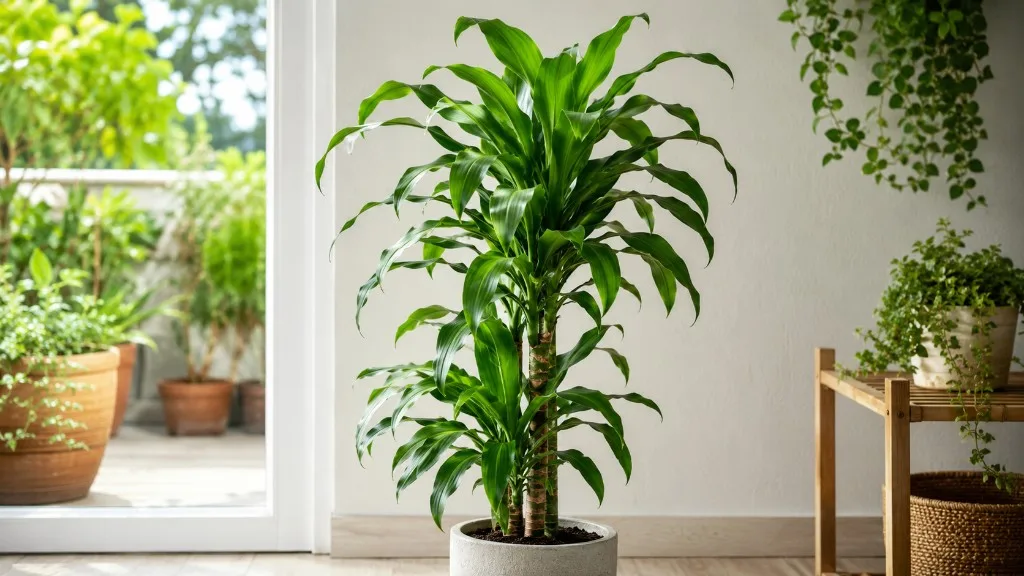
Corn plant is a slow-to-moderate grower indoors, typically reaching one to two meters in height over many years in a container, with a woody stem and arching strap-like leaves that resemble corn foliage - hence the common name. Native to tropical Africa, it evolved in filtered understory light with rainfall followed by drying cycles in well-aerated soil. Indoors, you replicate that rhythm by letting the root zone breathe between waterings rather than keeping the mix constantly damp because “Tuesday is watering day.”
The Missouri Botanical Garden notes that Dracaena fragrans performs best in organically rich, well-drained soil and Corn Plant light guide, and that it is sensitive to fluoride and boron in water (Missouri Botanical Garden - Dracaena fragrans). Those two facts - drainage and water chemistry - shape almost every watering decision more than any fixed interval printed on a care tag. A calendar reminder is useful as a prompt to check the plant, not as permission to pour water regardless of what the soil feels like.
Think of watering as matching the speed at which your specific container dries in your specific room. Pot material, mix composition, root mass, air temperature, humidity, and light intensity all change evaporation and uptake. A glazed ceramic pot in a heated winter room above a radiator dries differently than a plastic nursery pot in a cool north-facing office. Two corn plants bought on the same day can need water on completely different schedules within a month. That is normal, not a sign that one plant is “wrong.”
What a Healthy Watering Rhythm Looks Like
A healthy corn plant water schedule is not a number of days - it is a repeating pattern. You water thoroughly until a small amount runs from the drainage holes, you empty the saucer or cachepot so the roots are not sitting in pooled water, and then you wait until the upper soil has dried to your target depth before watering again. Between those events the plant should look firm, produce new leaves at the crown during active months, and show no chronic yellowing of multiple leaves at once.
Dracaena species are often described as drought-tolerant relative to many tropical foliage plants, and that tolerance matters for how you interpret stress signals. Corn plant can survive a dry spell better than it survives weeks of soggy anaerobic soil. Growers who panic at the first slight wilt and add water daily often create root rot on Corn Plant on a plant that would have recovered from one missed watering. The rhythm you want is full saturation followed by a real dry-down - not permanently moist surface soil with a waterlogged core.
Active Growth vs Rest Periods
During active growth - usually spring through early fall in most homes, or whenever you see steady new leaf production at the top of the stem - the plant transpires more water and the pot dries faster. This is when most growers water most often, commonly in the seven-to-fourteen-day range for medium pots in moderate light, always adjusted by soil checks.
During slower periods - shorter days, cooler rooms, or plants in very low light - metabolic demand drops even if the plant still looks green. The same volume of soil holds moisture longer because the roots are pulling less. Continuing a summer watering frequency through winter is one of the most common paths to yellow lower leaves and soft stems. Reduce frequency by checking more carefully and waiting longer, not by giving less water per session. When you do water in winter, still water thoroughly; just do it less often.
The Moisture Target: How Dry Should Soil Get?
The most useful moisture target for corn plant is letting the upper portion of the potting mix dry before the next watering. For many home setups that means the top one to two inches of soil feel dry to the touch on smaller pots, or roughly the top half of the mix in larger containers where the root ball sits deep. The RHS advises watering once the top 5 cm (2 in) feels dry, and allowing the mix to dry slightly between waterings while reducing frequency from fall through winter.
The goal is not bone-dry soil pulled away from the pot walls - that is underwatering on Corn Plant territory - but also not damp surface mulch sitting over wet core mix day after day. You want the root zone to approach dryness at the depth where fine roots actively absorb, then receive a full rewetting. If only the very top quarter inch is dry but a finger pushed deeper hits cool, clinging soil, wait. If the top two inches are dry and the pot feels noticeably lighter when lifted, it is likely time.
Corn plant prefers slightly acidic conditions, with ideal soil pH often cited around 5.5 to 6.5 (Clemson HGIC - Dracaena). Chronically alkaline or mineral-heavy water can stress the plant over time, which is one reason water quality and flushing matter alongside simple moisture timing.
Soil Checks That Actually Work
Reliable soil moisture checks beat any app, sticker, or inherited family rule about houseplants. Use at least one physical method consistently for two or three weeks and you will learn how your exact pot dries - that calibration is worth more than any generic schedule.
Finger, Skewer, Moisture Meter, and Pot Weight
The finger test is the fastest tool: insert your index finger to the second knuckle, about two inches, in several spots near the stem and at the pot edge. Dry, dusty, or room-temperature crumbly soil at depth means water; cool, clinging soil means wait. A wooden skewer or chopstick works the same way and stays cleaner on dusty mixes - push it deep, leave it thirty seconds, pull it out, and feel the stick for moisture.
Pot weight is the check experienced growers trust most. Lift the pot right after a thorough watering and notice the heft. Lift it every few days. When it is substantially lighter and the soil surface looks matte rather than dark and glossy, the root ball has likely dried enough for another drink. This method catches situations where the surface looks dry but the core is wet - and the opposite, where the surface still looks dark but the root zone has actually dried in a very root-bound pot.
A moisture meter can help if you calibrate it against finger and weight results, but treat readings as one data point. Cheap probes often misread chunky perlite mixes and can corrode over time. If the meter says “dry” but the pot still feels heavy and soil clings to a skewer, trust the physical evidence.
Before every watering, run a quick three-point check: finger or skewer at depth, pot weight compared to your mental “just watered” baseline, and a glance at the plant - firm upright leaves versus limp or yellowing lower foliage. All three aligning is a stronger signal than any one alone.
How to Water Corn Plant Step by Step
How to water corn plant correctly is simple in sequence but easy to shortcut in practice. Follow these steps every time and most chronic problems fade within a few weeks.
First, confirm the soil actually needs water using the checks above. Second, use room-temperature water - cold tap water straight from the pipe can shock warm roots and slow uptake. Third, water slowly and evenly across the soil surface, not in one fast stream at the stem base, until you see excess begin to drain from the bottom holes. That full saturation re-wets the entire root ball; partial top splashes leave dry pockets that roots cannot access.
Fourth, wait a few minutes and water once more lightly if the mix absorbed the first pass quickly and no drainage appeared - some very peat-heavy mixes surface-tension dry the first time. Fifth, empty the saucer, cachepot, or decorative outer pot within thirty minutes so roots do not sit in stale pooled liquid. Sixth, note the date and how the pot felt - not as a rigid next watering day, but to build your sense of dry-down speed in the current season.
Bottom watering - setting the pot in a tray of water and letting the mix wick upward - is acceptable for corn plant if you still top-water occasionally to flush minerals downward. Pure bottom watering without occasional top flushing can accumulate salts at the soil surface over months, especially if you use tap water in a fluoridated municipality.
Water Quality: Fluoride, Chlorine, and Safer Options
Water quality is the single most underexplained factor in corn plant care, and it is often the real reason brown tips persist after the owner “fixed” the schedule. Dracaena fragrans is notably sensitive to fluoride and to excess boron and soluble salts in irrigation water (Missouri Botanical Garden - Dracaena fragrans). Fluoride accumulates in leaf margins over time, producing tan to dark brown tips and streaks on otherwise healthy foliage. Chlorine in municipal tap water can contribute to marginal burn in sensitive plants, though chlorine largely dissipates if water sits uncovered for twenty-four hours - fluoride does not evaporate by sitting out.
Distilled, Rainwater, and What Sitting Tap Water Does Not Fix
The most reliable low-fluoride options for corn plant are distilled water, rainwater collected from a clean surface, and water from a reverse osmosis system that removes fluoride at the filter stage. Standard carbon pitcher filters improve taste but typically do not remove fluoride; relying on them alone often fails to stop tip burn in fluoridated cities. If you must use tap water, alternate with distilled or rainwater when tips worsen, and flush the soil periodically by running several pot volumes of low-mineral water through the mix and letting it drain fully.
Hard water - high in calcium and magnesium - adds another stress layer independent of fluoride. Combined with fertilizer salts, it can crust the soil surface and burn margins. If your kettle builds white scale quickly, your corn plant probably wants filtered or distilled water year-round, not only after damage appears.
Low humidity does not replace fluoride as the primary cause of tip burn, but very dry indoor air below roughly thirty to forty percent relative humidity can worsen marginal drying once damage starts. Average household humidity of forty to fifty percent is usually adequate; grouping plants or using a humidifier helps in arid winters more than misting, which offers only minutes of relief and can spot leaves if water sits on them in cool rooms.
Seasonal Watering Schedule Adjustments
A seasonal watering schedule is a framework for how often to expect to check the plant, not a command to water on specific dates. Corn plant in a typical heated home often follows this rough pattern when soil, light, and pot size are otherwise normal.
Spring and Summer Intervals
From mid-spring through early fall, when new leaves unfurl at the crown and temperatures are warm, many indoor corn plants need watering about every seven to fourteen days. Bright indirect light, warm rooms, and air movement accelerate drying toward the shorter end. A plant outdoors in shade during summer in a humid climate may need even more frequent checks. Always let the top one to two inches (or top half on large pots) dry first.
During this window, keep the soil lightly moist through the active profile between waterings - meaning you rewater after a real dry-down, not while the core is still saturated from the last session. Pair increased watering frequency with the increased light and optional feeding that active growth invites, but never feed a plant sitting in soggy soil.
Fall and Winter Stretch
From late fall through winter, stretch checks to every fourteen to twenty-one days or longer. Some low-light office plants go three to four weeks between thorough waterings in cool months without harm, provided the soil truly dries and the plant is not near a heat vent that desiccates the mix unevenly. Reduce watering from fall to late winter as growth slows.
The critical winter mistake is maintaining summer frequency because the plant “looks fine” while roots absorb slowly in cooler soil. Unused water lingers, oxygen is displaced, and lower leaves yellow. If you heated your home aggressively but kept the plant in a dim corner, the soil may still dry slowly - check physically rather than assuming the furnace means more water.
| Season | Typical check interval | Dry-down target | Notes |
|---|---|---|---|
| Spring–Summer (active growth) | Every 7–14 days | Top 1–2 inches dry | Bright light → shorter end |
| Fall (slowing) | Every 10–18 days | Top 2 inches dry | Taper as new growth slows |
| Winter (low growth) | Every 14–28+ days | Top 2 inches dry | Cool/dim → longer end |
| After Corn Plant repotting guide | Variable | Slightly more moist at first | Roots need time to explore |
The table is a starting framework. Your pot and room will differ. Within two weeks of consistent checking, you will know whether your plant behaves like the short or long end of each range.
How Light, Pot Size, and Humidity Change Frequency
Light is the largest driver of watering frequency after pot drainage. Corn plant tolerates low light - which is why it survives in offices - but low light slows photosynthesis and water use. The same plant moved from a dim corner to bright indirect light may need water twice as often within a week. Conversely, a plant pushed into too much direct sun may dry the surface quickly while stress-shutting stomata; always confirm with depth checks, not surface color alone.
Pot size relative to the root ball changes dry-down time immediately after repotting. A root-bound plant in a tight pot may need water every five to seven days in summer because there is little soil volume to hold moisture. Freshly repotted into a pot two sizes larger, the same plant may go two to three weeks between waterings while roots grow into the new mix - and overwatering on Corn Plant during that window is extremely common. Match frequency to current root fill, not to memory of the old pot.
Pot material matters too: unglazed terra-cotta breathes and dries faster; glazed ceramic and glass cachepots slow evaporation. Humidity affects how fast leaf tips lose water but is secondary to soil moisture for scheduling; very dry air may increase frequency slightly in bright light but should not double your watering without soil evidence.
Temperature in the sixty-five to eighty degrees Fahrenheit range (eighteen to twenty-seven degrees Celsius) suits corn plant well. Cold drafts below roughly fifty-five degrees Fahrenheit can damage foliage and slow root activity, making soil stay wet longer - another hidden winter overwatering trigger near poorly sealed windows.
Signs You Are Overwatering Corn Plant
Corn plant overwatering is more common than underwatering indoors because growers interpret yellow leaves as thirst when they often mean the opposite. Watch for these patterns together rather than isolated spots on old leaves.
Soft, mushy, or wrinkled lower stems near the soil line suggest crown or root tissue breaking down in wet conditions. Yellowing leaves that spread up the plant, especially if lower and middle leaves yellow while the soil smells sour or fungus gnats appear, point to excess moisture. Brown tips can occur with fluoride independently, but uniform yellowing plus wet soil is classic overwatering. New growth may stall or emerge smaller and pale. The pot stays heavy days after you thought you watered. Green moss or algae on the soil surface in indoor light is another warning.
Roots tell the final story if you gently slide the plant from the pot: healthy dracaena roots are firm and orange-tan; rotting roots are black, slimy, or hollow. If you see rot, stop watering immediately and read the recovery section below before repotting aggressively.
Overwatering often partners with poor drainage - no hole in the pot, compacted peat mix, or a decorative outer pot holding runoff. Fixing the schedule without fixing drainage rarely works.
Signs You Waited Too Long to Water
Corn plant underwatering shows different signals. Leaf tips and margins may turn brown and crispy, especially if drought repeats cyclically. Leaves may droop or curl slightly, then recover after a thorough watering - a useful diagnostic if the soil was genuinely dry and the pot light. Extremely dry peat pulls away from the pot sides, and water runs down the gap without wetting the root ball - a condition called hydrophobic dry-out.
A single dry episode rarely kills an established corn plant; these plants tolerate missed waterings better than chronic sogginess. Repeated drought, however, damages fine root hairs, and when water finally returns the plant may lose lower leaves anyway because the root system cannot support full foliage. If you forgot for two weeks and the soil is dust dry, water thoroughly once, let it drain, then check again in a few days rather than drowning the plant daily out of guilt.
Do not confuse underwatering brown - often accompanied by very light pot weight and dusty soil - with fluoride tip burn on an otherwise well-hydrated plant with a heavy pot and moist skewer test.
Yellow Leaves and Brown Tips: Watering vs Other Causes
Yellow leaves on corn plant usually mean overwatering, low light, cold stress, natural senescence of old lower leaves, or occasionally pest and nutrient issues - in that rough order of frequency for indoor growers. If multiple leaves yellow at once and soil stays wet, suspect water first. If only the oldest bottom leaf yellows and drops while new top growth looks fine, that is often normal aging.
Brown tips are most commonly fluoride or mineral toxicity from tap water, especially when tips appear on otherwise turgid leaves and soil moisture has been appropriate (PNW Handbooks - Dracaena tip burn). Low humidity and fertilizer salt buildup contribute secondarily. Underwatering tips tend to come with visible wilt, very dry soil, and lighter leaf color overall. Overfertilizing can mimic burn; if you feed monthly, consider whether salts plus fluoride are compounding.
Work through a simple diagnostic: check soil moisture and pot weight, review recent water source, note light level and whether lower leaves only are affected, and inspect for spider mites on undersides if stippling appears. Change one variable at a time - switch to distilled water for a month, or adjust watering frequency, but not both simultaneously - so you know what helped.
Note that corn plant is toxic to cats and dogs if ingested, causing vomiting and drooling according to the ASPCA (ASPCA - Dracaena). Watering with open containers or spilled saucers matters in pet households for reasons beyond plant health.
How to Recover an Overwatered Corn Plant
If you suspect root rot from overwatering, act quickly but calmly. First, stop watering and move the plant to brighter indirect light if it was in very low light - not direct sun - to help the soil dry. Second, slip the plant from the pot and inspect roots; trim black or mushy sections with clean scissors. Third, if more than half the root mass is healthy, repot into fresh well-draining mix with perlite in a pot with drainage holes, using a similar size or only slightly smaller pot - not a huge upgrade. Fourth, water lightly once to settle mix, then wait until the top two inches dry before watering again.
If the stem is soft at the base, propagation from a firm cutting above the rot line may be the salvage path; corn plant roots readily from stem sections with nodes. Severe crown rot on a single-stem specimen may not be recoverable as a whole plant.
For mild overwatering without rot - yellow lower leaf, heavy pot, no sour smell - often simply drying the soil fully once and correcting the schedule is enough. Remove the yellow leaf for aesthetics. Do not fertilize until new growth resumes and soil rhythm stabilizes for several weeks.
Flushing helps when minerals or fluoride have accumulated: run two to three pot volumes of distilled or rainwater through the soil, let drain completely, and switch your regular water source afterward.
Common Corn Plant Watering Mistakes
The mistakes below appear repeatedly in troubleshooting threads because they feel logical but fight how Dracaena fragrans actually lives in a pot.
Watering on a fixed weekly schedule without checking soil tops the list. Use the calendar as a reminder to lift the pot, not as an automatic pour.
Leaving runoff in the saucer or cachepot keeps the bottom third of the root zone anaerobic. Empty within thirty minutes, every time.
Using straight tap water in fluoridated cities while chasing brown-tip cures with humidity trays treats the wrong problem. Switch water first.
Assuming brown tips always mean underwatering leads to more water on already wet soil and accelerates rot.
Giving small sips daily instead of thorough periodic watering keeps the surface moist while the core never fully hydrates or fully dries - the worst of both patterns.
Repotting into a much larger pot and watering on the old schedule surrounds roots with wet unused soil for weeks.
Watering with cold tap water in winter shocks roots and slows uptake when the plant is already metabolically slow.
Misting as a substitute for watering does not rehydrate the root zone and can spot leaves in cool air.
Ignoring seasonal slowdown and watering twelve months at summer frequency in a dim winter office is a reliable yellow-leaf generator.
Each mistake is fixable without new gadgets: check soil, water fully, drain fully, use better water, adjust for season and light.
Conclusion
Watering corn plant well comes down to a short list of habits practiced consistently: check the soil at depth and the pot’s weight before every watering, soak the mix thoroughly when the upper profile has dried, empty all drainage trays promptly, and use low-fluoride water if brown tips persist. Expect roughly seven to fourteen days between waterings in active warm months and two to four weeks or longer in cool, dim periods - always as outcomes of soil checks, not as rules carved in stone.
Corn plant rewards boring, observational care more than clever shortcuts. Once you calibrate your specific pot to your room’s light and temperature, the plant becomes predictable: firm leaves, steady slow height gain, and clean tips if water quality is addressed. When something looks wrong, let soil moisture and pot weight guide your first move before you repot, fertilize, or move the plant to a new window. Most watering crises are diagnosed and fixed at the root zone, not on the leaf surface alone.
When to use this page vs other Corn Plant guides
- Corn Plant overview - Start here for whole-plant context before deep-diving this topic.
- Corn Plant problems hub - Jump to symptom-specific fix guides when this care topic does not resolve the issue.
- Overwatering on Corn Plant - Escalate here when watering adjustments are not enough.
- Underwatering on Corn Plant - Escalate here when watering adjustments are not enough.
- Root Rot on Corn Plant - Escalate here when watering adjustments are not enough.
Related Corn Plant guides
- Corn Plant overview
- Corn Plant light
- Corn Plant soil
- Corn Plant propagation
- Corn Plant fertilizer
- Corn Plant repotting
- Overwatering on Corn Plant
- Underwatering on Corn Plant
- Root Rot on Corn Plant
- Wilting on Corn Plant
- Drooping Leaves on Corn Plant
- Mold on Soil on Corn Plant
Related tool
Try the Plant Watering Calculator with corn-plant pre-selected to estimate needs for your setup.