Drooping Leaves on Corn Plant: Causes, Checks & Fixes
Quick answer
Drooping leaves on corn plant usually trace to watering imbalance, cold drafts, or repot shock-not normal leaf arch. First step: squeeze the lower cane for firmness and probe the top 2 inches of soil before watering or moving the pot.
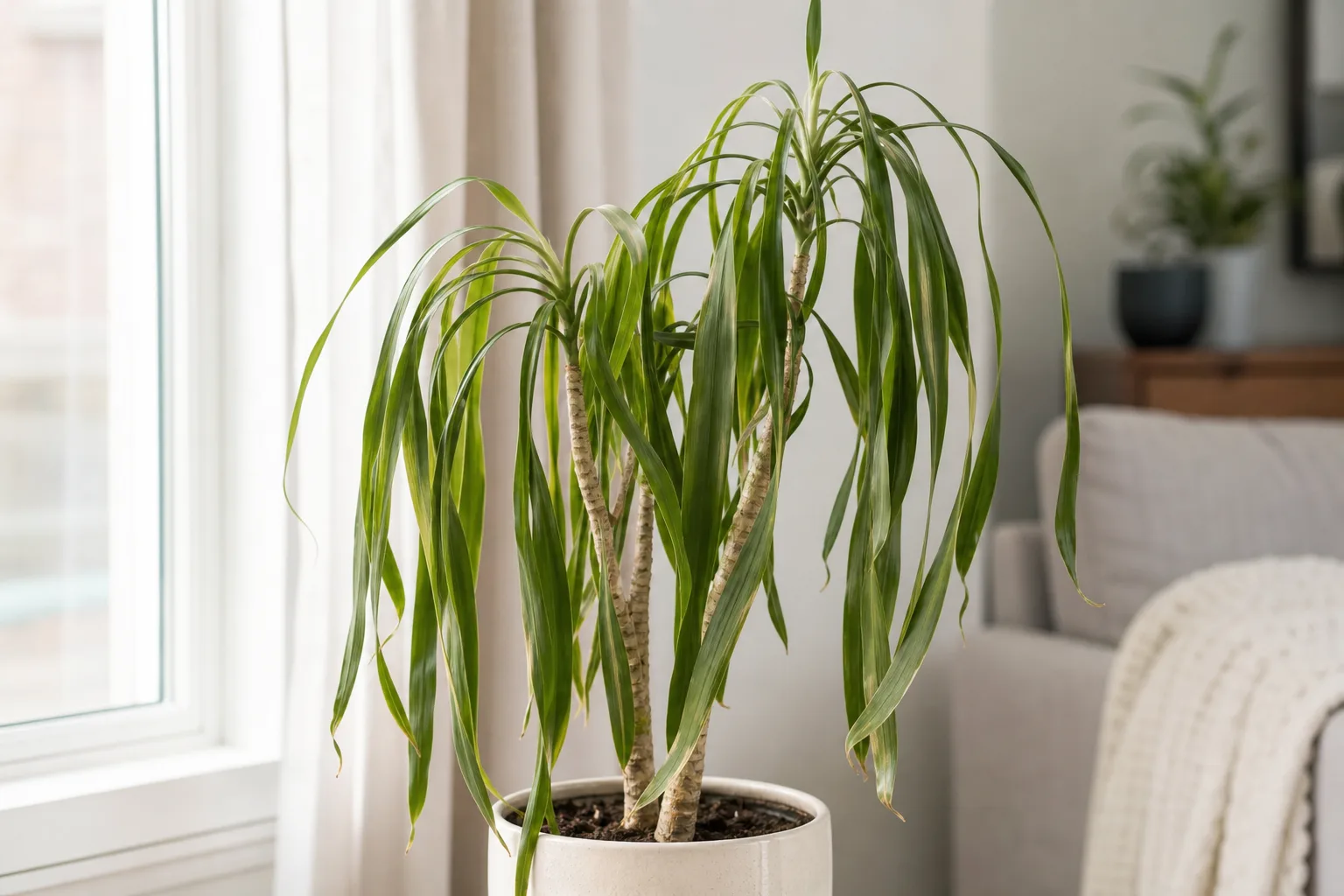
Drooping Leaves on Corn Plant: Causes, Checks & Fixes
This guide covers drooping leaves on Corn Plant. See also the general Drooping Leaves guide, watering, and light pages for this plant.
Drooping Leaves on Corn Plant: Causes, Checks & Fixes
Quick answer
Drooping leaves on corn plant usually trace to watering imbalance, cold drafts, or repot shock-not normal leaf arch. First step: squeeze the lower cane for firmness and probe the top 2 inches of soil before watering or moving the pot.
Dracaena fragrans stores water in its thick woody cane, so the plant can look fine for weeks while roots sit in soggy mix, then collapse suddenly when the lower stem rots through. The same limp rosette appears when a bright, warm room dries the pot faster than your watering rhythm. Split wet-soil from dry-soil paths before you pour another drink.
What drooping looks like on corn plant
Normal arch (no action needed):
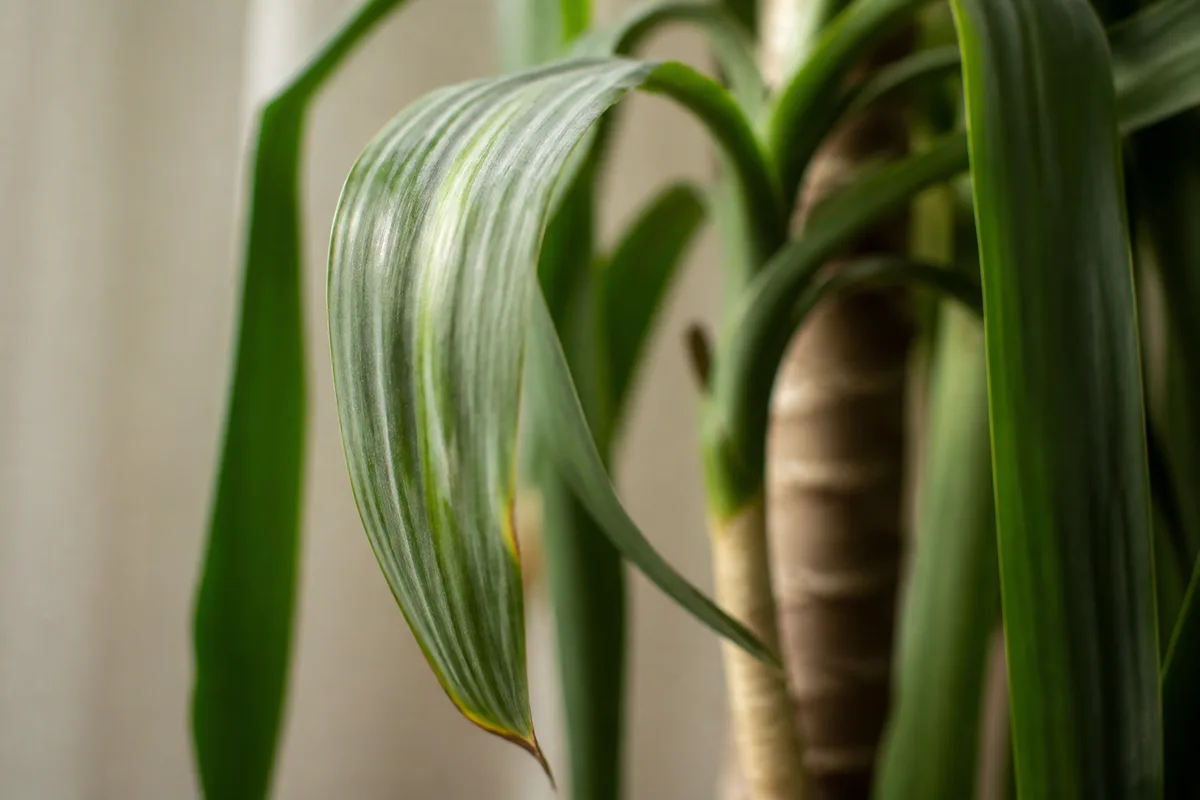
Drooping Leaves symptoms on Corn Plant - compare with healthy tissue on the same plant.
- Broad strap leaves curve gracefully downward from a firm upright cane
- Lower leaves may hang lower than upper ones while newest crown leaves stay stiff and green
- Cane feels solid when you squeeze it gently above the soil line
- Soil moisture matches your usual dry-down-neither sour-wet nor dust-dry
Stress droop (needs diagnosis):
- Entire rosette goes limp and loses turgor; leaves feel soft rather than leathery
- Drooping spreads to the newest unfurling leaves at the crown
- Cane feels soft, wrinkled, or hollow near the base-especially with wet soil
- Pot feels unusually heavy (overwatering) or very light (underwatering on Corn Plant) compared to right after your last thorough watering
On ‘Massangeana’ and other variegated cultivars, weak floppy new leaves in dim corners often arrive with faded central stripes. That pattern points to low light rather than a sudden watering crisis.
Why corn plant droops - cane storage and late collapse
Corn plant evolved as an understory species in tropical Africa with filtered light and seasonal rainfall. Indoors, the thick cane acts like a water reservoir. That adaptation is why drooping can appear late: upper leaves stay turgid from stored moisture while lower roots fail in anaerobic wet soil.
Root rot usually results from soil that does not drain quickly or from overly frequent watering, according to Clemson HGIC. The rot travels upward into the cane before the whole plant looks obviously sick. The opposite failure-underwatering in a sunny window-dries the root ball while the cane still feels firm, producing limp leaves on dry mix.
Cold drafts, recent Corn Plant repotting guide, spider mites on leaf undersides, and top-heavy leaning on a tall thin cane can all droop foliage without the same root-rot timeline.
Main causes of drooping leaves on corn plant
Overwatering and stem rot
- Mix stays wet for many days; surface may look dry while deeper soil is saturated
- Lower cane softens; sour smell from pot or drainage holes
- Yellowing often spreads beyond a single aging lower leaf
- Common in dim rooms where evaporation is slow and on calendar watering schedules
Underwatering
- Top half of mix is dry; pot feels light
- Cane still firm; leaf margins may crisp before full limp collapse
- More likely in bright warm rooms, small pots, or after a heat wave
Cold draft or AC shock
- Drooping appears within hours to a day after HVAC change or winter window placement
- Leaves may show dark water-soaked patches if chilling is severe
- Dracaenas grow best at 60–70°F during the day with cooler nights; sustained cold below about 55°F stresses tissue
Recent repot or move
- Drooping within a week of transplant or relocation to a new room
- Roots disturbed; plant acclimating to different light or airflow
- Usually firm cane unless you watered heavily right after repotting into wet mix
Low light weak growth
- Slow floppy internodes; variegation dulls on Massangeana
- If light levels are too low, leaves will narrow per NC State Extension
- Drooping is gradual over weeks, not sudden overnight collapse
Spider mites
- Fine stippling on leaf undersides; faint webbing in advanced cases
- Limp foliage on otherwise dry, firm-cane plants in hot dry air
- Distinct from root rot because soil moisture is normal
Top-heavy lean
- Tall specimen on a single thin cane; rosette weight pulls the stem sideways
- Cane and roots are firm; issue is mechanical support, not root failure
Lookalike symptoms
Drooping vs. wilting: On this site, wilting emphasizes sudden loss of turgor often tied to water stress. Drooping here includes the slow graceful arch of healthy mass cane. If only lower leaves hang while the crown is stiff, you may be seeing normal habit-not the same problem as a limp overwatered rosette.
Drooping vs. yellow leaves: Yellowing with wet soil and soft cane points to root trouble shared with yellow leaves on corn plant. Pure droop on green leaves with dry soil is more often drought.
Drooping vs. brown tips: Brown tips from fluoride or salt stress can coexist with firm upright leaves. Tip burn alone rarely collapses the whole rosette unless underwatering also dried the root ball.
Drooping vs. not enough light: Weak floppy new growth without wet soil or cold shock is usually a light problem-see not enough light on corn plant if variegation is fading and internodes stretch.
How to confirm the cause
Work through these checks in order:
- Cane squeeze - Pinch the lower cane above the soil. Firm and solid is healthy. Soft, squishy, or wrinkled tissue with wet soil suggests advancing rot.
- Top 2-inch soil probe - Push your finger or a skewer about 2 inches into the mix at the pot edge and near the stem. Dry throughout suggests drought. Cool, damp, or wet at depth with a heavy pot suggests overwatering.
- Pot weight - Lift the container. Compare to how it felt right after your last thorough watering. Light and dry confirms underwatering; heavy days later confirms slow dry-down or excess water.
- Newest leaf condition - Firm pale-green unfurling leaves mean the crown is still functioning. Limp new growth on wet soil is a red flag.
- Environmental scan - Note AC vents, heat registers, and window drafts within 3 feet of the plant. Recent repot within two weeks?
- Leaf undersides - Check for stippling, webbing, or sticky residue if soil and cane tests are inconclusive.
| Cane feel | Soil moisture | Likely cause | First direction |
|---|---|---|---|
| Firm | Dry top half | Underwatering | Deep soak after confirming dryness |
| Soft | Wet / heavy pot | Overwatering / rot | Stop watering; dry-down |
| Firm | Wet surface, dry deep | Light too low or poor drainage | Check drainage; brighten indirect light |
| Firm | Normal | Draft, repot shock, or normal arch | Review placement and recent changes |
First fix for corn plant
Squeeze the lower cane and probe the top 2 inches of soil-then act on that pair alone.
If the cane is firm and the top half of the mix is dry, water thoroughly until excess runs from drainage holes, then empty the saucer. Do not mist, fertilize, or repot on the same day.
If the cane is soft or the mix is wet and heavy, stop watering immediately. Move the plant to brighter indirect light and better airflow so the root zone can dry. Do not add water hoping leaves perk-that deepens rot on a cane-forming dracaena.
This single branch prevents the two costliest mistakes: soaking rotting roots because leaves look thirsty, or withholding water from a firm-cane plant sitting in dust-dry mix.
Step-by-step recovery
After the first moisture or dry-down correction:
- Underwatering recovery - One surface splash may not rehydrate a shrunken peat root ball. If water runs straight through, bottom-water for twenty to thirty minutes, then drain fully. Re-check in two to three days rather than watering daily.
- Overwatering recovery - Hold water until the top 2 inches dry. If limp leaves persist after ten to fourteen days of dry-down, slide the plant partly out and inspect roots. Trim mushy brown roots with clean shears, replant in fresh well-draining mix, and wait a week before resuming light watering.
- Draft recovery - Move off the vent or add a buffer of a few feet from cold glass. Leaves often re-firm within five to seven days without other treatment if cane tissue stayed firm.
- Repot shock - Keep soil lightly moist-not wet-for the first week after transplant, then return to the top-50% dry rule. Avoid fertilizer until new growth looks stable.
- Low light correction - Shift to medium Corn Plant light guide gradually over one to two weeks. Weak new leaves should stiffen on the next one or two flushes of growth.
- Spider mites - Rinse leaf undersides in the shower, isolate the plant, and confirm active pests before applying horticultural soap or oil. Repeat per label directions; dracaenas are sensitive to fluoride in tap water-use low-fluoride rinse water when possible.
Do not fertilize a stressed corn plant until firm new growth appears for at least two weeks.
Recovery timeline
Limp leaves from underwatering often re-firm within two to five days after a proper soak if roots are healthy.
Overwatering recovery takes longer-two to four weeks for roots to regain function if rot was caught early. Soft cane tissue does not firm up again; salvage may require cutting firm cane above the rot zone and propagating.
Cold draft damage usually shows improvement within a week once placement is corrected.
Repot shock droop typically resolves in one to two weeks when watering stays moderate and light is stable.
Old leaves that fully collapsed may not return to their original arch. Judge success by firm new crown growth, stable cane above the soil line, and stopped spread of limp tissue-not by old leaf posture alone.
When soft lower cane means stem rot
Treat as urgent when:
- Lower cane feels mushy or hollow while soil smells sour
- Limp leaves spread to the crown on continuously wet mix
- Black or dark mushy patches appear at the soil line
Stop watering. Let the mix dry to at least the top half. If the soft zone advances after ten days, unpot and trim rot back to firm cane and healthy roots. Sections of firm cane above the damage can be propagated as stem cuttings per NC State guidance. If more than half the root mass is mushy and the cane is soft to mid-height, replacement is often more practical than extended rescue.
For overlapping wet-soil guidance, see overwatering on corn plant and root rot.
What not to do
Do not fertilize a drooping corn plant before confirming moisture and cane firmness. Salt stress worsens tip burn on a species already sensitive to fluoride and built-up salts.
Do not repot into a larger container to “help drying” while soil is wet-that increases the volume of saturated mix around a struggling root ball.
Do not confuse normal graceful arch with underwatering and water repeatedly on a schedule while the mix stays soggy.
Do not stack repotting, heavy pruning, and pesticide on the same day-make one care correction at a time so you can read the plant’s response over the next week.
If a pet chewed the cane, remember corn plant is toxic to cats and dogs; localized droop from damage is separate from watering failure-contact your veterinarian if ingestion occurred.
How to prevent drooping leaves next time
Match everyday care to how Dracaena fragrans actually grows in your room:
- Allow dracaenas to dry slightly between waterings-wait until the top 50% of mix is dry, about the top 2 inches in a standard pot-using finger, skewer, and pot-weight checks rather than a fixed calendar. Details live in the corn plant watering guide.
- Use low-fluoride water (rainwater, distilled, or reverse osmosis) to reduce salt and fluoride stress that weakens leaf margins.
- Keep medium to bright indirect light so the plant uses moisture predictably; rotate the pot every few weeks so the cane grows upright.
- Avoid cold drafts and direct AC; maintain roughly 65–80°F (18–27°C) for steady growth.
- Weekly cane squeeze during your regular inspection-firm tissue and appropriate soil dryness catch trouble before the whole rosette collapses.
For full care context-cultivar differences, repot timing, and pet safety-see the corn plant overview.
Related corn plant problems
- Wilting on corn plant - sudden turgor loss and overlapping water-stress patterns
- Overwatering on corn plant - wet soil, yellowing, and fungus gnats
- Root rot on corn plant - advanced soft cane and root inspection
- Yellow leaves on corn plant - aging vs. stress yellowing
- Not enough light on corn plant - weak floppy growth in dim rooms
- Brown tips on corn plant - fluoride and salt stress lookalike
When to use this page vs other Corn Plant guides
- Corn Plant watering guide - Use for routine moisture checks before assuming drooping leaves is the main issue.
- Corn Plant problems hub - Browse all 16 common issues on this species.
- Underwatering on Corn Plant - Different entry point when symptoms overlap with drooping leaves.
- Overwatering on Corn Plant - Different entry point when symptoms overlap with drooping leaves.
- Root Rot on Corn Plant - Different entry point when symptoms overlap with drooping leaves.