Ajwain Plant Care Guide: Growing Indian Borage at Home
Plectranthus amboinicus
Ajwain plant (Indian borage) roots easily from cuttings, tolerates part sun, and thrives in warm humid conditions with moderate watering.
Ajwain Plant Care Guide: Growing Indian Borage at Home (Light, Water, Soil, Harvest)
Start with wateringThe most common care mistake for Ajwain PlantWatering guide →Ajwain Plant care essentials
Light
bright indirect light to partial sun (3–5 hours direct sun)
Water
Moderate watering - let the top 2–3 cm dry between waterings; stores water in thick leaves.
Soil
Well-draining, moderately fertile potting mix; very tolerant of average soils.
Humidity
Moderate to high (50–70%); naturally adapted to Indian tropical conditions
Temperature
20°C to 38°C (68–100°F)
Fertilizer
Use balanced liquid fertilizer or compost tea at half strength and stop if the plant is stressed, newly repotted, or not actively growing.
About Ajwain Plant
Ajwain Plant is native to Southern and Eastern Africa; naturalised across South and Southeast Asia, typically reaches 30–60 cm tall; 60–90 cm wide - sprawling habit indoors, with fast in warm humid conditions growth. Ajwain Plant has a bushy growth habit and part of the Lamiaceae family. It is also known as Indian Borage, Country Borage, Mexican Mint, Spanish Thyme, Karpooravalli, and Doddapatre.
| Detail | Information |
|---|---|
| Also known as | Indian Borage, Country Borage, Mexican Mint, Spanish Thyme, Karpooravalli, Doddapatre |
| Native region | Southern and Eastern Africa; naturalised across South and Southeast Asia |
| Mature size | 30–60 cm tall; 60–90 cm wide - sprawling habit |
| Growth rate | Fast in warm humid conditions |
| Growth habit | Bushy |
| Scientific name | Plectranthus amboinicus |
| Family | Lamiaceae |
Ajwain Plant Care Guide: Growing Indian Borage at Home (Light, Water, Soil, Harvest)
What the “ajwain plant” actually is (and what it isn’t)
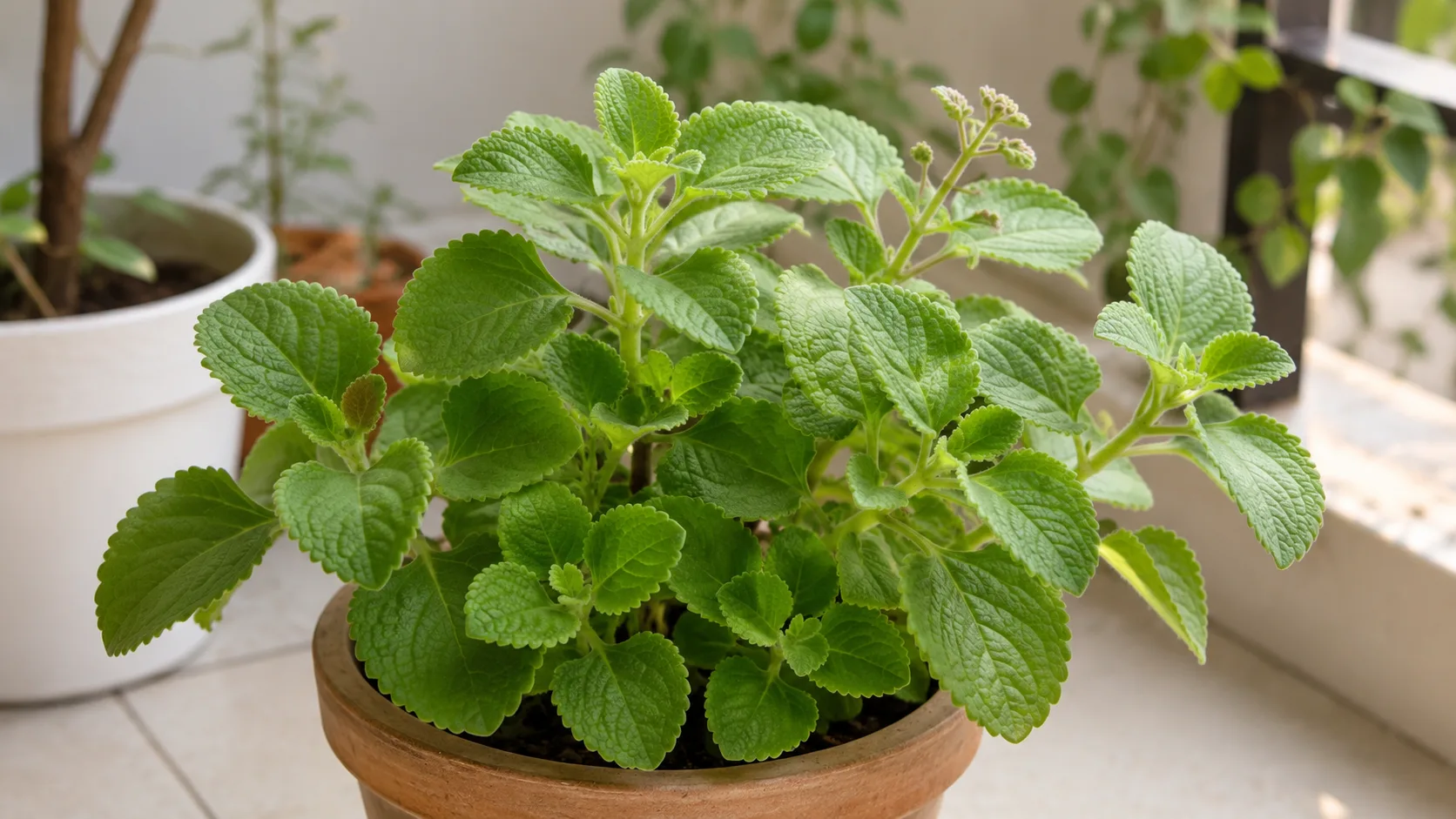
If you’ve ever stood in an Indian grocery, a plant nursery, or a Southeast Asian kitchen garden pointing at a fuzzy-leaved, intensely fragrant herb and asked, “Is this the ajwain plant?” - you’re not alone. The plant most people in the houseplant world call an “ajwain plant” is Plectranthus amboinicus, also classified in older references as Coleus amboinicus, and widely known by its common names: Cuban oregano, Indian borage, country borage, Spanish thyme, French thyme, Mexican mint, and soup mint. It is a semi-succulent perennial in the Lamiaceae (mint) family with thick, velvety, scalloped leaves that smell strongly of oregano, thyme, and a hint of camphor the moment you brush them.
The “ajwain” in the houseplant name is borrowed from the flavor of its leaves, which resembles the ajwain seed spice used across South Asian cooking. That seed spice, however, comes from a completely different plant: Trachyspermum ammi, an annual herb in the Apiaceae (carrot/parsley) family grown for its small, pungent seeds, not its leaves. True Trachyspermum ammi is rarely grown as a windowsill houseplant in most countries; it wants a long, open field and a dry winter-to-spring growing cycle. The plant on your kitchen counter, with the chunky aromatic leaves, is almost always Plectranthus amboinicus, and the rest of this guide is about caring for that plant.
The naming confusion: Plectranthus amboinicus vs. Trachyspermum ammi
It helps to be precise, because the two plants have nothing in common horticulturally. Plectranthus amboinicus is a tender, semi-succulent perennial that is happy indoors, propagates from stem cuttings in days, and tolerates pots. Trachyspermum ammi is a dry-climate annual in the carrot family (Apiaceae) that is grown in the ground from seed, harvested for its seed heads, and rarely kept on a windowsill. If a friend gives you a “ajwain plant cutting” with thick fuzzy leaves, you have Plectranthus amboinicus. If someone hands you a paper sachet of “ajwain seeds,” that is Trachyspermum ammi, and you would plant those in a garden bed in cool weather, not in a kitchen pot. Keeping the botanical name Plectranthus amboinicus (or Coleus amboinicus) on the plant tag, if there is one, prevents most of the cross-confusion that shows up in online care advice.
How to identify the ajwain plant by leaf, stem, and habit
The leaves are the easiest give-away. They are thick, fleshy, ovate to heart-shaped, 4–7 cm long, with a crenate (scalloped) or toothed margin, and they are covered in fine hairs that give them a soft, velvety, almost silvery-green sheen. The stems are square in cross-section (a classic mint-family trait), thick, brittle, and slightly succulent when young, becoming semi-woody as the plant matures. Mature plants form a sprawling, mounding shrub 30–60 cm tall and 60–90 cm wide. When crushed, the leaves release a strong, oregano-thyme-camphor aroma dominated by the volatile compounds carvacrol and thymol - the same phenolic monoterpenes that give oregano and thyme their flavor. Variegated cultivars, sometimes sold as “Variegatus,” have a cream or white margin around each leaf and are otherwise identical in care.
Why the ajwain plant is worth growing at home
Two reasons stand out: the kitchen and the medicine cabinet. Both are worth a clear-eyed look.
Culinary, aromatic, and traditional medicinal uses
In South Indian, Sri Lankan, Caribbean, Vietnamese, and Filipino cooking, the fresh leaves of Plectranthus amboinicus are used the way other cuisines use oregano or thyme - sparingly, because the flavor is intense. A single leaf can flavor a pot of dhal, rasam, or a stir-fry; in the Caribbean, leaves are tucked into meat stews and rice dishes; in Vietnam, leaves are battered and fried into herbal pakoras; in the Philippines, they are steeped into a hot drink called “oregano tea.” Dried leaves can be stored, although drying is harder than with Mediterranean herbs because the high essential-oil content means the leaves brown and lose some aroma quickly; shade-drying in a single layer preserves more of the camphor note than oven-drying.
The flavor is not identical to Mediterranean oregano (Origanum vulgare), even though the plants share a pungency. Expect more of a sharp, menthol-camphor bite on the finish, with a slightly bitter edge if you use too much. Most cooks start with one small leaf per dish, taste, and adjust.
The plant also has a long folk-medicine record across India, Southeast Asia, the Caribbean, and Brazil, where it is used for coughs, asthma, congestion, fever, headache, constipation, and skin complaints such as burns, insect bites, and wounds. A 2016 review of the species in the peer-reviewed journal Molecules (Arumugam et al.) catalogued the essential-oil chemistry of the plant and noted that the oil is rich in carvacrol, thymol, β-caryophyllene, α-humulene, γ-terpinene, p-cymene, and related monoterpenes with demonstrated antibacterial, antifungal, and antioxidant activity in lab studies. That is real biochemistry, but it is lab and animal evidence, not clinical proof in humans, and traditional use is not the same as a recommendation.
Treat the kitchen and folk-medicine uses as separate things. For seasoning food, the leaves are a flavorful herb used in small amounts. For medicinal use, the leaves are a traditional remedy with some supportive phytochemistry, and they are not a substitute for advice from a clinician - especially for children, for anyone who is pregnant or breastfeeding, for people on blood-thinning or antidiabetic medication (because carvacrol and thymol have documented physiological effects), or for anyone with a chronic condition. The leaves are also potent enough that overuse can cause stomach upset. If you are unsure, ask a doctor or pharmacist before using them as a remedy.
Light requirements for an indoor ajwain plant
The ajwain plant is a bright-light tropical that copes with a range of indoor conditions but produces its most aromatic, compact growth in good light. Aim for 4–6 hours of bright light per day, with 2–3 hours of gentle direct sun being beneficial and well tolerated. The sweet spot indoors is a south- or west-facing window with a thin curtain, or an east-facing window with unobstructed morning sun. In dimmer apartments, a full-spectrum grow light 20–30 cm above the canopy for 10–12 hours a day will keep the plant dense and flavorful; without that boost, growth stretches and the leaves thin out.
The plant is forgiving about direction, but it is strict about extremes. Too little light produces a leggy, pale plant: long gaps between leaf pairs (long internodes), small new leaves, and thin, floppy stems. The aroma also weakens because the volatile oils are produced in response to sun stress. Too much direct midday sun, especially through a hot window in summer, bleaches the upper leaves, crisps the edges, and can scorch patches that go papery and brown. North Carolina Extension notes that the plant prefers a hot, dry location for best performance, with some protection from the hottest summer sun, since full sun can burn the leaves. If you move the plant from indoors to a balcony, harden it off over a week or two - start in shade and increase direct exposure gradually - to avoid a single bad afternoon burning the canopy.
Watering an ajwain plant the right way
Plectranthus amboinicus is a semi-succulent, which means the leaves store water and the plant tolerates short dry spells far better than it tolerates a wet pot. That is the single most important fact about watering. The reliable rule is to water thoroughly when the top 2–3 cm of the mix is dry to the touch. In practice, that means roughly once a week in active, warm, bright growth (spring through early autumn for most homes) and every 2–3 weeks in winter, when the plant slows and the pot dries much more slowly. Pot size, light, humidity, and soil mix all change the interval, so use your finger or a wooden chopstick to check the mix rather than the calendar. Water at the base of the plant until water runs from the drainage holes, then empty the saucer so the pot is never sitting in runoff.
Why overwatering on Ajwain Plant is the #1 killer
The thick, fleshy leaves look like they need lots of water, which is the opposite of the truth. In a heavy, moisture-retentive indoor mix, the roots stay wet for days, suffocate, and begin to rot. The plant’s response is paradoxical: leaves go soft, yellow, and droopy, which the owner reads as “thirsty” and waters again, accelerating the rot. The cure is to use a gritty, fast-draining mix, to let the top of the mix dry between drinks, and to never let the pot sit in standing water. A common rescue protocol when you suspect overwatering is to unpot the plant, inspect the roots, cut away any that are brown and mushy, and repot into fresh dry mix; hold off watering for a few days to let the cut roots callus.
Best soil and pot for an ajwain plant
The plant is pH tolerant (6.0–7.5), and it grows in lean to moderately fertile mixes as long as drainage is excellent. Heavy, peat-based “general houseplant” mixes hold too much water and compact quickly, which is the recipe for root rot on Ajwain Plant. A reliable homemade mix is 2 parts cactus/succulent potting mix, 1 part perlite or pumice, 1 part coarse sand or fine gravel, and a handful of compost or worm castings for slow fertility. The goal is a mix that drains fast, holds some air around the roots, and does not stay wet for more than a day or two after a thorough watering. If the mix you buy feels spongy and water-retentive in the bag, lighten it with perlite before potting.
Use a terracotta or unglazed clay pot if you can, because it wicks moisture through the walls and helps the mix dry evenly. Whatever the material, drainage holes are non-negotiable - a decorative pot with no holes is a slow death for Ajwain Plant overview. A starter pot of 15–20 cm diameter with at least 15 cm depth suits a young plant. Repot every 1–2 years, or when the plant doubles in size, going up only one pot size at a time (about 2–3 cm wider in diameter), because a pot that is too large holds water the roots cannot use. Repot at the start of active growth in spring, water lightly for the first week, and resume normal watering only when you see fresh growth.
Temperature, humidity, and airflow
The ajwain plant is frost-tender and tropical. It grows best between 18°C and 27°C (65–80°F), tolerates brief dips to around 10°C (50°F), and is damaged below 4°C (40°F). North Carolina Extension lists the outdoor range as USDA Hardiness Zones 9a–11b, which means most of North America and Europe can only keep this plant outside in summer and must bring it indoors before nights drop below 10°C. Indoors, the plant tolerates normal household humidity in the 40–60% range and does not need a humidifier. Avoid the three classic problem spots: directly under an air-conditioning vent, on a freezing window ledge in winter, and above a hot radiator - each of these can swing the local microclimate out of the plant’s range within hours.
Airflow matters more than humidity for this species. The thick, hairy leaves trap still, humid air against the stem and can invite fungal leaf spot in a stuffy room. A small fan, an open window in summer, or simply not crowding the plant between other pots will reduce that risk significantly.
Fertilizing an ajwain plant without burning it
Plectranthus amboinicus is a light feeder. A balanced, water-soluble houseplant fertilizer at half the label rate, applied once a month during active growth (spring through early autumn), is more than enough - Clemson HGIC notes that herbs grown in very fertile soils tend to produce lush leaves that lack flavor. Apply to already-moist soil so the solution moves through the root zone without burning, and pause feeding in winter, after a major repot, or while the plant is recovering from pests or root issues. Over-fertilized plants produce lush, soft growth that is more attractive to mealybugs and aphids, and the leaves can take on a metallic or “off” flavor - a sign that salts have built up in the mix. If the pot has a white crust on the surface, flush it with plain water until it runs clear from the drainage holes, and skip the next scheduled feeding.
How to propagate an ajwain plant from cuttings
Stem cuttings are by far the most reliable method. The plant is vegetatively propagated almost exclusively because, as a sterile hybrid in cultivation, it sets viable seed rarely and inconsistently. A single healthy cutting can become a full plant in 4–6 weeks.
Water propagation vs. soil propagation
Water propagation is faster to observe: roots appear in 7–10 days in a clear jar on a bright windowsill, with water changed every 2–3 days. The downside is that water-grown roots are slightly weaker and the cutting can rot if the water level is too high or is not changed often. Soil propagation produces a stronger root system in the long run, although you cannot watch the roots form, so success is judged by new leaf growth in 3–4 weeks. Either method works; if you are a beginner, start in water for the visibility, then transplant to soil once the roots are 2–3 cm long.
A simple stem-cutting method: cut a healthy 8–15 cm stem with 3–4 leaf pairs and at least 2–3 nodes just below a node; strip the lower leaves; let the cut end air-dry for 1–2 hours to form a light callus (optional but reduces rot); root in a clear jar with the bottom node submerged, or plant 3–4 cm deep in a pre-moistened, gritty mix of equal parts coco coir and perlite; cover soil cuttings loosely with a clear plastic bag to hold humidity; keep in bright indirect light; change water every 2–3 days, or keep soil mix just barely moist; transplant or pot up once the cutting resists a gentle tug and shows new leaf growth - usually 3–4 weeks from cutting to pot-ready plant. Avoid propagating from a stressed, diseased, or heavily pest-infested parent; the cutting inherits the parent’s problems.
How to harvest ajwain leaves without killing the plant
The plant is ready to harvest once it is well-branched and 15–20 cm tall, typically 30–60 days after a cutting has rooted or about 2–3 months from a nursery start. The most aromatic leaves are the mature, fully expanded ones, not the tiny new growth at the tips.
To harvest without setting the plant back, follow a simple discipline. Pick no more than one-third of the foliage at a time; removing more starves the plant of photosynthesis and stunts regrowth. Snip above a leaf node, where two leaves meet the stem, because new branches will sprout from just below the cut, which is what makes the plant bushy over time. Harvest in the morning after the dew has dried but before the day gets hot; essential-oil content is highest then. Use the leaves fresh for the strongest flavor; if you dry them, lay them in a single layer in shade with good airflow and store in an airtight jar once they crumble easily.
Frequent, light harvesting actually encourages new growth in this species. The more you tip-prune, the more the plant branches and the denser the canopy becomes. If you want essential oil, harvest at peak maturity, before the plant has put energy into flowering.
Pruning and shaping for a bushier plant
Ajwain plants become leggy and bare at the base with age, especially in lower light, because the natural habit is to sprawl outward and upward. The fix is regular, light pinching rather than occasional hard pruning. Every 3–4 weeks during active growth, pinch out the growing tip of each long stem just above a leaf pair. This forces two new branches to break below the cut and doubles the leaf-producing wood. Save the pinched tips - they are perfect cuttings for propagation. Hard pruning (cutting the plant back by a third) is also safe in spring; the plant rebounds quickly from a hard cut, and the removed material can be potted up as new plants.
Common ajwain plant problems and fixes
Most problems with this plant are environmental, not mysterious, and almost all of them trace back to overwatering, cold shock, or pest stress. Yellowing is the most common complaint and the leading causes, in order, are: overwatering and root rot (check the soil moisture first; if the mix is soggy, unpot, trim rotted roots, and repot into fresh, dry, gritty mix); cold shock (a drafty window in winter or a cold delivery can yellow leaves in days); insufficient light (pale, small, widely spaced new growth combined with yellow lower leaves); nutrient deficiency (usually nitrogen; light green older leaves with no other symptoms on a long-unfed plant); normal older-leaf drop (the bottom leaves of an aging stem yellow and drop one at a time; this is not a problem if new growth at the tip is healthy); and spider mites or mealybugs (check the undersides of leaves and the leaf axils before changing the Ajwain Plant watering guide). A plant that drops leaves suddenly in winter is almost always too cold or too wet, not too dry.
Brown, crispy leaf edges usually point to low humidity, dry soil for too long, salt buildup from over-fertilizing, or fluoride/chlorine in tap water. Brown, soft, translucent patches are usually cold damage or sunburn. Brown spots with yellow halos can be fungal leaf spot, which is most common in still, humid air. The fixes are straightforward: flush salts out of the pot, switch to filtered or 24-hour-stood water if you suspect fluoride, raise humidity modestly, and improve airflow.
Pests: mealybugs, spider mites, whiteflies
The aromatic oils of Plectranthus amboinicus repel most insects, but stressed plants can still host mealybugs, spider mites, whiteflies, aphids, and thrips. North Carolina Extension lists mealybugs, spider mites, powdery mildew, and root rot among the common pests and diseases of this species.
Mealybugs appear as white, cottony masses in leaf axils and along stems. Dab each cluster with a cotton swab dipped in 70% isopropyl alcohol, repeat every 3 days for 2 weeks, and follow with a neem oil spray (1 teaspoon neem oil + 1 teaspoon mild liquid soap + 1 quart water) at dusk. Spider mites produce fine webbing and a stippled, dusty look on the undersides of leaves, especially in dry winter air. A forceful shower in the sink, increased humidity, and insecticidal soap usually clear them; quarantine the plant while you treat it. Whiteflies are tiny white insects that cloud up when the plant is disturbed; yellow sticky traps plus insecticidal soap work. Fungus gnats suggest the top of the mix is staying wet for too long; let the surface dry between waterings and consider a top-dress of coarse sand.
Catch infestations early. A weekly inspection of the leaf undersides takes 30 seconds and prevents most outbreaks from getting out of hand.
Pet safety: is the ajwain plant toxic to cats and dogs?
No - the ajwain plant is not safe for pets. The ASPCA Animal Poison Control Center lists Plectranthus amboinicus (Coleus amboinicus) as toxic to cats, dogs, and horses, with the toxic principle identified as the plant’s essential oils. Reported effects include vomiting, diarrhea (sometimes bloody), drooling, depression, loss of appetite, incoordination, and pawing at the mouth. The toxicity appears to be driven by the plant’s essential oils, particularly the diterpenes and the same volatile compounds that give the leaves their flavor. Horses do not typically vomit, but they can show colic, lethargy, and weakness.
If you share your home with a cat, dog, or horse, place the plant out of reach (a hanging basket, a tall shelf, or a closed terrarium), and keep prunings and dropped leaves off the floor. If you suspect your pet has chewed the plant, contact your veterinarian or the ASPCA Animal Poison Control hotline (888-426-4435) immediately, and have the botanical name (Plectranthus amboinicus) ready. Do not wait for symptoms to develop. Other Plectranthus species, like Swedish ivy (Plectranthus australis), are classified as non-toxic to dogs, cats, and horses by the ASPCA, which is why correct identification matters.
Conclusion
The ajwain plant on your kitchen windowsill is almost certainly Plectranthus amboinicus, a semi-succulent, fast-growing tropical herb in the mint family that is grown for its thick, fuzzy, intensely aromatic leaves. It is one of the easier culinary herbs to keep alive indoors, with two non-obvious rules: the soil must drain fast and the pot must never sit in water, and the plant is toxic to cats, dogs, and horses, so it belongs somewhere pets cannot reach it. Given 4–6 hours of bright light, water only when the top of the mix is dry, a gritty neutral-to-slightly-alkaline mix, and warm temperatures above 10°C, the plant rewards you with year-round harvestable leaves, easy propagation from cuttings, and a forgiving response to pruning. Use the leaves sparingly in the kitchen for their oregano-thyme-camphor flavor, treat the traditional medicinal uses as folk tradition supported by some lab evidence rather than as a clinical recommendation, and keep the plant in mind as both a useful herb and a small responsibility - one that needs the right light, the right restraint with water, and a safe distance from curious pets.
When to use this page vs other Ajwain Plant guides
- Ajwain Plant overview - Canonical hub for this species - care topics and problems branch from here.
- Ajwain Plant problems - Symptom-first path when you already know something is wrong.
Related Ajwain Plant guides
How to care for Ajwain Plant?
How much light does Ajwain Plant need?
bright indirect light to partial sun (3–5 hours direct sun)
- bright indirect light to partial sun (3–5 hours direct sun) - bright indirect light to partial sun (3–5 hours direct sun).
When should you water Ajwain Plant?
Moderate watering - let the top 2–3 cm dry between waterings; stores water in thick leaves.
- Thick leaves remain firm when hydrated; slightly soft when thirsty - Moderate watering - let the top 2–3 cm dry between waterings; stores water in thick leaves.
- Drain excess water - Moderate watering - let the top 2–3 cm dry between waterings; stores water in thick leaves.
What soil works best for Ajwain Plant?
Well-draining, moderately fertile potting mix; very tolerant of average soils.
- 50% potting soil - Well-draining, moderately fertile potting mix; very tolerant of average soils.
- 30% compost
- 20% coarse sand or perlite - Light white granules that keep soil airy and help prevent compaction.
Grower notes for Ajwain Plant
What matters most with Ajwain Plant
Ajwain Plant is usually grown for harvest, so flavor, fresh shoots, and quick regrowth matter more than keeping old stems forever. Replace or restart tired plants instead of nursing woody, exhausted growth indefinitely. In practice, the care checkpoint is simple: bright indirect light to partial sun (3–5 hours direct sun). Pair that with well-draining, moderately fertile potting mix; very tolerant of average soils, and avoid changing water, pot size, and placement all at once.
Best placement in a real home
Ajwain Plant belongs where bright indirect light to partial sun (3–5 hours direct sun) is realistic for most of the day, not only where the pot looks good. Moderate watering - let the top 2–3 cm dry between waterings; stores water in thick leaves. If the pot stays wet longer than expected, move the plant into better light or reassess the mix before watering again. Humidity target: Moderate to high (50–70%); naturally adapted to Indian tropical conditions. Temperature comfort zone: 20°C to 38°C (68–100°F).
Before you buy this plant
Choose Ajwain Plant with firm new growth, clean leaf undersides, and soil that does not smell sour or feel compacted. Be cautious if you see yellow-leaves, sticky residue, collapsed crowns, or a pot that is wet in poor light. Cosmetic old-leaf damage is less worrying than weak roots or active pests.
First month after bringing it home
Do not repot Ajwain Plant on day one unless the mix is failing or pests are obvious. Quarantine it, learn how fast the pot dries, and keep care boring while it adjusts. Watch especially for yellow-leaves, leggy-growth, and mold-on-soil. If problems appear, correct the condition first rather than stacking fertilizer, repotting, and pruning together.
Pet-aware note for Ajwain Plant
Ajwain Plant should be treated like other toxic ornamentals in homes with cats or dogs. Use high shelves or separate rooms if animals chew foliage, and choose a genuinely non-toxic herb for floor pots or shared pet zones.
How to tell Ajwain Plant is settling in
Also sold as Indian Borage, Country Borage, and Mexican Mint, this plant should be judged by stable new growth rather than label names alone. If you plan to multiply it later, common methods include Stem cuttings and Leaf cuttings. Repot only when you see stems flopping over pot sides and roots visible at drainage holes. If leggy-growth shows up early, inspect light, watering, and roots before assuming the plant is permanently weak.
Is it pet safe?
Ajwain Plant is not pet safe for cats and dogs.
Indian borage (Plectranthus amboinicus) is listed by ASPCA as toxic to cats, dogs, and horses. Keep it out of reach of pets and grazing animals.
Watering Ajwain Plant
For Ajwain Plant, thick leaves remain firm when hydrated; slightly soft when thirsty and water every 3–4 days in summer; every 5–7 days in winter. Reduce in winter; thrives on moderate water in monsoon.
| Detail | Information |
|---|---|
| How often | Every 3–4 days in summer; every 5–7 days in winter |
| How to check | Thick leaves remain firm when hydrated; slightly soft when thirsty |
| Seasonal changes | Reduce in winter; thrives on moderate water in monsoon |
Signs of overwatering
- yellowing lower leaves
- stem rot at base
- soggy soil
Signs of underwatering
- leaves wrinkling slightly
- dry soil
- wilting in peak heat
Soil & potting for Ajwain Plant
Use a mix of 50% potting soil, 30% compost, 20% coarse sand or perlite for Ajwain Plant. Good drainage; tolerates average conditions better than most herbs. Target soil pH around 6.0–7.5. Repot every 1–2 years or when sprawling out of pot, ideally in spring or monsoon onset.
| Detail | Information |
|---|---|
| Recommended mix | 50% potting soil, 30% compost, 20% coarse sand or perlite |
| Drainage | Good drainage; tolerates average conditions better than most herbs |
| Soil pH | 6.0–7.5 |
| Repotting frequency | Every 1–2 years or when sprawling out of pot |
| Best season to repot | Spring or monsoon onset |
Signs it needs repotting
- stems flopping over pot sides
- roots visible at drainage holes
Humidity & temperature for Ajwain Plant
Ajwain Plant prefers moderate to high (50–70%); naturally adapted to Indian tropical conditions, though normal home humidity is usually fine. Keep temperatures around 20°C to 38°C (68–100°F).
| Detail | Information |
|---|---|
| Humidity | Moderate to high (50–70%); naturally adapted to Indian tropical conditions - normal home humidity is fine. |
| Ideal temperature | 20°C to 38°C (68–100°F) |
Fertilizer & pruning for Ajwain Plant
Use use balanced liquid fertilizer or compost tea at half strength and stop if the plant is stressed, newly repotted, or not actively growing. for Ajwain Plant.
| Detail | Information |
|---|---|
| Fertilizer type | Use balanced liquid fertilizer or compost tea at half strength and stop if the plant is stressed, newly repotted, or not actively growing. |
Common problems on Ajwain Plant
Likely cause: Overwatering or natural lower-leaf ageing
Quick fix: Remove yellow leaves; reduce watering frequency; check drainage
Full fix guide →Leggy Growth
MediumLikely cause: Insufficient light or infrequent harvesting and pruning
Quick fix: Move to brighter spot; cut back leggy stems by half
Full fix guide →Mold on Soil
LowLikely cause: Poor airflow and consistently moist topsoil
Quick fix: Allow top soil to dry slightly; improve ventilation around the plant
Full fix guide →Brown Tips
MediumLikely cause: Common on this plant type; confirm with recent watering, light, and root checks.
Quick fix: Inspect the plant and correct the most likely care stressor before stacking treatments.
Full fix guide →Root Rot
MediumLikely cause: Common on this plant type; confirm with recent watering, light, and root checks.
Quick fix: Inspect the plant and correct the most likely care stressor before stacking treatments.
Full fix guide →Overwatering
MediumLikely cause: Common on this plant type; confirm with recent watering, light, and root checks.
Quick fix: Inspect the plant and correct the most likely care stressor before stacking treatments.
Full fix guide →Underwatering
MediumLikely cause: Common on this plant type; confirm with recent watering, light, and root checks.
Quick fix: Inspect the plant and correct the most likely care stressor before stacking treatments.
Full fix guide →Spider Mites
MediumLikely cause: Common on this plant type; confirm with recent watering, light, and root checks.
Quick fix: Inspect the plant and correct the most likely care stressor before stacking treatments.
Full fix guide →Mealybugs
MediumLikely cause: Common on this plant type; confirm with recent watering, light, and root checks.
Quick fix: Inspect the plant and correct the most likely care stressor before stacking treatments.
Full fix guide →Aphids
MediumLikely cause: Common on this plant type; confirm with recent watering, light, and root checks.
Quick fix: Inspect the plant and correct the most likely care stressor before stacking treatments.
Full fix guide →Slow Growth
MediumLikely cause: Common on this plant type; confirm with recent watering, light, and root checks.
Quick fix: Inspect the plant and correct the most likely care stressor before stacking treatments.
Full fix guide →Wilting
MediumLikely cause: Common on this plant type; confirm with recent watering, light, and root checks.
Quick fix: Inspect the plant and correct the most likely care stressor before stacking treatments.
Full fix guide →Drooping Leaves
MediumLikely cause: Common on this plant type; confirm with recent watering, light, and root checks.
Quick fix: Inspect the plant and correct the most likely care stressor before stacking treatments.
Full fix guide →Low Humidity
MediumLikely cause: Common on this plant type; confirm with recent watering, light, and root checks.
Quick fix: Inspect the plant and correct the most likely care stressor before stacking treatments.
Full fix guide →Not Enough Light
MediumLikely cause: Common on this plant type; confirm with recent watering, light, and root checks.
Quick fix: Inspect the plant and correct the most likely care stressor before stacking treatments.
Full fix guide →Fungus Gnats
MediumLikely cause: Common on this plant type; confirm with recent watering, light, and root checks.
Quick fix: Inspect the plant and correct the most likely care stressor before stacking treatments.
Full fix guide →Curling Leaves
MediumLikely cause: Common curling leaves pattern on Ajwain Plant under indoor care stress.
Quick fix: Inspect roots, watering, light, and pests; adjust one variable and monitor new growth.
Full fix guide →Brown Leaves
MediumLikely cause: Common brown leaves pattern on Ajwain Plant under indoor care stress.
Quick fix: Inspect roots, watering, light, and pests; adjust one variable and monitor new growth.
Full fix guide →Black Spots
MediumLikely cause: Common black spots pattern on Ajwain Plant under indoor care stress.
Quick fix: Inspect roots, watering, light, and pests; adjust one variable and monitor new growth.
Full fix guide →Holes in Leaves
MediumLikely cause: Common holes in leaves pattern on Ajwain Plant under indoor care stress.
Quick fix: Inspect roots, watering, light, and pests; adjust one variable and monitor new growth.
Full fix guide →Pale Leaves
MediumLikely cause: Common pale leaves pattern on Ajwain Plant under indoor care stress.
Quick fix: Inspect roots, watering, light, and pests; adjust one variable and monitor new growth.
Full fix guide →Distorted Leaves
MediumLikely cause: Common distorted leaves pattern on Ajwain Plant under indoor care stress.
Quick fix: Inspect roots, watering, light, and pests; adjust one variable and monitor new growth.
Full fix guide →Scale Insects
MediumLikely cause: Common scale insects pattern on Ajwain Plant under indoor care stress.
Quick fix: Inspect roots, watering, light, and pests; adjust one variable and monitor new growth.
Full fix guide →Thrips
MediumLikely cause: Common thrips pattern on Ajwain Plant under indoor care stress.
Quick fix: Inspect roots, watering, light, and pests; adjust one variable and monitor new growth.
Full fix guide →Whiteflies
MediumLikely cause: Common whiteflies pattern on Ajwain Plant under indoor care stress.
Quick fix: Inspect roots, watering, light, and pests; adjust one variable and monitor new growth.
Full fix guide →Leaf Miners
MediumLikely cause: Common leaf miners pattern on Ajwain Plant under indoor care stress.
Quick fix: Inspect roots, watering, light, and pests; adjust one variable and monitor new growth.
Full fix guide →Caterpillars
MediumLikely cause: Common caterpillars pattern on Ajwain Plant under indoor care stress.
Quick fix: Inspect roots, watering, light, and pests; adjust one variable and monitor new growth.
Full fix guide →Nitrogen Deficiency
MediumLikely cause: Common nitrogen deficiency pattern on Ajwain Plant under indoor care stress.
Quick fix: Inspect roots, watering, light, and pests; adjust one variable and monitor new growth.
Full fix guide →Iron Deficiency
MediumLikely cause: Common iron deficiency pattern on Ajwain Plant under indoor care stress.
Quick fix: Inspect roots, watering, light, and pests; adjust one variable and monitor new growth.
Full fix guide →Magnesium Deficiency
MediumLikely cause: Common magnesium deficiency pattern on Ajwain Plant under indoor care stress.
Quick fix: Inspect roots, watering, light, and pests; adjust one variable and monitor new growth.
Full fix guide →Potassium Deficiency
MediumLikely cause: Common potassium deficiency pattern on Ajwain Plant under indoor care stress.
Quick fix: Inspect roots, watering, light, and pests; adjust one variable and monitor new growth.
Full fix guide →Calcium Deficiency
MediumLikely cause: Common calcium deficiency pattern on Ajwain Plant under indoor care stress.
Quick fix: Inspect roots, watering, light, and pests; adjust one variable and monitor new growth.
Full fix guide →