Ajwain Plant Light Guide: Windows, Sun & Grow Lights
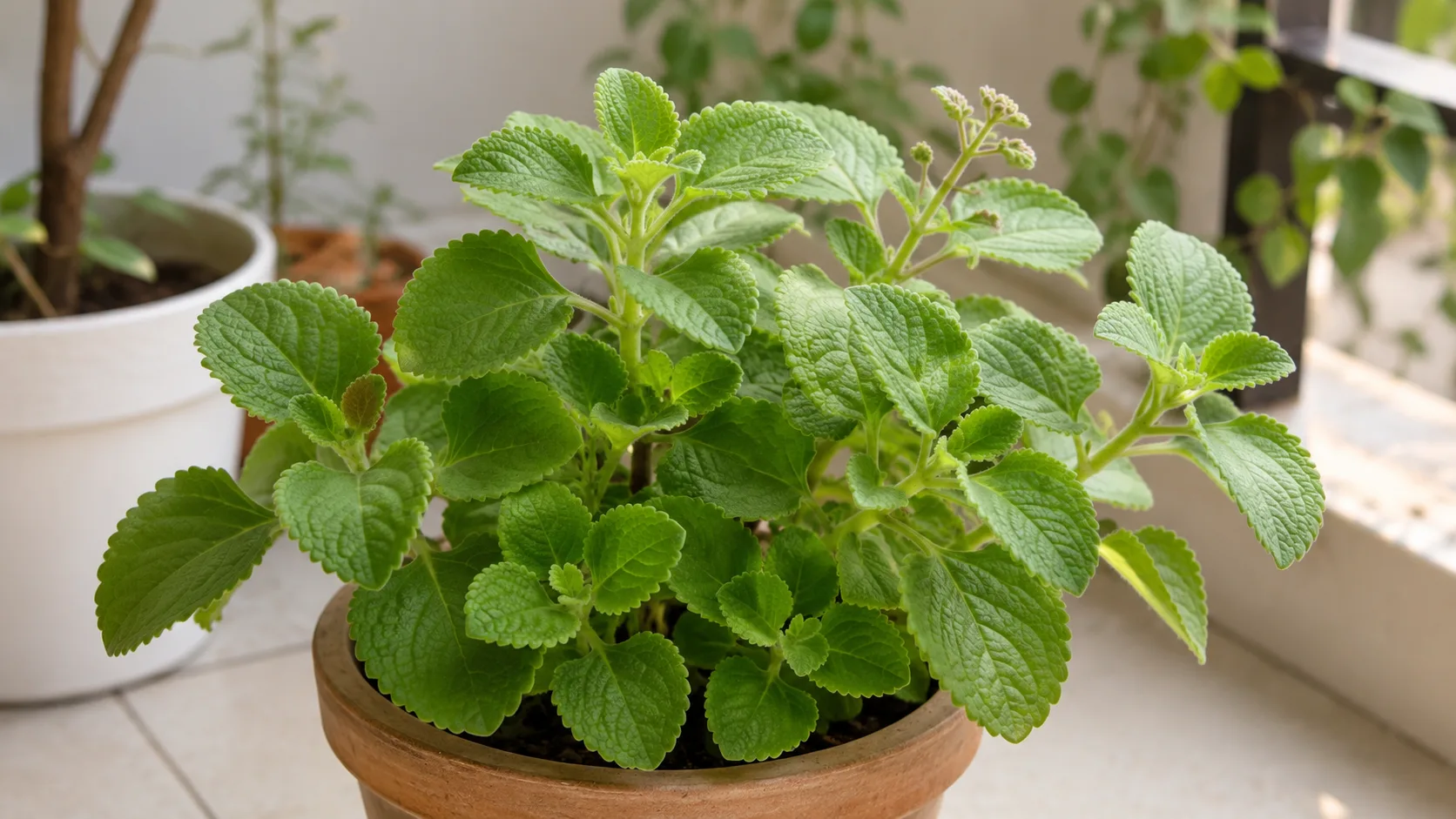
Ajwain Plant Light Guide: Windows, Sun & Grow Lights
Ajwain Plant Light Guide: Windows, Sun & Grow Lights
Why Light Matters for Ajwain Plant
The ajwain plant - Plectranthus amboinicus, also called Indian borage, Cuban oregano, Spanish thyme, and karpooravalli - looks like a chubby, fuzzy succulent dressed up as a kitchen herb. It is not the same plant as Trachyspermum ammi, the dry-climate annual grown for ajwain seed spice; the windowsill herb is Plectranthus amboinicus, grown for its thick aromatic leaves. The NParks FloraFaunaWeb database classifies it as a succulent plant with fleshy, fragrant foliage, and that semi-succulent physiology is the starting point for every light decision you make indoors.
Light is the engine of two things ajwain growers care about most. First, it drives photosynthesis, which produces the carbohydrates the plant uses to build new leaves, stems, and the dense network of oil-bearing trichomes that give the foliage its smell. Second, in aromatic Lamiaceae herbs, light intensity shapes volatile-oil production. Research on garden thyme (Thymus vulgaris) found essential-oil content nearly ten times higher under full light than under 20% light intensity (PLOS One, 2025), and Clemson Extension notes that fragrance oils - which account for herb flavor - are produced in the greatest quantity when plants receive plenty of sun, while very fertile, shaded conditions tend to produce lush leaves that lack flavor. Plectranthus amboinicus has not been studied as extensively as thyme in controlled light trials, but the same general pattern holds in practice: dim ajwain stretches, softens, and smells faint when you crush a leaf.
That connection between light and aroma is not a gardening myth. Mediterranean oregano and thyme are grown in full sun for the same biochemical reason. Ajwain is not Mediterranean - it is a semi-succulent tropical perennial - which changes the math. It can take strong light, but it cannot take punishing, dry, unfiltered midsummer sun on fleshy leaves without acclimation. NC State Extension captures the tension directly: the species prefers a hot, dry location for best performance, yet “full sun can burn the leaves” and afternoon protection helps in hot climates.
The practical upshot: a well-lit ajwain plant produces firmer new growth, larger leaves, stronger fragrance, and faster recovery from pruning. A dim ajwain plant survives, but it loses the punch that makes this species worth growing. If you are placing a pot on a kitchen windowsill, remember that the ASPCA lists Plectranthus amboinicus (Spanish thyme) as toxic to cats, dogs, and horses - bright sills are great for light, but keep pots out of reach of pets that chew leaves or dig in soil.
The Native Light Environment of Plectranthus amboinicus
Understanding where ajwain comes from makes its indoor preferences much easier to interpret. NParks FloraFaunaWeb records the native distribution as Kenya to South Africa, the Arabian Peninsula, and India, with native habitat in grassland, savannah, scrubland, and disturbed open ground at low elevations. The species has been cultivated and naturalized across India, Sri Lanka, Southeast Asia, and the Caribbean for centuries. In the wild it typically grows as a groundcover on rocky or sandy soil in semi-open landscapes - at woodland edges, beneath open tree canopies, along walls, and in cleared ground where taller vegetation has been removed.
That habitat gives a real-world light profile: full morning sun, then filtered or dappled light for much of the day, with year-round day lengths between roughly 11 and 13 hours in the tropics. The plant rarely sits in unbroken six-hour midday sun in nature, and it just as rarely sits in deep understory shade. UF/IFAS Gardening Solutions describes Cuban oregano as “an ideal herb to grow in partial shade,” which aligns with the woodland-edge biology rather than open-field Mediterranean herb culture.
For indoor growers, the practical translation is that bright light with protection from the harshest midday exposure is closer to its evolved preference than either “any dim corner will do” or “unfiltered south glass all summer.” Ajwain’s wild habitat also explains why the plant tolerates heat, mild drought, and lean soil better than it tolerates cold, low light, or waterlogged roots.
How Much Light Does an Ajwain Plant Need Indoors?
Most reputable sources converge on a similar recommendation: ajwain performs best in bright, indirect light with several hours of direct sun, ideally 3 to 5 hours of direct morning sun, with protection from harsh afternoon rays. NC State Extension lists the cultural range as full sun (six or more hours of direct sunlight daily) or partial shade (direct sun only part of the day, two to six hours), with the practical indoor sweet spot being bright indirect light supplemented by gentle direct sun.
Bright Indirect vs Partial Sun
“Bright indirect light” and “partial sun” are often used interchangeably, but they are not the same thing, and the distinction matters for placement.
Bright indirect light means a spot that receives strong ambient light for most of the day but is shielded from direct sunbeams - for example, one to three feet from a south- or west-facing window, immediately behind a sheer curtain, or near a large east-facing window after morning rays pass.
Partial sun means the plant receives direct sun for three to six hours per day, usually gentler morning or late-afternoon rays rather than the strongest midday sun.
Ajwain does best when it gets the best of both: bright indirect light as a baseline, plus a few hours of direct morning sun. That combination drives oil production without the leaf-scorch risk of an exposed west-facing windowsill in July.
Daily Light Hours and Intensity Targets
Aim for a daily target of four to six hours of direct or very bright light, with the rest of the day in strong ambient brightness. In practical terms:
- An east-facing window that catches three to four hours of direct morning sun, with bright ambient light for the rest of the day, is a strong default.
- A west- or south-facing window with sheer curtains or set back one to three feet from the glass can deliver similar totals.
- A north-facing window can work in summer if large and unobstructed, but in winter it usually falls short unless supplemented with a grow light.
In commercial herb production, daily light integral (DLI) for culinary herbs typically falls in the 10 to 20 mol·m⁻²·d⁻¹ range, with Michigan State University Extension noting that a common greenhouse target minimum is 10–12 mol·m⁻²·d⁻¹ and GrowerTalks reporting that most studied herbs require moderate (10–20) to high (>20) DLI for good- to excellent-quality finished plants. A bright windowsill in winter may deliver roughly half that total; a well-set grow light covers the gap. If you are not measuring DLI with a quantum sensor, use the new-growth test: are the newest leaves compact, deeply colored, and aromatic when crushed? If yes, light is in a workable range. If no, increase hours, increase intensity, or move the pot closer to the window.
Best Window Placement for Ajwain Plant
Window orientation is the single most practical decision you will make for an indoor ajwain plant. The right window depends on your hemisphere, your climate, and how far the pot sits from the glass, but the underlying logic is the same everywhere.
Window Direction Scorecard (Northern Hemisphere)
Compass direction is a map, not a guarantee - overhangs, trees, tint, and pot distance all shift real intensity. Still, for Northern Hemisphere growers choosing among household windows:
| Direction | Typical light profile | Suitability for ajwain |
|---|---|---|
| East-facing | Gentle direct morning sun, then bright ambient | Best default - matches woodland-edge morning sun |
| South-facing | Strong direct sun most of the day; hottest in summer | Good with filtration - excellent in winter; pull back or sheer in midsummer |
| West-facing | Hot, intense afternoon sun | Manage carefully - bright but high scorch risk without curtain or setback |
| North-facing | Mostly indirect; limited direct hours | Survival only - plan grow-light supplementation, especially in winter |
In the Southern Hemisphere, flip the logic: north-facing windows are brightest and south-facing windows are dimmest. Treat “north-facing” advice in temperate Northern Hemisphere guides as “your dimmest window” if you garden south of the equator.
East-Facing Windows
East windows are the default recommendation for a reason. They deliver three to four hours of gentle, direct morning sun - exactly the kind of light ajwain evolved to receive at the edge of an African woodland clearing. Morning sun is bright enough to drive strong photosynthesis and oil production, but it lacks the leaf-scorching intensity of midday and afternoon rays.
For most growers in the Northern Hemisphere, an unobstructed east-facing windowsill is the single best indoor spot for ajwain. Place the pot within about one to three feet of the glass, rotate the container a quarter turn each week to keep growth even, and watch for stems leaning hard toward the glass - that usually means move closer, not add light from another direction.
West- and South-Facing Windows
West- and south-facing windows deliver the most total light in the Northern Hemisphere, but they also deliver the harshest afternoon sun, especially from late spring through early autumn. Direct, unfiltered west sun in July can bleach ajwain leaves within a day or two.
That does not mean you should avoid these windows. It means you should manage them. Three reliable approaches:
- Set the pot back one to three feet from the glass so the plant receives bright light without the concentrated beam.
- Hang a sheer curtain between the plant and the window to diffuse the strongest hours while still letting most light through.
- Use a shade cloth rated at 30 to 50 percent during peak summer if the plant stays outside or in an unshaded window.
In winter, the same south- or west-facing window that is too hot in summer is often the best spot in the house. The sun is weaker, the days are shorter, and the plant is more likely to be light-limited than heat-stressed. A simple seasonal swap - close to the glass in winter, set back or filtered in summer - covers most situations.
North-Facing Windows
North-facing windows in the Northern Hemisphere deliver the least direct sun of any orientation. They are workable for ajwain in spring and summer if the window is large and unobstructed and the plant sits within one to two feet of the glass. In autumn and winter, a north window alone is rarely enough; the plant will slow down, drop lower leaves, and stretch toward whatever light is available.
If a north-facing window is your only option, plan to add a grow light for at least part of the year. Trying to nurse ajwain through a dark winter on ambient light alone is the most common reason for leggy, pale, slow growth. For a full diagnostic workflow once stretch is visible, see not enough light on ajwain plant.
Signs Your Ajwain Plant Is Not Getting Enough Light
A light-starved ajwain plant tells a familiar story: it stretches, fades, and stops performing. The signals are usually easy to read once you know what to look for, and they are reversible if you catch them early.
Leggy, stretched growth (etiolation) is the classic and most diagnostic sign. Stems elongate, gaps between leaf pairs widen, and the plant visibly leans toward the nearest light source. New leaves are smaller than older ones, and the whole plant looks loose and floppy rather than compact and bushy. A subtle clue specific to ajwain: stems may be too weak to hold themselves upright, and the plant may sprawl open at the center instead of holding its bushy shape. Once a stem has stretched, it will not shrink back - move the plant into more light, prune leggy stems back to just above a healthy leaf node, and let new compact growth replace the stretched material. For stretch-specific recovery, see leggy growth on ajwain plant.
Pale, small, or thin leaves emerge when the plant rationing energy. The deep, slightly grayish green of a healthy ajwain leaf fades toward washed-out yellow-green, and the velvety texture feels thinner. If you see both stretch and pale new leaves, the plant is clearly underlit and needs more hours, more intensity, or a better window.
Reduced aroma and essential oils is the signal most kitchen growers miss, because it does not look like damage. The plant appears green, but when you crush a leaf the oregano-thyme punch is muted. Clemson Extension ties fragrance-oil production to sunny placement, and thyme research confirms that low light dramatically suppresses essential-oil content (PLOS One, 2025). If aroma fades while everything else looks fine, move the pot to a brighter window or run a grow light for 12 to 14 hours daily - the next flush of new growth should smell noticeably stronger within a couple of weeks.
Signs Your Ajwain Plant Is Getting Too Much Sun
Too much sun on ajwain usually shows up faster than too little, because the damage is physical. The fleshy, fuzzy leaves hold water well but shed excess heat poorly, and they will tell you quickly when light is too intense.
The most common signs are:
- Bleached or whitish patches on the most exposed parts of the leaves, especially the upper surface facing the window. Bleaching is irreversible; the damaged tissue will not green up again.
- Crispy brown edges and tips, sometimes with a papery feel - sunscald on margins and tips first.
- Curling or cupping of leaves during the brightest hours, often returning to normal overnight.
- Sudden leaf collapse after a quick move from indoors to a sunny patio - leaves formed in dim indoor light lack the protective cuticle for outdoor intensity.
- Wilting that does not match soil moisture - if the plant wilts while soil is still damp on a bright day, light or heat stress is the likely culprit, not thirst.
If you see any of these signs, move the plant out of the direct beam, add filtration, or acclimate more slowly. NC State Extension explicitly warns that full sun can burn the leaves - the fix is placement, not more water. Trim severely scorched leaves only after the plant has stabilized in gentler light.
Acclimating an Ajwain Plant to Outdoor Sun
Moving ajwain outdoors is one of the highest-leverage things you can do for growth, fragrance, and vigor - but only if you do it gradually. A plant that has been indoors under window light all winter cannot be planted into a sunny garden bed in May and expected to thrive.
The standard hardening-off routine used by nurseries and extension services works well for ajwain:
- Days 1–2: Place the plant outdoors in a fully shaded, sheltered spot for two to three hours, then bring it back inside.
- Days 3–4: Move it into gentle morning sun for one to two hours, then back to shade.
- Days 5–6: Extend morning sun to three to four hours, with shade in the afternoon.
- Day 7+: If leaves look healthy, move the plant into its final outdoor position with three to six hours of direct sun and afternoon shade in hot climates.
Throughout the process, check leaves daily for bleaching, curling, or wilting. If the plant reacts, drop back a step and slow down. The whole transition usually takes 7 to 14 days.
For outdoor placement, aim for morning sun, afternoon shade, good air circulation, and protection from reflected heat off concrete or metal counters near west windows. Under a deciduous tree, on a covered porch, or along an east-facing wall are all strong choices. In USDA Hardiness Zones 9a–11b, ajwain can stay outdoors year-round. In Zones 6 to 8, treat it as a container plant that comes inside before nighttime temperatures drop below about 50°F (10°C) .
Using Grow Lights for Ajwain Plant
A grow light is the easiest way to keep ajwain vigorous when window light is not enough - dim apartments, north-facing rooms, or dark winters. The plant does not need anything exotic; a basic full-spectrum LED setup is enough for healthy, fragrant growth.
The practical recipe for most indoor herb gardens looks like this:
- Spectrum: Full-spectrum white LED (roughly 3000K to 6500K), or a balanced blue-and-red horticultural panel. Avoid old red/blue-only “blurple” fixtures in living spaces if you can; modern full-spectrum panels look like normal light and cover all growth stages.
- Intensity: Aim for roughly 200–400 µmol·m⁻²·s⁻¹ at the leaf surface - the same band many culinary herbs and succulents use on bright windowsills. Exact PPFD varies by fixture wattage; if new growth stays compact and aromatic after two weeks, intensity is sufficient. If stems still stretch with 14 hours of lamp time, move the fixture closer or upgrade wattage rather than adding hours alone.
- Wattage and coverage: A rough rule of thumb is about 20 watts of quality full-spectrum LED per square foot of growing area for dense herb shelves. A single 10–15 watt bulb suffices for one small pot; a two-foot shelf of herbs wants around 40 watts combined.
- Distance: Keep the fixture roughly 6–12 inches (15–30 cm) above the canopy for most small to medium LEDs. Raise the light if leaf tips bleach or feel hot to the touch.
- Daily duration: 12–14 hours of light per day is a strong default during active growth, with at least eight hours of darkness so respiration and hormone cycles stay normal.
- Timer: Use a mechanical or smart outlet timer. Consistency matters more than absolute precision.
The two clearest signals that a grow-light setup is working are compact new growth and stronger aroma when leaves are crushed. If the plant still stretches or smells faint after two weeks, move the light closer, increase daily duration by an hour or two, or both.
Seasonal Light Adjustments
The right amount of light for ajwain is not a fixed number. It changes through the year, and a good care routine tracks that change rather than fighting it.
In spring and summer, days are long, the sun is high, and light is intense. This is when the plant does most of its active growth and is also most at risk of sunscald. In hot climates, lean toward morning sun and afternoon shade, and watch for bleaching if a heat wave rolls in. In cooler climates, the same plant can usually take more direct sun than it would in July in a hot zone.
In autumn and winter, days are short, the sun is weak, and indoor light drops sharply. Even a south-facing window in December delivers a fraction of the light it delivered in June. The plant will naturally slow its growth, which is fine. The mistake is to keep watering and feeding at summer levels and then wonder why the pot stays wet too long and leaves stretch toward the dim corner of the room. Reduce watering per the ajwain watering guide, hold off on fertilizer, and either move the plant to the brightest window you have or add a grow light for 12 to 14 hours daily.
If the plant overwinters in a heated room with very low humidity, the combination of short days and warm temperatures tends to push soft, leggy growth. Cooler nighttime temperatures in the 55–65°F (13–18°C) range and as much direct sun as the season offers both help keep the plant compact through winter.
Common Light Mistakes to Avoid
Most ajwain light problems come from a handful of recurring mistakes. None are catastrophic, but each one chips away at growth and aroma.
- Treating it as a low-light plant. Ajwain is a sun-loving tropical herb, not a shade survivor like some ferns. A dark corner keeps it alive but not fragrant. If you only have a low-light spot, plan to add a grow light.
- Putting it straight into outdoor sun. A plant indoors all winter cannot handle a full day of direct outdoor light without hardening off over 7–14 days.
- Leaving it in a south or west window in midsummer without filtration. Strong afternoon sun can scorch leaves in a single day. Use a sheer curtain, set the pot back from the glass, or move it to a gentler window from late spring through early autumn.
- Chasing more hours instead of better intensity. Sixteen hours under a weak, distant grow light produces a different plant than twelve hours under a strong, close fixture. Position and intensity usually matter more than raw hours.
- Ignoring the new-growth test. The leaves the plant is producing this week are the most honest report on its light environment. Compact, deep green, fragrant growth is the green light. Small, pale, stretched growth is the warning.
- overwatering on Ajwain Plant in low light. A dim plant drinks less than a bright one. If you move ajwain into a darker spot, reduce watering - wet soil plus low light is the fastest path to root rot on Ajwain Plant. See the watering guide for dry-down checks tied to placement.
- Fertilizing to compensate for low light. Fertilizer does not replace light. In dim conditions, the plant uses less of everything, and excess fertilizer salts the soil and burns roots.
Related Ajwain Care
Light sits upstream of almost every other ajwain problem. When placement is wrong, watering, feeding, and harvest quality all look broken.
- Ajwain plant overview - species basics, naming clarity (Plectranthus vs Trachyspermum), toxicity, and seasonal rhythm.
- Not enough light - diagnosis and recovery when stretch and weak aroma are already visible.
- Leggy growth - pruning and placement fixes for stretched stems.
- Watering - moisture rhythm that must track every light change.
How We Wrote and Verified This Guide
By Sai Ananth · Reviewer: LeafyPixels Review Board (culinary herb care) · Last reviewed: 2026-06-15
Recommendations were cross-checked against NC State Extension Plant Toolbox (light range, sun-burn note, hardiness zones), NParks FloraFaunaWeb (native range, semi-shade preference), UF/IFAS Gardening Solutions (partial-shade ideal), Michigan State University Extension and GrowerTalks (herb DLI targets), Clemson HGIC herbs (sun and flavor-oil production), PLOS One thyme light study (essential-oil response to light intensity), ASPCA Spanish thyme listing (pet toxicity), and LeafyPixels sibling pages for overview, not enough light, leggy growth, and watering.
Conclusion
Ajwain (Plectranthus amboinicus) is a sun-loving tropical herb that performs best with three to five hours of direct morning sun and bright indirect light for the rest of the day. An east-facing window is the easiest reliable spot. South- or west-facing windows work with a sheer curtain or a small setback from the glass. North-facing windows usually need a grow light, especially in winter. The plant tells you which way the balance has tipped: leggy stems, pale new leaves, and fading aroma mean more light; bleached patches, crispy edges, and midday wilting on damp soil mean less - and NC State Extension makes the same point about leaf burn under harsh full sun.
Treat light as the most important care input you control. Judge results on the newest leaves and the smell of a crushed leaf, keep toxic pots off reachable sills, and adjust watering to match the light you have - not the light you wish you had. When windows fail, run a full-spectrum LED 12–14 hours daily at 200–400 µmol·m⁻²·s⁻¹ roughly 6–12 inches above the canopy. Get placement right and ajwain practically grows itself; miss it and every other knob turns the wrong way.
When to use this page vs other Ajwain Plant guides
- Ajwain Plant overview - Start here for whole-plant context before deep-diving this topic.
- Ajwain Plant problems hub - Jump to symptom-specific fix guides when this care topic does not resolve the issue.
- Not Enough Light on Ajwain Plant - Escalate here when light adjustments are not enough.
- Leggy Growth on Ajwain Plant - Escalate here when light adjustments are not enough.