Ajwain Plant Watering: How Often, How Much, and How to Fix
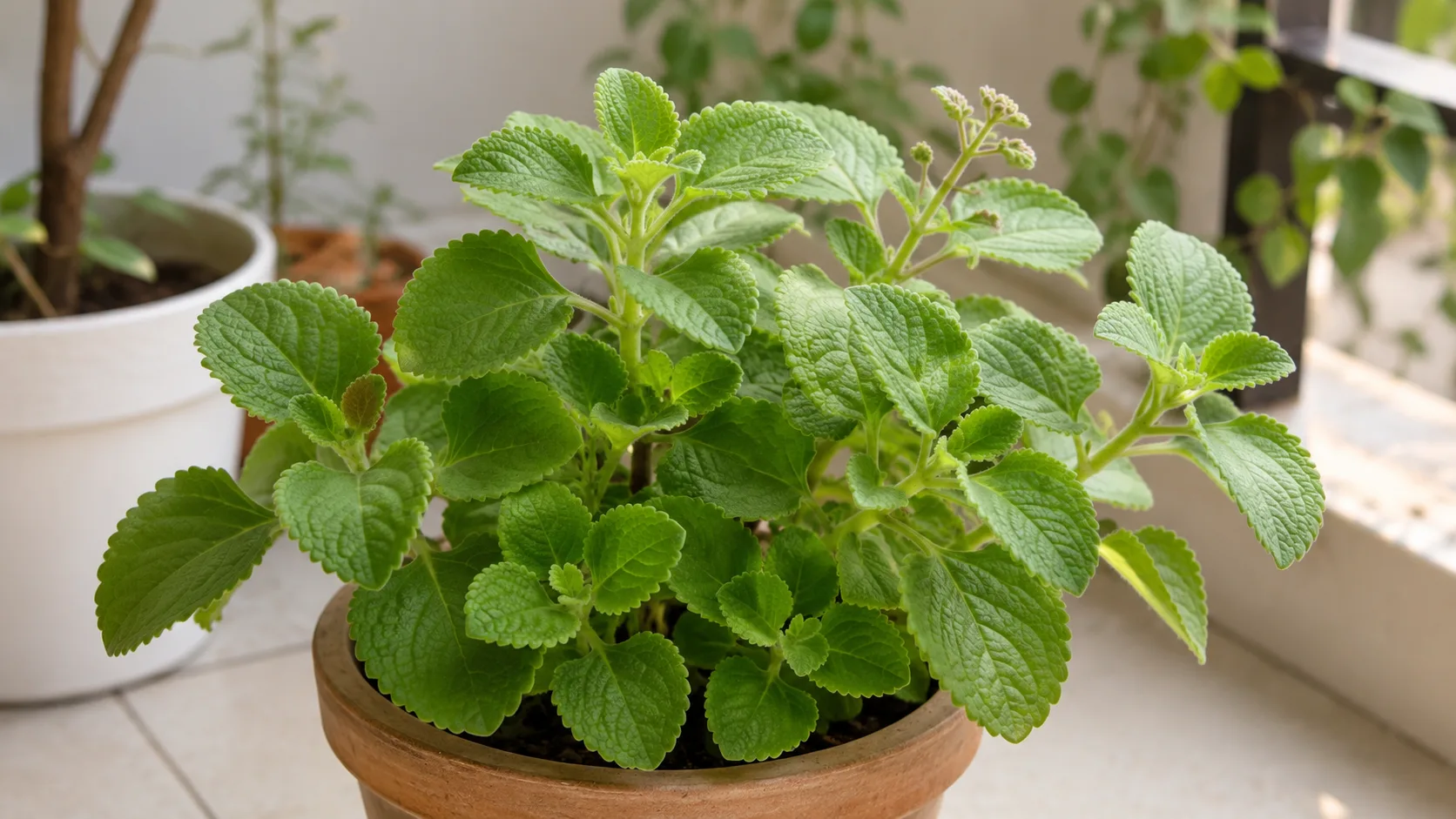
Ajwain Plant Watering: How Often, How Much, and How to Fix Mistakes
Ajwain Plant Watering: How Often, How Much, and How to Fix Mistakes
Ajwain plant watering is where most first-time growers lose Plectranthus amboinicus - not because the plant is fussy, but because it looks like basil and behaves like a small succulent. Indian borage, Cuban oregano, country borage: the common names all describe the same thick-leaved mint-family herb with fuzzy trichomes and water-storing stems. Water it on a mint schedule and the roots suffocate within weeks. Water it on a true desert-succulent schedule and you may starve a plant that still wants moderate drinks when the soil has genuinely dried. The workable middle is soak, dry down, soak again - confirmed by touch, chopstick, or pot weight, not by a calendar app.
This guide covers how often and how much to water ajwain indoors and on a balcony, what changes during Indian monsoon months, how to read overwatering versus underwatering (including the wilt that tricks almost everyone), water quality, cuttings and repot transitions, and a five-step rescue when soil has stayed wet too long. For species basics and naming clarity, start with the ajwain plant overview.
Why Ajwain Watering Is Different From Other Kitchen Herbs
Most kitchen-herb failures on ajwain start with the wrong mental model. Growers see lush, velvety leaves and assume high thirst. Basil and mint in the same family want consistently moist mix. Ajwain does not.
The succulent-like stems and leaves you can feel
NParks FloraFaunaWeb classifies Coleus amboinicus (syn. Plectranthus amboinicus) as a succulent plant with moderate water preference, fleshy aromatic leaves, and a requirement for sandy, well-drained soil. NC State Extension describes a fast-growing, spreading perennial that prefers a hot, dry location and warns that full sun can burn the leaves - a plant built for intermittent rain on free-draining ground, not a permanently damp herb bed.
Run your thumb across a healthy leaf: it feels thick, almost rubbery, and snaps when bent. Thirsty leaves feel thinner and flop. Stems thicken at the base and store water between drinks. That biology is why ajwain survives missed water far better than basil - and why saturated soil kills it faster.
Why shallow, frequent watering fails
A splash every day or two keeps only the surface damp. Deep roots never get a full drink, never grow downward, and the upper layer stays wet long enough for fungus gnats and root-rot fungi. UF/IFAS Gardening Solutions notes Cuban oregano needs well-drained soil and only occasional irrigation (if any) once established - the extension emphasis is drainage and restraint, not daily moisture. The rhythm ajwain wants is the opposite of “little and often”: one thorough soak, a real dry-down, then another soak.
The Golden Rule: Let the Top Inch Dry, Then Water Deeply
If you remember one rule: let the top inch (about 2–3 cm) of mix dry completely, then water deeply until runoff exits the drainage holes. UW Extension houseplant guidance and root-rot prevention notes align on the same principle - check soil moisture before watering, avoid waterlogged mix, and use pots with working drainage. Everything else - summer versus winter, monsoon, pot material - refines timing around this core.
Frequency note vs the overview: Our ajwain overview describes active-season watering as roughly once a week when the top 2–3 cm is dry. This dedicated watering page uses a 5–10 day summer range because larger glazed pots, AC-cooled rooms, and partial shade slow dry-down. ~7 days is the midpoint when a 6–8 inch pot in bright indirect light dries at a typical pace. Always defer to the soil test, not the calendar.
What “top inch dry” means in real soil
“Top inch” only works when mix drains predictably. Peat-heavy soil can feel dry on top while the lower half stays soggy. Gritty cactus-style mix dries faster at every depth. The honest version: top 2–3 cm dry to the touch and the pot noticeably lighter than right after watering. After repotting, wait two to three weeks before trusting the test - fresh bagged mix distributes moisture unevenly until roots bind the medium. See ajwain soil for mix ratios that make the top-inch signal reliable.
What “water deeply” looks like in practice
Pour slowly at the base in a circle until water runs from drainage holes, then stop. Let the pot sit ten minutes, empty the saucer, and return it to its spot. Shallow splashes train roots to stay near the surface where rot starts. If the pot has no drainage holes, upgrade: drill holes, double-pot (nursery pot inside a decorative cover), or switch to terracotta. UW Extension is explicit - root-rot pathogens thrive in waterlogged soil, and a pot with drainage holes is the first defense. Decorative cachepots without holes trap stagnant water; ajwain in that setup fails quickly regardless of how carefully you pour.
Three Reliable Ways to Test Moisture Before You Water
Guessing causes most ajwain deaths. These plants tolerate dry-down; when uncertain, wait another day.
Finger, chopstick, and pot-lift tests
Finger test: Push your index finger to the first knuckle (2–3 cm). Cool and damp - wait. Dry and warm - water. Takes five seconds; fails only when mix has gone hydrophobic (see underwatering recovery below).
Chopstick test: Insert a plain wooden skewer to half pot depth for thirty seconds. Dry wood with no soil cling means water. Dark damp stripe or clinging soil means wait. Essential for large pots and humid coastal balconies where the surface never looks dry.
Pot-lift test: Lift right after watering and note the weight. Within a week you build a mental scale - dry ajwain pots feel dramatically lighter. Fastest test with practice. A moisture meter with a 15 cm probe works if calibrated; aim for the dry-to-moist transition, never wet.
A Simple Seasonal Watering Schedule
The golden rule is year-round; how long the top inch takes to dry changes with season and placement. Use this India-centric table as a starting point (shift ±1 month for other climates), then confirm with tests.
| Season | Months (India-centric) | Typical interval | Notes |
|---|---|---|---|
| Summer (peak growth) | March – June | Every 5–10 days (~weekly at midpoint) | Deep soak; second light drink only in heat waves |
| Monsoon | July – September | Suspend if outdoors in rain | Supplement only in dry spells; drain saucers after storms |
| Post-monsoon | October – November | Every 7–14 days | Cooler air slows drying; watch for dormancy cues |
| Winter (dormancy) | December – February | Every 2–4 weeks | Err strongly dry; wet roots in cold soil kill fast |
Summer, monsoon, post-monsoon, and winter rhythms
Summer: Active growth uses more water; soil dries faster. Water early morning so leaves dry before night. Avoid mid-afternoon watering on hot roots.
Monsoon: Outdoor ajwain dies more from never-drying soil than from any single downpour. Humidity above 90% for weeks plus clogged drainage is lethal. Stop manual watering when rain is regular; check saucers after storms. A drizzle wets leaves - it does not replace a root-zone soak.
Post-monsoon: Rains stop, humidity drops, growth may still be active. Easy season to overwater because cool air slows evaporation. Resume top-inch rhythm; stretch interval when new growth slows.
Winter: Semi-dormant ajwain drinks half as much or less. Small terracotta pots can stay damp three weeks. Water only when top inch is bone dry and chopstick reads approaching dry below. Never water before a cold snap - wet roots in cold mix are the common winter killer.
Year-round outdoor watering in USDA Zones 9–11
In frost-free zones (NC State lists USDA 9a–11b for Plectranthus amboinicus), outdoor ajwain may grow year-round without a monsoon dormancy pattern. UF/IFAS Orange County describes Cuban oregano as Florida Friendly, needing well-drained soil and little if any extra water once established. In humid subtropical summers, shelter pots from daily thunderstorms - under eaves or porch overhangs - and water at the base only when the top inch dries, often every 5–7 days in active heat. In mild dry winters (Florida, coastal California, Hawaii lowlands), stretch to 10–14 days or longer. Ground-planted established specimens in sandy loam may need rainfall only, with supplemental water during multi-week dry spells.
How Container, Soil, and Climate Shift the Interval
The seasonal table assumes a 6–8 inch pot with well-draining mix. Change any variable and recalibrate.
Terracotta vs glazed ceramic vs plastic: Terracotta wicks moisture through walls; a 6-inch terracotta pot in May may dry in 4–5 days while glazed ceramic of the same size stays damp at day 9. Plastic holds more water near the base. Rough adjustment: glazed or plastic takes ~1.5× longer to dry than terracotta - treat a pot swap like a climate change and re-test from scratch.
Indoor vs balcony vs full outdoor: Wind and morning sun accelerate drying on outdoor plants. AC-cooled interiors paradoxically dry small pots fast despite cool air. Coastal Mumbai/Chennai balconies stay humid - trust the chopstick, not the surface.
Light linkage: A dim plant drinks slower than one in bright sun. If you move ajwain to lower light, stretch the interval. The light guide explains how placement changes dry-down speed.
After heavy harvest or pruning: Removing a third or more of foliage reduces transpiration. Skip the next scheduled drink and re-check in three to five days - freshly cut stems lose less water until new growth appears.
Reading the Warning Signs: Overwatering vs Underwatering
Visible symptoms usually mean the problem started a week or more earlier. Catch the early pattern and you can correct before stem rot.
Five overwatering signs: (1) yellow lower leaves spreading upward - one yellow leaf is aging, many is stress; (2) soft mushy stems at the base, sometimes sour-smelling; (3) wilt that does not improve after watering - rotting roots cannot absorb (UW Extension root-rot guidance); (4) soil wet more than a week with no obvious cause; (5) edema - water-soaked blisters or corky bumps on leaf undersides from roots taking up water faster than leaves transpire.
Five underwatering signs: (1) wilt that perks within hours of a deep soak; (2) crispy dry leaf edges; (3) leaves curling inward, thinner, veins visible; (4) soil pulling away from pot sides - water runs down the gap without wetting roots; (5) sudden lower-leaf drop to conserve water.
The wilt that fools almost everyone
Wilt is the most misread ajwain symptom. Overwatered wilt: leaf feels soft, soil is damp. Underwatered wilt: leaf feels papery, soil is dry. You cannot tell from across the room - walk over, touch a leaf, finger the soil, then decide. Adding water to rotting roots is the worst possible response.
Choosing the Right Water: Temperature, Type, and Minerals
Why room-temperature water matters
Cold tap on warm roots is mild shock - 10–15°C difference in summer, or 12°C tap against 22°C soil in heated rooms in winter. Let water sit in an open container in the same room 12–24 hours before use. UW Extension recommends letting tap water stand so chlorine can dissipate before watering sensitive houseplants.
Rainwater, tap, filtered, and RO
Rainwater is ideal - soft, slightly acidic, free of municipal disinfectants. Collect from a clean covered balcony bucket if you can. Tap water left 24–48 hours loses chlorine but not chloramine (used by many cities). For chloramine, use a carbon-filter pitcher or aquarium dechlorinator. RO water is mineral-free; if that is your only source, add quarter-strength balanced liquid fertilizer every other watering so roots still get trace elements.
Hard water and white crust
White or yellow crust on soil surface or pot rim is mineral buildup from hard tap water. Ajwain tolerates it better than acid-lovers, but months of salts stress roots. Scrape top 1–2 cm and replace with fresh mix; alternate rain or filtered water on half your drinks.
Humidity, Misting, and Monsoon Moisture
Ajwain is unusual among culinary Lamiaceae herbs: basil loves humidity; ajwain’s fuzzy trichomes evolved to shed water and reflect light. UF/IFAS recommends partial shade and well-drained soil with occasional irrigation - not wet leaves. Do not mist foliage. Damp leaf surfaces for hours invite fungal leaf spot. Standard indoor humidity 40–60% is fine. Very dry heated winter air speeds soil drying - adjust watering frequency, not leaf misting. If humidity drops below 35%, use a room humidifier or pebble tray near (not touching) the pot.
During extended outdoor rain, prioritize dry feet: move pots under eaves, ensure drainage holes are clear, empty saucers. After rain stops, withhold water until top inch is fully dry.
Watering Cuttings, Seedlings, and Newly Repotted Plants
Cuttings lack mature water storage - keep mix consistently moist but never waterlogged for the first 2–3 weeks. Plant in 50:50 peat and perlite or coarse sand, water in until drainage, then maintain damp surface with light drinks every 2–3 days. A loose plastic bag or dome holds humidity; open daily ten minutes against fungus. When new tip growth appears, transition to top-inch dry over two weeks. Full protocol: ajwain propagation.
Newly repotted plants: Water thoroughly once at repot to settle mix, then wait one full week before testing top inch. Fresh soil carries enough moisture while roots heal; extra water invites rot.
Post-repot resume: After seven days, finger or chopstick test. Resume normal rhythm only when new growth confirms roots are active.
How to Fix an Overwatered Ajwain in Five Steps
Early rescue - yellow leaves, damp soil, firm stems - usually succeeds. Mushy stems and sour smell drop the odds, but the steps are still worth attempting.
- Stop watering. Move to bright indirect light with good airflow.
- Unpot and inspect roots. Healthy roots are pale, firm, earthy-smelling. Rotten roots are dark, mushy, swampy.
- Trim all dark mushy root tissue with clean scissors back to firm white or tan. If more than half the roots are gone, prune a similar proportion of top growth.
- Repot into fresh well-draining mix (soil guide) in a clean pot with drainage. Terracotta helps dry-out.
- Withhold water 5–7 days, then resume top-inch testing. No fertilizer for at least a month.
If rot reached stem bases, take healthy tip cuttings and restart. Mother plant rarely recovers; cuttings give a clean plant in four to six weeks.
Pet-aware handling: The ASPCA lists Plectranthus amboinicus (Spanish thyme) as toxic to cats, dogs, and horses - ingestion can cause vomiting, diarrhea, and drooling. During unpotting and root trim, work on a washable surface away from pets, bag trimmed roots and discarded soil promptly, and wash hands before handling animals. See the overview toxicity section for full pet guidance.
Underwatering recovery: Mild droop - bottom-soak the pot 20–30 minutes in room-temperature water to half pot height, drain, return. Severe shrink-away soil - soak in a bucket an hour, then top-water in three slow passes. Going forward, chopstick-test weekly for a month.
Ajwain vs Other Culinary Herbs: A Quick Watering Comparison
| Herb | Family | Water needs | Typical summer interval | Drought tolerance |
|---|---|---|---|---|
| Ajwain / Indian borage | Lamiaceae (semi-succulent) | Low–moderate | 5–10 days | High once established |
| Basil | Lamiaceae | High | 1–3 days | Low |
| Mint | Lamiaceae | High | 2–4 days | Moderate |
| Oregano (Mediterranean) | Lamiaceae | Low | 7–14 days | High |
| Rosemary | Lamiaceae | Low | 7–14 days | High |
| Thyme | Lamiaceae | Low | 7–14 days | High |
| Curry leaf | Rutaceae | Moderate | 4–7 days | Low–moderate |
Ajwain sits with oregano, rosemary, and thyme on the dry end - not with mint and basil. Mediterranean-herb growers already know the rhythm; basil-only growers are probably overwatering.
A 7-Day Ajwain Watering Checklist
- Day 1: Lift every pot; note weight in a notebook. Water any pot whose top inch is dry.
- Day 3: Visual check - yellow leaves, soft stems, edema? Suspend watering; inspect roots within 24 hours if yes.
- Day 5: Chopstick test on largest pot; water if dry halfway down.
- Day 7: Re-lift; compare to Day 1 weight. Light pot gets water; heavy pot waits.
- Weekly: Empty saucers - standing water is the #1 rot cause.
- Bi-weekly (winter only): Room humidifier if humidity drops below 35%; never mist leaves.
- Monthly: Check for mineral crust; scrape and replace top 1–2 cm if present.
Common Myths About Ajwain Watering
“Lush leaves mean thirsty.” Thick leaves store water; lush appearance on a dry-down cycle is normal. Continuous wetness rots roots.
“Water daily in summer.” Appropriate for seedlings, not established ajwain in a reasonable pot. Daily shallow water is a fast track to rot.
“Tap water is always fine.” Fine short-term; two years of hard tap in one pot builds salts. Rain or filtered water on alternate drinks helps.
“Mist to keep leaves green.” Trichomes shed water; misting invites leaf-spot fungi. Raise room humidity if needed, not leaf surface moisture.
“Droop always means water now.” Droop is a symptom. Half the time the soil is already wet. Touch leaf, check soil, then act.
Related Ajwain Care Guides
Watering sits downstream of light and soil - and upstream of propagation success.
- Ajwain plant overview - species ID, toxicity, and weekly-watering summary reconciled with this page.
- Soil - drainage mix, pot size, and why top-inch tests fail in heavy peat.
- Light - how sun exposure changes dry-down speed.
- Propagation - cutting moisture transition from damp to dry-down.
- Root rot - dedicated problem page when rescue steps are not enough.
How We Wrote and Verified This Guide
By Sai Ananth · Reviewer: LeafyPixels Review Board (culinary herb care) · Last reviewed: 2026-06-15
Recommendations were cross-checked against NParks FloraFaunaWeb (succulent classification, moderate water, drainage), UF/IFAS Gardening Solutions and UF/IFAS Orange County (occasional irrigation, Florida Friendly), NC State Extension Plant Toolbox (hot dry preference, zones 9a–11b), UW Extension houseplant care and root rot (drainage, chlorine, moisture checks), ASPCA Spanish thyme listing (pet toxicity during rescue), and LeafyPixels sibling pages for overview, soil, light, and propagation.
Conclusion
Ajwain plant watering succeeds when you treat Plectranthus amboinicus as the semi-succulent herb NParks describes - not as basil. Let the top inch dry, water deeply until runoff, empty the saucer, and read three signals together: soil dryness, pot weight, and leaf feel. Summer active growth lands near weekly (~7 days) at the midpoint of a 5–10 day range; winter stretches to 2–4 weeks; monsoon outdoor pots need dry feet more than extra drinks. Overwatering shows yellow lower leaves and soft stems on damp soil; underwatering shows papery leaves on dry soil - and wilt alone cannot tell you which. Fix overwatering with the five-step rescue, keep pets away from trimmed roots, and lean on rain or settled tap when you can. Get the wet-dry cycle right and ajwain becomes one of the most forgiving kitchen herbs in the pot - pungent leaves, few surprises, and a plant that rewards restraint more than enthusiasm.