String of Pearls Care: Light, Water & Soil
Curio rowleyanus
String of Pearls needs bright indirect light with some morning sun and watering only every 2–3 weeks-the pearls store water and rot quickly in wet soil. It's toxic to cats and dogs.
String of Pearls Care: Light, Water & Soil
Start with wateringThe most common care mistake for String of PearlsWatering guide →String of Pearls care essentials
Light
bright indirect light with some morning direct sun, direct morning sun
Water
Water sparingly-every 2–3 weeks in summer; barely once a month in winter. The pearls store water and rot easily.
Soil
Fast-draining succulent or cactus mix-moisture retention causes inevitable rot.
Humidity
Low humidity, below 40%
Temperature
21–29°C (70–84°F)
Fertilizer
Feed lightly during active growth. Diluted balanced liquid fertilizer at quarter strength and stop if the plant is stressed, newly repotted, or not actively growing.
About String of Pearls
String of Pearls has a upright growth habit.
| Detail | Information |
|---|---|
| Growth habit | Upright |
| Scientific name | Curio rowleyanus |
String of Pearls Care: Light, Water & Soil
What Is String of Pearls?
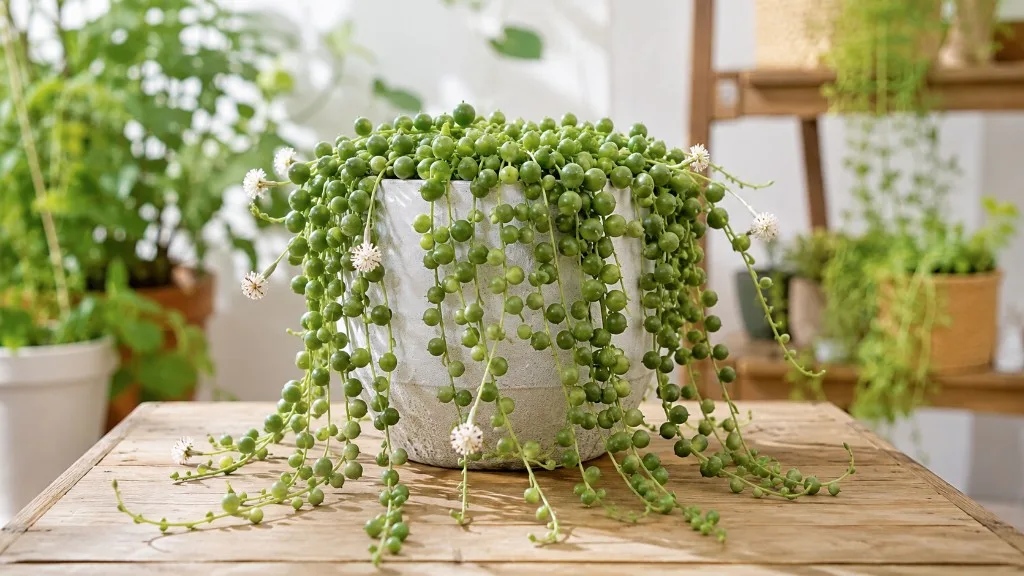
String of pearls is a trailing succulent vine grown for strands of round, bead-like leaves that cascade over pot edges like a living necklace. The accepted scientific name is Curio rowleyanus, though nursery tags and older references still use Senecio rowleyanus. Both names refer to the same plant for practical care purposes, and the advice below applies regardless of which synonym appears on your pot.
Indoors, string of pearls typically forms trailing stems 1 to 3 feet (30 to 90 cm) long, with each spherical leaf measuring roughly 0.25 inch (6 mm) in diameter. Mature plants in hanging baskets often reach 12 to 24 inches (30 to 60 cm) in overall spread before the longest strands begin to drape below the container rim. Growth is moderate in bright, warm conditions and slows sharply when light weakens or temperatures drop. The plant is a true succulent: every pearl stores water, which is why it survives dry spells in nature but rots quickly when kept too wet indoors.
If you are deciding whether string of pearls fits your home, the honest summary is this: it rewards bright light, excellent drainage, and restraint with the watering can - and it punishes overwatering on String of Pearls faster than almost any popular houseplant. It is harder than a pothos and easier than a finicky fern only if you treat it as a drought-adapted succulent, not a tropical vine. The payoff is one of the most distinctive silhouettes in indoor gardening, plus propagation so simple that a single healthy strand can fill a new basket in a season. One critical caveat for pet owners: string of pearls is toxic to cats and dogs according to the ASPCA, which surprises many people who assume small succulents are automatically pet-safe.
Botanical Background and Naming History
String of pearls belongs to the family Asteraceae - the daisy family - though its appearance has little in common with a sunflower. Botanists recently moved many trailing “senecios” into the genus Curio, which better reflects their succulent growth habit and drought ecology. Retail naming lags behind taxonomy, so a pot labeled Senecio, Curio, or simply “string of pearls” may still be C. rowleyanus. The specific epithet rowleyanus honors Gordon Douglas Rowley, a British botanist who specialized in succulents and cacti, according to the NC State Extension Gardener Plant Toolbox.
The species is native to arid scrublands in Southwest Africa, particularly regions of South Africa where rainfall is seasonal and soils drain quickly. In that climate, string of pearls grows as a ground-covering trailer that roots where stems touch soil, spreading across rocky slopes with minimal organic matter. Outdoors it is hardy in USDA Zones 9B through 11, where frost-free winters allow year-round growth. Everywhere else - including nearly all indoor settings - it is grown as a container or hanging-basket houseplant brought indoors before temperatures fall below about 50°F (10°C).
Each pearl is not just decorative. It is a modified leaf shaped to minimize surface area and maximize water storage, with a small translucent window (epidermal fenestration) on the sun-facing side that lets light reach interior chlorophyll. That adaptation is the key to understanding care: the plant is built to hold water for weeks, not to sit in damp mix. Treating it like a moisture-loving tropical vine is the single most common reason healthy-looking pearls turn mushy within days.
Do not confuse string of pearls with string of bananas (Curio radicans, formerly Senecio radicans), which has elongated banana-shaped leaves and slightly different moisture tolerance, or with string of hearts (Ceropegia woodii), a pet-safe trailing plant with heart-shaped leaves on thin wires. When buying, compare leaf shape: round pearls mean C. rowleyanus; curved cylinders mean a different species with its own rules.
Why the Bead-Like Leaves Define the Care Rules
The pearls are the plant’s water budget. When soil moisture is adequate, each bead feels firm and plump, with a deep green color and a slight gloss. When the plant draws on stored reserves, pearls become slightly soft, wrinkled, or show fine longitudinal lines - the visual cue experienced growers call the pearl squeeze test. Gently pinching a pearl between thumb and finger tells you more than checking only the soil surface, because string of pearls has a shallow, fine root system that dries unevenly in shallow hanging baskets.
Because leaves store water, string of pearls tolerates underwatering on String of Pearls far better than overwatering. A dry plant shrivels visibly but usually recovers after one thorough soak. An overwatered plant may show translucent, squishy pearls and black mushy stems at the soil line before you notice anything wrong at the tips - and root rot on String of Pearls at that stage is difficult to reverse. The care philosophy is therefore conservative with water and generous with light and drainage, the opposite of many leafy houseplants.
The trailing habit also changes how you manage the plant physically. Strands tangle easily, snap when handled roughly, and drop pearls when stressed by sudden light changes, cold drafts, or root disturbance. Display it where you can water without constantly lifting brittle stems, and accept that some pearl loss after String of Pearls repotting guide or a move is normal while the plant re-establishes. A well-situated specimen that receives enough light may produce small white flowers with a cinnamon-like scent in spring or summer - a sign conditions are genuinely good, not merely survivable.
Best Growing Conditions for String of Pearls
String of pearls does best when your space approximates the bright, dry rhythm of its native scrubland. The four variables that decide almost every outcome are light, water, soil, and temperature. Get those aligned and feeding, repotting, and propagation become routine. Get one badly wrong - especially water in low light - and the plant declines faster than its tough appearance suggests.
Light Requirements
String of pearls needs bright light - this is non-negotiable for compact, full strands. A practical indoor target is String of Pearls light guide with two to four hours of gentle direct morning sun. East-facing windows are often ideal: direct sun early in the day, then strong ambient light afterward. West-facing exposures can work if afternoon rays are filtered by a sheer curtain. South-facing windows are usable when the plant sits far enough back that midday sun does not scorch pearls, or when a light filter cuts intensity during peak summer hours.
The fastest diagnostic for incorrect light is new growth, not old damage. Firm, round pearls spaced closely along the stem mean the plant is probably receiving enough energy. Long gaps between pearls, smaller bead size, and stems reaching toward the window mean etiolation from insufficient light - a stretched look that does not reverse on old growth even after you improve conditions. Bleached, yellow, or brown sun-facing pearls mean too much unfiltered direct sun, especially if the plant was recently moved from a dim shop shelf without acclimation.
If natural light is weak - common in north-facing rooms or during winter at higher latitudes - a full-spectrum grow light on a 10–12 hour timer, positioned 6 to 12 inches (15 to 30 cm) above the canopy, prevents the sparse, fragile look that develops on string of pearls kept too far from a window. The Royal Horticultural Society emphasizes matching bright light and excellent drainage for Curio species; light and watering are linked because a brighter plant uses water faster and is less vulnerable to rot.
Outdoor summer placement in frost-free regions can boost growth dramatically. A covered porch or bright patio with morning sun and afternoon shade often produces the densest strands. Always acclimate gradually over one to two weeks when moving between indoor and outdoor conditions, and bring the plant back inside before nights drop toward 50°F (10°C).
Temperature and Humidity
String of pearls prefers stable temperatures between 70 and 84°F (21 and 29°C) during active growth, which matches most heated indoor environments. It tolerates brief dips toward 60°F (15°C) but stalls and may drop pearls when cold persists. Sustained exposure below about 50°F (10°C) damages tissue, and any frost is fatal - a hard limit for outdoor culture outside USDA Zones 9B–11.
Watch problem microclimates: cold window glass in winter, air-conditioning vents, and hot air from radiators all stress trailing stems that hang directly in the airflow. Because the plant sits in hanging baskets more often than on shelves, drafts hit it from multiple angles. A stable room with gentle air circulation beats a dramatic window that swings 20 degrees between day and night.
Humidity is one area where string of pearls differs from tropical houseplants: it prefers dry air, and average home humidity in the 30 to 50% range suits it well. Very humid bathrooms or terrariums increase rot risk unless airflow is excellent and the mix dries quickly. Do not mist string of pearls as a care strategy - wet pearls and crowded strands invite fungal problems, and surface moisture does not replace proper root-zone watering anyway. If you grow other humidity-loving plants, keep string of pearls in the brightest, driest room rather than grouping it with ferns that need constant moisture.
Soil and Drainage
Use a fast-draining succulent or cactus mix as your base. The principle matters more than a single branded bag: the mix should release water within hours, not hold moisture for days. A workable home blend is roughly two parts commercial cactus mix, one part perlite or pumice, and optionally one part coarse sand or fine grit if your home runs cool or dim and the pot dries slowly. Avoid heavy peat-heavy indoor mixes that compact over time - compaction suffocates the shallow roots string of pearls relies on.
Always plant in a container with a drainage hole. Hanging baskets with coco liners look attractive but often retain too much water unless lined sparingly and filled with gritty mix; plastic or ceramic pots with holes are more forgiving for beginners. If you use a decorative cachepot, water at the sink, let the pot drain completely, and never let the plant sit in runoff.
Target a slightly acidic to neutral pH around 6.0–7.0. Exact pH adjustment is rarely necessary in hobbyist setups; structure and pore space matter more. Repot into fresh mix every one to two years because old succulent soil breaks down into fine, water-retentive particles even when top dressing looks unchanged.
How to Water String of Pearls
The general rule for string of pearls is soak thoroughly, then let the mix dry completely before watering again. More precisely, plan around every two to three weeks in warm, bright summer conditions and roughly once a month in cooler, dimmer winter months as a starting range - then refine based on how fast your actual pot dries. Pot size, basket depth, soil texture, light, and room temperature all change the interval, so a calendar answer is a reminder to check, not a rule to follow blindly.
Before watering, use three checks together: the pearl squeeze test (slight softness or fine lines on several pearls), soil dryness an inch or two deep, and pot weight (a light pot after a dry period). When those signals align, water at the sink until water runs freely from the drainage holes, then let the pot drain fully before rehanging. Bottom watering - setting the pot in a shallow tray of water for 15–20 minutes - works well for dense baskets where top watering misses dry pockets, provided you still confirm the mix absorbed moisture and is not staying soggy at the center.
String of Pearls watering guide During Active Growth
During the warm, bright months when pearls are plump and new strands are extending, string of pearls uses water on a predictable cycle. The goal is a full soak followed by a complete dry-down, not permanently damp soil or frequent shallow sprinkles. In strong light, many indoor baskets need water every 10 to 14 days; in moderate light, every two to three weeks is common. Hanging baskets dry faster than deep pots when airflow wraps around the container, so compare your plant to its own history rather than a friend’s floor pot on a different schedule.
After watering, pearls should rehydrate within 24 to 48 hours, regaining firmness and color. If they stay wrinkled despite wet soil, suspect root damage from past overwatering rather than simple thirst - inspect the root zone before soaking again.
Seasonal Adjustments
In cooler, dimmer months, growth slows toward semi-dormancy and the mix stays wet longer. Stretch the interval between waterings and pause fertilizer until new growth resumes in spring. The most common winter failure is continuing a summer rhythm in lower light, which keeps the root zone waterlogged and leads to translucent pearls, stem collapse, and pearl drop.
If you move the plant closer to a window for winter light, remember that light changes alter drying speed - a brighter winter windowsill may need slightly more frequent checks even though overall growth is slower. Resume the active-season rhythm only when you see consistent new strand extension and stable temperatures above about 65°F (18°C).
Common Watering Mistakes
The single most damaging mistake is watering on a fixed schedule without checking the plant. The second is leaving the basket in a full saucer or outer pot, which suffocates shallow roots within days. The third is misting or giving tiny daily sips instead of a thorough soak when the plant is genuinely dry - that wets only the surface while the center stays parched, producing confusing cycles of shrivel and partial recovery.
People also misread pearl texture. Soft, wrinkled pearls on dry, light soil mean water. Soft, translucent, or squishy pearls on heavy, wet soil mean stop watering and inspect roots - adding more water accelerates rot. When in doubt, wait a few extra days; underwatering is recoverable, overwatering often is not.
How to Feed String of Pearls
String of pearls is a light feeder, not a hungry annual. A balanced water-soluble fertilizer - such as 10-10-10 or 20-20-20 - diluted to one-quarter of the label rate is sufficient during active growth. Apply to already-moist soil once monthly from spring through early fall, or skip feeding entirely if the plant looks vigorous on fresh mix with a slow-release starter charge. Some growers feed only once or twice per year with good results; the priority is avoiding salt buildup in a small, fast-draining root zone.
Hold fertilizer during winter rest, after repotting until new growth appears, and while the plant recovers from root rot or pest damage. Overfeeding produces crisp brown pearl tips and salt crust on the soil surface that persist even when watering seems correct. If that pattern appears, flush the pot with plain water at two to three times the pot volume and pause feeding for six to eight weeks.
Organic options such as half-strength liquid kelp or fish emulsion work if applied sparingly; string of pearls does not need high nitrogen, and excess nitrogen can produce lanky, fragile strands with pearls spaced farther apart.
Repotting and Root Health
Repot string of pearls roughly every one to two years, or whenever the basket dries out within a day of watering, pearls look chronically thirsty despite soaks, or the mix has broken down into fine mud. The best timing is early spring as active growth resumes, which gives the plant a full warm season to re-establish shallow roots. Because stems are fragile, repot when you must - not on a decorative whim.
Choose a pot only slightly larger than the current root mass. Oversized containers hold excess wet mix around roots that cannot use it, which is the most common trigger for rot after repotting. Use fresh gritty succulent mix, handle strands gently, and water lightly one week after repotting rather than soaking immediately - cut or disturbed roots heal better in slightly dry conditions.
Signs It Is Time to Repot
Physical signs include roots visible at the drainage hole, mix that water runs straight through without absorbing, or chronic wilting/shriveling immediately after you water - sometimes indicating the root ball no longer contacts moist mix effectively. Performance signs include pearl drop across many strands despite good light after you have ruled out drafts and pests, or a sour smell from old soil indicating organic breakdown.
Do not repot a plant that is actively collapsing from overwatering until you have trimmed brown, mushy roots and let the remaining tissue callus briefly. Moving a rotting root ball into fresh mix without fixing moisture habits rarely saves string of pearls.
Propagation Methods for String of Pearls
The standard home propagation method for string of pearls is stem cuttings laid on or lightly buried in moist, well-draining mix - not division, because the plant naturally trails rather than forming multiple crowns. Propagation is easiest in warm, bright conditions from late spring through summer when stems are actively extending.
Take a 4- to 6-inch (10 to 15 cm) cutting with clean, sharp scissors, choosing a healthy strand with firm pearls. Lay the cutting on top of moist cactus mix so the stem contacts soil along several nodes, or coil the strand lightly on the surface and pin it with a U-shaped wire or small stone if needed. Place the pot in bright indirect light, keep the mix barely moist - not wet - and expect rooting within two to four weeks when temperatures stay near 70°F (21°C). Mist the soil surface lightly if it dries completely, but avoid saturating the cutting.
Alternatively, water propagation works for short sections: suspend a cutting so nodes touch water without submerging pearls, change water every few days, and transplant to mix once roots reach half an inch (1 cm) or longer. Water-rooted cuttings are fragile; transplant carefully and withhold heavy watering for the first week.
Do not propagate mushy, pest-infested, or heavily shriveled strands - cuttings inherit the parent’s problems. Start from the healthiest distal growth on a recovering plant if the base stems are rotting but tips remain firm.
Common String of Pearls Problems
Most string of pearls problems trace to water and light, not mysterious diseases. The plant signals through pearl texture, stem color, and strand density long before the entire basket collapses. The useful habit is to check moisture and roots first, light second, pests third before changing multiple variables at once.
Shriveling Pearls, Mushy Stems, and Pests
Shriveled, wrinkled pearls on dry, lightweight soil mean underwatering or root loss from past rot that prevents uptake. Water thoroughly once, then monitor rehydration over 48 hours. If pearls stay wrinkled while soil stays wet, inspect roots - healthy roots are white and firm; rotting roots are brown and mushy.
Translucent, squishy pearls and black stems at the soil line mean overwatering or poor drainage - often combined with low light. Remove the plant from the pot, trim rot with sterile scissors, let cut surfaces dry for a day, and repot into fresh gritty mix. Reduce watering frequency and increase light if possible.
Pearl drop after a move usually means light shock, cold draft, or root disturbance rather than disease. Stabilize conditions for two to three weeks before reacting with more water or fertilizer.
Long gaps between pearls and thin new strands mean insufficient light. Move the plant to a brighter exposure or add a grow light; pinch or trim etiolated tips after new compact growth appears if you want a fuller restart.
Brown, crispy pearls on the sun-facing side indicate sun scorch. Pull the plant back from harsh afternoon rays or add a sheer curtain; scorched pearls will not green up again, but new growth should be undamaged.
Watch for mealybugs in stem joints and leaf axils - white cottony clusters that sap vigor. Aphids occasionally gather on new growth and flowers. Fungus gnats indicate overly wet surface mix; let the top inch dry between waterings. Inspect weekly, isolate infested baskets, and treat with insecticidal soap or isopropyl alcohol on a cotton swab for mealybugs, following label directions. Trailing strands make thorough coverage harder than on upright plants, so repeat treatments at the interval the product specifies.
Is String of Pearls Safe for Pets?
String of pearls is toxic to cats and dogs according to the ASPCA’s toxic plant listing. The NC State Extension Gardener Plant Toolbox notes that all parts are poisonous, with pyrrolizidine alkaloids as the toxic principle. Reported signs of ingestion include vomiting, diarrhea, drooling, and lethargy. Sap may also cause skin irritation or contact dermatitis in sensitive individuals - wear gloves when taking cuttings if you react to plant saps.
Toxic does not always mean fatal in a single nibble, but string of pearls presents a unique risk for cats because dangling strands look like toys. A basket at cat height is an invitation to bat, chew, and pull. Do not rely on “my pet never chews plants” as a safety plan. Hang baskets high enough that strands stay out of jump range, use ceiling hooks in pet-heavy rooms, or choose confirmed non-toxic trailing alternatives such as string of hearts if placement cannot be secured.
If you suspect your pet ingested string of pearls, contact your veterinarian or the ASPCA Animal Poison Control Center at (888) 426-4435 (a consultation fee may apply). Bring a photo of the plant or a strand sample to aid identification. This is general information, not veterinary advice - when symptoms are severe or persistent, professional care is the right move.
For households with curious pets, string of pearls belongs in the same caution category as jade plant or pencil cactus: visually perfect for hanging displays, but a poor choice anywhere a cat can reach the trails.
Conclusion
String of pearls (Curio rowleyanus) is a trailing South African succulent grown for strands of water-storing pearls that cascade from baskets and shelves. Give it bright indirect light with gentle morning sun, fast-draining cactus mix, complete dry-down between soakings, and warm stable temperatures above about 65°F, and it will produce dense, firm strands for years. Take stem cuttings in spring, repot only when roots outpace the basket, and feed lightly during active growth - heavy fertilizer and heavy watering both cause more harm than good.
When something looks wrong, read the pearls before reaching for fixes: wrinkled pearls on dry soil mean water; mushy translucent pearls on wet soil mean stop watering and check roots; long bare gaps between pearls mean more light. Pearl drop after a move usually settles once conditions stabilize. Fix environment first, adjust watering second, and treat pests before they spread through tangled strands. Do that, and string of pearls becomes one of the most rewarding trailing succulents you can grow - as long as you respect its drought roots, keep it bright, and hang it where pets cannot treat the beads like a snack.
When to use this page vs other String of Pearls guides
- String of Pearls overview - Canonical hub for this species - care topics and problems branch from here.
- String of Pearls problems - Symptom-first path when you already know something is wrong.
Related String of Pearls guides
- String of Pearls watering
- String of Pearls light
- String of Pearls soil
- String of Pearls propagation
- String of Pearls fertilizer
- String of Pearls repotting
- String of Pearls pruning
- Root Rot on String of Pearls
- Drooping Leaves on String of Pearls
- Crispy Leaves on String of Pearls
- Mealybugs on String of Pearls
- Yellow Leaves on String of Pearls
How to care for String of Pearls?
How much light does String of Pearls need?
bright indirect light with some morning direct sun, direct morning sun
- bright indirect light with some morning direct sun, direct morning sun - bright indirect light with some morning direct sun, direct morning sun.
When should you water String of Pearls?
Water sparingly-every 2–3 weeks in summer; barely once a month in winter. The pearls store water and rot easily.
- Check top 2 inches - Water sparingly-every 2–3 weeks in summer; barely once a month in winter.
- Drain excess water - Water sparingly-every 2–3 weeks in summer; barely once a month in winter.
What soil works best for String of Pearls?
Fast-draining succulent or cactus mix-moisture retention causes inevitable rot.
- Well-draining mix - Fast-draining succulent or cactus mix-moisture retention causes inevitable rot.
Grower notes for String of Pearls
What matters most with String of Pearls
String of Pearls stores water in leaves, stems, roots, or a swollen base, so overcare is usually more dangerous than short dry spells. Strong light and drainage are the safety net. In practice, the care checkpoint is simple: bright indirect light with some morning direct sun, direct morning sun. Pair that with fast-draining succulent or cactus mix-moisture retention causes inevitable rot, and avoid changing water, pot size, and placement all at once.
Best placement in a real home
String of Pearls belongs where bright indirect light with some morning direct sun, direct morning sun is realistic for most of the day, not only where the pot looks good. Water sparingly-every 2–3 weeks in summer; barely once a month in winter. The pearls store water and rot easily. If the pot stays wet longer than expected, move the plant into better light or reassess the mix before watering again. Humidity target: Low humidity, below 40%. Temperature comfort zone: 21–29°C (70–84°F).
Before you buy this plant
Choose String of Pearls with firm new growth, clean leaf undersides, and soil that does not smell sour or feel compacted. Be cautious if you see root-rot, sticky residue, collapsed crowns, or a pot that is wet in poor light. Cosmetic old-leaf damage is less worrying than weak roots or active pests.
First month after bringing it home
Do not repot String of Pearls on day one unless the mix is failing or pests are obvious. Quarantine it, learn how fast the pot dries, and keep care boring while it adjusts. Watch especially for root-rot, drooping-leaves, and crispy-leaves. If problems appear, correct the condition first rather than stacking fertilizer, repotting, and pruning together.
Safety note for String of Pearls
String of Pearls is not a plant to keep within reach of pets or children. Treat it as an inaccessible display plant. Use gloves if sap or plant tissue is irritating, and pick a pet-safe alternative for floor pots or low shelves.
How to tell String of Pearls is settling in
If you plan to multiply it later, common methods include Strand cuttings in dry soil and Strand cuttings in water. If drooping-leaves shows up early, inspect light, watering, and roots before assuming the plant is permanently weak.
Is it pet safe?
String of Pearls is toxic to cats and dogs.
ASPCA lists as toxic to cats and dogs. Contains compounds that may cause GI upset, drooling, vomiting, and lethargy.
Watering String of Pearls
Water sparingly-every 2–3 weeks in summer; barely once a month in winter. The pearls store water and rot easily.
Soil & potting for String of Pearls
Fast-draining succulent or cactus mix-moisture retention causes inevitable rot.
Humidity & temperature for String of Pearls
String of Pearls prefers low humidity, below 40%, though normal home humidity is usually fine. Keep temperatures around 21–29°C (70–84°F).
| Detail | Information |
|---|---|
| Humidity | Low humidity, below 40% - normal home humidity is fine. |
| Ideal temperature | 21–29°C (70–84°F) |
Fertilizer & pruning for String of Pearls
Use feed lightly during active growth. Diluted balanced liquid fertilizer at quarter strength and stop if the plant is stressed, newly repotted, or not actively growing. for String of Pearls.
| Detail | Information |
|---|---|
| Fertilizer type | Feed lightly during active growth. Diluted balanced liquid fertilizer at quarter strength and stop if the plant is stressed, newly repotted, or not actively growing. |
Common problems on String of Pearls
Crispy Leaves
MediumLikely cause: Too much direct afternoon sun or prolonged underwatering
Quick fix: Move out of direct afternoon sun; check if soil is bone dry and water if so
Full fix guide →Likely cause: Dec 16, 2019 · I have a very healthy string of pearls that seems to be infested with an ant nest. I've seen ants on my plant shelf and have often noticed them crawling on my plants because when I water they come out running.
Quick fix: Confirm diagnosis on your String of Pearls, then address the most likely care or pest factor described in current extension guidance.
Full fix guide →Curling Leaves
MediumLikely cause: Oct 7, 2022 · While String of Pearls doesn't need high humidity, extremely dry air can cause the leaves to curl and crisp up. If you suspect low humidity is the issue, try misting your plant occasionally or placing a small humidifier nearby
Quick fix: Confirm diagnosis on your String of Pearls, then address the most likely care or pest factor described in current extension guidance.
Full fix guide →Compacted Soil
MediumLikely cause: In testing with string of pearls, this mix prevented dirt compaction even after repeated waterings. The coarse particles create continuous air channels, reducing the risk of rot. Users report zero fungus gnat issues thanks to the peat-free
Quick fix: Confirm diagnosis on your String of Pearls, then address the most likely care or pest factor described in current extension guidance.
Full fix guide →Deformed New Growth
MediumLikely cause: Jul 11, 2021 · The primary reasons why your string of pearls is not growing are a lack of light and overwatering. Damage from pests, high humidity, and diseases can also result in stunted growth . Monitor your plant for signs of stress, pro
Quick fix: Confirm diagnosis on your String of Pearls, then address the most likely care or pest factor described in current extension guidance.
Full fix guide →Damaged Roots
MediumLikely cause: Jun 18, 2024 · Prune the affected roots with sterilized scissors or shears, cutting back to healthy tissue. This step is like triage; you're removing the damaged parts to save the whole. Thoroughly clean the pot with a bleach solution or al
Quick fix: Confirm diagnosis on your String of Pearls, then address the most likely care or pest factor described in current extension guidance.
Full fix guide →Drooping Leaves
MediumLikely cause: Underwatering causes wrinkled, shrivelled pearls that cause strands to droop
Quick fix: Water thoroughly and allow to drain completely; pearls should plump up within 24 hours
Full fix guide →Dry Hydrophobic Soil
MediumLikely cause: String of Pearls looking shriveled, dry , or bare? Use this simple diagnostic flow to spot underwatering, rot, sunburn, pests, compacted soil , handling stress, or dormancy and fix it fast.
Quick fix: Confirm diagnosis on your String of Pearls, then address the most likely care or pest factor described in current extension guidance.
Full fix guide →Distorted Leaves
MediumLikely cause: Jun 18, 2024 · Yellowing leaves and mushy stems are telltale signs that your 'String of Raindrops' is drowning in excess water. The soil should never feel like a wet sponge; it's a sign to put the watering can down.
Quick fix: Confirm diagnosis on your String of Pearls, then address the most likely care or pest factor described in current extension guidance.
Full fix guide →Heat Stress
MediumLikely cause: Oct 12, 2023 · Temperatures consistently above 85°F (29°C) can begin to stress the plant, leading to issues like wilting or sunburn. So, let’s explore how to keep them comfy when the heat is on. Spotting the signs of heat stress early can s
Quick fix: Confirm diagnosis on your String of Pearls, then address the most likely care or pest factor described in current extension guidance.
Full fix guide →Holes in Leaves
MediumLikely cause: May 19, 2026 · The spherical "pearls" are leaves engineered to minimize surface area in arid climates, with a translucent epidermal window on top that lets light reach interior chlorophyll.
Quick fix: Confirm diagnosis on your String of Pearls, then address the most likely care or pest factor described in current extension guidance.
Full fix guide →Leggy Growth
LowLikely cause: Leggy string of pearls growth shows up as long bare spaces between pearls, smaller beads, and strands that stretch toward the window. The plant is trying to find enough light to keep its succulent leaves compact.
Quick fix: Confirm diagnosis on your String of Pearls, then address the most likely care or pest factor described in current extension guidance.
Full fix guide →Low Humidity
LowLikely cause: Jan 21, 2024 · In this article, we’ll explore how humidity impacts the growth and overall health of your String of Pearls . We’ll look into the ideal humidity levels, how to adjust for low or high humidity , and tips for maintaining these c
Quick fix: Confirm diagnosis on your String of Pearls, then address the most likely care or pest factor described in current extension guidance.
Full fix guide →Leaf Spot Disease
MediumLikely cause: Understand why your String of Pearls is struggling. Learn to diagnose plant health issues and implement solutions for vibrant growth.
Quick fix: Confirm diagnosis on your String of Pearls, then address the most likely care or pest factor described in current extension guidance.
Full fix guide →Mealybugs
MediumLikely cause: Mealybugs colonise in the crown where strands are dense
Quick fix: Dab with isopropyl alcohol on a cotton swab; apply neem oil spray weekly
Full fix guide →No Drainage Hole
MediumLikely cause: HELP, I bought this string of pearls at home depot and noticed it is planted in the ceramic pot without a nursery pot or drainage hole . Any tips on how to transplant?
Quick fix: Confirm diagnosis on your String of Pearls, then address the most likely care or pest factor described in current extension guidance.
Full fix guide →Leggy Seedlings
MediumLikely cause: Leggy string of pearls growth shows up as long bare spaces between pearls, smaller beads, and strands that stretch toward the window. The plant is trying to find enough light to keep its succulent leaves compact.
Quick fix: Confirm diagnosis on your String of Pearls, then address the most likely care or pest factor described in current extension guidance.
Full fix guide →No Flowers
LowLikely cause: Sep 12, 2025 · String of pearls plant (Curio rowleyanus) is a unique and easy-to-care-for succulent. Learn how to grow this charming and delicate plant in your own home. May 20, 2026 · Discover how to grow and care for the string of pearls
Quick fix: Follow extension or botanical guidance for String of Pearls no flowers; adjust care before applying broad treatments.
Full fix guide →No New Growth
MediumLikely cause: How do I fix a string of pearls with no new growth ? Work through these steps in order: 1) Confirm it is not just dormancy; 2) Check light levels honestly; 3) Check if it is root-bound; 4) Feed during the growing season only; 5) Be patient
Quick fix: Confirm diagnosis on your String of Pearls, then address the most likely care or pest factor described in current extension guidance.
Full fix guide →Nutrient Lockout
MediumLikely cause: Aug 10, 2025 · String of Pearls thrives with a fertilizer that provides balanced nutrients , especially phosphorus for root development, and potassium for overall vitality. Avoid high nitrogen fertilizers which encourage excessive leaf grow
Quick fix: Confirm diagnosis on your String of Pearls, then address the most likely care or pest factor described in current extension guidance.
Full fix guide →Mold on Soil
LowLikely cause: Mold on your string of pearls ' soil means it's staying too wet — and root rot isn't far behind. Here's the 5-minute fix and the soil swap that prevents it permanently.
Quick fix: Confirm diagnosis on your String of Pearls, then address the most likely care or pest factor described in current extension guidance.
Full fix guide →Nitrogen Deficiency
MediumLikely cause: Feb 28, 2026 · Signs of nutrient deficiency in string of pearls include pale or yellowing leaves, stunted growth, and a general lack of vigor. While nutrient deficiencies can occur, they are less common than problems caused by over-fertiliz
Quick fix: Confirm diagnosis on your String of Pearls, then address the most likely care or pest factor described in current extension guidance.
Full fix guide →Overwatering
HighLikely cause: Can I save a String of Pearls if it’s severely overwatered? Yes , you can save it by following the right steps. Remove the plant from the waterlogged soil, trim away rotten roots, and repot it in fresh, well-draining soil. Provide optimal c
Quick fix: Confirm diagnosis on your String of Pearls, then address the most likely care or pest factor described in current extension guidance.
Full fix guide →Overfertilization
MediumLikely cause: What Does Overfertilization Damage Look Like on String of Pearls? Overfertilization damage on string of pearls typically looks like a "burn" or "scorch" on the plant's delicate tissues, as excess salts draw moisture out of the plant.
Quick fix: Confirm diagnosis on your String of Pearls, then address the most likely care or pest factor described in current extension guidance.
Full fix guide →Red Leaves
MediumLikely cause: Aug 11, 2025 · String of Pearls is a unique and captivating succulent, beloved for its long, trailing stems adorned with bead-like leaves . Learn how to master its care, from watering to propagation.
Quick fix: Confirm diagnosis on your String of Pearls, then address the most likely care or pest factor described in current extension guidance.
Full fix guide →Repotting Stress
MediumLikely cause: Apr 1, 2025 · The best time to repot string of pearls is in early spring or fall when the weather is mild, reducing stress on the roots and giving the repotted string of pearls the best chance to get established.
Quick fix: Confirm diagnosis on your String of Pearls, then address the most likely care or pest factor described in current extension guidance.
Full fix guide →Root Rot
HighLikely cause: Overwatering or moisture-retaining soil; the most common cause of death in this plant
Quick fix: Remove from pot; cut away black or mushy roots and stems; repot in dry cactus mix; do not water for 7–10 days
Full fix guide →Purple Leaves
MediumLikely cause: Aug 24, 2021 · The leaves of a String of Pearls will turn purple if the plant is stressed. Usually, the plant will produce a pigment called anthocyanin in response to environmental stressors like sunburn, underwatering, overwatering, intens
Quick fix: Confirm diagnosis on your String of Pearls, then address the most likely care or pest factor described in current extension guidance.
Full fix guide →Root Bound
MediumLikely cause: Jul 5, 2021 · The string of pearls has a shallow root system that does not become root - bound fast. The plant takes time to grow long roots and does not require frequent repotting.
Quick fix: Confirm diagnosis on your String of Pearls, then address the most likely care or pest factor described in current extension guidance.
Full fix guide →Thin Stems
MediumLikely cause: Aug 11, 2025 · String of Pearls is a unique and captivating succulent, beloved for its long, trailing stems adorned with bead-like leaves. Learn how to master its care, from watering to propagation.
Quick fix: Confirm diagnosis on your String of Pearls, then address the most likely care or pest factor described in current extension guidance.
Full fix guide →Soil Too Alkaline
MediumLikely cause: Learn about the best soil for String of pearls ( Curio rowleyanus ). Discover optimal soil types, pH levels, drainage requirements, and soil care tips for healthy growth.
Quick fix: Confirm diagnosis on your String of Pearls, then address the most likely care or pest factor described in current extension guidance.
Full fix guide →Stunted Growth
MediumLikely cause: Understand why your String of Pearls is struggling. Learn to diagnose plant health issues and implement solutions for vibrant growth .
Quick fix: Confirm diagnosis on your String of Pearls, then address the most likely care or pest factor described in current extension guidance.
Full fix guide →Transparent Leaves
MediumLikely cause: Round yellow pot containing a simplified illustration of a String of Pearls plant (Senecio rowleyanus). The plant features long, trailing stems adorned with small, spherical green leaves resembling pearls .
Quick fix: Confirm diagnosis on your String of Pearls, then address the most likely care or pest factor described in current extension guidance.
Full fix guide →Transplant Shock
MediumLikely cause: Learn how to properly transplant String of pearls ( Curio rowleyanus ). Discover the best timing, essential techniques, and expert tips for successful plant transplantation .
Quick fix: Confirm diagnosis on your String of Pearls, then address the most likely care or pest factor described in current extension guidance.
Full fix guide →Likely cause: What to Avoid: Harsh, direct afternoon sunlight can scorch the delicate pearls, causing them to turn brown or reddish and develop burnt spots. While some morning direct sun is beneficial, prolonged exposure to intense sun should be avoided.
Quick fix: Confirm diagnosis on your String of Pearls, then address the most likely care or pest factor described in current extension guidance.
Full fix guide →Wind Damage
MediumLikely cause: By recognizing these symptoms early, you can take corrective action to save your succulent and prevent further damage . With a little practice and patience, you’ll be able to strike the perfect balance and keep your String of Pearls happy a
Quick fix: Confirm diagnosis on your String of Pearls, then address the most likely care or pest factor described in current extension guidance.
Full fix guide →Yellow Leaves
MediumLikely cause: Dec 13, 2025 · However, the joy of owning a String of Pearls can quickly turn to frustration when those vibrant green “pearls” begin to yellow . This blog post aims to unravel the mystery behind yellowing String of Pearls leaves and provide
Quick fix: Confirm diagnosis on your String of Pearls, then address the most likely care or pest factor described in current extension guidance.
Full fix guide →