Song of India Plant Care: Complete Guide
Dracaena reflexa
Song of India needs bright indirect light to maintain its yellow-green variegation and regular but moderate watering. Avoid fluoride-heavy tap water.
Song of India Plant Care: Complete Guide
Start with wateringThe most common care mistake for Song of IndiaWatering guide →Song of India care essentials
Light
bright indirect light, medium indirect light
Water
Water when top 3–5 cm of soil dries; avoid overwatering.
Soil
Well-draining potting mix with perlite.
Humidity
Average to moderate humidity (40–60%)
Temperature
18°C to 27°C (65–80°F)
Fertilizer
Feed lightly during active growth. Use monthly during spring and summer..
About Song of India
Song of India has a upright growth habit.
| Detail | Information |
|---|---|
| Growth habit | Upright |
| Scientific name | Dracaena reflexa |
Song of India Plant Care: Complete Guide
What Is Song of India?
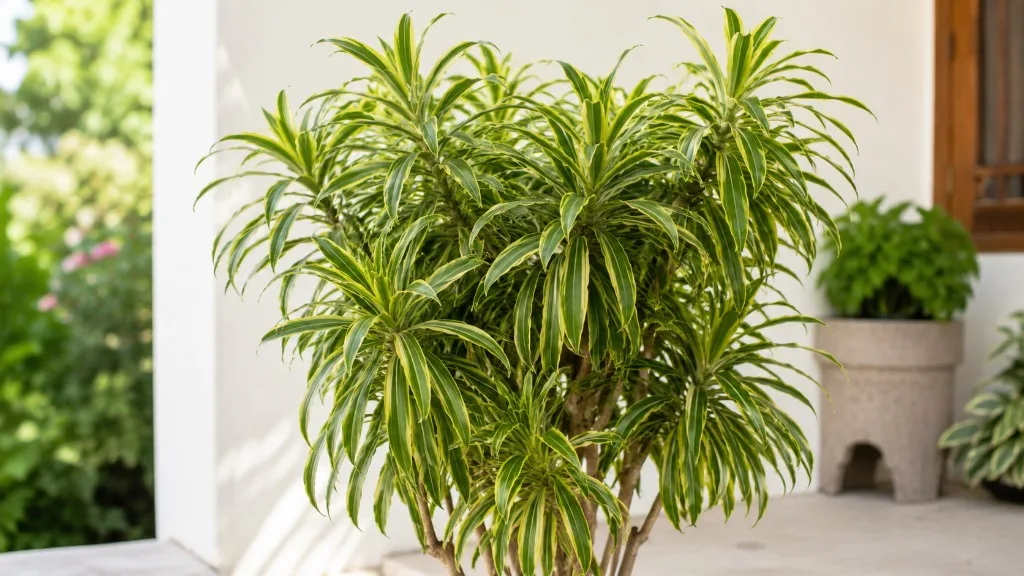
Song of India is a variegated tropical shrub grown for its spiraling stems and narrow leaves edged in chartreuse to creamy yellow against a deep green center. The accepted scientific name is Dracaena reflexa, and the cultivar most often sold under the common name is Dracaena reflexa ‘Variegata’ - though tags may also read Pleomele reflexa, an older synonym still common in the houseplant trade. You will sometimes see it labeled Malaysian Dracaena on pet-toxicity databases, which refers to the same species rather than a different plant.
Indoors, Song of India typically reaches 3 to 6 feet (0.9 to 1.8 m) tall over several years, though mature specimens in ideal conditions can grow taller with a narrow, upright habit and rosettes of glossy sword-shaped leaves clustered at stem tips. Growth is slow to moderate in a typical home - noticeably slower than a corn plant (Dracaena fragrans) and faster than a mature dragon tree (Dracaena marginata) in the same light. In its native habitat, mature plants can reach 12 to 18 feet (3.7 to 5.5 m) tall according to NC State Extension, but container culture and indoor ceilings keep most houseplants compact.
If you are deciding whether Song of India fits your space, the honest summary is this: it rewards Song of India light guide, consistent but not heavy watering, and stable warmth - and it punishes low light, cold drafts, fluoride-heavy tap water, and soggy soil. It is easier than a fiddle-leaf fig and more demanding than a snake plant. The payoff is architectural foliage with vivid variegation that reads clearly across a room, plus propagation simple enough that a single healthy stem can produce several new plants. One critical caveat for pet owners: Song of India is toxic to cats and dogs according to the ASPCA, which surprises many buyers who assume dracaenas are harmless because they are so common in offices and hotels.
Botanical Background and Native Range
Song of India belongs to the family Asparagaceae - the asparagus family - which places it alongside agaves, hostas, and yes, edible asparagus, though the ornamental dracaenas share little of asparagus’s edible character. Asparagaceae houseplants tend to share a few baseline rules: drainage matters more than rich soil, sudden temperature swings cause leaf drop, and most chronic problems begin at the roots before they show clearly on foliage. The narrow trunk and clustered leaf rosettes you see on a mature Song of India are characteristic of Dracaena reflexa in its shrub form.
The species is native to the Western Indian Ocean region, including Madagascar, Mauritius, Mozambique, Réunion, the Comoros, and the Seychelles, according to World Flora Online. In that warm, humid, frost-free climate, it grows as a woody perennial shrub or small tree year-round. In USDA Hardiness Zones 11 and 12, it survives outdoors as a landscape plant. Everywhere else, it is grown as a container houseplant or seasonal patio specimen brought indoors before temperatures drop. That native-range context is the single most useful fact for indoor care: Song of India overview evolved where light is strong, temperatures stay warm, and seasonal dry-down is mild rather than extreme.
The variegated form sold as Song of India is a cultivar selected for yellow-margined leaves, not a separate species. Variegation is a genetic trait that reduces the leaf’s total chlorophyll, which means the plant cannot photosynthesize as efficiently as an all-green dracaena in dim conditions. It compensates by demanding brighter light than its plain-green relatives - a trade-off most buyers do not learn until the chartreuse edges fade to pale green and stems stretch toward the nearest window.
Why the Name Creates Confusion in Stores
“Song of India” is a marketing common name, not a precise botanical identifier. Retail pots may be labeled Dracaena reflexa, Dracaena Song of India, Pleomele reflexa, or simply Song of India with no species printed at all. The good news is that the variegated reflexa sold under these names generally shares the same care requirements. The complication is that other dracaena species - corn plant, dragon tree, Janet Craig, lemon-lime dracaena - are sometimes grouped under the dracaena umbrella in care articles, and their tolerances differ meaningfully.
Song of India is more light-hungry and less drought-tolerant than Dracaena fragrans (corn plant), which can sit in moderate indirect light and tolerate the mix drying almost completely between waterings. Song of India sits closer to Dracaena marginata in its appetite for bright exposure, but with wider leaves that scorch faster under unfiltered afternoon sun. If your plant came with a tag, keep the botanical name. If it did not, use the leaf shape and variegation pattern as your identifier: narrow, reflexed (downward-arching) leaves with yellow margins on green centers, arranged in rosettes along upright stems. That profile distinguishes Song of India from the broader, cane-like leaves of a corn plant and the thinner, spikier foliage of a marginata.
Best Growing Conditions for Song of India
Song of India does best when your home approximates the warm, bright, humid rhythm of its native islands. The four variables that decide almost every outcome are light, water, soil, and temperature. Get those aligned and feeding, pruning, Song of India repotting guide, and propagation become routine maintenance. Get one badly wrong - especially light or water - and the plant declines in ways that fertilizer and wishful thinking cannot reverse.
Light Requirements
Song of India needs bright indirect light for most of the day - think of it as a medium-to-high-light houseplant, not a dim-corner survivor. NC State Extension lists partial shade - direct sunlight for part of the day, typically 2 to 6 hours - as the outdoor light equivalent, which maps indoors to bright, indirect exposure. An east-facing window is often ideal: gentle morning direct sun, then bright ambient light the rest of the day. A north window in a genuinely bright room can work if the plant sits close enough to receive plant-facing light, not just room brightness. South- and west-facing exposures work when the plant sits 2 to 4 feet (60 to 120 cm) back from the glass or behind a sheer curtain that filters harsh afternoon rays.
The fastest diagnostic for incorrect light is new growth, not old leaves. Compact rosettes with crisp yellow margins and deep green centers mean the plant is probably receiving enough energy to maintain its variegation. Long, bare stem sections with small pale leaves spaced far apart mean the plant wants more light. Bleached patches, brown scorch on sun-facing leaves, or midday curling mean it wants softer light or slower acclimation to a brighter position. Leaves formed in lower light burn easily if you move the plant suddenly to a hot afternoon sill - acclimate over one to two weeks by shifting the pot a few inches closer to the window each day.
Low light is the most common reason Song of India fails in homes. The plant may limp along for months in a north corner or across a dark living room, but variegation fades toward all-green, growth stalls, and the plant becomes more vulnerable to overwatering on Song of India because it uses less water while the mix dries slowly. If you cannot provide a bright window, a full-spectrum grow light on a 10–12 hour timer, positioned 12–18 inches above the canopy, is a better long-term fix than hoping the plant adapts to shade. Rotate the pot every few months so all sides receive even light and the rosettes do not lean dramatically toward one window.
Temperature and Humidity
Song of India prefers stable indoor temperatures between 65 and 75°F (18 and 24°C) during active growth, which NC State Extension gives as the preferred room-temperature range. It tolerates warmth into the low 80s°F (around 27°C) when soil moisture keeps pace, but it does not tolerate cold well. Even a brief exposure below about 55°F (13°C) - from a winter window ledge, an open door, or an AC vent blowing directly on the foliage - can cause leaf drop, blackened tips, or stalled growth that takes weeks to recover from. NC State recommends avoiding cold drafts and sudden temperature changes for this species.
Humidity is helpful but secondary compared with light and water. Song of India enjoys moderate to moderately high humidity in the 40–60% range and handles average home conditions reasonably well during active growth. Very dry air - below about 30% - can encourage spider mites, especially in winter when heating systems run constantly. Grouping plants, using a pebble tray with the pot elevated above the water line, or running a small humidifier nearby all help more than occasional misting, which raises humidity for minutes and can leave wet leaf surfaces that invite fungal spotting when air circulation is poor.
Soil and Drainage
Use a well-draining potting mix with perlite or pumice - the principle matters more than a single branded recipe. The mix should hold enough moisture in the root zone to prevent rapid drought stress, drain freely so water does not pool around roots for days, and retain enough air space that roots can breathe. A workable home blend is roughly two parts quality peat-free or peat-based houseplant mix and one part perlite, with an optional handful of orchid bark for extra aeration in large pots. NC State Extension recommends moist, well-drained potting mix with perlite or sand added for drainage - which translates in practice to a mix that feels lightly damp two days after a thorough watering, not wet mud.
Target a slightly acidic to neutral pH around 6.0 to 6.5. Hobbyists rarely need to meter pH for Song of India; the bigger practical issues are compaction, salt buildup from fertilizer and hard tap water, and pots without drainage holes. Always plant in a container with a drainage hole, and empty any saucer or cachepot after watering so roots are not standing in stale runoff. A heavy, peat-only mix that has sat in the same pot for three years will compact and suffocate roots even if your watering technique is correct - fresh mix at repotting time solves more problems than any additive.
How to Water Song of India
The general rule for Song of India is water when the top 3 to 5 cm (about 1 to 2 inches) of mix feels dry, then soak thoroughly until a small amount runs from the drainage hole. This plant is less drought-tolerant than a corn plant - if you let the entire root ball go bone-dry, leaves crisp at the edges and drop - but it is highly susceptible to root rot on Song of India if the mix stays wet for extended periods. Your calendar should be a reminder to check moisture, not a rule to water blindly.
Water thoroughly until water exits the drainage hole, then empty the saucer within 30 minutes. Check moisture with a finger, a wooden skewer, or by lifting the pot - a noticeably light pot with dry surface mix means water; a heavy pot with damp soil at depth means wait. Because Song of India has a relatively small root system compared with its leafy canopy, it uses water steadily in bright conditions but does not forgive waterlogged soil.
Song of India watering guide During Active Growth
During the warm, bright months when new rosette leaves are expanding, Song of India drinks on a fairly predictable rhythm - often roughly every 7 to 10 days for a medium pot in bright indirect light, though your interval will differ based on pot size, mix composition, and room temperature. The goal is a consistent moisture band: the deeper mix should approach dry before the next watering, but the plant should not sit wilting for days. A single wilt episode on a dry pot is recoverable after a thorough soak; repeated drought cycles damage fine roots and make the plant drop lower leaves.
If you just bought the plant, expect a short adjustment period. Nursery-grown Song of India often arrives in peat-heavy mix with roots accustomed to greenhouse humidity. Do not compensate for transplant stress by watering more frequently unless the pot is genuinely dry at depth; stabilize light first, then fine-tune the interval based on how fast your specific container dries in your home.
Seasonal Adjustments
In cooler, dimmer months - roughly late fall through early spring in temperate climates - growth slows and the pot dries more slowly. Stretch the interval between waterings and reduce or pause fertilizer until new growth resumes. The most common winter failure mode is continuing a midsummer watering schedule in lower light, which keeps the mix waterlogged and leads to yellow lower leaves, fungus gnats, and root rot. A plant near a cold window that receives weaker winter sun may need water only every two to three weeks, while the same plant in a bright, heated room may still need weekly checks.
Resume your active-season rhythm only when you see new rosette growth and the pot is drying at a noticeably faster rate. Seasonal adjustment is not about memorizing dates - it is about reading how fast the mix dries in current conditions.
Tap Water, Fluoride, and Brown Tips
Song of India belongs to a genus with a well-documented sensitivity to fluoride and chlorine in municipal tap water. Fluoride accumulates in leaf tips over time, causing brown, crispy margins that spread inward with repeated exposure. This symptom is so common on dracaenas that many owners assume it is a humidity problem when it is actually a water chemistry problem. NC State Extension notes that Dracaena reflexa does not tolerate fluoride or chlorine in tap water and recommends room-temperature filtered water; Clemson HGIC confirms dracaenas are very sensitive to fluoride.
Letting tap water sit overnight removes chlorine but does not remove fluoride, which is the more persistent issue for dracaenas. If switching water sources is not practical, flush the pot with plain water at two to three times the pot volume every few months to wash accumulated salts through. Avoid superphosphate fertilizers, which can add fluoride. When brown tips appear on otherwise healthy leaves with good light and correct moisture, change the water source before reaching for the humidifier.
How to Feed Song of India
Song of India is a light feeder during active growth, not a heavy one. Overfeeding produces salt buildup that shows up as brown leaf margins - the same symptom as fluoride damage, which makes diagnosis harder. A modest, balanced approach during the warm months is enough for most indoor specimens.
Fertilizer Type and Timing
Use a balanced water-soluble houseplant fertilizer - for example 10-10-10 or 20-20-20 - diluted to one-quarter to one-half of the label rate. Apply to already-moist soil every four to six weeks from spring through early fall, or monthly at quarter-strength if your plant is in bright light and actively producing new rosettes. If your potting mix contains a slow-release starter charge, hold off on supplemental feeding for the first four to six weeks after purchase or repotting.
Pause feeding entirely during the cool, low-light months, after a major repot until new growth appears, and while the plant is recovering from root rot, pest damage, or a significant pruning. Resume only when the plant is clearly in active growth and the pot is drying on a normal rhythm. If leaf margins brown despite good watering and filtered water, flush the pot and pause fertilizer for six to eight weeks before resuming at a lower concentration.
Pruning and Shaping
Song of India responds well to pruning and often needs it to stay compact indoors. Untrimmed stems can become leggy over time, especially if the plant spent a period in marginal light before you corrected placement. Prune with clean, sharp snips or scissors at any point along a stem - dracaenas do not branch at the cut the way a ficus might, but new rosettes often emerge from nodes below the cut or from the side of the stem, producing a bushier silhouette over time.
Remove yellowed, brown-tipped, or damaged leaves at the base of the rosette as they appear. This is normal maintenance, not a sign of failure - older lower leaves senesce as the stem extends upward. If the plant has become tall and sparse, you can cut the main stem back by one-third to one-half in spring at the start of active growth, then move it to its brightest acceptable location and wait for new rosettes to form. The top section you remove can be propagated as a stem cutting, so pruning does not have to mean waste.
Wipe dust from leaves with a damp cloth every few weeks. Dust blocks light from reaching the chlorophyll in variegated margins, which matters more on a plant that already has reduced photosynthetic tissue. Avoid leaf shine products - they interfere with gas exchange and add unnecessary chemicals to a fluoride-sensitive species.
Repotting and Root Health
Repot Song of India roughly every two to three years, or whenever roots circle drainage holes, the plant dries out within a day of watering, water runs straight through without soaking in, or the mix has compacted into a dense brick. The best timing is early spring as active growth resumes, which gives the plant a full warm season to fill the new root zone.
Choose a pot only one size larger than the current root ball - typically 1 to 2 inches (2.5 to 5 cm) wider. Oversized pots hold excess wet mix around a small root system, which is the most common trigger for rot after repotting. Use fresh, well-draining mix, plant at the same depth as before, and water lightly for the first week while cut roots heal. Keep the plant in bright indirect light and avoid fertilizer until you see new rosette growth.
Signs It Is Time to Repot
The clearest signs are physical: roots emerging from drainage holes, roots visible on the soil surface, a pot that dries out unusually fast despite regular watering, or water that channels through the mix without absorbing. A sour smell from the soil indicates organic breakdown and compaction - repot into fresh mix even if the calendar says you repotted recently. If you suspect root rot - yellowing leaves on wet soil, mushy stem base, foul odor - unpot immediately, trim brown soft roots with sterile scissors, and repot into fresh mix in a pot with excellent drainage. Recovery is possible if healthy white roots remain, but expect several weeks of slow progress.
Propagation Methods for Song of India
The most reliable home propagation method for Song of India is stem cuttings. Air layering works on thick older stems but is slower and more involved than most hobbyists need. Do not propagate a stressed, diseased, or heavily pest-infested plant - cuttings inherit the parent’s problems and weak stems fail at much higher rates.
To propagate by stem cutting: select a healthy stem with at least one node (the slight swelling where leaves attach). Cut the stem into sections 4 to 6 inches (10 to 15 cm) long, each with one or more nodes. Remove the lower leaves so at least one node sits below the soil line. Let cut ends callus for a few hours to one day on a dry surface, which reduces rot risk. Insert the cutting into a moist, well-draining mix - the same perlite-heavy blend you use for the parent plant works well. Keep the medium lightly moist, not wet, and place the pot in bright indirect light with stable warmth around 70 to 75°F (21 to 24°C).
Roots typically form in four to eight weeks, though patience is required - Song of India is not a fast-rooting coleus. You will know the cutting has rooted when you see new leaf growth or feel slight resistance when you tug gently on the stem. At that point, begin watering on the parent plant’s normal rhythm and transition to a standard pot once the root system fills the small container. You can also root cuttings in water, but transfer to soil promptly once roots reach 1 to 2 inches (2.5 to 5 cm); dracaena cuttings left in water too long often struggle at the soil transition.
Common Song of India Problems
Most Song of India problems are environmental, not mysterious. They show up as specific leaf symptoms that map to specific causes. The hardest part is usually patience: chronic issues take weeks to develop and weeks to resolve even after you fix the underlying cause.
Yellow Leaves, Brown Tips, and Pests
Yellow leaves are the most common complaint. They can mean overwatering (especially in low light), underwatering on Song of India, fluoride damage, cold exposure, nutrient deficiency, natural older-leaf senescence, or pests. Check moisture at depth first - if the mix is wet and the pot is heavy, pause watering and inspect roots. If the mix is dry and the pot is light, water thoroughly and watch for recovery. If moisture and light are both correct but lower leaves yellow steadily, consider fluoride in your water and whether the plant has been near a cold draft.
Brown leaf tips and margins usually point to fluoride or chlorine in tap water, salt buildup from over-fertilizing, very low humidity combined with underwatering, or scorch from direct sun. When tips brown on an otherwise healthy plant with good light and correct moisture, change the water source before adjusting anything else. Trim dead tip tissue with clean scissors for appearance - the cuts will not heal back to green, but new growth will be clean if the underlying cause is fixed.
Leaf drop after a move, a repot, or a cold event is often transient shock rather than disease. Hold watering steady, keep light bright but not harsh, and wait three to four weeks before making additional changes. Persistent drop with wet soil points to root rot; persistent drop with dry soil and pale new growth points to insufficient light.
Watch for spider mites in dry winter air - fine webbing on leaf undersides and stippled yellowing are early signs. Mealybugs hide in leaf axils as white cottony masses. Scale appears as brown bumps along stems. Catch infestations early by inspecting the plant weekly. A strong shower, manual removal with a cotton swab dipped in rubbing alcohol, and insecticidal soap applied to all leaf surfaces handle most issues if you start before the population spreads. Fungus gnats indicate the soil surface is staying too wet - let the top layer dry more between waterings and consider a layer of coarse sand or a yellow sticky trap while you adjust the watering rhythm.
Is Song of India Safe for Pets?
No. Song of India is toxic to cats and dogs - and horses, according to the ASPCA. The toxic principle is saponins, compounds also found in other dracaena species. Ingestion can cause vomiting (occasionally with blood), hypersalivation, loss of appetite, depression, and dilated pupils in cats. Severity depends on how much plant material was eaten and the size of the animal, but you should not wait to see how bad it gets - contact your veterinarian or the ASPCA Animal Poison Control Center at (888) 426-4435 if you suspect your pet has chewed any part of the plant.
Practical placement matters more than optimism. Elevated shelves are not reliable cat-proofing - cats reach surprising spots. A closed room, a hanging planter well away from furniture the cat uses as a launchpad, or simply choosing a different plant for a pet-active household are safer strategies. Dogs tend to be easier to manage with height, but puppies chew indiscriminately. If you already own a Song of India and a pet, move the plant now rather than after an incident. The foliage is attractive enough that curious animals investigate it.
Song of India is not among the most dangerously toxic houseplants - it is not an oleander or a sago palm - but saponin ingestion is unpleasant for pets and expensive for owners. The ASPCA listing under “Malaysian Dracaena” with scientific name Dracaena reflexa is the authoritative reference for confirming toxicity. Do not rely on generic “dracaena” advice from forums that treat the genus as uniformly low-risk.
Conclusion
The most useful thing to know about Song of India is that it is an upright, slow-growing tropical shrub from the Western Indian Ocean that keeps its chartreuse variegation only when light, water, soil, and temperature align with that origin. Place it in bright indirect light, water when the top 3 to 5 cm of mix dries, use fluoride-safe water if brown tips persist, keep temperatures above 55°F (13°C) away from drafts, and feed lightly during active growth. Prune leggy stems in spring, repot every two to three years into well-draining mix, and propagate from healthy stem cuttings when you want more plants.
When something goes wrong, check moisture at depth first, then light quality, then water chemistry, then pests - in that order. Most chronic problems trace to one of those four. If you share your home with cats or dogs, treat Song of India as a display plant in a pet-free zone, not a shelf plant within reach. Get the environment right and this dracaena rewards you with one of the cleanest variegation patterns in the houseplant trade - a plant that looks deliberate and architectural even when it is doing nothing but sitting in good light.
When to use this page vs other Song of India guides
- Song of India overview - Canonical hub for this species - care topics and problems branch from here.
- Song of India problems - Symptom-first path when you already know something is wrong.
Related Song of India guides
- Song of India watering
- Song of India light
- Song of India soil
- Song of India propagation
- Song of India fertilizer
- Song of India repotting
- Song of India pruning
- Leaf Drop on Song of India
- Brown Tips on Song of India
- Yellow Leaves on Song of India
- Root Rot on Song of India
- Overwatering on Song of India
How to care for Song of India?
How much light does Song of India need?
bright indirect light, medium indirect light
- bright indirect light, medium indirect light - bright indirect light, medium indirect light.
When should you water Song of India?
Water when top 3–5 cm of soil dries; avoid overwatering.
- Check top 2 inches - Water when top 3–5 cm of soil dries; avoid overwatering.
- Drain excess water - Water when top 3–5 cm of soil dries; avoid overwatering.
What soil works best for Song of India?
Well-draining potting mix with perlite.
- Well-draining mix - Well-draining potting mix with perlite.
Grower notes for Song of India
What matters most with Song of India
Song of India is easiest to grow when you judge the whole plant: new growth, root-zone moisture, light exposure, and how quickly the pot dries after watering. In practice, the care checkpoint is simple: bright indirect light, medium indirect light. Pair that with well-draining potting mix with perlite, and avoid changing water, pot size, and placement all at once.
Best placement in a real home
Song of India belongs where bright indirect light, medium indirect light is realistic for most of the day, not only where the pot looks good. Water when top 3–5 cm of soil dries; avoid overwatering. If the pot stays wet longer than expected, move the plant into better light or reassess the mix before watering again. Humidity target: Average to moderate humidity (40–60%).. Temperature comfort zone: 18°C to 27°C (65–80°F).
Before you buy this plant
Choose Song of India with firm new growth, clean leaf undersides, and soil that does not smell sour or feel compacted. Be cautious if you see leaf-drop, sticky residue, collapsed crowns, or a pot that is wet in poor light. Cosmetic old-leaf damage is less worrying than weak roots or active pests.
First month after bringing it home
Do not repot Song of India on day one unless the mix is failing or pests are obvious. Quarantine it, learn how fast the pot dries, and keep care boring while it adjusts. Watch especially for leaf-drop and brown-tips. If problems appear, correct the condition first rather than stacking fertilizer, repotting, and pruning together.
Safety note for Song of India
Song of India is not a plant to keep within reach of pets or children. Treat it as an inaccessible display plant. Use gloves if sap or plant tissue is irritating, and pick a pet-safe alternative for floor pots or low shelves.
How to tell Song of India is settling in
If you plan to multiply it later, common methods include Stem cuttings. If brown-tips shows up early, inspect light, watering, and roots before assuming the plant is permanently weak.
Is it pet safe?
Song of India is toxic to cats and dogs.
Toxic to cats and dogs; causes vomiting and loss of appetite.
Watering Song of India
Water when top 3–5 cm of soil dries; avoid overwatering.
Soil & potting for Song of India
Well-draining potting mix with perlite.
Humidity & temperature for Song of India
Song of India prefers average to moderate humidity (40–60%), though normal home humidity is usually fine. Keep temperatures around 18°C to 27°C (65–80°F).
| Detail | Information |
|---|---|
| Humidity | Average to moderate humidity (40–60%) - normal home humidity is fine. |
| Ideal temperature | 18°C to 27°C (65–80°F) |
Fertilizer & pruning for Song of India
Use feed lightly during active growth. Use monthly during spring and summer.. for Song of India.
| Detail | Information |
|---|---|
| Fertilizer type | Feed lightly during active growth. Use monthly during spring and summer.. |
Common problems on Song of India
Leaf Drop
MediumLikely cause: Temperature shock, low light, or overwatering.
Quick fix: Stabilise environment, improve light, and check watering schedule.
Full fix guide →Brown Tips
MediumLikely cause: Fluoride in water or low humidity.
Quick fix: Switch to filtered water and boost humidity.
Full fix guide →Yellow Leaves
MediumLikely cause: Common on this plant type; confirm with recent watering, light, and root checks.
Quick fix: Inspect the plant and correct the most likely care stressor before stacking treatments.
Full fix guide →Root Rot
MediumLikely cause: Common on this plant type; confirm with recent watering, light, and root checks.
Quick fix: Inspect the plant and correct the most likely care stressor before stacking treatments.
Full fix guide →Overwatering
MediumLikely cause: Common on this plant type; confirm with recent watering, light, and root checks.
Quick fix: Inspect the plant and correct the most likely care stressor before stacking treatments.
Full fix guide →Underwatering
MediumLikely cause: Common on this plant type; confirm with recent watering, light, and root checks.
Quick fix: Inspect the plant and correct the most likely care stressor before stacking treatments.
Full fix guide →Spider Mites
MediumLikely cause: Common on this plant type; confirm with recent watering, light, and root checks.
Quick fix: Inspect the plant and correct the most likely care stressor before stacking treatments.
Full fix guide →Mealybugs
MediumLikely cause: Common on this plant type; confirm with recent watering, light, and root checks.
Quick fix: Inspect the plant and correct the most likely care stressor before stacking treatments.
Full fix guide →Aphids
MediumLikely cause: Common on this plant type; confirm with recent watering, light, and root checks.
Quick fix: Inspect the plant and correct the most likely care stressor before stacking treatments.
Full fix guide →Leggy Growth
MediumLikely cause: Common on this plant type; confirm with recent watering, light, and root checks.
Quick fix: Inspect the plant and correct the most likely care stressor before stacking treatments.
Full fix guide →Slow Growth
MediumLikely cause: Common on this plant type; confirm with recent watering, light, and root checks.
Quick fix: Inspect the plant and correct the most likely care stressor before stacking treatments.
Full fix guide →Wilting
MediumLikely cause: Common on this plant type; confirm with recent watering, light, and root checks.
Quick fix: Inspect the plant and correct the most likely care stressor before stacking treatments.
Full fix guide →Drooping Leaves
MediumLikely cause: Common on this plant type; confirm with recent watering, light, and root checks.
Quick fix: Inspect the plant and correct the most likely care stressor before stacking treatments.
Full fix guide →Low Humidity
MediumLikely cause: Common on this plant type; confirm with recent watering, light, and root checks.
Quick fix: Inspect the plant and correct the most likely care stressor before stacking treatments.
Full fix guide →Not Enough Light
MediumLikely cause: Common on this plant type; confirm with recent watering, light, and root checks.
Quick fix: Inspect the plant and correct the most likely care stressor before stacking treatments.
Full fix guide →Fungus Gnats
MediumLikely cause: Common on this plant type; confirm with recent watering, light, and root checks.
Quick fix: Inspect the plant and correct the most likely care stressor before stacking treatments.
Full fix guide →Mold on Soil
MediumLikely cause: Common on this plant type; confirm with recent watering, light, and root checks.
Quick fix: Inspect the plant and correct the most likely care stressor before stacking treatments.
Full fix guide →