Spider Mites on Song of India: Causes, Checks & Fixes
Quick answer
Spider mites on Song of India cause yellow speckling on narrow variegated leaves and fine webbing at stem whorls, especially in dry winter heating. First step: isolate the plant and rinse leaf undersides thoroughly with lukewarm water before applying any spray.
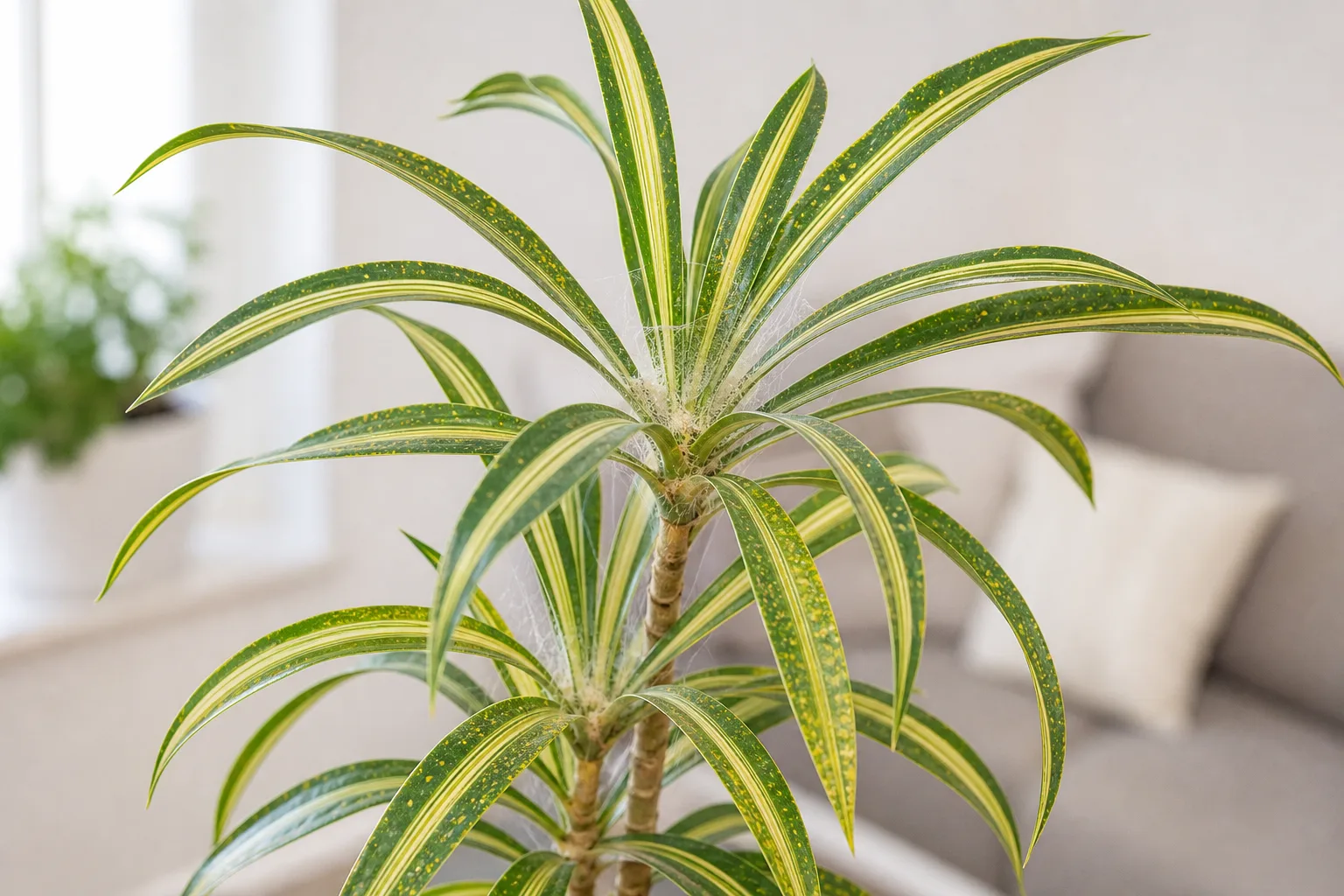
Spider Mites on Song of India: Causes, Checks & Fixes
This guide covers spider mites on Song of India. See also the general Spider Mites guide, watering, and light pages for this plant.
Spider Mites on Song of India: Causes, Checks & Fixes
Quick answer
Spider mites are among the most common indoor plant pests-and Song of India (Dracaena reflexa ‘Variegata’) is on the watch list. NC State Extension advises monitoring for spider mites on this naturally slow-growing dracaena, alongside scale and mealybugs. These microscopic sap feeders leave pale stippling on the narrow yellow-margined leaves and spin fine webbing where each whorl meets the stem.
This page is the D. reflexa ‘Variegata’ rescue path-whorl geometry, variegated-margin stippling, and fluoride lookalike forks that the thin genus-level dracaena spider-mites overview does not cover. When dry heated air is weakening foliage before webbing appears, start with the low-humidity guide. When stippling is absent but tips stay crispy, see brown tips for the water-quality-first path.
First step: isolate the plant and rinse every leaf underside with a forceful stream of lukewarm water. Cover the pot or tip it sideways so soil does not waterlog. Confirm live mites with a tap test over white paper before you reach for sprays. One rinse rarely clears an outbreak-eggs hatch in cycles-but isolation plus washing is the correct day-one move.
Why Song of India gets spider mites
Spider mites are not insects-they are tiny arachnids that pierce leaf cells and suck sap, leaving chlorotic speckles where feeding occurred. University of Minnesota Extension describes feeding damage as a stippled or mottled appearance that can yellow leaves and trigger drop when populations build.
Song of India is especially vulnerable in the conditions mites prefer. The species evolved in humid island climates around the Indian Ocean, but indoor heating often pulls humidity below 30–40%. Clemson HGIC notes that when house humidity falls below 30 to 40 percent, dracaenas benefit from occasional foliage misting-the same dry air that stresses your Song of India lets mites reproduce faster. Extension guidance consistently links spider mites to warm, dry indoor environments.
Several traits make damage obvious on this species before you notice it on tougher-leaved houseplants. Leaves spiral in tight whorls along upright stems, so undersides stack closely-perfect cover for colonies. The variegated margins are thinner and show stippling early as pale or bronze freckles against the green center. Song of India grows slowly compared with trailing vines, so damaged leaves stay on display for weeks even after mites are gone-and reinfection from adjacent dracaenas feels more urgent because new clean whorls take longer to replace the damaged ones.
Crowded shelves, dusty foliage, and drought-stressed plants accelerate outbreaks. UMN yard-and-garden guidance notes that dust on leaves reduces light and attracts spider mites. A pot that stays too dry while heating runs creates double stress: the plant weakens, and the air stays mite-friendly. Baseline watering rhythm and humidity targets matter as much as sprays once mites are confirmed.
What spider mites look like on Song of India
Early feeding:
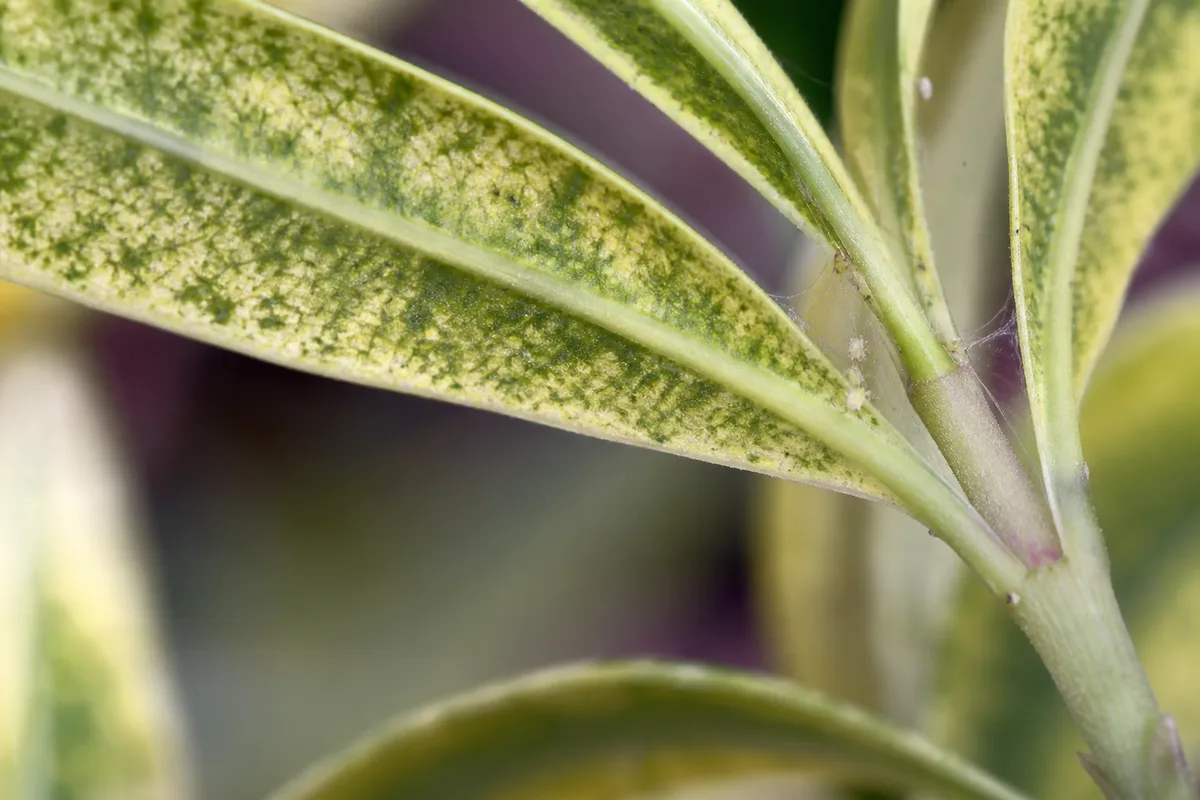
Spider Mites symptoms on Song of India - compare with healthy tissue on the same plant.
- Pinpoint yellow or pale speckles scattered across leaf surfaces, often most visible along creamy margins
- Leaves look dull or slightly bronzed before whole sections yellow
- No webbing yet-easy to confuse with fluoride tip burn or low-humidity stress
Established colonies:
- Fine silk webbing at leaf axils, stem joints, and tips of whorls
- Stippling merges into larger bleached patches on older leaves
- Tiny moving dots on undersides-green, yellow, or orange depending on species
- Lower leaves may yellow and drop while the stem stays firm if roots are healthy
What the mites themselves look like:
Adults are roughly 1/50 inch long and usually need magnification. UMN Extension notes amber eggs, whitish cast skins, and black fecal specks on undersides alongside live mites. To the naked eye they resemble moving dust grains, not the cottony blobs of mealybugs or the hard shields of scale.
How to confirm the cause
Work through these checks in order before you treat:
- Tap test - Hold a yellowing leaf over white paper and tap the underside firmly. Mites dislodged as moving specks confirm the diagnosis. Static dust does not walk.
- Webbing check - Look at stem whorls and leaf bases with a hand lens. Fine silk strands that reappear after rinsing mean active colonies-not fluoride damage or normal aging. Soap residue from a recent spray can look filmy but does not rebuild into new strands within 24 hours.
- Pattern on variegation - Mite stippling is scattered across the leaf face. Fluoride injury on dracaena usually starts at tips and margins as dry crispy brown-not random pinprick dots. When the tap test is negative but tips keep crisping, follow the brown-tips guide.
- Environmental read - Is the plant near a heating vent, sunny window with dry winter air, or a fan that strips humidity? Mites surge in those spots while mealybugs favor protected crevices regardless of humidity. A hygrometer at leaf level below 40% points to low-humidity stress as a parallel contributor.
- Neighbor plants - Inspect palms, ficuses, and other dracaenas on the same shelf. Mites walk across touching leaves and ride air currents on webbing.
- Soil and roots - Push a finger 3–5 cm into the mix. Soggy soil plus stippling suggests overlapping stress, not mites alone-but underwatered plants in dry rooms attract mites faster. Roots should feel firm, not mushy.
If you see stippling but no mites, webbing, or movement after two inspections a week apart, revisit water quality and humidity before committing to a spray schedule.
First fix for Song of India
Isolate the plant and rinse all foliage-especially undersides-with lukewarm water in a sink or shower.
Move Song of India away from other houseplants immediately. Mites migrate on contact and webbing strands. UMN Extension recommends washing plant foliage with a forceful spray of lukewarm water to reduce populations when repeated. Angle each whorl so water hits the underside of every narrow leaf. Wrap the soil surface in plastic or tip the pot sideways so rinse water does not soak the crown-Song of India tolerates foliage washing but not waterlogged roots.
Let leaves dry in bright indirect light the same day-never in harsh direct sun while wet. Do not apply horticultural oil or soap in the same session as a heavy rinse unless the label allows; start with water alone as your first action, then confirm mites are still present 24–48 hours later before spraying.
Do not fertilize, repot, or prune heavily on day one. Stressed dracaena responds better once the pest load drops.
Step-by-step recovery
After isolation and the initial rinse:
- Repeat water washes every two to three days for two weeks if colonies were light. Target undersides of whorled leaves where mites hide.
- Apply insecticidal soap or horticultural oil if mites persist after several rinses. Colorado State Extension notes repeat applications every four to seven days because soaps have no residual activity and do not kill eggs. Cover tops and bottoms of every leaf; mites on Song of India cluster in whorl crevices.
- Run at least three spray cycles on label intervals-one treatment rarely breaks the life cycle. Clemson HGIC advises treating in the early morning or late day and avoiding applications above 90°F or in full sun to prevent leaf burn on variegated dracaena foliage.
- Raise humidity to 40–60% with a humidifier or pebble tray per the low-humidity guide. Higher humidity slows mite reproduction but does not replace contact sprays on an active infestation.
- Prune only heavily webbed or bronzed leaves once sprays are underway. Removing a few worst leaves lowers pest load and improves coverage on tight whorls. Do not strip the plant bare-Song of India recovers from the top down.
- Scout adjacent plants weekly with the tap test. Treat any positive neighbors before mites re-cross the gap.
- Keep soil moisture even-water when the top 3–5 cm dries per the watering guide, not on a calendar. Mites thrive on drought-stressed hosts in dry air.
Wear gloves when handling rinsed or sprayed foliage. Dracaena is toxic to cats and dogs if chewed.
Recovery example: heating-season outbreak
A Song of India on a shelf beside a forced-air vent developed pale speckling along creamy margins in mid-December. A hygrometer at the leaves read 28% RH. Tap test over white paper showed orange moving specks; fine silk appeared at two whorl axils. The plant was isolated, rinsed daily for one week with the pot tipped sideways, then treated with labeled insecticidal soap at five-day intervals for three cycles. New stippling stopped by week three; the top whorl opened clean at week five. Old bronzed leaves were left in place until pruned after the third spray-stippled tissue never re-greened, which is normal on this slow grower.
Recovery timeline
Light infestations often show fewer new speckles within one week of consistent rinsing. Moderate outbreaks with webbing usually need two to three weeks of combined washing and soap or oil on proper intervals before new growth looks clean.
Stippled older leaves will not regain solid green or creamy margins-the damage is permanent on that tissue. Judge success by fresh whorled leaves at stem tips: no new stippling, no fresh webbing, and firm green growth. Because NC State lists D. reflexa as a slow grower, visible improvement at the tip may take four to six weeks even after mites are eliminated-longer than on fast-growing pothos or philodendron.
If tips stay pale, webbing returns within days of the last spray, or lower leaves keep dropping, the population is still active or neighboring plants are reinfecting your specimen.
Lookalike symptoms to rule out
| Pattern | What you see | First check |
|---|---|---|
| Spider mites (this page) | Pinprick stippling across leaf face; fine silk at whorl axils; moving specks on tap test | Isolate, rinse undersides, repeat soap/oil on label intervals |
| Fluoride tip burn | Dry crispy tan-to-brown tips and margins; no webbing; tap test negative | Brown tips - dracaenas do not tolerate fluoride in tap water |
| Low humidity stress | Crispy margins in heated winter rooms; no mites or silk on inspection | Low humidity - measure RH at leaf level first |
| Mealybugs | White cottony masses in leaf axils; slow movement; sticky honeydew | Mealybugs - different contact treatment |
| Scale insects | Brown or tan immobile bumps on stems; honeydew; no stipple pattern | Clemson lists scale and mites as main dracaena insect pests - scale lacks fine webbing |
| Thrips | Silvery scars and distorted new leaves; black fecal specks | Less common on Song of India than mites in dry indoor air |
| Normal lower leaf loss | Single yellowing bottom leaves without upper stippling | MOBOT notes lower leaves die off over time on mature stems - age, not mites |
Mistakes to avoid
Do not stop after one rinse or one spray-eggs hatch continuously in warm rooms.
Do not spray only the tops of leaves. Whorled Song of India foliage hides mites underneath.
Do not use standard houseplant insecticides aimed at aphids or beetles; many do not control mites and can harm natural enemies. Soaps and horticultural oils are the usual indoor-safe options when label directions allow.
Do not apply horticultural oil in direct sun on variegated leaves-oil plus heat burns margins.
Do not increase feeding to push new growth during an active infestation. Fertilizer does not kill mites and can stress roots.
Do not ignore nearby plants that look clean. Mites spread before webbing is obvious on every host.
Do not compost heavily infested prunings indoors or near other containers.
Do not mistake dried soap film for new webbing-wait 24 hours after rinsing and re-check with a hand lens before assuming treatment failed.
Song of India care cross-check
While treating mites, keep only the care constraints that directly affect pest pressure:
- Dry air accelerates mites - Target 40–60% RH near the foliage. See low-humidity for humidifier vs. pebble-tray choices.
- Drought stress attracts mites - Water when the top 3–5 cm dries per the watering guide; bone-dry spells in heated rooms weaken whorled leaves faster.
- Dusty foliage - Wipe or rinse leaves periodically; clean surfaces support photosynthesis and remove early mite scouts.
- Cold drafts compound leaf drop - Keep room temperatures above 65°F while recovering; cold-stressed dracaena sheds leaves faster when mites also feed.
Full light, soil, and fertilizer parameters live on the Song of India overview and sibling care guides-do not repot or fertilize during an active infestation unless a separate root problem is confirmed.
How to prevent spider mites next time
Scout leaf undersides monthly-weekly during peak heating season. Tap suspect leaves over white paper before webbing is obvious.
Quarantine new plants for at least two weeks before placing them beside Song of India. UMN Extension advises monitoring isolated newcomers for pest problems before mixing them with healthy collections.
Keep humidity in the moderate range Song of India prefers year-round, not only after an outbreak.
Avoid crowding plants so whorl tips touch neighbors on the same shelf.
Rinse foliage occasionally in winter when dust and dry air combine-UMN notes washing houseplants regularly during winter can keep mites at bay.
Inspect plants you move between rooms or bring in from patios-temperature shifts stress dracaena and coincide with mite spikes indoors.
When to worry
Escalate quickly when webbing covers multiple stems, new growth emerges stunted or bleached, or leaves drop in clusters despite rinsing. Those signs mean population pressure is high and the plant is losing photosynthetic tissue faster than Song of India replaces it.
Consider discarding and bagging severely defoliated specimens that share a room with other favorites. UMN Extension suggests placing a plastic bag over the plant before removal to limit mites drifting to neighbors when disposal is the pragmatic choice.
Early stippling without webbing is urgent enough to isolate and rinse-but not a reason to panic. Caught at that stage, Song of India usually recovers fully at the growing tips.
Related Song of India guides
- Song of India overview - species hub and whorled growth habit
- Song of India watering - dry-down rhythm and fluoride-safe water
- Low humidity on Song of India - dry-air stress that invites mites
- Brown tips on Song of India - fluoride lookalike when tap test is negative
- Mealybugs on Song of India - axil pest lookalike
- Slow growth on Song of India - why clean new whorls take weeks to appear
- All Song of India problems
FAQs
How can I confirm spider mites on Song of India?
Tap a suspect leaf over white paper-moving orange or green specks confirm mites. Fine silk webbing at leaf axils in the spirally arranged whorls and stippling along creamy leaf margins are classic signs. Fluoride tip burn on dracaena looks similar but has no webbing or moving dots-see the brown-tips guide when tips are crispy but the tap test is negative.
What should I check first for spider mites on Song of India?
Inspect the warmest, sunniest side of the plant and leaf undersides in each whorl with a hand lens. Check nearby dracaenas and palms-spider mites spread when leaves touch and thrive in the same dry indoor air Song of India dislikes. If humidity at the leaves reads below 40%, dry air may be weakening foliage even before webbing appears.
How do I rinse whorled Song of India leaves without waterlogging the pot?
Tip the pot sideways or wrap the soil surface in plastic while you shower undersides in a sink. Angle each whorl so water runs off the narrow leaves rather than pooling at the stem crown. Let foliage dry in bright indirect light the same day-never in harsh direct sun while wet.
Will mite damage on Song of India heal?
Stippled and bronzed leaves will not re-green; judge recovery by clean new growth at stem tips. Song of India grows slowly, so expect several weeks before fresh whorled leaves look normal again after mites are gone.
How do I prevent spider mites on Song of India?
Keep humidity at 40–60%, rinse foliage occasionally in heating season, quarantine new plants for two weeks, and inspect leaf undersides monthly. Dusty leaves in dry air attract mites faster than clean foliage on a well-watered plant-see the low-humidity guide when dry winter air is the underlying stress.
Conclusion
Spider mites on Song of India show up as stippling on variegated whorled leaves and fine webbing in dry heated homes-not as mysterious tip burn. Isolate first, rinse undersides thoroughly, confirm with a tap test, then repeat water washes or labeled soap or oil on short intervals until new top growth stays clean. Old stippled leaves will not revert; a healthy Song of India tells you the problem is solved when fresh whorls emerge without speckles or silk. If humidity reads fine but tips keep crisping with no mites, read brown tips next. If dry air weakened the plant before webbing appeared, pair treatment with the low-humidity path.