Leggy Growth on Song of India: Causes, Checks & Fixes
Quick answer
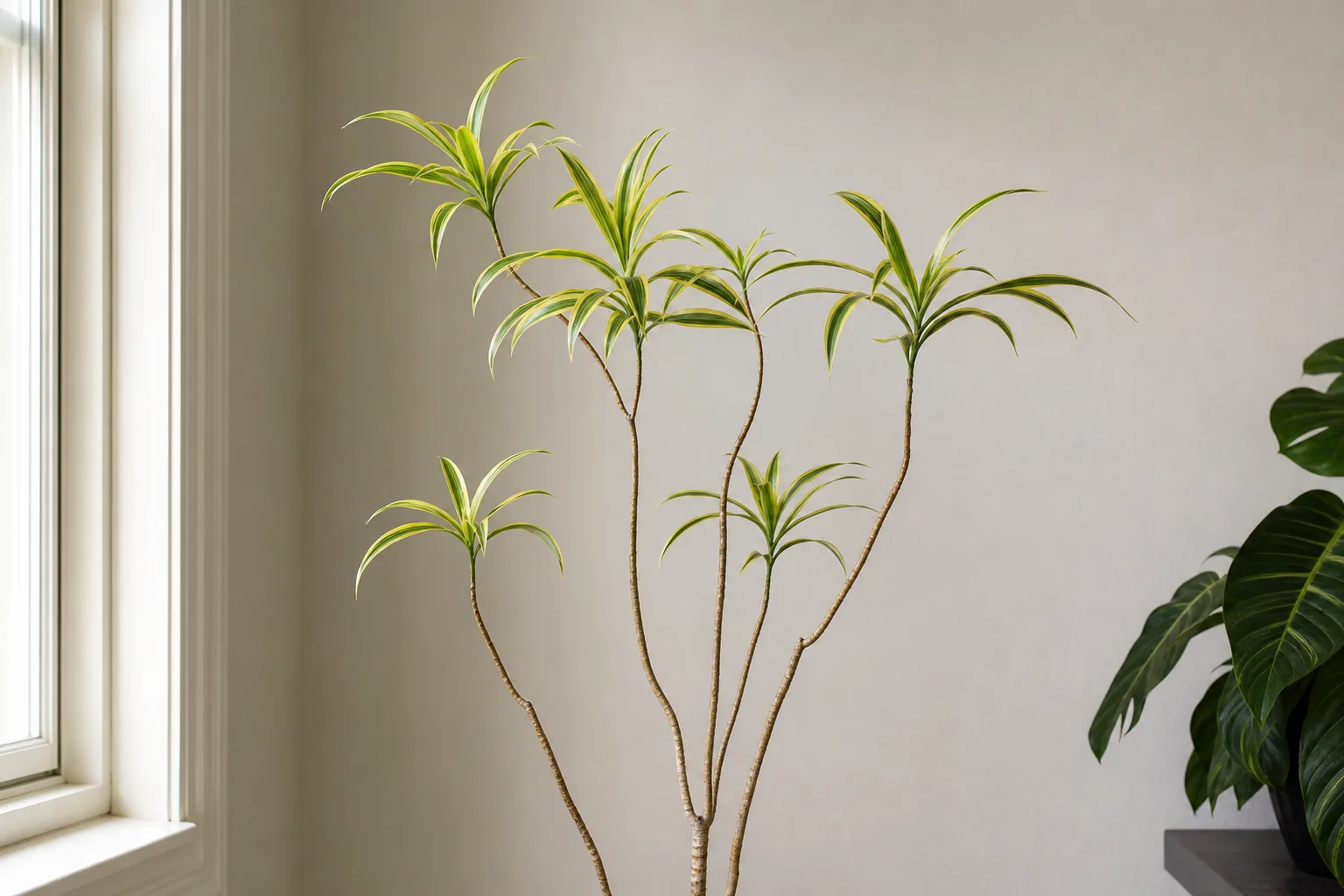
Leggy Song of India shows long gaps between spiral leaf whorls, thin leaning stems, and fading cream-yellow margins from insufficient light-not a fertilizer problem. First step: move to bright indirect light and acclimate over one to two weeks before pruning stretched tips.
Leggy Growth on Song of India: Causes, Checks & Fixes
This guide covers leggy growth on Song of India. See also the general Leggy Growth guide, watering, and light pages for this plant.
Leggy Growth on Song of India: Causes, Checks & Fixes
Quick answer
Leggy Song of India (Dracaena reflexa ‘Variegata’) is almost always etiolation-the plant stretching toward usable light. Long bare gaps between spiral leaf whorls, cream-yellow margins fading to muddy green, and thin stems leaning toward the brightest window confirm stretch, not a nutrient crash.
First step: move the plant to bright indirect light over one to two weeks. Protect variegated tissue from harsh direct sun except limited early morning exposure. Do not reach for fertilizer or repotting until light is corrected-those steps will not close stretched internodes.
Use this page when you can see long internodes between whorls and each new whorl sits farther from the last than the one below it. Use the not-enough-light guide instead when variegation fades and growth stalls but whorl spacing has not dramatically lengthened-you need full window-placement and acclimation depth beyond stretch diagnosis alone. Old stretched sections never shrink; only new whorls can restore compact form.
Leggy growth vs. not enough light on Song of India
Both problems share low light as the root cause, but these URLs serve different search moments:
| Your situation | Start here |
|---|---|
| Long bare gaps between spiral whorls; each new whorl smaller and paler than the last; visible lean | This page - etiolation and internode stretch |
| Fading chartreuse margins and slow growth without dramatic internode lengthening; unsure if placement is too dim | Not-enough-light guide |
| Grow-light distance, foot-candle bands, window direction, scorch vs. dim warnings | Light guide |
| Hard cutback timing, node cuts, and branching after light correction | Pruning guide |
Fixing leggy etiolation requires the same brighter placement described on those sibling pages-the difference is how you confirm stretch before you move the pot.
What leggy growth looks like on Song of India
Healthy Song of India holds tight whorls of leaves spiraling around stiff upright stems. Each whorl sits close to the next, and the yellow-lime margins stay vivid against the green center. Leggy plants look different:
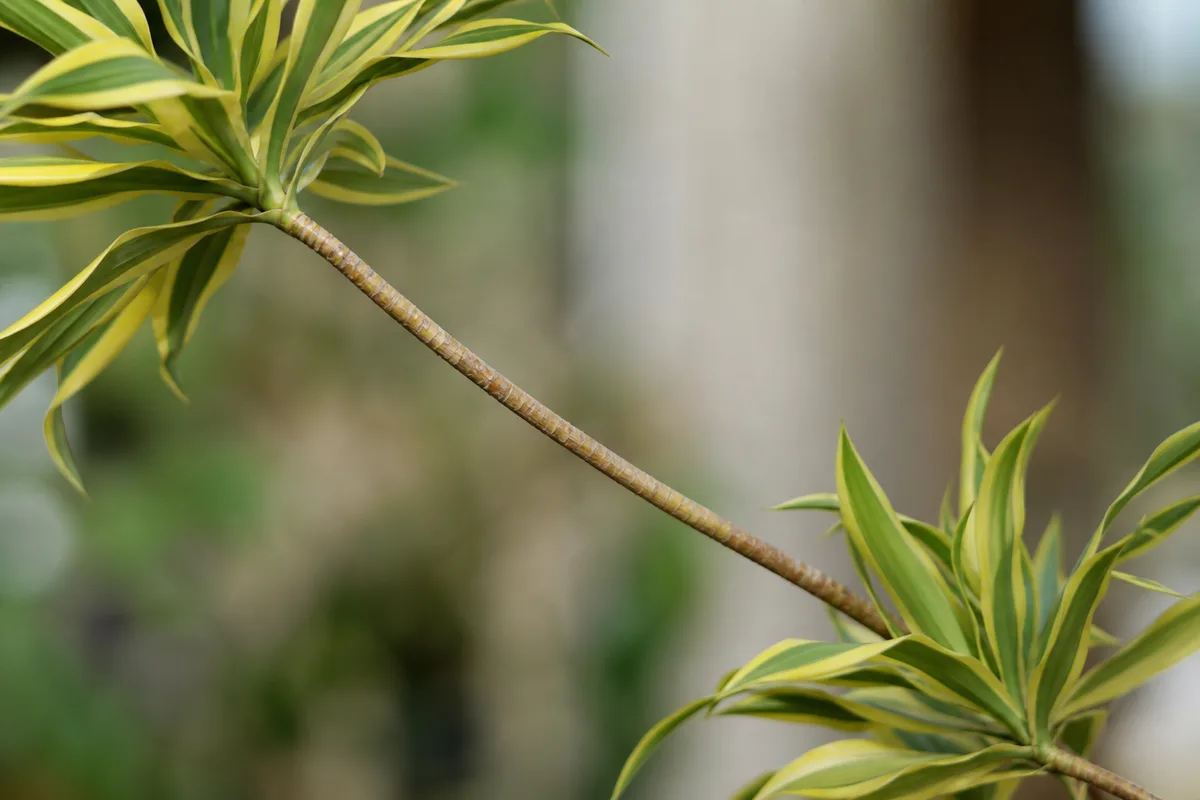
Leggy Growth symptoms on Song of India - compare with healthy tissue on the same plant.
- Long internodes - visible gaps of bare stem between leaf whorls, much wider than on compact growth from when you bought the plant
- Smaller, paler new leaves - recent whorls are thinner and less colorful than older ones near the base
- Fading variegation - cream-yellow margins wash out to chartreuse or solid green because the plant cannot photosynthesize enough in dim light
- One-sided lean - the whole pot or individual stems bend toward a window or lamp
- Sparse upper canopy - stems keep extending upward but look thin and weak rather than bushy
Song of India naturally sheds lower leaves over time, leaving bare cane sections near the base. That aging pattern is normal on mature plants. Legginess is different: the newest growth at the tips is stretched and pale, not just the lower stem showing through.
Petiole-spacing confirmation test
Compare the last three whorls on each stretched cane:
- Measure or estimate the bare stem between whorls with a finger span or ruler.
- Note whether each newer whorl sits farther from the one below it.
- Compare leaf size and margin color on the newest whorl vs. two whorls down.
Etiolation confirmed when internodes lengthen and new leaves shrink while margins fade-especially if all stems lean the same direction toward one window.
Example recovery pattern (illustrative): A north-facing office shelf produced whorls with roughly 8–10 cm bare gaps and muddy green new leaves. After moving to an east windowsill and acclimating over ten days, the first new whorl appeared five weeks later with a ~4 cm gap and restored cream-yellow margins. The old stretched section below stayed permanently long until pruned above the compact new growth.
Why Song of India gets leggy
Insufficient light is the primary cause
Leggy growth is etiolation-the plant stretching toward usable light at the expense of compact tissue. Song of India needs bright, indirect sunlight for best results. In dim corners, north rooms, or spots several feet from windows, stems elongate and leaves shrink.
The variegated ‘Variegata’ form is especially light-hungry. Yellow margins carry less chlorophyll than the green center, so the plant needs stronger indirect light than an all-green dracaena to maintain color and density. ‘Song of India’ cultivars depend on the green tissue to fuel photosynthesis for the lighter margins-dim light forces reversion toward solid green first, then stretch.
Why Song of India stretches faster than Janet Craig in the same corner
Dracaena fragrans ‘Janet Craig’ and other office-tolerant dracaenas can look acceptable several feet from a window. Song of India cannot if you want the variegated silhouette you bought. All-green tissue photosynthesizes more efficiently per leaf area; variegated Song of India needs higher light intensity at the leaf surface to hold chartreuse margins and compact whorls. The same dim corner that merely slows Janet Craig often produces visible internode stretch on Song of India within one growing season.
Clemson HGIC notes that Pleomele (Dracaena reflexa) foliage stays dense to the base if grown with enough light-sparse lower stems combined with stretched new tips usually means light has been insufficient for some time, not normal dragon-tree aging.
Winter and uneven exposure
Shorter days in winter drop light intensity even at the same window. Plants that looked fine in summer can stretch by February. One-sided light from a single window causes directional lean without necessarily making every stem equally long-rotate the pot if only one side stretches.
Over-fertilizing in low light
Heavy feeding in dim conditions can push weak, elongated shoots the plant cannot support with available light. This is secondary to the light issue. Fix placement before adding fertilizer.
What leggy growth is not
Legginess is not underwatering-dry stress causes limp, crispy leaves, not long internodes. It is not root rot, which shows soft stems, sour soil, and wilting. Slow growth from cold drafts slows the whole plant but does not typically produce dramatic stretch unless light is also poor-see slow growth when the plant is compact but unhurried.
How to confirm the cause
Work through these checks before you prune or repot:
- Light at the leaf level - Hold your hand where the top whorl sits at midday. A soft shadow with defined edges suggests usable indirect light in the 100–500 footcandle range typical of east or west exposures. A faint or absent shadow means the spot is too dim for variegated Song of India.
- Distance from the window - Light intensity decreases rapidly with distance from the source. Plants more than 1–2 metres from an unobstructed east or west window, or more than 0.5 metres from a north window, often stretch indoors.
- New growth pattern - Compare the last three whorls. If each new whorl sits farther from the last and leaves are smaller, light is the confirmed cause.
- Variegation check - Fading margins on new leaves while older lower whorls still show color strongly points to worsening light, not a sudden nutrient crash.
- Soil moisture rhythm - Leggy plants in low light use water slowly. If the pot stays wet for a week or more, pair the light fix with a watering audit-do not keep watering on a summer schedule.
- Season timing - Stretch that appeared or worsened between November and March often tracks shorter daylight. Supplemental lighting may be needed even if summer placement was adequate.
If all signs point to low light, you have a confirmed diagnosis. No pest inspection or root dig is required on day one.
First fix for Song of India
Move the plant to the brightest indirect spot available, acclimating over one to two weeks.
Practical targets from the light guide:
- East window: On the sill or within one foot of the glass for gentle morning sun plus bright indirect light the rest of the day.
- South or west window: Two to four feet back, or directly on the sill behind a sheer curtain that softens midday intensity.
- North window or interior room: Treat as temporary survival only; add a full-spectrum LED grow light 12–18 inches above the top whorl for 10–12 hours daily on a timer.
In too much shade, plants may grow spindly with variegated leaves losing their variegation. Protect from harsh direct sun except for limited early morning sun-harsh midday rays scorch the narrow leaves.
If coming from deep shade, shift the pot closer over several days rather than jumping straight into strong afternoon light. Watch new whorls for scorch-pale patches or brown edges mean back the plant off slightly.
Do not fertilize, repot, or hard-prune on the same day you move it. Light correction is the single first action.
Step-by-step recovery
After the plant is in better light:
- Rotate weekly - Turn the pot a quarter turn so all sides receive similar exposure and stems grow upright instead of leaning.
- Adjust watering - Brighter light means faster drying. Check the top 3–5 cm of mix before each drink per the watering guide instead of following an old calendar from the dim corner.
- Wait for compact new whorls - Give the plant four to eight weeks in improved light before judging recovery. The first one or two new whorls should sit closer together than the stretched section below them.
- Prune stretched tips - Once new growth looks tighter, cut leggy stems just above a leaf whorl with clean shears. If stems become too long and bare, cut them off at the desired height and new leaves will soon appear on dracaena. Song of India often branches from the cut point-see the pruning guide for node placement and how much to remove at once.
- Stake if needed - Thin stretched canes flop before new side shoots stiffen them-use a bamboo stake and soft tie until branching fills in.
- Consider tip cuttings - Leggy top sections root easily as stem cuttings if you want a fresh compact plant while the parent regrows from the cut. Root in moist mix with warm, bright indirect light-not as a substitute for fixing the parent plant’s placement.
Wear gloves when handling cut stems; dracaena is toxic to cats and dogs if ingested. Bag trimmings securely in pet homes.
Stagger hard pruning on a stressed plant. Removing more than one-third of foliage at once slows recovery when the plant is already light-starved.
Recovery timeline
Improvement shows on new growth, not old stretched tissue. Expect the first tighter whorl within four to six weeks after a successful light move. Full visual recovery-bushier shape and restored variegation on most of the visible canopy-often takes two to three growing seasons because old elongated sections remain until pruned away.
Signs you are on track:
- New whorls sit closer together than the leggy section below
- Cream-yellow margins return on fresh leaves
- Stems stop leaning once the pot is rotated regularly
- Pot weight drops predictably between waterings in the brighter spot
Signs the problem is continuing:
- Each new whorl is still farther apart than the last
- Margins keep fading to green on the newest leaves
- Stems lean harder despite rotation
- Soil stays soggy because growth remains too slow for the watering schedule
Lookalike symptoms to rule out
| Pattern | What you see | First check |
|---|---|---|
| Leggy etiolation (this page) | Long internodes; smaller pale new whorls; lean toward window | Shadow test; whorl spacing trend |
| Not-enough-light stall | Fading margins; slow growth; modest spacing | Not-enough-light guide |
| Normal lower-leaf aging | Bare lower cane; compact new tips; steady variegation on fresh whorls | Compare newest vs. oldest growth only |
| Overwatering / root rot | Yellowing with wet heavy soil; soft stem base; sour smell | Overwatering - fix light and dry-down together in dim corners |
| Fluoride tip burn | Brown or yellow tips on otherwise compact, well-placed plants | Brown tips - dracaenas do not tolerate fluoride and chlorine in tap water |
| Spider mites | Fine stippling and webbing in hot dry corners | Spider mites - pests, not a light diagnosis |
| Too much direct sun | Bleached white patches on sun-facing margins after a sudden move | Light guide - filter or pull back, do not move deeper into shade |
Plant leaning without long internodes may be uneven light only. Rotate the pot and watch whether new whorls stay compact-if gaps still widen, light intensity is still too low.
Slow growth in an otherwise compact plant can mean cold temperatures below 65°F, root-bound conditions, or winter dormancy-not necessarily stretch. Song of India in adequate light but cool rooms grows slowly without dramatic etiolation.
Mistakes to avoid
Do not fertilize a leggy Song of India hoping to “green it up.” Without adequate light, nutrients cannot produce compact variegated tissue.
Do not move from a dim corner straight into harsh south-window midday sun. Scorch damages leaves and does not replace gradual acclimation to bright indirect light.
Do not prune heavily without improving light first. Cut stems will simply stretch again from the same dim spot.
Do not repot into a larger container. Legginess is not a root-space problem, and extra soil in low light stays wet longer.
Do not confuse survival with health. Song of India can linger in deep shade for months while slowly stretching-move it before the plant becomes mostly bare cane with weak tips.
Do not assume every dracaena shares the same window. Song of India needs more brightness than Janet Craig or many office-tolerant species in the same dim corner.
Song of India care cross-check
Leggy growth often appears alongside other stress signals when light and watering drift together. Use this quick audit:
- Light - Bright indirect, protected from harsh direct sun; see the light guide
- Water - Top 3–5 cm of mix dry before watering; adjust rhythm after any light change
- Temperature - Steady 18–27°C (65–80°F); avoid cold drafts below 65°F
- Humidity - Average to moderate (40–60%); low humidity causes brown tips, not leggy stretch
- Water quality - Fluoride-sensitive dracaenas benefit from filtered water if tips brown despite good light
If the pot stayed wet in the old dim spot, let the mix dry further after the move and confirm roots are firm and white-not mushy-before returning to a normal watering rhythm.
How to prevent leggy growth next time
Keep the plant in bright indirect light year-round, not just during summer. Rotate the pot weekly. In weak winter windows, add a full-spectrum grow light 12–18 inches above the foliage for 10–12 hours daily to maintain whorl spacing and variegation.
Avoid placing Song of India where it looks good decoratively but receives only ambient room brightness-hallways, interior bathroom corners, and bookshelves away from windows are common stretch triggers.
When buying, choose plants with tight whorls and vivid margins at the nursery. An already-stretched specimen will need light correction and pruning from day one.
When to worry
Legginess alone is not an emergency. Treat it as urgent when weak stretched stems cannot support the plant upright, when soggy soil in low light suggests root rot risk, or when the plant has lost most of its variegation and stopped producing new whorls entirely. Those patterns mean light correction and watering adjustment cannot wait.
If improved light for two months still produces stretched pale whorls, reassess whether the spot truly delivers bright indirect light at the leaf level-or add supplemental lighting rather than assuming the window is enough.
Related Song of India guides
- Song of India overview - hub page for the full care cluster
- Song of India light - window placement, grow-light distance, scorch warnings
- Not enough light on Song of India - fading variegation and placement overhaul without dramatic stretch
- Song of India pruning - hard cutback, node cuts, and branching after light correction
- Song of India watering - dry-down rhythm after light changes
- Slow growth on Song of India - compact but unhurried vs. true etiolation
- Brown tips on Song of India - fluoride burn vs. stretch
- Spider mites on Song of India - stippling in dim dry corners
Conclusion
Leggy Song of India is a light diagnosis, not a mystery disease. Long gaps between whorls, fading margins, and thin leaning stems confirm etiolation. Move to bright indirect light first, acclimate gradually, add grow lights in north rooms or winter if needed, then prune and stake once compact new growth proves the fix is working. Old stretched sections never shrink-but new whorls can restore the upright, variegated look this plant is grown for.