Hornwort Care: What This Aquarium Plant Really Needs
Ceratophyllum spp.
Hornwort is treated as a lower-risk aquatic plant in current tortoise-focused references, but it should still be used conservatively and only from clean, correctly identified sources.
Hornwort Care: What This Aquarium Plant Really Needs
Start with wateringThe most common care mistake for HornwortCheck pet-safe plants →Hornwort care essentials
Light
Moderate to bright aquarium or pond light; avoid sudden harsh outdoor sun without acclimation.
Water
Keep fully aquatic in clean, dechlorinated water; refresh water quality before the plant declines.
Soil
Aquatic setup with no ordinary potting mix in the turtle tank; anchor or float according to the species.
Humidity
Aquatic or constantly humid surface conditions
Temperature
18-28 C (64-82 F)
Fertilizer
Usually unnecessary in turtle tanks with normal nutrients. Aquarium-safe fertilizer only if needed, used outside the turtle tank when possible
About Hornwort
Hornwort is native to Freshwater habitats across much of the world, typically reaches 30-150 cm floating or submerged stems indoors, with fast in stable water growth. Hornwort has a herbaceous growth habit and part of the Ceratophyllaceae family. It is also known as Coontail and Rigid Hornwort.
| Detail | Information |
|---|---|
| Also known as | Coontail, Rigid Hornwort |
| Native region | Freshwater habitats across much of the world |
| Mature size | 30-150 cm floating or submerged stems |
| Growth rate | Fast in stable water |
| Growth habit | Herbaceous |
| Scientific name | Ceratophyllum spp. |
| Family | Ceratophyllaceae |
Hornwort Care: What This Aquarium Plant Really Needs
Hornwort is the plant aquarists reach for when everything else has failed - and then forget about until it has filled half the tank. That is not a criticism. Ceratophyllum demersum is genuinely one of the most forgiving freshwater plants in the hobby, but “forgiving” does not mean “immune.” It means the plant tells you clearly when something is wrong, usually by dropping needles across the substrate like a green snowfall. The difference between a lush, bushy hornwort forest and a shedding mess comes down to a handful of aquarium-specific decisions: how you place it, whether you respect that it has no true roots, and whether your water stays stable long enough for the plant to acclimate. This guide covers all of that - for tanks, ponds, and breeding setups, not for pots on a windowsill.
What Hornwort Actually Is
Botanical background and the Ceratophyllaceae family
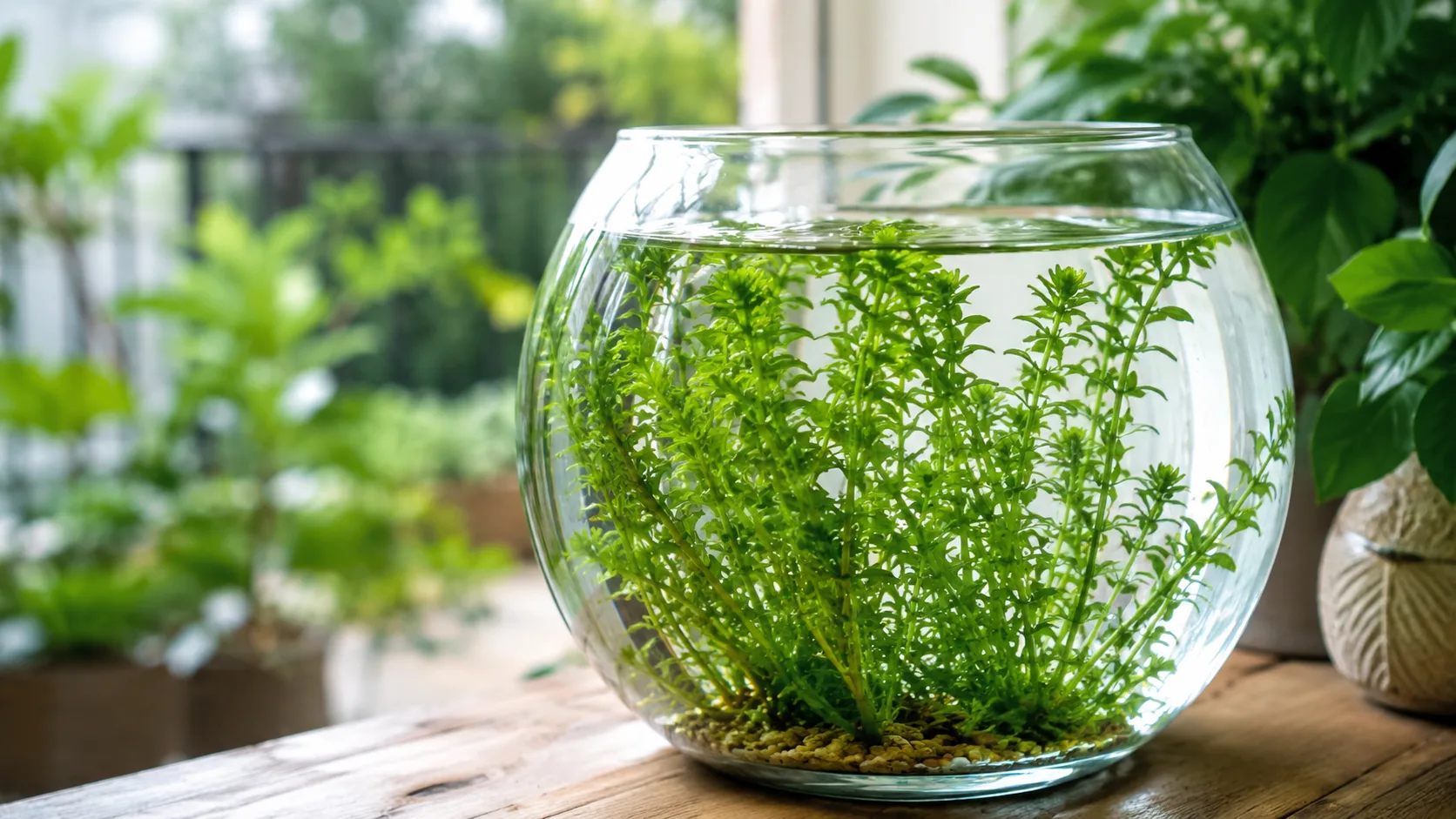
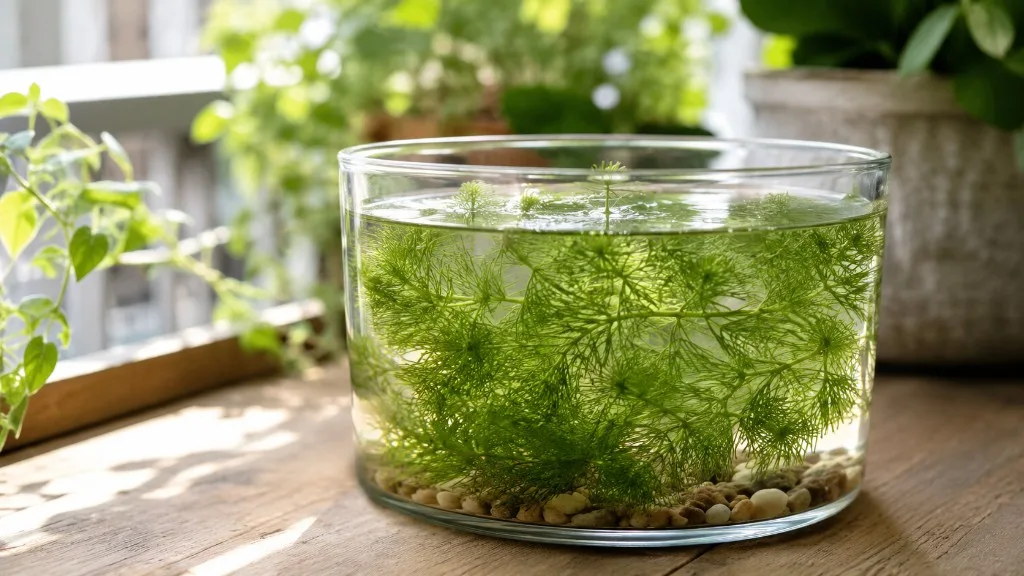
Hornwort - trade name for Ceratophyllum demersum, also called coontail or rigid hornwort - is a fully submersed freshwater plant in the Ceratophyllaceae family. Unlike most aquarium plants you will buy at a fish store, hornwort has no true roots. It absorbs water, dissolved gases, and nutrients directly through its feathery, whorled leaves and stems. In nature it free-floats or loosely anchors itself to sediment and debris with modified leaf bases, but it never depends on a root system the way Anacharis, swords, or crypts do.
The stems are brittle and fork repeatedly, carrying dense whorls of narrow, forked leaves that give the plant its bottle-brush silhouette. Mature stems in a well-lit tank can reach 30 to 150 cm (12 to 60 inches) within weeks under good conditions. Growth is herbaceous and extremely fast when water quality, light, and nutrients align - often visibly taller within a single week in a moderately stocked community tank.
Ceratophyllum demersum is a flowering plant, though the flowers are tiny, inconspicuous, and rarely seen in aquarium conditions. Reproduction in tanks is almost entirely vegetative: fragments break off, float away, and keep growing. That fragmentation habit is why hornwort spreads so easily in ponds and wild waterways - and why responsible keepers never dump aquarium trimmings into lakes, rivers, or storm drains.
A related species, Ceratophyllum submersum (soft hornwort), appears in the trade occasionally. Care is essentially identical. If your plant came without a label, treat it as C. demersum and you will be close enough for practical purposes.
Native range and why it is not a houseplant
Ceratophyllum demersum has a cosmopolitan distribution - native to freshwater habitats on every continent except Antarctica. It grows in lakes, ponds, slow rivers, and ditches from temperate to tropical latitudes. In seasonal climates it survives winter by forming turions - dense, root-like resting buds that sink to the bottom and resprout when warmth and daylight return.
That ecology matters because hornwort is not a terrestrial houseplant and cannot be grown in potting mix on a shelf. It requires continuous submersion in clean freshwater (or brackish tolerance is minimal to none - keep it freshwater). Emersed growth is not its normal aquarium mode. If you see hornwort listed in a generic “plant care” guide alongside pothos and peace lilies, ignore the watering and soil advice entirely. What hornwort needs is an aquarium, tub, or pond with stable water chemistry, adequate light penetration, and enough flow to deliver nutrients without shredding the plant against a filter intake.
Outside its native range in some countries - notably New Zealand, where it is classed as an unwanted organism, and Tasmania, Australia, where it is a declared weed - hornwort can form dense mats that choke waterways and interfere with infrastructure. That invasive potential is real. Inside your tank it is an asset; released into the wild it can become a liability. Dispose of trimmings in the trash or compost, never in natural water bodies.
Why Hornwort Belongs in a Freshwater Tank
Oxygenation, nutrient uptake, and shelter for fry
Hornwort earns its place in a tank by doing several jobs at once, most of them tied to its growth speed and column-feeding habit.
During daylight hours, healthy hornwort photosynthesizes actively and releases dissolved oxygen into the water. In moderate light you may see pearling - tiny bubbles forming on leaf tips and rising to the surface. While hornwort alone is not a substitute for adequate filtration and surface agitation, it measurably contributes to daytime oxygen levels in planted and lightly stocked tanks.
As a column feeder, hornwort pulls ammonia, nitrate, and phosphate directly from the water. That makes it valuable during tank cycling, in overstocked goldfish setups, and anywhere nutrient levels creep upward between water changes. A dense hornwort mass can drop measurable nitrate within days in a small tank - which is exactly why it helps suppress nuisance algae when the overall system is otherwise balanced.
Research on submerged macrophytes also documents allelopathic effects: hornwort can release compounds that inhibit some phytoplankton and cyanobacteria. In an aquarium this can translate to clearer water and fewer green-water outbreaks, though allelopathy is not a magic shield against every algae type. Hair algae, diatoms, and biofilm can still colonize hornwort leaves if light and nutrients are misaligned.
Finally, the dense, forked foliage creates refugia - hiding structure for fish fry, baby shrimp, and small invertebrates. Livebearers, betta fry, and neocaridina shrimp all benefit from floating hornwort mats or anchored background thickets. The plant collects detritus and biofilm between its needles, which shrimp sift through constantly. For a breeding box or grow-out tank, a handful of hornwort often outperforms expensive commercial spawning mops.
Floating vs Planted: Which Setup to Choose
Hornwort is unusual in that it genuinely supports two placement styles. Neither is wrong; they solve different problems.
How to float hornwort without blocking the tank
Floating is the easiest method and the one most experienced keepers default to for new stems. Drop trimmed bunches on the water surface and let them spread. Floating hornwort receives the strongest light (nothing shades it from above), accesses atmospheric CO2 at the surface film, and grows at its maximum rate.
The trade-offs are management and aesthetics. Uncontrolled floating hornwort can shade the entire tank, blocking light from reaching bottom-dwelling plants and slow-growing stems below. It can also reduce gas exchange at the surface if allowed to cover 100% of the water area in a small tank. For fry cover and quarantine tubs, that shade is a feature. For a display aquascape with carpeting plants or red stems that need strong light, it is a problem.
Practical floating management: corral the plant with a floating ring (a DIY loop of airline tubing works), restrict it to one corner, or trim weekly to keep roughly 30–50% of the surface clear. Remove brown or shedding portions promptly so decaying needles do not add ammonia back to the water. If you run a hang-on-back filter, expect occasional stem fragments near the intake - a prefilter sponge on the intake tube prevents clogging.
How to anchor hornwort without burying stems
Anchored placement - what hobbyists often call “planting” hornwort - gives a background forest look without a floating tangle on the surface. Here is the critical rule: never bury hornwort stems deep in substrate the way you would Anacharis or stem plants with roots. Buried portions rot, the stem releases needles, and the whole bunch floats back up within days.
Instead, use one of these anchoring methods:
- Plant weights or lead-free anchors: Wrap the lower inch of a stem bundle loosely and rest it on the substrate surface.
- Suction cups: Pin the stem base to the glass near the bottom - a technique Aquarium Co-Op and multiple nursery guides recommend for stem stability.
- Hardscape tuck: Wedge stems between rocks or driftwood so they stay in place without burial.
- Shallow gravel tuck: Gently press only the bottom centimeter into fine gravel or sand - not deep enough to bury whorled leaves.
Anchored hornwort still has no functional roots for nutrient uptake. Substrate type (aquasoil, gravel, sand, bare glass) affects only anchoring, not feeding. Lower stem sections in shade may shed if light does not reach them; trim bottom portions regularly or use moderate background lighting so the lower whorls stay green.
Decision shortcut: Float for fry tanks, quarantine, cycling, and low-effort nutrient export. Anchor for display backgrounds and midground bushy texture. In large tanks, many keepers do both - a floating mat at one end and anchored stems along the back wall.
Water Parameters That Keep Hornwort Stable
Temperature, pH, GH, and KH ranges that work
Hornwort’s reputation for hardiness is earned through a genuinely wide tolerance band. Across nursery profiles (Tropica, Aqua-Fish.net) and established retailer care guides (Aquarium Co-Op), the overlapping comfort ranges look like this:
- Temperature: 59–86°F (15–30°C) tolerated; 68–78°F (20–26°C) is the sweet spot for fast, compact growth. Hornwort works in unheated goldfish tanks, tropical community tanks, and outdoor tubs that do not freeze solid. Below 60°F it survives but grows slowly. Above 85°F, watch for needle drop if water goes stagnant.
- pH: 6.0–7.8 with best growth around 6.5–7.5. It handles slightly acidic soft-water setups and moderately alkaline hard-water tanks equally well.
- General hardness (GH): 4–18 dGH - soft to moderately hard water.
- Carbonate hardness (KH): 3–15 dKH - no special buffering demands.
Most municipal tap water and standard dechlorinated aquarium water falls inside these ranges without modification. That is why hornwort is often recommended as a first plant for beginners: you usually do not need to chase parameters.
The mistake is not picking the wrong number - it is changing numbers abruptly. Hornwort adapts to stable conditions, but large sudden shifts in pH, temperature, or TDS after a water change trigger needle shedding. When introducing new hornwort, float it first for a day or two while slowly mixing tank water into the transport bag if parameters differ significantly. Avoid changing more than 2–3°F or a large pH swing in a single water change when the plant is newly added.
Lighting Requirements
Hornwort tolerates low to high light, which is broader than most stem plants can claim. In low light it survives but grows leggy and sparse - longer internodes, thinner whorls, and a higher tendency to shed lower leaves on anchored stems. In moderate to high light it stays bushy, bright green, and fast-growing.
Practical targets for aquarium LEDs: roughly 30–50 PAR at the zone where the plant sits (surface for floating; mid-to-upper background for anchored stems). A full-spectrum LED in the 5000–6500K range on a timer for 8–10 hours per day is sufficient for most setups. Photoperiods beyond 12 hours rarely help hornwort and often fuel algae if nutrients and CO2 are not balanced to match.
Floating hornwort always gets adequate light at the surface. Anchored hornwort is where light failures show up: the top whorls stay green while the bottom half goes bare. Fix that by trimming regularly, raising light intensity modestly, or choosing floating placement instead of deep anchoring in tall tanks.
If needles bleach to pale yellow-green at the tips under very strong light, the plant may be outpacing available nutrients - increase liquid fertilization slightly rather than reducing light first, unless algae is also exploding on the glass.
CO2: Optional but Useful
Hornwort does not require CO2 injection. In a standard low-tech community tank it pulls dissolved CO2 and bicarbonates from the water and grows vigorously without any supplementation. That is one reason it thrives in goldfish tanks, breeding setups, and beginner aquaria where CO2 systems are absent.
If you already run pressurized CO2 in a high-tech planted tank, hornwort will respond with denser whorls, shorter internodes, and faster vertical growth. Expect to trim more often - sometimes weekly in a 20-gallon tank under high light and CO2. A target of 15–25 ppm CO2 is plenty; hornwort is not the plant that demands precision dosing.
Liquid carbon products (glutaraldehyde-based solutions sold as “Excel” and similar) sit in a middle ground. Some aquarists use them as a low-tech growth booster. Hornwort is notably sensitive to liquid carbon at full dose - many keepers report rapid needle shedding after treatment. If you dose liquid carbon in a hornwort tank, start at half label strength, treat away from the plant if possible, or remove hornwort temporarily during treatment. This sensitivity is one of the most common causes of “my hornwort died after one Excel dose” forum posts.
Fertilizer and Nutrient Demands
Because hornwort feeds from the water column, root tabs and substrate fertilizers do essentially nothing for it directly. What matters is dissolved macronutrients (nitrogen, phosphorus, potassium) and micronutrients (iron, manganese, and trace elements) in the water.
In a lightly stocked tank with moderate hornwort mass, the plant often scrounges enough nutrition from fish waste and leftover food without supplemental dosing. In a heavily planted tank, a fast-growing hornwort stand can strip nitrates to zero within days - starving slower plants and sometimes itself.
When liquid ferts matter in low-tech tanks
Dose a balanced liquid all-in-one fertilizer at half to full label strength weekly when any of these signs appear:
- Pale or yellow-green new growth while light is adequate.
- Nitrate reads 0 ppm in a tank with fish and plants (test before assuming deficiency).
- Fast hornwort growth paired with algae on other plants - the hornwort may be winning the nutrient race while the rest of the tank starves.
Hornwort responds quickly to improved water-column fertility. You will see greener whorls and reduced shedding within 5–10 days of consistent dosing. Avoid over-fertilizing in a low-light tank - excess nutrients with insufficient plant uptake fuel algae on glass and slow-growing leaves, even if hornwort itself looks fine.
Iron deficiency shows as pale tips on new whorls; a comprehensive liquid fert usually resolves it without separate iron dosing unless you run extremely soft RO water with no remineralization.
Algae Control and Hornwort’s Role
Hornwort is one of the better biological algae-management tools available to freshwater keepers, though it works best as part of a balanced system rather than as a standalone fix.
Its fast growth outcompetes algae for nitrate and phosphate. In newly set up tanks, adding hornwort during or after cycling can absorb ammonia and nitrite spikes while beneficial bacteria establish - always alongside proper filtration, not instead of it.
The allelopathic compounds hornwort releases can suppress some planktonic algae and cyanobacteria, contributing to clearer water in tanks prone to green-water blooms. It will not eliminate hair algae, black beard algae, or diatoms on its own if you run 12-hour photoperiods, excess nutrients, and weak flow simultaneously.
When hornwort itself becomes coated in fuzzy algae or biofilm, the underlying cause is almost always too much light duration or excess nutrients relative to plant mass. Reduce photoperiod to 8 hours, perform a 25–30% water change, manually remove algae from affected leaves, and review fertilizer dose. Amano shrimp, nerite snails, and otocinclus can help clean hard surfaces, though they will not fully de-needle a hornwort bush - trim affected stems instead.
Paradoxically, overgrown hornwort can indirectly worsen algae by blocking light to other plants and creating dead zones of decaying needles on the substrate. Weekly trimming is algae prevention as much as aquascaping hygiene.
Propagation and Maintenance
Propagating hornwort is almost embarrassingly simple. Cut any healthy stem with sharp scissors, remove brown portions, and either float the cutting or re-anchor it. No rooting hormone, no special substrate, no emersed transition. Cuttings begin extending within days under moderate light.
For bushier anchored stands, trim the top third of long stems and replant or float the tops. The cut stem often forks into multiple side shoots below the cut point, similar to other stem plants - except hornwort forks naturally even without trimming, which is why it gets dense so fast.
Maintenance rhythm in a typical 20–40 gallon community tank with moderate light:
- Trim every 1–2 weeks to prevent surface blockage and filter intake clogging.
- Gravel-vacuum shed needles during water changes so decay does not spike ammonia.
- Rotate or split floating mats so all portions receive light - bottom layers in a thick mat can brown out.
- Inspect filter intakes and add a prefilter sponge if stems fragment frequently.
In outdoor tubs and ponds, hornwort often expands explosively through summer. Thin it monthly and never allow overflow into natural drainage channels.
Compatibility with Fish, Shrimp, and Goldfish
Hornwort is among the most tank-mate-compatible plants in the hobby. It suits community tanks, species-only setups, cold-water goldfish aquaria, shrimp colonies, and turtle habitats - with a few practical caveats.
Small peaceful fish - tetras, rasboras, danios, guppies, Corydoras - use hornwort as cover without damaging it. Fry and shrimp benefit most from floating mats.
Goldfish and koi are notorious plant destroyers, but hornwort is one of the exceptions. Its stiff, needle-like texture makes it unpalatable to most goldfish; they may uproot anchored bunches while foraging but rarely consume the plant the way they devour Anacharis or soft-leaved stems. Floating hornwort in a goldfish tank usually survives and helps manage nitrate from heavy bioload.
Large cichlids vary - some ignore hornwort, others shred it during territory disputes. Plant-heavy cichlid tanks are not hornwort’s best application, but it is worth trying in mbuna setups where other plants fail.
Turtles generally tolerate hornwort when it is correctly identified and sourced from clean water. Confirm guidance for your species before adding any plant, and avoid pesticide-treated store plants in reptile habitats.
Invertebrates: Cherry shrimp, amano shrimp, and snails coexist well. Hornwort does not harbor as much periphyton as moss, but the needle structure traps fine detritus shrimp graze on constantly.
Avoid: strong suction without a prefilter - hornwort needles clog filter impellers. Copper-based medications harm most aquarium plants including hornwort; remove or expect heavy shedding during treatment.
Common Problems and How to Fix Them
Most hornwort failures trace to placement errors, parameter shock, or chemical sensitivity - not mysterious disease.
Needle shedding is the signature symptom. Common triggers: newly introduced plant acclimating to different water (wait 1–2 weeks - leave healthy stems in place); liquid carbon dosing (reduce dose or remove plant during treatment); buried rotting stems (re-anchor without burial); insufficient light on lower anchored sections (trim, float, or increase light); strong filter current shredding whorls (deflect flow or move plant); sudden large water changes with mismatched parameters (match temperature and remineralize consistently).
Yellow or pale growth with adequate light usually means nutrient deficiency, especially nitrate or iron. Test nitrate; dose liquid fertilizer if readings are very low in a planted tank.
Filter clogging from fragments: add a prefilter sponge, trim before stems break apart, and reduce direct current on floating mats.
Complete collapse after snail-killing treatments: hornwort is reported to drop all leaves when exposed to some molluscicides. Stems often recover within 2–3 weeks if rhizome tissue stays firm - do not discard immediately.
Invasive spread outside the tank: never release hornwort into wild water. Bag trimmings for trash disposal. In regions where the species is regulated, check local guidance before keeping it in outdoor ponds.
Conclusion
The most useful thing to know about hornwort is that it is a rootless, column-feeding aquatic plant - not a houseplant - that thrives when you float it or anchor it without burial, keep stable freshwater parameters in the 59–86°F and pH 6.0–7.8 range, and give it moderate light for 8–10 hours a day. CO2 is optional; liquid fertilizer helps when fast growth outpaces tank nutrients; and hornwort earns its keep through oxygenation, nitrate uptake, fry cover, and algae competition. Trim weekly, protect your filter intake, acclimate new stems patiently through any initial shedding, and dispose of trimmings responsibly. Do that, and Ceratophyllum demersum will do what it does best: grow fast, forgive beginner mistakes, and keep working long after fussier plants have melted away.
When to use this page vs other Hornwort guides
- Hornwort overview - Canonical hub for this species - care topics and problems branch from here.
- Hornwort problems - Symptom-first path when you already know something is wrong.
Related Hornwort guides
How to care for Hornwort?
How much light does Hornwort need?
Moderate to bright aquarium or pond light; avoid sudden harsh outdoor sun without acclimation.. Low-tech aquarium light. Filtered outdoor pond light
- Moderate to bright aquarium or pond light - Moderate to bright aquarium or pond light; avoid sudden harsh outdoor sun without acclimation..
- avoid sudden harsh outdoor sun without acclimation - Moderate to bright aquarium or pond light; avoid sudden harsh outdoor sun without acclimation..
- Low-tech aquarium light - Low-tech aquarium light.
- Filtered outdoor pond light - Filtered outdoor pond light.
When should you water Hornwort?
Keep fully aquatic in clean, dechlorinated water; refresh water quality before the plant declines.
- Check water clarity - Keep fully aquatic in clean, dechlorinated water; refresh water quality before the plant declines.
- temperature
- flow
- and leaf color rather than watering by a calendar - Keep fully aquatic in clean, dechlorinated water; refresh water quality before the plant declines.
- Drain excess water - Keep fully aquatic in clean, dechlorinated water; refresh water quality before the plant declines.
What soil works best for Hornwort?
Aquatic setup with no ordinary potting mix in the turtle tank; anchor or float according to the species.
- Aquarium-safe sand or gravel if rooted - Aquatic setup with no ordinary potting mix in the turtle tank; anchor or float according to the species.
- No fertilizer-rich potting soil in turtle tanks - Aquatic setup with no ordinary potting mix in the turtle tank; anchor or float according to the species.
- Attach rhizome plants to rock or driftwood - Aquatic setup with no ordinary potting mix in the turtle tank; anchor or float according to the species.
How to propagate Hornwort?
Propagate from healthy divisions or cuttings taken from clean, untreated stock.
- Division - Propagate from healthy divisions or cuttings taken from clean, untreated stock.
- Stem cuttings - Propagate from healthy divisions or cuttings taken from clean, untreated stock.
- Runner separation
Hornwort pet safety
Hornwort appears lower-risk in current tortoise-focused references, but LeafyPixels still treats reptile safety evidence as limited and source-dependent; remove decaying fragments from tank water.
The Tortoise Table treats hornwort as a lower-risk aquatic plant when correctly identified and sourced from clean water, but LeafyPixels keeps reptile status conservative because the evidence is still limited.
Watering Hornwort
For Hornwort, check water clarity, temperature, flow, and leaf color rather than watering by a calendar. and water always submerged or floating in clean water; maintain tank or pond water changes. Growth slows in cool water or short winter light; thin excess growth and keep filtration steady.
| Detail | Information |
|---|---|
| How often | Always submerged or floating in clean water; maintain tank or pond water changes |
| How to check | Check water clarity, temperature, flow, and leaf color rather than watering by a calendar. |
| Seasonal changes | Growth slows in cool water or short winter light; thin excess growth and keep filtration steady. |
Signs of overwatering
- melting stems
- yellowing leaves
- rotting crowns
- foul water smell
Signs of underwatering
- dry floating mats
- crispy leaves
- shrinking growth
- plant breaking apart
Soil & potting for Hornwort
Use a mix of Aquarium-safe sand or gravel if rooted, No fertilizer-rich potting soil in turtle tanks, Attach rhizome plants to rock or driftwood for Hornwort. Not applicable for submerged aquatic culture; prioritize clean, oxygenated water. Target soil pH around About 6.5-7.8 for most community turtle aquariums. Repot thin or reposition growth as needed rather than repotting on a schedule, ideally in warm active growth.
| Detail | Information |
|---|---|
| Recommended mix | Aquarium-safe sand or gravel if rooted, No fertilizer-rich potting soil in turtle tanks, Attach rhizome plants to rock or driftwood |
| Drainage | Not applicable for submerged aquatic culture; prioritize clean, oxygenated water. |
| Soil pH | About 6.5-7.8 for most community turtle aquariums |
| Repotting frequency | Thin or reposition growth as needed rather than repotting on a schedule |
| Best season to repot | Warm active growth |
Signs it needs repotting
- overcrowded tank surface
- plants clogging filter intake
- root mats trapping debris
Humidity & temperature for Hornwort
Hornwort prefers aquatic or constantly humid surface conditions. Keep temperatures around 18-28 C (64-82 F). Avoid letting Hornwort sit below Protect from freezing unless grown as an outdoor seasonal pond plant. Match the plant to the turtle species temperature range and quarantine new plants before use.
| Detail | Information |
|---|---|
| Humidity | Aquatic or constantly humid surface conditions |
| Ideal temperature | 18-28 C (64-82 F) |
| Minimum temperature | Protect from freezing unless grown as an outdoor seasonal pond plant |
| Temperature notes | Match the plant to the turtle species temperature range and quarantine new plants before use. |
Humidity tips
- Keep exposed roots and floating leaves from drying out
- Use a covered aquarium only if ventilation remains adequate
Fertilizer & pruning for Hornwort
Feed Hornwort usually unnecessary in turtle tanks with normal nutrients using aquarium-safe fertilizer only if needed, used outside the turtle tank when possible. The best feeding window is active growth only. Copper, pesticide residues, strong pond chemicals, and terrestrial fertilizers in turtle water.
| Detail | Information |
|---|---|
| Fertilizer schedule | Usually unnecessary in turtle tanks with normal nutrients |
| Best season | Active growth only |
| Fertilizer type | Aquarium-safe fertilizer only if needed, used outside the turtle tank when possible |
| What to avoid | Copper, pesticide residues, strong pond chemicals, and terrestrial fertilizers in turtle water |
Pruning
Thin old, melting, or excess growth before it fouls turtle water. Remove uneaten plant debris promptly.
Common problems on Hornwort
Yellow Leaves
MediumLikely cause: Low nutrients, poor light, dirty water, or acclimation melt after moving tanks
Quick fix: Remove melting growth, improve water changes, and adjust light gradually.
Full fix guide →Slow Growth
LowLikely cause: Weak light, cold water, or nutrient imbalance in a low-tech setup
Quick fix: Stabilize temperature and use moderate aquarium lighting before adding fertilizer.
Full fix guide →Brown Tips
MediumLikely cause: Common on this plant type; confirm with recent watering, light, and root checks.
Quick fix: Inspect the plant and correct the most likely care stressor before stacking treatments.
Full fix guide →Root Rot
MediumLikely cause: Common on this plant type; confirm with recent watering, light, and root checks.
Quick fix: Inspect the plant and correct the most likely care stressor before stacking treatments.
Full fix guide →Overwatering
MediumLikely cause: Common on this plant type; confirm with recent watering, light, and root checks.
Quick fix: Inspect the plant and correct the most likely care stressor before stacking treatments.
Full fix guide →Underwatering
MediumLikely cause: Common on this plant type; confirm with recent watering, light, and root checks.
Quick fix: Inspect the plant and correct the most likely care stressor before stacking treatments.
Full fix guide →Spider Mites
MediumLikely cause: Common on this plant type; confirm with recent watering, light, and root checks.
Quick fix: Inspect the plant and correct the most likely care stressor before stacking treatments.
Full fix guide →Mealybugs
MediumLikely cause: Common on this plant type; confirm with recent watering, light, and root checks.
Quick fix: Inspect the plant and correct the most likely care stressor before stacking treatments.
Full fix guide →Aphids
MediumLikely cause: Common on this plant type; confirm with recent watering, light, and root checks.
Quick fix: Inspect the plant and correct the most likely care stressor before stacking treatments.
Full fix guide →Leggy Growth
MediumLikely cause: Common on this plant type; confirm with recent watering, light, and root checks.
Quick fix: Inspect the plant and correct the most likely care stressor before stacking treatments.
Full fix guide →Wilting
MediumLikely cause: Common on this plant type; confirm with recent watering, light, and root checks.
Quick fix: Inspect the plant and correct the most likely care stressor before stacking treatments.
Full fix guide →Drooping Leaves
MediumLikely cause: Common on this plant type; confirm with recent watering, light, and root checks.
Quick fix: Inspect the plant and correct the most likely care stressor before stacking treatments.
Full fix guide →Low Humidity
MediumLikely cause: Common on this plant type; confirm with recent watering, light, and root checks.
Quick fix: Inspect the plant and correct the most likely care stressor before stacking treatments.
Full fix guide →Not Enough Light
MediumLikely cause: Common on this plant type; confirm with recent watering, light, and root checks.
Quick fix: Inspect the plant and correct the most likely care stressor before stacking treatments.
Full fix guide →Fungus Gnats
MediumLikely cause: Common on this plant type; confirm with recent watering, light, and root checks.
Quick fix: Inspect the plant and correct the most likely care stressor before stacking treatments.
Full fix guide →Mold on Soil
MediumLikely cause: Common on this plant type; confirm with recent watering, light, and root checks.
Quick fix: Inspect the plant and correct the most likely care stressor before stacking treatments.
Full fix guide →