Leggy Growth on Hornwort: Causes, Checks & Fixes
Quick answer
Leggy Hornwort is etiolation: stems stretch with wide gaps between needle whorls because tank light is too weak for the depth where stems sit. First step: float green tips at the water surface and compare whorl spacing on new growth after two weeks-old stretched sections never compact.
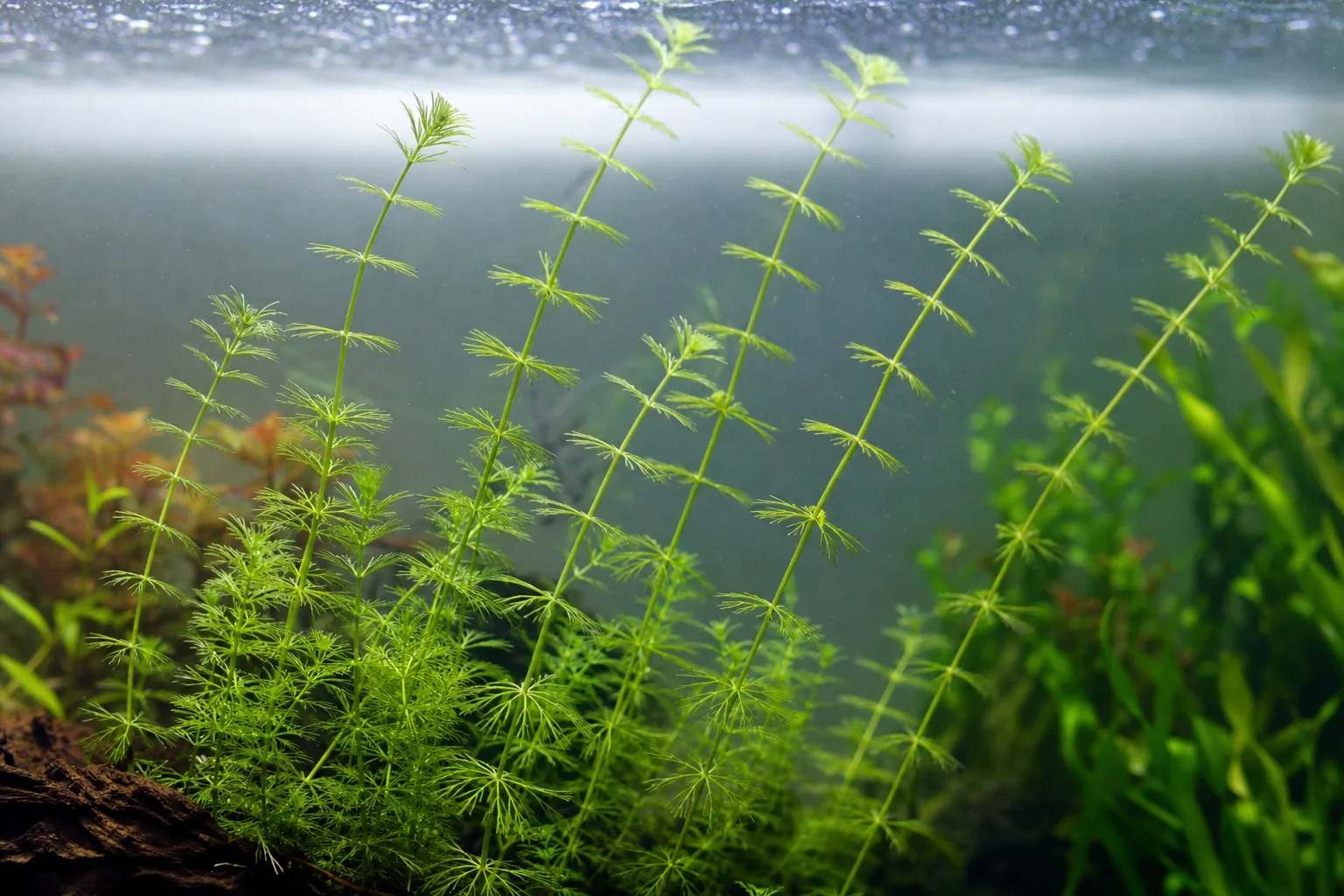
Leggy Growth on Hornwort: Causes, Checks & Fixes
This guide covers leggy growth on Hornwort. See also the general Leggy Growth guide, watering, and light pages for this plant.
Leggy Growth on Hornwort: Causes, Checks & Fixes
Quick answer
Leggy Hornwort is etiolation-stems stretch with wide gaps between needle whorls because tank light is too weak for the depth where those stems sit. Ceratophyllum demersum (coontail) tolerates dim water longer than many aquatics, but it still elongates when photons fall short, producing the stringy “coontail” look instead of dense bottlebrush whorls.
First step: float green tips at the water surface and compare whorl spacing on new growth after two weeks. Old stretched sections never compact; recovery is judged only on the next one or two whorls. For fixture upgrades, photoperiod, and turtle-tank shading, see the not enough light on Hornwort guide-this page focuses on stretch diagnosis, trimming, and how leggy differs from slow growth.
Leggy growth vs slow growth vs not enough light
These three Hornwort problem pages overlap, but each answers a different search question:
| What you see | Most likely issue | Start here |
|---|---|---|
| Wide gaps between whorls, stringy stems, stretch toward surface light | Leggy growth (etiolation) | This page |
| Pale color, heavy needle shed, sparse mats, dim tank overall | Not enough light (broader light deficiency) | Not enough light |
| Little new length for weeks, tight whorls, cold water or ultra-clean tank | Slow growth (temperature, nutrients, season) | Slow growth |
Leggy Hornwort still grows length-often quickly-but each whorl sits farther from the last. Slow-growth Hornwort may look healthy and compact yet barely adds stem length. Not-enough-light covers the full light-stress picture including shedding and color loss; leggy growth zeroes in on whorl spacing as the signature stretch pattern and the permanent elongation that trimming alone cannot reverse.
What leggy growth looks like on Hornwort
Healthy Hornwort carries dense whorls of forked needles every few millimeters along the stem-Rutgers coontail guidance describes plants that are often bushy near the tips with a raccoon-tail silhouette. Leggy etiolation breaks that pattern:
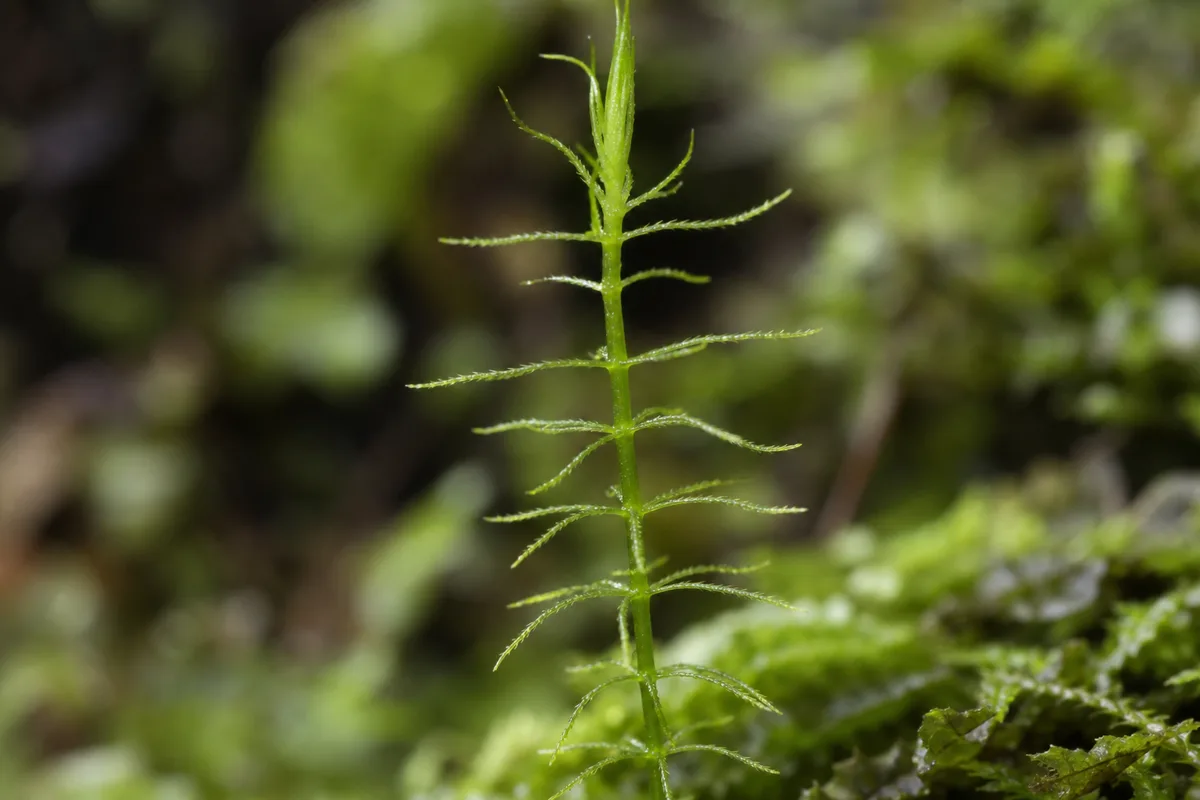
Leggy Growth symptoms on Hornwort - compare with healthy tissue on the same plant.
- Wide spaces between whorls - gaps of several centimeters where needles used to cluster tightly; the bottlebrush turns stringy
- Pale or olive lower stem sections - color washes out on shaded mid-column tissue while floating tips may stay greener
- Thin, see-through floating mats - surface clumps look sparse instead of dense green ceiling
- Lower stems bare while tips stay fuller - classic depth gradient when light penetrates only the top few inches
- Directional stretch - active stems lean or grow fastest toward the brightest zone (usually the surface)
Compare the newest three whorls on an active stem with whorls from when the plant first arrived in brighter conditions. If spacing has doubled or tripled, you are looking at etiolation-not normal Hornwort variability. Insufficient light causes stems to grow long spaces between leaf nodes; on Hornwort those nodes are needle whorls, not broad leaves.
Why Hornwort gets leggy
Hornwort has no true roots and absorbs nutrients from the water column. It cannot “reach down” for light the way a rooted stem plant might adjust placement-every inch of stem must intercept photons directly. When intensity drops with depth, stems elongate between whorls to place needles closer to usable light. That is classic etiolation adapted to submerged life.
Common stretch triggers in aquariums and ponds:
- Anchored or deep placement - stems tucked behind rock, driftwood, or in the lower third of a tall tank receive a fraction of surface intensity
- Weak kit LEDs - viewing lights on turtle setups often fail to deliver enough PAR for compact mid-column growth; see Hornwort aquarium lighting for fixture targets
- Self-shading surface mats - thick floating Hornwort blocks light to stems just inches below, creating stringy lower growth in the same clump that looks bushy on top
- Turbid turtle water - suspended particles cut penetration sharply; light fades exponentially with depth in the water column
- Short photoperiod - even moderate intensity may fail if the timer runs far below eight hours daily during active growth
Hornwort tolerates a wider light range than many native submerged plants, including turbid systems where competitors struggle. That tolerance is the trap: the plant survives stretch for months while you assume the easy-plant label means form is fine. In nature, coontail forms denser growth in shallower water where light is ample and becomes sparser at depth-the same vertical gradient appears inside your tank.
Over-fertilizing a dim tank rarely fixes spacing. Extra nitrogen without adequate light can push soft extension without tightening whorls.
How to confirm the cause
Work through this stretch-focused checklist before dosing fertilizer or replacing the whole plant:
- Whorl spacing trend - Mark the newest whorl on an active stem. If the next two whorls appear farther apart than the previous pair, etiolation is ongoing.
- Surface vs depth comparison - Float a small healthy cutting at the surface for two weeks while leaving part of the clump in its old position. Bushy floating whorls plus stringy deep stems confirm a light-gradient problem.
- Floating-tip vs bare-base pattern - In one tank, green compact tips above naked lower stems almost always mean insufficient mid-column light-not nutrient crisis.
- Photoperiod count - Confirm timer hours. Stretch often follows schedules well under eight hours in low-tech setups.
- Shading map - Note basking platforms, hood edges, duckweed layers, and dense Hornwort mats blocking rays to lower stems.
- Water clarity - Look through the tank wall at mid depth. Murky water can make a decent fixture look weak before you blame the plant.
Lookalike symptoms to rule out
Slow growth - Whorls stay relatively tight but the plant adds little length over weeks; often cold water or ultra-clean low-nutrient tanks. No dramatic widening between whorls on new growth.
Post-purchase melt - Heavy needle drop in the first 7 to 10 days after shipping; spacing may look odd temporarily. Should stabilize once acclimated if surface stems stay green and new whorls form at normal density.
Nutrient deficiency in ultra-clean tanks - Yellowing on new whorls with already moderate light and very light stocking; stretch is not the primary pattern. Stocked turtle tanks rarely fit this profile.
Buried-stem rot - Mushy brown sections where stems were pushed into gravel; Hornwort lacks functional roots and rotting buried portions can leave bare stringy lengths that mimic etiolation. Firm green tissue above rot points to placement error, not pure low light.
Not enough light (broader) - Pale color, constant shed, and sparse mats without obvious stretch may be general light stress. If whorl spacing is the main complaint, you are on the right page; if pale shedding dominates, cross-check not enough light.
First fix for Hornwort
Float the healthiest green tips at the water surface.
Detach or trim compact sections from the best-looking stems and let them float freely under your aquarium or pond light. Surface placement puts Hornwort in the highest-intensity band of the tank-matching how coontail naturally forms denser growth where light is strongest.
Do not fertilize, anchor deep into gravel, split every stem, or upgrade the fixture and change photoperiod all in the same week. Change one variable and read the next one or two whorls for tighter spacing before stacking fixes.
If floating alone does not tighten new whorls within two to three weeks, upgrade to a full-spectrum aquarium LED and run 8 to 10 hours daily on a timer with supplemental lighting where natural tank light is insufficient. Detailed fixture guidance lives on the Hornwort light page.
Step-by-step recovery
After floating healthy tips:
- Skim shed needles - Remove decaying fragments before they clog turtle filters or foul water. Decay competes with recovery.
- Thin dense surface mats - Open gaps so light reaches stems an inch or two below. A solid green ceiling can starve the plant it came from.
- Hold fertilizer for two weeks - Stocked aquariums usually carry enough nitrogen once light improves. Dosing into a dim tank pushes soft growth without fixing whorl spacing.
- Watch two new whorls - Judge success on tighter needle clusters and brighter color on new sections only.
- Trim bare lower stems after proof - Once new whorls compact, cut back elongated stringy sections and keep green tips floating. Old spacing does not revert.
- Clarify turbid water if needed - Partial water changes and detritus removal help light reach mid-column stems in turtle setups.
Skip burying stems deep behind décor until mid-tank light is proven adequate. Planted Hornwort in the lower third of a tall tank needs stronger fixtures or shallower placement to stay bushy.
Recovery timeline
Expect visible change on the next one or two whorls within two to three weeks after a meaningful light increase during active growth. Needle clusters should tighten; shedding related to stretch should slow.
Dense, tank-filling growth can return in four to eight weeks in warm, stocked aquariums with corrected lighting-Hornwort can grow quickly when light and nutrients align. Cool water or short winter days may slow the response even after you fix placement.
Old elongated stems do not shorten. Wide whorl spacing on mature sections stays unless you trim them. Recovery is forward-looking: the next needles tell you whether lighting is correct. A “half-fixed” clump-compact new whorls on floated tips above permanent stringy lower sections-is normal until you trim the bare zones.
Worsening signs: bleach-white or brown scorched tips after slamming a dim tank under intense unfiltered light (reduce intensity gradually); continued melt with foul water after light improves (decay overload or chemical exposure); green floating tips but persistent lower melt in a tall tank (still insufficient mid-column light).
What not to do
Do not bury Hornwort deep hoping lower stems find light-it has no functional root system and buried portions rot.
Do not over-fertilize a dim tank to force compact whorls. Excess nutrients with marginal light can fuel algae without fixing spacing.
Do not trim stringy stems before fixing light unless removing mushy rot. Pruning alone redirects energy but new whorls will stretch again toward the same dim zone.
Do not assume stretch equals healthy fast growth. Rapid length with wide whorl gaps is weakness, not vigor.
Do not stack light changes with copper treatments, major rescapes, and large water chemistry swings the same week-you will not know which stressor caused the next shed.
How to prevent leggy growth next time
Place Hornwort where photons hit needles, not where the mat looks decorative on the substrate. Floating is the reliable default in turtle tanks and low-tech aquariums; shallow anchoring works only when the fixture penetrates to that depth through clear water.
Run 8 to 10 hours of full-spectrum aquarium lighting on a timer year-round. Thin dense surface mats seasonally so self-shading does not creep in. Keep water clear enough that mid-tank stems receive usable light, especially in turtle setups where detritus builds quickly.
Match plant mass to tank size-trim before Hornwort forms a solid ceiling that blocks light to everything below, including its own lower stems. Review the Hornwort overview for floating vs anchored culture basics.
When to worry
Leggy stretch alone rarely kills established Hornwort quickly-it degrades form, sheds into filters, and stalls the dense look you wanted. Treat as urgent when mushy stems, foul-smelling water, or copper or pesticide exposure accompany melt; those combinations need water-quality and chemical review, not just a brighter bulb.
If two new whorls still arrive elongated after floating healthy tips under your strongest fixture, assume the setup is still too dim and upgrade tank lighting rather than replacing Hornwort with another species.
Related Hornwort problems
- Not enough light on Hornwort - pale color, shedding, turtle-tank shading, and fixture upgrades when light deficiency is broader than stretch alone
- Slow growth on Hornwort - when whorls stay tight but the plant barely adds length
- Hornwort aquarium lighting - PAR targets, photoperiod, and LED selection
- Hornwort care overview - floating culture, rootless biology, and tank placement
When to use this page vs other Hornwort guides
- Hornwort watering guide - Use for routine moisture checks before assuming leggy growth is the main issue.
- Hornwort problems hub - Browse all 16 common issues on this species.
- Not Enough Light on Hornwort - Different entry point when symptoms overlap with leggy growth.
- Slow Growth on Hornwort - Different entry point when symptoms overlap with leggy growth.
- Yellow Leaves on Hornwort - Different entry point when symptoms overlap with leggy growth.