Hornwort Substrate Guide: Floating, Anchoring, and Gravel
Hornwort Substrate Guide: Floating, Anchoring, and Gravel Setup
Hornwort Substrate Guide: Floating, Anchoring, and Gravel Setup
If you searched for hornwort substrate or hornwort soil, you are probably holding a bundle of feathery green stems and wondering what to put underneath them. The honest answer is simpler than most planting guides suggest: hornwort does not need soil at all. It does not have true roots. It pulls nearly all of its nutrients from the water around it, and any gravel or sand you add exists only to hold the plant in place - not to feed it. That single biological fact reshapes every decision you make about floating versus anchoring, which weights to use, and what materials belong nowhere near your tank.
Ceratophyllum demersum, the species sold as common hornwort or coontail, is one of the few submerged aquatic plants that evolved without a functional root system. In nature it drifts freely, wedges loosely into soft sediment with modified anchoring structures, or forms dense midwater masses just below the surface. In your aquarium or pond, you can replicate any of those positions. What you cannot do - at least not without predictable failure - is treat hornwort like a terrestrial houseplant and bury it in potting mix, garden soil, or deep substrate the way you would a rooted stem plant.
Hornwort has no true roots - and that changes everything about substrate
Most aquarium planting advice assumes roots. Vallisneria sends runners through gravel. Amazon swords anchor deep and pull phosphorus from the sediment. Even forgiving stem plants like anacharis develop adventitious roots that grip substrate and supplement water-column feeding. Hornwort skips that entire playbook. According to UC Davis weed-control guidance for Ceratophyllum demersum, the species is a submerged aquatic angiosperm in which roots are lacking, though leafy branches are sometimes modified as rhizoids. Rutgers NJAES describes coontail - the same plant under a regional common name - as deriving nutrition from the water rather than from anchored root systems, a trait that makes it visually distinctive and ecologically versatile.
For the hobbyist, that biology translates into a practical rule: substrate type barely matters for hornwort growth. Inert gravel, fine sand, bare glass, or no bottom contact at all can all support healthy plants as long as water quality, light, and flow are reasonable. What matters is positioning - whether you want a floating canopy, a weighted midground bush, or a loose anchored mass - and making sure you never smother the stems in a way that triggers decay.
What rhizoids are (and what they are not)
The word rhizoid shows up often in hornwort discussions, and it causes confusion because it sounds like “root.” It is not. Rhizoids on hornwort are modified basal leaves or hair-like branch structures that help the plant grip soft sediment, debris, or other surfaces. They anchor loosely. They do not function as a nutrient-absorbing root system the way true roots do in rooted aquatic plants.
In a tank, you may notice hornwort developing denser, darker growth near the base after it has rested against substrate or hardscape for several weeks. Those structures help it stay put in gentle flow. They are not a signal that the plant has “taken root” and now needs root tabs, aquasoil, or buried fertilizer. Treating rhizoids as roots is one of the most common mistakes in hornwort care, and it leads directly to over-burial, stem rot, and the frustrating cycle of replanting floating fragments every few days.
How hornwort actually absorbs nutrients
Hornwort is a water column feeder. Nitrogen, phosphorus, potassium, and trace elements enter the plant primarily through its stems and fine, forked leaves - the same surfaces that photosynthesize and oxygenate the water around them. In nutrient-rich ponds and lakes, this rootless architecture lets hornwort colonize areas where rooted competitors struggle: hard bottoms, unstable sediment, moving water, and open water with no attachment at all.
Inside an aquarium, that means liquid fertilizers and dissolved tank nutrients do the heavy lifting. A rich planted-substrate zone beneath hornwort is optional at best and irrelevant at worst. Hornwort is often kept specifically for nutrient export - it grows fast, pulls nitrogen and phosphorus from the water, and gives you a physical mass to trim and remove when you want to pull excess nutrients out of the system. None of that depends on what sits at the bottom of the tank. It depends on what dissolves in the water the stems pass through.
Floating hornwort: the default, lowest-maintenance setup
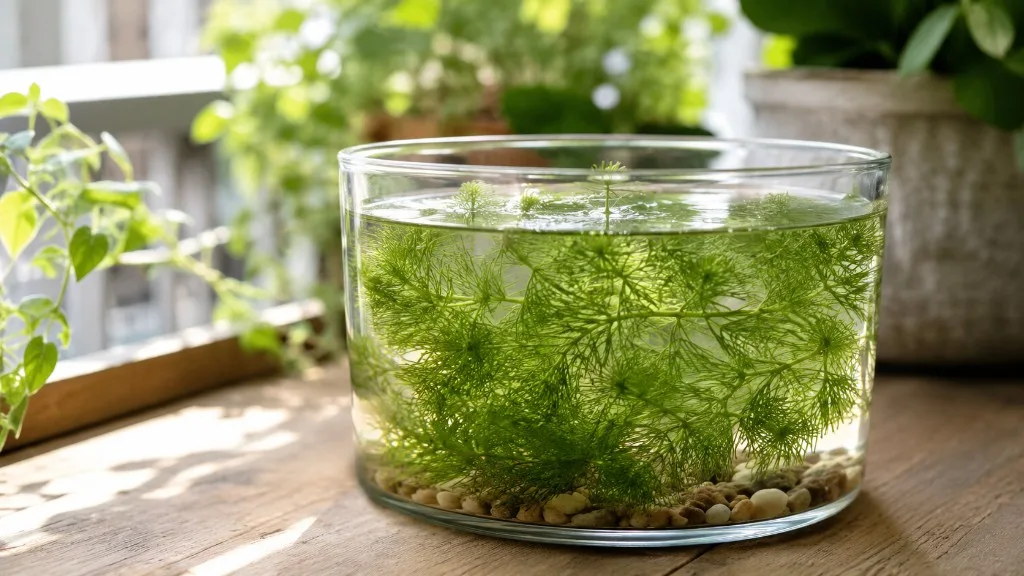
If you want the method with the fewest failure points, let hornwort float. Drop a cleaned bundle onto the surface or release it just below the waterline and let it find its own level. Within days the stems spread into a soft green mass that drifts with gentle current, shades the tank below, and gives fry, shrimp, and shy fish immediate cover. Floating is not a compromise. It is how the plant behaves in a large fraction of its wild habitat, and it sidesteps every substrate-related mistake in one move.
Advantages of a floating mass
Floating hornwort gets excellent light access from above, easy contact with atmospheric CO₂ at the surface film, and uninterrupted flow around the entire stem surface. Growth is often faster than in anchored setups because nothing at the tank bottom is shading the lower portions or trapping debris against the base. For breeders, a floating mat is practical shelter that stays where fish can use it without uprooting work. For algae management, a healthy floating mass competes for the same dissolved nutrients that would otherwise feed green water or film algae.
There is also almost no equipment cost. You do not need plant weights, aquascaping tweezers, a particular gravel grade, or replanting after every trim. When you thin the mass, toss the clippings back in to float or remove them for nutrient export. Propagation is literally fragmentation - every trimmed piece can become a new plant. That simplicity is why experienced keepers often recommend floating hornwort to beginners before any anchored arrangement.
Managing light and density when floating
The main trade-off with floating hornwort is shading. A dense canopy blocks light from reaching carpet plants, slow-growing stems, and anything on the substrate below. In high-light tanks with demanding foreground species, you will need to thin the floating mass regularly - weekly or biweekly in fast-growth conditions - rather than letting it form a solid blanket. In low-tech community tanks where shade is a feature rather than a problem, less intervention is required.
Flow also matters. In strong filter outflow, loose floating hornwort can get pushed into overflow slots, skimmers, or the intake screen. A simple fix is to corral the mass with a floating ring, airline tubing loop, or gentle repositioning away from the direct blast. Avoid crushing the stems when corralling; hornwort breaks easily by design, and crushed sections become fragments that may clog equipment if they drift unattended.
Anchored hornwort: weights, gravel, and hardscape tie-downs
Anchoring is an aesthetic choice, not a biological requirement. You anchor hornwort when you want a bush-like midground or background silhouette at a fixed depth, when floating mats keep drifting into equipment, or when your aquascape calls for vertical green volume in a specific zone. The anchor is always mechanical - a weight, a tie, a wedge between stones - never a buried stem pretending to be a rooted plant.
Plant weights and lead-free anchoring options
Plant weights are the most common anchoring tool. Modern aquarium weights are typically lead-free - flexible metal strips, coated wire, or small ceramic rings designed to pinch a bundle of stems without crushing them. To use one, gather three to six hornwort stems into a loose bunch, wrap the weight around the lowest inch of the bundle snugly but not tight enough to score the stems, and lower the weighted end to the substrate. The weight sits on or slightly in the gravel. The stem bases rest above the substrate surface in open water.
This is the critical detail most planting tutorials get wrong: bury the weight if you need to, not the stems. The stems themselves should remain exposed to light and flow. When only the weight is partially nestled into gravel or sand for stability, you get the visual effect of a planted bush without the anaerobic rot that comes from burying soft hornwort tissue underground. Lead-free strip weights are inexpensive, reusable, and easy to reposition when the plant grows unevenly.
Suction cup stem holders offer another option, especially in breeding tanks and bare-bottom setups. Anchor the cup to the glass at the desired height, tuck a hornwort bundle into the clip, and let the stems trail into the water column. This method keeps the substrate out of the equation entirely while still giving you a fixed planting location.
Tying stems to driftwood, stone, and cholla wood
For a more natural look, tie hornwort bundles to driftwood, smooth stone, or cholla wood with fishing line, cotton thread, or plant-safe zip ties. Cotton thread dissolves over time once the plant wedges itself into position; fishing line lasts longer and suits permanent hardscape layouts. Wrap the tie around the base of the bundle and the hardscape together, position the knot on the underside where it is less visible, and place the assembly on the substrate or lean it against the tank wall.
Hardscape anchoring works well in aquascapes that already feature wood and stone as focal points. The hornwort softens hard edges and fills vertical gaps without requiring any particular substrate grain. After one to two weeks, rhizoid-like basal growth often helps the bundle grip the surface, and you can remove the tie if the plant stays put on its own. If flow dislodges it, re-tie with a slightly tighter bundle or move the assembly to a lower-flow zone.
Why burying hornwort stems in substrate causes rot
Search any forum for “hornwort keeps floating” or “hornwort melting at the base” and you will find the same root cause repeated: the stems were buried. Hornwort tissue buried in gravel, sand, or aquatic soil is cut off from adequate light and flow. The buried section goes anaerobic, decays, and releases ammonia and organics into the water column - coontail reproduces from fragments but does not tolerate buried stem tissue. The rot can spread upward, leaving you with bare, stringy lower stems and bushy tips that eventually break free and float anyway.
This is not a substrate-quality problem. It happens in pristine aquasoil and inert gravel alike because the plant is not built for subterranean stem life. Occasional advice suggests burying “just the bottom inch” of hornwort. Even that is risky in warm, nutrient-heavy, or low-flow tanks where decay outpaces new growth. The safer version of the planted look always keeps living stem tissue above the substrate line and uses a weight or tie for mechanical hold.
If you have already buried hornwort and notice slimy bases, persistent ammonia spikes after trimming, or stems that disintegrate when you tug gently, pull the affected bundles out, trim away every softened section back to firm green tissue, and re-anchor with a weight-on-top method. A partial water change after removing rotting plant mass is good practice because decaying hornwort releases nutrients rapidly - the same fast decomposition that makes it useful for nutrient cycling in ponds can foul a small aquarium when rot happens at the substrate line.
Fine gravel versus sand for loose anchoring
When you do use substrate as part of an anchored hornwort setup, choose inert materials: plain aquarium gravel, natural pebbles, pool-filter sand rinsed thoroughly, or commercial inert sand without coatings. Grain size matters less for hornwort nutrition - remember, the plant is not root-feeding - but it matters for weight stability and debris management.
Fine gravel in the 2–5 mm range is the most practical default. It holds plant weights without compacting as tightly as sand, allows detritus to settle rather than smother stems, and stays stable under the gentle pressure of a ceramic or metal weight. Sand works when you want a cleaner minimalist look, but it can compact around a partially buried weight and create pockets where decaying plant debris accumulates if you are not vacuuming gently during maintenance. If you use sand, keep weights resting on top rather than buried deep, and avoid stirring the sand directly into hornwort bundles during rescapes.
Aquasoil and active planted substrates like ADA Amazonia or Fluval Stratum are not harmful to hornwort, but they are unnecessary expense for Hornwort overview. Hornwort will not leverage the nutrient-rich substrate the way a root feeder would. If you already run a high-tech planted tank with aquasoil for other species, hornwort will grow fine anchored above that substrate - just do not expect the soil to be the primary growth driver. Coarse gravel above 7–8 mm is awkward for small plant weights, which tend to tip or slide, but hornwort tied to hardscape on coarse gravel still works because the tie does the holding, not the grain.
For outdoor ponds, hornwort often wedges into silty or muddy bottoms on its own using rhizoids. You do not need to replicate pond mud in an aquarium. Inert gravel or sand is cleaner, easier to maintain, and avoids introducing uncontrolled organics into a closed system.
Potting soil, garden dirt, and terrestrial substrates to avoid
This section is blunt because the mistake is common: do not put potting soil, garden dirt, topsoil, compost, or any terrestrial potting mix in an aquarium for hornwort. These products are formulated for land plants with root systems that hornwort does not have. They contain peat, bark, perlite, fertilizers, and wetting agents that cloud water, spike ammonia, and support anaerobic bacterial zones incompatible with submerged stem tissue.
Hornwort is sometimes sold alongside pond plants or bundled for outdoor water gardens. Even there, the plant is not “planted” in potting mix the way a hosta would be. It floats or self-anchors in natural sediment. If a seller ships hornwort in a pot with garden soil, rinse the stems thoroughly, discard the soil entirely, and quarantine the plant before adding it to a display tank - especially a turtle habitat where substrate contamination and pesticide residues are higher-stakes concerns.
The same logic applies to DIY dirted tanks and Walstad-style soil-under-cap setups. Those methods can work beautifully for rooted carpets and heavy root feeders. Hornwort is not the plant you design that system around. It will grow in the water above the cap regardless. Putting hornwort’s stems into direct contact with organic soil guarantees rot.
Pond and outdoor hornwort substrate considerations
In outdoor ponds, hornwort behaves as both a submerged plant and a drifting mass depending on depth, wind, and current. Shallow margins may see basal stems contact natural sediment - silt, clay, or gravel - where rhizoids develop enough grip to hold the plant during calm periods. Deeper zones often host free-floating populations that move with wind and wave action until they strand in coves or against planting shelves.
For managed ponds, you rarely need to “plant” hornwort at all. Toss cleaned bundles into the water and let them distribute. If you want hornwort in a planting basket for convenience, use inert gravel or pea stone in the basket for weight, place the hornwort on top, and submerge the basket so stems trail upward into the water column. Do not fill the basket with loam or potting soil. In koi and goldfish ponds where fish dig, weighted bundles or basket anchoring prevent the entire mass from being scattered overnight.
Seasonal die-back is normal in cold climates. Hornwort drops fragments and senesces rapidly at season’s end, releasing nutrients back into the water - a documented ecological pattern in temperate lakes. In garden ponds, skim decaying masses in autumn to reduce excessive nutrient reload before winter, and reintroduce fresh hornwort in spring if the population did not overwinter.
Turtle-safe hornwort anchoring and clean sourcing
Hornwort is a popular addition to turtle tanks because it tolerates grazing, provides cover, and helps manage nutrients in high-waste systems. Substrate choice in turtle habitats adds another layer: anything that clouds water, compacts into anaerobic pockets, or cannot be vacuumed easily is a poor fit. Inert gravel or a bare-bottom tank with weighted hornwort bundles is usually easier to maintain than sand that turtles stir constantly.
Sourcing matters more than substrate here. Use hornwort from aquarium suppliers or pond sources you trust, rinse stems under dechlorinated water, and inspect for snails or pesticides if the plant was grown outdoors. When adding hornwort to turtle habitats, confirm species identification and clean sourcing - coontail is a common native pond plant, but pesticide-treated store stock remains unsafe regardless of anchoring method.
For anchoring in turtle tanks, favor lead-free weights or hardscape ties over loose sand burial. Turtles dislodge light stems quickly, and buried sections rot faster in warm, nutrient-rich turtle water. A weighted bundle near a basking area or a suction-cup-anchored mass on the glass gives turtles cover without turning the substrate into a rot zone. Remove and replace stems that show slime, blackening, or persistent grazing damage before decay affects water quality.
Preparing hornwort bundles before you anchor
Fresh hornwort from a shop often arrives rubber-banded or zip-tied in a tight bundle. Remove every rubber band, metal twist tie, or shipping wrap before anchoring. Those constrictions trap moisture against the stems, encourage rot at the bind point, and make it harder to spread the plant into a natural shape. Rinse the bundle under tank water or dechlorinated tap water to remove debris, snail hitchhikers, and any residual treatment chemicals from shipping water.
Trim the lowest section if it looks pale, crushed, or already slimy from transit. You want firm green tissue at the base of every anchored bundle. Group stems in bunches of four to eight for weights - smaller bunches anchor less securely; much larger bunches look uneven and trap detritus in the center. If you are tying to hardscape, a single dense bundle reads more naturally than scattered individual stems that drift apart before rhizoids develop.
Give new hornwort 48 to 72 hours to acclimate before judging anchoring success. The plant sheds fine needles when stressed, which is normal. If entire stems turn brown and mushy at the base within the first week, suspect burial depth or a too-tight weight and adjust before decay spreads.
Troubleshooting floating, rotting, and bare-stem hornwort
Floating after anchoring usually means the hold failed, not that the plant rejected your substrate. Re-wrap the weight more snugly, switch to a heavier ceramic ring, tie to hardscape, or accept floating placement instead of fighting flow weekly. In high-current tanks, anchoring near the downstream end of a wood piece or behind a rock out of the direct blast outperforms heavier weights in the open.
Rotting bases mean buried stems, constricting ties, or decaying debris trapped in the bundle center. Pull the plant, trim to healthy tissue, rinse, and re-anchor with only the weight touching substrate. Check ammonia and nitrite if rot was advanced; a partial water change helps.
Bare stems with bushy tops are the classic signature of failed subterranean planting. The lower stem rotted underground while upper growth continued until the connection failed. Trim the bare sections off and propagate the healthy tops as floating or newly weighted bundles.
Melting or needle drop without obvious rot often points to sudden parameter shifts, medication exposure, or insufficient light - not substrate. Stabilize conditions before repeatedly replanting, or you will chase a positioning problem that is actually a water-quality or lighting problem.
Substrate versus liquid fertilizer: where hornwort gets its food
Because hornwort feeds from the water column, liquid fertilizers are the relevant delivery system when your tank needs a boost. A balanced aquarium plant fertilizer dosed according to your tank’s plant mass and lighting supports hornwort growth more directly than root tabs pressed into gravel beneath it. In lightly stocked, low-tech tanks, hornwort may grow adequately from fish waste alone - one reason it is popular in beginner setups.
Root tabs beneath hornwort are wasted product in most cases. The nutrients leach into the water where hornwort can access them, but you are paying for root-zone delivery the plant does not use efficiently. If you run root tabs for other species in a community planted tank, hornwort will still benefit indirectly from elevated water-column nutrients - just do not buy tabs specifically for hornwort.
CO₂ injection is optional. Hornwort grows well in non-injected tanks and often thrives in the slightly elevated CO₂ at the water surface when floated. In high-tech tanks, anchored hornwort grows vigorously without any substrate fertility program beyond what you dose into the water. Trim regularly regardless of method; fast growth is hornwort’s normal state, not a sign that your gravel needs upgrading.
Choosing floating or anchored hornwort for your tank
Use floating hornwort when you want maximum ease, fastest growth, fry cover at the surface, nutrient export with simple trimming, or a low-tech tank where bottom planting is not part of the design. Floating wins in breeding tanks, hospital tanks, quarantine setups, and any system where you want zero substrate entanglement during maintenance.
Choose anchored hornwort when your aquascape needs a fixed green bush at midground or background depth, when floating mats repeatedly clog equipment, or when you are designing around hardscape and want soft texture tied to wood or stone. Anchoring also suits tanks where surface cover would shade carpeting plants you are trying to establish.
You can run both in the same tank - a weighted background cluster and a floating mass up top - as long as you manage total biomass so light and flow stay balanced. Neither approach requires potting soil, garden dirt, or deep stem burial. Both work over inert gravel, sand, bare glass, or mixed planted substrates designed for other species. Pick the position that serves your layout, anchor mechanically if you anchor at all, and let the water column do the feeding work hornwort evolved to expect.
Conclusion
Hornwort substrate is really a question about positioning, not soil science. The plant has no true roots, absorbs nutrients from the water, and uses rhizoids only for loose anchoring when it rests near the bottom. Floating is the simplest and most reliable setup. Anchoring with lead-free weights, hardscape ties, or suction cups gives you design control without pretending hornwort is a rooted plant. Inert gravel or sand can support those anchors, but burying stems in any substrate - or worse, introducing potting mix - invites rot, ammonia spikes, and the bare-string failures that frustrate new keepers.
Treat every hornwort stem as a photosynthetic straw floating in moving water. Give it light, stable parameters, occasional liquid fertility if your tank is lean, and mechanical hold only when your layout demands it. Get that framework right and hornwort becomes one of the easiest plants in the hobby, regardless of what lies beneath it on the tank floor.
When to use this page vs other Hornwort guides
- Hornwort overview - Start here for whole-plant context before deep-diving this topic.
- Hornwort problems hub - Jump to symptom-specific fix guides when this care topic does not resolve the issue.
- Root Rot on Hornwort - Escalate here when soil adjustments are not enough.
- Mold on Soil on Hornwort - Escalate here when soil adjustments are not enough.
Related Hornwort guides
- Hornwort overview
- Hornwort watering
- Hornwort light
- Hornwort propagation
- Hornwort fertilizer
- Hornwort repotting
- Root Rot on Hornwort
- Mold on Soil on Hornwort
- Hornwort problems
Related tool
Try the Soil Mix Calculator with hornwort pre-selected to estimate needs for your setup.