Hornwort (Ceratophyllum demersum) Water Parameters
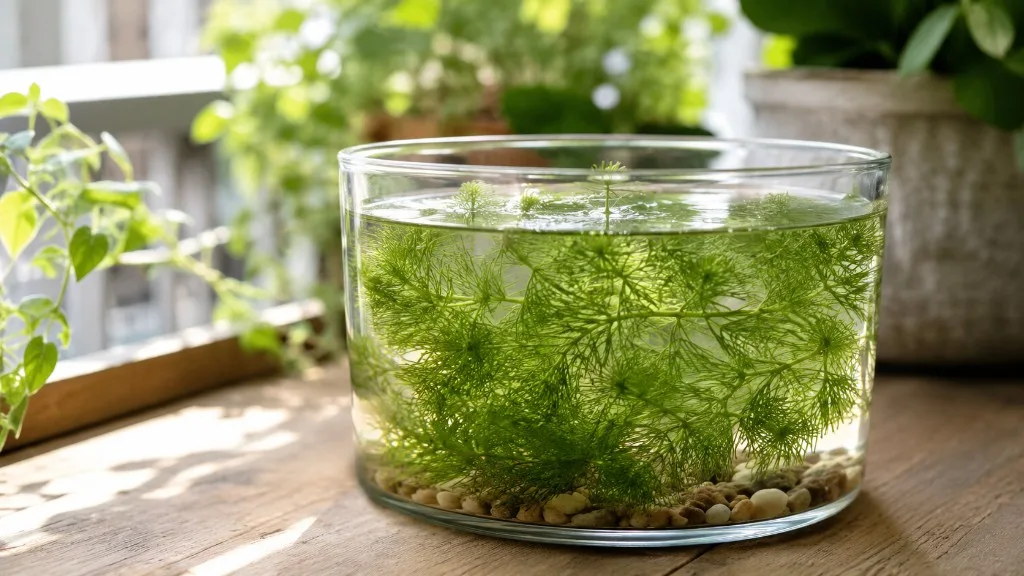
Hornwort (Ceratophyllum demersum) Water Parameters: Temperature, pH, Hardness
Hornwort (Ceratophyllum demersum) Water Parameters: Temperature, pH, Hardness
Hornwort does not get “watered” the way a pothos on a windowsill does. It lives entirely submerged - or floating on the surface - absorbing every mineral and nitrogen compound it needs directly from the aquarium water through stems and needle-like leaves. Ceratophyllum demersum, sold everywhere as hornwort or coontail, has no true roots. That biology is why water parameters - temperature, pH, general hardness, carbonate hardness, and the dissolved wastes riding alongside them - matter more for Hornwort overview than almost any other variable you can adjust. Keep the chemistry stable and hornwort grows several centimeters per week, pulls nitrates down between water changes, and shades fry without demanding CO₂ or fancy substrate. Let a parameter swing after a careless refill and the same plant dumps needles across your substrate like a submerged Christmas tree shedding in July. This guide gives you the numbers that work, the water-change routine that keeps quality high, the testing schedule that catches drift early, and the acclimation steps that turn a messy first week into a durable background or floating mass.
Why Aquarium Water Chemistry Matters More Than “Watering” Hornwort
Hornwort belongs to Ceratophyllaceae, a family of rootless freshwater plants that evolved to pull nutrition from the water column rather than from anchored root systems. Calcium, magnesium, potassium, nitrogen, and trace elements enter through leaf surfaces and diffuse into rapidly dividing stem tissue. When tank water chemistry shifts, hornwort cannot retreat into moist soil and wait things out. It responds immediately - and the response often looks like needle shedding: fine leaves detach, sink, clog filter intakes, and decay if you leave them on the gravel.
The good news is that hornwort tolerates one of the widest envelopes in the hobby. Extension and agency profiles describe a wide tolerance band - commonly 59–86°F (15–30°C) for aquarium use, with cold-season survival in temperate ponds - and pH from roughly 6 to 8 in typical freshwater systems. Those ranges reflect a cosmopolitan species found on every continent except Antarctica - a plant shaped by lakes, ponds, and slow rivers that swing seasonally.
The bad news is the same lesson every experienced keeper learns: tolerance is not comfort, and comfort is not stability. A hornwort bunch that survives 84°F will shed more needles and grow thinner than one at 72°F. A stem acclimated to pH 7.8 will drop leaves if you move it into pH 6.4 overnight, even though both numbers sit inside published ranges. Understanding survival range, ideal range, and the stability requirement on top of both is the core of hornwort aquarium water care - not how often you pour water over a pot, which does not apply here at all.
The Ideal Temperature Range for Hornwort
Temperature controls metabolic rate, dissolved oxygen availability, and how aggressively hornwort consumes nitrogen from the water. For aquarium use, the consensus across nurseries and databases converges on 68–79°F (20–26°C) as the ideal growth range, with 59–86°F (15–30°C) as the practical outer tolerance band before shedding and stall accelerate. Penn State Extension notes that coontail often stays green through winter in deep ponds - cooler than many tropical community tanks run, but warmer than unheated goldfish setups in a cool room.
Within the ideal window, moderate temperatures produce dense, bottle-brush stems with tight needle clusters. Warmer water pushes faster vertical growth but increases needle loss on lower stems, especially when light cannot reach shaded sections. If your heater holds 78°F for tetras and angelfish, hornwort usually survives - but it will not look as compact as the same species floating in a 70°F shrimp tank. That is physiology, not failure on your part.
Cold-Water Tolerance in Unheated, Shrimp, and Pond Setups
Hornwort is one of the few popular aquarium plants that genuinely performs in cold and unheated setups. Cherry shrimp tanks in the low 60s°F, goldfish aquariums at 65–72°F, and outdoor ponds that dip toward 50°F in spring are all environments where hornwort routinely outcompetes delicate stem plants. Maryland DNR notes winter hardiness in temperate climates: pond populations form compact resting shoots that sink and resume growth when temperatures rise. In aquariums, unheated indoor tanks during winter often produce the lushest hornwort because parameters stay stable without aggressive heater cycling.
For shrimp keepers, the temperature match is nearly ideal. Neocaridina species thrive at 65–74°F; hornwort at those temperatures grows fast enough to recover from grazing, provides dense cover for berried females, and rarely sheds excessively unless another parameter is off. If you are choosing a floating or background plant specifically for an unheated tank, hornwort is a stronger water-parameter fit than Hygrophila, Rotala, or most red stem plants sold alongside it.
Tropical Tanks and Upper Heat Limits
Heated community tanks in the 78–84°F range are workable but not optimal. Above 80°F (27°C), growth efficiency drops and needle shedding becomes more frequent, especially after shipping, large water changes, or moving stems between tanks. Prolonged heat also lowers dissolved oxygen - a problem in heavily stocked tanks where hornwort is often added specifically to improve water quality. If your display must run tropical for the fish, compensate with stable pH, consistent weekly water changes, and moderate lighting rather than chasing a lower temperature the livestock cannot tolerate.
Avoid placing the tank near a sunny window where summer afternoon heat pushes water 5°F above the heater setting within hours. A stick-on thermometer checked during heat waves costs less than replacing melted bunches every month. If room temperature routinely exceeds 82°F, increase surface agitation slightly so the column feeder and the fish share adequate oxygen - hornwort produces oxygen during photosynthesis, but it consumes it at night like any plant.
pH: Where Hornwort Grows Best
pH 6.0–7.5 is the comfort band for most community aquariums. Hornwort leans slightly acidic to neutral relative to some hard-water African cichlid setups, and it grows most vigorously when pH sits in the high 6s to mid 7s with daily fluctuation of no more than 0.2 to 0.3 units. The tolerated range extends across mildly acid to basic freshwater in typical aquarium practice - wider than most home aquarists need to plan around.
In practical terms, pH matters for hornwort because it influences the balance of carbon species available for photosynthesis and the solubility of micronutrients like iron. In soft, acidic water below pH 6.5, iron and manganese stay soluble but phosphate dynamics differ from hard-water tanks. In alkaline water above pH 7.8, iron precipitates and chelated fertilizers show up as rusty spotting on other plants - hornwort itself usually copes, but the tank may look worse overall. Neither extreme kills hornwort quickly, but both produce visual symptoms people misattribute to “bad light” or “not enough fertilizer.”
Stable pH vs. Chasing a Perfect Number
The most important pH lesson for hornwort is that stability beats precision. A tank locked at pH 7.4 with KH 6 will grow healthier stems than a tank that swings from pH 6.9 in the morning to pH 7.6 after CO₂ shuts off at night - even if the average looks ideal on paper. If you run CO₂ injection, size the bubble rate so pH drop stays within 0.3 to 0.5 units and does not crash overnight when gas diffusion catches up. If you run low-tech, resist dosing pH buffers every time a test strip reads slightly off. Repeated chemical pH manipulation creates the swings that trigger needle shedding far more reliably than a steady number one point away from the textbook ideal.
General Hardness (GH): From Soft to Very Hard Water
General hardness (GH) measures dissolved calcium and magnesium - minerals that build cell walls and enzyme systems in aquatic plants. For hornwort, hobby sources commonly cite 5–15 dGH (roughly 90–270 ppm) as the comfortable growth band, with tolerated extremes from very soft to very hard water. ModestFish lists 5–18 dGH; aqua-fish.net recommends 4–18 dGH. Flowgrow simply notes adaptation from soft to very hard - accurate for a species that colonizes everything from rainwater ponds to limestone spring creeks.
Unlike some stem plants that become brittle in very soft water, hornwort is genuinely not picky about GH. ModestFish puts it plainly: hornwort “couldn’t care less” about hard water compared to delicate species. That said, extremely soft RO water with GH near zero can still produce pale, slow-growing stems if micronutrients are stripped and never replaced. Calcium and magnesium remain structural inputs absorbed through leaves even for a tolerant species. If your GH test reads 1 to 2 dGH and hornwort looks thin despite good light and nitrate, remineralize before you blame the plant.
In moderate to hard municipal tap water from 6 to 18 dGH, hornwort is in its element. Most city water in the United States and Europe falls here without modification. You do not need to soften water for hornwort. Hard-water keepers often have the easier job: test once, confirm GH is above 4 dGH, and focus attention on water-change consistency instead.
Carbonate Hardness (KH): The Buffer That Protects Your pH
Carbonate hardness (KH) measures bicarbonate and carbonate ions - the buffer system that prevents pH from crashing or spiking. As a cosmopolitan freshwater species, hornwort tolerates a wide KH band; most community-tank guides implicitly assume KH in the 3–10 dKH range that matches typical tap water. In tanks with KH below 3, pH tends to drift downward over time as organic acids accumulate, especially in heavily stocked or peat-influenced setups. In tanks with KH above 15, pH stays locked high and iron dosing for other plants becomes trickier, though hornwort itself usually copes.
For most keepers, a KH of 4 to 8 dKH provides enough buffering to hold pH stable through a weekly 25 to 30 percent water change without chemical intervention. If you use RO water, remineralize to hit both GH and KH targets simultaneously - products like Seachem Equilibrium or Salty Shrimp GH/KH+ are designed for exactly this. Testing KH monthly, or after any remineralization change, takes thirty seconds and prevents the slow pH drift that causes needle shedding two weeks after you thought the tank was settled.
Water Changes, Nitrogen Compounds, and Hornwort’s Role as a Filter Plant
Here is the misconception that wastes more hornwort than any temperature error: “Hornwort eats nitrates, so I can skip water changes.” Hornwort is an exceptional nutrient sponge - as a water-column feeder with no true roots, it absorbs dissolved nutrients directly from the water to fuel fast growth. In a cycling or heavily stocked tank, that uptake genuinely improves water quality between changes. It does not eliminate the need for partial water changes.
Decaying fish waste, uneaten food, shed hornwort needles, and dissolved organics still accumulate. Nitrate that hornwort absorbs gets locked in tissue, not destroyed - when needles shed and decay on the substrate, stored nitrogen returns to the water. Evaporation concentrates TDS. Buffering ions deplete slowly. A weekly 25 to 30 percent water change remains the baseline for almost every hornwort aquarium, with 30 to 40 percent in turtle or goldfish tanks where bioload runs high. Match replacement water temperature to tank water within 2°F, treat tap water with dechlorinator before it enters the tank, and siphon shed needles while you change - do not let them compost on the gravel.
Test ammonia and nitrite weekly in new tanks and monthly in established ones; both should read 0 ppm before fish are added and stay there afterward. Nitrate is where hornwort shines as a living filter. Flowgrow lists an optimal nitrate range of 10–50 mg/L for Ceratophyllum demersum; in community practice, anything from 5 to 40 ppm supports healthy growth. Below 5 ppm in a bright tank, stems may yellow from nitrogen deficiency. Above 40 ppm, you are not hurting hornwort - you are signaling that water changes are overdue and algae may follow despite the plant’s allelopathic suppression of some species.
How Hornwort Absorbs Ammonia, Nitrate, and Phosphate
Because hornwort has no roots, every nitrogen atom it removes enters through leaf surfaces directly from the water. During aquarium cycling, that means hornwort can accelerate the transition from ammonia to nitrate by absorbing ammonium and nitrate simultaneously - a reason many breeders float hornwort in fry tanks and shrimp nurseries. In established tanks, fast growth literally pulls nitrate and phosphate out of solution, reducing algae pressure and stabilizing pH slightly (nitrate is acidic over time as it accumulates).
The trade-off is biomass management. A hornwort mass that grew by consuming 20 ppm of nitrate still holds that nitrogen in its needles. Trimmed stems in the trash take nitrogen with them - one of the most effective export methods in a low-tech tank. Stems left to shed and rot on the bottom put it back. Water changes dilute what the plant cannot export fast enough. Think of hornwort as a supplement to your maintenance schedule, not a replacement for it.
TDS, Salinity, and Freshwater Limits
Total dissolved solids (TDS) is a composite measurement - the sum of every dissolved ion in the water - and it correlates loosely with GH, KH, and nitrate together. Hornwort tolerates TDS from soft-water readings around 100 ppm up to hard-water readings above 400 ppm in community tanks. A TDS pen is not a substitute for GH and KH tests, but it is useful for tracking drift: if baseline TDS was 200 ppm and reads 380 ppm three weeks later without a water change, nitrates or evaporation concentrate are building and a partial change is overdue.
Salinity is a hard limit. Ceratophyllum demersum is a strict freshwater species. Brackish conditions kill it. Do not attempt hornwort in salt-adjusted hospital tanks, marine sumps, or cichlid setups with salt dosing. Even short exposure to aquarium salt at doses some keepers use for disease prevention can stress stems; remove hornwort before medicating if the label mentions salt or sodium chloride. Hornwort’s wide pH and hardness tolerance does not extend to saline water - a common point of confusion because the plant otherwise looks “unkillable.”
How to Test Hornwort Water Parameters at Home
You do not need a laboratory. A liquid reagent test kit covering pH, ammonia, nitrite, nitrate, GH, and KH - brands like API, Salifert, or NT Labs - covers every parameter that matters for hornwort health. Test strips exist but liquid kits give finer resolution on pH and hardness, which is where hornwort problems usually hide behind clear water.
Run this schedule in a tank with established hornwort:
- Weekly: nitrate, temperature (digital thermometer or probe), visual check for shed needles during siphoning.
- Biweekly: pH, GH, KH (or weekly if you recently changed remineralization or CO₂).
- Monthly: ammonia and nitrite spot-check in established tanks; weekly during cycling.
- After every water change: temperature-match new water to tank water within 2°F before adding; confirm dechlorinator dose matches change volume.
Record results in a notebook or phone note for the first month. Patterns - like pH dropping 0.4 units every week in a soft-water tank - are easier to spot in a log than from memory.
Which Tests Actually Matter for a Rootless Column Feeder
If budget or time is limited, prioritize in this order: temperature, nitrate, pH, GH. Temperature swings cause the fastest visible needle drop. Nitrate tells you whether water changes are keeping pace with stocking and whether hornwort has enough nitrogen to grow without yellowing. pH and GH catch the slow drifts that cause shedding two weeks after a setup change. KH matters most in soft-water and CO₂-injected tanks. Ammonia and nitrite matter most during cycling and after filter crashes. TDS is optional context, not a primary decision tool.
Acclimating New Hornwort to Your Tank’s Water Chemistry
Store-bought hornwort often arrives in water with different temperature, pH, and hardness than your tank. Dumping stems straight in is the most common cause of the legendary first-week needle explosion. Aquarium Co-Op and ModestFish both warn that shedding is worst when the plant adjusts to new water chemistry - not because the plant is dying, but because column feeders react immediately to mismatched parameters. Use this acclimation routine instead:
- Float the bunch in the tank for 15 to 30 minutes to equalize temperature.
- Open the bag or transfer to a cup with the store water; add a small amount of tank water every 5 to 10 minutes over 30 to 45 minutes (roughly 1 part tank water to 3 parts store water, then half-and-half, then mostly tank water).
- Check temperature one last time - the cup water should be within 2°F of the tank.
- Float or anchor the stems; remove rubber bands, lead weights, and any brown sections first. Do not deeply bury stems - hornwort has no roots and rotting buried sections pollute water.
- Wait and siphon. Needle shedding in the first one to two weeks is normal transition shock, not necessarily permanent failure. Gravel-vacuum shed needles during weekly changes so they do not decay and release nutrients back.
If shedding continues heavily after three weeks with stems thinning to bare wire, test pH, GH, temperature, and nitrate against the ranges in this guide before assuming the batch was doomed. Healthy hornwort should show new bright-green growing tips even while lower needles drop.
Aquarium vs. Pond: Water Dynamics That Surprise Keepers
The same species behaves differently in a closed aquarium and an open pond because the stabilizing forces differ. In an aquarium, the heater, filter, and scheduled water changes keep conditions tight. In a pond, sun, rain, evaporation, and runoff swing parameters daily.
Outdoor hornwort tolerates spring water in the 50s°F and summer peaks into the low 80s°F, matching the tolerated aquarium range but with slower spring startup and explosive midsummer growth. Spring rain dilutes KH and drops pH; summer evaporation concentrates TDS and nitrate. Autumn leaf litter releases tannins and acids. Maryland DNR notes that temperate pond populations form compact winter resting shoots that sink to the bottom and resume when warmth returns - a dormancy pattern you rarely see in a heated living-room tank.
For pond keepers: test pH and KH at spring startup and midsummer; skim decaying leaves weekly; remove excess hornwort before it chokes surface gas exchange in small tubs. Never release aquarium hornwort into natural waterways - Ceratophyllum demersum is invasive in many regions and spreads aggressively from fragments. In indoor aquariums, your main seasonal risk is room-temperature swings from HVAC - a tank near a west-facing window in June can exceed 84°F by afternoon even with a heater set lower.
Needle Shedding Triggered by Water Parameter Shifts
Needle shedding is hornwort’s signature stress response, and water parameters are the most common trigger after initial acclimation. Sudden temperature drops during large water changes, pH shifts from untreated tap water, or moving a bunch from a hard-water shop tank to your soft-water home aquarium all produce the same visual: green needles covering the substrate, clogging filter intakes, and convincing beginners the plant is dead.
It usually is not dead. ModestFish advises leaving stems in place for several weeks - new needles often grow from nodes while the plant adjusts. Shedding also occurs when strong currents mechanically strip leaves, when lower stems are shaded by upper growth in planted (anchored) configurations, and when liquid carbon products (glutaraldehyde-based “liquid CO₂”) contact hornwort tissue. Aquarium Co-Op explicitly lists liquid carbon dosing as a melt trigger. Hydrogen peroxide dips and algicides produce similar damage. Parameter stability and avoiding those chemicals matter more than chasing a perfect pH to the second decimal.
Cleaning Shed Needles During Water Changes Without Creating New Problems
Shed needles are not just cosmetic - they are stored nutrients returning to the system. Gravel-vacuum them during every water change, especially in the first month after adding hornwort. Use a gentle siphon pattern that does not uproot anchored stems or suck floating masses into the hose. If needles clog your filter intake, wrap it with a coarse sponge pre-filter or reposition hornwort away from maximum flow.
Avoid the trap of massive “cleanup” water changes that fix the mess but shock the remaining stems with cold or pH-different tap water - triggering another shed cycle. Change 25 to 30 percent weekly, vacuum needles, match temperature, and let stability do the recovery work. Patience beats a 70 percent emergency change almost every time with hornwort.
Common Water Parameter Mistakes and How to Fix Them
The mistakes that frustrate hornwort keepers are almost never “wrong pH by half a point.” They are sudden changes, untreated source water, and assumptions that clear water means stable chemistry - or that a nitrate-eating plant eliminates maintenance.
Replacing more than 50 percent of the tank volume at once with tap water that differs in temperature or pH shocks every plant and fish simultaneously. Scale back to 25 to 30 percent weekly changes, match temperature, and add dechlorinator to the new water before it enters the tank.
Skipping water changes because hornwort grows fast lets TDS, dissolved organics, and decaying shed needles accumulate until algae or fish stress appears. Trim and export biomass, change water weekly, vacuum needles.
Running a new heater without an independent thermometer check cooks plants before fish show distress. Verify the set point after installation.
Dosing liquid carbon with hornwort in the tank often melts needles within days regardless of other parameters being “perfect.” Remove hornwort during treatment or accept stem loss; many keepers choose hornwort specifically because it thrives without CO₂ injection.
Dosing copper-based ich medication or algaecides with hornwort present typically kills or severely damages the plant at fish-safe copper doses. Move stems to a quarantine tub of matched tank water during treatment.
Large cold water changes are the number-one recurring melt trigger in forum posts. You neglect changes for three weeks, do a “big clean,” refill with water that feels “about the same” to your wrist, and three days later the hornwort looks like a bare wire brush. Fix: use a thermometer in the change bucket, not your hand. Target ±2°F between new and tank water. In winter, let tap water sit until it matches room-temperature tank water or pre-warm with a small heater in the bucket. In summer, run cold tap briefly then adjust - cold shock sheds needles as reliably as heat shock.
Liquid carbon is a separate category because it is not a parameter swing - it is a direct chemical injury. Even at label doses, glutaraldehyde products contact every needle in the water column. If you must treat algae with liquid carbon, temporarily relocate hornwort to a tub of tank water for the treatment course, or replace the bunch afterward. Peroxide spot treatments on hornwort itself produce the same browning and needle loss. Parameter perfection cannot protect against those products.
Conclusion
Hornwort earns its beginner-plant reputation through tolerance, not through indifference to aquarium water chemistry. Target 68–79°F, pH 6.0–7.5, GH 5–15 dGH, and KH 4–8 dKH for everyday growth, keep ammonia and nitrite at zero and nitrate in check with weekly 25 to 30 percent water changes, and treat stability as the hidden fifth parameter that matters as much as the four on the test kit. Acclimate new stems slowly, match water-change temperature within 2°F, vacuum shed needles before they decay, and pull hornwort before liquid carbon, copper medications, or salt treatments go in. Do those things and Ceratophyllum demersum rewards you with fast nutrient export, fry cover, and algae suppression in everything from unheated shrimp tanks to outdoor ponds. Skip them and you will keep buying replacement bunches while cursing the needle mess - when the water was the problem all along, not the concept of watering a plant that was never meant to leave the tank.
When to use this page vs other Hornwort guides
- Hornwort overview - Start here for whole-plant context before deep-diving this topic.
- Hornwort problems hub - Jump to symptom-specific fix guides when this care topic does not resolve the issue.
- Overwatering on Hornwort - Escalate here when watering adjustments are not enough.
- Underwatering on Hornwort - Escalate here when watering adjustments are not enough.
- Root Rot on Hornwort - Escalate here when watering adjustments are not enough.
Related Hornwort guides
- Hornwort overview
- Hornwort light
- Hornwort soil
- Hornwort propagation
- Hornwort fertilizer
- Hornwort repotting
- Overwatering on Hornwort
- Underwatering on Hornwort
- Root Rot on Hornwort
- Wilting on Hornwort
- Drooping Leaves on Hornwort
- Mold on Soil on Hornwort
Related tool
Try the Plant Watering Calculator with hornwort pre-selected to estimate needs for your setup.