Hornwort Fertilizer Guide: Liquid Column Nutrition
Hornwort Fertilizer Guide: Liquid Column Nutrition
Hornwort Fertilizer Guide: Liquid Column Nutrition
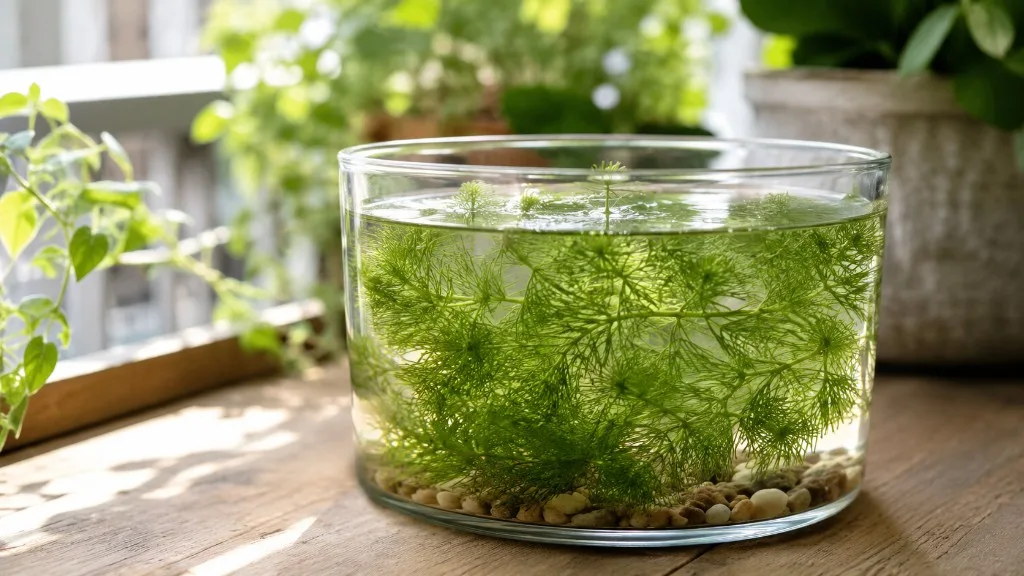
Hornwort is one of the fastest-growing plants in the freshwater aquarium hobby, and it earns that reputation by pulling dissolved nutrients straight out of the water around it. Ceratophyllum demersum - coontail, rigid hornwort, or simply hornwort - has no true roots. It does not sit in soil. It does not mine a substrate for nitrogen or iron. Every macro- and micronutrient it uses arrives through its feathery needles and flexible stems, dissolved in the water column. That single biological fact is the entire foundation of hornwort fertilization, and it is the reason so much generic plant advice fails Hornwort overview.
If you treat hornwort like a potted houseplant - granular feed in dirt, slow-release pellets pushed into a growing medium, bloom booster sprayed on leaves - you are feeding a system the plant cannot access. The right approach is simpler and more precise: liquid aquarium fertilizer dosed into the water, sized to your stocking level, your light, and how densely the tank is planted. Get that right and hornwort becomes a living filter, exporting nitrate, oxygenating the water, and outcompeting algae for the same dissolved nutrients. Get it wrong and you get pale needles, shedding stems, or an algae bloom that has nothing to do with hornwort being “hard to grow.”
This guide covers exactly how to fertilize hornwort in a planted aquarium: why water-column feeding is the only method that works, which liquid products reach the plant, how often to dose, when fish waste replaces bottles entirely, and how to read yellow or brown needles as a nutrient report card rather than a mystery.
If symptoms persist, see the Yellow Leaves on Hornwort guide.
Why Hornwort Fertilization Is Not Like Gardening or Houseplants
Garden fertilizers are built for roots in soil. A 10-10-10 granular product releases nutrients into moist earth, where root hairs absorb them and transport them upward. Houseplant liquids are diluted and poured over potting mix so the root zone can take them up over hours or days. Hornwort does not participate in that system at all.
In an aquarium, hornwort either floats freely at the surface or gets loosely wedged into gravel, sand, or around hardscape. The modified leaf structures at its base can grip substrate, but they are not a functional root system in the horticultural sense. There is no root mass exploring the gravel for phosphorus pellets. There is no capillary action pulling dissolved salts up from a potting mix. The plant’s entire interface with nutrition is the water it bathes in.
That is why soil fertilizer, garden spikes, terrestrial plant food, and aquarium root tabs do not meaningfully feed hornwort. Root tabs release nutrients into substrate pore water; hornwort’s feeding surfaces sit in the open water column above. Even nutrient-rich aquasoil contributes little to a floating mass compared with what needles pull directly from tank water. If you have found advice about potting soil, salt crust, or flushing a pot, you are reading guidance for a different organism.
Aquarium liquid fertilizers dissolve into the water column, where hornwort absorbs them through leaf and stem surfaces within minutes. This guide covers comprehensive liquids, trace supplements, and targeted nitrogen or iron boosters - never soil, substrate granules, or root-zone feeding as a primary strategy.
How Hornwort Absorbs Nutrients From the Water Column
Understanding hornwort’s feeding anatomy saves money on the wrong products and prevents weeks of troubleshooting that was never going to work. The plant is engineered for life fully submerged in moving or still freshwater, filtering nutrients from the surrounding solution the way a sponge pulls dye from water - except selectively, and with metabolic purpose.
No True Roots: Why Substrate Fertilizers Fail
Botanically, hornwort lacks true roots. It does not produce the root hairs, vascular connections to a central root crown, or mycorrhizal partnerships that terrestrial and many aquatic plants use to mine the substrate. What looks like anchoring at the base of a stem is modified foliage, not a nutrient-extraction organ. Hobby references from Tropica, Aquarium Co-Op, and multiple planted-tank care guides converge on the same point: hornwort is a rootless or functionally rootless stem plant whose nutrition comes from the water column.
Substrate fertilizers - root tabs, nutrient capsules buried in gravel, enriched soil layers - release their payload into the sediment pore water. Plants with active root systems like Amazon swords, Cryptocoryne, and Vallisneria tap that reservoir efficiently. Hornwort does not. A $15 pack of root tabs sitting under a hornwort bunch is feeding the bacteria in your gravel more than the hornwort floating six inches above it.
This is why hornwort works as a nitrate sponge in fish tanks - it intercepts ammonium, nitrite, and nitrate directly from the water before they accumulate. Agency weed guides describe Ceratophyllum as a water-column feeder that absorbs nutrients directly from surrounding water. In your aquarium, hornwort competes with algae for dissolved nutrients, not substrate-locked ones. If needles yellow, reach for liquid fertilizer or test nitrate - not a root tab.
Leaf and Stem Uptake: The Feeding Mechanism
Hornwort’s needles - the fine, whorled, forked leaves along each stem - present enormous surface area relative to their volume for water-column uptake. That geometry matters because aquatic plants absorb many nutrients through diffusion and active transport across submerged leaf surfaces. Nitrogen, potassium, iron, manganese, and the full suite of micronutrients in a comprehensive aquarium fertilizer enter the plant from the water surrounding each needle, not from below.
Stems participate too. A long hornwort stem floating at the surface or anchored mid-tank is essentially one continuous feeding surface. This is why dosing location matters less than dosing into the water column at all. Pouring liquid fertilizer near the filter outflow, at the surface near floating hornwort, or at the base of planted stems all achieve the same outcome: dissolved nutrients distributed through tank circulation until they contact hornwort tissue.
Hornwort absorbs ammonium directly from fish waste as well as nitrate, so stocked tanks often feed the plant in real time. Shrimp-only or lightly stocked tanks may need a nitrogen-containing liquid. Carbon and fertilizer are separate inputs: hornwort uses dissolved CO2 or bicarbonate for growth, but you still need adequate light for the plant to use iron and nitrogen from your bottle.
Does Hornwort Need Fertilizer in Your Tank?
The honest answer is: often no, and sometimes yes. Hornwort is not a demanding species in the way a red Ludwigia or a delicate carpeting plant might be. In a normally stocked community aquarium with routine feeding and water changes, hornwort frequently thrives on fish waste alone, growing fast enough to require weekly trimming without a single drop of bottled fertilizer.
The “yes” cases cluster around predictable situations. Heavily planted tanks with light fish stocking run lean on nitrogen because many plants compete for the same dissolved nutrients and the bioload does not replace them fast enough. Shrimp-only tanks, betta-only tanks, and breeding setups with few adult fish produce minimal nitrogen waste relative to plant mass. Brand-new tanks still cycling may have unstable nutrient profiles. Tanks with aggressive chemical filtration - phosphate removers, nitrate-absorbing resin - can strip the water column below what fast-growing hornwort prefers. In any of these, a weekly comprehensive liquid fertilizer is the correct tool.
A simple decision framework:
- Moderately to heavily stocked community tank, hornwort growing green and bushy: you likely need no macro fertilizer. A light trace supplement once a week after a water change can still help maintain deep green color if needles look pale at the tips.
- Lightly stocked or plant-heavy tank, slow hornwort growth or yellowing needles: dose a comprehensive liquid fertilizer weekly, starting at half label strength.
- Shrimp or fry tank with hornwort as the primary plant: treat liquid fertilizer as the default, not the exception. Use invertebrate-safe products at label or half-label dose.
- Tank with hornwort melting or shedding for the first two weeks after purchase: hold extra fertilizer. This is usually transition shock, not deficiency.
Hornwort’s reputation for being “easy” is real, but easy does not mean immune to empty water. It means the plant tells you quickly when the column is lean, and it recovers quickly when you correct it with the right liquid dose.
Liquid Fertilizers for Hornwort: Products That Actually Reach the Plant
Every fertilizer recommendation in this section assumes one delivery method: mixed into aquarium water. These are not substrate products. They are not garden concentrates diluted by guesswork. They are bottled formulas designed for submerged plants whose leaves and stems drink from the tank.
All-in-One Comprehensive Liquids
All-in-one liquids combine macronutrients (nitrogen, phosphorus, potassium) with micronutrients (iron, manganese, boron, and others) in a single bottle. For hornwort in tanks without heavy fish bioload, they are the most straightforward choice because you do not need to diagnose which nutrient is missing before you start.
NilocG Thrive and Aquarium Co-Op Easy Green are popular all-in-one options built around planted-tank dosing routines that supply both macros and traces in one step. They suit shrimp-only tanks, lightly stocked community tanks, and any hornwort setup where you want one weekly dose without juggling three bottles. Start at half the label recommendation for a 10- or 20-gallon tank with a modest hornwort mass, then increase only if needles stay pale after two weeks of consistent dosing.
Tropica Specialised Nutrition is explicitly formulated for aquariums with many fast-growing plants and lighter fish stocking. According to Tropica’s product specifications, it contains nitrogen (1.3% w/w), phosphorus (0.1% w/w), potassium (1.0% w/w), plus magnesium, sulfur, and a full trace package including iron. The standard dose is 6 mL per 50 L per week. For hornwort in a planted tank pushing growth - background bush, floating mass for fry cover, dense nutrient export - Specialised is the better Tropica pick because it fills the nitrogen gap that fish waste is not covering.
Tropica Premium Nutrition contains no nitrogen and no phosphorus. It supplies potassium, magnesium, sulfur, and the same trace elements. Tropica markets it for tanks with many fish and fewer plants, where adding more nitrogen and phosphorus would tilt the balance toward algae. In a well-stocked community tank where hornwort is one of several plants, Premium plus fish waste is often the disciplined combination.
Trace-Only vs. Macro-Complete Formulas
Not every bottle labeled “plant fertilizer” contains the same nutrient profile, and the distinction matters for hornwort.
Seachem Flourish is the most widely used trace-element supplement in the freshwater hobby. Per Seachem’s official dosing guidance, Flourish supplies iron, manganese, magnesium, calcium, potassium, and other micronutrients, but does not contain significant nitrogen or phosphorus. The label dose is 5 mL per 250 L (about 60 US gallons), once or twice weekly. In a stocked community tank, Flourish alone is often sufficient for hornwort because fish waste supplies the nitrogen and phosphate hornwort wants, while Flourish fills the iron and trace gap. In a shrimp-only tank, Flourish alone is incomplete - you need a nitrogen source alongside it, whether that is Tropica Specialised, Seachem Flourish Nitrogen, or an all-in-one product.
API Leaf Zone is a minimal formula containing iron and potassium only. It is a targeted tool, not a daily driver. When hornwort’s newest needles emerge pale yellow-green while the rest of the plant looks healthy, Leaf Zone at 5 mL per 10 US gallons once or twice weekly addresses a suspected iron shortfall without dumping extra nitrogen into a tank that may already be well stocked.
Seachem Flourish Nitrogen and Seachem Flourish Iron are single-nutrient supplements for when testing or symptoms point to a specific gap. They belong on the shelf as correction tools rather than as the first bottle you buy.
The decision rule is simple: match the bottle to what your bioload already supplies. Heavy fish stocking means trace-only or Premium-style formulas. Light stocking means macro-complete or all-in-one liquids. Hornwort does not care about brand loyalty; it cares whether dissolved nitrogen, iron, and potassium arrive at its needles.
Dosing Frequency and How Much to Use
Hornwort responds to consistent, moderate liquid dosing better than to infrequent heavy dumps. Weekly dosing aligned with your water-change routine is the standard cadence most aquarists settle on, because it replaces nutrients removed during the water change and gives you a fixed day to observe the plant’s response.
A practical weekly framework by tank type:
- Stocked community tank (roughly 1 inch of fish per gallon or more): dose a trace-focused liquid like Seachem Flourish or Tropica Premium at label strength once a week immediately after a 20–30% water change. Skip macro supplements unless nitrate tests consistently read near zero.
- Lightly stocked or shrimp-only tank: dose an all-in-one or Tropica Specialised at half to full label strength once a week. In a 10-gallon tank, measure small volumes with a 1 mL syringe rather than eyeballing cap threads.
- Heavily planted tank with CO2 and strong lighting: hornwort growth accelerates enough to pull nutrients fast. Weekly comprehensive dosing at full label strength is appropriate; some high-tech keepers split doses across two weekly applications to keep levels steadier.
Start low. Liquid fertilizers are dosed for plant mass and uptake rate, not water volume alone. A 20-gallon tank with one floating hornwort sprig needs far less than a 20-gallon tank packed with hornwort, stem plants, and floating cover. Beginning at half the manufacturer’s recommended dose and watching new growth for 10–14 days is safer than pouring label-max volumes into a sparsely planted tank and triggering a green water bloom.
Measure nitrate when you can. Hornwort is a nitrogen sponge, but it still needs nitrogen to exist in the water. If your test kit reads nitrate consistently below 5–10 ppm in a planted, lightly stocked tank, that is a clear signal to add a nitrogen-containing liquid fertilizer rather than a trace-only product. If nitrate runs above 40 ppm in a stocked tank, the problem is water-change frequency or overfeeding, not a need for more fertilizer.
Pause dosing during the first two weeks after introducing new hornwort. Most commercially sold hornwort is grown under conditions different from your tank - different light spectrum, harder or softer water, sometimes emersed production - and the plant sheds needles as it acclimates. That shedding looks alarming and tempts you to double the fertilizer dose. Resist. The plant is reallocating energy to new growth adapted to your water chemistry. Adding excess nutrients during this window feeds algae on dying tissue more than it helps the plant establish.
Fish Waste, Stocking Level, and When Biology Replaces Bottles
The most underused hornwort fertilizer strategy is no bottle at all. Fish excrete ammonia through their gills and in waste. Beneficial bacteria convert ammonia to nitrite and then to nitrate. Hornwort absorbs nutrients from the water column rather than from substrate, incorporating that nitrogen into new stem and needle tissue faster than many filters remove it.
In a community tank with normal feeding and a sensible stocking level, this biological loop often supplies everything hornwort needs for fast, green growth. Hobbyists running hornwort as a floating nitrate sink in goldfish tanks, guppy breeding setups, and standard community aquariums frequently report vigorous growth with zero liquid fertilizer - not because hornwort is magic, but because the bioload is doing the job a macro fertilizer bottle would do.
The threshold is not precise science, but experience across planted-tank communities aligns on a rough guide: when you have more than about one inch of adult fish length per gallon of water, and you feed daily or every other day, hornwort usually has adequate nitrogen and phosphorus without supplementation. Below that stocking density - a single betta in a planted 10-gallon, a shrimp colony with no fish, a quarantine tank - the water column runs lean and liquid fertilizer becomes necessary.
If hornwort yellows in a well-fed guppy tank, nitrogen deficiency is unlikely - check light, transition melt, or iron instead. In high-bioload setups, the risk is rarely nutrient poverty but shading, fish damage, or filter clogging from shed needles.
CO2, Light, and the Nutrient Triangle
Fertilizer does not work in isolation. Hornwort needs light to photosynthesize and a usable carbon source to build tissue from the nutrients it absorbs. Think of light, carbon, and dissolved nutrients as three linked inputs. Raising one without the others does not produce more hornwort; it often produces more algae.
Low-Tech Hornwort Without Pressurized CO2
Most hornwort keepers run low-tech tanks without pressurized CO2, and the plant grows well in that context. Dissolved CO2 from atmospheric exchange and fish respiration, combined with bicarbonate in harder water, supplies enough carbon for moderate growth under low to medium lighting. In these setups, a weekly liquid fertilizer dose at half to full strength is usually the entire nutrient program.
Low-tech success with hornwort means resisting the urge to crank light intensity to maximum without adding CO2 and matching nutrients. Hornwort tolerates a wide light range, but extremely intense light without balanced nutrients and carbon can make stems brittle and increase needle shedding. If you are running a basic LED on a timer for eight hours daily and your hornwort is green and growing, you do not need a high-tech upgrade to make fertilizer work.
Pressurized CO2 increases growth and nutrient demand - dose comprehensive liquids at full strength in CO2-enriched tanks. The Estimative Index (EI) method works for high-tech setups but is more complex than most hornwort tanks need; weekly all-in-one dosing suits standard community tanks. Liquid carbon products are not fertilizers; dose aquarium plant liquids into the water column instead.
Reading Deficiency Symptoms on Hornwort Needles
Hornwort is expressive for an aquarium plant. When the water column is short on a nutrient, the needles change color, density, or texture before the plant dies back. The diagnostic skill is reading where on the stem the symptom appears, because mobile nutrients like nitrogen show damage on old growth first while immobile nutrients like iron show damage on new growth first.
Nitrogen Deficiency: Yellowing and Translucent Tips
Nitrogen deficiency on hornwort typically appears as yellowing or translucent needles, often starting on older segments of the stem or as an overall pale, washed-out green across the plant. Because nitrogen is mobile inside plant tissue, hornwort cannibalizes nitrogen from older needles to fund new growth at the tips, leaving the lower and older portions of each stem looking chlorotic first.
In aquarium terms, nitrogen deficiency is most common in heavily planted, lightly stocked tanks where hornwort is competing with other plants for a thin nitrogen supply. It is uncommon in a well-fed community tank where nitrate is measurable. If your test kit reads nitrate near zero and your hornwort looks pale, add a nitrogen-containing comprehensive liquid fertilizer - Tropica Specialised, Easy Green, Thrive, or Seachem Flourish Nitrogen - at half to full dose weekly and retest in two weeks.
Target 10–20 ppm nitrate in planted tanks. Zero nitrate often means starving plants; sustained readings above 40–50 ppm signal overfeeding or insufficient water changes.
Iron Deficiency: Pale New Growth
Iron deficiency looks different. The newest needles at growing tips emerge pale, yellowish, or almost lime-green, while older needles on the same stem may remain a deeper green. Iron is immobile in plant tissue, so the plant cannot rob older leaves to supply new growth. The tips suffer first.
Iron shortage appears in tanks dosed with trace-only fertilizers in low-bioload setups, in tanks with very soft water, and in tanks where high light drives fast photosynthesis without a matching trace dose. The fix is a targeted iron supplement - API Leaf Zone, Seachem Flourish Iron, or a comprehensive liquid with iron in the mix - dosed consistently for two weeks. New needles should emerge darker green within 10–14 days if iron was the limiting factor.
If iron dosing does not improve new growth, check your light. Iron is only useful when photosynthesis is running. A hornwort bunch shaded under a thick floating mat or parked in a dim corner may look pale for energy reasons rather than iron reasons. Trim and redistribute stems so all whorls receive light, then reassess before escalating fertilizer.
One critical exception: yellowing and needle drop on freshly purchased hornwort is usually transition melt, not deficiency. New stems shed old needles while adapting to your water parameters, temperature, and light spectrum. Hold fertilizer steady at your normal low dose or pause macros for the first week, keep water parameters stable, and wait for fresh green growth from the tips. That new growth is the true health signal.
Over-Fertilizing, Algae, and Water Changes
More liquid fertilizer is not more hornwort. Hornwort already grows fast under modest nutrients. Over-dosing comprehensive liquids in a lightly planted tank is one of the fastest routes to green water, hair algae on slower plants, or diatom blooms on glass and decorations.
Excess dissolved nutrients do not sit inertly in the water forever. If hornwort and your other plants cannot absorb them fast enough, algae uses them instead. The warning signs of over-fertilization include algae growth accelerating within days of dosing, green water after increasing fertilizer, or nitrate and phosphate readings climbing between water changes despite stable feeding.
The corrective response is straightforward: skip the next fertilizer dose, perform a 30–50% water change, and resume at half your previous dose once algae is back under control. In high-tech tanks running EI-style dosing, the large weekly water change is built into the method specifically to prevent nutrient accumulation. In low-tech hornwort tanks, a regular weekly partial water change plays a similar balancing role - it exports nitrate, resets trace element levels, and removes organic waste that competes with hornwort for oxygen.
Water changes and fertilizer serve different roles - use both. Trimming exports nutrients physically; in high-bioload setups, regular pruning may matter more than extra dosing.
Common Hornwort Fertilizer Mistakes
Most hornwort fertilizer failures trace back to a short list of repeatable errors.
Using soil, granular, or root-tab fertilizers as the primary feed. Liquid aquarium fertilizer is the correct category.
Dosing houseplant or garden fertilizer into the aquarium. Use products labeled for aquarium use only.
Pouring label-max doses into a sparsely planted tank. Start at half strength and titrate up over two weeks.
Fertilizing aggressively during transition melt. Wait for new green tips before escalating.
Ignoring stocking level. Well-fed community tanks need traces at most; shrimp-only tanks need comprehensive macros weekly.
Running bright light with lean nutrients. Match comprehensive liquid dosing to light intensity.
Misreading yellow needles. Old tissue pale means nitrogen; new tips pale means iron. Test nitrate when unsure.
Hornwort in Ponds, Turtle Tanks, and Breeding Setups
Hornwort’s fertilizer needs shift with the container and the inhabitants. The water-column rule does not change - it is still liquid nutrition or dissolved waste - but the bioload math does.
Outdoor ponds usually supply enough nutrients from fish waste and organics; add aquarium-grade liquids only if growth looks pale in a new, lightly stocked pond. Never use lawn fertilizer - excess nutrients can push coontail to nuisance levels and foul pond water quality. Turtle tanks have heavy bioloads, so nitrogen deficiency is rare; turtles shredding the plant is the usual problem. Breeding and fry tanks are lightly stocked relative to plant mass - dose shrimp-safe all-in-one liquids weekly. Quarantine tanks without fish need light comprehensive dosing; pause if running copper-based medications.
Conclusion
Hornwort fertilizer is a water-column conversation, not a soil conversation. Ceratophyllum demersum has no true roots and absorbs every nutrient it needs through its needles and stems from the dissolved inventory in your tank water. That means liquid aquarium fertilizers - comprehensive all-in-ones for lean tanks, trace-focused formulas for well-stocked community tanks - are the products that actually work. Soil fertilizer, garden spikes, houseplant food, and substrate root tabs do not reach the plant in any meaningful way.
If you remember three things from this guide, make them these. First, match your bottle to your bioload: fish-heavy tanks often need only traces; shrimp-only and lightly stocked planted tanks need macro-complete liquids weekly. Second, dose moderately and consistently rather than heavily and rarely - half-strength weekly after a water change is a safer starting point than label-max dumps. Third, read the needles: pale old tissue points to nitrogen, pale new tips point to iron, and shedding on freshly added hornwort is usually acclimation rather than a fertilizer emergency.
Run the routine for two weeks, watch new growth at the stem tips, and adjust dose strength before you change products. Hornwort responds fast when the water column has what it needs - and it will tell you just as fast when it does not.
When to use this page vs other Hornwort guides
- Hornwort overview - Start here for whole-plant context before deep-diving this topic.
- Hornwort problems hub - Jump to symptom-specific fix guides when this care topic does not resolve the issue.
Related Hornwort guides
- Hornwort overview
- Hornwort watering
- Hornwort light
- Hornwort soil
- Hornwort propagation
- Hornwort repotting
- Hornwort problems
Related tool
Try the Fertilizer Dilution Calculator with hornwort pre-selected to estimate needs for your setup.