Fungus Gnats on Hornwort: Causes, Checks & Fixes
Quick answer
Fungus gnats around hornwort mean wet organic matter somewhere near the tank-gravel detritus, paludarium soil, damp rockwool, or a neighboring overwatered houseplant pot-not the submerged plant mass. First step: gravel-vacuum sunken hornwort needles and set a yellow sticky trap at the tank margin while you find the breeding site.
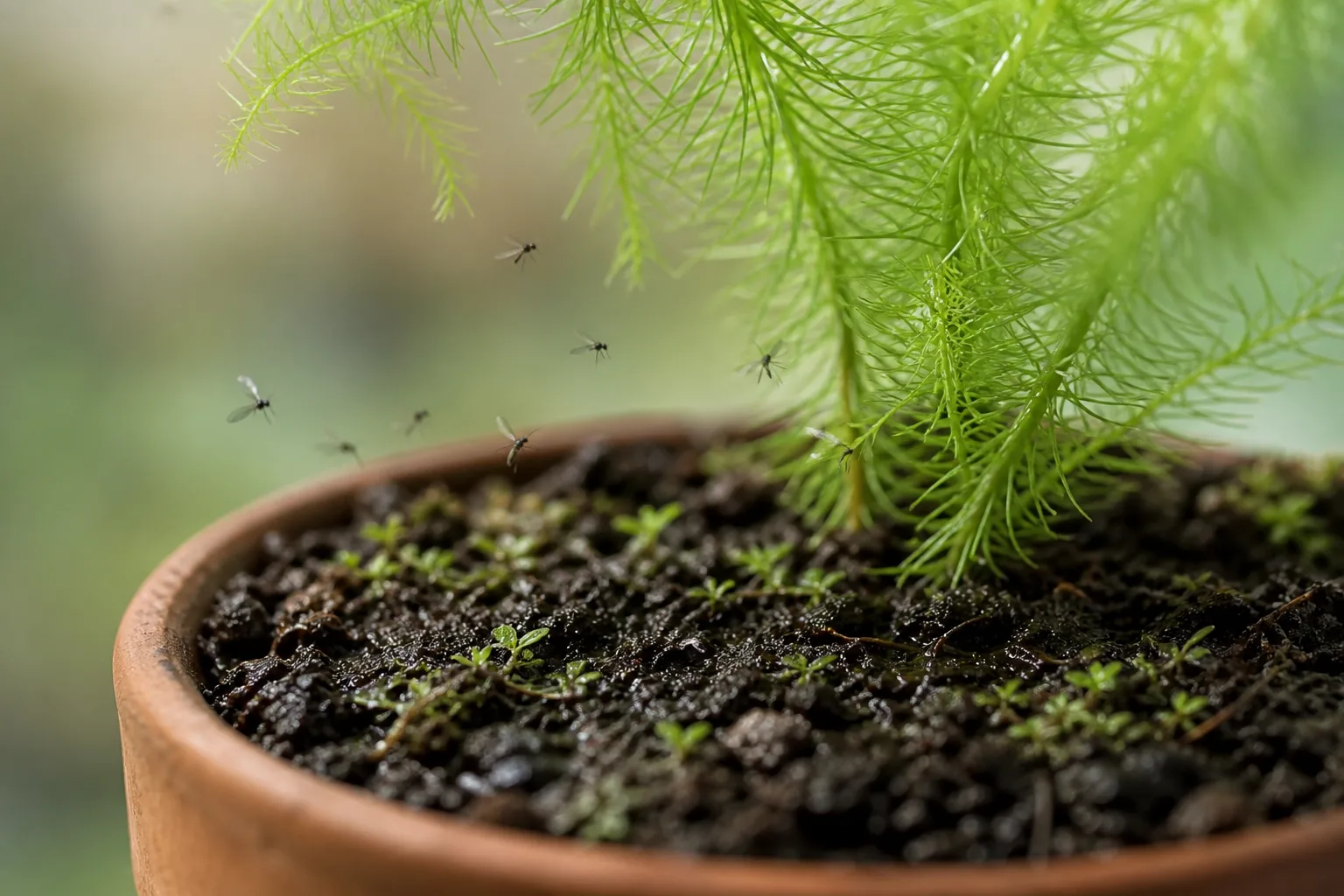
Fungus Gnats on Hornwort: Causes, Checks & Fixes
This guide covers fungus gnats on Hornwort. See also the general Fungus Gnats guide, watering, and light pages for this plant.
Fungus Gnats on Hornwort: Causes, Checks & Fixes
Quick answer
Fungus gnats near hornwort (Ceratophyllum demersum, coontail) are a wet-organic-matter signal-not proof that flies are infesting the submerged plant itself. Hornwort is a fully aquatic, rootless column feeder that absorbs nutrients directly from the water through its stems and forked whorls. It is grown floating, loosely anchored, or in paludarium setups-not in potting mix on a shelf.
First step: gravel-vacuum decaying hornwort needles and uneaten food off the substrate during your next partial water change, and place a yellow sticky trap at the tank rim or paludarium soil line. While you clean, watch where adult flies rise when disturbed. Gnats breed in moist organic substrate: wet gravel pockets under floating mats, damp rockwool on newly purchased stems, paludarium terrestrial soil touching emersed tips, or an overwatered houseplant pot on the same stand-not in open aquarium water around healthy submerged whorls.
Hornwort is aquatic-where gnats actually breed (and where they do not)
Understanding hornwort biology explains why generic houseplant gnat advice fails here.
Hornwort has no true roots. Rutgers NJAES notes that coontail may be loosely anchored by modified stems but lacks true roots and draws nutrients from the water column. Submerged green stems sitting in clean, filtered water do not offer the moist organic soil fungus gnat larvae require.
Where larvae can live near hornwort displays:
| Location | Gnats likely? | Why |
|---|---|---|
| Submerged floating hornwort in open water | No | No organic soil layer; larvae need moist decaying matter |
| Wet gravel/sand under floating mats with sunken needles | Yes | Decaying plant fragments + moisture = larval habitat |
| Damp rockwool or fiber on store-bought stems | Yes | Greenhouse-style wet organic media |
| Paludarium terrestrial soil at emersed stem zone | Yes | Same conditions as overwatered houseplant pots |
| Nearby houseplant pot on tank stand | Yes | Adults disperse short distances to windows and tank rims |
| Turtle tank gravel with food debris under hornwort | Yes | Organic buildup mimics constantly wet potting mix |
If your hornwort lives entirely submerged with firm green whorls and flies appear only when you disturb gravel or a neighboring pot, the breeding site is the substrate or pot-not the plant mass in water. See the hornwort overview for floating vs. anchored culture and why hornwort cannot be grown in ordinary potting mix.
What fungus gnats look like near a hornwort tank
Adult flies:
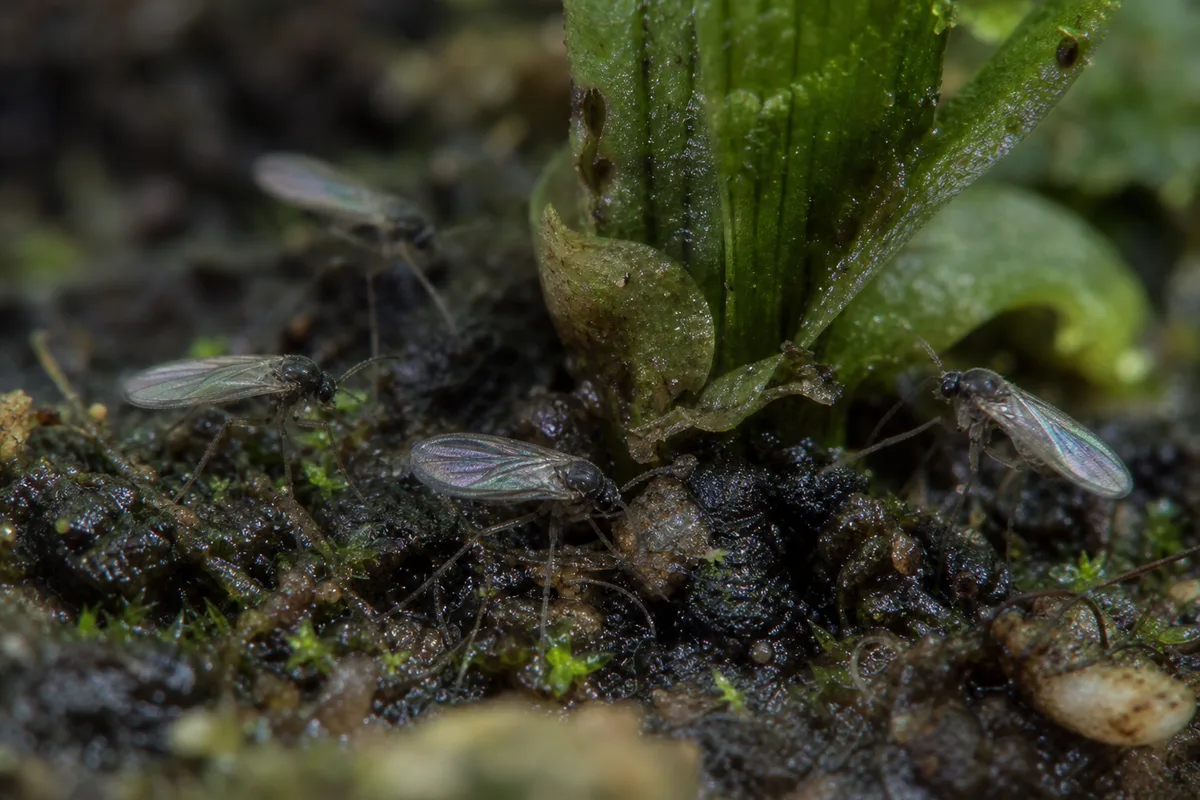
Fungus Gnats symptoms on Hornwort - compare with healthy tissue on the same plant.
- Tiny dark or gray mosquito-like insects, roughly 1/16 to 1/8 inch long, with long legs and antennae
- Rise in a small cloud when you disturb wet gravel, paludarium soil, or a houseplant pot-not when you gently move submerged hornwort in open water
- Rest on tank glass near the waterline, paludarium ledges, windows, or pot rims
- Do not bite people or pets
Larval stage (in substrate, not on submerged stems):
- Translucent wormlike larvae with dark head capsules in the top 2 to 3 inches of wet gravel, soil, or rockwool
- Sometimes visible when you scrape back damp fiber on a newly purchased hornwort bunch or lift a potato test slice from a nearby houseplant pot
- Feed on fungi, algae, and decaying organic matter-and may chew fine roots of terrestrial plants, not hornwort stems in water
What hornwort melt looks like instead:
- Brown, translucent needles shedding from acclimation stress or buried stem rot
- Does not hover as flying insects; may feed saprophytic growth on the substrate-overlap with mold on substrate under hornwort
- Firm green whorls on floating stems with separate fly activity at the tank bottom points to detritus + gnats, not foliar pest damage
Why gnats show up around hornwort displays
Fungus gnats need consistently moist organic matter to reproduce. UC IPM describes adults laying eggs in moist potting mix, compost, and other decomposing media. Near hornwort, that habitat appears in predictable aquarium-specific ways:
Sunken needle detritus under floating mats. Hornwort sheds brittle fragments during acclimation, trimming, and turtle foraging. Needles that sink into gravel voids rot and create the same fungal food web gnat larvae use in houseplant soil-especially in low-flow pockets below dense mats.
Mis-anchored or buried stems. Hobbyists sometimes push hornwort deep into gravel to hold it in place. Buried portions go anaerobic, shed needles, and add decay to the substrate-the same mistake that leads to stem-base rot on hornwort. Gnats follow the wet detritus, not the healthy floating tips.
Damp rockwool and packing from fish stores. Nursery and aquarium trade plants often arrive in wet synthetic or organic fiber. Quarantine buckets with gravel bottoms or damp fiber trap larvae exactly like greenhouse benches.
Paludarium terrestrial zones. Emersed hornwort tips above the waterline sit next to potting soil, coco coir, or drainage layers in paludarium builds. Wet soil against the glass or hardscape is standard gnat habitat-similar to fungus gnats on java fern when rhizomes sit in damp substrate.
Cross-contamination from houseplant pots. A pothos or fittonia on the same shelf whose soil never dries breeds gnats that disperse to the aquarium area. Many keepers blame hornwort because the green mass is visible, while the actual nursery is a pot six inches away.
High-bioload turtle and goldfish tanks. Uneaten food and waste trapped in gravel under hornwort mats keep substrate perpetually organic and moist-conditions that support both substrate mold and fungus gnats at the tank margin.
How to confirm gnats vs. fruit flies, shore flies, and hornwort melt
Work through this checklist before treating:
- Flight trigger - Do flies rise when you disturb gravel, paludarium soil, or a houseplant pot? Fruit flies hover near kitchen compost and ripening fruit. Shore flies breed in very wet algae-rich conditions and are stouter than fungus gnats.
- Location on the plant - Are insects associated with submerged whorls or with surfaces below/ beside the tank? Gnats at the waterline on glass while submerged hornwort stays untouched confirms a substrate or nearby-pot source.
- Substrate moisture - Push aside gravel under the hornwort mat. Soggy detritus with visible larvae or slime trails on organic surface film confirms larval habitat per extension guidance on moist media.
- Potato slice or sticky trap at the margin - Place a yellow sticky card at the tank rim or insert a raw potato wedge on wet gravel overnight. Catching small dark flies or finding larvae on the potato underside confirms active breeding in that zone-not on open water.
- Nearby pot audit - Water each houseplant on the stand separately and watch where flies emerge. Dry the top 1–2 inches of any infested pot while you clean the aquarium zone.
- Hornwort tissue check - Firm green floating stems with no insects on whorls, plus flies only at substrate level, rules out mealybugs or other emersed pests-see mealybugs on hornwort if white cottony clusters appear on tips above water.
If traps stay empty, gravel is clean and dry, and flies appear only in the kitchen, your hornwort tank may not be the source. Identify the correct pot or paludarium zone before adding any treatment to aquarium water.
First fix: vacuum detritus, expose stems, dry terrestrial zones, trap adults
Gravel-vacuum sunken hornwort needles and organic debris off the substrate during your next partial water change.
That single step removes larval food from the most common hornwort-tank breeding site while you investigate other sources. Do not pour pesticides into open tank water as a first response.
Then, in order:
- Lift and inspect anchored stems - Remove weights or rubber bands. Trim any mushy buried bases back to firm green tissue and float or re-anchor shallowly so living whorls stay in open water, per hornwort anchoring guidance.
- Strip rockwool and packing - Rinse store-bought hornwort under lukewarm water; discard all damp fiber before quarantine or display placement.
- Dry paludarium terrestrial soil - Allow the top layer of any emersed-zone soil to dry between waterings while keeping submerged hornwort hydrated normally.
- Set one yellow sticky trap - Yellow sticky traps capture adult fungus gnats at the tank rim, paludarium soil line, or beside a suspect houseplant pot to monitor adult counts while you fix moisture.
- Dry neighboring houseplant pots - If a pot on the same stand is the source, stop watering until the top 1–2 inches of mix are dry before treating the aquarium zone further.
Step-by-step recovery
Light infestation (few flies, clean submerged hornwort)
- Complete one thorough gravel vacuum under floating mats
- Remove visible rockwool and shed needles from the tank floor
- One sticky trap at the margin for seven to ten days
- Expect fewer adults within one to two weeks once detritus and surface moisture drop
Moderate infestation (regular flies when disturbing gravel or paludarium soil)
- Repeat gravel vacuuming twice weekly until traps catch almost nothing
- Thin dense hornwort mats so debris does not collect in stagnant bottom pockets
- Dry paludarium soil top layer and fix any overwatered houseplant on the same stand
- For terrestrial zones only: a Bacillus thuringiensis israelensis (BTI) product labeled for fungus gnats in potting mix may help paludarium soil or quarantine pots-never add unverified chemicals to stocked aquarium water
Heavy infestation (clouds of flies, sour substrate smell, livestock stress)
- Treat as a water-quality and detritus emergency, not a fly problem alone
- Large-scale gravel cleaning, reduced feeding, improved flow under mats
- Test ammonia and nitrite; decay may overlap with stem-base rot if stems were buried
- Move livestock temporarily if you must deep-clean substrate; do not rely on houseplant soil drenches in the main tank
Recovery timeline
Adult gnat counts on sticky traps should drop noticeably within one to two weeks once breeding sites dry and detritus is removed. Full control often takes three to four weeks because overlapping generations hatch from eggs already in wet gravel or soil.
Signs you are winning:
- Fewer flies when you vacuum gravel
- Trap catches declining week over week
- Submerged hornwort stays firm and green without new fly activity on whorls
- Paludarium soil or nearby pots pass the finger dryness test between waterings
Signs the problem is deeper:
- Sour smell, cloudy water, or ammonia/nitrite spikes after cleaning
- Brown slimy hornwort collapse tank-wide-points to breakdown overwhelming filtration, not gnats alone
- Flies persist despite dry pots and clean gravel-search for hidden wet organic matter (filter sponge gunk trays, drip trays, compost bins beside the tank)
Lookalike symptoms to rule out
| What you see | Likely cause | Where to look |
|---|---|---|
| Flies near kitchen fruit bowl | Fruit flies | Kitchen, not tank |
| Stout flies on very wet algae-coated glass | Shore flies | Algae-heavy paludarium walls |
| Tiny jumping specks on damp substrate | Springtails | Harmless; often in wet terrariums |
| White cottony clusters on emersed hornwort tips | Mealybugs | Mealybugs guide |
| Brown needles on bottom, no flying insects | Acclimation melt or burial rot | Overview shedding section, root-rot guide |
| White fuzz on gravel only | Saprophytic mold on debris | Mold on substrate guide |
Mistakes to avoid
Do not dry “soil” on submerged hornwort. There is no potting mix on a correctly kept aquatic bunch. Trying to let a submerged plant “dry out” will kill hornwort while larvae thrive in gravel below.
Do not bury stems deep to anchor them. Buried hornwort rots, sheds more needles, and worsens the detritus load that feeds gnats-see stem-base rot.
Do not pour houseplant fungus-gnat drenches, neem oil, or insecticidal soap into a stocked aquarium without confirming fish, shrimp, turtle, and invertebrate safety. Physical cleanup and drying terrestrial zones come first.
Do not blame the floating hornwort mass when a pothos on the same stand stays soggy. Fix the pot’s moisture before re-treating the tank repeatedly.
Do not skip rockwool removal at setup. Damp fiber is a common introduction pathway from fish-store bundles.
Hornwort care cross-check during treatment
While clearing gnats, keep hornwort healthy so you are not fighting detritus from unnecessary melt:
- Floating vs. anchored - Floating is simplest for quarantine; anchor with weights on gravel surface only, never deep burial
- Light and flow - Moderate light and gentle current reduce excessive shedding; see hornwort overview
- Water changes - Regular partial changes remove dissolved organics that fuel substrate decay
- Trim mushy stems - Remove brown sections before they add to gravel detritus
- Quarantine new bunches - Two to three weeks in a separate container lets you catch gnats from packing material before display placement
How to prevent fungus gnats near hornwort next time
- Net and vacuum shed needles weekly during routine maintenance
- Remove all rockwool and damp packing when introducing new hornwort
- Keep paludarium terrestrial soil from staying constantly wet at the emersed transition zone
- Dry houseplant pots on the same shelf between waterings-allow the top 1–2 inches of mix to dry between waterings so soil does not stay soggy for days
- Thin floating mats so bottom flow reaches gravel and debris cannot accumulate under still water
- Quarantine new plants in buckets with clean water; inspect container bottoms for larvae before tank entry
- Reduce overfeeding in turtle and goldfish setups so organic load stays low under hornwort
When to worry - tank parameter spikes, melt, and anaerobic breakdown
Escalate beyond standard gnat cleanup if:
- Ammonia or nitrite rises in a cycled tank after a large detritus disturbance
- Sour or rotten smell persists after thorough vacuuming
- Hornwort turns brown and slimy tank-wide while livestock act stressed-decay may exceed what gnats alone explain
- Flies remain heavy after four weeks of dry pots, clean gravel, and trapping-look for hidden breeding sites (greenhouse trays, compost, floor drains, filter drip trays)
For chronic infestations in complex paludarium builds or commercial turtle systems, consult an extension entomology resource or experienced aquatics specialist before applying any pesticide near open water.
Conclusion
Fungus gnats near hornwort almost always mean wet organic matter at the tank margin, in gravel detritus, in paludarium soil, or in a nearby houseplant pot-not an infestation of submerged Ceratophyllum demersum in open water. Gravel-vacuum sunken needles, expose and float mis-anchored stems, dry terrestrial zones, and trap adults while you eliminate the actual breeding site. Fix the moisture and detritus, and the flies usually leave the hornwort display alone.
When to use this page vs other Hornwort guides
- Hornwort watering guide - Use for routine moisture checks before assuming fungus gnats is the main issue.
- Hornwort problems hub - Browse all 16 common issues on this species.
- Overwatering on Hornwort - Different entry point when symptoms overlap with fungus gnats.
- Mold on Soil on Hornwort - Different entry point when symptoms overlap with fungus gnats.
- Root Rot on Hornwort - Different entry point when symptoms overlap with fungus gnats.