Duckweed Care Guide: Light, Water & Growth
Lemna, Spirodela, Landoltia, Wolffia, and Wolffiella spp.
Duckweed is sometimes used in turtle feeding from clean water, but LeafyPixels treats it as a cautious reptile-specific candidate rather than a universal safe-plant approval. Tortoises, if offered any, should get only very small amounts.
Duckweed Care Guide: Light, Water & Growth
Start with wateringThe most common care mistake for DuckweedCheck pet-safe plants →Duckweed care essentials
Light
Moderate to bright aquarium or pond light; avoid sudden harsh outdoor sun without acclimation.
Water
Keep fully aquatic in clean, dechlorinated water; refresh water quality before the plant declines.
Soil
Aquatic setup with no ordinary potting mix in the turtle tank; anchor or float according to the species.
Humidity
Aquatic or constantly humid surface conditions
Temperature
18-28 C (64-82 F)
Fertilizer
Usually unnecessary in turtle tanks with normal nutrients. Aquarium-safe fertilizer only if needed, used outside the turtle tank when possible
About Duckweed
Duckweed is native to Freshwater ponds and slow-moving water worldwide, typically reaches Tiny floating fronds, usually under 1 cm each indoors, with very fast in nutrient-rich water growth. Duckweed has a herbaceous growth habit and part of the Araceae family. It is also known as Duck Weed and Lemna.
| Detail | Information |
|---|---|
| Also known as | Duck Weed, Lemna |
| Native region | Freshwater ponds and slow-moving water worldwide |
| Mature size | Tiny floating fronds, usually under 1 cm each |
| Growth rate | Very fast in nutrient-rich water |
| Growth habit | Herbaceous |
| Scientific name | Lemna, Spirodela, Landoltia, Wolffia, and Wolffiella spp. |
| Family | Araceae |
Duckweed Care Guide: Light, Water & Growth
What Is Duckweed?
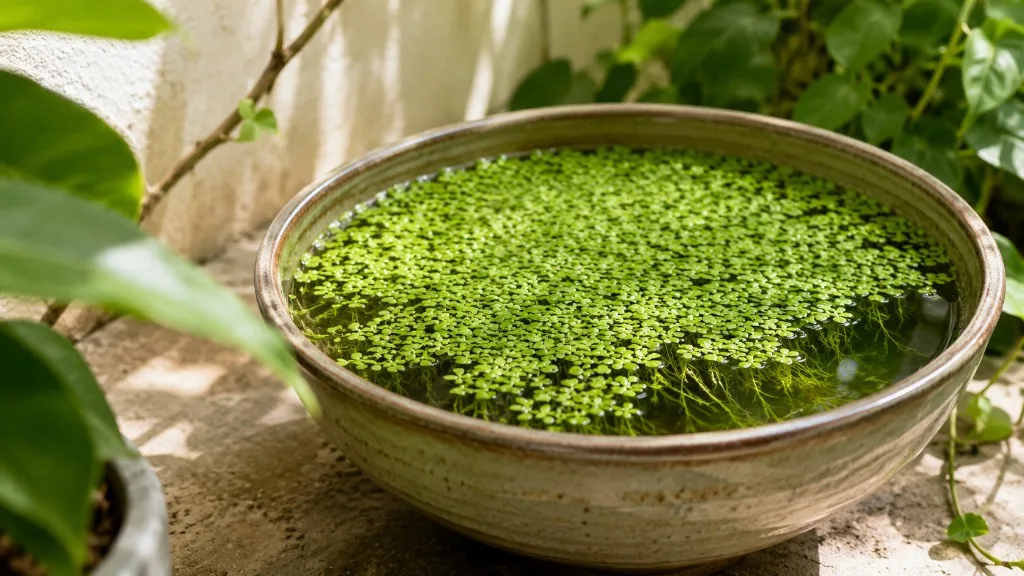
Duckweed is a group of tiny, free-floating freshwater plants that live entirely on the water surface - no pot, no soil, no drainage hole. The plants most hobbyists encounter belong to the subfamily Lemnoideae within the family Araceae, the same botanical family that includes peace lilies and anthuriums, though duckweed shares almost none of their terrestrial care needs. Common genera in trade and wild ponds include Lemna, Spirodela, Landoltia, Wolffiella, and Wolffia, often sold simply as “duckweed” without a species label.
Individual fronds are astonishingly small. Lemna minor - common duckweed - typically measures 1 to 8 mm across per plant body, while Wolffia species can be under 1 mm, making them among the smallest flowering plants on Earth. Despite that miniature scale, duckweed behaves like a powerhouse in nutrient-rich water: it spreads vegetatively, forms dense green mats within days, and pulls dissolved nitrogen and phosphorus out of the water column as it grows. In aquariums, backyard ponds, turtle tanks, and aquaponics setups, that combination makes duckweed both a practical water-quality tool and a management headache if you forget how fast it multiplies.
If you are deciding whether duckweed fits your setup, the honest summary is this: duckweed rewards still, clean, nutrient-bearing freshwater with moderate-to-bright light - and it punishes strong currents, chlorinated tap water, and neglect of surface thinning. It is easier than a demanding stem plant and harder than leaving the tank bare. The payoff is rapid nutrient uptake, shade for shy fish, supplemental forage for turtles and herbivorous species, and propagation so simple that a pinch of plants becomes a full carpet without any rooting step. The trade-off is control: without a harvest rhythm, duckweed will cover every square centimeter of open water and starve everything below of light.
Botanical Background and the Five Genera
Duckweeds are free-floating aquatic macrophytes found in still or slow-moving freshwater worldwide - ponds, ditches, marshes, quiet lake margins, and sheltered aquarium surfaces. They do not anchor to substrate. Each plant body, called a frond or thallus, floats thanks to air spaces and a small amount of root tissue in most genera. Spirodela and Lemna carry visible roots beneath the frond. Wolffia and some Wolffiella species appear as tiny green specks with little or no root, which changes how they respond to surface agitation and fish grazing.
Taxonomists recognize five genera within Lemnoideae, and they differ enough that two bags labeled “duckweed” may behave differently in your tank. Spirodela polyrhiza (greater duckweed) produces larger fronds with several roots and tolerates outdoor ponds well. Lemna minor is the classic aquarium and turtle-tank workhorse - small, fast, easy to skim. Landoltia punctata sits between them in size and growth habit. Wolffia species are microscopic by comparison and can slip through mesh barriers that stop Lemna. Knowing which type you have matters less for basic water parameters than for containment strategy, because smaller genera are harder to remove once they spread.
Growth is almost entirely asexual. Mature fronds bud daughter plants from a pocket on one side, and those daughters detach to form new individuals. Sexual flowering is rare in cultivation and irrelevant to home propagation. Under favorable conditions, duckweed can double its biomass every two to three days, with some literature citing even faster doubling for certain species in warm, nutrient-loaded water - a 2025 study in Scientific Reports recorded a 2.42-day doubling time for duckweed grown on diluted biogas slurry at optimal nutrient concentration. A 2022 Frontiers in Plant Science survey of native duckweed ecotypes found frond-number doubling times between roughly 51 and 71 hours for the fastest clones. Those numbers explain why a “small starter portion” becomes a solid lid within a week.
Duckweed also sits at the center of phytoremediation research - the use of plants to clean polluted water. Reviews in Plants (MDPI) document high removal rates for total nitrogen, total phosphorus, ammonium, and organic loading when duckweed mats are maintained on wastewater, sewage effluent, and agricultural runoff. Your home aquarium is not a treatment plant, but the same biology applies: duckweed is a living sponge for excess nutrients that would otherwise feed algae.
Why Duckweed Is Not a Houseplant
The most expensive mistake beginners make with duckweed is importing terrestrial houseplant logic - potting mix, saucers, “water when the top inch is dry,” humidity trays, and Duckweed repotting guide schedules. None of that applies. Duckweed has no use for soil. Substrate contact usually sinks or smothers fronds. Drainage is meaningless because the plant lives in the water column interface, not in a root zone surrounded by mix.
Watering, in the houseplant sense, does not exist either. Duckweed is always in water. What matters is water quality: temperature stability, pH within range, dechlorination, dissolved nutrients, and how often you refresh or partially change the water. You are not hydrating a pot; you are maintaining an aquatic environment. Similarly, repotting translates to harvesting and thinning, not moving to a larger container. When guides written for pothos or philodendrons talk about checking soil moisture with a finger, ignore that framing for duckweed entirely and watch surface coverage, frond color, and nutrient signs in the water instead.
If your only plant experience is indoor foliage in containers, think of duckweed as closer to aquarium plants or pond floating flora - like water lettuce or frogbit - than to anything you would put on a windowsill in soil. The four variables that decide almost every outcome in a home setup are light, water chemistry, dissolved nutrients, and surface management. Get those aligned and propagation, turtle forage, and nutrient uptake become almost automatic. Get one badly wrong - especially chlorine exposure or unchecked overgrowth - and the plant either dies outright or takes over faster than you can net it out.
Best Growing Conditions for Duckweed
Duckweed does best when your tank or pond approximates the quiet, sun-lit, nutrient-bearing freshwater where it evolved. It is extraordinarily adaptable compared with many aquarium stem plants, but that adaptability cuts both ways: it survives conditions that kill pickier species and then outcompetes them once established. The sections below translate pond and laboratory parameters into practical targets for aquariums, turtle tubs, and backyard water features.
Light Requirements
Duckweed needs enough light to photosynthesize steadily, and it grows fastest under moderate-to-high intensity. In outdoor ponds, duckweed naturally receives long hours of diffuse or direct sun and can form thick mats from spring through fall. Indoors, aim for 6 to 12 hours of light daily as a baseline, extending toward 12 to 16 hours if you are pushing growth for harvest, turtle forage, or nutrient export in a brightly stocked tank. A full-spectrum LED aquarium fixture or dedicated grow light positioned over an open surface area works better than weak ambient room light, which produces pale, sparse fronds and slower spread.
Intensity matters as much as duration. Duckweed tolerates low light longer than many red or carpeting aquarium plants, but growth becomes thin and lime-colored, and nutrient uptake slows. Medium to high aquarium lighting - the same range recommended for moderate stem-plant tanks - supports dense, deep-green mats. Avoid sudden jumps from dim shop conditions to intense noon sun on an outdoor tub without acclimation; fronds can bleach or yellow under shock exposure even though the species is broadly light-tolerant.
Balance light against nutrient availability. High light with rich nitrogen and phosphorus drives explosive multiplication. High light in a very clean, low-nutrient tank can shift competition toward algae on frond surfaces or stall duckweed while green water develops. If your goal is controlled coverage rather than maximum biomass, reduce photoperiod by an hour or two, skim more aggressively, or dim the fixture slightly rather than starving the tank of light entirely - total darkness kills duckweed as surely as it kills any photosynthesizing plant.
Water Temperature and Parameters
Duckweed prefers stable freshwater temperatures between 60 and 90°F (15 and 32°C), with many sources converging on 68 to 86°F (20 to 30°C) as the practical sweet spot for aquariums and turtle setups. Growth slows noticeably below about 60°F (15°C); in cold climates, outdoor ponds may lose surface mats to winter die-off unless you overwinter a small culture indoors. Heat above 90°F (32°C) is tolerable briefly in shaded ponds but increases evaporation and can pair with oxygen stress in very small, sun-heated tubs if circulation is poor.
pH tolerance is broad. Aim for 6.5 to 7.5 in community aquariums and turtle tanks; most keepers report healthy growth anywhere in the slightly acidic to slightly alkaline range without micromanaging. Water hardness matters little - duckweed grows in soft and hard water alike. What does matter is toxic chemistry: unneutralized chlorine and chloramine in fresh tap water can kill fronds within hours. Always dechlorinate new water or age tap water 24 to 48 hours with aeration before large exchanges that will contact your duckweed culture. Copper-based medications and algicides are equally risky; treat sick fish in a hospital tank and reintroduce duckweed only after confirming the main system is copper-free.
Salinity is not part of normal duckweed care. These are freshwater plants. Brackish or marine tanks are out of scope. For aquariums, maintain ordinary ammonia and nitrite at zero through filtration and stocking discipline; duckweed consumes nitrogen compounds but does not replace a cycled biofilter. In turtle tubs with heavy waste loading, combine duckweed with robust mechanical filtration and partial water changes - the plant helps, but an overloaded tub will still crash water quality if biomass is not harvested.
Water Movement and Surface Coverage
Duckweed evolved in still or slow-moving water. In nature it inhabits ponds and backwaters where surface drift is gentle. In tanks, strong surface agitation from powerheads, spray bars, or overflow boxes pushes fronds underwater, shreds them, and drives them into filter intakes. Aquaculture references note poor survival in currents above roughly 0.3 meters per second. Practical translation: a calm sponge-filtered shrimp tank suits duckweed; a high-flow river biotope with pointed powerheads does not unless you corral the plants.
Surface coverage is the other half of water management. Duckweed performs best when it covers a partial share of the surface, not necessarily 100%. Many pond managers and aquarists target 30 to 50% coverage as a balance point - enough to shade shy species, export nutrients, and support grazing, but not so much that submerged plants and gas exchange suffer. Beyond about 70 to 80%, you risk oxygen transfer reduction at the air-water interface, light starvation for plants below, and difficulty spotting fish health issues. Treat maximum cover as a ceiling to manage, not a goal to achieve.
Corral options include floating rings, airline tubing loops, or commercial floating plant barriers that keep duckweed in one corner while leaving the rest of the surface open. In ponds, partial shade from marginal plants or a mesh shade cloth can slow summer overgrowth without eliminating the culture. The principle is always the same: duckweed is easy to grow and hard to uncrowd once it wins - plan the surface area before you dump in the first spoonful.
Nutrients and Water Quality
Duckweed is a nutrient-powered plant. Unlike root-feeders that mine the substrate, floating Lemna and Wolffia absorb dissolved minerals directly from the water through their fronds and short roots. That makes water chemistry the equivalent of soil fertility for terrestrial plants. Clean, sterile-looking water with near-zero nitrogen and phosphorus can support a thin duckweed skim, but it will not sustain the fast, deep-green growth most keepers expect without supplementation or a bioload that produces waste.
Nitrogen and Phosphorus Uptake
The main reason people add duckweed to aquariums, turtle tubs, and ponds is nutrient export. Duckweed rapidly assimilates ammonium, nitrate, and phosphate - the same compounds that fuel algae blooms and degrade water quality in overfed systems. Phytoremediation literature consistently shows high removal percentages for total nitrogen (TN) and total phosphorus (TP) when duckweed biomass is regularly harvested, because removal is partly locked in plant tissue that must be physically removed to export nutrients from the system. A mat that grows, dies, and decays in place recycles much of that load back into the water.
In a well-stocked aquarium or turtle habitat with normal feeding, fish and reptile waste often supplies enough nitrogen and phosphorus without deliberate fertilizing. Watch for pale green or yellowing fronds combined with persistent algae in the water column - that pattern can mean duckweed is starved while algae outcompete it, or that growth has outpaced available nutrients per unit of water. In nutrient-poor display tanks with few fish, duckweed may linger without thriving until you add a light, balanced aquatic fertilizer at low dose or increase bioload modestly.
Protein content is a side benefit that matters for livestock and pet forage. Duckweed biomass commonly tests at 30 to 40% crude protein by dry weight under good culture conditions, which is why aquaculture researchers study it as feed for fish, poultry, and waterfowl. For home turtle keepers, that protein density is useful but not a license to feed duckweed alone - more on balanced forage in the turtle section below.
Fertilizing When Nutrients Are Low
Fertilizer is optional, not mandatory. In rich water, duckweed needs no added products. When growth stalls in an otherwise healthy-light setup, a dilute complete aquatic fertilizer or trace supplement after a partial water change can restore color and spread. Use fractions of label rates - duckweed responds to small nutrient pulses more predictably than to full-strength macro dumps that spike algae. CO2 injection is not required; duckweed grows vigorously in low-tech tanks. High-tech CO2 systems do not harm floating plants directly, but they often correlate with stronger submerged-plant competition and more careful nutrient balancing.
Can duckweed live in tap water? Only after dechlorination. A cup of tap water for a quick top-off on an established dechlorinated tank is different from filling a bare container with fresh tap and tossing duckweed in. Chlorine disinfectants target delicate aquatic tissue. Pond water, rain water, or dechlorinated tap are appropriate sources. If fronds turn white or dissolve after a water change, suspect chlorine, chloramine, or a recent medication before blaming light or temperature.
Refresh water on a schedule that matches your bioload. Duckweed does not eliminate the need for partial water changes in closed aquariums; it reassigns some nitrogen and phosphorus into harvestable biomass, but organics, salts, and trace wastes still accumulate. Harvest a portion of the mat weekly in fast-growing setups and replace 10 to 25% of the water on your normal aquarium rhythm. In outdoor ponds, seasonal rain and overflow may suffice; in small tubs, manual topping with dechlorinated water is routine.
Adding Duckweed to Aquariums and Ponds
Introducing duckweed is mechanically simple and biologically sensitive. You are not planting roots; you are releasing a floating culture onto a prepared water surface. Start with a small quantity - a teaspoon to tablespoon of healthy green fronds - even if you want full coverage eventually. Observe spread for a week before adding more. That restraint prevents the classic beginner outcome: one generous handful becomes an unskimmable blanket before you learn your light and nutrient balance.
Rinse purchased or shared duckweed gently in a bucket of dechlorinated water to shed hitchhikers: snail eggs, copepods, and duckweed-eating insects are common stowaways. Quarantine wild-collected duckweed if possible; outdoor ponds may harbor parasites, pesticides, or invasive fragments of other species. For turtle tanks and edible-fish systems, buy from aquarium or aquaculture sources that do not treat with copper or systemic pesticides, and avoid lawn-runoff ponds near treated turf.
In ponds, duckweed colonizes open sun patches quickly through spring and summer. Anchor a starter batch in a quiet cove away from fountain spray and waterfall spill. Koi and large goldfish graze duckweed enthusiastically - that grazing controls spread but may eliminate it unless you maintain a protected nursery zone behind mesh. In indoor aquariums, float the starter inside a corral for the first two weeks so filter outflows do not suck fronds into the impeller. Once the culture thickens, you can remove the corral and rely on weekly skimming.
Turtle Tanks and Fish Compatibility
Duckweed is widely used in turtle habitats because turtles graze it readily and it tolerates the messy water chemistry of feeding tanks better than many ornamental plants. Red-eared sliders, painted turtles, and many aquatic species will crop surface mats continuously. That grazing is natural forage behavior and doubles as growth control - but only if you replenish or maintain a backup culture elsewhere, because hungry turtles can strip a tank bare in days.
Duckweed is not a complete diet. It is high in protein and relatively low in fiber compared with leafy greens and commercial pellets. Tortoise keepers especially should treat duckweed as an occasional supplement, not a staple, because excess protein without adequate fiber contributes to nutritional imbalance over time. For aquatic turtles, combine duckweed with dark leafy vegetables, appropriate pellets, and calcium sources per species guidance from a reptile veterinarian or current herpetological reference. Pesticide-free sourcing is non-negotiable when plants are eaten.
In fish-only aquariums, duckweed suits betta, gourami, livebearers, goldfish, and shrimp setups that prefer some surface shade. Fast surface swimmers and strongly filtered tanks may frustrate the plant mechanically even if chemistry is fine. Snails (pond snails, bladder snails) eat duckweed slowly; large snail populations can thin a mat over weeks. That interaction is usually beneficial in overgrown tanks but annoying if you are trying to establish a deliberate cover.
Managing Fast Growth
Duckweed’s reputation as invasive is earned in open ponds and warm wastewater, not because the plant is malicious, but because its doubling time under optimal light and nutrients can be measured in days. Management is not optional maintenance - it is core care, equivalent to pruning a hedge that grows inches daily.
Thinning, Harvesting, and Containment
Skim weekly in warm, bright conditions. Use a fine mesh net, aquarium-safe plastic spoon, or pond skimmer to remove excess fronds. Compost harvested duckweed, feed it to chickens or turtles where appropriate, or freeze portions for later reptile meals - do not simply dump live duckweed into storm drains or natural waterways, where it may establish non-native populations.
Set a coverage target before you start. For mixed planted aquariums, 30 to 50% surface duckweed is a common ceiling. For dedicated culture tubs or nutrient-export systems, 50 to 80% may be desirable until harvest. When coverage exceeds your target, remove volume, not just surface film - thick stacks of fronds shade their own lower layers, which turn yellow and decay, adding organics back to the water.
Containment tools slow spread without stopping growth entirely. Floating rings, booms, and partitioned turtle tubs keep duckweed on one side while turtles or filter outflows occupy the other. Increased surface agitation in one zone can deter duckweed from colonizing that area, though it is a blunt instrument in display tanks. Reducing photoperiod or nutrient input slows multiplication when you need breathing room, but starving a culture long-term produces yellow mats and defeats the purpose of growing it.
If duckweed escapes into filter sumps or hang-on-back boxes, rinse media during maintenance and accept that complete eradication from a decorated tank is tedious. Every fragment buds anew. Many aquarists maintain a separate culture jar - a quart of dechlorinated water under a cheap LED - as insurance after a tank wipe-out or turtle feast.
Propagation Methods for Duckweed
Duckweed propagation is vegetative and automatic. You do not take cuttings, callus tissue, or wait for roots. Daughter plants bud from parent fronds, detach, and repeat. Home propagation is therefore a matter of culture hygiene and starter density, not technique.
To propagate deliberately, scoop one to two tablespoons of healthy green fronds into a clear container of dechlorinated water. Place it under bright light at room temperature to warm-tropical temperatures. Within days, the surface should film over; within one to two weeks, you will have enough to seed another tank. Change 20 to 30% of the water weekly and harvest excess to prevent anaerobic decay in thick, unstirred stacks.
Division, in the traditional plant sense, is literally splitting the mat - tear a dense clump in half and move each portion to a new water body. There are no nodes or stems to orient. When sharing with another hobbyist, ship fronds in a small bag of water with minimal air space to prevent drying; heat packs help in cold weather.
Do not propagate from yellowing, pesticide-exposed, or wild urban runoff cultures if the destination is a pet-edible turtle tank. Diseases and contaminants clone forward as surely as genetics. Restart from a clean vendor source when in doubt.
Common Duckweed Problems
Most duckweed problems trace to water chemistry, light balance, flow, or overcrowding - not mysterious pathogens. The plant does not suffer spider mites or root rot on Duckweed. Its failures are aquatic and environmental.
Yellowing, Algae Competition, and Invasion
Yellow or pale fronds usually signal nutrient limitation, insufficient light, old decaying layers at the bottom of a thick mat, or shock after chlorinated water changes. Peel back dense stacks during weekly skims; if lower fronds are slime-yellow while top leaves are green, thin harder rather than fertilizing blindly. If the entire culture is pale in bright light, test whether nitrogen and phosphate are genuinely low in a lightly stocked tank and supplement modestly.
Algae on duckweed - hair algae clinging to roots, or green dust on fronds - competes for the same nutrients and light. Manual rinse in a bucket of tank water during harvest helps. Fix the underlying nutrient-to-light ratio rather than dosing algaecides that may kill the duckweed too.
Invasion is the social problem: duckweed blocks your view, clogs filters, and spreads to every connected tub. Prevention beats cure. Use barriers, separate sumps, and disciplined skimming. Never release into natural waterways. In shared club ponds, communicate before adding duckweed; one enthusiastic donation can years later still require annual netting.
Filter clogging happens when outflows suck fronds into foam pads. Prefilter sponges and corrals are cheap insurance. If fronds vanish overnight without turtle grazing, check the filter intake first.
Is Duckweed Safe for Pets?
Context matters because “pets” spans aquatic turtles, tortoises, fish, cats, and dogs - and duckweed’s role differs in each case.
Aquatic turtles commonly eat duckweed safely when plants are clean and pesticide-free. It is a useful graze crop, not a complete diet. Tortoises should receive duckweed only in small amounts because of the protein-to-fiber ratio. Fish do not eat duckweed as a rule unless herbivorous species nip at it; duckweed is not toxic to typical aquarium fish at normal coverage.
Cats and dogs rarely consume duckweed in meaningful quantities. The plant is not a common ASPCA-listed household toxin in the way lilies are, but it is not a pet food product either. Keep chemical treatments away from any tank a pet might drink from. The bigger pet-safety story is water quality and pesticide sourcing, not frond toxicity.
When children handle duckweed during pond play, basic hygiene - rinse hands after - is sufficient. The plant is not caustic or spiny. Allergic skin reactions are uncommon.
Conclusion
The most useful thing to know about duckweed is that it is a free-floating freshwater plant from the Lemnoideae group that grows fastest in still, dechlorinated, nutrient-bearing water under moderate-to-bright light, doubling biomass every few days when conditions align. It does not use soil, does not follow houseplant watering rules, and does not forgive chlorine, strong surface flow, or uncontrolled surface coverage. If light, water parameters, nutrients, and weekly thinning fit that description, duckweed becomes a low-maintenance ally for shade, nutrient export, turtle forage, and simple propagation. If they do not, fix the aquatic environment first - usually dechlorination, flow reduction, or skimming - and the culture usually responds within days. Treat spread as a harvest opportunity, not a surprise, and duckweed earns its place in ponds and aquariums without taking over by default.
When to use this page vs other Duckweed guides
- Duckweed overview - Canonical hub for this species - care topics and problems branch from here.
- Duckweed problems - Symptom-first path when you already know something is wrong.
Related Duckweed guides
How to care for Duckweed?
How much light does Duckweed need?
Moderate to bright aquarium or pond light; avoid sudden harsh outdoor sun without acclimation.. Low-tech aquarium light. Filtered outdoor pond light
- Moderate to bright aquarium or pond light - Moderate to bright aquarium or pond light; avoid sudden harsh outdoor sun without acclimation..
- avoid sudden harsh outdoor sun without acclimation - Moderate to bright aquarium or pond light; avoid sudden harsh outdoor sun without acclimation..
- Low-tech aquarium light - Low-tech aquarium light.
- Filtered outdoor pond light - Filtered outdoor pond light.
When should you water Duckweed?
Keep fully aquatic in clean, dechlorinated water; refresh water quality before the plant declines.
- Check water clarity - Keep fully aquatic in clean, dechlorinated water; refresh water quality before the plant declines.
- temperature
- flow
- and leaf color rather than watering by a calendar - Keep fully aquatic in clean, dechlorinated water; refresh water quality before the plant declines.
- Drain excess water - Keep fully aquatic in clean, dechlorinated water; refresh water quality before the plant declines.
What soil works best for Duckweed?
Aquatic setup with no ordinary potting mix in the turtle tank; anchor or float according to the species.
- Aquarium-safe sand or gravel if rooted - Aquatic setup with no ordinary potting mix in the turtle tank; anchor or float according to the species.
- No fertilizer-rich potting soil in turtle tanks - Aquatic setup with no ordinary potting mix in the turtle tank; anchor or float according to the species.
- Attach rhizome plants to rock or driftwood - Aquatic setup with no ordinary potting mix in the turtle tank; anchor or float according to the species.
How to propagate Duckweed?
Propagate from healthy divisions or cuttings taken from clean, untreated stock.
- Division - Propagate from healthy divisions or cuttings taken from clean, untreated stock.
- Stem cuttings - Propagate from healthy divisions or cuttings taken from clean, untreated stock.
- Runner separation
Duckweed pet safety
Duckweed may be a cautious turtle-specific candidate from clean water, but LeafyPixels does not treat it as broad pet-safe clearance. Tortoise use stays caution-only because it should not be staple forage.
Duckweed is sometimes used in turtle feeding from clean water, but LeafyPixels treats that as limited-evidence husbandry guidance rather than blanket safety clearance. Tortoises should only get small amounts, if at all.
Watering Duckweed
For Duckweed, check water clarity, temperature, flow, and leaf color rather than watering by a calendar. and water always submerged or floating in clean water; maintain tank or pond water changes. Growth slows in cool water or short winter light; thin excess growth and keep filtration steady.
| Detail | Information |
|---|---|
| How often | Always submerged or floating in clean water; maintain tank or pond water changes |
| How to check | Check water clarity, temperature, flow, and leaf color rather than watering by a calendar. |
| Seasonal changes | Growth slows in cool water or short winter light; thin excess growth and keep filtration steady. |
Signs of overwatering
- melting stems
- yellowing leaves
- rotting crowns
- foul water smell
Signs of underwatering
- dry floating mats
- crispy leaves
- shrinking growth
- plant breaking apart
Soil & potting for Duckweed
Use a mix of Aquarium-safe sand or gravel if rooted, No fertilizer-rich potting soil in turtle tanks, Attach rhizome plants to rock or driftwood for Duckweed. Not applicable for submerged aquatic culture; prioritize clean, oxygenated water. Target soil pH around About 6.5-7.8 for most community turtle aquariums. Repot thin or reposition growth as needed rather than repotting on a schedule, ideally in warm active growth.
| Detail | Information |
|---|---|
| Recommended mix | Aquarium-safe sand or gravel if rooted, No fertilizer-rich potting soil in turtle tanks, Attach rhizome plants to rock or driftwood |
| Drainage | Not applicable for submerged aquatic culture; prioritize clean, oxygenated water. |
| Soil pH | About 6.5-7.8 for most community turtle aquariums |
| Repotting frequency | Thin or reposition growth as needed rather than repotting on a schedule |
| Best season to repot | Warm active growth |
Signs it needs repotting
- overcrowded tank surface
- plants clogging filter intake
- root mats trapping debris
Humidity & temperature for Duckweed
Duckweed prefers aquatic or constantly humid surface conditions. Keep temperatures around 18-28 C (64-82 F). Avoid letting Duckweed sit below Protect from freezing unless grown as an outdoor seasonal pond plant. Match the plant to the turtle species temperature range and quarantine new plants before use.
| Detail | Information |
|---|---|
| Humidity | Aquatic or constantly humid surface conditions |
| Ideal temperature | 18-28 C (64-82 F) |
| Minimum temperature | Protect from freezing unless grown as an outdoor seasonal pond plant |
| Temperature notes | Match the plant to the turtle species temperature range and quarantine new plants before use. |
Humidity tips
- Keep exposed roots and floating leaves from drying out
- Use a covered aquarium only if ventilation remains adequate
Fertilizer & pruning for Duckweed
Feed Duckweed usually unnecessary in turtle tanks with normal nutrients using aquarium-safe fertilizer only if needed, used outside the turtle tank when possible. The best feeding window is active growth only. Copper, pesticide residues, strong pond chemicals, and terrestrial fertilizers in turtle water.
| Detail | Information |
|---|---|
| Fertilizer schedule | Usually unnecessary in turtle tanks with normal nutrients |
| Best season | Active growth only |
| Fertilizer type | Aquarium-safe fertilizer only if needed, used outside the turtle tank when possible |
| What to avoid | Copper, pesticide residues, strong pond chemicals, and terrestrial fertilizers in turtle water |
Pruning
Thin old, melting, or excess growth before it fouls turtle water. Remove uneaten plant debris promptly.
Common problems on Duckweed
Yellow Leaves
MediumLikely cause: Low nutrients, poor light, dirty water, or acclimation melt after moving tanks
Quick fix: Remove melting growth, improve water changes, and adjust light gradually.
Full fix guide →Slow Growth
LowLikely cause: Weak light, cold water, or nutrient imbalance in a low-tech setup
Quick fix: Stabilize temperature and use moderate aquarium lighting before adding fertilizer.
Full fix guide →Brown Tips
MediumLikely cause: Common on this plant type; confirm with recent watering, light, and root checks.
Quick fix: Inspect the plant and correct the most likely care stressor before stacking treatments.
Full fix guide →Root Rot
MediumLikely cause: Common on this plant type; confirm with recent watering, light, and root checks.
Quick fix: Inspect the plant and correct the most likely care stressor before stacking treatments.
Full fix guide →Overwatering
MediumLikely cause: Common on this plant type; confirm with recent watering, light, and root checks.
Quick fix: Inspect the plant and correct the most likely care stressor before stacking treatments.
Full fix guide →Underwatering
MediumLikely cause: Common on this plant type; confirm with recent watering, light, and root checks.
Quick fix: Inspect the plant and correct the most likely care stressor before stacking treatments.
Full fix guide →Spider Mites
MediumLikely cause: Common on this plant type; confirm with recent watering, light, and root checks.
Quick fix: Inspect the plant and correct the most likely care stressor before stacking treatments.
Full fix guide →Mealybugs
MediumLikely cause: Common on this plant type; confirm with recent watering, light, and root checks.
Quick fix: Inspect the plant and correct the most likely care stressor before stacking treatments.
Full fix guide →Aphids
MediumLikely cause: Common on this plant type; confirm with recent watering, light, and root checks.
Quick fix: Inspect the plant and correct the most likely care stressor before stacking treatments.
Full fix guide →Leggy Growth
MediumLikely cause: Common on this plant type; confirm with recent watering, light, and root checks.
Quick fix: Inspect the plant and correct the most likely care stressor before stacking treatments.
Full fix guide →Wilting
MediumLikely cause: Common on this plant type; confirm with recent watering, light, and root checks.
Quick fix: Inspect the plant and correct the most likely care stressor before stacking treatments.
Full fix guide →Drooping Leaves
MediumLikely cause: Common on this plant type; confirm with recent watering, light, and root checks.
Quick fix: Inspect the plant and correct the most likely care stressor before stacking treatments.
Full fix guide →Low Humidity
MediumLikely cause: Common on this plant type; confirm with recent watering, light, and root checks.
Quick fix: Inspect the plant and correct the most likely care stressor before stacking treatments.
Full fix guide →Not Enough Light
MediumLikely cause: Common on this plant type; confirm with recent watering, light, and root checks.
Quick fix: Inspect the plant and correct the most likely care stressor before stacking treatments.
Full fix guide →Fungus Gnats
MediumLikely cause: Common on this plant type; confirm with recent watering, light, and root checks.
Quick fix: Inspect the plant and correct the most likely care stressor before stacking treatments.
Full fix guide →Mold on Soil
MediumLikely cause: Common on this plant type; confirm with recent watering, light, and root checks.
Quick fix: Inspect the plant and correct the most likely care stressor before stacking treatments.
Full fix guide →