Duckweed Mat Decay and Root Decline: Causes, Checks & Fixes
Quick answer
Root rot on duckweed almost always means mat decay or water-quality failure-not soggy potting soil. First step: skim brown, slimy, or foul-smelling fronds from the thickest mat zones before thinning coverage to roughly 30–50% open water.
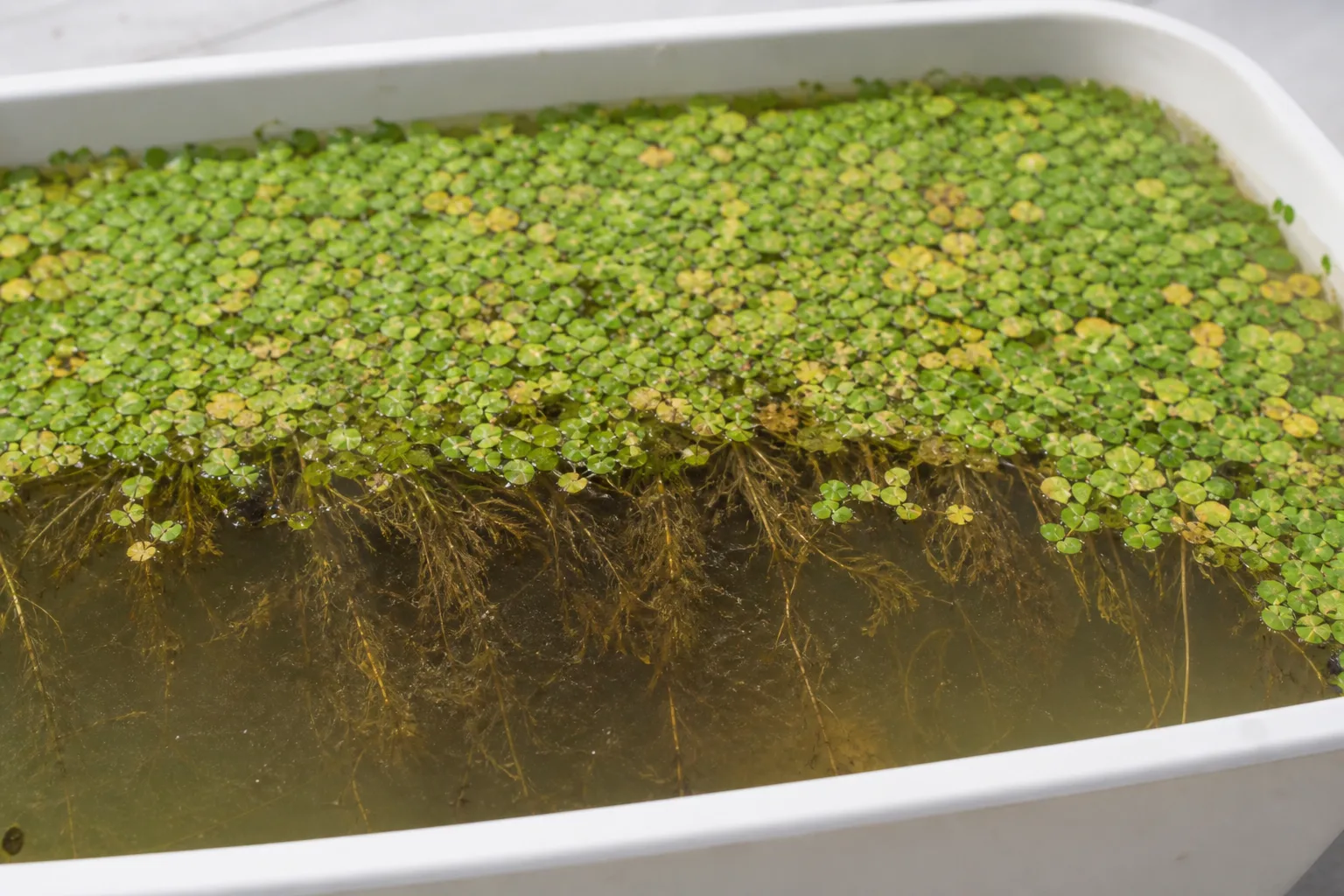
Duckweed Mat Decay and Root Decline: Causes, Checks & Fixes
This guide covers root rot on Duckweed. See also the general Root Rot guide, watering, and light pages for this plant.
Duckweed Mat Decay and Root Decline: Causes, Checks & Fixes
Quick answer
When aquarists search “root rot on duckweed,” they usually mean mat decay, anaerobic shedding, or water-quality collapse-not houseplant-style root-ball failure in potting mix. Duckweed (Lemna, Spirodela, Landoltia, Wolffia, and related genera) is a free-floating aquatic with no soil, no pot, and no drainage hole. Each tiny frond floats on calm water with one or a few short roots trailing below-there is no crown to inspect and no mix to dry out.
First step: skim brown, slimy, or foul-smelling fronds from the thickest mat zones before thinning the canopy to roughly 30–50% open water. Rotting tissue under a sealed mat adds ammonia and consumes dissolved oxygen faster than removing healthy green biomass alone. Do not reach for Duckweed repotting guide mix, stop watering, or let “soil surface dry”-those fixes belong to terrestrial plants and will kill a floating culture. For the full floating-plant context, see the duckweed care overview.
Mat decay vs. houseplant root rot
Houseplant root rot happens when waterlogged soil suffocates roots in a container. Duckweed never touches soil. Its “roots” are short structures beneath millimeter-scale fronds-botanically part of the plant body, without true root hairs-that absorb dissolved nutrients from the water column.
What hobbyists call root rot on duckweed usually traces to one of three aquatic mechanisms:
- Anaerobic decay under dense mats - When coverage seals the surface, gas exchange drops and shed fronds rot in the layer beneath the green canopy.
- Water-quality failure - Ammonia, nitrite, chlorine, copper medication, or heavy organic loading damages fronds and roots alike because both sit in the same water.
- Acclimation melt mistaken for rot - New cultures often shed pale or translucent fronds for several days after shipping or tank moves without the sour smell and slime of true decay.
The duckweed watering guide covers chemistry maintenance; the pruning guide covers harvest rhythm. This page focuses on diagnosing and stopping collapse once brown, slimy decline appears.
What mat decay looks like on Duckweed
Healthy duckweed forms a thin, firm green film on calm water. Individual Lemna minor fronds are typically 1/16 to 1/8 inch long with light-green oval leaves and a single root cluster. Mat decay shifts that pattern:
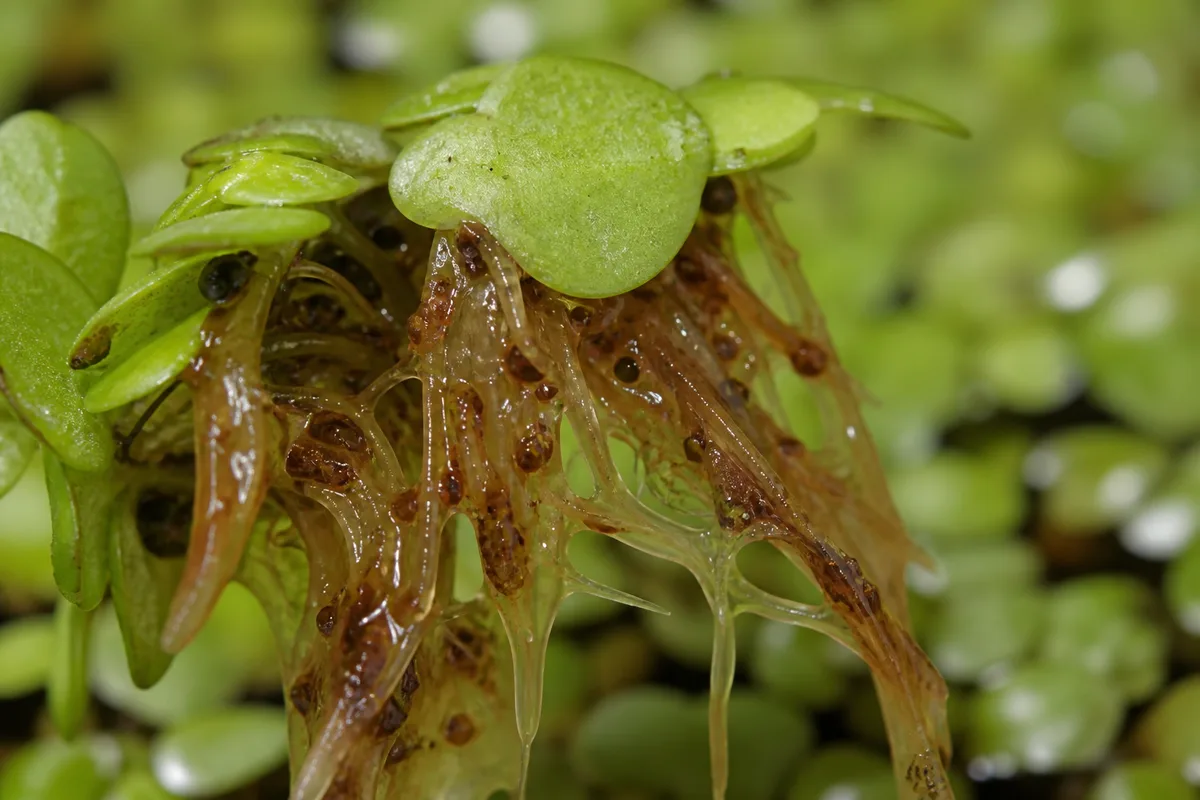
Root Rot symptoms on Duckweed - compare with healthy tissue on the same plant.
Early signs:
- Yellow-brown fronds mixed into otherwise green cover, often concentrated at mat edges or filter corners
- Translucent “melt” fronds that tear when the net passes but lack the uniform dryness of underwatering damage
- Fine root clusters turning brown or disintegrating while the frond above still looks briefly green
- A faint sour or swampy smell when you lift the mat edge
Advanced decay:
- Slimy brown or black patches that coat multiple fronds and stick together in a greasy sheet
- Mat sections that sink or break apart when disturbed instead of sliding as a cohesive floating layer
- Persistent cloudiness or foam at the surface after skimming
- Livestock gasping at dawn, filter intake clogging, or submerged plants melting below a thick canopy
If white cottony growth appears only on sunken debris at the gravel line while floating colonies stay green, read mold on substrate under duckweed-that is saprophytic growth on waste, not live-frond rot at the surface.
Why Duckweed cultures collapse
Dense mats and oxygen stress
Duckweed clusters in large mats in slow-moving water. In home tanks, unchecked growth can seal 70% or more of the surface within days-duckweed can double biomass in roughly two days under warm, nutrient-rich conditions.
When colonies cover the entire surface, oxygen transfer at the air-water interface drops and light penetration to submerged plants falls. Fronds trapped in the bottom layer of the mat yellow, shed, and begin anaerobic breakdown. At night, respiration continues while photosynthesis stops-warm, heavily covered tanks are especially vulnerable to dawn oxygen sags.
Decomposition and ammonia loading
Dying and decaying aquatic plant material removes dissolved oxygen from the water through decomposition. Bacteria breaking down rotting duckweed consume oxygen and release ammonia and other breakdown products back into the column. A sealed mat that dies in place can trigger a faster crash than live overgrowth alone because decay adds organics faster than a healthy skim exports them.
Research on Lemna minor shows that very high ammonium concentrations cause oxidative stress, chlorophyll loss, and growth suppression-so ammonia from rotting biomass can damage surviving fronds even after you remove visible slime.
Stagnant, nutrient-loaded water
Turtle tubs, overfed community tanks, and small patio containers often carry heavy nitrogen and phosphorus loads. Duckweed thrives on those nutrients until something limits gas exchange or a shock hits the culture. Dense duckweed growth can block sunlight and reduce oxygen in ponds; the same physics apply in aquariums at smaller scale.
Mineral creep from months of evaporation top-offs without partial water changes can also stress colonies-yellowing from TDS buildup is not decay, but it weakens mats until a hot week or missed harvest tips them into rot.
Water chemistry shocks
Unneutralized chlorine or chloramine in tap water kills delicate floating tissue within hours. Copper-based fish medications and algicides are equally risky. Always dechlorinate new water before it contacts duckweed.
Melt after shipping vs. true rot
New duckweed commonly sheds for three to seven days after cold shipment, bright-light shock, or a tank move. Melt fronds are often pale or translucent but not uniformly slimy, and smell stays mild if you skim daily. True mat decay deepens into brown slime, sour odor, and spreading collapse despite stable water level and chemistry.
How to confirm the cause
Work through these checks in order before adding fertilizer, medication, or replacing the entire culture:
- Coverage estimate - Quarter the surface mentally. If you cannot see open water without pushing fronds aside, dense-mat anaerobiosis is a prime suspect.
- Color, texture, and smell - Lift the thickest edge with a fine net. Slimy brown tissue with sour odor confirms decay. Dry crispy edges with low water level point to underwatering instead.
- Water level and stranding - Fronds stuck on dry glass or heater rims are drought stress, not rot. Full water with submerged slime supports decay diagnosis.
- Recent events - Missed weekly harvest, new turtle feeding spike, filter upgrade that increased surface splash, untreated tap water change, or copper treatment in the last two weeks?
- Chemistry tests - Ammonia above 0.25 ppm or any nitrite in a stocked tank supports urgent cleanup. Very low nitrate in a bright tank may mean nutrient limitation yellowing, not rot.
- Livestock behavior - Dawn gasping or shrimp clustering at the waterline suggests oxygen stress tied to thick mats or decomposition.
- Rule out lookalikes - Use the comparison table below before committing to a rot diagnosis.
| Pattern | Likely cause | Key differentiator |
|---|---|---|
| Slimy brown mat, sour smell, >70% cover | Anaerobic mat decay | Wet, foul tissue under dense canopy |
| Crispy edges, low waterline, dry hardware | Underwatering | Fronds stranded above water |
| Uniform yellow, stable level, low nitrate | Nutrient depletion | No slime; gradual pale-green fade |
| Pale shed after purchase or tank move | Acclimation melt | Mild smell; stops after stable week |
| White fuzz on gravel only | Substrate saprophytes | Green floating mat otherwise healthy |
| White fronds after large tap change | Chlorine/chloramine shock | Timing matches untreated water add |
Confirmed mat decay requires slime, smell, or chemistry evidence-not color change alone on a thin, open-surface culture.
First fix for Duckweed
Skim decaying brown, yellow, or slimy fronds from the thickest mat zones with a fine-mesh net held flat against the surface.
That single pass removes the organic load that fuels further breakdown and ammonia release. Compost or discard removed tissue immediately-do not return it to the tank or rinse it down a storm drain. Never release harvested duckweed into natural waterways.
Do not repot into well-drained mix. Do not stop adding water. Do not dump copper or broad fungicides into a stocked turtle tank as a first response. Do not fertilize a slimy collapsing culture on day one.
After decay skimming, if open water is still scarce, continue with broader flat passes until coverage drops toward 30–50%-the band most mixed aquariums and ponds tolerate without oxygen stress. See the duckweed pruning guide for harvest technique and coverage targets.
Step-by-step recovery
After the first decay skim:
- Thin the green canopy - Remove 30–50% of remaining healthy biomass if cover still exceeds roughly 70%. Export nutrients locked in fronds; reopen gas exchange.
- Partial water change - Replace 20–30% with dechlorinated water matched to tank temperature. Export dissolved organics and ammonia without shocking livestock.
- Clear filter intakes - Pull duckweed and sludge from inlet foam so flow recovers and fronds are not continuously shredded into the water column.
- Redirect surface flow - Angle filter returns downward or add a floating ring so new growth stays on calm water. Duckweed grows in quiet, undisturbed colonies, not under pounding outflow.
- Reduce feeding briefly - Smaller portions for one to two weeks lower new organic input while bacteria process existing decay.
- Test again in 24 hours - Recheck ammonia and nitrite if livestock were stressed. Repeat light skims if slime reappears at mat edges.
- Reseed from backup culture if needed - Float a teaspoon of the healthiest green fronds from a separate jar of dechlorinated tank water. If the main mat is more than half slime with no firm green survivors, starting from backup is faster than nursing dead biomass.
- Hold fertilizer three to five days - Let stabilized fronds resume budding before adding concentrated macros that could spike algae during recovery.
Make one major change at a time where possible: skim and thin first, then water change, then feeding adjustment. Stacking unrelated treatments makes it harder to see what helped.
Recovery timeline
Within 24–48 hours: Sour smell should fade and slime spread should stop after decay removal and a partial water change. Fish dawn gasping should ease once coverage drops and oxygen exchange widens.
Within three to seven days: New pale-green fronds commonly bud from surviving clusters in warm, nutrient-adequate water. Open water should stay visible in multiple surface zones if you maintain the 30–50% harvest band.
One to two weeks: A culture that retained scattered firm green tissue often re-covers a healthy portion of the surface. Mats that were more than half uniform slime with no green survivors may need full reseeding from backup or clean nursery stock.
Old brown or translucent fronds do not re-green. Judge recovery by fresh budding colonies and stable livestock behavior, not by salvaging every damaged leaf.
Signs the problem is worsening: slime returns within 24 hours of skimming despite thinning, ammonia stays elevated, entire mat turns uniformly brown, or fish deaths occur after cleanup. At that point, remove all visible duckweed, perform a larger partial change, verify filtration and feeding, and restart from a quarantined backup source rinsed in dechlorinated water.
What not to do
Do not stop watering or let any “soil surface” dry-duckweed requires continuous water contact on fronds and roots.
Do not unpot, trim mushy roots in potting mix, or repot into well-drained houseplant soil. There is no pot and no terrestrial root ball.
Do not keep adding untreated tap water hoping to dilute slime. Chlorine worsens shock; use dechlorinated water only.
Do not leave a 90%+ mat in place because the top still looks green. Decay progresses underneath until an overnight oxygen crash or ammonia spike hits.
Do not confuse drought with rot. Stranded dry fronds are crispy, not slimy-see underwatering on duckweed.
Do not return skimmed decay to the tank or compost pile beside an outdoor pond where wind can blow fragments back to water.
Do not treat with copper-based medication in the same tank as a duckweed culture you intend to keep. Move plants to a hospital container or expect total loss of floating colonies.
How to prevent mat decay next time
Harvest on a rhythm, not a crisis schedule. Pair skimming with your weekly partial water change; in turtle tanks and summer ponds, scoop every three to five days when growth is fast.
Skim decay before green biomass whenever you net the surface-rotting material under the canopy degrades water quality faster than removing live fronds alone.
Target 30–50% surface coverage in mixed livestock setups so light reaches submerged plants and the water surface can exchange gas. Treat 70% cover as a hard ceiling, not a goal.
Maintain a backup culture jar with dechlorinated tank water and a thin floating layer. If the display mat collapses, you reseed without buying new stock.
Dechlorinate every addition and avoid copper medications in the main display. Test ammonia and nitrite monthly in heavily fed turtle tubs.
Remove uneaten food within an hour, vacuum sunken melt during water changes, and keep filter intakes protected with pre-filter foam so fronds are not continuously pulverized into the column.
For outdoor ponds, provide partial shade before the hottest weeks and skim before surface cover seals completely-small amounts of duckweed are harmless; dense growths block sunlight and reduce oxygen.
When to worry
Treat as urgent when fish or turtles gasp at dawn, ammonia or nitrite readings rise above safe livestock limits, or more than half the mat is slimy brown with sour odor. Dense duckweed cover can contribute to oxygen depletion and fish kills when decay outpaces harvest-especially in warm, shallow water.
Also act promptly if you recently added untreated tap water to a small culture jar and fronds turned white within hours-that is chemical shock, not slow rot, but the salvage path is the same: remove dead tissue, dechlorinate, and reseed from any surviving green fronds.
If water level is stable, coverage is moderate, chemistry tests are normal, and yellowing continues without slime for more than a week, stop assuming mat decay and review nutrients, light, and TDS per the watering guide.
Conclusion
Root rot on duckweed is almost always mat-level organic breakdown or water-quality failure in a floating aquatic culture-not overwatering on Duckweed in a houseplant pot. Dense sealed mats shed anaerobic, ammonia-rich decay under the green canopy; chemistry shocks and heavy organic loading produce similar slime without any soil involved. Skim brown and foul-smelling fronds first, thin to roughly 30–50% open water, partial-change with dechlorinated water, and reseed from a backup jar if needed. Prevent recurrence with weekly harvest, decay-first skimming, and calm surface conditions. Recovery shows up as fresh green budding on open water-damaged fronds will not re-green, and that is normal.
When to use this page vs other Duckweed guides
- Duckweed watering guide - Use for routine moisture checks before assuming root rot is the main issue.
- Duckweed problems hub - Browse all 16 common issues on this species.
- Overwatering on Duckweed - Different entry point when symptoms overlap with root rot.
- Yellow Leaves on Duckweed - Different entry point when symptoms overlap with root rot.
- Wilting on Duckweed - Different entry point when symptoms overlap with root rot.