Underwatering on Duckweed: Causes, Checks & Fixes
Quick answer
Underwatering on duckweed means fronds dried out because water level dropped or mats stranded above the surface. First step: top off with dechlorinated, temperature-matched water and float every frond back onto calm surface water.
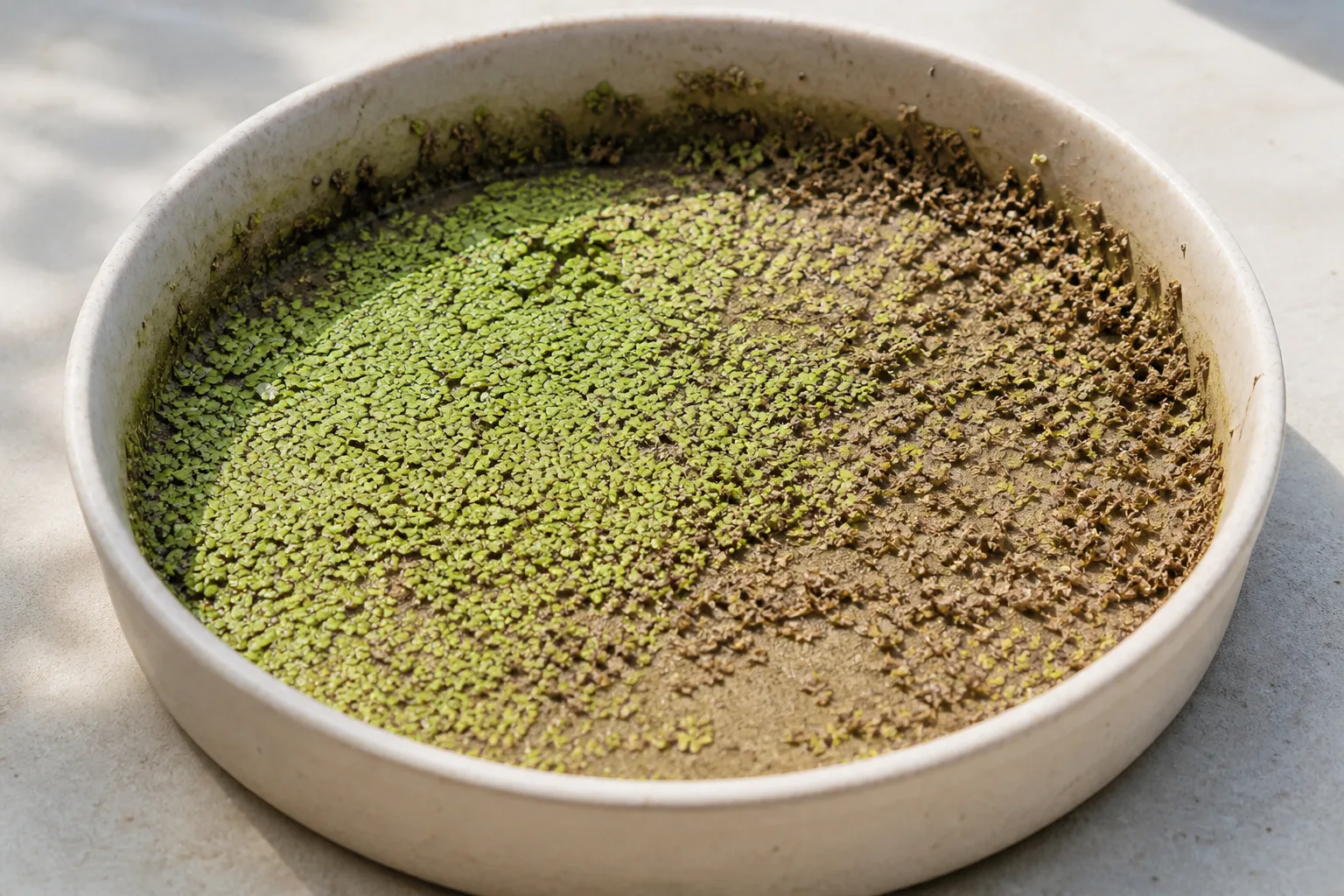
Underwatering on Duckweed: Causes, Checks & Fixes
This guide covers underwatering on Duckweed. See also the general Underwatering guide, watering, and light pages for this plant.
Underwatering on Duckweed: Causes, Checks & Fixes
Quick answer
Duckweed does not live in soil, so “underwatering” here almost always means fronds lost contact with water-not a forgotten watering can. When the tank level drops from evaporation, filter splash pushes mats onto dry glass, or you leave harvested duckweed on a counter too long, the tiny floating leaves dehydrate fast. Healthy duckweed should sit as a thin green film on calm water with roots dangling below.
First step: top off with dechlorinated, temperature-matched water and gently float every stranded frond back onto the surface. Do not reach for fertilizer until water level and surface contact are restored. Crispy tissue will not green up again, but new buds usually appear within days once the mat is fully wet.
Why Duckweed gets underwatered
The label “underwatering” misleads keepers who treat duckweed like a potted houseplant. Lemna, Spirodela, and related species are free-floating aquatics that take up water and dissolved nutrients directly from the column below. They have no soil buffer. Any gap between frond and water surface is drought stress.
Common triggers in home setups:
- Evaporation without top-offs - Open-top aquariums, patio tubs, and turtle tanks lose water steadily, especially in heated rooms or summer sun. Minerals stay behind; fronds do not, and low water exposes rims and hardware where mats get stranded.
- Strong surface flow - Filter outflow aimed at the surface shatters mats and can pile duckweed against dry edges or push fronds under turbulent water where gas exchange and light differ from calm floating culture.
- Transfer and harvest delays - Scooping duckweed into a net or bowl for thinning, then leaving it on a dry surface for even an hour, causes edge crisping and mat breakup. Small backup cultures in shallow jars dry out fastest.
- Over-thinning without a reserve - Turtles and goldfish graze duckweed quickly. If you remove most of the mat and the remaining fronds sit in too shallow water, the culture cannot rebound before the level drops again.
- Misread care advice - Advice written for terrestrial plants (“wait until soil dries”) does not apply. Duckweed needs constant surface contact; the equivalent of dry soil is a dry frond.
Duckweed grows explosively when conditions are right-it can double biomass in roughly two days under optimal light and nutrients-but that speed also means damage shows up within hours once fronds dry out.
What underwatering looks like on Duckweed
Underwatering on duckweed has a distinct look that differs from nutrient yellowing or rot:
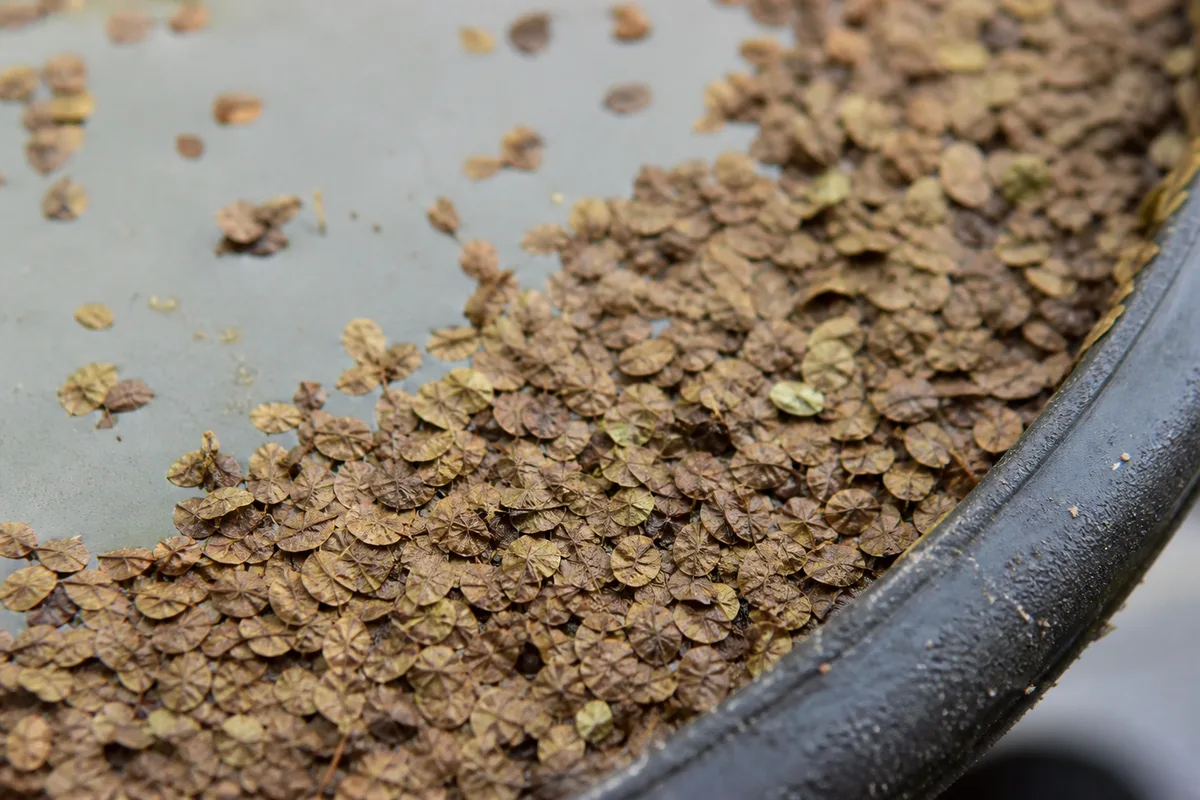
Underwatering symptoms on Duckweed - compare with healthy tissue on the same plant.
Typical dehydration signs:
- Dry or papery frond edges - Individual leaves turn tan to brown at margins while the center may still look green briefly.
- Shrinking, thin mats - Coverage that was dense yesterday looks sparse, with gaps showing open water.
- Mats clinging to dry surfaces - Fronds stuck on tank glass above the waterline, filter brackets, heater tops, or driftwood that projects out of the water.
- Fronds breaking apart when touched - Healthy duckweed separates easily in nets; dehydrated tissue crumbles or tears instead of sliding as a cohesive sheet.
- Pale, flattened appearance - Dehydrated fronds lose turgor and look thinner than the plump oval leaves on a healthy mat.
Patterns that suggest underwatering rather than other problems:
- Damage concentrates at the waterline edge or on fronds that were obviously above water.
- The water level is visibly low compared with equipment marks or a reference tape on the glass.
- Problems started right after a missed top-off, heat wave, or long net hold-not gradually over weeks with stable water level.
If the water level is full and fronds stay submerged yet turn uniformly yellow, suspect nutrient depletion or poor water quality instead. If fronds are waterlogged, translucent, and foul-smelling, look toward overwatering on Duckweed / stagnant anaerobic conditions, not drought.
How to confirm the cause
Work through these checks before changing fertilizer or moving the tank:
- Water level vs reference mark - Tape or note the normal surface height against the tank frame, heater, or label. More than about half an inch below that mark on an open-top tank strongly supports evaporation stress.
- Stranding scan - Trace the tank perimeter. Fronds on dry glass or hardware confirm contact loss even if most of the mat still floats.
- Touch test on edges - Gently lift a corner of the mat. Crispy, crackling edges that break when bent indicate dried tissue; soft yellow fronds in full water suggest a different diagnosis.
- Recent handling review - Did you net duckweed yesterday and leave it in a dry colander? Transfer delays are a common hidden cause in small cultures.
- Flow check - Watch the filter outflow. If the surface churns like a whirlpool, duckweed may be cycling into splash zones or submerging repeatedly.
- Rule out lookalikes - With stable water level and no stranded fronds, test nitrate and general water clarity before calling it underwatering. Uniform yellowing in fully submerged mats often traces to nitrogen limitation or mineral buildup, not drought.
Confirmed underwatering requires visible contact loss or a clear recent drop in water level-not guesswork from color alone.
First fix for Duckweed
Top off the tank with dechlorinated water matched to within about 2°F of the existing volume, then float every stranded frond back onto calm surface water.
That single step restores the environment duckweed requires. Dechlorinate every addition before it enters the tank. Use a clean cup or pitcher; pour slowly along the glass to avoid blasting mats under the outflow. After the level returns to your reference mark, use a spoon or finger to slide fronds off dry rims, heater caps, and driftwood back onto the surface. Skim obviously brown, paper-thin debris so rotting tissue does not foul the water.
Do not dump a full bottle of plant fertilizer into a dehydrated culture on day one. Do not aggressively scrub fronds under running tap water-brief exposure to chlorinated stream water adds stress. If you maintain a backup jar, top that off at the same time so your reserve culture does not fail while the display tank recovers.
Step-by-step recovery
After the initial top-off:
- Redistribute the mat - Spread fronds thinly so they cover roughly 25 to 50 percent of the surface rather than one thick clump that blocks gas exchange and traps heat.
- Baffle or redirect flow - Angle the filter outlet downward or add a surface baffle so new growth stays on calm water.
- Remove unsalvageable tissue - Compost or discard fronds that are fully brown and brittle; they will not recover and can decay in the tank.
- Hold fertilizer for three to five days - Let rehydrated fronds stabilize. If new growth stays pale after water level is stable for a week, then test nitrate and consider a dilute aquarium-safe supplement.
- Restart a backup culture - Float a teaspoon of the healthiest green fronds in a separate jar of dechlorinated tank water near a window or under a plant light. This insurance prevents total loss if the main tank level drops again.
- Monitor daily for one week - Check the waterline each morning in open-top setups until the level stays steady between top-offs.
In turtle tanks, expect grazing to thin the mat; replenish from the backup jar rather than letting coverage drop to a few scattered fronds in shallow water.
Recovery timeline
Mild edge crisping often stops spreading within hours once fronds sit fully on water again. New bud growth from surviving green tissue commonly appears within two to five days under moderate light and stable temperature. Mats that were mostly dried to brown may need one to two weeks to re-cover the surface from scattered survivors-if any green fronds remain.
Old crispy leaves do not revert to green. Judge success by fresh oval fronds multiplying at the edges of healthy clusters, not by damaged tissue rehydrating.
Signs the problem is worsening: increasing brown area despite full water level, foul smell from decaying mats, or complete mat disintegration within 24 hours of re-wetting. At that point, discard the dead batch and reseed from a clean backup source or nursery stock rinsed in dechlorinated water.
Lookalike symptoms to rule out
Nitrogen or phosphorus depletion - Fronds yellow uniformly while fully submerged and water level is stable. Water tests show very low nitrate in a bright, lightly stocked tank. Fix with partial water changes or controlled fertilizer, not more top-offs alone.
Mineral and TDS buildup - Yellowing or stalled growth with stable water level but months of evaporation top-offs without partial changes. TDS climbs even though fronds never dried out.
Strong surface agitation - Fronds sink, fragment, or collect in the outflow corner looking damaged, but tissue is wet, not crispy. Duckweed clusters in slow-moving water; calming the surface fixes this without raising water level.
Heat stress above roughly 90°F (32°C) - Outdoor pond mats yellow and shrink in extreme summer heat even with adequate water depth. Shade or skim coverage; the water is present but temperature exceeds comfort range.
Acclimation melt after purchase - New duckweed may pale or shed for several days after a cold shipment or tank move despite correct water level. Stable chemistry and light matter more than top-offs here.
Mistakes to avoid
Do not interpret houseplant underwatering advice-dry soil checks, bottom-watering trays, waiting for mix to dry-for duckweed. There is no potting mix involved.
Do not leave netted duckweed on a counter while you finish a water change. Keep harvested fronds floating in a bowl of tank water.
Do not confuse “adding water” with “changing water.” Top-offs restore level; partial water changes export minerals and waste. Both matter, but only top-offs fix contact loss from evaporation.
Do not push duckweed fully underwater thinking it needs “more water.” Submerged fronds struggle; the plant is adapted to float.
Do not fertilize a dehydrated culture hoping to green it up. Rehydrate first.
Do not rely on misting the room or raising ambient humidity. Duckweed needs direct water contact on fronds and roots, not humid air alone.
How to prevent underwatering next time
Mark a target waterline on open-top aquariums and check it every few days-daily in summer heat or near basking lamps in turtle setups.
Pair top-offs with a regular partial water-change rhythm so you are already at the tank weekly; use that visit to verify level and redistribute mats away from dry hardware.
Keep filter outflow below the surface or baffled so duckweed stays on calm water.
Maintain a backup jar culture with at least an inch of dechlorinated water and a thin floating layer. Refill the jar whenever you top off the main tank.
When thinning duckweed, move excess directly into a container of tank water or the backup jar-never onto a dry surface.
For outdoor tubs and ponds, plan seasonal refills before heat waves drop small containers several inches. A floating thermometer helps catch heat stress early.
Skim to roughly 25 to 50 percent surface coverage so mats do not get wind-pushed or filter-pushed onto dry edges while still leaving enough plants to filter nutrients.
When to worry
Treat as urgent when most of the mat is brown and brittle, the backup jar has nearly dried out, or fronds have sat on a dry counter for more than an hour. Duckweed does not recover from total desiccation the way some terrestrial plants bounce back after a soak.
Also act promptly if low water exposed heater coils or filter intakes above the surface-equipment damage and livestock stress compound the plant issue.
If water level is correct, fronds are fully floating, and yellowing continues for more than a week after stable care, stop topping off blindly and test water quality for nutrients, pH drift, or ammonia. Continuing to add water will not fix a chemistry problem.
Conclusion
Underwatering on duckweed is a water-contact problem, not a soil-moisture problem. Low levels from evaporation, stranded mats on dry tank hardware, and harvest delays dehydrate tiny fronds within hours. Top off with dechlorinated, temperature-matched water, float every frond back onto calm surface water, and remove crisp dead tissue. Prevent recurrence with a marked waterline, gentle surface flow, and a backup jar culture. Once contact is restored, new growth tells you the fix worked-crispy old leaves will not, and that is normal.
When to use this page vs other Duckweed guides
- Duckweed watering guide - Use for routine moisture checks before assuming underwatering is the main issue.
- Duckweed problems hub - Browse all 16 common issues on this species.
- Wilting on Duckweed - Different entry point when symptoms overlap with underwatering.
- Brown Tips on Duckweed - Different entry point when symptoms overlap with underwatering.
- Yellow Leaves on Duckweed - Different entry point when symptoms overlap with underwatering.