Yellow Leaves on Duckweed: Causes, Checks & Fixes
Quick answer
Pale or yellow duckweed fronds usually trace to nutrient-poor water, chlorinated tap after a water change, excessive surface coverage, or cold water-not soil or pot problems. First step: test ammonia and nitrate, estimate surface coverage, and confirm the last water change used dechlorinator.
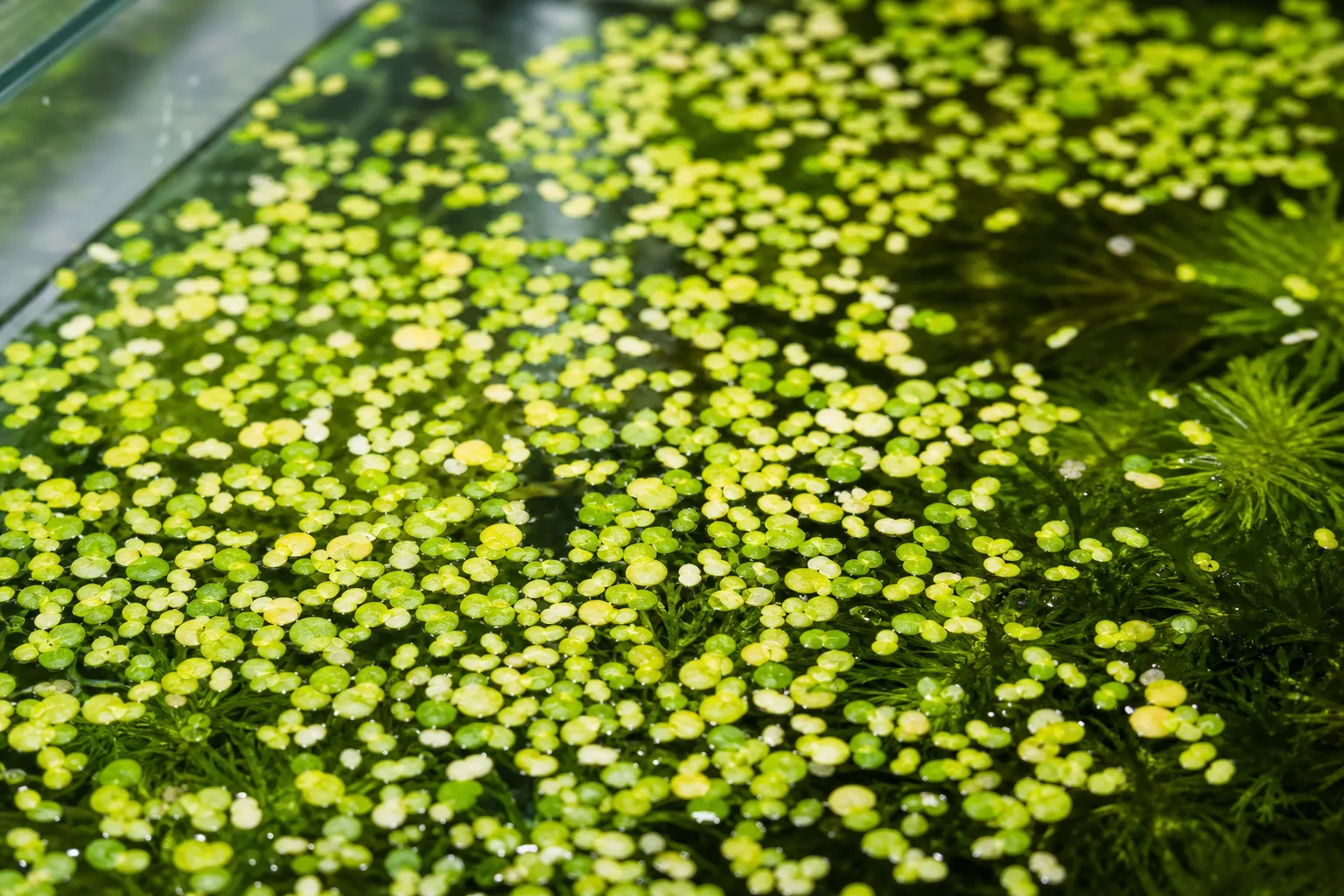
Yellow Leaves on Duckweed: Causes, Checks & Fixes
This guide covers yellow leaves on Duckweed. See also the general Yellow Leaves guide, watering, and light pages for this plant.
Yellow Leaves on Duckweed: Causes, Checks & Fixes
Quick answer
Pale or yellow duckweed fronds are a water-surface symptom, not a houseplant leaf problem. Duckweed (Lemna, Spirodela, Landoltia, and related floating species) lives entirely on open freshwater-no pot, no soil, no roots to inspect in potting mix. When fronds lose their deep green color, the cause is almost always in the water column, light at the surface, surface coverage, or recent water chemistry-not underwatering on Duckweed a terrestrial plant.
First step: test ammonia and nitrate, estimate how much of the surface the mat covers, and confirm whether your last water change used dechlorinator. In turtle tanks, check ammonia before assuming nitrogen deficiency. In lightly stocked display tanks, pale fronds with good light often mean dissolved nutrients are low. In every setup, a mat covering nearly 100 percent of the surface commonly yellows its own lower layers from self-shading.
This guide covers pale and yellow frond diagnosis in aquariums, ponds, and turtle tubs. For baseline culture parameters, see the duckweed care overview. For photon-specific troubleshooting when the whole mat is lime-green and sparse, see not enough light on duckweed.
Floating culture scope
Duckweed is a free-floating freshwater macrophyte in the subfamily Lemnoideae. Each tiny frond (thallus) floats at the air-water interface and absorbs nutrients directly from the water-there is no substrate culture, no “top inch dry” check, and no crown or rosette leaf pattern like terrestrial houseplants.
Lemna minor fronds typically span 1 to 8 mm across; Spirodela polyrhiza runs larger with several visible roots per frond. That size gap matters when you judge mat thickness-dense Spirodela stacks self-shade faster than thin Lemna films at the same surface percentage, so skim more aggressively when your culture runs on the larger genus.
Keepers encounter yellowing in three common setups:
- Aquariums - community tanks, shrimp tubs, and quarantine containers where duckweed exports nutrients and shades shy species
- Ponds and outdoor tubs - seasonal temperature swings, fountain spray, and spring overgrowth after winter die-off
- Turtle tanks - high bioload, basking-platform shade, filter splash, and grazing that strips mats quickly
If your only plant experience is potted houseplants, reframe every diagnostic step around water tests, surface coverage percentage, dechlorination, and frond budding-not soil moisture or root firmness. Terrestrial overwatering logic does not apply; duckweed is always submerged at the surface interface.
What pale or yellow fronds look like on duckweed
Duckweed does not have “leaves” in the houseplant sense-it has millimeter-scale fronds that bud daughter plants vegetatively. Yellowing appears as color change across those fronds and mats, not as lower leaves on a stem.
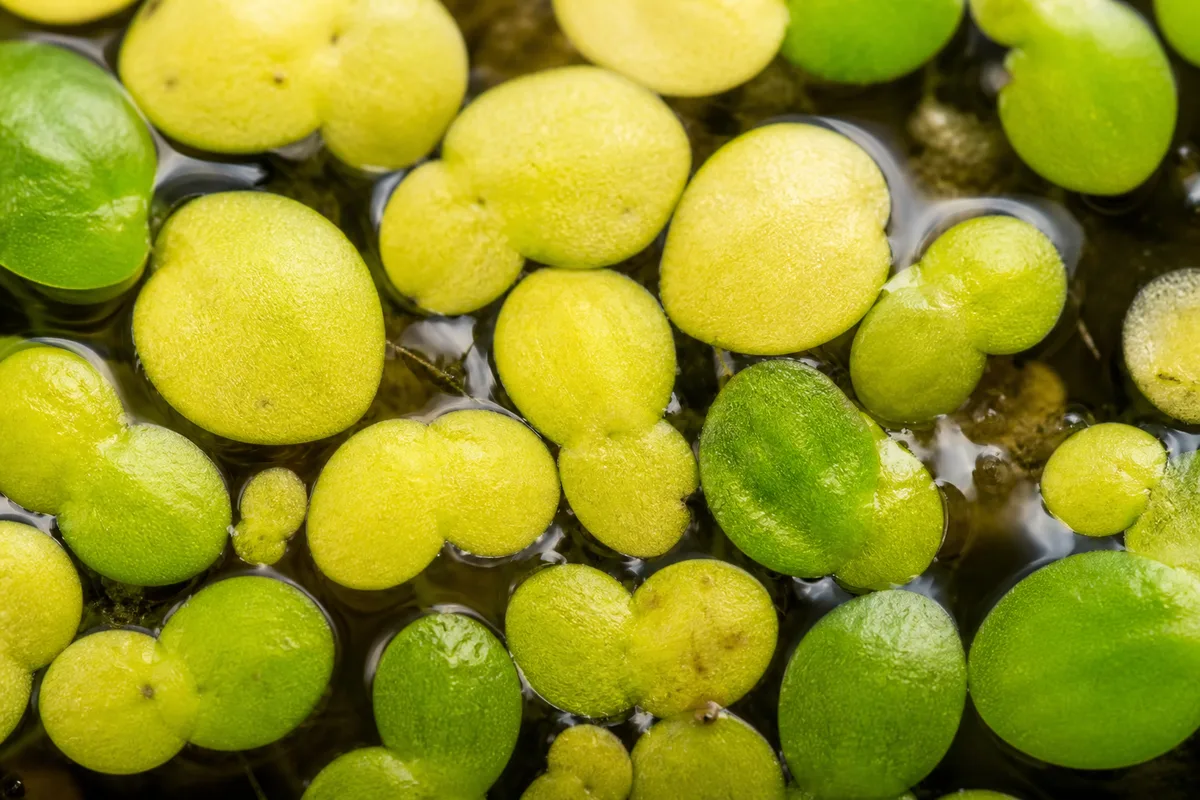
Yellow Leaves symptoms on Duckweed - compare with healthy tissue on the same plant.
Typical patterns:
- Uniform lime-green or yellow-green across most fronds - often nutrient limitation in a clean, brightly lit tank, or insufficient light intensity across the whole surface
- Deep green top layer with yellow, slimy fronds underneath - self-shading in an over-dense mat; lower layers starved for light and oxygen at the stack interface
- Sudden bleach-white or translucent melt after a water change - chlorine or chloramine shock; may spread across the whole culture within hours
- Pale scatter with stalled spread - cold water slowdown, weak photoperiod, or post-shipping acclimation melt
- Yellowing that follows copper medication or algicide - chemical phytotoxicity; fronds may dissolve rather than simply pale
- Whole-culture fade in a turtle tub with cloudy water - suspect ammonia or nitrite before fertilizer; pale duckweed can track poor water quality in heavy feeding setups
Recovery signal: Watch newly budded daughter fronds at the mat edge. Older pale disks rarely re-darken in place; healthy culture shows fresh deep-green buds within days once the limiting factor is corrected.
Symptom photos pending: labeled images of green-top/yellow-bottom self-shading, uniform nutrient-pale mats, and chlorine bleach-white melt will be added in a future update so readers can confirm patterns at a glance.
Why duckweed fronds turn pale or yellow
Nutrient-poor water column
Duckweed pulls dissolved ammonium, nitrate, and phosphate from the water, not from soil. In lightly stocked display tanks, quarantine setups, and rainwater-filled tubs, fronds may stay pale despite adequate light because nitrate and phosphate are near zero. The plant persists as a thin lime-green film rather than a deep-green carpet.
Well-fed aquariums and turtle habitats usually supply enough waste-derived nutrients without deliberate fertilizing. If the entire culture is pale in bright water with zero ammonia, nutrient poverty is a leading suspect-see the duckweed fertilizer guide for dilute dosing after you confirm light and temperature.
RO or ultra-soft water edge case: tanks filled exclusively with reverse-osmosis or distilled water can show persistent lime-green paleness even when macronutrients test adequate, because trace minerals-especially iron-are stripped from the source. Iron becomes less plant-available as pH rises, so pale fronds in very clean soft water may need a complete aquatic fertilizer with chelated iron rather than nitrogen alone. Confirm light and temperature first; then dose half-strength complete aquatic fertilizer and watch new daughter fronds over seven days.
Chlorine and chloramine shock after water changes
Unneutralized tap disinfectants attack delicate floating tissue. A large water change with untreated tap can turn fronds white or dissolve them within hours-often misread as “duckweed died” when surviving specks would bud back under dechlorinated conditions. Always treat new water before it contacts your culture; see the duckweed watering guide for dechlorination rhythm.
Excessive surface coverage (self-shading)
Duckweed performs best when it covers a partial share of the surface, not a sealed lid. When coverage exceeds roughly 70 to 80 percent, upper fronds block sunlight penetration to lower layers and submerged plants below and can cause oxygen depletion at the surface. The top may look green while underneath turns yellow and decays-adding fertilizer without thinning often worsens the stack because accelerated growth thickens the dead lower layer.
Target 30 to 50 percent coverage in mixed aquariums; skim weekly in warm bright conditions.
Cold water slowdown
Growth and chlorophyll production slow noticeably below about 60°F (15°C). Outdoor ponds in early spring, unheated garage cultures, and cold-room tubs may hold fronds alive while color washes out to yellow-green. Warming into the roughly 60 to 90°F (15 to 32°C) active band restores green budding faster than fertilizer alone.
Ammonia or nitrite spikes (turtle tanks and new cycles)
In turtle tubs and overloaded feeding tanks, pale or melting fronds can track ammonia stress before you ever reach nitrogen deficiency. Duckweed takes up nutrients through all exposed surfaces but does not replace a cycled biofilter. Ammonia in aquatic systems is toxic even at low concentrations-test ammonia and nitrite first in any turtle habitat showing whole-mat fade, cloudy water, or rapid melt. Reduce feeding temporarily, perform a partial water change with dechlorinated water, and verify filtration before dosing aquatic fertilizer.
Acclimation melt after harvest, shipping, or pond collection
Newly introduced duckweed commonly sheds fronds during the first week after shipping, wild harvest, or a large temperature swing. That temporary melt is not the same as chronic nutrient stress unless paleness persists after water stabilizes. Float a small starter portion in calm dechlorinated water under moderate light and wait seven to ten days before declaring the culture failed.
Copper medication and algicide exposure
Copper-based fish medications and some algaecides damage floating plants. If yellowing or dissolution follows a hospital-tank treatment or pond herbicide application, assume chemical injury. Reintroduce duckweed only after confirming the display system is copper-free. In turtle habitats treated with copper-based fish medications, consult your veterinarian before returning duckweed as forage-copper clearance timelines vary by dose and filtration, and reptile systems tolerate residual copper differently than planted display tanks.
Symptom lookalike comparison
| Pattern | Likely cause | Quick check | First action | Urgency |
|---|---|---|---|---|
| Uniform pale green in bright, ultra-clean tank | Nutrient poverty | Nitrate near zero; ammonia zero | Half-strength aquatic fertilizer after partial water change | Low - adjust over days |
| White melt within hours of tap water change | Chlorine/chloramine shock | Recent untreated top-off or change | Dose dechlorinator; remove dissolved tissue | Medium - act same day |
| Green top, yellow slimy bottom in thick mat | Self-shading | Coverage near 100% | Skim to ~30–50% surface | Low - routine weekly skim |
| Pale culture, slow spread, cold water | Temperature stall | Water below ~60°F (15°C) | Warm culture or wait for seasonal rise | Low - seasonal wait |
| Whole-mat fade, cloudy turtle water | Ammonia/nitrite stress | Test NH₃/NH₄⁺ and NO₂⁻ | Partial water change; improve filtration | High - same day |
| Melt after medication | Copper/chemical exposure | Recent fish treatment | Remove plants; confirm copper cleared | High - culture restart likely |
| Thin pale scatter first week after purchase | Acclimation melt | Recent shipping or harvest | Stable dechlorinated water; wait 7–10 days | Low - observe |
| Limp, flat fronds on calm water | Wilting / contact loss | Fronds stranded on dry rim or heavy flow | Restore calm water contact; see wilting guide | Medium - fix contact today |
Confirm the cause - inspection checklist
Work in this order:
- Recent water changes - Did the last addition use dechlorinator? How large was the change?
- Ammonia and nitrite - Especially in turtle tanks, new cycles, or after filter disruption. Zero is the target in cycled systems per UF/IFAS ammonia guidance.
- Nitrate and general clarity - Very low nitrate in a bright, lightly stocked tank supports nutrient poverty; foul cloudy water points to bioload stress first.
- Surface coverage estimate - Glance from above: solid lid versus ~half open water. Peel back a thick corner and compare top frond color to the layer touching the water.
- Light hours and fixture strength - Count photoperiod; note hood shadows from basking platforms or rim glare. Uniform pale scatter in a bright-looking tank may still be light-limited-compare surface PAR to the duckweed light guide targets (roughly 40–70 µmol m⁻² s⁻¹ at the water surface for dense green growth, with 110 µmol m⁻² s⁻¹ cited as efficient for biomass production).
- pH - Most community aquariums and turtle tubs run healthiest for duckweed between pH 6.5 and 7.5; extreme swings can stress floating tissue alongside nutrient uptake.
- Water temperature - Thermometer reading or season context for outdoor tubs.
- Chemical history - Copper meds, algicides, or wild pond harvest near treated lawns in the last two weeks.
- Newest daughter fronds - Green buds at the edge mean the culture is recovering even when older disks look bad.
Do not inspect soil moisture, pot weight, crown firmness, or terrestrial lower-leaf senescence-those checks do not apply to floating duckweed.
First fix for duckweed
If you are unsure where to start: skim the mat to roughly 30–50 percent surface coverage, confirm the water is dechlorinated, and test ammonia in turtle or newly stocked tanks.
Then branch by what you confirmed:
- Chlorine shock suspected - Remove melted tissue, dose dechlorinator per product label, avoid another large untreated tap change for 48 hours, and protect remaining fronds from filter splash with a floating ring.
- Self-shading confirmed - Harvest volume weekly until open water is visible between clusters; compost or feed trimmings-never release to natural waterways.
- Nutrient poverty in a clean bright tank - After ammonia reads zero, add half-strength liquid aquatic fertilizer following a partial water change; wait seven days before a second dose.
- Turtle-tank ammonia present - Partial water change, reduce feeding temporarily, and verify filtration before any fertilizer.
- Cold water - Move a starter culture indoors or wait for warming; do not stack fertilizer on a dormant mat.
- Light-limited uniform pale scatter - Move fronds to the brightest calm surface zone and extend photoperiod toward 10–12 hours before blaming nutrients; see not enough light.
Make one targeted correction, then wait seven days before stacking fertilizer, medications, and major filtration overhauls.
Recovery timeline by cause
| Cause | What to expect |
|---|---|
| Chlorine shock (survivors present) | New green buds within 3–7 days in warm dechlorinated water |
| Self-shading after skim | Lower-layer yellow decay stops; edge budding greens up in ~1 week |
| Nutrient supplementation | New daughters deepen in color within 5–10 days; old pale disks may not darken |
| Cold slowdown | Color and spread return as water warms-days to weeks depending on temperature rise |
| Acclimation melt | Stabilization within 7–10 days if light and water are steady |
| Ammonia/copper damage | May require restarting from firm green backup culture; melted tissue rarely recovers |
Under warm nutrient-rich conditions, duckweed commonly doubles biomass every two to three days when healthy-use new green frond budding as your success metric, not the color of older disks.
Editorial note: In a 78°F community tank, edge buds often green within five days after skimming a self-shaded mat from full coverage to roughly 40 percent open water-recovery tracks new daughters, not the pale disks left behind.
What not to do
- Do not check soil moisture, repot, or flush salts from a pot-duckweed has no potting mix.
- Do not dose terrestrial houseplant fertilizer into aquarium or turtle water.
- Do not fertilize while ammonia or nitrite is elevated.
- Do not leave a 100 percent surface lid in place because “duckweed likes to float”-thin first when lower layers yellow.
- Do not add copper medications to a tank you intend to keep planted with duckweed.
- Do not dump live duckweed into storm drains, streams, or ponds where it may establish aggressive invasive mats.
How to prevent pale fronds next time
- Maintain a backup culture jar - Keep a quart of dechlorinated water under a cheap full-spectrum LED on a windowsill or shelf. If chlorine shock or turtle grazing wipes the main tank, you restart from this reserve instead of buying again. Refresh the jar water weekly and skim excess so it does not self-shade.
- Source pesticide-free plants when duckweed is turtle forage; wild pond harvest near treated lawns can carry herbicide residue that yellows cultures weeks later.
- Test water on a schedule in turtle tubs matched to feeding level-do not wait for visual melt.
- Skim before the mat seals the surface - prevention is easier when you harvest at 50 percent coverage rather than waiting for yellow lower layers.
For dechlorination rhythm, photoperiod targets, pH bands, and ongoing nutrient balance, use the watering, light, and fertilizer guides rather than repeating every baseline parameter here.
When to worry
Higher urgency: ammonia or nitrite above zero with melting fronds; whole-culture white dissolve within 48 hours of medication; foul-smelling cloudy water; rapid die-off across an outdoor pond after herbicide drift.
Lower urgency: Slow cosmetic paleness with green daughter buds at the mat edge, seasonal yellow-green color in cold spring water, or lower-layer yellowing in a mat you already plan to skim this week.
If pale fronds persist after two weeks with confirmed dechlorinated water, adequate light, appropriate temperature, 30–50 percent coverage, and zero ammonia, review whether dissolved nutrients are genuinely low, whether RO water needs chelated trace minerals, or whether a persistent chemical contaminant (copper, pesticide residue from wild harvest) is involved-and consider restarting from a clean vendor culture.
For persistent water-quality problems in turtle habitats, contact your veterinarian or your local cooperative extension office for species-specific habitat guidance.
Related duckweed problems
- Duckweed care overview - baseline floating-culture hub
- Not enough light on duckweed - sparse lime-green mats and PAR targets
- Wilting on duckweed - limp, deflated fronds and contact loss (not simple color fade)
- Slow growth on duckweed - spread stalls that accompany paleness
- Overwatering on duckweed - scope note for terrestrial-template searchers
- Duckweed fertilizer - dilute dosing after confirmed nutrient poverty
- Duckweed watering - dechlorination rhythm
- Duckweed light - photoperiod and surface PAR detail
FAQs
My duckweed turned pale after a water change-is it dead?
Not always. Chlorine or chloramine in untreated tap water can bleach or melt fronds within hours, but a few surviving green specks often bud new daughters within days once water is dechlorinated and calm. Scoop out white or dissolved tissue, dose dechlorinator if you skipped it, and watch for fresh green buds at the surface edge. If the entire culture turns translucent and sinks with no new specks after a week, restart from a backup jar or clean vendor source.
Is pale duckweed the same as melting or wilting?
Not always. Uniform lime-green paleness in bright water usually means nutrients or light limits. Sudden white dissolve after a water change is chlorine shock. Limp, thin, deflated fronds that lost turgor point to wilting-often stranded mats or flow stress-rather than simple color fade. Cosmetic pale fronds with firm plump shape and green edge buds are lower urgency than whole-mat dissolve or ammonia-cloudy water.
Should I fertilize or skim first?
Skim first when coverage exceeds roughly 50 percent or you see a green top with yellow slimy layers underneath-self-shading causes paleness that fertilizer alone worsens. Fertilize first only when the mat is thin, surface is mostly open, light is adequate, ammonia reads zero, and nitrate is near zero in a lightly stocked tank. In turtle tubs with moderate nitrate, fix filtration and harvest before assuming deficiency.
Will old pale fronds turn green again?
Usually no. Older pale disks rarely re-darken in place; recovery shows on newly budded daughter fronds at the mat edge within days to two weeks once you correct the limiting factor. Skim decaying yellow tissue so it does not foul water or block light to healthy survivors.
When is yellow duckweed urgent in a turtle or fish tank?
Treat as urgent if ammonia or nitrite reads above zero, fronds melt across the whole surface within 48 hours after a medication dose, or water clouds with a foul smell. Those patterns point to water-quality crisis or chemical exposure, not cosmetic nutrient stress. Pale fronds alone in otherwise clear, cycled water are lower urgency-confirm cause before stacking fertilizer, algaecides, or large water changes.
When to use this page vs other Duckweed guides
- Duckweed watering guide - Use for routine moisture checks before assuming yellow leaves is the main issue.
- Duckweed problems hub - Browse all 16 common issues on this species.
- Overwatering on Duckweed - Different entry point when symptoms overlap with yellow leaves.
- Underwatering on Duckweed - Different entry point when symptoms overlap with yellow leaves.
- Not Enough Light on Duckweed - Different entry point when symptoms overlap with yellow leaves.