Not Enough Light on Duckweed: Causes, Checks & Fixes
Quick answer
Duckweed in dim tanks stays pale, thin, and slow to spread. First step: float healthy fronds in the brightest calm surface zone and target roughly 110 µmol m⁻² s⁻¹ at the water line with 10–14 hours of full-spectrum light daily before adding fertilizer.
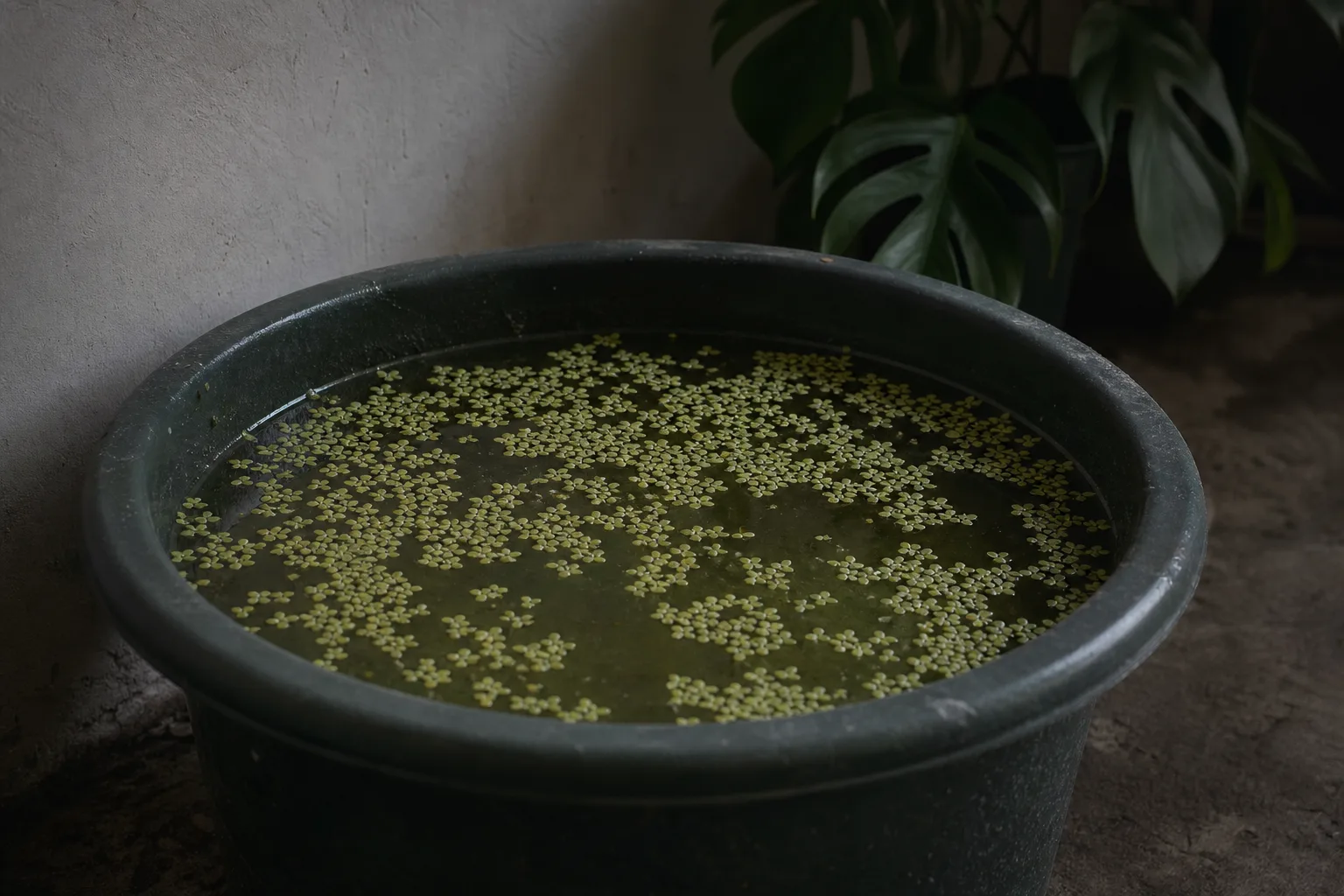
Not Enough Light on Duckweed: Causes, Checks & Fixes
This guide covers not enough light on Duckweed. See also the general Not Enough Light guide, watering, and light pages for this plant.
Not Enough Light on Duckweed: Causes, Checks & Fixes
Quick answer
Duckweed (Lemna, Spirodela, Landoltia, and related floating species) is often sold as nearly impossible to kill, but it still needs usable photosynthetic light at the water surface to form the dense green mats turtle keepers and aquarists actually want. In dim turtle tanks, low-tech aquariums, shaded ponds, and grow tubs blocked by overhangs, weak light shows up as pale yellow-green fronds, thin scattered coverage, slow or stalled spread, and mats that never thicken despite stable water changes.
First step: move healthy fronds into the brightest calm zone of the tank or tub-directly under your aquarium LED or into open sun on a protected outdoor container-and extend photoperiod toward 10–14 hours daily while targeting roughly 110 µmol m⁻² s⁻¹ at the water surface before you dose fertilizer or overhaul filtration. Duckweed floats at the air-water interface and catches more photons than anything submerged below it, but only when fronds stay on the surface in clear water. Filter splash that buries fronds underwater, murky turtle water, and short timer hours can all starve the culture while the plant technically survives.
This page is the symptom diagnosis and first-fix guide for pale sparse mats. For PAR calibration, fixture height, spectrum choices, and long-term light culture, see the duckweed light guide. For baseline biology and culture parameters, see the duckweed care overview. If spread is slow but multiple causes-cold water, nutrients, self-shade-may be stacking, see slow growth on duckweed.
Who this guide is for
Aquarium hobbyists, turtle-tank keepers, pond growers, and duckweed-culture users who see pale thin mats rather than the dense green carpet they expected. Duckweed has no stems and no directional lean toward a window-diagnosis depends on frond color, mat density, and doubling speed at the water surface, not houseplant stretch patterns.
What insufficient light looks like on duckweed
Low light reads on frond color, mat density, and doubling speed-not on stem stretch toward a window, because duckweed has no stems and no directional lean.
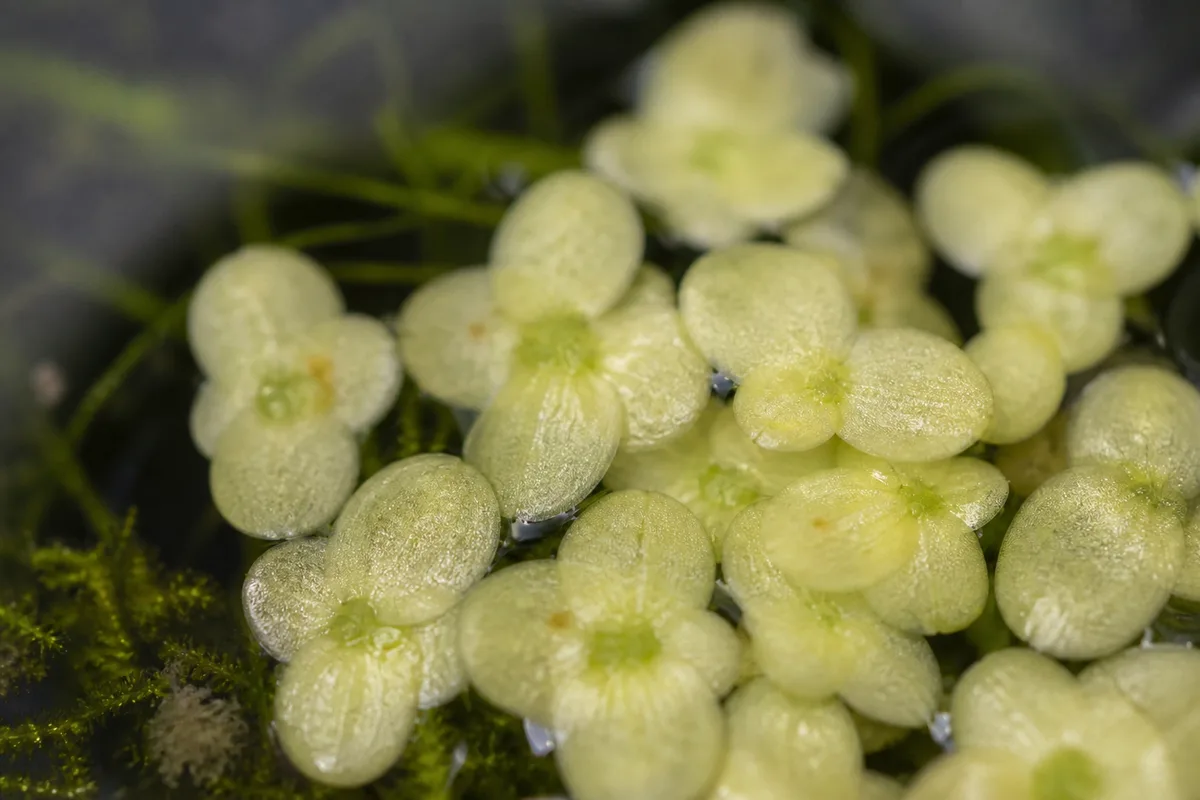
Not Enough Light symptoms on Duckweed - compare with healthy tissue on the same plant.
Typical signs:
- Pale lime-green or yellow-green fronds - healthy Lemna minor under good light runs deeper green; washed-out color on most of the mat signals low energy for chlorophyll production
- Thin, see-through scatter - individual specks persist without merging into a cohesive carpet
- Slow spread - coverage that barely expands over weeks; in bright warm water duckweed can double every two to three days, so glacial growth is a red flag
- Smaller new fronds - daughter disks bud smaller and lighter than older ones on the same cluster
- Dense growth only under the fixture - fronds pile up under the aquarium light while the rest of the surface stays bare
- Fronds sinking or clustering at outflow - turbulence pushes plants underwater where they photosynthesize poorly and look sparse
- Algae on glass but dull duckweed - photons reach the tank walls more than the floating layer when water is turbid or the mat is too thin to compete
Not the same as nutrient deficiency. Yellowing from low nitrate in a brightly lit, ultra-clean tank often hits new growth uniformly while spread still moves at a normal pace. Light-limited duckweed more often shows pale color plus stalled spread in shaded corners while fronds under the bulb still look acceptable-see yellow leaves on duckweed when pale fronds persist under already strong surface light. Not the same as post-move melt - newly introduced duckweed commonly sheds fronds during the first week in a new tank; persistent thinness after acclimation points to ongoing insufficient light.
Why duckweed runs out of light in tanks and ponds
Human eyes adapt to room brightness; floating fronds do not. A turtle tank that looks fine from across the room may deliver too few photons through tea-colored water, hood shadows, or a weak kit fixture.
Common triggers:
- Stock aquarium or turtle hood LEDs - fixtures sized for viewing, not for dense floating-plant production
- Short photoperiod - timers below roughly six hours daily leave too little cumulative light even if intensity is moderate
- Murky or green water - suspended particles and algae cut penetration before rays hit the surface layer; light attenuates sharply in water
- Filter surface agitation - powerheads, cascade returns, and strong outflows push fronds underwater where photosynthesis drops
- Self-shading mats - thick surface cover blocks light to fronds just millimeters below the top layer
- Basking platforms and hood edges - midday shadows on half the surface leave persistent bare zones
- Pond shade or tree canopy - outdoor cultures under heavy shade stay thinner than plants in open shallows; the RHS notes duckweed spreads fastest in full sun
- Competing surface plants - water lilies, water lettuce, or another duckweed mat stealing the photic zone
- Winter daylight drop - same timer in a dim room through short days collapses daily light totals
Duckweed tolerates dim conditions better than many aquatics, which is part of the trap: it persists as a few pale specks while you assume care is adequate-the survival-budget trap. In nature, duckweed colonizes sun-exposed quiet water; shaded ditches hold survivors, not harvest-grade mats. When light is low, the plant runs a survival budget-thin fronds, slow cloning, and little of the nutrient-scrubbing or turtle-forage density growers expect.
Low light also creates secondary mess in turtle setups. Sparse dying fronds decay, load filters, and contribute to cloudy water-which blocks light further in a feedback loop.
How to confirm the cause
Work through these checks before dosing fertilizer, moving turtles, or replacing the whole culture:
- Bright zone vs shaded zone comparison - Move a teaspoon of healthy fronds into the brightest calm corner under your fixture or into open sun on a separate shallow tray. If that patch greens and spreads within two weeks while the main tank stays sparse, light-not species failure-is the limiter.
- Photoperiod and fixture - Confirm timer hours. Most home production cultures need at least six hours of moderate light daily as a floor, with 10–14 hours under full-spectrum supplemental lighting for dense mats indoors. Much less often produces pale scatter and stalled spread.
- Surface PAR if you have a meter - Aim for roughly 80–150 µmol m⁻² s⁻¹ at the water surface for dense home cultures; research identifies 110 µmol m⁻² s⁻¹ as a cost-efficient production target. Below roughly 40–50 µmol m⁻² s⁻¹, mats often stay thin unless nutrients are very high. Full calibration guidance lives on the duckweed light guide.
- Surface turbulence map - Note where filter return, bubblers, or turtle activity churn the surface. Fronds trapped in flow that stay pale while calm patches thicken confirm a placement problem layered on top of fixture strength.
- Water clarity - Look through the tank wall at the surface layer. Cloudy, tea-stained, or algae-green turtle water blocks usable light before it reaches fronds. Clarify water before judging the bulb inadequate.
- Frond color on newest buds - Pale daughter fronds with little spread confirm low energy. Deep green compact clusters under the same water parameters suggest light is adequate and another stressor deserves attention.
- Spread velocity - Mark a small zone with tape on the glass and photograph it weekly. Visible expansion within days under warm water and good light is normal; unchanged bare glass after two weeks in summer strongly points to insufficient light.
Fixture decision tree
When pale scatter persists, work through this order before stacking multiple fixes:
| If you see… | Most likely limiter | First action |
|---|---|---|
| Green only under the bulb; bare zones elsewhere | Dim fixture or hood shadow | Extend photoperiod to 10–14 h; upgrade LED or add clip-on over calm corner |
| Pale everywhere; water tea-colored or cloudy | Turbid water blocking surface light | Partial water changes; remove detritus before blaming the bulb |
| Pale at outflow; thicker in calm corners | Filter splash burying fronds | Redirect return below surface; corral duckweed away from churn |
| Thick green top; sparse underneath | Self-shading mat | Skim to ~30–50% coverage; see pruning guide |
| Pale scatter after two weeks under strong calm-surface light | Nutrient poverty in clean tank | Check nitrate; see fertilizer guide-not more light |
Lookalike comparison
| Pattern | Low light | Acclimation melt | Copper / algaecide | Nutrient deficiency | Cold water |
|---|---|---|---|---|---|
| Onset | Gradual over weeks | First 7–10 days after move | Rapid whole-surface loss | Gradual in clean bright tanks | Seasonal stall |
| Frond color | Pale lime-green scatter | Shedding + thin scatter | Rapid disappearance | Yellow new fronds; spread may continue | Pale; no melt |
| Placement clue | Dense only under bulb | Tank-wide temporary | Tank-wide regardless of zone | Uniform in bright water | Stalls below ~60°F (15°C) |
| First fix | Surface placement + PAR | Wait; confirm light adequate | Water change; carbon; vet for meds | Dilute aquatic fertilizer | Warm water |
Rule out lookalikes before treating:
- Acclimation melt - heavy frond loss in the first 7 to 10 days after purchase or a big parameter swing; should stabilize if surface light is adequate
- Copper, algaecide, or pesticide exposure - rapid frond disappearance across the whole tank regardless of placement; consult a veterinarian before re-dosing copper-based turtle medications when fronds melt rapidly
- Cold water - growth stalls below the active range even under good light; duckweed prefers roughly 18–28 °C (64–82 °F) for fastest doubling
- Nutrient deficiency in ultra-clean tanks - rare in stocked turtle aquariums; more likely when light is already moderate and new fronds yellow uniformly while spread continues
If fronds turn white or translucent tank-wide with mushy breakdown and foul water, inspect filtration and chemical exposure before assuming light alone will reverse the crash.
First fix: surface placement and photoperiod
Move healthy fronds into the brightest calm surface zone and extend photoperiod on a timer.
Skim green fronds from the healthiest section and float them directly under your aquarium LED, on a sunny windowsill tray within about 30 cm (12 inches) of bright glass, or in open sun on a shallow outdoor tub-acclimate outdoor moves over 5 to 7 days if the culture came from a dim indoor tank. Keep the surface calm so fronds stay floating; redirect filter returns or contain duckweed in a quiet corner with airline tubing if splash is burying plants.
Run full-spectrum lighting 10–14 hours daily on a timer. Mount fixtures roughly 20–40 cm (8–16 inches) above the water for even spread; closer increases PAR but also heat on shallow tubs. Target roughly 110 µmol m⁻² s⁻¹ at the surface for dense production-most capable aquarium or horticultural LEDs reach that at the water line when photoperiod is long enough. Do not fertilize, split every frond, change multiple tank parameters, or add pond chemicals the same week. Duckweed responds best when you change one variable and read new frond color and spread rate over the next 7 to 10 days.
If calm surface placement under your strongest fixture still produces pale buds after two weeks, upgrade to a full-spectrum aquarium LED that delivers at least ~80–110 µmol m⁻² s⁻¹ at the surface rather than assuming duckweed needs no light. Fixture specs and spectrum notes are on the duckweed light guide.
Turtle tank hood workarounds
Stock turtle hoods often combine a weak viewing LED with basking heat that does not replace broad-spectrum plant lighting. Practical fixes without naming specific products:
- Float duckweed in the brightest calm corner directly under any available full-spectrum LED
- Add a clip-on aquarium LED over a quiet surface zone away from cascade splash
- Clarify murky water with partial changes so photons reach fronds-tea-colored turtle water can make a decent fixture look weak
- Partial hood removal or repositioning basking platforms that cast midday shadows on half the surface
- Never assume a heat bulb alone feeds duckweed; it does not supply the PAR floating fronds need
Step-by-step recovery
After the first surface move and timer extension, follow this order:
- Reduce surface turbulence - Aim returns below the waterline or corral duckweed away from outflows so fronds stay at the air-water interface.
- Clarify water if turbid - Increase partial water changes and remove detritus in turtle tanks so light reaches the surface layer. Murky water can make a decent fixture look weak.
- Thin competing surface cover - Open gaps if water lettuce, lily pads, or an old duckweed mat blocks rays to the recovery zone.
- Hold fertilizer for two weeks - Stocked turtle tanks usually carry enough nitrogen once light improves. Dosing into a dim tank pushes soft algae without fixing pale scatter.
- Skim decaying fronds promptly - Remove pale sinking debris before it fouls filters or clouds water further.
- Wait for new daughter fronds - Judge success on deeper green color and faster local spread on newly budded disks, not on old pale fronds.
- Extend photoperiod gradually in winter - If pale scatter returns November through February, add timer hours or supplemental LED rather than accepting thin mats as seasonal normal. Extending photoperiod beyond 14 hours without matching nutrients may fuel algae on glass-balance duration with surface PAR.
Skip stacking light changes with copper treatments, major rescapes, and large chemistry swings the same week-you will not know which stressor caused the next die-off.
Recovery timeline
Expect visible greening on newly budded fronds within one to two weeks after a meaningful light increase during active growth. Local patches should start merging into a visible carpet within that window when temperature and water quality are stable.
Dense harvest-grade mats can return in three to six weeks in warm, stocked aquariums with corrected lighting-duckweed can double every two to three days when light, nutrients, and calm surface conditions align. Cool water or short winter days may slow the response even after you fix placement.
Old pale fronds do not darken in place. Washed-out disks stay light until skimmed. Recovery is forward-looking: the next daughter fronds tell you whether lighting is correct.
Worsening signs during adjustment: bleached or brown fronds after jumping a dim culture into blistering unfiltered midday sun-step exposure over a week; continued melt with foul water after light improves-decay overload or chemical exposure; or green patches under the bulb but persistent bare zones elsewhere-still insufficient or uneven light-thin mats, redirect flow, or upgrade the fixture.
Lookalike symptoms
- Post-purchase melt - temporary frond drop after shipping or a new tank; should stop once acclimated if calm surface fronds stay green and new fronds form
- Slow growth from cold water - stalled spread in unheated rooms or outdoor tubs in early spring; warming often helps more than another bulb alone-see slow growth when multiple causes may stack
- Nutrient deficiency - yellow new fronds in very clean, lightly stocked tanks with already moderate light; confirm stocking level before dosing-see yellow leaves
- Excess light or heat stress - bleached or browning fronds in shallow tubs in blazing sun or with LEDs mounted too close; differs from pale scatter from dim conditions
- Turtle browsing - irregular bare zones where animals graze; damage follows feeding traffic, not uniform shading under hood edges
- Chemical damage - rapid whole-surface disappearance after copper medication or algaecide; requires water change and carbon filtration, not just brighter light; verify medication labels with a veterinarian for turtle tanks
- Self-shading from overgrowth - thick mats look green on top but sparse underneath; skim before blaming the fixture
What not to do
Do not treat duckweed like a houseplant-there is no pot to rotate, no soil moisture to check, and no window lean to diagnose. Focus on surface photons, photoperiod, and water clarity.
Do not over-fertilize a dim tank to force color. Excess nutrients with marginal light often fuel algae on glass without thickening duckweed mats.
Do not leave filter returns crashing through the mat if fronds sink and pale. Calm surface placement beats stronger nutrients.
Do not jump from a dim indoor tray to full midday sun in one afternoon on a shallow tub. Step exposure over a week if new fronds bleach or brown-photoinhibition is plausible when PAR jumps from dim indoor culture to blazing outdoor sun.
Do not assume a basking heat lamp feeds duckweed. Heat bulbs do not replace broad-spectrum plant lighting for surface mats.
Do not let decaying fronds accumulate in turtle filters. Rotting plant debris worsens water clarity and blocks light further.
Do not expect submerged fronds to thrive-duckweed is a floating plant; anything pushed under the surface by flow will photosynthesize poorly until it floats again.
How to prevent low-light stress next time
Place duckweed where calm surface water receives photons, not where it merely looks decorative floating in shadow. In turtle tanks and low-tech aquariums, the zone directly under the fixture-or open sun on outdoor tubs-is the reliable default.
Run at least 10 hours of full-spectrum aquarium lighting on a timer year-round for production cultures, adding supplemental hours in short winter days rather than accepting pale scatter as normal. Clean hood lenses and thin dense mats seasonally so self-shading does not block light to lower fronds in the mat.
Match spread to goals: skim before duckweed forms a solid ceiling that blocks light to submerged plants and reduces gas exchange at the water line. Keep turtle tank water clear enough that the surface layer receives usable light, especially where detritus builds quickly. Long-term photoperiod and PAR targets are on the duckweed light guide.
When to worry
Low light alone rarely kills established duckweed quickly-it persists as a thin pale film. Treat as urgent when rapid frond melt, foul-smelling water, or copper or pesticide exposure accompany disappearance; those combinations need water-quality and chemical review, not just a brighter bulb. Consult a veterinarian before re-dosing copper-based medications in turtle tanks when fronds melt rapidly.
If newly budded fronds stay pale after two weeks floating under your strongest calm-surface fixture at adequate PAR, assume the setup is still too dim and upgrade tank lighting per the light guide rather than replacing duckweed with another species.
Related tool
Use the Plant Problem Diagnosis Tool to narrow causes for not enough light on this plant before changing multiple variables at once.
Related guides
- Duckweed care overview - biology, growth benchmarks, and turtle-tank context
- Duckweed light - PAR, photoperiod, full sun, and fixture upgrades
- Slow growth on duckweed - multi-cause stalls when light is only one limiter
- Yellow leaves on duckweed - nutrient pale vs. light pale in bright tanks
Conclusion
Pale duckweed is usually a surface exposure and photoperiod problem disguised as unkillable-plant failure. The survival-budget trap-persisting as pale specks while you assume care is adequate-is the insight most keepers miss. Confirm by comparing bright calm zones to shaded or churned areas, move healthy fronds into the brightest surface band, target roughly 110 µmol m⁻² s⁻¹ with 10–14 hours of full-spectrum light, and judge recovery on new green daughter fronds-not old washed-out disks.
When to use this page vs other Duckweed guides
- Duckweed watering guide - Use for routine moisture checks before assuming not enough light is the main issue.
- Duckweed problems hub - Browse all 16 common issues on this species.
- Leggy Growth on Duckweed - Different entry point when symptoms overlap with not enough light.
- Slow Growth on Duckweed - Different entry point when symptoms overlap with not enough light.
- Yellow Leaves on Duckweed - Different entry point when symptoms overlap with not enough light.