Duckweed Water Management: Levels, pH, Hardness
Duckweed Water Management: Levels, pH, Hardness, and Top-Offs
Duckweed Water Management: Levels, pH, Hardness, and Top-Offs
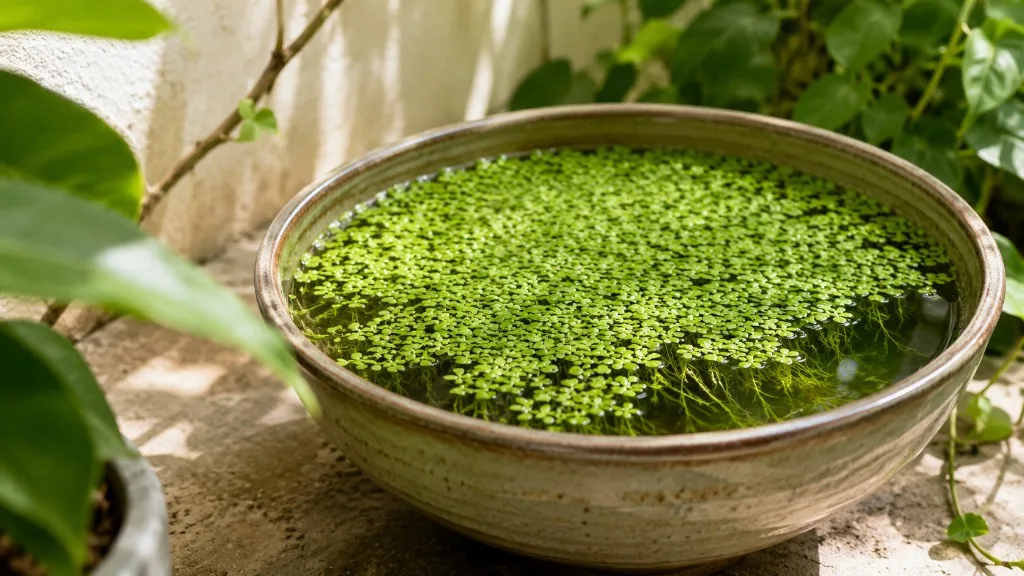
Duckweed does not get watered the way a pothos does. There is no soil to soak, no drainage hole to check, and no “wait until the top inch dries” rule. Lemna minor, Spirodela polyrhiza, and the other tiny floating species sold as duckweed live entirely on the water surface, absorbing every mineral and nitrogen compound they need directly from the column below. Your job is not to pour water onto a plant - it is to manage the water itself: keep the level stable, replace what evaporates without letting minerals concentrate, and hold pH, hardness, and temperature in a range where fronds multiply instead of yellowing and sinking. Get that right and duckweed becomes one of the lowest-maintenance plants in the hobby, filtering nutrients, shading fish, and doubling every few days. Let the water creep out of balance and the same plant turns into a thin, pale mat that clogs your filter and dies off within a week. This guide covers the water-management system that actually keeps duckweed healthy in aquariums, ponds, and turtle tanks.
Why Duckweed Care Is Water Management, Not Watering
The word “watering” misleads people into thinking about schedules - every Tuesday, every three days, every time the soil feels dry. Duckweed breaks that mental model completely. Each frond is a tiny floating leaf with roots dangling millimeters into the water. Those roots do not anchor in gravel or extract moisture from substrate. They pull dissolved calcium, magnesium, nitrogen, phosphorus, and trace elements straight from the surrounding water. When aquarists say their duckweed “doesn’t need much care,” what they really mean is that the plant tolerates a wide envelope of water chemistry as long as the water stays clean, still enough, and chemically stable.
That tolerance has limits people discover the hard way. Duckweed can survive pH swings, temperature shifts, and both soft and hard water - but it cannot survive filthy water, relentless surface turbulence, or months of evaporation top-offs that never include a partial water change. The minerals left behind when pure water evaporates do not disappear; they concentrate. A tank that started at 150 ppm TDS can climb past 300 ppm in a few months of tap-water top-offs alone, as documented repeatedly in open-top aquarium discussions. Duckweed may absorb some of those dissolved solids, but it cannot outpace unchecked mineral creep in a heavily topped, rarely changed tank. Water management for duckweed means treating the entire volume as the plant’s growing medium and maintaining that medium the way you would maintain nutrient solution in a hydroponic system - with attention to level, chemistry, and replacement rhythm.
How Duckweed Uses the Water Column
Understanding duckweed’s relationship with water explains why certain problems show up predictably. Lemna minor and related species are among the fastest-growing angiosperms on Earth, capable of doubling biomass in as little as two days under optimal conditions. That growth rate is fueled entirely by dissolved nutrients in the water column - fish waste, decomposing organics, and supplemental fertilizers all contribute. Duckweed is so efficient at pulling nitrogen and phosphorus from water that researchers use it for phytoremediation of eutrophic ponds and even contaminated wastewater. In your home aquarium, that same biology means duckweed actively lowers nitrate levels, which is genuinely useful in stocked tanks but also means the plant can deplete its own nutrient supply in a lightly fed, heavily skimmed setup.
Water temperature directly controls duckweed’s metabolic rate. Growth reviews on Lemna minor place the viable range between roughly 6°C and 33°C (43–91°F), with fastest growth around 26°C (79°F) and oxidative stress below 10°C or above 40°C. Light intensity and photoperiod matter too, but water chemistry is the variable most keepers neglect until fronds turn yellow. Yellowing in duckweed usually signals nitrogen or phosphorus limitation, poor water quality, or temperature stress - not a need for more “watering.” Because the plant has no soil buffer, it responds to water problems within hours, not days. A sudden ammonia spike, a pH crash after a large untreated water change, or a week of 90°F pond water will produce visible damage faster than almost any rooted aquatic plant.
Maintaining the Right Water Level in Tanks and Ponds
Water level is the first practical variable to control, and it is simpler than chemistry but easier to ignore. Duckweed needs the water surface to exist at a consistent height relative to your equipment. If the level drops too far below the filter outflow, surface current intensifies and pushes fronds into the outflow stream where they clog intakes and break apart. If the level rises too high in an open-top tank, you risk overflow during top-offs and increased humidity damage to nearby surfaces. The target is a stable surface plane that keeps duckweed floating freely without contacting the glass lid, rim, or filter hardware.
In aquariums, check the waterline weekly - more often in summer or in heated rooms where evaporation accelerates. Mark the ideal level with a piece of tape on the tank frame or note it mentally against a fixed reference point like a heater top or label on the glass. When the surface drops more than half an inch below that mark, top off. In ponds and outdoor containers, level management is seasonal: spring rain may raise water automatically, while summer heat can drop a small patio tub several inches per week. Refill ponds with dechlorinated water matched roughly to the existing temperature, especially if fish or turtles share the space.
Open-Top Aquariums vs Covered Setups
Open-top tanks evaporate faster and create the maintenance rhythm most duckweed keepers eventually adopt: top off every few days to weekly, partial water change every one to two weeks. The advantage is better gas exchange and easier access for skimming excess duckweed. The disadvantage is mineral concentration from evaporation-only maintenance and higher room humidity. Duckweed itself partially offsets evaporation by covering the surface - research on Lemna gibba mats found evaporation rates roughly 27% lower under plant cover compared to open water in controlled conditions. That reduction helps, but it does not eliminate the need for top-offs or water changes.
Covered tanks with glass lids or hoods evaporate more slowly and lose less CO₂ if you inject it, but condensation can drip back unevenly and push duckweed into corners where it mats too thickly. If you run a lid, leave a small gap for air exchange or accept that duckweed may accumulate moisture on the underside of the glass and need occasional redistribution with a net. Either setup works; the maintenance difference is frequency, not philosophy. Open-top keepers top off more often but may change water less urgently if they also skim duckweed regularly. Covered keepers top off rarely but should still test TDS monthly because mineral creep happens even at low evaporation rates.
Pond and Outdoor Container Depth
In garden ponds, duckweed does not care about total depth the way a rooted lily does. It cares about surface conditions: calm water, adequate light, and nutrient availability. Shallow patio tubs heat up faster in summer sun, which accelerates both duckweed growth and evaporation. Deep ponds buffer temperature swings better but may develop anoxic bottom layers if circulation is poor - duckweed on the surface cannot compensate for oxygen-depleted water below. Aim for at least 12 to 18 inches of depth in outdoor containers so temperature spikes are moderated, and add gentle circulation if the water goes stagnant. In natural ponds, duckweed colonizes windward edges where fronds accumulate; manually redistributing or skimming prevents one corner from becoming a solid green carpet that blocks gas exchange for the entire pond.
Evaporation, Top-Offs, and Mineral Buildup
Evaporation is the invisible maintenance task that drives more duckweed failures than any single parameter mistake. Water molecules leave the surface as vapor; salts, minerals, and dissolved organics stay behind. Over weeks and months, topping off with tap water without removing any volume adds more minerals to a shrinking effective dilution. The water looks clear, the duckweed still floats, but TDS and hardness quietly climb until fronds yellow, growth stalls, or sensitive tankmates show stress.
Why Only Pure Water Evaporates
This is the concept that separates experienced aquatic plant keepers from frustrated beginners. When your open-top tank loses half an inch of water in a week, you have lost nearly pure H₂O. The calcium, magnesium, carbonate, nitrate, and chloride remain. If your tap water has 200 ppm TDS and you add two inches of it every week without ever removing water, you are stacking minerals into a closed system. Duckweed absorbs some nutrients - nitrogen and phosphorus especially - but it does not selectively remove the calcium and carbonate that drive hardness and pH upward. A UK Aquatic Plant Society thread documented a shrimp bowl where TDS rose from 150 to 300 and KH from 4 to 7 over six months of evaporation top-offs alone, with gradual livestock decline. Duckweed was present but could not keep pace with mineral accumulation.
The fix is not complicated: pair top-offs with partial water changes. Top off to replace evaporated volume between changes; change 20 to 30 percent of the tank weekly (or 25 to 40 percent biweekly in lightly stocked tanks) to export concentrated minerals. In ponds, periodic overflow or deliberate drainage serves the same function. Treat top-offs as level maintenance and water changes as chemistry maintenance - conflating the two is how tanks drift out of range while looking perfectly fine.
RO Water vs Tap Water for Top-Offs
Tap water is the practical default for most keepers. Match temperature, dechlorinate, and add slowly. Short-term, it works well because duckweed tolerates a wide hardness range and municipal water is usually within pH 6.5 to 8.0. Long-term in open-top, low-change systems, tap top-offs accelerate mineral creep.
RO (reverse osmosis) water for top-offs slows mineral accumulation because it replaces evaporated volume without adding new dissolved solids. If you already run RO for a shrimp tank or discus setup, topping off with RO and remineralizing only during water changes gives you precise control. The trade-off is cost and inconvenience - storing RO water, monitoring TDS, and ensuring you still perform actual water changes because RO top-offs do not remove organics or nitrates. For lightly stocked duckweed tubs maintained with weekly partial changes, tap water top-offs are perfectly adequate. For zero-water-change experiments or breeding setups where parameter drift is critical, RO top-offs make sense.
Ideal Temperature Range for Duckweed
Temperature shapes duckweed growth more visibly than hardness does. The consensus across hobby guides and scientific literature converges on 68–86°F (20–30°C) as the active growth window, with approximately 78°F (26°C) as the sweet spot where doubling time is shortest. Below 60°F (15°C), growth slows dramatically; fronds may persist but rarely multiply fast enough to recover from harvesting or fish grazing. Above 90°F (32°C) in outdoor ponds, duckweed may persist but often yellows as dissolved oxygen drops and metabolic stress rises.
In heated indoor aquariums, standard tropical temperatures of 76–80°F suit duckweed well. The plant is not a cold-water specialist like some temperate floaters, but it tolerates cooler unheated tanks in the mid-60s°F without dying - useful for goldfish and some turtle setups. Seasonal pond keepers should expect explosive spring growth when water warms into the 70s°F, followed by potential summer die-back if water exceeds 90°F and oxygen sags under a full surface mat. Shade part of the pond or skim duckweed back to 30 to 50 percent surface coverage before the hottest weeks arrive. A floating thermometer checked weekly in outdoor setups costs less than replacing an entire duckweed culture after a heat wave.
pH: Where Duckweed Grows Best
pH 6.0 to 7.5 is the comfort band cited by most aquarium plant guides and supported by wastewater-treatment research on Lemna minor, which found best growth in slightly acidic to neutral conditions. Duckweed’s real superpower is tolerance, not pickiness. A comprehensive PMC review on duckweed survival notes that most species grow well between pH 5 and 8 in laboratory conditions, while natural populations have been documented in waters ranging from pH 3.5 to 10.4 depending on species and location. Aquarium guides often cite a tolerated range of 5.0 to 9.0, which aligns with field observations for common species like Lemna minor and Spirodela polyrhiza.
In practice, pH matters less for duckweed survival than for duckweed appearance and ecosystem balance. In acidic water below pH 6.0, growth can continue but may slow. In alkaline water above pH 8.0, some species struggle - the PMC review notes that pH above 8 has been reported to preclude Lemna minor growth in certain lake systems, causing local die-offs. For community aquariums and turtle tanks targeting pH 6.8 to 7.6, duckweed fits without special adjustment.
Stable pH vs Extreme Tolerance
The critical lesson is the same one that applies to every aquatic plant: stability beats precision. A tank holding steady at pH 7.4 with KH 4 will grow greener duckweed than a tank swinging from pH 6.7 at dawn to pH 7.8 after lights on due to poor buffering or CO₂ mismanagement. If you run CO₂ injection, ensure your KH is high enough to buffer the acid injection - typically 3 to 5 dKH minimum - so pH does not crash overnight. If you run low-tech, resist chasing pH with chemical buffers every time a test reads slightly off. Repeated pH manipulation creates the swings that yellow duckweed faster than a steady number one point away from textbook ideal. Test pH at the same time of day each week for consistent readings.
General Hardness (GH) and Carbonate Hardness (KH)
Duckweed is unusual among popular aquarium plants because it genuinely does not care much about general hardness (GH). Whether your water measures 2 dGH or 15 dGH, duckweed usually grows. Aquarium Nexus, Biology Insights, and multiple nursery guides all note the same pattern: soft water, hard water, and everything between works. That adaptability reflects duckweed’s global distribution in ponds, ditches, and slow streams with wildly different mineral profiles.
Carbonate hardness (KH) matters more than GH because KH buffers pH. A tank with KH below 2 dKH will show pH drift over time, especially in lightly stocked setups with duckweed pulling carbon from the water. Most community aquariums run KH 3 to 8 dKH without issue. If you use RO water, remineralize to hit both GH and KH targets - products like Seachem Equilibrium or Salty Shrimp GH/KH+ are designed for this. Duckweed will not tell you KH is low until pH starts drifting and fronds yellow from combined stress. Testing KH monthly takes thirty seconds and prevents slow chemistry drift that catches keepers off guard two weeks after they thought the tank was settled.
For turtle tanks and pond setups using tap water, hardness is rarely the limiting factor. Focus instead on dechlorination, waste loading, and whether calcium from hard tap water combined with evaporation top-offs is pushing TDS uncomfortably high for sensitive invertebrates sharing the space.
TDS, Nutrients, and Duckweed as a Water Filter
Total dissolved solids (TDS) measures the sum of every dissolved ion in the water - a composite number that tracks overall concentration rather than identifying individual parameters. Duckweed actively lowers TDS by absorbing nitrogen compounds, phosphorus, potassium, and some trace metals from the water column. Research on landfill leachate treatment showed duckweed reducing TDS substantially in high-nutrient waste streams; in home aquariums the effect is more modest but real, especially in stocked tanks where fish waste supplies continuous nitrogen.
That filtering capacity creates a management paradox. Duckweed improves water quality in under-filtered or overstocked tanks, which encourages keepers to reduce water changes - which then allows non-plant-absorbed minerals to accumulate via evaporation. The plant is not a substitute for partial water changes; it is a supplement to them. In a well-managed tank, expect TDS to stay relatively stable week to week. If your TDS pen reads 180 ppm at baseline and climbs past 280 ppm within a month without water changes, you are concentrating minerals faster than duckweed can remediate.
Nitrogen compounds deserve separate attention. Duckweed uses ammonia and nitrate as nitrogen sources, which is why it thrives in turtle and goldfish tanks with moderate waste loading. Ammonia above 0.25 ppm still stresses fish and degrades plant health even if duckweed initially grows on the ammonia pulse. Nitrate from 5 to 40 ppm supports healthy duckweed in community tanks; below 5 ppm in a bright tank, fronds may yellow from nitrogen limitation despite “clean” water. Above 40 ppm, duckweed is not suffering - you are signaling that water changes are overdue and algae may follow.
Dechlorination and Water Source Safety
Every gallon you add - whether topping off evaporation or performing a partial change - must be safe for aquatic life. Municipal tap water contains chlorine or chloramine, both toxic to fish, invertebrates, and the biofilm duckweed roots interact with. Dechlorinate before adding water to the tank. Sodium thiosulfate-based conditioners like Seachem Prime neutralize chlorine instantly and bind chloramine for 24 to 48 hours; dose for the volume being added, not just the tank’s total volume, when doing partial changes.
Rainwater collection is popular for pond top-offs in some regions, but roof runoff can carry zinc, copper, and pesticide residues. If you collect rain, test pH and TDS before using it in a tank with duckweed and turtles. Well water may contain iron, hydrogen sulfide, or high hardness that shifts parameters abruptly - test GH, KH, and pH before committing a duckweed culture to it. For new duckweed purchases, rinse fronds in dechlorinated tank water and quarantine in a separate container for three to five days before adding to a turtle tank. Nursery duckweed may carry snails, pesticides, or polluted source water that a rinse alone will not fix.
Water Flow, Surface Agitation, and Mat Formation
Duckweed evolved in still or slow-moving water - ponds, backwaters, and ditches where surface current is minimal. In aquariums, strong filter outflow aimed at the surface shatters mats, pushes fronds into the filter intake, and slows growth by preventing the calm surface film duckweed needs to colonize. Aquarium Breeder and multiple hobby guides recommend positioning filter outlets 4 to 5 inches below the surface or redirecting flow toward the substrate so the water surface stays relatively still.
Some surface agitation is healthy. Gentle ripples improve gas exchange and prevent a stagnant biofilm from forming under a 100 percent duckweed cover. The problem is intensity, not presence. If your duckweed constantly circles the tank like a carnival ride, growth will lag and fronds will fragment. In ponds, fountains and waterfalls can inhibit duckweed establishment in the turbulent zone while mats thrive in the calm leeward side - use that pattern deliberately if you want duckweed in part of the pond but not near the aerator.
Manage surface coverage as a water-quality tool. Allow duckweed to cover 25 to 50 percent of the surface in most aquariums - enough to filter nutrients and reduce evaporation without blocking all gas exchange. Skim excess weekly with a fine net, slotted spoon, or aquarium-safe hair comb. In turtle tanks, expect grazing to thin coverage naturally; replenish from a backup culture container if the turtles eat faster than the plant reproduces.
How to Test Duckweed Water Quality at Home
You do not need a laboratory. A liquid reagent test kit covering pH, ammonia, nitrite, nitrate, GH, and KH - API, Salifert, NT Labs, or equivalent - covers every parameter that matters for duckweed health. A TDS meter adds useful trend data for open-top tanks maintained with frequent top-offs. A digital thermometer is non-negotiable for outdoor ponds and heated tanks.
Run this schedule in a tank with established duckweed:
Weekly: nitrate, temperature, visual water level check (top off if needed). Biweekly: pH, GH, KH (or weekly if you recently changed water source or remineralization). Monthly: TDS trend check in open-top tanks; ammonia and nitrite spot-check in established tanks. After every partial water change: dechlorinate new water; match temperature within 2°F of tank water before adding.
Record results for the first month in a phone note or notebook. Patterns - like TDS climbing 20 ppm per week with tap top-offs only - are easier to spot in a log than from memory. If budget is limited, prioritize tests in this order: temperature, nitrate, pH, TDS trend. Temperature swings cause the fastest visible damage. Nitrate tells you whether water changes are keeping pace with waste loading. pH catches buffering problems. TDS catches mineral creep that individual GH/KH tests might miss until the shift is large.
Aquarium vs Pond Water Management
Indoor aquariums offer control. You choose the water source, dose dechlorinator precisely, set the heater, and skim duckweed on demand. The main risk is complacency - assuming a small open-top tank with duckweed can run indefinitely on top-offs alone. It cannot. Weekly or biweekly partial changes remain the backbone of aquarium water management regardless of how much duckweed filters the column.
Outdoor ponds introduce weather, runoff, bird waste, and seasonal temperature swings. Spring warmth triggers explosive duckweed growth that can cover the entire surface in two weeks; skim aggressively before the mat blocks light to submerged plants and traps heat. Summer heat plus full coverage can crash dissolved oxygen at night when duckweed respires along with fish. Autumn leaf litter adds tannins and organic acids that lower pH; remove debris before it sinks and decays. Winter management depends on climate: in zones where ponds ice over, duckweed typically dies back and recolonizes from turions or surviving fronds at the edges in spring. Do not assume indoor aquarium parameters transfer directly to a 300-gallon pond - test pond water independently at least monthly during the growing season.
Turtle tanks combine high waste loading with grazing pressure. Duckweed handles the nitrogen side well but needs periodic replenishment because turtles eat it. Water changes of 25 to 50 percent weekly are common in turtle setups; match that rhythm rather than relying on duckweed as the sole filtration strategy. Use only clean, pesticide-free duckweed from aquarium sources, rinse before introduction, and never harvest duckweed from wild ponds for turtle consumption due to pollution and parasite risk.
Common Water Mistakes and How to Fix Them
Top-offs without water changes is the most common failure mode. The tank looks fine, the duckweed floats, but TDS and hardness climb until fronds yellow and shrimp or snails show stress. Fix: institute weekly 20 to 30 percent partial changes alongside top-offs; track TDS monthly.
Strong surface flow shreds duckweed and sends it into the filter. Fix: redirect the outflow below the surface, add a baffle, or use a sponge pre-filter on the intake. Growth recovers within days once the surface calms.
100 percent surface coverage reduces oxygen exchange and can crash dissolved oxygen overnight in stocked tanks. Fix: skim back to 25 to 50 percent coverage weekly. The remaining duckweed still filters nutrients without sealing the surface.
Adding untreated tap water during top-offs or changes introduces chlorine spikes that damage biofilter bacteria and stress livestock. Fix: dechlorinate every addition, every time, without exception.
Ignoring temperature in outdoor setups leads to summer die-back when water exceeds 90°F under Duckweed light guide. Fix: provide partial shade, increase surface skimming, or temporarily relocate excess duckweed to a shaded holding container.
Buying wild or pesticide-treated duckweed for turtle tanks introduces copper, herbicides, and pathogens into water you cannot easily detoxify. Fix: buy from aquarium nurseries, quarantine, rinse, and maintain a backup culture in a separate jar of dechlorinated water.
Conclusion
Duckweed care is water care. The plant does not need a watering schedule - it needs a managed aquatic environment where the level stays consistent, evaporation is replaced thoughtfully, minerals are exported through regular partial changes, and pH, hardness, and temperature remain stable enough for a floating plant that has no soil buffer to fall back on. Target pH 6.0 to 7.5, temperature 68 to 86°F with fastest growth near 78°F, and do not worry about soft versus hard water because duckweed tolerates both. Top off open tanks to maintain level, but pair every top-off routine with weekly or biweekly partial water changes so TDS does not creep into trouble territory. Keep surface flow gentle, coverage around 25 to 50 percent, and test nitrate, pH, and temperature weekly until the system runs predictably. Get those habits in place and duckweed stops being the plant that “took over your tank” and becomes what it should be: a low-maintenance water manager that keeps your aquarium or pond cleaner while asking very little in return.
When to use this page vs other Duckweed guides
- Duckweed overview - Start here for whole-plant context before deep-diving this topic.
- Duckweed problems hub - Jump to symptom-specific fix guides when this care topic does not resolve the issue.
- Overwatering on Duckweed - Escalate here when watering adjustments are not enough.
- Underwatering on Duckweed - Escalate here when watering adjustments are not enough.
- Root Rot on Duckweed - Escalate here when watering adjustments are not enough.