Leggy Duckweed? Why It Looks Thin & How to Fix Sparse Mats
Quick answer
Duckweed has no stems to stretch, so 'leggy' usually means a pale, thin mat that is not spreading. First step: skim healthy fronds into the brightest calm surface zone and compare spread rate there to the rest of the tank before changing nutrients.
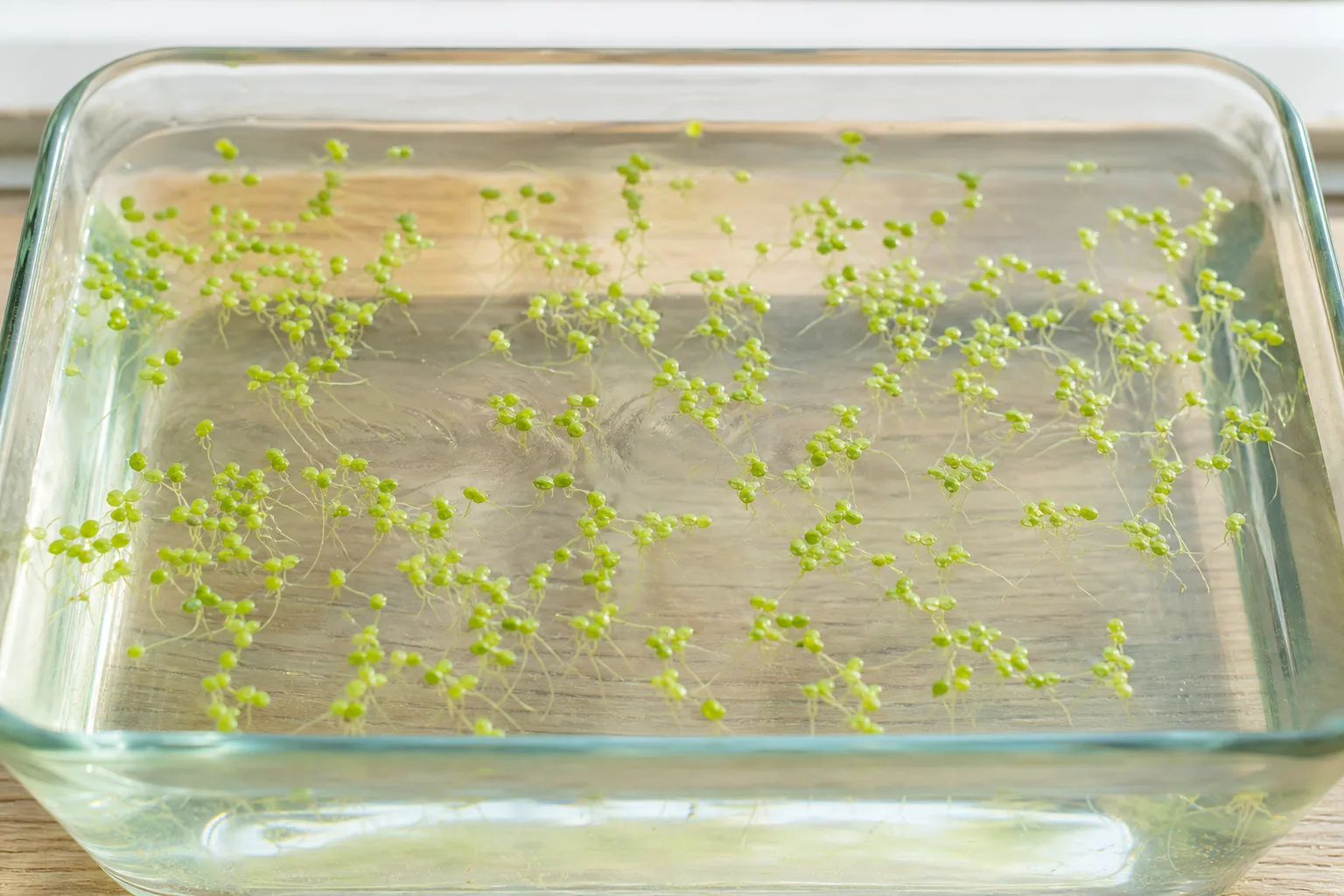
Leggy Growth on Duckweed: Causes, Checks & Fixes
This guide covers leggy growth on Duckweed. See also the general Leggy Growth guide, watering, and light pages for this plant.
Leggy Growth on Duckweed: Causes, Checks & Fixes
Quick answer
Searchers often ask about leggy duckweed, but the term comes from vining houseplants-not from floating aquatics. Duckweed (Lemna, Spirodela, Landoltia, and related genera) has no stems, no internodes, and no lean toward a window. Each plant is a tiny photosynthetic frond that floats at the air-water interface and reproduces by budding daughter fronds, not by stretching upward.
When duckweed looks “leggy,” “thin,” or “stringy,” the real pattern is almost always a pale, sparse surface mat with slow spread-the same low-light presentation covered in depth on our not enough light on duckweed guide. Fronds stay lime-green or yellow-green, scatter instead of merging into a carpet, and may cluster in filter outflow where turbulence pushes them underwater.
First step: skim the greenest fronds you can find into the brightest calm zone of the tank-directly under your aquarium LED or into open sun on a protected outdoor tub-and watch whether new daughter fronds green up and spread within one to two weeks. Do not check soil moisture, repot, or dose fertilizer before confirming surface light and spread rate. Duckweed does not use soil or substrate; terrestrial legginess advice will send you down the wrong path.
Why duckweed does not get leggy
Leggy growth on pothos, mint, or jasmine is etiolation: long internodes, bare stem sections, and stems bending toward the brightest window when photons are too few. Duckweed biology makes that impossible.
Each frond is a flattened thallus-essentially a tiny floating leaf disk with a short root in most species. Growth is asexual and vegetative: mature fronds bud daughter plants from a pocket on one side. There is nothing to elongate between nodes. Under dim conditions duckweed does not reach; it thins, pales, and slows cloning.
That distinction matters for diagnosis. If you are waiting for stems to shorten or for the plant to “bush out” after a light fix, you will misread recovery. Success on duckweed is deeper green on new buds and faster surface coverage-often doubling every two to three days when light, nutrients, and calm surface conditions align-not compact internodes.
What “leggy duckweed” usually means
Growers use stretch language for floating plants because the mat looks stringy and unfinished compared with photos of dense green lids. Map common phrases to duckweed-specific signs:
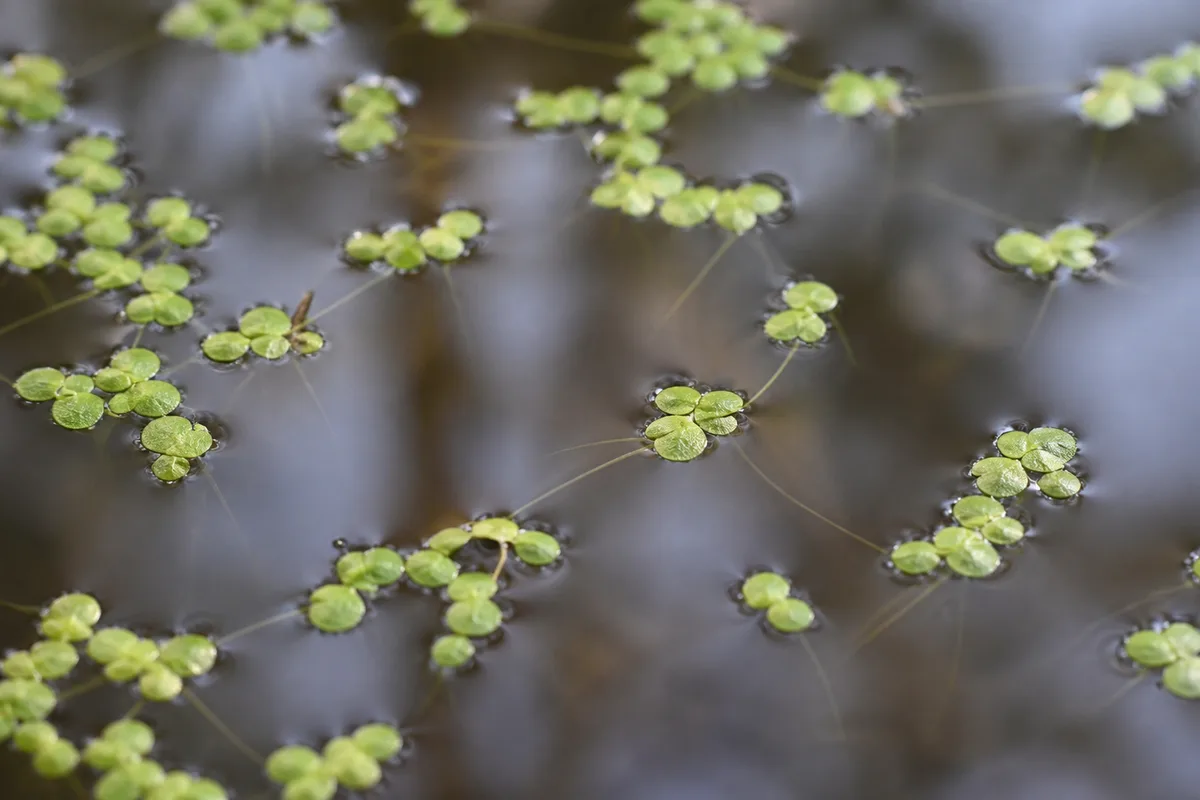
Leggy Growth symptoms on Duckweed - compare with healthy tissue on the same plant.
| What you might say | What you are probably seeing on duckweed |
|---|---|
| ”Leggy” or “etiolated” | Pale scattered fronds, not stem stretch-wrong frame for this species |
| ”Thin” or “stringy” | See-through scatter that never merges; fronds trapped in filter flow looking like threads |
| ”Not filling in” | Glacial spread over weeks when bright cultures should expand in days |
| ”Reaching for light” | Dense pile under the fixture only, bare zones elsewhere-not directional stem lean |
| ”Weak growth” | Small pale daughter fronds; culture persists but never hits harvest density |
Healthy Lemna minor under good light runs deeper green with fronds that merge into a cohesive mat. Washed-out lime-green color on most of the surface, with slow or stalled spread, is the duckweed equivalent of what houseplant growers call leggy-and it traces most often to insufficient usable light at the water surface, not to underwatering on Duckweed a pot.
How to confirm sparse-mat light stress
Work through this short confirmation path before fertilizer, large water changes, or replacing the culture:
- Bright zone vs shaded zone - Move a teaspoon of fronds into the brightest calm corner under your fixture. If that patch greens and spreads within two weeks while the main tank stays sparse, light placement-not species failure-is the limiter.
- Spread velocity - Mark a zone on the glass and photograph weekly. Visible expansion within days under warm water and adequate light is normal; unchanged bare glass after two weeks strongly points to insufficient surface exposure.
- Photoperiod check - Confirm timer hours. Production cultures typically need at least six hours of moderate light daily as a floor, with 10–14 hours under full-spectrum supplemental lighting for dense mats indoors.
- Surface turbulence - Note where returns, bubblers, or turtle activity churn the surface. Fronds pushed underwater photosynthesize poorly and look thin even when the bulb is adequate elsewhere.
- Water clarity - Murky turtle water or green water blocks rays before they hit fronds. Light attenuates sharply in water; clarify before blaming the fixture alone.
- Newest daughter fronds - Pale buds with little spread confirm low energy. Deep green clusters under the same water parameters suggest light is adequate and another stressor deserves attention.
Rule out lookalikes before treating:
- Post-intro melt - heavy frond loss in the first 7 to 10 days after purchase; should stabilize if surface light is adequate
- Nutrient deficiency in ultra-clean tanks - yellow new fronds with spread still moving at a normal pace; more common when light is already moderate
- Cold water - growth stalls below roughly 18–28 °C (64–82 °F) even under good light
- Chemical exposure - rapid whole-surface disappearance after copper or algaecide regardless of placement
- Self-shading - thick mats green on top but sparse underneath; skim before upgrading the bulb
For the full numbered confirmation workflow, photoperiod tables, and turtle-tank turbidity checks, use the not enough light on duckweed guide-it covers the same root cause with more step-by-step depth.
First fix for thin sparse duckweed
Move healthy fronds into the brightest calm surface zone and extend photoperiod on a timer-then wait one to two weeks before any other intervention.
Skim green fronds from the healthiest section and float them directly under your aquarium LED or into open sun on a shallow outdoor tub, acclimating outdoor moves over 5 to 7 days if the culture came from a dim indoor tank. Keep the surface calm so fronds stay at the air-water interface; redirect filter returns or corral duckweed in a quiet corner if splash is burying plants.
Run full-spectrum lighting 10–14 hours daily on a timer. Do not fertilize, overhaul filtration, or change multiple tank parameters the same week. Duckweed responds best when you change one variable and read new frond color and spread rate on daughter buds.
If calm placement under your strongest fixture still produces pale buds after two weeks, upgrade to a full-spectrum aquarium LED sized for your tank footprint rather than assuming duckweed needs no light. Outdoor ponds in full sun produce the fastest spread when water is calm and nutrients are available-indoor equivalents need deliberate fixture strength, not room ambient glow.
Recovery timeline
Expect visible greening on newly budded fronds within one to two weeks after a meaningful light increase during active growth. Local patches should start merging into a visible carpet within that window when temperature and water quality are stable.
Old pale fronds do not darken in place. Washed-out disks stay light until skimmed. Recovery is forward-looking: the next daughter fronds tell you whether lighting is correct.
Dense harvest-grade mats can return in three to six weeks in warm, stocked aquariums with corrected lighting. Cool water or short winter days may slow the response even after you fix placement.
Worsening signs during adjustment: bleached or brown fronds after jumping a dim culture into blistering unfiltered midday sun-step exposure over a week; continued melt with foul water after light improves-decay overload or chemical exposure; green patches under the bulb but persistent bare zones elsewhere-still insufficient or uneven light.
Lookalike symptoms
- Not enough light (primary overlap) - pale scatter plus stalled spread; this leggy-growth page translates search language, while not enough light on duckweed carries the full diagnostic and recovery workflow
- Slow growth from cold or nutrients - see slow growth on duckweed when spread is stalled but frond color is not uniformly pale lime-green
- Post-purchase melt - temporary frond drop after shipping; should stop once acclimated if calm surface fronds stay green and new buds form
- Turtle browsing - irregular bare zones where animals graze; damage follows feeding traffic, not uniform shading under hood edges
- Filter burial - stringy clusters at outflow where fronds sink; differs from tank-wide pale scatter from dim fixtures
- Self-shading from overgrowth - thick mats look green on top but sparse underneath; skim before blaming insufficient light globally
What not to do
Do not treat duckweed like a houseplant-there is no pot to rotate, no soil moisture to check, and no stem lean to diagnose. Focus on surface photons, photoperiod, and water clarity.
Do not over-fertilize a dim tank to force color. Excess nutrients with marginal light often fuel algae on glass without thickening duckweed mats.
Do not leave filter returns crashing through the mat if fronds sink and pale. Calm surface placement beats stronger nutrients.
Do not assume a basking heat lamp feeds duckweed. Heat bulbs do not replace broad-spectrum plant lighting for surface mats.
Do not release excess harvest into natural waterways-duckweed is invasive in many regions and can block light and gas exchange when unmanaged.
Do not expect submerged fronds to thrive-anything pushed under the surface by flow will photosynthesize poorly until it floats again.
How this page relates to other duckweed guides
This URL exists because people search “leggy duckweed” using houseplant vocabulary. The biology answer is: duckweed does not etiolate; it thins and pales under low surface light. That makes this page a symptom-language bridge, not a duplicate of the light-fix encyclopedia.
| Topic | Best page |
|---|---|
| Photoperiod, fixture upgrades, step-by-step light recovery | Not enough light on duckweed |
| PAR targets, full sun vs grow lights, self-shading math | Duckweed light needs |
| Floating setup, turtle tanks, harvest cadence, no-soil basics | Duckweed care overview |
| Cold water or nutrient stall without pale scatter | Slow growth on duckweed |
If your only symptom is pale thin mats in a dim tank, either page helps-but start here when you arrived asking about legginess, then follow the not-enough-light guide for the full fix sequence.
Conclusion
Leggy growth on duckweed is a search-language mismatch, not a stem-etiolation problem. Free-floating Lemna and relatives have no internodes to lengthen; thin, stringy, unfilled mats mean pale sparse fronds under insufficient surface light, filter splash, murky water, or self-shading-not soil stress or pot drainage. Confirm by comparing bright calm zones to shaded or churned areas, move healthy fronds into the brightest surface band as the first fix, and judge recovery on new green daughter fronds and spread rate, not old washed-out disks. For photoperiod depth, turtle-tank clarity work, and full recovery steps, continue to not enough light on duckweed after you have mapped your symptoms here.
When to use this page vs other Duckweed guides
- Duckweed watering guide - Use for routine moisture checks before assuming leggy growth is the main issue.
- Duckweed problems hub - Browse all 16 common issues on this species.
- Not Enough Light on Duckweed - Different entry point when symptoms overlap with leggy growth.
- Slow Growth on Duckweed - Different entry point when symptoms overlap with leggy growth.
- Yellow Leaves on Duckweed - Different entry point when symptoms overlap with leggy growth.