Low Humidity on Duckweed: Causes, Checks & Fixes
Quick answer
Ambient humidity rarely limits duckweed because fronds float in direct water contact. First step: confirm every frond sits on calm surface water and the tank level has not dropped-do not add a humidifier or mist the mat.
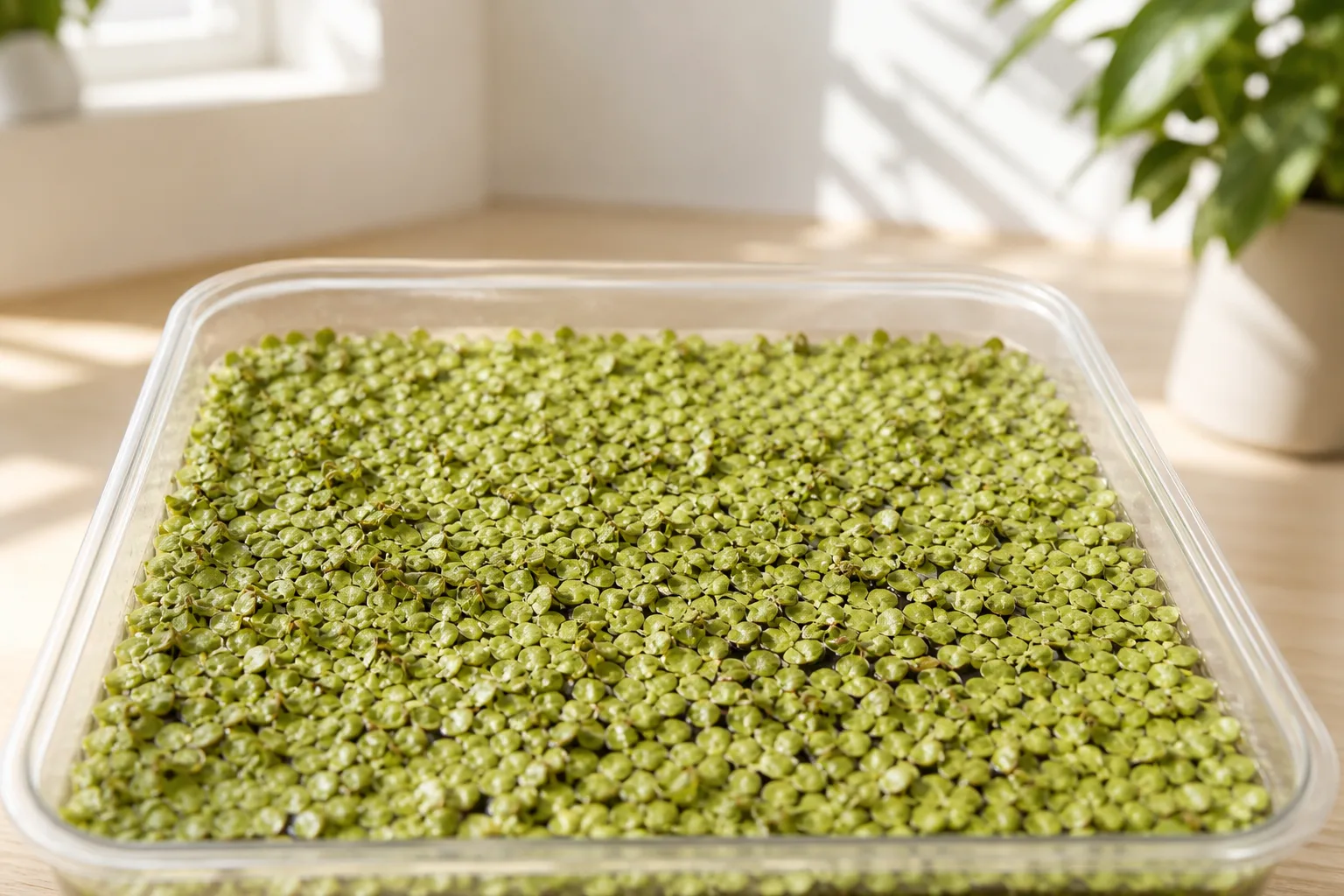
Low Humidity on Duckweed: Causes, Checks & Fixes
This guide covers low humidity on Duckweed. See also the general Low Humidity guide, watering, and light pages for this plant.
Low Humidity on Duckweed: Causes, Checks & Fixes
Quick answer
If you searched “low humidity on duckweed” after reading houseplant advice, you are probably in the wrong diagnostic lane. Duckweed (Lemna, Spirodela, Landoltia, Wolffia, and related genera) is a free-floating aquatic that lives on the water surface-not in soil, not on a humidity tray, and not as a windowsill foliage plant. Its tiny fronds stay in direct contact with freshwater, so ambient room humidity rarely limits growth the way it limits a pothos leaf tip in a heated winter room.
What dry indoor air can do is speed evaporation from open-top aquariums and turtle tubs, which drops the water level and strands mats on dry tank hardware. That is a water-contact problem dressed up as a humidity problem. Pale, thin, or crispy duckweed in a full tank usually traces to low nutrients, weak light, strong surface flow, or chlorine exposure-not RH below 40%.
First step: confirm every frond floats on calm surface water and top off the tank if the level has dropped. Do not mist the mat, run a humidifier, or check soil moisture. See our duckweed overview for why terrestrial houseplant logic does not apply, and underwatering on duckweed when fronds have clearly dried out.
Does duckweed need high humidity?
No-for normal floating culture, duckweed does not need high ambient humidity. Each frond is a small floating leaf, often only 1 to 8 mm across in Lemna minor, that rests on still or slow-moving freshwater. Roots hang millimeters into the column and pull dissolved nutrients directly from the water. The upper frond surface touches the water film continuously, so the plant rehydrates from the aquatic environment-not from moist air above the tank.
Duckweed evolved in quiet ponds, lakes, and sheltered backwaters where wind may lower local humidity at the surface but water contact never breaks. In home aquariums, turtle tanks, and patio tubs, the same rule holds: if fronds float, humidity is a background variable, not a growth limiter.
The one partial exception is briefly emersed tissue-fronds pushed onto dry glass, filter rims, or a counter during harvest. Those exposed edges can desiccate in dry air within hours. That is dehydration from lost water contact, not a tank-wide humidity deficiency. Return stranded fronds to the surface and the issue resolves without raising room RH.
Why houseplant humidity advice does not apply
Houseplant low-humidity guides describe leaves that transpire moisture into dry air. Brown tips on calatheas, curling fern fronds, and crispy peace lily edges happen because roots supply water that leaves lose faster than they can replace when RH drops in winter. The fixes-humidifiers, pebble trays, grouping plants, misting-target air moisture around foliage.
Duckweed breaks every step in that model:
- No soil or potting mix - There is nothing to check with a finger, no “water when the top inch dries,” and no drainage hole. Substrate advice from terrestrial guides is actively wrong here.
- No use for humidity trays - Trays raise RH near potted leaves on a shelf. They do not change conditions for a mat floating six inches below on an open aquarium.
- Misting hits the wrong layer - A fine mist on duckweed may briefly wet fronds but does not replace stable surface contact or fix a dropped water level. It can even push mats under filter splash where they fragment.
- Constant water contact - Floating Lemnoideae behave as hydrophytes adapted to life at the air-water interface, not as aerial leaves negotiating dry room air.
If your duckweed looks stressed, start with water level, surface calm, light, and dissolved nutrients-the same variables that decide outcomes in our watering guide. Chasing 60% room humidity first wastes time and can delay the real fix.
When dry room air still matters for duckweed keepers
Dry winter air rarely desiccates a healthy floating mat, but it does change your maintenance rhythm on open-top setups. Heated rooms with RH in the 20–35% range pull more water vapor from exposed tank surfaces. You top off more often; if you only replace evaporated volume and never partial-change, minerals concentrate and fronds may yellow from chemistry stress-not from air drying the leaves.
Open-top tank evaporation in heated dry rooms
Open-top aquariums lose pure water to evaporation while salts and dissolved solids remain. Our duckweed watering guide explains that topping off with tap water without periodic partial changes can push TDS and hardness upward over weeks. Duckweed may then look “sick” in a full tank while you blame humidity.
Practical signs that dry room air is affecting your setup indirectly:
- Waterline drops faster in winter or near heat vents, even though fronds still float
- You top off every few days but rarely change water, and fronds pale gradually with stable contact
- Mats get pushed onto dry rims when low water exposes hardware the filter splash zone used to miss
The fix is level maintenance plus partial water changes, not a humidifier. Duckweed mats also reduce evaporation somewhat by shading the surface compared with bare water, but they do not remove the need for top-offs in dry rooms.
What people mistake for “low humidity” on duckweed
Searchers often arrive here with symptoms copied from houseplant forums. On duckweed, three lookalikes explain most “dry air” scares.
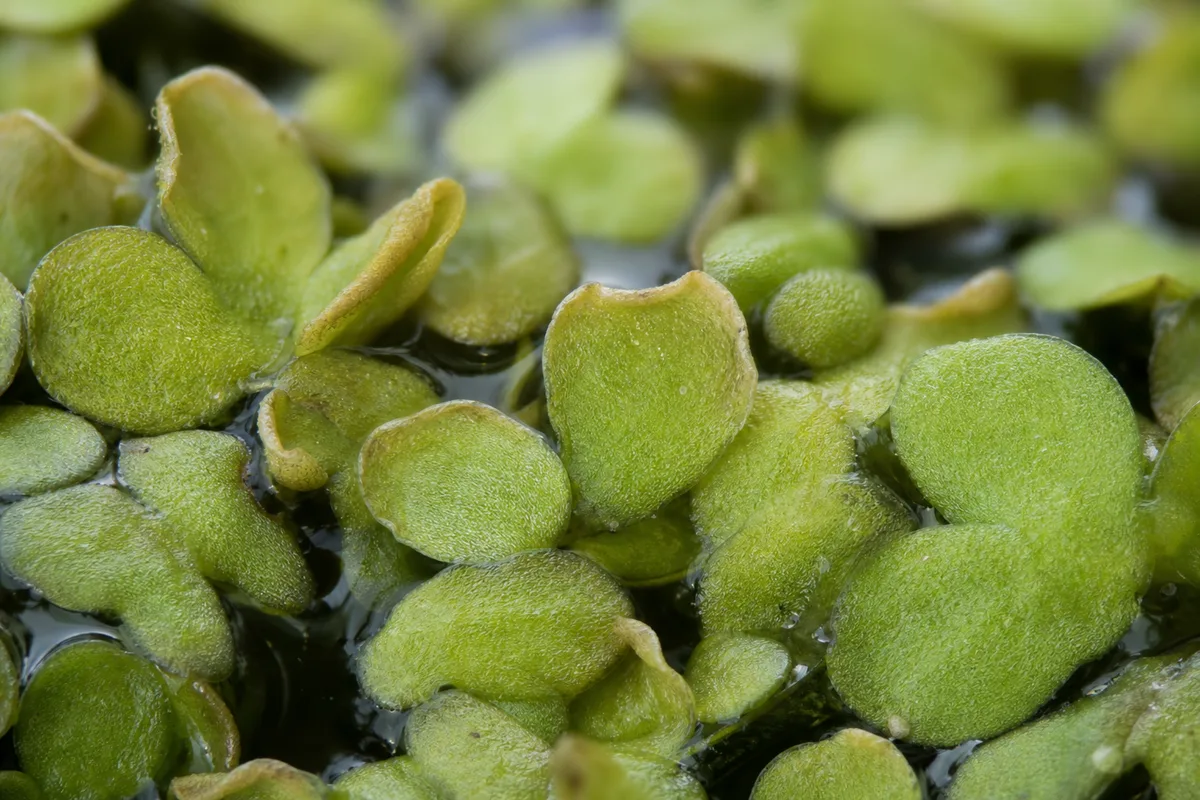
Low Humidity symptoms on Duckweed - compare with healthy tissue on the same plant.
Pale fronds vs. dry air
Pale lime-green or yellow-green fronds across a mat that still floats in full water usually mean insufficient light or nutrient depletion, not low humidity. Duckweed can persist as a thin film under dim conditions but will not deepen to the rich green of a well-lit culture. Uniform paleness with stable water level points to not enough light or low nitrate in a clean display tank-not RH.
Dry papery edges on fronds stuck above the waterline are different. That pattern matches underwatering / contact loss, where exposed tissue desiccates whether room air is humid or not.
Water level drop vs. humidity
When the tank loses half an inch from evaporation, mats can cling to dry glass, heater caps, or filter brackets. The fronds look crispy-exactly like a houseplant in dry air-but the cause is lost surface contact. Top off with dechlorinated, temperature-matched water and float every frond back before considering any humidity device.
Strong surface agitation produces a related misread. Duckweed does not survive well in fast currents and prefers still or slow water. Fronds shredded in the outflow may look damaged and “dry” while fully wet. Calm the surface with a baffle or redirected filter return instead of raising humidity.
Other common lookalikes
| What you notice | More likely cause | Quick check |
|---|---|---|
| Crispy edges only on fronds above waterline | Stranding / low water level | Compare level to a taped reference mark |
| Uniform yellow-green mat, stable full water | Low light or nutrients | Photoperiod hours; nitrate test |
| White or dissolving fronds after water change | Chlorine or medication | Dechlorinate; hospital-tank history |
| Thin mat, foul smell, stagnant surface | Over-thick cover / poor gas exchange | Skim to 25–50% coverage |
How to confirm the real cause
Work through this order before buying a humidifier or misting the tank:
- Water level check - Mark the normal surface height on the glass. More than about half an inch below that mark on an open-top tank supports evaporation stress and possible stranding-not ambient RH alone.
- Contact scan - Trace the tank perimeter. Fronds on dry hardware confirm contact loss even if most of the mat still floats.
- Flow observation - Watch the filter outflow for thirty seconds. Churning surface water that buries or shreds mats implicates current, not humidity.
- Light and color review - If fronds are fully wet and level is stable, note photoperiod and whether color is uniformly pale versus edge-crispy only at the waterline.
- Water chemistry screen - In a full, calm tank with pale mats, test nitrate and review recent top-off-only maintenance. Mineral creep from dry-room evaporation patterns can yellow duckweed without any frond drying out.
- Handling history - Net-held duckweed left on a dry counter for an hour will crisp at edges in any room. That is harvest delay dehydration, not chronic low humidity.
Confirmed “low humidity” as the primary problem on floating duckweed is rare. You should either find stranding or evaporation maintenance issues, or redirect to light, nutrients, or flow lookalikes.
First fix for duckweed
Top off with dechlorinated, temperature-matched water if the level has dropped, then float every frond onto calm surface water.
That single step addresses the only humidity-adjacent failure mode that actually harms duckweed: dry air accelerating evaporation until mats strand. Dechlorinate every addition before it enters the tank. Pour slowly along the glass to avoid blasting mats into the outflow. Slide fronds off dry rims, heater tops, and driftwood back onto the surface with a spoon or finger. Skim obviously brown, paper-thin debris so rotting tissue does not foul the water.
Do not run a humidifier, mist the mat, or set up pebble trays as the first response. Do not check soil moisture or repot-there is no pot. If water level is already correct and every frond floats, move to light and nutrient checks per our not enough light and watering guides instead of raising room RH.
Recovery timeline
Stranded or dehydrated fronds: Edge crisping often stops spreading within hours once full surface contact returns. New bud growth from surviving green tissue commonly appears within two to five days under moderate light and stable temperature. Old crispy tissue does not turn green again-judge success by fresh oval fronds multiplying at cluster edges.
Pale mats in full water (misread as humidity stress): Recovery depends on the real cause. Extending photoperiod toward 10–14 hours or adding a dilute aquatic fertilizer after a partial water change may green new growth within one to two weeks. Fronds that formed under dim or nutrient-poor conditions stay pale until replaced by daughter plants.
Evaporation-only maintenance drift: After you resume partial water changes alongside top-offs, color and growth often stabilize over one to two weekly change cycles as mineral concentration normalizes.
Signs the problem is worsening: increasing brown area despite restored water level, foul smell from decaying mats, or complete mat disintegration within a day of re-wetting. At that point, discard dead tissue and reseed from a clean backup culture rinsed in dechlorinated water.
What not to do
Do not apply terrestrial low-humidity fixes-humidifiers aimed at the room, pebble trays on nearby shelves, daily misting, or grouping with houseplants expecting spillover moisture. None of those restore duckweed’s required surface contact.
Do not check soil moisture, drainage, or pot size. Duckweed has no substrate. Advice to “water when the surface dries” describes potting mix, not a floating mat.
Do not mist duckweed expecting humidity benefits. Brief wetting does not fix stranded fronds and may increase filter entanglement.
Do not confuse topping off with changing water. Top-offs replace evaporated volume; partial changes export concentrated minerals. Dry winter rooms need both rhythms.
Do not fertilize a dehydrated or stranded culture on day one. Restore water contact and stable level for three to five days before testing nutrients.
Do not push duckweed fully underwater thinking it needs “more water.” Submerged fronds struggle; the species is adapted to float on calm surfaces in still or slow-moving freshwater.
How to prevent confusion next time
Mark a target waterline on open-top aquariums and check it every few days-daily in heated dry rooms or near turtle basking lamps. Pair top-offs with a regular partial water-change schedule so dry-air evaporation does not silently concentrate minerals.
Keep filter outflow below or baffled away from the surface so mats stay on calm water and do not collect on dry hardware when the level dips slightly.
Maintain a backup jar culture with at least an inch of dechlorinated water and a thin floating layer. Refill the jar whenever you top off the main tank.
When thinning duckweed, move excess directly into a bowl of tank water-never onto a dry counter.
If you also keep houseplants, separate mental models: tropical foliage may need winter humidifiers; floating duckweed needs stable water surface, light, and nutrients. Bookmark the overview section on why duckweed is not a houseplant before mixing care advice across species classes.
Skim to roughly 25 to 50 percent surface coverage so thick mats do not trap heat, block gas exchange, or get wind- and filter-pushed onto dry edges-while leaving enough plants to filter nutrients.
Conclusion
Low humidity on duckweed is usually a category error, not a primary aquatic problem. Floating Lemnoideae take up water from the surface and column; room RH rarely limits healthy mats. Dry winter air matters mainly by increasing evaporation and tempting keepers toward useless humidifiers while water level and nutrients go unchecked.
Check water contact first, top off and redistribute stranded fronds, calm surface flow, then rule out light and nutrient lookalikes. Skip soil checks, misting, and humidity trays entirely. When fronds float on clean, calm water with adequate light, duckweed often doubles its biomass every few days-no humidifier required.
When to use this page vs other Duckweed guides
- Duckweed watering guide - Use for routine moisture checks before assuming low humidity is the main issue.
- Duckweed problems hub - Browse all 16 common issues on this species.
- Brown Tips on Duckweed - Different entry point when symptoms overlap with low humidity.