How to Prune Hornwort: When, Where & What to Cut
How to Prune Hornwort: When, Where & What to Cut
How to Prune Hornwort: When, Where & What to Cut
Hornwort (Ceratophyllum demersum), also sold as coontail, is a fast, rootless oxygenating plant for freshwater aquariums, turtle tanks, and ponds. It grows from the water column, fragments easily, and can dominate a tank within weeks if left alone. First, remove any mushy, transparent, or brown stem sections with clean sharp scissors and take those pieces out of the water immediately. Decaying hornwort fouls small tanks fast. Once only firm green tissue remains, shorten stems before they form surface mats and thin dense stands by removing whole sections-not by giving every stem the same haircut.
How Hornwort Growth Works - and Why Cuts Differ From Anacharis
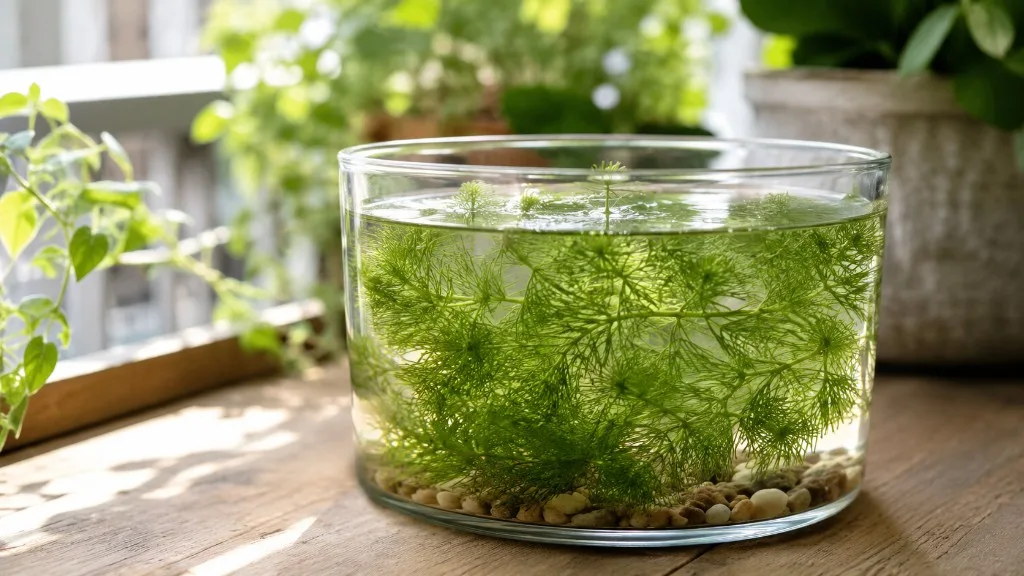
Ceratophyllum demersum is a rootless submerged plant that absorbs nutrients directly from the water rather than from substrate roots. Modified leaves and rhizoid-like branches may grip gravel or décor, but there is no root crown to protect or replant from. Stems carry leaves in whorls-forked, needle-like segments arranged around the stem-with the densest foliage near each growing tip.
Because hornwort spreads primarily by fragmentation, almost any healthy green piece you remove can become an independent plant within days. That is different from node-based stems like Anacharis (Egeria densa), where cutting above a whorl triggers lateral shoots from nodes below. Hornwort does not need nodal precision; it needs strategic mass removal before mats block light, reduce flow, and shed needles into your filter.
Botanically, hornwort produces one lateral branch per node on its freely branching stems - not the multi-shoot bushing some stem plants show after topping. Aquarists build density by keeping multiple stems or fragments, not by expecting one topped stem to fill out dramatically.
What to Check Before You Cut
Walk the tank in good light and note four things:
- Surface coverage - overlapping floating pieces or stems bent along the top glass within 2–3 inches (5–8 cm) of the waterline
- Interior color - green outer whorls hiding yellowing or bare stem inside a dense stand
- Filter proximity - green fuzz on the intake sponge or loose needles drifting toward equipment
- Tissue firmness - springy green needles vs transparent melt, mush, or brown sections
If the plant arrived recently and is shedding a fine green snow from transport stress, stabilize conditions for 7–14 days before heavy shaping. Cleanup of clearly dead tissue is always allowed; cosmetic thinning can wait until tips stay firm between water changes.
When to Trim Hornwort
Timing follows growth state and tank impact, not a calendar season. Indoor aquariums stay active whenever light and temperature are steady.
Height and surface triggers
Trim when floating stems begin layering across the surface or when anchored stems reach within 2–3 inches (5–8 cm) of the top. Hornwort does not stop at the waterline; it keeps elongating and forms light-blocking mats that shade carpet plants, Anubias, and anything below midground.
Density, filter, and cleanup triggers
Thin when you part a stand and see bare stem or loose needles in the middle-self-shading has already started. Trim when stem snippets cluster near filter intakes, powerheads, or skimmers. Remove mushy or transparent sections any time; that tissue will not recover and consumes oxygen as it decays.
In turtle tanks, LeafyPixels grower notes flag hornwort pruning as required maintenance: excess growth fouls water and clogs intakes before it becomes a visual problem.
When to wait
Avoid heavy shaping during acclimation melt after a new purchase. Needle drop from shipping or emersed-to-submersed transition looks alarming but often stabilizes once temperature and lighting hold steady. Remove only clearly dead material until new tips stay firm.
The First Cut to Make
After mushy tissue is gone, address surface mats before background height. Floating layers steal the most light per square inch and are the fastest path to a dark substrate. Lift one edge of the mat, identify the longest stems, and shorten them 2–4 inches (5–10 cm) below your target waterline. Break continuous coverage into separate clusters with visible gaps between pieces.
If nothing is floating yet, start with the tallest anchored stems touching the surface or bending along the glass. Surface control comes before cosmetic shaping of lower sections.
Where and How to Cut Hornwort Stems
The cut rule is simple: snip firm green tissue at the length you want with one clean stroke. There is no “above the node” requirement.
- Height control: shorten stems 2–4 inches below the surface on anchored plants; trim floaters before they overlap into a second layer
- Thinning: remove entire outer stems or large sections to open light paths-do not shorten every stem to identical height
- Bare-base cleanup: when the lower half is sparse and the top is dense, discard the weak base and keep or reanchor the green top
Fragments you intend to keep should be at least 2–4 inches (5–10 cm) with multiple intact whorls. Shorter snippets may survive in strong light but shed more easily.
Hold stems gently mid-length, cut, and place pieces directly in a cup or net. Yanking clumps upward releases a needle cloud and uproots loosely anchored bases.
Step-by-Step: Restore Light and Flow
- Surface first - break up mats; leave gaps, not a green raft
- Tallest background stems - cut to target height; remove one of every three or four outer stems if the stand feels solid
- Net continuously - collect trimmings as you go; run the net near the intake when finished
- Check lower plants - if carpet or rosette species were shaded, give them 1–2 weeks of returned light before changing fertilizer or photoperiod
In breeding tanks, open light windows in the center while leaving smaller floating clusters at the edges for fry cover.
How Much You Can Safely Remove
For routine maintenance in established tanks, removing 20–30% of total hornwort biomass per session is a practical baseline. Wait five to seven days before another major pass if the stand was severely overcrowded.
Sudden removal of 50% or more in one day can trigger heavy needle shed, cloudy water from decaying debris, and parameter swings in tanks under 20 gallons (76 L). Exception: take out all mushy or transparent tissue immediately regardless of percentage-decay harms water quality more than a heavy healthy trim stresses the plant.
When a tank is fully dominated-solid surface mat, packed background, etiolating plants below-use a staged recovery over two to three weeks rather than one demolition cut.
Pruning Floating vs Anchored Hornwort
Floating hornwort grows fastest at the surface and forms mats quickest. Trim every 7–10 days in warm, well-lit tanks. Break continuous sheets into separate clusters. Control population by removing excess fragments from the tank entirely, not relocating them to another corner.
Anchored hornwort-weighted or lightly pressed into substrate-is trimmed for vertical height and stand density. Lower sections go bare as upper whorls shade them; cycle stems by removing sparse bases and reanchoring green tops. Penn State Extension notes coontail lacks true roots and may float freely or anchor loosely-buried stems without light often rot rather than establish.
In high-flow tanks, thinned anchored stems may lift. Reinsert bases gently or use a temporary plant weight for 24–48 hours-not a permanent crush on brittle stems.
Trimmed Pieces: Propagation and Safe Disposal
Every healthy trim is a propagation event. Sort cuttings: keep firm green sections 2–4 inches or longer; discard mush immediately.
Float extras for fry cover, push bases into fine gravel until rhizoid-like leaves contact substrate, or share with another aquarist. Never release hornwort into ponds, streams, storm drains, or wild lakes. Coontail reproduces from small fragments left behind after cutting, which is why mechanical harvesting requires careful collection. Ceratophyllum is regulated or problematic in several regions outside its native range-compost on land, trash sealed trimmings, or give them away; do not flush or dump outdoors.
Aftercare and Recovery
After trimming, prioritize debris control and stable parameters. Do not simultaneously slash photoperiod, double fertilizer, or reshuffle CO₂ on the same day.
Keep light steady so shaded lower plants can rebound. Rinse the prefilter sponge 24 hours after a major trim-fine needles arrive on delay. After removing more than 30% of biomass, skip doubling liquid fertilizer for a few days; hornwort exports nutrients from the water column when growing aggressively, and sudden removal changes uptake.
Firm green tips extending within 3–7 days signal normal recovery. Pearling on fresh growth is a bonus sign, not a requirement. Heavy needle snow after a light trim usually means the plant was already stressed-net debris, stabilize conditions one week, then resume with 10–20% removal passes.
Outdoor ponds may see hornwort form winter buds (hibernacula) that sink and resume in spring; autumn goals differ from aquariums. Remove clippings from pond edges so fragments do not reestablish in filters or margins.
Mistakes to Avoid
- Leaving trimmings and needles in the water - they decay quickly and clog filtration
- Even-height shearing - a tidy wall still blocks light; thinning needs gaps
- Over-thinning in one session - staged removal protects parameters in small tanks
- Applying Anacharis node rules - nodal precision does not drive hornwort density
- Burying stems deep in substrate - rootless tissue rots without light and flow
- Trimming hard during acclimation melt - wait for firm adapted growth
- Ignoring filter intakes during and after the session - wrap sponges or reduce flow briefly while netting
Conclusion
Trimming hornwort is biomass management, not nodal surgery. Remove dead tissue first, break surface mats before they seal the tank, and thin by removing whole sections rather than uniform height cuts. Collect every fragment, dispose of excess responsibly, and match trim frequency to placement-floaters need more frequent passes than loosely anchored background stems. Done consistently, Ceratophyllum demersum stays a fast, forgiving oxygenator instead of a filter-clogging mat.
When to use this page vs other Hornwort guides
- Hornwort overview - Start here for whole-plant context before deep-diving this topic.
- Hornwort problems hub - Jump to symptom-specific fix guides when this care topic does not resolve the issue.
- Leggy Growth on Hornwort - Escalate here when pruning adjustments are not enough.
- Slow Growth on Hornwort - Escalate here when pruning adjustments are not enough.
- Brown Tips on Hornwort - Escalate here when pruning adjustments are not enough.