Rubber Plant Care: Light, Water, Soil & Tips
Ficus elastica
Rubber plants thrive in bright indirect light with watering every 7–10 days when the top 2 inches of soil are dry. They are sensitive to sudden moves and draughts which trigger leaf drop, and are toxic to cats and dogs.
Rubber Plant Care: Light, Water, Soil & Tips
Start with wateringThe most common care mistake for Rubber PlantWatering guide →Rubber Plant care essentials
Light
bright indirect light
Water
Water when the top 2 inches of soil are dry - roughly every 7–10 days in summer.
Soil
Well-draining, moderately fertile potting mix.
Humidity
40–60%
Temperature
18–29°C (65–85°F)
Fertilizer
About Rubber Plant
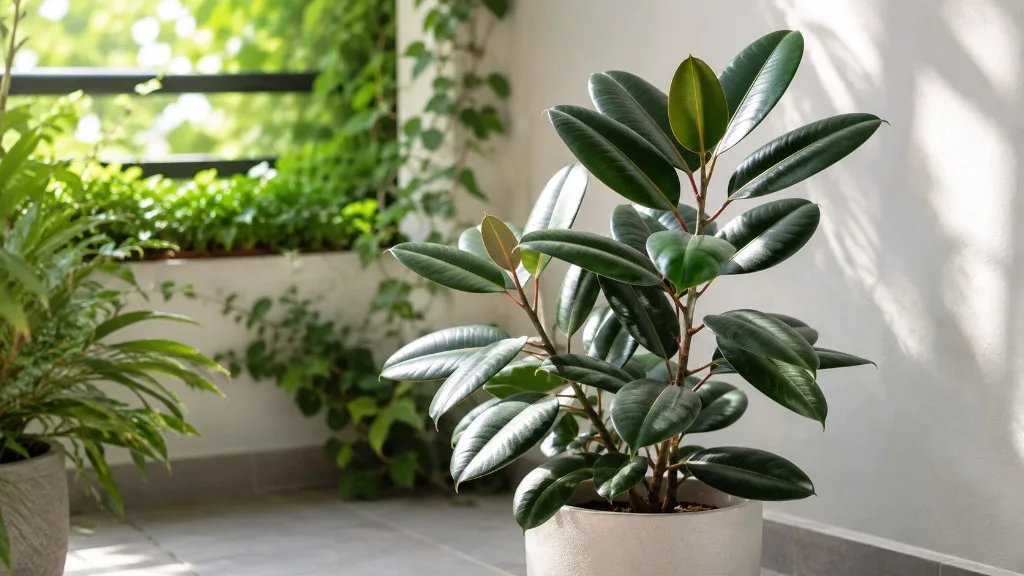
Rubber Plant is native to South and Southeast Asia (India, Nepal, Bhutan, Indonesia), typically reaches 4–10 ft tall indoors; large glossy oval leaves 8–12 inches long indoors, with moderate to fast growth. Rubber Plant has a tree like growth habit and part of the Moraceae family. It is also known as Rubber Tree, Indian Rubber Tree, and Rubber Fig.
| Detail | Information |
|---|---|
| Also known as | Rubber Tree, Indian Rubber Tree, Rubber Fig |
| Native region | South and Southeast Asia (India, Nepal, Bhutan, Indonesia) |
| Mature size | 4–10 ft tall indoors; large glossy oval leaves 8–12 inches long |
| Growth rate | Moderate to fast |
| Growth habit | Tree Like |
| Scientific name | Ficus elastica |
| Family | Moraceae |
Rubber Plant Care: Light, Water, Soil & Tips
What Is Rubber Plant?
Rubber plant - also called rubber tree - is one of the most recognizable large-leaf houseplants in the world. The accepted botanical name is Ficus elastica, a member of the Moraceae (fig) family that shares care DNA with fiddle-leaf figs, weeping figs, and other ficus species grown indoors. What sets rubber plant apart is the combination of glossy, paddle-shaped leaves, upright tree-like growth, and a tolerance profile that makes it genuinely beginner-friendly once you understand its few non-negotiables: bright light, drainage, and stability.
Indoors, rubber plant typically reaches 4 to 10 feet (1.2 to 3 m) tall over several years, with individual leaves measuring 8 to 12 inches (20 to 30 cm) long on mature specimens. Growth is moderate to fast in warm, bright conditions - often 12 to 24 inches (30 to 60 cm) per year when light and watering align - and slows sharply when temperatures drop or light weakens. The plant forms a single upright trunk with a canopy of thick, waxy foliage that reads as architectural rather than delicate, which is why it anchors living rooms, office lobbies, and bright corners where smaller plants would disappear.
If you are deciding whether rubber plant fits your home, the honest summary is this: it rewards Rubber Plant light guide, well-draining soil, and a Rubber Plant watering guide tied to actual dryness - and it punishes soggy roots, cold drafts, and sudden environmental changes. It is easier than a fiddle-leaf fig for most growers and more demanding than a snake plant or ZZ plant. The payoff is a bold vertical statement that fills vertical space without constant fussing, plus propagation simple enough that a single parent plant can supply backups for free. One critical caveat for pet owners: rubber plant is toxic to cats and dogs according to the ASPCA, which surprises people who assume its tough leaves mean it is chew-safe.
Botanical Background and Native Range
Rubber plant is native to South and Southeast Asia, including India, Nepal, Bhutan, Indonesia, and Malaysia, where it grows as a large tree in tropical and subtropical forest understories. In the wild, specimens can exceed 100 feet (30 m) tall, though indoor plants remain a fraction of that size because root volume, light, and ceiling height all cap upward growth. The species name elastica refers to the milky latex sap that oozes from cut stems and broken leaves - the same substance that historically made Rubber Plant overview commercially important for rubber production before Hevea brasiliensis replaced it as the primary rubber crop.
Understanding the native range matters for indoor care more than most plant tags suggest. Ficus elastica evolved in a climate with warm temperatures year-round, high ambient humidity, and filtered light filtered through a forest canopy - not the dim corner or the baking windowsill where houseplants often end up. When in doubt, mirror that rhythm: bright but softened light, stable warmth, and soil that dries partially between waterings rather than staying wet for days. The Missouri Botanical Garden notes that rubber plant is reliably hardy only in USDA Zones 10 through 12 outdoors; everywhere else, it is a container or indoor plant that must come inside before temperatures fall below about 50°F (10°C).
Rubber plant belongs to Moraceae, a family with characteristic care patterns worth learning once because they apply across multiple popular houseplants. Moraceae plants tend to share a few baseline rules: drainage matters more than fertilizer, sudden temperature swings trigger leaf drop, and most problems start at the roots before they show clearly on the foliage. Ficus species also react visibly to relocation - moving a rubber plant from a nursery bench to your living room, or from one window to another, often causes temporary leaf drop even when the new spot is technically better. That reaction is normal; repeated drop after the plant has settled is not.
Do not confuse Ficus elastica with Peperomia obtusifolia, sometimes sold as “American rubber plant.” They share a common name but are unrelated species with completely different care profiles and toxicity. Peperomia obtusifolia is generally considered non-toxic to pets; Ficus elastica is not. When pet safety matters, confirm the botanical name on the tag rather than relying on the words “rubber plant” alone.
Popular Cultivars and How They Differ
Commerce sells rubber plant under many cultivar names, and light tolerance varies more than generic care guides admit. The most common varieties and their practical differences:
Robusta and Decora are the classic deep-green forms with broad, glossy leaves and the most forgiving light requirements of the group. They tolerate medium bright indirect light better than variegated siblings and are the safest choice for growers still learning window placement. Burgundy (also sold as Abidjan or Black Prince) produces near-black leaves with vivid red leaf sheaths on new growth. It tolerates moderate light but needs enough brightness to keep the dark pigmentation rich; in dim corners, new leaves emerge greener and less dramatic.
Tineke is a variegated cultivar with gray-green centers, cream margins, and pink tones on new growth. Ruby pushes the pink further, holding red-pink coloration on mature leaves when light is strong enough. Both variegated types need consistently bright indirect light - more than Robusta or Burgundy - because the white and cream sections contain less chlorophyll and cannot photosynthesize as efficiently. In insufficient light, Tineke and Ruby produce progressively greener leaves, lose their pink, and grow slowly with long gaps between nodes. Melany is a compact, branching cultivar suited to smaller spaces; it shares the family’s baseline care rules but stays shorter without aggressive pruning.
The cultivar on your pot changes one decision above all others: how much light the plant needs to look like the plant you bought. Solid-green types survive a wider range of placements. Variegated types punish dim rooms faster and more visibly. If you do not know your cultivar, watch the newest leaves - if they are smaller, paler, or less patterned than older ones, the plant is asking for more light.
Best Growing Conditions for Rubber Plant
Rubber plant does best when your space approximates the warm, bright, humid rhythm of its native range. The four variables that decide almost every outcome are light, water, soil, and temperature. Get those aligned and feeding, Rubber Plant repotting guide, pruning, and propagation become routine. Get one badly wrong - especially water or cold - and the plant declines in ways that fertilizer and leaf-wiping cannot fix.
Light Requirements
Rubber plant needs bright indirect light for most of the day - roughly six to eight hours of strong ambient light without harsh midday sun burning the leaves. A spot near an east-facing window is often ideal: gentle morning direct sun, then bright indirect exposure the rest of the day. South- and west-facing windows work well when the plant sits three to six feet (1 to 2 m) back from the glass or behind a sheer curtain that filters afternoon intensity. North windows can sustain solid-green cultivars in genuinely bright rooms, but growth will be slower and variegated types will lose color.
The fastest diagnostic for incorrect light is new growth, not old leaves. Compact internodes, firm stems, and leaf color that matches your cultivar’s description mean the plant is probably happy. Long, bare stems with small pale leaves - called etiolation - mean the plant wants more light. Bleached patches, brown crispy spots on sun-facing leaves, or midday curling mean it wants less direct exposure or a slower acclimation to stronger light. Rubber plant can tolerate a few hours of gentle morning direct sun when acclimated, but avoid harsh afternoon rays that scorch the large leaf surface area quickly.
Acclimate gradually over one to two weeks when moving from a dim shop shelf to a bright sill. Leaves formed in low light contain less protective pigment and burn easily if you jump straight into unfiltered afternoon sun. Rotate the pot every week or two so growth stays upright rather than leaning hard toward the window. If natural light is weak - common in winter at northern latitudes - a full-spectrum grow light on a 10–12 hour timer, positioned 12–24 inches above the canopy, prevents the stretched, sparse look that appears on windowsill rubber plants between November and February.
Temperature and Humidity
Rubber plant prefers stable temperatures between 65 and 85°F (18 and 29°C) during active growth, with 60 to 75°F (16 to 24°C) as the comfortable everyday range most homes already provide. It tolerates brief warmth above 85°F when soil moisture keeps pace, but it suffers in sustained cold. Treat 50°F (10°C) as the danger threshold - below that, leaf drop, blackened foliage, and permanent damage become likely. Watch problem spots that homeowners overlook: directly under an AC vent, on a winter window ledge touching cold glass, and above a radiator that cycles hot and dry.
Humidity is helpful but secondary compared with light and water for most rubber plants. The species handles average home humidity reasonably well - Clemson HGIC notes rubber plants prefer humid conditions but tolerate the dry air common in homes. Very dry winter air - below about 30% - can encourage spider mites on indoor specimens, especially when combined with irregular watering. Grouping plants, using a pebble tray with the pot elevated above the water line, or running a small humidifier near the plant all help more than misting, which raises humidity briefly and can leave wet foliage that invites fungal issues when air circulation is poor.
Soil and Drainage
Use a well-draining, moderately fertile potting mix that holds some moisture without staying waterlogged for days. The principle matters more than a single branded recipe: the mix should retain enough air space around roots that they can breathe, drain freely within minutes of watering, and not compact into a dense brick within a year. A workable home blend is roughly two parts quality peat-free or peat-based houseplant mix, one part perlite or pumice, and optionally one part orchid bark for extra structure in large pots. Add extra perlite if your home runs hot and bright; add slightly more organic matter if you struggle to keep moisture even in very large containers.
Target a slightly acidic to neutral pH around 5.5 to 7.0. Hobbyists rarely need to meter pH precisely for rubber plant; the bigger practical issue is compaction and salt buildup from hard tap water and over-fertilizing, which show up as crust on the soil surface and brown leaf margins. Always plant in a container with a drainage hole. Decorative cachepots are fine only if you empty runoff after every watering. A heavy, peat-only indoor mix that has sat in the same pot for three years is one of the fastest paths to root problems - refresh the substrate when you repot rather than expecting old mix to perform indefinitely.
How to Water Rubber Plant
The general rule for rubber plant is water when the top 1 to 2 inches (2.5 to 5 cm) of soil are dry, then soak thoroughly until a small amount runs from the drainage hole. More precisely, plan around every 7 to 10 days in summer and every 14 to 21 days in winter as starting intervals, then refine based on how fast the actual pot dries in your home. Pot size, soil mix, light, humidity, and season all change the interval, so a calendar answer is a starting point, not a rule to follow blindly.
Rubber plant’s thick, waxy leaves store moisture and make the species more drought-tolerant than many tropical houseplants - but that same leaf structure also means underwatering on Rubber Plant shows up late, after roots have already been stressed. The greater risk for most indoor growers is overwatering on Rubber Plant, which leads to yellow lower leaves, soft stems, and root rot on Rubber Plant. Use your finger, a wooden skewer, or the pot’s weight to assess moisture an inch or two into the mix before you pour. If the deeper soil is still damp, wait. If the top layer is dry and the pot feels noticeably lighter, water until roughly 10 to 20% of the applied volume drains from the bottom, then empty the saucer within 30 minutes so roots are not standing in stale water.
Watering Rhythm During Active Growth
During active growth - usually the warm, bright months from late spring through early fall - rubber plant uses water predictably. The pot dries on a steady rhythm and the plant produces firm new leaves at the growing tip. Water thoroughly when the top of the mix is dry, not on a fixed day of the week. In bright rooms with large specimens, you may need to check every few days; in moderate light, once a week is often enough. The goal is even moisture without waterlogging - roots should access water when they need it, then access air as the mix dries.
Leaf wiping is not watering, but it supports the plant’s moisture balance indirectly. Large rubber plant leaves collect dust that blocks light and reduces photosynthetic efficiency. Wipe leaves monthly with a damp cloth to keep the surface clean. Avoid leaf shine products; they clog stomata and create more problems than they solve.
Seasonal Adjustments
In cooler, dimmer months, rubber plant slows its metabolism even if your thermostat stays constant. The same watering rhythm that worked in August will overwater the plant in January. Stretch the interval, check moisture more carefully, and pause or reduce fertilizer when no new growth is visible. Resume the normal rhythm only when new leaves are clearly emerging and the pot is drying at a faster rate. If you run heating that dries the air sharply, the surface may dry faster than the root zone - probe deeper than the top inch before assuming the plant needs a drink.
Common Watering Mistakes
The single most common cause of problems with rubber plant is watering on a schedule instead of on the plant’s actual state. Other frequent mistakes include watering a little every day instead of deeply when needed, leaving the pot sitting in runoff, and interpreting leaf drop after a move as a call for more water when the plant actually needs stable light and time to acclimate. If lower leaves turn yellow while the soil stays wet and the stems feel soft, check roots immediately - healthy roots are white or tan and firm; black, mushy roots mean rot and require repotting into fresh, dry mix after trimming damaged tissue.
How to Feed Rubber Plant
Rubber plant does not need heavy feeding. A modest, balanced fertilizer applied during active growth is enough. Strong doses, frequent feeding, and fertilizer applied to dry or stressed soil are how people burn roots and accumulate salt that shows up as brown leaf edges months later.
A balanced water-soluble houseplant fertilizer (such as 10-10-10 or 20-20-20) at one-quarter to one-half of the label rate is a safe starting point. Apply to already-moist soil every four to six weeks from spring through early fall, or monthly at half strength if you prefer a simpler calendar. If your potting mix contains a starter charge - common in commercial blends - hold off on supplemental feeding for the first month after repotting. Organic slow-release granules applied at repotting work well for growers who do not want a liquid schedule, but keep doses modest; rubber plant grows fine with less fertilizer than faster-feeding annuals.
Pause feeding during dormancy, after a major repot, while the plant is recovering from pest damage or root rot, and during the deepest part of winter when no new growth appears. Feeding a plant that cannot use the nutrients just adds salt to the mix. Resume when the plant is clearly in active growth and the pot is drying on a normal rhythm.
Repotting and Root Health
Repot rubber plant roughly every one to two years, or whenever the pot dries much faster than it used to, roots circle the drainage holes, or water runs straight through without soaking in. The best time is at the start of the active growing season - usually early spring - so the plant has a full warm, bright season to fill the new pot with roots.
Go up only one pot size at a time, typically 1 to 2 inches (2.5 to 5 cm) wider in diameter. A pot that is too large holds too much wet soil relative to the root system, which is the most common cause of root rot after repotting. Use fresh, well-draining mix, position the plant at the same depth it sat before, and water lightly for the first week to let damaged roots heal. Expect some leaf drop after repotting; new growth is the signal that roots have re-established.
Signs It Is Time to Repot
The clearest signs are physical: roots emerging from the drainage holes or soil surface, water running straight through a root-bound mass, a plant that is top-heavy and prone to tipping, or a specimen that has not been repotted in more than two years regardless of visible roots. If the mix has compacted, smells sour, or grows a persistent crust of white salt, repot into fresh substrate even if the calendar says wait. Rubber plant tolerates being slightly root-bound better than being planted in an oversized wet pot - when in doubt, choose the smaller upgrade.
Pruning and Shaping Rubber Plant
Rubber plant grows upright by default, but pruning controls height, encourages branching, and removes damaged foliage. The best time to prune is during active growth in spring or early summer, when the plant can seal wounds and push new shoots quickly. Always use clean, sharp shears and expect milky latex sap to flow from every cut - wear gloves if you have latex sensitivity, keep sap away from eyes, and wipe tools after finishing.
To limit height, cut the main stem just above a leaf node at the desired height. New growth often emerges below the cut, sometimes as multiple shoots that create a bushier silhouette. To encourage bushiness on a single-stem plant, pinch or prune the top once the plant reaches a height you like; the loss of apical dominance redirects energy to side buds. Remove yellowed, damaged, or diseased leaves at the petiole base whenever you see them - they will not recover, and they drain resources while attracting pests.
Some growers use notching - a shallow cut above a node on the trunk - to stimulate branching without removing top growth. Results vary by cultivar and plant vigor; a healthy, well-lit rubber plant responds more reliably than a stressed one in a dim corner. Wipe sap from cuts with a damp cloth; it sets quickly and is messy on floors and furniture.
Propagation Methods for Rubber Plant
The most reliable home propagation method for rubber plant is stem cuttings taken during active growth. Air layering works for large specimens you do not want to cut short, but stem cuttings are faster and simpler for most growers.
For stem cuttings: select a healthy stem with at least one leaf and one node, make a clean cut with sharp shears, and optionally remove the lowest leaf to expose the node. Let the cutting sit for 30 to 60 minutes so the latex sap seals at the cut surface - this reduces rot risk in the rooting medium. Root in a moist, well-draining mix of perlite and peat-free potting soil, or in water if you change the water weekly. Keep the cutting in bright indirect light with stable humidity; a loose plastic bag over the pot (not touching leaves) helps if your air is very dry. Roots typically form in three to eight weeks; new leaf growth confirms success.
Do not propagate a stressed, diseased, or heavily pest-infested plant. The cutting inherits the parent’s problems, and weak cuttings fail at a much higher rate than healthy ones. Address the parent’s issues first, then propagate from firm, mature growth.
Common Rubber Plant Problems
Most problems with rubber plant are environmental, not mysterious. They show up as specific leaf symptoms that map to specific causes. The hardest part is usually patience: many issues take weeks to develop and weeks to resolve once you correct the underlying condition.
Leaf drop after a move is the signature ficus reaction and does not always mean you are watering wrong. If the plant drops a few older leaves within two weeks of coming home or changing windows, hold the environment steady and wait for new growth. If drop continues for more than a month, or new leaves fall before opening, investigate light stability, draft exposure, and root moisture.
Yellow leaves on lower stems often signal overwatering or poor drainage, especially when the soil smells musty or feels wet deep in the pot. Yellow leaves with dry, crispy edges point toward underwatering or salt buildup. Check moisture first, then light, then inspect leaf undersides and stem joints for spider mites, mealybugs, and scale - pests stress rubber plant enough to cause chlorosis even when watering is correct.
Brown tips and edges usually indicate low humidity, salt accumulation, or fluoride/chlorine sensitivity in tap water. Flush the pot with plain water quarterly to wash salts through, and consider filtered water if brown tipping persists despite correct watering. Brown spots with yellow halos on variegated cultivars often mean sun scorch on pale leaf sections; move the plant back from direct rays or add a sheer curtain.
Spider mites appear as fine webbing and stippled leaves in dry air. Mealybugs cluster in leaf axils as white cottony masses. Scale looks like immobile brown bumps on stems. Catch infestations early by inspecting weekly. A strong shower, manual removal, and insecticidal soap applied to all leaf surfaces handle most issues if you start before the population spreads.
Is Rubber Plant Safe for Pets?
No - rubber plant is toxic to cats and dogs. The ASPCA lists Ficus elastica as toxic to both species, and this applies to every cultivar, including Robusta, Burgundy, Tineke, Ruby, and Melany. There is no pet-safe variety of Ficus elastica. The toxic agents are ficin (a proteolytic enzyme) and ficusin (a psoralen compound) present in the milky latex sap that flows from cut or broken tissue.
Ingestion can cause oral irritation, excessive drooling, vomiting, and diarrhea in pets. Skin contact with sap may cause dermatitis. The plant is generally considered less severely toxic than some houseplants - ingestion is rarely fatal in small amounts - but the discomfort is real and veterinary guidance is appropriate when you know or suspect a pet has chewed leaves or stems. Contact the ASPCA Animal Poison Control Center at (888) 426-4435 (fee may apply) or your veterinarian if ingestion occurs.
For households with curious pets, place rubber plant out of reach on a sturdy stand, in a room pets do not access, or choose a genuinely non-toxic alternative such as a true palm or a peperomia. Do not rely on bitter sprays or foil deterrents as long-term solutions for a plant with leaves at pet height. If you must handle the plant after pruning, wash hands before touching pets, and clean sap from floors where paws can track it.
Conclusion
The most useful thing to know about rubber plant is that it is a tree-like tropical fig from South and Southeast Asia that wants bright indirect light, well-draining soil, and water only when the top of the mix has dried - not a calendar, not a guess, and not a reaction to every dropped leaf. Solid-green cultivars like Robusta and Burgundy forgive moderate light; variegated Tineke and Ruby demand more brightness to keep their color. The plant grows at a moderate to fast rate to roughly 4 to 10 feet indoors when conditions align, and it rewards stability more than constant intervention.
Get the four basics right - light, water, soil, and temperature - and feeding, repotting, pruning, and propagation become straightforward maintenance. Get any one badly wrong and the plant shows it through yellow leaves, brown tips, or persistent drop. Fix the environment first; the plant usually follows. And if you share your home with cats or dogs, treat rubber plant as a display plant kept well out of reach, not a shelf plant at nose height. That single decision prevents the most serious consequence of an otherwise excellent houseplant.
When to use this page vs other Rubber Plant guides
- Rubber Plant overview - Canonical hub for this species - care topics and problems branch from here.
- Rubber Plant problems - Symptom-first path when you already know something is wrong.
Related Rubber Plant guides
How to care for Rubber Plant?
How much light does Rubber Plant need?
bright indirect light
- bright indirect light - bright indirect light.
When should you water Rubber Plant?
Water when the top 2 inches of soil are dry - roughly every 7–10 days in summer.
- Insert finger 2 inches into soil - Water when the top 2 inches of soil are dry - roughly every 7–10 days in summer.
- water thoroughly until it drains from the bottom - Water when the top 2 inches of soil are dry - roughly every 7–10 days in summer.
- Drain excess water - Water when the top 2 inches of soil are dry - roughly every 7–10 days in summer.
What soil works best for Rubber Plant?
Well-draining, moderately fertile potting mix.
- standard peat-free potting compost - Well-draining, moderately fertile potting mix.
- perlite (20–25%) - Light white granules that keep soil airy and help prevent compaction.
- coarse bark
Grower notes for Rubber Plant
What matters most with Rubber Plant
Rubber Plant often reacts to change before it reacts to bad care. Leaf drop after a move is common, but repeated drop means light, drafts, watering, or root conditions are still unstable. In practice, the care checkpoint is simple: bright indirect light. Pair that with well-draining, moderately fertile potting mix, and avoid changing water, pot size, and placement all at once.
Best placement in a real home
Rubber Plant belongs where bright indirect light is realistic for most of the day, not only where the pot looks good. Water when the top 2 inches of soil are dry - roughly every 7–10 days in summer. If the pot stays wet longer than expected, move the plant into better light or reassess the mix before watering again. Humidity target: 40–60%. Temperature comfort zone: 18–29°C (65–85°F).
Before you buy this plant
Choose Rubber Plant with firm new growth, clean leaf undersides, and soil that does not smell sour or feel compacted. Be cautious if you see leaf-drop, sticky residue, collapsed crowns, or a pot that is wet in poor light. Cosmetic old-leaf damage is less worrying than weak roots or active pests.
First month after bringing it home
Do not repot Rubber Plant on day one unless the mix is failing or pests are obvious. Quarantine it, learn how fast the pot dries, and keep care boring while it adjusts. Watch especially for leaf-drop, yellow-leaves, and brown spots. If problems appear, correct the condition first rather than stacking fertilizer, repotting, and pruning together.
Safety note for Rubber Plant
Rubber Plant is not a plant to keep within reach of pets or children. The database flags it for cats and dogs. Use gloves if sap or plant tissue is irritating, and pick a pet-safe alternative for floor pots or low shelves.
How to tell Rubber Plant is settling in
Also sold as Rubber Tree, Indian Rubber Tree, and Rubber Fig, this plant should be judged by stable new growth rather than label names alone. If you plan to multiply it later, common methods include Stem cuttings in water, Air layering, and Leaf-bud cuttings. Repot only when you see Roots circling the pot base or escaping drainage holes and growth slowing despite good care. If yellow-leaves shows up early, inspect light, watering, and roots before assuming the plant is permanently weak.
Is it pet safe?
Rubber Plant is toxic to cats and dogs.
Milky sap (latex) is irritating to the skin, eyes, and mucous membranes. ASPCA classifies as toxic to cats and dogs; ingestion causes vomiting and diarrhoea.
Watering Rubber Plant
For Rubber Plant, insert finger 2 inches into soil; water thoroughly until it drains from the bottom and water every 7–10 days in summer; every 14–21 days in winter. Reduce frequency in winter; rubber plants are semi-dormant and more prone to overwatering in cold months.
| Detail | Information |
|---|---|
| How often | Every 7–10 days in summer; every 14–21 days in winter |
| How to check | Insert finger 2 inches into soil; water thoroughly until it drains from the bottom |
| Seasonal changes | Reduce frequency in winter; rubber plants are semi-dormant and more prone to overwatering in cold months |
Signs of overwatering
- Yellow dropping leaves
- brown patches on leaf undersides
- soggy soil smell
Signs of underwatering
- Leaves curling inward
- leaf drop starting from lower leaves
- very dry soil
Soil & potting for Rubber Plant
Use a mix of standard peat-free potting compost, perlite (20–25%), coarse bark for Rubber Plant. Good drainage; avoid dense heavy mixes. Target soil pH around 5.5–7.0. Repot every 1–2 years while young; every 2–3 years once mature, ideally in spring.
| Detail | Information |
|---|---|
| Recommended mix | standard peat-free potting compost, perlite (20–25%), coarse bark |
| Drainage | Good drainage; avoid dense heavy mixes |
| Soil pH | 5.5–7.0 |
| Repotting frequency | Every 1–2 years while young; every 2–3 years once mature |
| Best season to repot | Spring |
Signs it needs repotting
- Roots circling the pot base or escaping drainage holes
- growth slowing despite good care
- plant becoming top-heavy
Humidity & temperature for Rubber Plant
Rubber Plant prefers 40–60%, though normal home humidity is usually fine. Keep temperatures around 18–29°C (65–85°F).
| Detail | Information |
|---|---|
| Humidity | 40–60% - normal home humidity is fine. |
| Ideal temperature | 18–29°C (65–85°F) |
Fertilizer & pruning for Rubber Plant
Common problems on Rubber Plant
Leaf Drop
MediumLikely cause: Rubber plants are sensitive to sudden moves, cold draughts, overwatering, or underwatering - any stress triggers leaf drop
Quick fix: Identify and remove the stressor; find a stable position with good indirect light and consistent watering
Full fix guide →Root Rot
HighLikely cause: Overwatering in winter when the plant is semi-dormant and growth is slow
Quick fix: Reduce winter watering significantly; repot if roots are mushy
Full fix guide →Yellow Leaves
MediumLikely cause: Overwatering is most common; also caused by sudden temperature changes or too little light
Quick fix: Allow soil to dry further between waterings; check drainage; stabilise position
Full fix guide →Curling Leaves
MediumLikely cause: Common curling leaves pattern on Rubber Plant under indoor care stress.
Quick fix: Inspect roots, watering, light, and pests; adjust one variable and monitor new growth.
Full fix guide →Brown Leaves
MediumLikely cause: Common brown leaves pattern on Rubber Plant under indoor care stress.
Quick fix: Inspect roots, watering, light, and pests; adjust one variable and monitor new growth.
Full fix guide →Black Spots
MediumLikely cause: Common black spots pattern on Rubber Plant under indoor care stress.
Quick fix: Inspect roots, watering, light, and pests; adjust one variable and monitor new growth.
Full fix guide →Holes in Leaves
MediumLikely cause: Common holes in leaves pattern on Rubber Plant under indoor care stress.
Quick fix: Inspect roots, watering, light, and pests; adjust one variable and monitor new growth.
Full fix guide →Pale Leaves
MediumLikely cause: Common pale leaves pattern on Rubber Plant under indoor care stress.
Quick fix: Inspect roots, watering, light, and pests; adjust one variable and monitor new growth.
Full fix guide →Distorted Leaves
MediumLikely cause: Common distorted leaves pattern on Rubber Plant under indoor care stress.
Quick fix: Inspect roots, watering, light, and pests; adjust one variable and monitor new growth.
Full fix guide →Scale Insects
MediumLikely cause: Common scale insects pattern on Rubber Plant under indoor care stress.
Quick fix: Inspect roots, watering, light, and pests; adjust one variable and monitor new growth.
Full fix guide →Thrips
MediumLikely cause: Common thrips pattern on Rubber Plant under indoor care stress.
Quick fix: Inspect roots, watering, light, and pests; adjust one variable and monitor new growth.
Full fix guide →Whiteflies
MediumLikely cause: Common whiteflies pattern on Rubber Plant under indoor care stress.
Quick fix: Inspect roots, watering, light, and pests; adjust one variable and monitor new growth.
Full fix guide →Leaf Miners
MediumLikely cause: Common leaf miners pattern on Rubber Plant under indoor care stress.
Quick fix: Inspect roots, watering, light, and pests; adjust one variable and monitor new growth.
Full fix guide →Caterpillars
MediumLikely cause: Common caterpillars pattern on Rubber Plant under indoor care stress.
Quick fix: Inspect roots, watering, light, and pests; adjust one variable and monitor new growth.
Full fix guide →Nitrogen Deficiency
MediumLikely cause: Common nitrogen deficiency pattern on Rubber Plant under indoor care stress.
Quick fix: Inspect roots, watering, light, and pests; adjust one variable and monitor new growth.
Full fix guide →Iron Deficiency
MediumLikely cause: Common iron deficiency pattern on Rubber Plant under indoor care stress.
Quick fix: Inspect roots, watering, light, and pests; adjust one variable and monitor new growth.
Full fix guide →Magnesium Deficiency
MediumLikely cause: Common magnesium deficiency pattern on Rubber Plant under indoor care stress.
Quick fix: Inspect roots, watering, light, and pests; adjust one variable and monitor new growth.
Full fix guide →Potassium Deficiency
MediumLikely cause: Common potassium deficiency pattern on Rubber Plant under indoor care stress.
Quick fix: Inspect roots, watering, light, and pests; adjust one variable and monitor new growth.
Full fix guide →Calcium Deficiency
MediumLikely cause: Common calcium deficiency pattern on Rubber Plant under indoor care stress.
Quick fix: Inspect roots, watering, light, and pests; adjust one variable and monitor new growth.
Full fix guide →