Drooping Leaves on Rubber Plant: Causes, Checks & Fixes
Quick answer
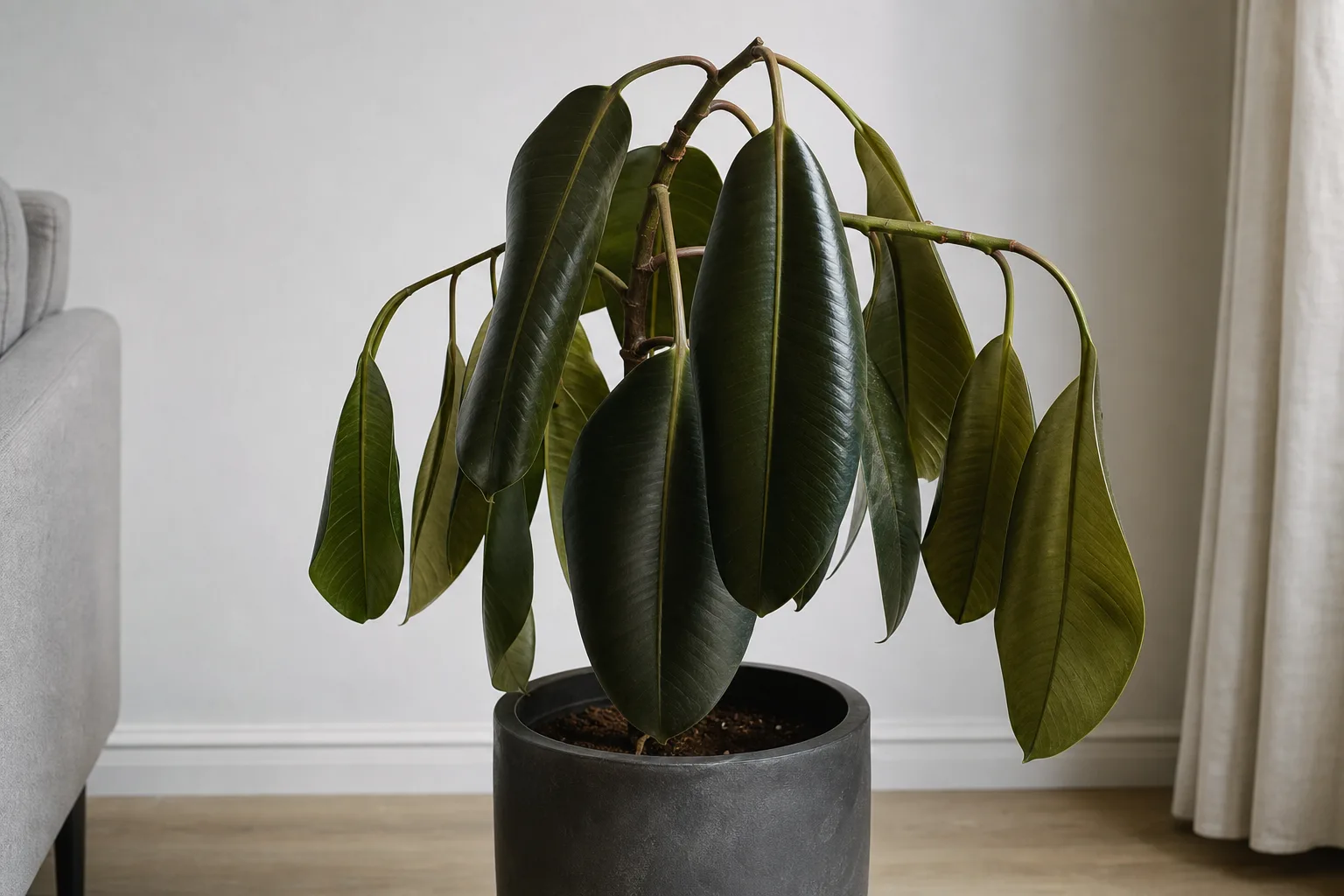
Drooping leaves on Rubber Plant usually mean roots cannot supply enough water to stiff, heavy blades-either the mix is too dry or too wet and failing. Lift the pot and check the top 2 inches of soil before you change anything.
Drooping Leaves on Rubber Plant: Causes, Checks & Fixes
This guide covers drooping leaves on Rubber Plant. See also the general Drooping Leaves guide, watering, and light pages for this plant.
Drooping Leaves on Rubber Plant: Causes, Checks & Fixes
Quick answer
Drooping leaves on Rubber Plant (Ficus elastica) look alarming because the plant holds large, stiff, leathery blades that normally stand at a confident angle. When those leaves hang limp, the issue is almost always water transport-not a mystery leaf disease.
The trap is that underwatering on Rubber Plant and overwatering on Rubber Plant can look identical from above. Dry roots cannot push water into heavy foliage; rotting roots cannot absorb water even when the pot feels wet. Before you reach for the watering can, lift the pot and check the top 2 inches of soil. That single step separates thirst from root failure and keeps you from watering a drowning plant.
Why Rubber Plant leaves droop
Rubber Plant leaves are thick, glossy, and stiffly leathery-8–12 inches long on mature specimens. That size demands steady root uptake. When turgor pressure drops inside leaf cells, petioles lose rigidity and blades hang downward. On Rubber Plant overview, droop is a fast stress signal-not a slow cosmetic fade.
Several causes fit Rubber Plant’s actual care profile:
Underwatering. When the mix has been dry too long-especially in bright rooms or during summer growth-the plant cannot replace water lost through those large leaves. Lower leaves often show stress first. The pot feels light, soil is dry several inches down, and stems may still feel firm.
Overwatering and root stress. Saturated soil suffocates fine roots. Damaged roots cannot take up water, so foliage droops despite wet soil-the classic wilt paradox. Root rot usually results from overly frequent watering or soil that does not drain quickly. Winter makes this worse: Rubber Plant growth slows from fall through late winter, so the same watering volume that worked in summer keeps roots wet too long-reduce watering from fall to late winter.
Environmental shock. Rubber Plant is sensitive to change. A recent move across the room, Rubber Plant repotting guide, opening a winter window nearby, or cold air from HVAC can trigger temporary droop even when moisture is technically adequate. Rubber Plant prefers to remain in one location and reacts before slow neglect shows.
Heat and light stress. Unfiltered direct sunlight can damage leaves; scorch and increased water loss can outpace root uptake. A plant pushed against a hot south window without matching soil moisture can droop on the exposed side first.
Pest sap loss. Mealybugs, scales, and spider mites can be problematic on Rubber Plant. Heavy feeding weakens tissue and can accompany limp leaves, stippling, or sticky residue-but pests are less common than water mismatch as a first explanation.
What drooping leaves look like on Rubber Plant
Healthy Rubber Plant holds upright, glossy leaves on stiff stems. Drooping changes the silhouette before color always changes.
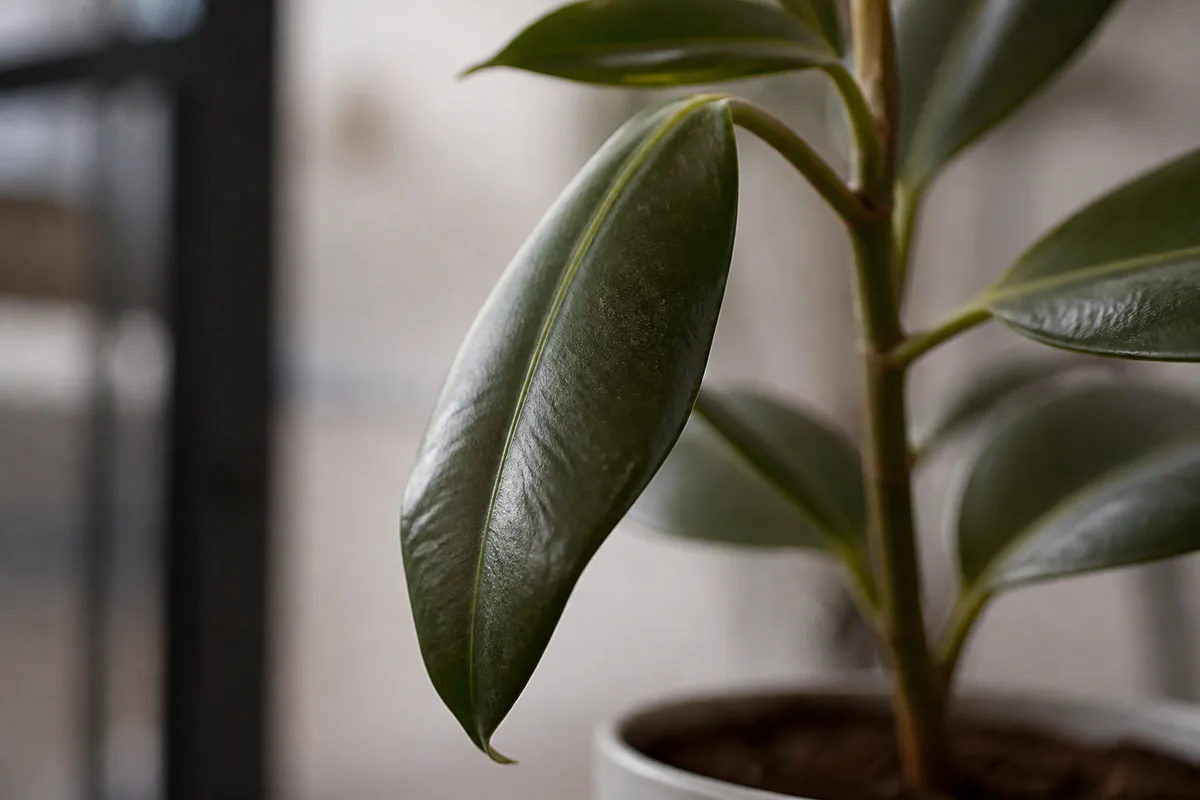
Drooping Leaves symptoms on Rubber Plant - compare with healthy tissue on the same plant.
Thirst-related droop:
- Leaves hang downward but stay green at first
- Pot feels noticeably light
- Top 2 inches of soil are dry; lower mix may be fully dry in severe cases
- Leaves may feel slightly less rigid but not mushy
- Perking within hours after a thorough watering strongly confirms simple dehydration
Overwatering-related droop:
- Leaves limp while soil stays wet for days
- Pot feels heavy; saucer may hold standing water
- Yellowing may appear if the soil stays too wet, especially on lower leaves
- Stems may soften near the base; soil may smell sour
- Drooping persists or worsens after you add more water
Shock-related droop:
- Starts within days of a move, repot, or temperature swing
- Often affects multiple leaves at once while new tips still look normal
- Soil moisture may be fine; timing matches the change
- Gradual firming over one to three weeks once conditions stabilize
Pest-related droop:
- Limp leaves paired with sticky residue, cottony clusters, scale bumps, or fine webbing
- Often localized on one branch before spreading
- Does not match a clear dry-or-wet pot pattern alone
One or two lower leaves drooping slowly while new growth at the top stays firm may be normal aging-not an emergency.
How to confirm the cause
Work through these checks in order. Each step narrows the diagnosis before you act.
- Pot weight test - Lift the container. If it is light, it needs water; heavy and wet suggests overwatering or poor drainage.
- Soil probe - Insert your finger 2 inches into the mix. That depth matches Rubber Plant’s standard dry-down checkpoint. Surface dryness with wet core still points to prior overwatering.
- Stem squeeze - Firm stems with dry soil mean thirst. Soft, collapsing stems with wet soil mean root damage-do not water again yet.
- Smell check - Sour or musty odor from drainage holes supports rotting roots, not simple thirst.
- Timing review - Did you repot, move, or expose the plant to a new draft in the last two weeks? Shock droop fits a recent change with otherwise reasonable moisture.
- Light and heat scan - Note if droop hits the side facing a window or heater. Partial collapse on one exposure suggests light or heat stress.
- Underside inspection - Check for mealybugs, scale, stippling, or webbing if water checks do not explain the pattern.
If dry soil and a light pot confirm thirst, you have a clear underwatering diagnosis. If wet soil, heavy pot, and soft stems align, treat as root stress first-adding water will deepen the problem.
First fix for Rubber Plant
Lift the pot. If the top 2 inches of soil are dry and the pot is light, water thoroughly once until water runs from the drainage holes, then discard saucer water.
That is the correct first action for thirst-driven droop on Rubber Plant. Use room-temperature water and wet the full root ball-not a splash on the surface. Wait six to twenty-four hours and check whether leaves regain partial firmness.
If the pot is heavy, soil is wet, or stems feel soft, do not water. Stop irrigation, move the plant out of direct sun, and let the mix dry toward the top 2 inches before any next watering. If stems stay soft after several days of dry-down, unpot and inspect roots-trim mushy tissue and repot into fresh well-drained mix only when rot is confirmed.
Do not repot, fertilize, or prune heavily on day one unless roots are clearly failing. Rubber Plant recovers faster when you fix one variable at a time.
Step-by-step recovery
After the first fix, follow the path that matches your diagnosis.
For underwatering:
- Water thoroughly once, then wait for partial perk-up before watering again.
- If soil repelled water and ran straight through dry pockets, bottom-soak the pot in a tray of water for twenty to thirty minutes, then drain fully.
- Move the plant out of harsh direct sun until turgor returns-Rubber Plant light guide is enough during recovery.
- Resume the normal rhythm: water when the top 2 inches are dry, not on a fixed calendar.
For overwatering without confirmed rot:
- Stop watering until the top 2 inches dry out.
- Empty saucers after every future watering.
- Confirm the pot has drainage holes and the mix drains within minutes, not hours.
- Reduce winter frequency when growth slows.
For root rot:
- Unpot and rinse roots. Trim soft, dark, or foul-smelling tissue with clean scissors.
- Repot into fresh well-drained houseplant mix in a clean pot with drainage-same size or slightly smaller, not oversized.
- Wait one week before resuming careful dry-down watering.
- Remove leaves that stay limp and yellow after roots stabilize-they will not re-stiffen.
For shock droop:
- Leave the plant in one stable bright indirect spot-do not move it again while recovering.
- Match watering to dry-down; avoid compensating with extra water or fertilizer.
- Wait two to three weeks. New firm leaves at the tip are the success signal.
For pest-related droop:
- Isolate the plant.
- Wipe or rinse leaf undersides and stems to remove visible mealybugs or scale.
- Treat confirmed infestations before expecting leaves to firm up-sap loss must stop first.
Recovery timeline
Simple underwatering often shows partial improvement within six to twenty-four hours after a thorough drink. Full firmness on large older leaves may take several days; judge success by stopped spread and stiff new growth, not perfect old blades.
Overwatering recovery without rot may take one to three weeks once soil dries and roots breathe again. Root rot repot recovery commonly runs two to six weeks depending on how much tissue was lost.
Shock droop from a move or repot usually eases over one to three weeks if placement and watering stay stable. Light-deficiency droop tied to weak structure rebuilds slowly as new leaves form under better light-often a month or more.
Limp leaves that have fully collapsed rarely return to their original upright shape. That is normal. Recovery means the plant stops losing turgor on new tissue.
Lookalike symptoms to rule out
Leaf drop without sustained droop. Rubber Plant may shed leaves after stress while remaining stems stay upright. Mass drop after a move is common; persistent limp blades with firm stems suggest active water mismatch instead.
Yellow leaves as the primary sign. Yellowing often precedes or accompanies droop from wet soil, but pale yellow upper leaves in low light can occur without full collapse. Check whether blades hang limp or simply fade color.
Wilting vs drooping. On Rubber Plant the terms overlap-both mean lost turgor. The diagnostic question is always wet soil or dry soil, not the word you use.
Leggy stretched growth. Insufficient light produces long internodes and pale leaves reaching toward windows. Stems may lean without the heavy limp hang of water-stressed blades. Improving light fixes structure over time; it is not an acute watering emergency.
Brown crispy edges. Dry air or underwatering can crisp margins while the leaf midsection still holds some rigidity. Pure droop without browning more often points to root-zone water balance or shock.
Mistakes to avoid
Do not water automatically when leaves hang-confirm soil first. Wet-soil droop gets worse with more water.
Do not move the plant repeatedly while it droops. Rubber Plant hates instability; each move resets recovery.
Do not fertilize a stressed plant hoping to push new growth. Feed only after turgor stabilizes during active spring or summer growth.
Do not repot on day one unless soil is failing or roots are mushy. Unnecessary repotting adds shock on top of droop.
Do not prune all limp leaves immediately. Wait to see which tissue recovers after the root zone is corrected.
Do not leave the pot in standing saucer water. Saturated bottoms mimic overwatering even when top soil feels acceptable.
How to prevent drooping leaves next time
Match watering to dry-down, not the calendar. Water thoroughly but let the soil dry slightly between waterings-when the top 2 inches are dry, roughly every seven to ten days in active summer growth and less often in winter when the plant is semi-dormant.
Keep Rubber Plant in bright indirect light with protection from harsh afternoon sun. Strong appropriate light helps the pot dry predictably between waterings.
Leave the plant in one stable location away from cold drafts, winter window gaps, and blasting HVAC. Avoid temperatures lower than 55°F and cold drafts-sudden drops stress roots and foliage together.
Use well-draining mix with perlite or bark and pots with drainage holes. Empty saucers after every watering.
Scout leaf undersides during weekly care so pest sap loss does not mimic thirst.
When repotting, do it in spring during active growth and avoid changing placement, pot size, and Rubber Plant watering guide all in the same week.
When to worry
Treat drooping as urgent when multiple leaves collapse within a day or two, soil smells sour, stems soften at the base, or limp leaves persist more than forty-eight hours after a correct thirst watering. Those patterns suggest advancing root failure, not a slow single-leaf fade.
Also act quickly if droop spreads branch to branch while soil stays wet-you may be in an overwatering feedback loop where each extra drink damages more roots.
Lower urgency fits one older leaf drooping slowly while new glossy tips stay firm, or mild temporary limpness within days of a known move that improves as the plant settles.
If more than half the root mass is mushy after inspection, salvage may require stem cuttings from firm upper growth rather than saving the whole root system.
Conclusion
Drooping leaves on Rubber Plant are a water-transport problem dressed up as a leaf problem. Lift the pot, read the top 2 inches of soil, and let weight tell you whether to water once or to stop and inspect roots. Fix one cause, wait for firm new growth, and keep placement stable-the combination that keeps heavy glossy leaves standing upright in the first place.
When to use this page vs other Rubber Plant guides
- Rubber Plant watering guide - Use for routine moisture checks before assuming drooping leaves is the main issue.
- Rubber Plant problems hub - Browse all 17 common issues on this species.
- Underwatering on Rubber Plant - Different entry point when symptoms overlap with drooping leaves.
- Overwatering on Rubber Plant - Different entry point when symptoms overlap with drooping leaves.
- Root Rot on Rubber Plant - Different entry point when symptoms overlap with drooping leaves.