Rubber Plant Light Needs: Best Window, Sun & Warning Signs
Rubber Plant Light Needs: Best Window, Sun & Warning Signs
Rubber Plant Light Needs: Best Window, Sun & Warning Signs
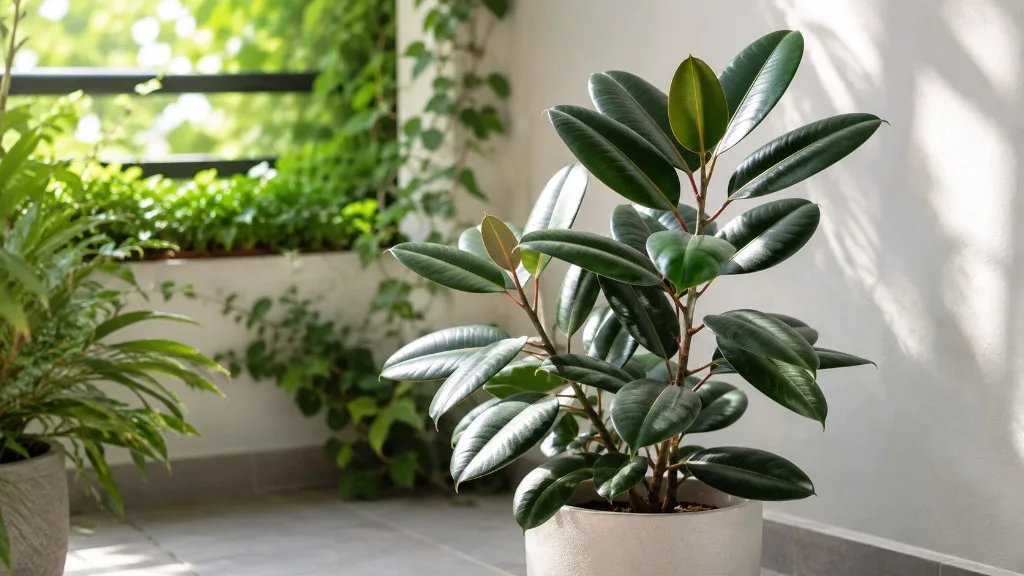
Ficus elastica - the rubber plant or rubber tree - is one of the most recognizable indoor trees in temperate homes: thick stems, large glossy oval leaves, and a habit that can reach 6 to 10 feet indoors when conditions support steady growth. That scale makes light a bigger decision than it is for a small desk succulent. A rubber plant parked in the wrong exposure does not just look slightly pale; it stretches, drops lower leaves, opens smaller new foliage, and turns routine watering into a guessing game because the pot dries at a completely different rate than the care blog assumed.
The practical target for most rubber plant cultivars is bright indirect light - strong ambient brightness near a window that sees open sky, with direct sun either limited to gentle morning exposure or softened by distance, sheer fabric, or seasonal setback from hot glass. Clemson HGIC recommends bright light with morning exposure from an east window as the baseline indoor placement, with south- or west-facing windows workable when filtered or set back from hot glass. That is not the vague “medium light” label on a nursery tag. It is a placement you can test by reading new leaf size, internode spacing, and firmness over two weeks after any move.
This guide covers the decisions that keep rubber plants dense and glossy: how much light Ficus elastica actually needs, how solid green, burgundy, and variegated cultivars differ, where to place pots by window direction, when direct sun helps versus hurts, how to acclimate without triggering the leaf drop that makes owners overwater, and how to read warning signs on new growth before you repot a healthy root system or rewrite the feeding schedule.
How Much Light Rubber Plant Actually Needs
Rubber plant is a tropical fig native to South and Southeast Asia - India, Nepal, Bhutan, Indonesia, and surrounding regions - where wild trees grow at the forest edge and in bright filtered canopy gaps, not in deep understory shade and not in all-day exposed scorch on open rock. NC State Extension describes Ficus elastica as preferring partial shade or bright indirect light indoors, with dappled sunlight in its native range - which frames why indoor “low light tolerant” advice often underserves a species built for strong brightness.
Indoors, that ecology translates to bright indirect light as the default for healthy rubber plant performance. Clemson Cooperative Extension HGIC classifies rubber plants as preferring bright light while noting adaptability to lower light - an important distinction. Adaptability means survival, not the compact, glossy, moderately fast growth most growers want from a statement tree. (Clemson HGIC) HGIC specifically recommends morning light from an east window as a strong placement pattern, which matches how many experienced growers place rubber plants: enough intensity to drive photosynthesis and firm new leaves, without the heat load of unfiltered afternoon rays on west glass.
Bright indirect light sits between two familiar failure zones. Too little light produces etiolation - visible stretching between leaf pairs, smaller new foliage, and gradual lower-leaf drop as the plant sheds tissue it cannot support energetically. Too much unfiltered direct sun, especially hot afternoon beams through south or west windows on a plant grown in softer nursery light, produces bleached patches, crisp brown edges, leaf cupping, and sometimes sudden leaf collapse after an unacclimated move. Rubber plant leaves are thick and can handle more sun than many variegated houseplants once hardened, but thickness is not immunity to abrupt exposure jumps or leaf-scorching window contact.
Placement success shows up in new leaves, not nostalgia for older foliage. Healthy new growth should emerge firm, glossy, and appropriately sized for the cultivar - with short internodes (little space between leaf pairs) and an upright habit that does not lean hard toward the glass within a week. If the plant meets those checks, your light is probably in range even if the room fails a casual “bright enough” eye test. Human eyes adapt to dim interiors; rubber plants do not.
The Short Answer for Busy Growers
If you only remember four rules, use these. Default placement: brightest suitable window with bright indirect exposure - east window, or south/west with sheer curtain or one to three feet of setback from hot summer glass. Daily brightness target: roughly six to eight hours of meaningful light on the canopy, not just visible daylight across the room. Direct sun rule: morning sun is often fine when acclimated; avoid harsh midday and afternoon beams on unadapted plants, especially through west glass in summer. Diagnostic rule: judge light by the newest leaf or shoot after 10 to 14 days in a spot; old damaged leaves never tell you whether today’s placement works.
Light also sets the pace for water use. A rubber plant in stronger correct light dries its pot faster, grows more actively in warm months, and tolerates less chronic soggy soil. A plant moved to lower light needs less frequent watering - otherwise yellow lower leaves and root stress look like a mysterious watering failure when the real problem is dim exposure. Treat light as the throttle for the whole care system, not an isolated variable you fix after everything else fails.
Why Light Controls Rubber Plant Health and Form
Rubber plant belongs to Moraceae, the fig family - a group that shares a few indoor truths: roots hate chronic wetness in dim corners, sudden environmental changes trigger leaf drop before slow decline, and most “mystery” problems started with an unannounced move. Light is the variable that most often starts that chain. A plant shifted from a bright greenhouse bench to a dim living room drops leaves, the owner waters more because the pot feels light after leaf loss, and now the remaining roots sit in wet mix with reduced foliage to transpire moisture away. The plant looks sick; the sequence began with photons, not pathogens.
Understanding why rubber plant reacts this way makes placement decisions easier to trust. You are not chasing an arbitrary brightness rule from a blog - you are approximating the forest-edge light economy the species evolved under, then adjusting for glass, cultivar pigmentation, and the Ficus habit of defending stability over rapid adaptation.
Forest-Edge Origins and Bright Indirect in Practice
In native habitat, Ficus elastica grows as a large tree at the forest edge - bright filtered gaps rather than deep shade - which is why indoor “low light tolerant” advice underserves a species built for strong brightness. Clemson HGIC notes rubber plants can reach 6 to 10 feet indoors when space allows, with light as the primary governor of leaf size and growth pace. Rubber plant also shows phototropic lean toward the strongest source; rotation prevents one-sided form, but hard lean with long internodes together usually means total daily light is too low.
Bright indirect light means the plant sees a bright sky without a direct sunbeam baking leaves for hours. At midday, your hand near the foliage should cast a soft shadow, not a hard knife-edge shadow. Crouch to the plant’s height: if it sees open sky and is not pressed against hot glass, you are likely in range. One to three hours of gentle morning sun on east glass often works when acclimated; five hours of afternoon west sun in summer is scorch territory unless filtered. Compare candidate spots by whether new growth stays compact over two weeks rather than chasing a fixed meter reading. Wipe dust from glossy leaves - grime effectively dims the plant in place near kitchen or urban windows.
Rubber Plant Cultivar Light Differences
Not every Ficus elastica sold as rubber plant shares the same light budget. Decades of cultivar breeding produced solid green workhorses, dark burgundy selections, and heavily variegated show types whose pale leaf zones change the risk math. The species-level rule - bright indirect default - still applies, but how close to the glass, how much direct morning sun, and how quickly bleach appears vary by cultivar.
NC State Extension lists common indoor cultivars including ‘Tineke’, ‘Burgundy’, ‘Robusta’, and ‘Red Ruby’, all grown as houseplants under bright indirect light with regular care during active growth. “All grow well” does not mean “all identical.” Variegated types pay a photosynthetic tax on every white or pink zone that cannot contribute sugar at full efficiency.
Solid Green and Burgundy Types
Ficus elastica ‘Robusta’ and other solid green rubber plants are the most forgiving of the group in moderate indoor light - still not true low-light plants, but slower to show stretch than variegated siblings when placed a few feet from a decent window. Ficus elastica ‘Burgundy’ - sometimes sold as Black Prince - uses anthocyanin-rich dark pigments that deepen in stronger light and fade toward greener tones when light drops. Burgundy types can tolerate slightly more direct sun than variegated cultivars when acclimated because dark pigments and thick tissue handle higher photon loads before visible bleaching, but low light still defeats the cultivar’s reason to exist by greening new foliage over time.
For solid green and burgundy rubber plants, the placement target remains bright indirect near an east window or filtered south/west. Direct morning sun is often a color and vigor upgrade for burgundy selections when introduced gradually. Do not interpret burgundy’s relative toughness as permission for a north hallway without supplementation - you will get a living plant and lose the dense, dark silhouette you bought.
Variegated Tineke and Ruby Varieties
Ficus elastica ‘Tineke’ and ‘Ruby’ are variegated rubber plants whose white, cream, pink, or ruby-pink zones lack full chlorophyll capacity and bleach faster under harsh direct sun. Clemson HGIC lists variegated cultivars such as ‘Tricolor’ and ‘Doescheri’ with cream and pink leaf zones that need brighter overall light than solid-green types to maintain color - not dimmer corners because variegation “looks delicate.” That counterintuitive rule trips many buyers: variegated rubber plants often need more total brightness, not less, while simultaneously tolerating less unfiltered beam intensity on the pale zones.
Place variegated types in strong bright indirect - often closer to east glass or under a supplemental LED - while filtering hot afternoon sun that whitens pale zones. Watch cream or pink sections first when diagnosing scorch; green tissue may look fine while variegation crisps. In too little light, contrast fades and stems stretch faster than on solid green types. Never pair low light with heavy feeding to “save” color - pigment pattern is a light problem. A Tineke usually wants more total photons with softer direct rays than a Robusta, though neither belongs in a dark corner long term.
Best Window Placement for Rubber Plant
Window direction is a starting guess, not a verdict. A labeled “south window” blocked by a neighbor’s balcony may deliver less usable light than an open east window. Rubber plant placement succeeds when canopy-level brightness stays strong for enough hours daily and heat load on leaves stays manageable through the season.
Indoors, put the pot within one to three feet (30–90 cm) of the glass on the chosen exposure when bright indirect light is the goal - not on a console across the room where human eyes read brightness but the plant receives a fraction of the photons. Clemson HGIC’s east-window morning-light recommendation is a practical anchor for Rubber Plant overview. (Clemson HGIC) Rotate the pot a quarter turn every week or two once growth stabilizes to prevent hard lean; Ficus species noticeably orient toward light sources.
East, South, West, and North Windows Compared
An east-facing window is the most reliable default for rubber plant in most temperate homes. Morning sun is bright but cooler than late-day sun, delivering intensity that supports large glossy leaves without the heat spike that bleaches or crisps foliage on west glass. Many rubber plants tolerate one to three hours of direct early sun on east panes when acclimated, then spend the rest of the day in strong indirect brightness - an excellent match for both solid green and variegated cultivars when pale zones are monitored.
South windows excel fall through spring but may overheat leaves in summer - use sheer curtains or setback. West windows carry harsh afternoon rays; diffuse peak hours or acclimate carefully. North windows rarely sustain vigorous growth; expect stretch and smaller new leaves unless you add a grow light.
Distance From Glass and Seasonal Adjustments
Light falls off fast with distance. Moving a pot from one foot to six feet from the same window can drop usable intensity dramatically - the difference between firm large new leaves and gradual stretch over a month. If furniture layout forces distance, compensate with a brighter exposure category (east instead of north, filtered south instead of deep room placement) or a full-spectrum LED, not more fertilizer.
Hot glass contact is separate from brightness. Leaves pressed against summer window panes can scorch locally even when the exposure would be fine at a slight distance. Keep foliage clear of glass, especially west and south, and watch dark pots on windowsills - they heat root zones and compound leaf stress.
Window light is not static through the year. Winter lowers sun angle and shortens photoperiod; a rubber plant that thrived six inches from a south window in June may stretch slightly by February in the same physical spot because total daily light drops. Summer intensifies rays on south and west glass; a March-perfect placement may scorch in August without diffusion. Seasonal management is mostly small moves and observation - inches, not monthly room hopping. Ficus species prefer stable placement once adjusted; radical reshuffling triggers leaf drop even when each individual spot might have been acceptable.
Direct Sun: What Rubber Plant Can Handle
Rubber plant is more direct-sun tolerant than many variegated houseplants and more tolerant than Ficus lyrata (fiddle-leaf fig) in some grower comparisons, because thick leaves and - in burgundy types - dark pigments handle higher photon loads before visible bleaching. That tolerance still requires acclimation and heat awareness. Clemson HGIC recommends bright light with morning east-window exposure as the safest default, with afternoon sun filtered to avoid leaf burn.
Outdoors in USDA zones 9a–12b, established Ficus elastica tolerates partial shade to dappled sun per NC State Extension; indoor pots in temperate climates face different heat dynamics through glass and should stay conservative until the plant proves otherwise.
Morning Sun vs Harsh Afternoon Rays
Morning direct sun - especially east exposure before noon - is the safest direct-ray category for rubber plant. Light intensity is rising, air and glass temperatures are lower, and acclimated plants often produce firmer, more glossy new leaves with modest early direct exposure. Many growers report excellent rubber plant performance on east sills with two to three hours of morning sun, then bright indirect the rest of the day.
Midday and afternoon direct sun - particularly west and unfiltered south in summer - carries higher heat and UV load. Unacclimated plants may show bleached tan patches, crisp brown edges, or leaf cupping within days. Variegated Tineke and Ruby types fail first in pale zones. Even acclimated solid green plants have limits on hot window sills above radiators or dark surfaces that reflect heat upward. If you want afternoon sun, build exposure slowly and prefer filtered light through sheer fabric over a raw beam on the canopy.
How to Acclimate Without Mass Leaf Drop
Plants grown in nursery shade houses or big-box dim shelves arrive soft. Jumping them to a blazing west sill without transition is how crisp leaves and Ficus leaf drop happen together - then owners overwater the shedding plant because the pot feels dry on top after foliage loss, compounding stress.
A practical acclimation path over 7 to 14 days:
- Days 1–3: Place in bright indirect one to two feet farther from the target sunny window than final placement, or use a sheer curtain full-time.
- Days 4–7: Reduce filtering or move six inches closer daily while watching newest leaves for bleach or curl during peak hours.
- Days 8–14: Reach final position if new growth stays firm and glossy; if crisping appears, retreat one step and hold a week before advancing.
Make one environmental change at a time - do not acclimate to sun, repot, and fertilize in the same week. Short-term leaf drop after a move is common Ficus behavior if watering matches the new dry-down rate. Rubber plant sap is irritating; ASPCA lists Ficus elastica as toxic to cats and dogs if ingested. (ASPCA)
Low Light Limits and Survival vs Performance
Rubber plant is often marketed as adaptable to low light, and Clemson HGIC reflects that adaptability honestly - but adaptability is not endorsement. In low light, rubber plant survives longer than many ficus cousins and longer than variegated types with higher photosynthetic demand, yet performance collapses toward slow stretch, smaller leaves, and gradual lower-leaf shedding.
Low light failure follows a predictable sequence. First, internodes lengthen - visible gaps between leaf pairs increase and the stem looks like it is reaching for a brighter source. New leaves emerge smaller and thinner than older leaves formed in better light. Growth slows, so pots stay wet longer, raising root rot on Rubber Plant risk if watering habits do not adjust. Lower leaves may yellow and drop as the plant sheds foliage it cannot support energetically. None of that requires pests or nutrient crisis; it is often pure photon deficit misread as underwatering on Rubber Plant or overwatering on Rubber Plant.
The common mistake is keeping a rubber plant in a dim corner because it still looks green. Green is not the metric. Form and new leaf quality are the metrics. A rubber plant that is alive but stretched with sparse lower branches is a light problem waiting for a watering disaster.
Signs Your Plant Needs More Brightness
Use new growth as your primary signal. Move the plant or add light if you see several of these on fresh leaves or stems over two weeks:
- Long internodes and visible lean toward the brightest direction
- Smaller leaf size on new flushes compared to older leaves formed in better light
- Slow unfurling of new leaves with soft or thin texture
- Lower leaf yellowing and drop without overwatering symptoms in the root zone
- Variegation fading toward plain green on Tineke or Ruby types
- Soil staying wet for days on the surface because transpiration dropped with dim light
Fix priority is increase brightness, not nitrogen fertilizer. Feed cannot substitute for adequate light flux on a tree-scale foliage plant. If the only available spot is dim, accept slower greener growth or install a grow light - do not pretend a 6-foot rubber plant will stay compact in a north hallway without help.
Grow Lights When Natural Light Falls Short
When the brightest window still produces stretched stems or undersized new leaves - common in winter, north rooms, office settings, or apartments with light wells - a full-spectrum LED grow light is the most reliable fix. Rubber plant responds to artificial light the same way other large foliage ficuses do: compact growth and larger leaves return when spectrum, duration, and distance are adequate, not when a weak decorative bulb sits across the room.
Setup, Hours, and Adjustment Signals
Position a full-spectrum LED 12 to 18 inches (30–45 cm) above the top leaves, not only to the side. Side lighting alone produces lean; overhead or angled top light mimics window sky brightness more evenly across the canopy. Run 10 to 14 hours daily on a timer to supplement natural window light; in rooms without useful window exposure, 12 to 16 hours is a common foliage-houseplant range, watching for heat buildup near the canopy.
Choose full-spectrum white LEDs (4000K–6500K) and prioritize even canopy coverage. After two weeks, if stems still stretch, lower the fixture slightly or add an hour - not both at once. Match watering to slower winter dry-down even when LEDs extend photoperiod.
Warning Signs of Too Much or Too Little Light
Wrong light rarely announces itself with one obvious symptom on rubber plant. Too little light whispers through stretch and small new leaves for weeks before the plant looks “bad.” Too much sun can strike fast on unacclimated plants - bleach and crisp within days of a move to hot glass. Because rubber plant also drops leaves when watering, temperature, or root conditions shift, light diagnosis requires looking at which leaves fail, how fast, and what new growth does afterward.
Too little light - watch for: long internodes; strong directional lean; progressively smaller new leaves; slow dry-down paired with chronic wet surface soil because transpiration dropped; lower leaf yellowing and drop without root rot smell; variegation losing contrast toward green on Tineke and Ruby.
Too much light - watch for: bleached or tan patches, especially on the window-facing side or on pale variegated zones; crisp brown edges that progress rather than stable old mechanical damage; leaf cupping or folding during brightest hours; sudden scorch after an unacclimated move; soil and pot overheating on a summer sill; wilting on moist soil at midday in direct beam, which may indicate root-zone heat rather than drought.
Yellow leaves confuse owners because Clemson HGIC lists too much water, too little light, dry air, and cold drafts among causes. Use context: yellowing after a hotter window suggests sun stress; yellowing in a dim corner with wet soil suggests light-driven overwatering; yellowing on lower leaves only with firm new top growth may be normal senescence.
Judge by new growth, not old damage. Bleached or yellowed mature leaves will not fully recover when you fix placement - only new leaves and internodes tell you whether the current spot works. Wait 10 to 14 days after a move before declaring failure unless acute scorch demands an immediate retreat. Stabilize light and match watering to the new dry-down rate before Rubber Plant repotting guide or feeding.
Conclusion
Rubber plant light requirements boil down to one placement principle above the rest: bright indirect light strong enough to support large glossy leaves and compact internodes, with harsh direct sun avoided until the plant acclimates and you can manage heat on the foliage. East windows and filtered south or west exposures are the usual winners; north windows and deep room placements need honest acceptance of slow stretch or the addition of a full-spectrum grow light. Low light may keep the plant alive - marketing adaptability is not wrong - but it will not keep a 6-foot indoor tree looking like the specimen that prompted the purchase.
Use new growth as your feedback loop, remember that variegated Tineke and Ruby types need more total brightness than solid green Robusta even while bleaching faster in harsh beams, and link brighter light to faster dry-down and adjusted watering. Move exposure in small acclimated steps rather than sudden jumps that trigger Ficus leaf drop, wipe dust from glossy leaves so light reaches the tissue, and change one variable at a time when troubleshooting. Get those habits right and Ficus elastica becomes a surprisingly straightforward large houseplant - dense, glossy, and steady - instead of a leaf-dropping mystery that keeps sending you back to search results for a clearer answer.
When to use this page vs other Rubber Plant guides
- Rubber Plant overview - Start here for whole-plant context before deep-diving this topic.
- Rubber Plant problems hub - Jump to symptom-specific fix guides when this care topic does not resolve the issue.
- Not Enough Light on Rubber Plant - Escalate here when light adjustments are not enough.
- Leggy Growth on Rubber Plant - Escalate here when light adjustments are not enough.
- Leaf Drop on Rubber Plant - Escalate here when light adjustments are not enough.
Related Rubber Plant guides
- Rubber Plant overview
- Rubber Plant watering
- Rubber Plant soil
- Rubber Plant propagation
- Rubber Plant fertilizer
- Rubber Plant repotting
- Not Enough Light on Rubber Plant
- Leggy Growth on Rubber Plant
- Leaf Drop on Rubber Plant
- Rubber Plant problems
Related tool
Try the Plant Problem Diagnosis Tool with rubber-plant pre-selected to estimate needs for your setup.