Aparajita (Clitoria ternatea) Care Guide: Light, Water
Clitoria ternatea
Aparajita is an easy tropical climber needing full sun, a trellis, and regular watering - sow seeds in March for beautiful indigo-blue flowers through India's summer and rainy season.
Aparajita (Clitoria ternatea) Care Guide: Light, Water, Soil, Pruning
Start with wateringThe most common care mistake for AparajitaWatering guide →Aparajita care essentials
Light
full sun - 5–6 hours of direct sunlight for prolific flowering
Water
Regular watering; allow top 3 cm to dry between waterings.
Soil
Well-draining, moderately fertile potting mix or garden soil; fixes nitrogen.
Humidity
Moderate to high (50–70%); naturally adapted to Indian tropical climate
Temperature
22°C to 38°C (72–100°F)
Fertilizer
About Aparajita
Aparajita is native to Tropical Asia (Indian subcontinent and Southeast Asia), typically reaches 2–5 m as climber; compact in 30–60 cm containers with support indoors, with fast once established growth. Aparajita has a climbing growth habit and part of the Fabaceae family. It is also known as Butterfly Pea, Blue Pea Vine, Asian Pigeonwings, and Shankhpushpi variant.
| Detail | Information |
|---|---|
| Also known as | Butterfly Pea, Blue Pea Vine, Asian Pigeonwings, Shankhpushpi variant |
| Native region | Tropical Asia (Indian subcontinent and Southeast Asia) |
| Mature size | 2–5 m as climber; compact in 30–60 cm containers with support |
| Growth rate | Fast once established |
| Growth habit | Climbing |
| Scientific name | Clitoria ternatea |
| Family | Fabaceae |
Aparajita (Clitoria ternatea) Care Guide: Light, Water, Soil, Pruning
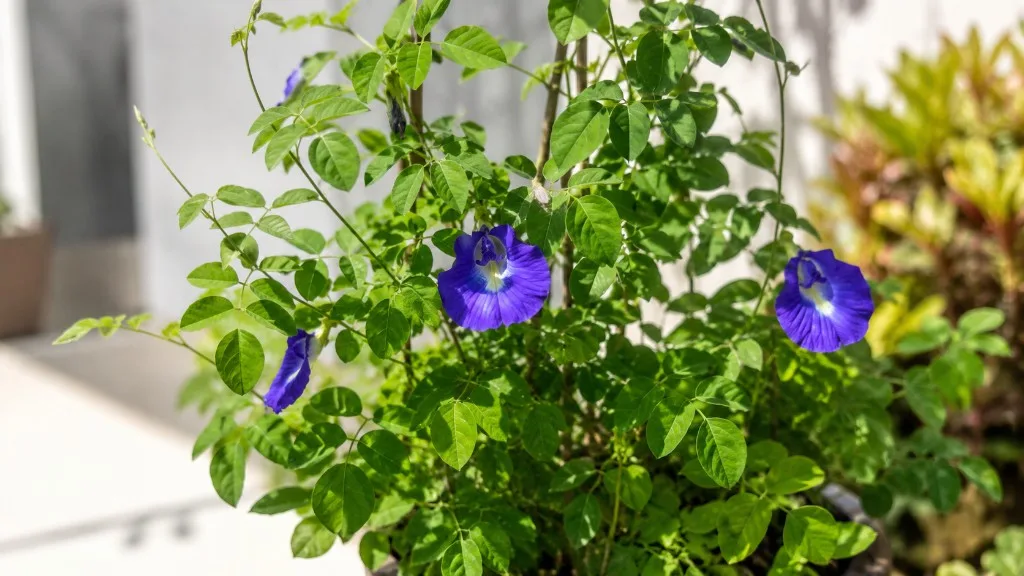
If you want a flowering vine that delivers a real “wow” in the garden, Aparajita (Clitoria ternatea) belongs on your shortlist. The flowers are an almost impossibly vivid blue, the plant is a member of the legume family (Fabaceae), the blooms are edible, and the same pigment that paints the petals also tints tea, rice, and cocktails. But the plant that gardeners in tropical Asia have grown for centuries is not a one-climate-fits-all houseplant. It wants sun, warmth, well-drained soil, and a structure to climb. Get those four things right and it will repay you with a long season of color; get them wrong and you will be diagnosing yellow leaves for months.
This guide pulls together what the university extensions, peer-reviewed reviews, and experienced growers actually say about caring for Clitoria ternatea - and then adds the practical decisions that most articles skip: which scarification method actually works, when to bring the vine inside, and whether you should grow it in a pot or the ground.
What Is Aparajita? Botanical Background of Clitoria ternatea
Taxonomy, Family, and Common Names
Aparajita is the Sanskrit-derived name used across India and Nepal for Clitoria ternatea, a perennial twining vine in the legume family (Fabaceae). English-speaking gardeners know it as butterfly pea, blue pea, or Asian pigeonwings; in Malaysia it appears in dishes as bunga telang; in Thai and Vietnamese kitchens the dried flowers flavor teas and desserts. The genus name Clitoria was coined by Linnaeus because the flower’s shape reminded him of human female genitalia - a botanical curiosity rather than anything you need to think about while pruning.
It is a fast-growing herbaceous perennial in the tropics and a tender annual or potted specimen anywhere it freezes. Vines reach 10 to 15 feet when supported, but the plant stays tidy at roughly 3 feet tall because the stems twine rather than sprawl. Compound leaves carry 5 to 9 elliptic leaflets; the pea-like flowers (about 2 inches across) are most often a deep cobalt blue with a pale yellow throat, though white and double-blue cultivars exist.
Native Range, Growth Habit, and Why the Flower Looks Like a Butterfly
Clitoria ternatea is believed to be native to tropical equatorial Asia - most likely a wide arc from India through Southeast Asia - though it has been cultivated for so long that the exact origin is debated. The species epithet ternatea refers to the island of Ternate in Indonesia, although that may be a Linnaean misattribution. It has since naturalized across the tropics, including the southern United States, where it appears in Florida, Texas, California, and Georgia.
The “butterfly” in butterfly pea is literal: the standard petal sits upright while the two wing petals spread horizontally, giving the open flower the silhouette of a small blue butterfly with a yellow center. A single flower lasts only a day or so, but mature plants produce them in steady flushes from early summer through fall, especially in warm, humid weather.
Why Grow Aparajita: Uses Beyond the Backyard
The Famous Blue Tea and Culinary Uses
Aparajita’s biggest claim to fame is the blue tea (sometimes called “chang shan” or “nam dok anchan”) brewed from the fresh or dried flowers. Steep 5 to 8 dried flowers in hot water for 3 to 5 minutes and you get an electric-blue infusion that shifts to violet when you add a few drops of lemon juice - a live demonstration of the pH-sensitive anthocyanin pigments (a group called ternatins) inside the petals. The same effect is used to color rice (the Malaysian dish nasi kerabu and Thai khao tom), cocktails, jellies, and even frostings.
The flowers are eaten fresh in salads, candied for garnishes, and dried for tea blends that pair with lemongrass, lavender, honey, or pandan. In modern cafés they show up in color-changing “butterfly pea lemonade” - the drink is blue in the glass and turns purple the moment citrus hits it.
Traditional Medicine and Modern Research (Ayurveda to the FDA)
In Ayurveda and Southeast Asian folk medicine, C. ternatea has been used to support memory, calm the nerves, and reduce fever and inflammation. Modern research has caught up: peer-reviewed reviews catalog antioxidant, antidiabetic, anti-inflammatory, antimicrobial, hepatoprotective, and neuroprotective activity in extracts from the flowers, leaves, and roots. A 2019 review in Frontiers in Plant Science highlighted the plant’s unusual content of cyclotides - ultra-stable circular peptides that act as natural insecticides and are being explored for pharmaceutical delivery.
What the research hasn’t fully done is move beyond animal and laboratory studies into large, rigorous human clinical trials. A few small trials suggest the flower extract can improve post-meal antioxidant status and modest glucose response, but the evidence base is still considered preliminary. In September 2021 the U.S. FDA approved butterfly pea flower extract as a natural blue colorant for food and beverages, which is a meaningful safety signal for culinary use even if it isn’t a therapeutic endorsement.
A practical bottom line: brewing blue tea at home is well within the plant’s traditional use and supported by modern food-safety rulings. Strong medicinal doses, concentrated extracts, or root and seed preparations should be approached with more caution - they are not standardized, and human safety data is thin.
Light Requirements: Aparajita light guide for the Best Blooms
Aparajita is a sun lover. For the heaviest flowering it wants 6 to 10 hours of direct sunlight per day, with a slight concession to light afternoon shade in climates where summer temperatures regularly push past 95°F (35°C). Anything less than 6 hours of direct sun and you will get a leafy vine with scattered blooms; anything less than 4 hours and you’ll get leaves and very few flowers, if any.
Indoors, place the pot in your brightest south- or west-facing window. If you do not have a window that delivers strong direct light, a full-spectrum grow light on a 12- to 14-hour timer will keep the plant compact and flowering. North-facing windows in the northern hemisphere are too dim for reliable bloom.
If you are moving an indoor plant outside for the summer, harden it off gradually over 7 to 10 days, starting with an hour of morning sun and increasing exposure to avoid leaf scorch.
Watering Aparajita: How Much, How Often, and From Where
Aparajita prefers consistently moist but never waterlogged soil. Once established, it has a reputation for drought tolerance, but you will trade bloom count for that tolerance. Aim for roughly 1 inch of water per week for seedlings and container plants, supplementing rainfall as needed. In a heat wave, plan to water more; in cool, cloudy weather, dial back.
The single most common mistake is watering from overhead onto the foliage. The butterfly pea vine is prone to fungal issues - anthracnose, bacterial soft rot, and powdery mildew show up when leaves stay wet and air circulation is poor. Water at the base of the plant, in the morning, so the soil surface dries by evening. A soaker hose, a watering wand set on a gentle flow, or a self-watering container all solve this nicely.
A simple finger test is more reliable than a fixed schedule: push a finger 1 to 2 inches into the soil. If it feels dry at that depth, water deeply until you see runoff from the pot’s drainage holes. If it feels moist, wait another day and check again.
Best Soil Mix and pH for Butterfly Pea
Aparajita is forgiving about soil texture. The Missouri Botanical Garden and the North Carolina Extension Gardener Plant Toolbox both confirm that it will grow in clay, loam, or sand, and it tolerates both acid and alkaline conditions. What it will not tolerate is sitting in water, so drainage is the non-negotiable trait.
The ideal mix is:
- Slightly acidic to neutral, with a pH of about 6.6 to 7.5 (it tolerates a wider 6.0 to 8.0 swing without complaint).
- Well-draining and fertile, with organic matter worked into the top 8 to 10 inches.
- Slightly sandy if you are growing in a pot, because pots dry and re-wet more often and need a faster-draining mix.
A practical homemade blend is two parts quality potting soil, one part coarse sand or perlite, and one part compost or well-rotted manure. In ground beds, amend heavy clay with compost and consider raised mounds or berms to lift the root zone above the wettest part of the bed.
As a legume, C. ternatea forms a symbiosis with rhizobium bacteria in its roots, fixing atmospheric nitrogen the way beans and peas do. That is good news: in average garden soil you rarely need to push nitrogen, and overdoing it will deliver leaves at the expense of flowers.
Temperature, Humidity, and USDA Hardiness Zones
This is a tropical plant. It grows best when daytime temperatures sit between 65°F and 95°F (18°C to 35°C), and it stops flowering when nights drop below about 60°F (16°C). It is reliably perennial in USDA hardiness zones 10 to 12, marginal in zone 9, and grown as an annual in zones 8 and below. The first hard frost will kill the vine to the ground.
Humidity matters more than most guides admit. The plant tolerates average indoor humidity (40 to 60 percent) but performs better when humidity is closer to 60 to 80 percent, which is the tropical norm. Brown leaf edges, spider mite flare-ups, and crisping flower buds are all common signals that the air is too dry. Grouping pots, using a humidity tray, or running a small humidifier nearby all help. In zones 9 and below, plan ahead for the cold. You have two options. The lowest-effort route is to treat the vine as an annual: let it flower all summer, collect mature seedpods in fall, save the dry seeds in a paper envelope in a cool, dark drawer, and start fresh next spring. That works in zones 7 and 8 with the right microclimate. The second option is to overwinter a potted plant indoors. Move the container inside before nighttime temperatures fall below 55°F (13°C), place it in the brightest window you have, cut watering back to roughly half, stop fertilizing, and expect some leaf drop. The plant will look tired but should bounce back in spring. Do not try to overwinter a vine planted directly in the ground north of zone 9 - the roots will not survive freezing soil.
Fertilizer Schedule: Less Is Often More
Because the plant fixes its own nitrogen, you do not need much. A single application of compost or well-rotted manure at planting is enough for in-ground vines in decent soil. For container plants or poor soil, feed with a balanced NPK fertilizer (something close to 10-10-10) at half strength every 4 to 6 weeks during the active growing season.
If bloom count is disappointing and the vine is at least a year old, switch to a phosphorus- and potassium-leaning fertilizer (such as 5-10-10) for one feeding. The standard “bloom booster” trick. Skip high-nitrogen lawn or leafy-green feeds; they will produce a beautiful wall of leaves and almost no flowers.
Stop fertilizing about 6 weeks before your first expected frost so the plant can slow down and harden off before going dormant or being moved inside.
Support, Training, and Pruning a Twining Vine
Aparajita climbs by twining, not by tendrils or aerial roots. That means it needs something thin and vertical to wrap around: a trellis, an obelisk, a piece of bamboo, a chain-link fence, or the stems of a sturdy shrub. Anything thicker than about half an inch is hard for the soft stems to grip. A standard tomato cage is usually too coarse; a wooden or metal trellis with cross-bars no more than 1.5 inches wide works much better.
For container growing, an obelisk-style trellis inserted into the pot lets the vine climb up and spill back over the rim for a full, lush look. Indoors, a small fan-shaped trellis pinned to a window frame keeps the plant tidy and lets light reach all the leaves.
Pruning has three useful purposes: control size, encourage branching (more branches = more flowers), and remove tired or damaged growth. Pinch the growing tips when the vine is about 12 inches tall to force side shoots. After the first major flush of flowers, cut the longest stems back by a third to a leaf node. Deadhead spent blooms regularly - they only last a day but the developing seedpods can redirect energy away from new flowers. In late winter, cut the whole plant back to 6 to 12 inches of stem to reset its shape for the new season.
Propagation: Seeds, Cuttings, and Scarification That Actually Works
Aparajita is one of the easier ornamentals to propagate. Both seed and stem cuttings work, but the seed method is the most reliable and the most accessible.
Step-by-Step: Growing Aparajita from Seed
The seed has a hard, water-resistant coat, so skipping scarification is the most common reason for poor germination. A 2022 study out of the University of Florida found that mechanically nicking the seed coat with a blade or nail clipper, then soaking in water for 24 hours, raised germination to roughly 81 percent - far above the rate of untreated seed.
Here is the method that works:
- Collect or buy fresh seed. Mature pods turn brown and dry on the vine; pick them before they split, then finish drying indoors.
- Scarify each seed. Hold the seed steady and nick the coat opposite the hilum (the small scar where the seed was attached to the pod) with a nail clipper, file, or razor. Just enough to expose the pale inner seed - do not cut into the embryo.
- Soak in warm water for 12 to 24 hours. Viable seeds swell noticeably; discard any that stay hard and small.
- Sow ½ inch deep in a moist, well-draining seed-starting mix. Maintain a substrate temperature of about 70 to 75°F (21 to 24°C). A heat mat is the single most useful tool for tropical seeds.
- Wait 3 to 6 days for radicles to emerge, then another 2 to 3 weeks before true leaves develop. Provide bright light as soon as you see green.
- Transplant once the seedling has 2 to 3 sets of true leaves and the root system holds the plug together.
You can expect flowers roughly 10 to 14 weeks after sowing in ideal conditions. In short-season climates, start seeds indoors 8 to 10 weeks before the last expected frost and transplant out only when soil temperatures are consistently above 65°F.
Step-by-Step: Propagating from Soft-Stem Cuttings
Cuttings are useful when you want a clone of a parent plant (a particularly good bloomer, a double-blue cultivar, or a plant with white flowers). Take them in spring or early summer when the vine is actively growing.
- Cut a 4 to 6 inch section of healthy stem that includes at least two nodes and a few leaves.
- Strip the lower leaves, leaving one or two at the top. If the leaves are large, snip them in half to reduce moisture loss.
- Dip the cut end in rooting hormone (powder or gel).
- Insert the cutting 1 to 2 inches deep into a moist mix of perlite and peat or a sterile seed-starting blend.
- Cover with a clear plastic dome or a loosely sealed plastic bag to keep humidity high. Place in bright, indirect light.
- Roots usually form in 2 to 4 weeks. Tug gently to feel resistance; once the cutting resists, pot it up into normal potting mix.
Growing Aparajita in Pots vs. In the Ground
Both work, and the choice depends on your climate and goals.
| Factor | In-ground | In a pot |
|---|---|---|
| Best climate | Zones 10 to 12 (perennial) or 8 to 9 (annual) | Zones 4 to 9 (overwinter indoors) |
| Pot / bed size | Bed with 2 to 3 ft spacing between plants | 12 to 16 in diameter, 10+ in deep |
| Trellis | Trellis, fence, or allowed to sprawl as groundcover | Inserted obelisk or small fan trellis |
| Watering | Less frequent; 1 in/week once established | More frequent; may need daily in heat |
| Bloom count | Generally higher with unrestricted roots | Slightly lower, but still strong |
| Overwintering | Cut down at frost; reseed next year | Move the whole pot indoors |
| Invasive risk | Higher in warm zones - can self-seed aggressively | Contained |
Use pots in cold-winter climates so you can bring the plant inside. Use in-ground beds in warm climates where the plant will perform as a perennial and where you have room for it to climb a fence, arbor, or pergola. In tropical and subtropical regions, treat the planting site thoughtfully: Aparajita can self-seed enthusiastically and has naturalized in some warm areas, so avoid putting it next to natural bushland where escape is a concern.
For containers, choose a terracotta or fabric pot over plastic if you can - both breathe and reduce the risk of waterlogging. Make sure the pot has drainage holes. Self-watering containers work very well for C. ternatea because they keep soil moisture even.
Common Problems: Yellow Leaves, root rot on Aparajita, and Pests
Aparajita is generally low-maintenance, but it has a handful of recurring issues. Here is how to diagnose what you are seeing.
Yellow leaves (chlorosis). The single most common complaint, and the most common cause is overwatering on Aparajita. Soil that stays soggy deprives roots of oxygen, the plant stops taking up nutrients, and the lower or older leaves yellow first. The second most common cause is nutrient deficiency, typically iron or nitrogen in alkaline soil or container-bound roots. The third is underwatering on Aparajita, where leaves yellow because the plant cannot move nutrients around. Finally, check the undersides of the leaves for sap-sucking pests (see below).
The fix depends on the cause: cut back watering and improve drainage if the soil is soggy; repot with fresh mix and a slow-release fertilizer if the plant is pot-bound; water more deeply and consistently if the soil is bone-dry between drinks; treat pests with insecticidal soap if you find aphids or mites.
Root rot. Caused by persistent overwatering, poorly drained soil, or pots without drainage. Roots turn dark and mushy and often smell sour. The fix is to remove the plant from its pot, cut away every soft brown root with clean scissors, dust the healthy roots with a little cinnamon or a copper-based fungicide, and repot into fresh, fast-draining mix. Going forward, water only when the top inch of soil is dry, and make sure the pot empties freely.
Aphids. Tiny soft-bodied insects that cluster on new growth and leaf undersides, leaving sticky honeydew and causing leaves to curl. Knock them off with a strong spray of water in the morning, repeat every 2 to 3 days, and follow up with insecticidal soap or neem oil if the infestation persists.
Spider mites. Common in dry indoor air. Look for fine webbing on the undersides of leaves and a stippled, dusty, or bronzed appearance. Boost humidity, rinse the foliage under tepid water, and treat with neem oil. NC State Extension lists spider mites among pests that can affect butterfly pea in dry conditions.
Whiteflies. Small white insects that fly up in a cloud when the plant is disturbed. They respond to the same treatments as aphids: water sprays, insecticidal soap, neem oil, and yellow sticky traps to monitor populations.
Anthracnose and bacterial soft rot. Fungal and bacterial diseases that show up as dark, sunken spots on leaves or mushy stems, especially in wet, humid, poorly ventilated conditions. Remove affected leaves, avoid overhead watering, improve air circulation, and dispose of badly infected plants rather than composting them.
Failure to bloom. Almost always a light issue, a nitrogen issue, or a maturity issue. Less than 6 hours of direct sun will mute flowering. Heavy nitrogen fertilizer pushes leaves over flowers. A plant grown from a cutting or a young seedling may simply need another few weeks of warm weather before it starts setting buds.
Pet Safety: Is Aparajita Toxic to Cats and Dogs?
The short answer is that Clitoria ternatea is not listed as toxic to dogs or cats by the ASPCA, and it is widely cultivated and consumed as food in human cuisine. The Missouri Botanical Garden and The Spruce describe it as generally low-risk.
The longer answer is more nuanced. Butterfly pea is a legume, not a sweet pea. Sweet pea (Lathyrus odoratus) contains toxins that can be harmful to pets, and the two are sometimes confused by common name. The pea-like seeds and roots of Clitoria ternatea are not part of normal ornamental exposure - pets nibbling a flower or a leaf now and then are very unlikely to have a serious reaction, but a dog that eats a large quantity of seed pods may experience mild gastrointestinal upset, including vomiting or diarrhea, simply from the volume of plant material.
If you have a curious puppy, a plant-mouthing cat, or a small pet like a rabbit or guinea pig, the safest path is to keep the plant out of reach - on a tall indoor stand, in a hanging basket, or in a section of the garden the pet does not access. If you suspect your pet has eaten a meaningful quantity of any part of the plant, call your veterinarian or the ASPCA Animal Poison Control Center at (888) 426-4435.
Conclusion
Aparajita is one of those rare plants that delivers on every front it advertises. The blue flowers are as close to electric as anything in the plant kingdom, the tea is genuinely a conversation piece, and the vine itself is unfussy once you respect its tropical nature. The care routine comes down to a few non-negotiables: full sun for at least 6 hours a day, soil that drains well, consistent moisture without waterlogging, warm temperatures above 60°F, and something to climb. Add a modest fertilizer, a once-a-season prune, and a watchful eye for spider mites, and you will have a steady supply of blooms from early summer through fall.
In tropical and subtropical climates, plant it in the ground and let it scramble up a fence or arbor - it will reward you for years. In colder regions, grow it in a container, train it on an obelisk, and bring it inside before the first frost. Start new plants from scarified seed in spring, save seeds from your best bloomers in fall, and you will have a self-renewing supply of one of the most photogenic vines a home gardener can grow. Pour the harvested flowers into hot water, watch the cup turn cobalt, and add a slice of lemon to see the color shift to purple. That single moment is most of the reason Aparajita overview has been loved for centuries.
When to use this page vs other Aparajita guides
- Aparajita overview - Canonical hub for this species - care topics and problems branch from here.
- Aparajita problems - Symptom-first path when you already know something is wrong.
Related Aparajita guides
How to care for Aparajita?
How much light does Aparajita need?
full sun - 5–6 hours of direct sunlight for prolific flowering
- full sun - 5–6 hours of direct sunlight for prolific flowering - full sun - 5–6 hours of direct sunlight for prolific flowering.
When should you water Aparajita?
Regular watering; allow top 3 cm to dry between waterings.
- Water when top 3 cm is dry; slightly drought-tolerant once established - Regular watering; allow top 3 cm to dry between waterings.
- Drain excess water - Regular watering; allow top 3 cm to dry between waterings.
What soil works best for Aparajita?
Well-draining, moderately fertile potting mix or garden soil; fixes nitrogen.
- 60% potting mix or garden soil - Well-draining, moderately fertile potting mix or garden soil; fixes nitrogen.
- 20% compost
- 20% coarse sand - Adds weight and drainage; use coarse horticultural sand rather than fine beach sand.
Grower notes for Aparajita
What matters most with Aparajita
Aparajita needs enough light and seasonal rhythm to bloom well. Leaves may stay alive in mediocre light, but flowers usually reveal whether the plant is truly getting what it needs. In practice, the care checkpoint is simple: full sun - 5–6 hours of direct sunlight for prolific flowering. Pair that with well-draining, moderately fertile potting mix or garden soil; fixes nitrogen, and avoid changing water, pot size, and placement all at once.
Best placement in a real home
Aparajita belongs where full sun - 5–6 hours of direct sunlight for prolific flowering is realistic for most of the day, not only where the pot looks good. Regular watering; allow top 3 cm to dry between waterings. If the pot stays wet longer than expected, move the plant into better light or reassess the mix before watering again. Humidity target: Moderate to high (50–70%); naturally adapted to Indian tropical climate. Temperature comfort zone: 22°C to 38°C (72–100°F).
Before you buy this plant
Choose Aparajita with firm new growth, clean leaf undersides, and soil that does not smell sour or feel compacted. Be cautious if you see yellow-leaves, sticky residue, collapsed crowns, or a pot that is wet in poor light. Cosmetic old-leaf damage is less worrying than weak roots or active pests.
First month after bringing it home
Do not repot Aparajita on day one unless the mix is failing or pests are obvious. Quarantine it, learn how fast the pot dries, and keep care boring while it adjusts. Watch especially for yellow-leaves, slow-growth, and leggy-growth. If problems appear, correct the condition first rather than stacking fertilizer, repotting, and pruning together.
Safety note for Aparajita
Aparajita is not a plant to keep within reach of pets or children. The database flags it for cats and dogs. Use gloves if sap or plant tissue is irritating, and pick a pet-safe alternative for floor pots or low shelves.
How to tell Aparajita is settling in
Also sold as Butterfly Pea, Blue Pea Vine, and Asian Pigeonwings, this plant should be judged by stable new growth rather than label names alone. If you plan to multiply it later, common methods include Seeds and Stem cuttings. Repot only when you see roots densely filling pot and slowing of growth. If slow-growth shows up early, inspect light, watering, and roots before assuming the plant is permanently weak.
Is it pet safe?
Aparajita is toxic to cats and dogs.
Clitoria ternatea has mild toxicity concerns - seeds and roots contain alkaloids that may cause GI upset in pets. Some sources report mild toxicity. While widely used as herbal tea in humans, exercise caution and keep out of reach of pets.
Watering Aparajita
For Aparajita, water when top 3 cm is dry; slightly drought-tolerant once established and water every 2–3 days in summer; once a week in winter. Maintain regular moisture during flowering season; reduce in winter.
| Detail | Information |
|---|---|
| How often | Every 2–3 days in summer; once a week in winter |
| How to check | Water when top 3 cm is dry; slightly drought-tolerant once established |
| Seasonal changes | Maintain regular moisture during flowering season; reduce in winter |
Signs of overwatering
- yellow leaves
- root rot in waterlogged soil
Signs of underwatering
- wilting vines
- reduced flowering
Soil & potting for Aparajita
Use a mix of 60% potting mix or garden soil, 20% compost, 20% coarse sand for Aparajita. Good drainage; as a legume it tolerates varied soil conditions. Target soil pH around 6.0–7.5. Repot annual if grown in containers; or directly sow in large pots (15+ litres), ideally in spring (March–April).
| Detail | Information |
|---|---|
| Recommended mix | 60% potting mix or garden soil, 20% compost, 20% coarse sand |
| Drainage | Good drainage; as a legume it tolerates varied soil conditions |
| Soil pH | 6.0–7.5 |
| Repotting frequency | Annual if grown in containers; or directly sow in large pots (15+ litres) |
| Best season to repot | Spring (March–April) |
Signs it needs repotting
- roots densely filling pot
- slowing of growth
Humidity & temperature for Aparajita
Aparajita prefers moderate to high (50–70%); naturally adapted to Indian tropical climate, though normal home humidity is usually fine. Keep temperatures around 22°C to 38°C (72–100°F).
| Detail | Information |
|---|---|
| Humidity | Moderate to high (50–70%); naturally adapted to Indian tropical climate - normal home humidity is fine. |
| Ideal temperature | 22°C to 38°C (72–100°F) |
Fertilizer & pruning for Aparajita
Common problems on Aparajita
Yellow Leaves
MediumLikely cause: Overwatering, nitrogen toxicity (over-fertilising), or magnesium deficiency
Quick fix: Reduce watering; use balanced rather than high-nitrogen fertilizer
Full fix guide →Slow Growth
LowLikely cause: Insufficient sunlight or cool temperatures
Quick fix: Move to full sun; wait for warmer weather in spring
Full fix guide →Leggy Growth
LowLikely cause: Vine needs support structure to grow properly
Quick fix: Install trellis or string immediately; tie stems to guide direction
Full fix guide →Wilting
MediumLikely cause: Drought stress or waterlogged root rot
Quick fix: Check soil - if dry, water immediately; if wet, improve drainage
Full fix guide →Brown Tips
MediumLikely cause: Common on this plant type; confirm with recent watering, light, and root checks.
Quick fix: Inspect the plant and correct the most likely care stressor before stacking treatments.
Full fix guide →Root Rot
MediumLikely cause: Common on this plant type; confirm with recent watering, light, and root checks.
Quick fix: Inspect the plant and correct the most likely care stressor before stacking treatments.
Full fix guide →Overwatering
MediumLikely cause: Common on this plant type; confirm with recent watering, light, and root checks.
Quick fix: Inspect the plant and correct the most likely care stressor before stacking treatments.
Full fix guide →Underwatering
MediumLikely cause: Common on this plant type; confirm with recent watering, light, and root checks.
Quick fix: Inspect the plant and correct the most likely care stressor before stacking treatments.
Full fix guide →Spider Mites
MediumLikely cause: Common on this plant type; confirm with recent watering, light, and root checks.
Quick fix: Inspect the plant and correct the most likely care stressor before stacking treatments.
Full fix guide →Mealybugs
MediumLikely cause: Common on this plant type; confirm with recent watering, light, and root checks.
Quick fix: Inspect the plant and correct the most likely care stressor before stacking treatments.
Full fix guide →Aphids
MediumLikely cause: Common on this plant type; confirm with recent watering, light, and root checks.
Quick fix: Inspect the plant and correct the most likely care stressor before stacking treatments.
Full fix guide →Drooping Leaves
MediumLikely cause: Common on this plant type; confirm with recent watering, light, and root checks.
Quick fix: Inspect the plant and correct the most likely care stressor before stacking treatments.
Full fix guide →Low Humidity
MediumLikely cause: Common on this plant type; confirm with recent watering, light, and root checks.
Quick fix: Inspect the plant and correct the most likely care stressor before stacking treatments.
Full fix guide →Not Enough Light
MediumLikely cause: Common on this plant type; confirm with recent watering, light, and root checks.
Quick fix: Inspect the plant and correct the most likely care stressor before stacking treatments.
Full fix guide →Fungus Gnats
MediumLikely cause: Common on this plant type; confirm with recent watering, light, and root checks.
Quick fix: Inspect the plant and correct the most likely care stressor before stacking treatments.
Full fix guide →Mold on Soil
MediumLikely cause: Common on this plant type; confirm with recent watering, light, and root checks.
Quick fix: Inspect the plant and correct the most likely care stressor before stacking treatments.
Full fix guide →Curling Leaves
MediumLikely cause: Common curling leaves pattern on Aparajita under indoor care stress.
Quick fix: Inspect roots, watering, light, and pests; adjust one variable and monitor new growth.
Full fix guide →Brown Leaves
MediumLikely cause: Common brown leaves pattern on Aparajita under indoor care stress.
Quick fix: Inspect roots, watering, light, and pests; adjust one variable and monitor new growth.
Full fix guide →Black Spots
MediumLikely cause: Common black spots pattern on Aparajita under indoor care stress.
Quick fix: Inspect roots, watering, light, and pests; adjust one variable and monitor new growth.
Full fix guide →Holes in Leaves
MediumLikely cause: Common holes in leaves pattern on Aparajita under indoor care stress.
Quick fix: Inspect roots, watering, light, and pests; adjust one variable and monitor new growth.
Full fix guide →Pale Leaves
MediumLikely cause: Common pale leaves pattern on Aparajita under indoor care stress.
Quick fix: Inspect roots, watering, light, and pests; adjust one variable and monitor new growth.
Full fix guide →Distorted Leaves
MediumLikely cause: Common distorted leaves pattern on Aparajita under indoor care stress.
Quick fix: Inspect roots, watering, light, and pests; adjust one variable and monitor new growth.
Full fix guide →Scale Insects
MediumLikely cause: Common scale insects pattern on Aparajita under indoor care stress.
Quick fix: Inspect roots, watering, light, and pests; adjust one variable and monitor new growth.
Full fix guide →Thrips
MediumLikely cause: Common thrips pattern on Aparajita under indoor care stress.
Quick fix: Inspect roots, watering, light, and pests; adjust one variable and monitor new growth.
Full fix guide →Whiteflies
MediumLikely cause: Common whiteflies pattern on Aparajita under indoor care stress.
Quick fix: Inspect roots, watering, light, and pests; adjust one variable and monitor new growth.
Full fix guide →Leaf Miners
MediumLikely cause: Common leaf miners pattern on Aparajita under indoor care stress.
Quick fix: Inspect roots, watering, light, and pests; adjust one variable and monitor new growth.
Full fix guide →Caterpillars
MediumLikely cause: Common caterpillars pattern on Aparajita under indoor care stress.
Quick fix: Inspect roots, watering, light, and pests; adjust one variable and monitor new growth.
Full fix guide →Nitrogen Deficiency
MediumLikely cause: Common nitrogen deficiency pattern on Aparajita under indoor care stress.
Quick fix: Inspect roots, watering, light, and pests; adjust one variable and monitor new growth.
Full fix guide →Iron Deficiency
MediumLikely cause: Common iron deficiency pattern on Aparajita under indoor care stress.
Quick fix: Inspect roots, watering, light, and pests; adjust one variable and monitor new growth.
Full fix guide →Magnesium Deficiency
MediumLikely cause: Common magnesium deficiency pattern on Aparajita under indoor care stress.
Quick fix: Inspect roots, watering, light, and pests; adjust one variable and monitor new growth.
Full fix guide →Potassium Deficiency
MediumLikely cause: Common potassium deficiency pattern on Aparajita under indoor care stress.
Quick fix: Inspect roots, watering, light, and pests; adjust one variable and monitor new growth.
Full fix guide →Calcium Deficiency
MediumLikely cause: Common calcium deficiency pattern on Aparajita under indoor care stress.
Quick fix: Inspect roots, watering, light, and pests; adjust one variable and monitor new growth.
Full fix guide →