Aparajita Light Requirements: Sun, Windows & Warning Signs
Quick answer
Aparajita (Clitoria ternatea) needs 5–8 hours of direct sun on the foliage for strong blue blooms; east-facing balconies in India often outperform north exposure. First step: count direct sun hours at the bud-forming zone, then acclimate over one to two weeks if moving brighter.
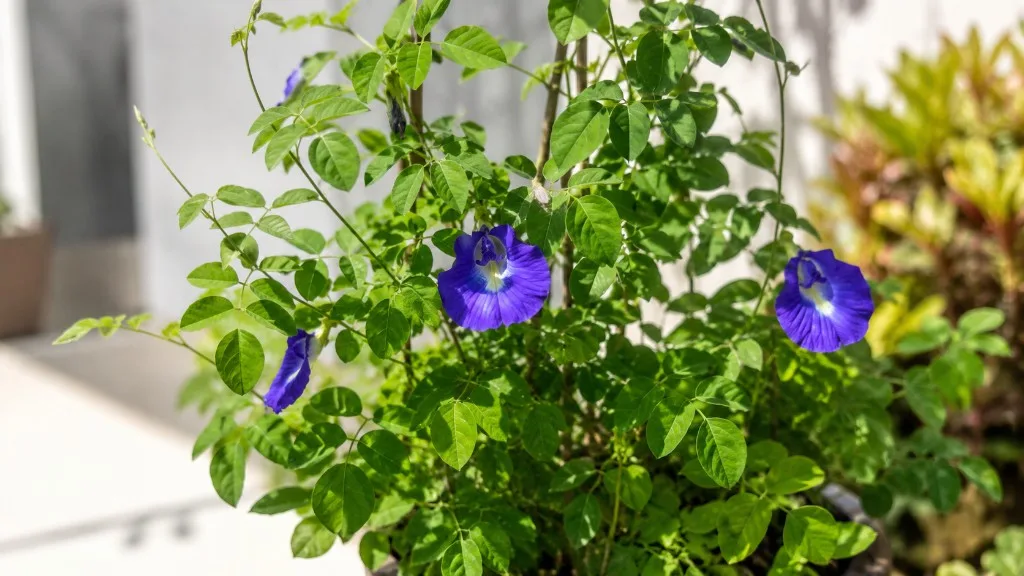
Aparajita Light Requirements: Sun, Windows & Warning Signs
Aparajita Light Requirements: Sun, Windows & Warning Signs
Author: sai-ananth · Reviewed by: LeafyPixels Review Board · Updated: 2026-06-15
Aparajita Light Requirements: Sun, Windows & Warning Signs
If your Aparajita vine looks healthy but refuses to produce those iconic indigo-blue flowers, light is almost always the first suspect - not a new fertilizer schedule or repotting until placement is ruled out. Clitoria ternatea, known across India as Aparajita and internationally as butterfly pea or blue pea vine, is a fast-growing tropical legume that evolved in open, sunny habitats across tropical Asia. This page owns proactive light placement and adjustment. For whole-plant context, see the Aparajita overview. If stretch and bloom failure are already advanced, use the not enough light diagnosis page or the leggy growth guide after you read the placement logic here.
Quick answer
Aparajita performs best with 5 to 8 hours of direct sunlight daily on the foliage during active growth. NC State Extension defines full sun as six or more hours of direct sunlight per day, and that range aligns with the strongest flowering on butterfly pea. In hot Indian summers, many established vines bloom well at the lower end if morning and early-afternoon exposure is strong. Partial shade below roughly five direct hours usually reduces bloom count even when leaves stay green. East-facing balconies are often the easiest high-performance placement; north-facing exposures rarely deliver enough direct sun without a grow light.
Why light is the main bloom trigger for Aparajita
Aparajita is a flowering climber, not a foliage houseplant that happens to bloom occasionally. Its growth habit is twining and fast once established, which means the plant is constantly deciding where to allocate energy: building more vine length, producing leaves, fixing nitrogen through its root nodules, or forming flower buds. Light intensity drives that decision more than fertilizer, more than pruning, and often more than watering frequency. When photons are abundant, the plant has surplus energy for reproductive growth. When light is weak, the plant prioritizes reaching toward the brightest source, stretching internodes and producing larger, thinner leaves that capture whatever light exists.
This matters because many growers judge Aparajita by leaf color alone. Deep green leaves can look fine in a partially shaded corner while the plant quietly stops flowering. NC State Extension lists Clitoria ternatea as requiring full sun. NParks Singapore notes the species prefers full sunlight to semi-shade and grows as a fast-climbing legume with deep, nitrogen-fixing roots. Those institutional descriptions align with what home growers observe: the plant lives in shade, but it performs in sun. If your goal is the vivid blue blooms used in teas, temple offerings, or balcony displays, light is not a secondary detail. It is the primary care lever.
Light also interacts with temperature and humidity in ways that change the practical placement decision. Aparajita is naturally adapted to warm tropical conditions. The Missouri Botanical Garden recommends growing butterfly pea in full sun outdoors where temperatures stay above 60°F (about 15°C), with some light afternoon shade in hot climates. In the 22°C to 38°C (72–100°F) comfort zone common across much of India, strong light usually supports vigorous metabolism without the dormancy triggers that affect temperate plants. In cooler or dimmer conditions, growth slows, the plant uses less water, and the margin for overwatering on Aparajita errors widens dangerously. Getting light right does not just improve flowering. It stabilizes the entire care rhythm.
How much daily sunlight Clitoria ternatea needs
The practical target for Aparajita is 5 to 8 hours of direct sunlight per day during active growth. NC State Extension’s full-sun definition starts at six hours, and NParks GardeningSG recommends 4 to 8 hours of direct sunlight for edible butterfly pea in pots. In Indian balcony and terrace contexts, where summer sun is intense, many healthy plants perform well at the lower end of that range if morning and early-afternoon exposure is strong and unobstructed. In cooler or cloudier regions, aim closer to eight hours.
Direct sun means sunlight hits the leaves without passing through tree canopy, tinted glass that blocks significant UV, or deep room shade. Bright ambient light in a room several feet from a window does not count toward those hours even if the space feels well lit to human eyes. For a potted vine on a balcony railing, direct sun means the pot and the majority of the foliage receive unfiltered rays for the stated duration. A plant tucked under an overhang where only the top few leaves catch sun is not receiving full-sun conditions even if it looks green.
Seedlings and newly transplanted vines are the exception during the first one to two weeks. Young plants benefit from bright light but should not jump immediately into harsh afternoon sun on a west-facing terrace. See the propagation guide for seedling light during germination. Established vines, by contrast, are surprisingly heat-tolerant once acclimated and often handle Indian summer conditions better than many temperate ornamentals. The distinction is developmental stage plus acclimation history, not a permanent shade requirement.
If you cannot provide at least five hours of direct sun outdoors or through a very bright south- or east-facing window, plan on supplemental lighting or accept reduced flowering. Aparajita is not a low-light plant by nature. It is a sun plant that can tolerate partial shade as a compromise, not as an ideal.
Full sun vs partial shade - performance comparison
Full sun for Aparajita means the plant receives the majority of its daily light as direct rays, with enough intensity to keep internodes short and flower buds forming regularly. Partial shade-typically three to six hours of direct sun or bright dappled light for much of the day-changes the outcome predictably. The vine usually survives and may still produce some flowers, but bloom count drops, flowering becomes irregular, and vines tend toward legginess as they search for brighter conditions.
| Condition | Typical direct sun on foliage | Bloom performance | Internode length | Water use | Best for |
|---|---|---|---|---|---|
| Full sun (outdoor terrace/railing) | 6–8+ hours | Strong, regular warm-season flowering | Short, firm | High; pot dries every 2–3 days in summer | Balcony trellis growers wanting profuse blue blooms |
| Partial shade (north balcony, under eaves) | 3–5 hours | Sparse or irregular flowers | Elongated, searching | Moderate; soil stays wet longer | Courtyard vines where any flower is a bonus |
| Bright indoor window only | 2–4 hours direct on sill | Weak unless south/east sill | Moderate stretch | Low–moderate | Seasonal overwintering in temperate climates |
| Indoor shelf + grow light | 12–14 h lamp + window | Moderate with adequate fixture | Compact if lamp close | Moderate | Apartments with no sunny outdoor space |
The trade-off is worth stating plainly because many ranking pages list “full sun, partial shade” as equivalent options without explaining the performance gap. Leaves may stay green in partial shade while flowers tell the truth about whether the plant is truly satisfied. If you are growing Aparajita primarily for ornamental blue blooms on a balcony trellis, partial shade is a fallback, not a target.
One nuance: as a legume, Aparajita fixes some of its own nitrogen through root nodule bacteria. In lower light, the plant uses less nitrogen and less water overall, which can mask light stress temporarily. Do not interpret moderate growth in shade as proof that the plant prefers shade. Interpret it as tolerance. The Missouri Botanical Garden notes butterfly pea appreciates some light afternoon shade in hot climates while still requiring full sun as the baseline cultural condition.
Best window and balcony placement
The best placement for Aparajita is wherever the plant receives strong, direct sun for most of the day without being trapped in stagnant heat against glass or concrete that radiates late-afternoon scorch. Outdoors, that usually means an open balcony, terrace edge, or garden trellis with southern or eastern exposure in the Northern Hemisphere. Indoors, it means the brightest window available, ideally south- or east-facing, with the pot close enough that foliage-not just the pot rim-sits in the light beam.
Distance matters enormously. A vine placed two meters inside a bright room may receive only a fraction of the light available at the windowsill. For indoor attempts, put the pot directly adjacent to the glass during the sunniest hours, or accept that a grow light will be necessary. Outdoors, elevation helps: railing-mounted pots often outperform floor-level corners where walls and furniture block low-angle morning light.
Support structure is part of placement. Aparajita is a twining climber that reaches 10 to 15 feet in open ground per NC State Extension and stays more compact in 30–60 cm containers with a trellis, string, or balcony grill to wrap around. Place the support where the upper vine will also receive sun, not just the base of the plant. A common mistake is training the lower vine in full sun while the upper growth disappears into shade beneath an overhang.
Rotate the pot every few days if growth leans hard toward one direction. Leaning is a real-time light report. If the vine consistently reaches toward a single point, either rotate for even growth or move the entire setup closer to that light source.
East-facing vs south-facing in Indian homes
An east-facing window or balcony is often the easiest high-performance placement for Aparajita in hot climates. Morning sun is strong enough to drive photosynthesis and flower initiation but gentler than late-afternoon rays that can scorch unacclimated leaves on west exposures. In cities like Bengaluru, Hyderabad, or Pune, an east balcony with four to six hours of direct morning sun frequently produces excellent bloom sets through the warm season, especially when the vine is acclimated and watering matches the faster dry-down that sun creates.
A south-facing exposure delivers the longest total sun duration and is ideal in cooler months or in North Indian winters when light intensity drops. During peak summer, south and west balconies can deliver more heat load than the plant needs, especially for specimens that grew in nursery shade or were recently moved from a dim shop floor. South-facing placement works well when you can provide airflow, avoid dark pots that overheat, and offer slight afternoon protection during extreme heat waves if leaves show stress.
North-facing balconies and windows rarely provide enough direct sun for strong Aparajita flowering. The plant may grow soft, elongated stems and pale leaves while producing few buds. If north exposure is your only option, treat grow lights as required equipment rather than an optional boost.
Balcony railings, terraces, and upper-vine shade
Balcony railings solve two problems at once: they lift the vine into brighter airspace above parapet shadows, and they provide a natural trellis. Secure the pot so wind does not topple it, and ensure drainage holes are not blocked by saucers that hold stagnant water. Terraces offer the most sun but also the most heat reflection from concrete and tiles. In peak summer, watch leaf margins on the sun-facing side. A light shade cloth during the harshest midday window-often 12 p.m. to 3 p.m. on west terraces-can prevent scorch without sacrificing overall daily sun totals if morning and late-afternoon exposure remain strong.
On multi-story balconies, the upper third of a 2–3 m trellis often sits in shade cast by the floor above or a neighbor’s overhang. Buds form on new growth at the tips; if those tips live in dim air, flowering fails even when the pot base bakes in sun. Train the vine on an angled support that keeps the growing tips in the brightest band, or shorten the trellis height so the entire plant stays in one light zone.
Tinted glass and overhang pitfalls
Tinted or UV-filtering balcony glass reduces the photosynthetically active radiation that reaches leaves. A space that feels bright to you may deliver only one to three hours of usable direct-equivalent light through heavy tint. If your vine stretches toward the glass but rarely sets buds, count actual sun hours at the leaf surface, not at the human comfort level inside the enclosure. Moving the pot outside the glass line for morning hours often restores bloom vigor within a few weeks.
Deep overhangs, permanent awnings, and recessed balcony pockets create the same false confidence: the corner is hot and humid but starved of direct rays. Test with a simple shadow check at 9 a.m., noon, and 4 p.m. on a clear day. If the pot sits in shade at two of those three checks, it is not in full sun regardless of how green the leaves look.
Direct afternoon sun tolerance and acclimation
Yes, established and acclimated Aparajita can handle direct afternoon sun, including the intense summer sun common across much of India. Butterfly pea is heat-loving and, once hardened, often outperforms in bright conditions that would stress shade-adapted houseplants. The critical word is acclimated. Leaves formed under nursery shade or indoor lower light contain chlorophyll arrangements suited to moderate intensity. Moving that plant in one step to a west-facing terrace at noon produces bleached patches, crisp brown edges, and sometimes sudden wilting that looks like underwatering on Aparajita but is actually light and heat shock.
Afternoon sun becomes risky when combined with reflected heat from glass, metal railings, or dark pot surfaces; when airflow is poor and leaf temperature spikes; or when the root zone overheats in small black nursery pots sitting on hot concrete. Mitigations include using lighter-colored pots, elevating containers on pot feet for air circulation beneath, shifting placement by one meter into slightly filtered afternoon light during heat waves, or using a 20–30% shade cloth for the hottest three hours while preserving morning and late-day direct sun.
Do not confuse wilting at midday with a demand for shade. Aparajita leaves sometimes droop slightly in peak heat and recover by evening when roots are healthy and soil moisture is adequate. Persistent scorch marks, bleaching, or leaves that stay damaged after sunset indicate too much exposure or too fast an acclimation, not a normal daily rhythm.
Indoor windows and seasonal overwintering
Aparajita can grow indoors, but indoor culture without supplemental light usually produces weak flowering or none at all. The practical standard is at least six hours of direct sunlight daily on the foliage, often from a south-facing window where the plant sits on the sill through the sunniest hours. That standard is achievable in a bright sunroom. It is difficult in a typical living room where the vine sits on a shelf several feet from glass.
If you are attempting indoor culture, prioritize these conditions: maximum window exposure during the brightest part of the day; a trellis or string to keep the vine vertically organized so upper leaves also receive light; and regular rotation so one side does not dominate. Expect slower growth and fewer flowers than an outdoor balcony specimen unless you add grow lights. Indoor humidity often drops when air conditioning runs, which compounds stress from marginal light. A humidity range of 50–70% supports healthier foliage when light is already borderline.
Indoor Aparajita is a seasonal strategy in temperate climates-overwintering a potted vine when frost threatens, below about 10°C- not a permanent low-light houseplant placement. In tropical and subtropical India, indoor growing is usually a choice driven by space or pets, not climate necessity. In that case, treat the brightest window plus optional LED supplementation as the minimum viable setup. Pet-aware sill placement matters for Aparajita; see the overview for toxicity notes before moving pots to low shelves pets can reach.
Grow lights when natural sun is insufficient
When natural light delivers fewer than five hours of usable direct sun on the foliage, a full-spectrum LED grow light becomes the difference between a surviving vine and a flowering one. For Aparajita specifically, think in terms of canopy geometry, not generic room lighting: the lamp must illuminate the top 30–60 cm of twining growth on a balcony-container trellis, not just the pot rim.
Mount a moderate-intensity full-spectrum panel 20 to 40 cm above the highest active vine tip on a 30–60 cm pot with a 1–1.5 m trellis. Run the light 12 to 14 hours daily on a timer during active growth months. Aparajita does not require a complicated short-day photoperiod to flower the way some poinsettias do, but it does need sufficient daily light energy in a consistent rhythm. Seedlings started indoors benefit from the same photoperiod before transplant; direct harsh sun on wet seed trays dries them too quickly.
Watch for light stress from fixtures placed too close: pale or bleached upper leaves, tight curled new growth, or dry brown tips on the canopy directly beneath the lamp. Back the fixture off 5–10 cm or reduce duration by two hours and reassess after one week. Combine artificial light with the brightest natural window available rather than placing the vine in a dark corner with a lamp too distant to reach the twining tips.
Double-flowered cultivars and light needs
Double-flowered Aparajita (Clitoria ternatea var. pleniflora, sometimes sold as double butterfly pea) produces showier blooms but does not reduce the sun requirement. NParks Singapore lists the double form as preferring full sun with slight semi-shade tolerance-the same light preference as the single-flowered species. Double types may flower slightly later in establishment because extra petal tissue demands more energy per bud. Give them the same five-to-eight-hour direct-sun target, and do not park a double cultivar in deeper shade expecting the ornamental form to compensate for weak light.
Seasonal light shifts across India
Light placement for Aparajita is not a set-once decision because season changes the sun angle, day length, and heat load on the same balcony. In South India and coastal tropical zones, Aparajita may grow year-round with consistent strong light, though monsoon cloud cover temporarily reduces intensity and slows dry-down. In North India, winter short days and lower sun angle can weaken flowering on the same terrace that performed brilliantly in May. Moving the pot a meter closer to the open sky edge, pruning shade-casting obstructions, or adding a few hours of grow-light supplementation during December and January often restores bloom vigor.
Spring (March–April) is the natural sowing and repotting window for many growers, and increasing day length supports rapid establishment. Summer delivers maximum light but also maximum heat stress risk on west exposures. Monsoon season brings humidity that helps foliage but cloud cover that can reduce flower consistency if the plant sits in a deeply shaded pocket beneath eaves. Post-monsoon autumn often provides an excellent flowering flush when sun returns and temperatures remain warm.
Regional case note: On a coastal Mumbai east-facing balcony, growers commonly report a noticeable bud flush in late September through October after monsoon cloud cover lifts, provided the vine received at least four to five hours of morning direct sun through the rainy season and was not pushed into a darker corner under the eave. In contrast, a dry Hyderabad terrace with unobstructed south exposure may flower heavily from April through June at the upper end of the sun-hour range, then need light afternoon filtering during peak May heat. Track seasonal shifts by the same new-growth test year-round. If internodes lengthen and flowers thin out in winter despite green leaves, light dropped below the plant’s performance threshold even if watering and fertilizer stayed constant.
How light changes your watering and fertilizer rhythm
Every light change alters how fast Aparajita uses water and nutrients. A vine in full sun on a windy balcony transpires heavily and may need watering every two to three days in summer when the top 3 cm of soil dries. The same vine moved to partial shade uses water more slowly, and the pot stays wet longer. Overwatering in dim conditions is one of the most common indirect consequences of insufficient light: roots sit in soggy mix while the grower repeats a sunny-weather schedule.
Because Aparajita partially fixes its own nitrogen as a legume, excess nitrogen fertilizer in low light pushes foliage at the expense of flowers. In bright light, moderate feeding every three to four weeks during March through October supports bloom cycles. In shade, reduce both water and fertilizer until growth and flowering signals justify resuming the stronger rhythm. Light is the upstream variable; watering and feeding are downstream responses.
If you improve light significantly, increase watering checks before increasing fertilizer. Brighter conditions raise metabolic demand, and a plant that suddenly dries its pot in two days where it previously took five is telling you the light upgrade worked. Match moisture to the new pace rather than drowning the plant out of habit.
Acclimating to brighter light safely
Sudden moves cause the most preventable light damage. Use a gradual acclimation schedule whenever shifting from nursery shade, indoor lower light, or a dim corner to full balcony sun:
- Move the plant to the new bright location for two to three hours in the gentler morning window only, then return it to the previous spot for three to four days.
- Extend morning exposure by one to two hours every three days, watching the newest leaves for bleaching or crisp edges.
- Once the plant tolerates full morning sun without damage on new growth, add early afternoon hours if your target placement requires them.
- Avoid the first acclimation week during record heat waves; choose a milder stretch when possible.
- Water slightly before sun exposure on acclimation days so cells are turgid, but do not keep soil soggy.
- Hold off on heavy pruning or repotting until acclimation finishes; stacked stressors produce misleading symptoms.
Old leaves that scorched during a bad move will not fully recover, but new leaves formed under correct light should look firm, evenly green, and appropriately sized. Judge success by new growth, not by repairing old damage.
Not enough light - signs and where to get help
Insufficient light produces a recognizable pattern on butterfly pea: leggy stretched vines with long internodes, smaller paler new leaves, reduced or absent flowering despite green older foliage, persistent leaning toward one window, and soil that stays wet for many days. Low light rarely kills Aparajita quickly. It slowly converts the plant into a sparse, searching vine that frustrates growers who expected a blue-flowered showpiece.
This page focuses on choosing and improving placement. For step-by-step diagnosis, recovery timelines, and mistake-specific fixes when stretch is already severe, follow the dedicated not enough light and leggy growth guides. The fix is almost always more direct sun hours, a better balcony orientation, or grow-light supplementation-not more fertilizer to “force” blooms.
Before moving a shaded vine brighter: trim only dead or damaged tissue initially. If the upper canopy is a mass of thin shade-grown growth, a light prune of the most elongated tips after the first week of acclimation can redirect energy to new buds in brighter conditions. Do not hard-prune and move to full sun on the same day.
Too much sun - scorch, bleaching, and heat stress
Too much sun-or too fast a move into sun-shows different signals: bleached white or yellow patches on sun-facing surfaces, crisp brown margins, curling that persists after evening, sudden damage right after a placement change, and stunted pale new growth when the canopy overheats. These symptoms overlap partially with underwatering, which is why placement history matters in diagnosis. If damage appeared the day after a move to a west terrace, suspect light shock first. If damage develops gradually on a long-established plant with unchanged placement, consider root moisture before blaming sun.
Bleaching occurs when chlorophyll breaks down faster than the plant can adapt. Scorch is tissue death showing as crisp brown areas that do not green up again. Heat stress combines high leaf temperature with intense light, sometimes causing temporary midday wilting even when soil moisture is adequate. Recovery requires pulling back to morning sun or filtered afternoon light until new growth looks clean, then re-acclimating more slowly. Remove severely scorched leaves only after the plant stabilizes.
Aparajita teaches a useful diagnostic lesson: foliage can look acceptable while flowering fails. Many leguminous vines produce respectable leaf canopies at light levels below what bud formation requires. Flower initiation demands sustained energy surplus over weeks, not a single bright afternoon. If your vine has deep green leaves, active twining, and no pests, yet buds are absent through the warm season, compare actual direct sun hours against the five-to-eight-hour target before changing fertilizer or repotting. Deadheading spent blooms redirects energy to new flowers, but deadheading cannot substitute for insufficient light.
Common balcony mistakes and the weekly light audit
The most frequent errors are predictable and fixable:
- Choosing placement for aesthetics over sun hours, tucking the pot where it looks nice against a wall but receives less than four hours of direct light.
- Assuming bright shade equals sun because the balcony feels hot or well lit to a person standing in it.
- Moving from nursery to full west sun in one day, causing scorch that the grower misreads as disease or nutrient deficiency.
- Ignoring the upper vine as it climbs into shade beneath an overhang while the base still sits in sun.
- Trusting tinted glass to deliver full-sun hours without checking shadow at the pot.
- Overwatering a shaded vine on the same schedule used when the plant lived in full terrace sun.
- Skipping grow lights indoors while expecting outdoor-level flowering from a shelf five feet from a window.
- Changing light, water, and fertilizer simultaneously, making it impossible to know which adjustment helped or hurt.
Once a week, at the same time of day, run this five-point light audit:
- Count direct sun hours at the pot location across a typical day, not at peak noon only. Note morning vs afternoon contribution.
- Inspect the newest leaf or vine tip for color, size, and internode length compared with last week.
- Check bloom status: new buds forming, open flowers, or none during a warm growth week.
- Feel the top 3 cm of soil and note dry-down speed relative to current light conditions.
- Rotate or adjust the pot if leaning exceeds a slight tilt, or move one step brighter or softer based on scorch vs stretch signals.
Write one sentence in a phone note after each audit: “New growth firm, two buds forming” or “Internodes lengthening, no buds, move to east railing.” Patterns over three to four weeks beat single-day guesses.
Conclusion
On a Mumbai east balcony, a vine that sat through monsoon cloud at four hours of morning sun often pushes its best bud flush once October clears-if the pot never migrated into a darker corner under the eave. That single seasonal adjustment, more than any fertilizer tweak, explains why two identical-looking Aparajita plants on the same floor can flower so differently. Clitoria ternatea wants five to eight hours of direct sun on the foliage for the strongest flowering, with east and south balconies, terrace edges, and bright windowsills ranking among the best placements in Indian homes. Partial shade keeps the vine alive but rarely delivers the profuse blue blooms that justify the trellis. Move plants gradually into stronger sun, increase watering checks when light improves, and read stretch and absent buds as placement signals-not nutrient emergencies. When symptoms are already established, pair this placement guide with the not enough light and leggy growth pages while keeping your weekly audit boring and consistent.
Reviewed by LeafyPixels Review Board · Author: sai-ananth · Methodology: recommendations checked against botanical and extension references, LeafyPixels plant-care data, and practical indoor growing constraints before publication.
When to use this page vs other Aparajita guides
- Aparajita overview - Start here for whole-plant context before deep-diving this topic.
- Aparajita problems hub - Jump to symptom-specific fix guides when this care topic does not resolve the issue.
- Not Enough Light on Aparajita - Escalate here when light adjustments are not enough.
- Leggy Growth on Aparajita - Escalate here when light adjustments are not enough.