Aparajita Fertilizer Guide: When, How Much, and Common
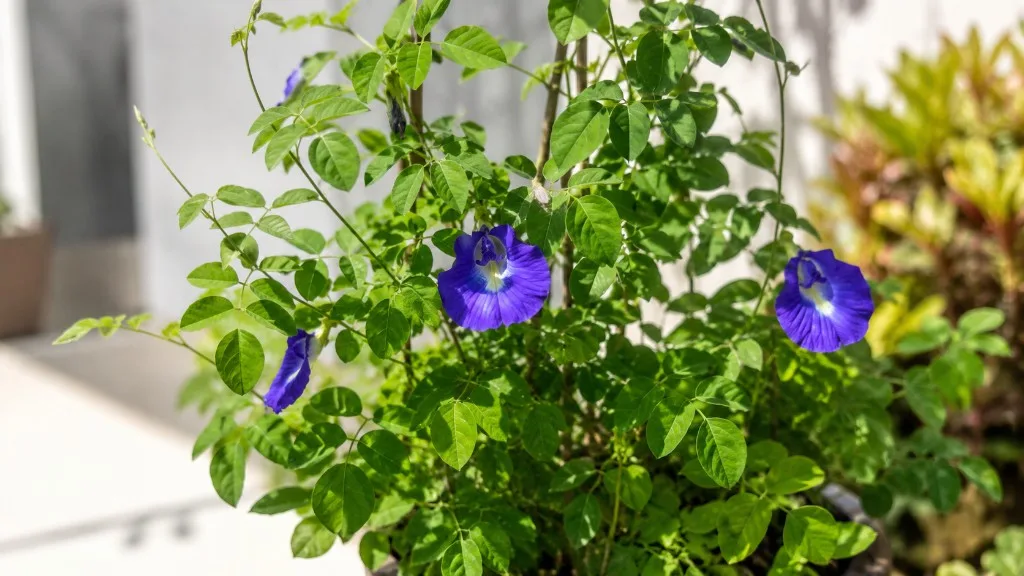
Aparajita Fertilizer Guide: When, How Much, and Common Mistakes
Aparajita Fertilizer Guide: When, How Much, and Common Mistakes
Aparajita (Clitoria ternatea), the butterfly pea vine prized for its electric-blue flowers and edible blooms, is one of those plants that looks like it should be hungry. It grows fast in warm weather, covers a trellis in a single season, and pumps out flowers that gardeners photograph, brew into tea, and use to color rice. Yet the most common fertilizer mistake on Aparajita overview is not underfeeding - it is feeding it like a hungry leafy vegetable or a lawn. Aparajita is a legume. It forms a partnership with soil bacteria that pull nitrogen from the air and store it in root nodules. Push extra nitrogen on top of that natural supply and you often get a lush, soft, very green vine with disappointing bloom counts.
That does not mean fertilizer is optional. Container plants exhaust phosphorus and potassium faster than in-ground vines. Poor soil, repeated watering, and long seasons of flowering all draw minerals out of the root zone. The skill is knowing what to feed, how much, and when to stop. This guide covers the full decision: NPK ratios that support flowers instead of foliage, organic routines that work on Indian balconies, liquid dilution math, seasonal pauses, and the recovery steps when salts build up in a pot.
Why Aparajita Is Not a Heavy-Feeding Vine
Most fertilizer guides assume every ornamental needs a steady nitrogen supply. Aparajita breaks that assumption because it belongs to the Fabaceae family - the same group as beans, peas, and cover crops grown specifically to put nitrogen into soil rather than pull it out. The NC State Extension Gardener Plant Toolbox describes Clitoria ternatea as a rapidly growing twining vine that tolerates a wide soil pH range and performs best in full sun with good drainage. Those cultural notes matter for feeding: a fast-growing sun lover uses nutrients, but it is not a gross feeder in the way a corn crop or a heavy-blooming rose might be.
Think of fertilizer on Aparajita as supplemental, not foundational. A single incorporation of compost or well-rotted manure at planting can carry an in-ground vine through a decent season in average garden soil. A potted balcony plant in a 10- to 12-inch container has no surrounding soil bank to draw from, so it needs light, repeated top-ups during active growth. The error is treating both situations the same and doubling the dose when flowers fail to appear.
Nitrogen Fixation and What It Means for Your Fertilizer Choice
Legumes fix atmospheric nitrogen through a symbiosis with Rhizobium bacteria. The bacteria colonize nodules on the roots; the plant supplies carbon; the bacteria supply usable nitrogen. NC State Extension’s cover crop guidance explains that legumes like clovers, vetch, and peas form this relationship in soil, converting nitrogen from the air into a form plants can use - which is exactly why farmers plant legume cover crops between cash crops.
Aparajita participates in the same biology. In fertile garden soil with healthy microbial life, mature vines often need little or no added nitrogen. In fact, high-nitrogen fertilizer actively works against flowering on many legumes because nitrogen drives vegetative growth - more stems, larger leaflets, softer tissue - at the expense of reproductive effort. Gardeners who see a wall of green and ask “why no blue flowers?” frequently discover they have been using lawn fertilizer, fresh poultry manure, or a leafy-green NPK with the first number doubled.
There are two practical caveats. First, young seedlings and newly rooted cuttings may not yet have functional nodules; a light balanced feed after the first true leaves appear can help early establishment without going heavy on nitrogen. Second, container culture leaches and flushes nutrients with every watering, so even a nitrogen-fixing vine in a pot may benefit from a complete fertilizer - just not one dominated by nitrogen. If you start from seed, inoculating with a legume-specific rhizobium product at sowing time (following label directions) can improve nodulation in sterile potting mix, though many garden soils already carry compatible bacteria.
Phosphorus, Potassium, and Micronutrients Aparajita Still Needs
Nitrogen fixation covers one macronutrient. It does not manufacture phosphorus, potassium, calcium, magnesium, iron, or the trace elements that support root branching, flower bud formation, water regulation, and stress tolerance. Phosphorus is the nutrient most closely tied to flowering and root development in general plant nutrition; potassium supports overall vigor, drought response, and disease resistance. Micronutrients matter more than many guides admit, especially when the vine grows in a soilless or heavily leached mix and receives purified or low-mineral water.
For Aparajita, the feeding goal is a complete but modest supply of everything except excess nitrogen. You are not trying to force growth; you are replacing what watering, flowering, and rapid stem extension remove from a finite root zone. A vine that blooms daily - each individual flower lasts only a day or so, but new buds keep forming in warm weather - spends energy and minerals continuously. Pale new leaflets, weak side branching, or a sudden drop in flower size after months in the same pot often signal that phosphorus, potassium, or micronutrients have thinned out, not that the plant needs a nitrogen boost.
The Best Fertilizer Type and NPK Ratio for Aparajita
The best Aparajita fertilizer is one that is complete (contains N, P, K, and ideally micronutrients), easy to dose accurately, and not overloaded on nitrogen. For most home growers that means either a diluted liquid or water-soluble product, or a measured organic top-dressing on a predictable schedule. Slow-release granules can work in ground beds at planting time, but in small pots they are harder to adjust if you overapply.
As a starting point, these NPK profiles fit the plant’s biology:
| Fertilizer profile | Example ratio | Best use case |
|---|---|---|
| Balanced, mild | 10-10-10 or 20-20-20 at half strength | General container care, young vines |
| Bloom-leaning | 5-10-10 or 10-20-20 at half strength | Mature vine with good light but shy flowering |
| Organic complete | Compost, vermicompost, well-rotted cow dung | Balcony and garden beds, monthly top-dress |
| Supplemental tonic | Diluted seaweed extract | Micronutrient boost every 2–3 weeks if needed |
The Missouri Botanical Garden notes that butterfly pea grows in well-drained soil with a pH of about 5.5 to 7.5 and, as a legume, does not require high-nitrogen fertilizer - aligning with the phosphorus- and potassium-forward approach most experienced growers use for bloom production. The MBG profile is accessible at its Plant Finder entry for Clitoria ternatea.
Balanced vs. Bloom-Lean Formulas: Which Wins for Butterfly Pea?
A balanced fertilizer such as 10-10-10 used at half the label strength is the safest default for container Aparajita through spring and summer. It replaces a little of everything without assuming the plant is nitrogen-starved. If your vine sits in bright direct sun, grows steadily, and blooms regularly, stay on balanced feeding rather than chasing a “bloom booster.”
Switch to a phosphorus- and potassium-leaning formula - something in the neighborhood of 5-10-10 or 10-20-20, still at reduced strength - when three conditions are true: the plant is at least one season old, it receives at least 5–6 hours of direct sun (or equivalent grow-light intensity), and it produces healthy green leaves but few flowers. One or two feedings with a bloom-leaning product over four to six weeks is usually enough to test the response. If flowers still do not appear, the limiting factor is almost certainly light, root crowding, or pruning habit - not a missing phosphorus megadose.
Avoid these common mismatches:
- High-nitrogen lawn or leafy-green formulas (e.g., 30-0-0, 24-8-16 heavy on the first number): excellent for grass, counterproductive for butterfly pea flowers.
- Undiluted general houseplant strength on a small pot: root burn and salt crust arrive within weeks.
- Calcium nitrate or urea as a standalone feed: fast nitrogen hit with no balance; legumes rarely need this in home culture.
If you use a 20-20-20 product, remember the numbers describe nutrient percentages, not dose. Twenty-twenty-twenty is twice as concentrated as ten-ten-ten at the same volume. Always dilute to half strength or weaker for Aparajita unless the label explicitly provides a feeding-plant or vine rate - and even then, start conservative.
Organic Options: Compost, Vermicompost, Cow Dung, and Seaweed
Organic feeding suits Aparajita well because the vine evolved in tropical soils rich in organic matter, and because slow, biology-linked release reduces the shock risk of concentrated salts. In Indian home gardening, the standard combination is a handful of vermicompost mixed with well-rotted cow dung manure (gobar khad) scratched into the top 2–3 cm of soil once a month during spring and summer. For a 10- to 12-inch pot, that means roughly a small handful of each - about 2 to 3 tablespoons total combined - not a thick layer that traps moisture against the stem.
Vermicompost supplies a broad spectrum of nutrients and improves microbial activity in the root zone. Well-rotted cow dung adds organic matter and gentle nutrition; it must be fully composted - fresh, hot manure will burn roots and can introduce pathogens. Compost from a managed pile works the same way at planting time or as a mid-season top-dress. Work any organic amendment into the surface, water lightly to settle it, and keep the material off the crown of the vine.
Seaweed extract or diluted fish emulsion every two to three weeks can fill micronutrient gaps when a plant looks generally healthy but slightly dull, or when it has been in the same pot a long time without Aparajita repotting guide. Use seaweed at the lower end of the label dilution - this is a tonic, not a meal. Organic options are not automatically weak; overstacking vermicompost every week plus liquid feed plus slow-release pellets still oversupplies nutrients and salts.
One myth worth correcting: diluted synthetic fertilizer is not inherently harmful to Aparajita. What harms the plant is concentration and imbalance, not the word “chemical.” A half-strength complete liquid used on moist soil is often safer than an excessive organic dump that ferments in a waterlogged pot.
When to Fertilize Aparajita Throughout the Year
Timing matters as much as product choice. Aparajita grows on a tropical rhythm: surge in warmth and long days, slow in cool weather, and often unpredictable during heavy monsoon cloud cover when growth softens even though temperatures stay high. Fertilizer should track visible growth, not a calendar printed for temperate-zone tomatoes.
Spring and Summer: Active-Growth Feeding Schedule
Begin feeding when the vine shows active new leaves, lengthening stems, or the first flower buds after winter or a dormant spell - not merely when a date on the calendar says March. In USDA zones 10–12 and most of tropical India, that active window often runs from late February through September, though local climate shifts it.
During active growth, use this baseline:
- Liquid or water-soluble complete fertilizer: every 3 to 4 weeks at half label strength, applied to already-moist soil.
- Organic top-dress (vermicompost + rotted manure): once a month for container plants; once at planting plus one mid-season for in-ground vines in decent soil.
- Seaweed tonic: every 2 to 3 weeks only if the plant looks micronutrient-limited or has been in the same pot more than one season.
| Season / phase | Container plant | In-ground plant |
|---|---|---|
| Early active growth | Half-strength balanced liquid every 4 weeks | Compost at planting; optional balanced liquid once mid-season |
| Peak bloom period | Half-strength balanced or 5-10-10 every 3–4 weeks | Optional PK-leaning liquid every 4–6 weeks if soil is lean |
| Organic routine | Monthly vermicompost + rotted manure top-dress | Single compost incorporation at planting |
Feed the growth you can see. If the vine is doubling stem length and opening flowers, the schedule above makes sense. If it is static - same leaf count, no new tendrils - investigate light and water before adding fertilizer.
Monsoon and Late Summer: When to Reduce Feeding
In regions with a heavy monsoon, Aparajita often keeps growing but with softer, sometimes yellowing tissue and reduced flowering under extended cloud cover and saturated air. Cut feeding frequency in half during prolonged wet periods, and skip any application if the pot stays wet for days. Nitrogen fixation continues, but roots in waterlogged mix cannot take up nutrients efficiently; unused fertilizer salts accumulate and compound root stress.
Late summer, even outside monsoon climates, is a taper period. Reduce from every three weeks to every five or six weeks, then stop entirely four to six weeks before you expect growth to slow from cooling temperatures or before moving a potted vine indoors for winter. You want the plant to harden off, not push soft late-season growth that invites pest and fungal problems.
Winter and Dormancy: Why You Should Stop
Aparajita is reliably perennial only in USDA zones 10–12. Below that, it is grown as an annual or overwintered indoors. When nights drop below about 55°F (13°C) or growth visibly stalls, stop fertilizing entirely. A dormant or semi-dormant vine cannot metabolize nutrients; salts remain in the soil and burn roots when watering eventually resumes in spring.
Indoor overwintering follows the same rule: bright window, reduced watering, no fertilizer until new spring growth appears. Restart at quarter to half strength for the first feeding, then move to the regular schedule after the second flush of leaves confirms the roots are active again.
How Much Fertilizer to Use: Dose and Dilution Rules
“How much” is where precise language saves plants. For liquid fertilizer, read the label’s houseplant or general ornamental rate, then cut it in half for Aparajita as a first-season default. If the label says one teaspoon per gallon for houseplants, use one-half teaspoon per gallon. If you prefer metric dosing, 5 ml per liter on the label becomes 2.5 ml per liter. Apply until the solution drains freely from the bottom of the pot, then discard saucer water so the roots are not re-absorbing concentrated runoff.
For organic top-dress, think in surface area, not volume heaped against the stem. A 10-inch pot receives about 2–3 tablespoons total combined vermicompost and rotted manure, scratched in lightly and watered. A 14-inch pot can take 4–5 tablespoons. In-ground planting: 2–5 liters of compost worked into the planting hole and backfill is enough at establishment; additional manure mid-season is optional in poor sand or clay.
Never increase dose because flowers are slow. Increase light exposure, check root bound status, and confirm pruning is not removing bud sites before you escalate feeding. Doubling fertilizer is the fastest route to brown leaf margins and a white mineral crust on the soil.
How to Apply Fertilizer Step by Step
Safe application is boring and repeatable - which is exactly what roots prefer.
- Check the plant state. Do not feed a wilted, waterlogged, pest-ridden, or recently repotted vine. Wait two to three weeks after repotting unless the new mix is clearly nutrient-free and the label on the bag confirms no starter charge.
- Confirm soil moisture. If the top 3 cm is dry, water with plain water first and feed 24 hours later. Fertilizer on dry roots causes burn.
- Mix fertilizer at half strength (or organic dose as above) in a watering can. Use room-temperature water.
- Apply at the soil surface around the pot rim, not over the foliage. Butterfly pea is prone to fungal issues when leaves stay wet; keep fertilizer solution off the leaflets.
- Water until drainage runs clear, then empty the saucer.
- Record the date on a phone note or calendar. Aparajita tolerates a missed month better than a doubled dose.
Once a month during the feeding season, substitute a plain-water flush: run two to three pot volumes of water through the container to leach accumulated salts. This matters more in small pots and hard-water areas where mineral crust already appears.
Container vs. In-Ground Application Differences
Container vines have the entire root zone in a few liters of mix. Nutrients deplete and salts concentrate quickly. Favor liquid half-strength feeds every 3–4 weeks or monthly organic top-dress, plus the monthly plain-water flush. Repot or refresh the top 5 cm of mix yearly if growth slows despite good light.
In-ground vines tap surrounding soil and often nodulate more effectively. A compost-rich planting hole may be sufficient for the whole season. If soil is sandy or heavily leached, one or two half-strength liquid feeds during peak bloom are enough. Avoid turning a garden bed into a high-nitrogen test plot; neighboring plants may appreciate the fixed nitrogen Aparajita releases, but the vine itself still blooms best on moderation.
Signs Your Aparajita Is Getting Enough Nutrients
Healthy nutrition shows up in new growth, not old leaves you wish looked better. Look for these positive signals on the newest stems and leaflets:
- Deep, even green on standard blue varieties (not lime-yellow and not dark blue-green softness from excess nitrogen).
- Sturdy stems that climb without snapping; internodes neither stretched nor compressed.
- Regular flower production in warm, sunny weather - not one burst then silence for months.
- Clean soil surface without white crystalline crust.
- Steady but not explosive vine extension; a mature plant adds side branches after tip pinching.
If old lower leaves yellow and drop while new growth stays firm, that is often natural senescence, not hunger. Judge feeding by the top and tips of the vine.
Signs of Over-Fertilizing and Nutrient Burn
Over-fertilizing is the most common preventable injury on potted Aparajita. Symptoms develop faster in small containers and when fertilizer is applied to dry soil or at full label strength.
Watch for:
- Brown, crisp margins on leaflets, often starting on the oldest leaves but spreading if salts accumulate.
- White or yellowish crust on the soil surface or pot rim - crystallized fertilizer salts.
- Sudden leaf drop after a feed, especially combined with wilting despite wet soil (root damage from osmotic stress).
- Soft, overly dark new growth with no flowers after repeated high-nitrogen feeds.
- Sour or musty smell from the pot, indicating organic matter breaking down anaerobically after excessive top-dress in wet conditions.
These signs overlap with underwatering on Aparajita, root rot on Aparajita, and spider mite damage. The distinguishing clue for fertilizer burn is a recent feed or visible salt crust, often with wilting despite moist mix because damaged roots cannot transport water.
How to Fix Over-Fertilized Aparajita
Recovery is straightforward if you catch it early and stop making the problem worse.
- Stop all fertilizer immediately for 4 to 6 weeks minimum.
- Scrape off visible salt crust from the soil surface without damaging roots.
- Flush the pot with plain room-temperature water: run water slowly through the mix for 3 to 5 minutes, let it drain fully, empty the saucer. Repeat two more times over the next 48 hours.
- Replace the top 2–3 cm of mix with fresh, unfertilized potting soil if crust was heavy or the plant wilted severely.
- Move the vine to bright indirect light temporarily if leaf burn is advanced - not deep shade, but avoid harsh midday sun on stressed tissue.
- Resume feeding only when new unstressed growth appears, at quarter strength for the first application.
Badly burned leaves will not green up again; wait for replacement foliage. If the vine was root-bound and salt-loaded, repotting into fresh mix after flushing is faster than repeated rescue flushes on exhausted soil.
Common Aparajita Fertilizer Mistakes to Avoid
Most failures repeat the same patterns:
- Using high-nitrogen fertilizer because the plant “looks hungry.” On a legume, this produces leaves, not butterfly-shaped blooms.
- Feeding on a calendar regardless of growth. Winter, post-repot, and waterlogged monsoon periods need pauses.
- Applying fertilizer to dry soil for convenience. Always moisten first.
- Stacking products - slow-release granules, monthly manure, and weekly liquid - without realizing the cumulative dose.
- Chasing blooms with fertilizer when light is insufficient. Aparajita needs direct sun for prolific flowering; fertilizer cannot substitute for photons.
- Ignoring salt flush in containers, especially with hard tap water.
- Fresh manure or undiluted synthetic concentrate - both cause rapid root injury.
- Foliar feeding as the primary method. Leaves are not the main uptake route here; wet foliage invites fungal spotting.
The safest mindset: when in doubt, skip a feeding. Aparajita tolerates a lean month far better than a rescue flush after burn.
How Fertilizer Connects to Light, Water, and Soil
The Herb Society of America notes that butterfly pea thrives in warm climates with 6–10 hours of bright direct sun daily - light that drives photosynthesis and makes modest fertilizer use efficient. The same vine in dim light with soggy mix will accumulate salts, stretch weakly, and refuse to bloom no matter how much phosphorus you pour on.
Light drives photosynthesis; without adequate energy capture, nutrients sit unused in the root zone. Water moves nutrients into roots; erratic drought stress or constant waterlogging both break uptake. Soil structure determines whether roots breathe and whether salts linger; heavy, compacted mix in a small pot magnifies every dosing error. The NC State Extension profile emphasizes full sun and good drainage - pair those cultural basics with light feeding and the fertilizer program finally makes sense.
Before changing fertilizer, run this quick check:
- Is the vine getting at least 5–6 hours of direct sun (or strong grow lights)?
- Does water drain within minutes, with the top 3 cm drying between waterings?
- Is the plant actively growing right now?
- Is there no salt crust, and was the last repot more than two weeks ago?
If any answer is no, fix that condition first. Fertilizer rewards a healthy system; it does not create one.
Conclusion
Aparajita fertilizer is less about feeding heavily and more about feeding correctly for a nitrogen-fixing legume that blooms best on moderation. Use a complete, half-strength liquid every three to four weeks during active growth, or a monthly organic top-dress of vermicompost and well-rotted cow dung in containers. Favor balanced or phosphorus- and potassium-leaning NPK over high-nitrogen formulas. Pause through winter, wet monsoon stalls, and any period when the vine is stressed, repotted, or not growing.
Watch new leaves and flower buds - not the calendar - and flush salts monthly in pots. If you remember only one rule, make it this: Aparajita fixes its own nitrogen; your job is to supply everything else, lightly, while sun and drainage do the real work. Get that balance right and the blue flowers follow; get it wrong and you will have the healthiest-looking green vine on the block with nothing to steep for tea.
When to use this page vs other Aparajita guides
- Aparajita overview - Start here for whole-plant context before deep-diving this topic.
- Aparajita problems hub - Jump to symptom-specific fix guides when this care topic does not resolve the issue.
Related Aparajita guides
- Aparajita overview
- Aparajita watering
- Aparajita light
- Aparajita soil
- Aparajita propagation
- Aparajita repotting
- Aparajita problems
Related tool
Try the Fertilizer Dilution Calculator with aparajita pre-selected to estimate needs for your setup.