Aloe Vera Plant Care: Light, Water, Soil, Pups, and Safety
Aloe vera
Aloe vera needs bright light and watering only every 2–4 weeks when soil is completely dry. It thrives on neglect, grows well on windowsills, but is toxic to cats and dogs.
Aloe Vera Plant Care: Light, Water, Soil, Pups, and Safety
Start with wateringThe most common care mistake for Aloe VeraWatering guide →Aloe Vera care essentials
Light
bright indirect light to direct morning sun
Water
Water deeply and infrequently - only when the soil is completely dry, roughly every 2–4 weeks.
Soil
Fast-draining cactus and succulent mix with added grit.
Humidity
20–40%
Temperature
13–27°C (55–80°F)
Fertilizer
About Aloe Vera
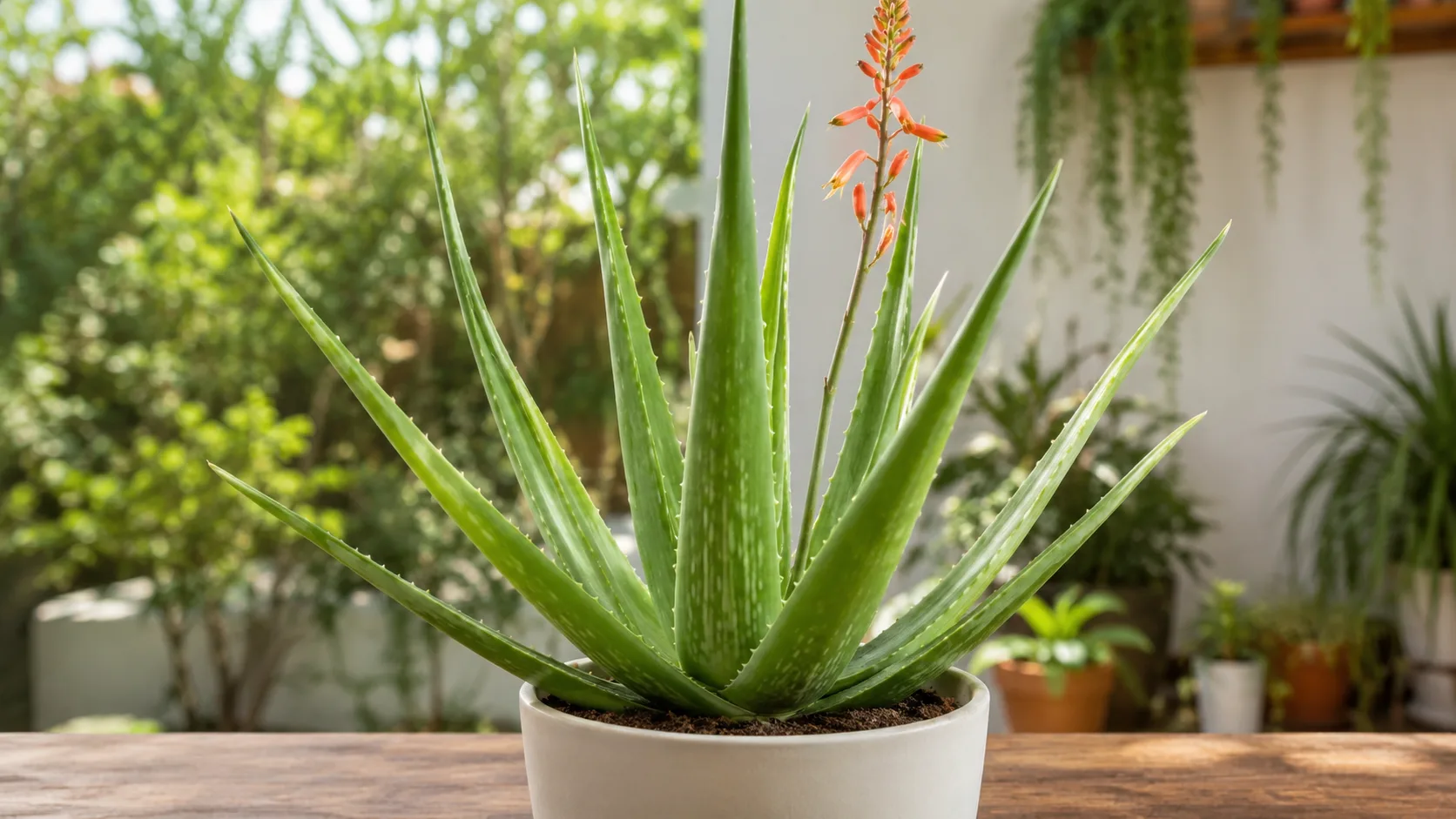
Aloe Vera is native to Arabian Peninsula; naturalised worldwide in tropics and subtropics including India, typically reaches 1–2 ft tall and wide indoors; thick fleshy serrated leaves indoors, with slow to moderate growth. Aloe Vera has a rosette growth habit and part of the Asphodelaceae family. It is also known as Burn Plant, Medicinal Aloe, True Aloe, and Barbados Aloe.
| Detail | Information |
|---|---|
| Also known as | Burn Plant, Medicinal Aloe, True Aloe, Barbados Aloe |
| Native region | Arabian Peninsula; naturalised worldwide in tropics and subtropics including India |
| Mature size | 1–2 ft tall and wide indoors; thick fleshy serrated leaves |
| Growth rate | Slow to moderate |
| Growth habit | Rosette |
| Scientific name | Aloe vera |
| Family | Asphodelaceae |
Aloe Vera Plant Care: Light, Water, Soil, Pups, and Safety
What Aloe Vera Actually Is (and Why That Matters for Care)
Aloe vera is a stemless or short-stemmed succulent perennial, not a cactus. The accepted scientific name is Aloe vera (L.) Burm.f., with the widely used synonym Aloe barbadensis Mill.; both refer to the same plant. It belongs to the family Asphodelaceae.
Its native range is narrower than most people assume. Phylogenetic work places the only likely truly indigenous wild populations in the Hajar Mountains of northeastern Oman and adjacent eastern United Arab Emirates. A 2015 BMC Ecology and Evolution analysis (Grace et al.) places Aloe vera among Arabian species at “the northernmost natural range limit of aloes.” The Royal Botanic Gardens, Kew Plants of the World Online entry confirms the native range as “N. Oman (Hajar Mountains)” and the plant is a “succulent perennial” that “grows primarily in the desert or dry shrubland biome.” Long cultivation has since naturalized it across North Africa, the Canary Islands, the Mediterranean, and parts of the Americas. The traits that let it survive rocky Hajar-Mountain scree are the exact traits that punish you when you overwater it on a kitchen counter.
Three plant parts do most of the work, and keeping them straight will save you from a surprising number of mistakes. The outer green rind is largely structural. Just beneath it sits a thin yellow layer of latex, the bitter exudate that contains anthraquinone glycosides (the most studied being aloin). Inside that is the clear, water-rich parenchyma gel that most people are actually after, a mucilaginous tissue that is roughly 95–99% water, with the rest made up of complex carbohydrates (notably acemannan), small amounts of vitamins and minerals, and various enzymes. The “aloe” of older pharmacopeias is mostly the gel; the “aloe latex” sold as a laxative is the yellow layer underneath, and the two have very different safety profiles.
For related Aloe Vera care, see Spider Mites on Aloe Vera.
Aloe Vera at a Glance
A quick reference card for the plant, in plain English:
- Botanical name: Aloe vera (L.) Burm.f., synonym Aloe barbadensis Mill.
- Family: Asphodelaceae
- Type: Succulent perennial; rosette of fleshy leaves; spreads via underground offsets (“pups”)
- Mature size: Typically 24–36 inches (60–90 cm) tall and wide in a large container; smaller and slower indoors
- Light: Aloe Vera light guide, with some direct sun; gentler morning sun is better than harsh afternoon sun through glass
- Water: Soak-and-dry; allow the top third of the mix to dry between waterings
- Soil: Gritty, fast-draining cactus and succulent mix
- Temperature: Comfortable in 55–80 °F (13–27 °C); damaged below 40 °F (4 °C); killed by a hard frost
- Toxicity to pets: Toxic to dogs, cats, and horses (ASPCA)
- Hardiness outdoors: USDA zones 10–12 reliably; marginal in zone 9b with protection
Light: Bright, Indirect, and a Little Direct Sun
Aloe vera evolved in relentless sun, but with two built-in protections: a waxy, sometimes glaucous leaf surface and a water-buffered parenchyma. Indoors, those same leaves can scorch when sunlight passes through a south- or west-facing window, where UV intensity is amplified and the leaf surface heats up faster than the plant can move water to cool itself.
The rule most extension services converge on: bright indirect light for most of the day, with a couple of hours of direct morning sun if you can offer it. Penn State Extension recommends placing indoor aloes near sunny windows for “full sun to bright indirect light” and rotating the pot so all sides of the rosette get even exposure. The Old Farmer’s Almanac and University of Arizona Cooperative Extension single out a south- or west-facing window as ideal, and NC State lists the acceptable range as “Full sun (6+ hours of direct sunlight a day)” down to “Partial Shade (2–6 hours).”
In a dim home, the plant will tell you within a few weeks. Aloe kept in low light stretches toward the window, the leaves grow thinner and more spaced out, the rosette flops open, and the plant loses its compact, upright form. This is etiolation, and it is not reversible on the affected leaves; the only fix is more light and new growth. A grow light on a 12–14 hour timer, set about 12–18 inches above the plant, will keep an aloe tight and green even in an interior room with no window.
In a very sunny spot, the opposite problem shows up as bleached, papery, or rust-colored patches on the side of the leaves facing the glass. That is sunburn, and the answer is to pull the plant 2–5 feet back from the window or diffuse the light with a sheer curtain. Move it gradually over a week or two; a sudden move from a shaded corner to a bright sill is the most reliable way to scorch an otherwise healthy plant.
Watering: The Soak-and-Dry Rhythm That Mirrors Its Native Habitat
Watering is where most indoor aloe owners lose their plants. The instinct is to treat aloe like a leafy tropical and water on a schedule; the reality is that aloe is a succulent built to store water in its leaves and ride out dry spells in coarse, mineral soil. Saturating the root zone every week, or letting the pot sit in a saucer of runoff, suffocates the roots and invites the fungal infections that turn a healthy rosette into mush.
The University of Arizona Cooperative Extension puts it bluntly: the soil should be “completely soaked, but allowed to dry between watering.” The Old Farmer’s Almanac recommends allowing the top third of the mix to dry before watering again, and roughly doubling the time between waterings in winter. Penn State Extension frames it as “err on the side of underwatering on Aloe Vera” during dormancy, when the plant is barely growing and using very little water. The North Carolina Extension Gardener Plant Toolbox makes the same point: “Allow the soil to dry between watering, then water well, allowing the water to drain from the pot.”
A workable indoor rhythm: water thoroughly until a small amount runs out of the drainage hole, let the pot drain for 10–15 minutes, then empty the saucer so the root ball is never sitting in water. Do not water again until the top one to two inches of mix feel dry and the pot feels noticeably lighter when you lift it. Expect about every 2–3 weeks during active growth in spring and summer, and roughly every 4–6 weeks in fall and winter, depending on light, temperature, and pot size.
Two diagnostic shortcuts are worth learning. Gently squeeze a mid-leaf: a well-hydrated leaf is firm and springy, a thirsty leaf is slightly soft and pliable, and an overwatered leaf is waterlogged and easily bruised. Then pick up the pot right after a thorough watering and remember that weight; a dry pot is dramatically lighter than a wet one, and that sensory difference is the single most reliable watering cue in succulent care.
Seasonal Watering Calendar
| Season | Plant state | Approximate interval | What to check before watering | |
|---|---|---|---|---|
| Spring (active growth) | Pushing new leaves from the center | Every 2–3 weeks | Top 1–2 inches of mix dry; pot feels light | |
| Summer (active growth) | Steady growth; brighter light | Every 2–3 weeks, more often in hot rooms | Same; watch for thirsty leaves | |
| Fall (slowing) | Growth tapering; light dropping | Every 3–5 weeks | Top 2 inches of mix dry; reduce if nights cool | |
| Winter (dormancy) | Mostly resting | Every 4–8 weeks, sometimes longer | Mix dry at least 2 inches down; the plant uses very little water in cool, low-light months |
These are starting points, not rules. Pot size, soil composition, ambient humidity, and direct sun all shift the actual interval. Always let the pot, not the calendar, decide.
Soil: Build a Gritty Mix That Drains in Seconds
Aloe vera’s roots are adapted to gritty, mineral, fast-draining substrates. The native soil in its Hajar-Mountain range is rocky and shallow, and water passes through it quickly; standing water in a pot mimics the opposite of that environment and is the most common cause of indoor aloe death. NC State and Penn State both recommend a cactus and succulent potting mix as the baseline, with extra perlite, pumice, lava rock, or coarse sand added to push drainage even further.
A simple mix you can build at home is roughly one part standard potting soil, one part coarse horticultural sand (not play sand, which compacts), and one part perlite or pumice. Commercial cactus and succulent mixes also work, especially if you top them up with another 20–30% mineral grit by volume; bagged mixes vary widely. A thin top-dress of lava rock or decorative gravel is optional but helps keep the leaf bases out of wet soil and discourages fungus gnats.
A few mistakes to avoid. Do not use garden soil, which is too dense and often contains pathogens and weed seeds. Do not use a moisture-control potting mix designed to retain water, no matter how convenient the bag looks. Do not use a deep layer of rocks at the bottom of the pot in place of drainage holes; the “drainage layer” myth has been thoroughly disproven in container horticulture, and it actually raises the perched water table right where the roots sit.
Temperature, Humidity, and Airflow
Indoor aloe is comfortable in the 55–80 °F (13–27 °C) range that most homes maintain naturally. Below about 50 °F (10 °C), growth slows dramatically and the plant begins to experience cold stress; below 40 °F (4 °C), cellular damage shows as dark, water-soaked, or translucent patches. Around freezing (32 °F / 0 °C), the water-saturated leaf parenchyma - the very tissue that makes the plant useful to people - ruptures as ice crystals form, and affected leaves turn to brown mush within hours. The Missouri Botanical Garden Plant Finder entry confirms that Aloe vera is reliably hardy outdoors only in USDA Zones 10 to 12, and the Royal Horticultural Society notes that aloes “cannot withstand freezing temperatures.”
This is why aloe is reliably hardy outdoors only in USDA zones 10–12, and only marginally in protected 9b microclimates. If you move the plant outside for the summer, bring it back inside well before nights drop below 50 °F (10 °C), and keep it out of the path of air conditioning vents, which deliver a steady cold draft that mimics the worst of winter.
Humidity is rarely a problem indoors because aloe prefers dry air. The risk in a humid room is that the potting mix stays wet for longer than it would in a drier home, which compounds overwatering on Aloe Vera. Good airflow helps the leaf surfaces and the top of the soil dry quickly between waterings, so a spot near (but not directly in front of) a frequently opened window or a ceiling fan is usually fine. Avoid bathrooms and kitchens where humidity spikes during showers and cooking, unless you are disciplined about cutting back on watering.
Fertilizer: Less Is More, and Mostly in Summer
Aloe vera in the wild survives on a famously lean diet, and indoors it inherits that frugality. Overfertilizing is one of the fastest ways to push a plant into soft, weak, rot-prone growth; underfertilizing is almost impossible to do indoors.
The consensus: feed lightly, only during the active growing season, and stop entirely in fall and winter. The Old Farmer’s Almanac, Greg, and the Green Aesthetic recommend a half-strength dose of a low-nitrogen, succulent-appropriate fertilizer (something in the 2-7-7 or 10-40-10 NPK range) applied once in early spring and once in midsummer. Gardener’s Path suggests monthly half-strength liquid feeds or two half-dose applications of slow-release granules per year. Epic Gardening notes that a healthy aloe in decent soil can go an entire year without any fertilizer and be perfectly fine. The Royal Horticultural Society recommends “fertilise sparingly, using a general-purpose liquid food diluted to half the recommended strength” once in spring and again in late summer.
A practical rule: one or two half-strength feedings spaced six to eight weeks apart in spring and summer is plenty. Skip fertilizer entirely if the plant has just been repotted, has been overwatered, or is in obvious stress from sunburn, root rot on Aloe Vera, or cold damage.
Choosing the Right Pot (Size, Material, and Drainage)
Aloe vera prefers to be slightly pot-bound, but a tiny nursery pot will only carry it for a season or two before the pups and the thickening root system start to crowd it out. Choose a container that is 1–1.5 inches (2.5–4 cm) wider in diameter than the current root ball, with at least one large drainage hole. Going up by more than one pot size at a time is a common mistake; the extra soil volume stays wet for too long and the roots can’t use it.
Material matters more than style. Unglazed terracotta is the gold standard: the porous clay wicks moisture out of the root zone, giving you a little extra margin against overwatering. Glazed ceramic, plastic, and concrete pots work fine, but they hold moisture longer, so you’ll water less often and need to be extra careful not to leave the pot sitting in runoff. Whatever you choose, never use a pot without a drainage hole unless you are an experienced grower managing a true hydroculture setup. A heavier, wider-based pot also helps the plant stay upright once it grows tall.
Aloe Vera repotting guide Aloe Vera Without Damaging the Roots
Most indoor aloes need to be repotted every two to three years, both to refresh depleted potting mix and to make room for the pups that will eventually crowd the parent. Penn State Extension recommends replanting aloe every two years for exactly this reason, and the timing lines up well with the natural pupping cycle.
The best moment to repot is at the start of the active growing season, in early to mid-spring, when the plant is about to push new roots and can recover from the disturbance quickly. Repotting in deep winter slows recovery and increases the risk of rot in disturbed roots that aren’t actively using water.
The process is straightforward. Water the plant a day or two before you repot; hydrated roots flex and bend rather than snap. Turn the pot on its side, support the base of the rosette with one hand, and slide the root ball out. If it’s stuck, run a clean knife around the inside edge of the pot to free the roots. Shake off the old mix and inspect the roots: healthy roots are pale, firm, and slightly fibrous, while rotted roots are dark, mushy, and may smell sour. Trim anything rotted with a sterilized blade and let the cuts air-dry for a day if you did significant trimming. Set the plant in its new pot at the same depth it was before, backfill with fresh mix, and wait 5–7 days before watering so any broken roots can callus over.
Propagation: Separating Pups the Right Way
Pups, also called offsets or babies, are the small clonal rosettes that emerge from the base of a mature aloe on short underground stems (stolons). They share part of the parent’s root system at first, then develop their own roots, and they are by far the most reliable way to propagate aloe vera at home. BBC Gardeners’ World and similar horticultural references put it simply: division of offsets is the most reliable way to propagate aloe. Leaf cuttings are possible but inconsistent, and seed-grown aloe takes years to reach a useful size.
The standard workflow:
- Wait for size. A pup is ready to separate when it is roughly one-fifth the size of the parent and 3–4 inches tall, with at least a few of its own roots visible. Tiny pups without roots can survive separation, but they take much longer to establish.
- Withhold water. Stop watering the parent for about a week before you divide it. Dry mix falls away more easily from the roots and gives you a clearer view of the connections.
- Unpot the whole cluster. Tip the pot on its side and slide out the entire root ball. Shake or brush off the loose mix so you can see where each pup joins the parent.
- Separate cleanly. Some pups pull away with a gentle twist, taking a tuft of their own roots with them. For stubborn connections, use a clean, sharp knife sterilized with 70% isopropyl alcohol and cut the stolon in a single stroke as close to the mother as possible. Don’t tear or saw; ragged wounds heal slowly and are entry points for fungus.
- Callus the wounds. Set each pup (and the mother, if you trimmed her) on a paper towel in a dry, shaded, well-ventilated spot for 24–48 hours. The cut end should form a thin, papery callus before it goes back into soil. Some growers dust the cut with cinnamon or sulfur powder as a natural antifungal.
- Pot up in a small container. Use a small pot just slightly larger than the pup’s root ball - usually 3–4 inches in diameter - filled with the same gritty mix as the parent. Plant only to the base of the lowest leaves; do not bury any leaf tissue.
- Wait before watering. Hold off for 5–7 days to let the cut roots heal. After that, water sparingly and only when the top of the mix is dry. New leaf growth from the center of the rosette is the visible sign that roots have taken; expect it within 4–6 weeks.
What If Your Aloe Has No Pups?
A few mature aloes stubbornly refuse to produce offsets, especially if they have been kept in the same small pot for years or grown in lower light than they prefer. A change of conditions often triggers pupping: move the plant into brighter light (acclimated over a couple of weeks), repot into fresh mix in spring, and make sure it is being watered on the soak-and-dry rhythm described above. Stressed plants sometimes produce pups as a survival response, so the trick is moderate stress, not severe stress.
If you need a new plant and your aloe won’t cooperate, the less reliable alternative is leaf propagation: cut a healthy outer leaf at the base, let the cut end callus for several days, then lay it on top of moist gritty mix and wait. Success rates for aloe leaf cuttings are modest at best - many will callus and then rot rather than root - so don’t count on this method if you need a guaranteed replacement.
Common Problems and How to Read Them
Aloe vera is unusually good at signaling what’s wrong, because every major stress shows up on the leaves. The trick is matching the symptom to the cause before you act, because the same symptom (a brown leaf, a soft leaf, a stretched plant) can come from very different problems with opposite solutions.
The most common failures, in roughly the order of frequency:
- Overwatering and root rot: Leaves go soft, translucent, yellow, then mushy brown from the base upward. The soil stays wet for days. Stop watering immediately, unpot the plant, trim any dark and mushy roots with a sterilized blade, let the plant air-dry for a day or two, and repot into fresh, dry, gritty mix. Wait 7–10 days before watering again.
- Underwatering: Leaves thin out, develop a slightly wrinkled surface, and the tips may turn brown and crispy. The plant is still firm, just less plump. A thorough deep watering usually rehydrates it within 48 hours.
- Sunburn: Sudden bleached, papery, or rust-colored patches on the side facing the window. Move the plant back from the glass or filter the light, and let damaged leaves remain until new growth replaces them.
- Cold damage: Dark, water-soaked, or translucent patches that appear after a cold night. Trim affected tissue back to firm, healthy leaf once the plant has stabilized in a warm spot, and avoid watering until new growth resumes.
- Etiolation / leggy growth: on Aloe Vera Long, thin, pale leaves spaced wide apart on a leaning stem. The plant needs more light; move it to a brighter spot, acclimate gradually, and consider a grow light in darker months.
- Pests: White cottony tufts in the leaf joints (mealybugs), small brown bumps that scrape off (scale), or fine webbing (spider mites, less common on aloe).
Brown Leaves: Six Different Problems Sharing One Symptom
Because “my aloe is turning brown” is the most common search query from worried owners, it is worth separating the six distinct things “brown” can mean and what each one tells you:
- Soft, mushy brown from the base up: Overwatering and root rot. The most dangerous variant. Stop watering, unpot, and inspect the roots.
- Crispy brown tips, otherwise firm leaves: on Aloe Vera Mild underwatering or low humidity. Deeply water the plant and let it recover.
- Bleached or rust-colored patches, dry and papery: Sunburn, usually after a sudden move into brighter light.
- Dark, water-soaked patches appearing overnight in winter: Cold or frost damage. Move the plant to warmth and avoid watering until it stabilizes.
- Reddish-brown stress color at the edges, with otherwise healthy leaves: A harmless response to very bright light, drought, or cool nights. The plant is fine; the color is cosmetic.
- Brown spots concentrated on the lower leaves only: Natural aging. Older outer leaves die back as the plant grows.
Mealybugs, Scale, and the Rare Aphid
Mealybugs are the most common aloe pest indoors. They look like small tufts of white cotton tucked into the tight angles where leaves meet the stem, and they leave a sticky residue called honeydew. A light infestation can be handled with a cotton swab dipped in 70% isopropyl alcohol, dabbed directly onto each visible cluster. Heavier infestations respond to insecticidal soap or a neem oil solution sprayed on the leaf surfaces (shade the plant during treatment and follow the product label). Quarantine the affected plant away from your other houseplants while you treat it.
Scale insects show up as small, hard, brown bumps that don’t brush off easily. The same alcohol-swab approach works, but you’ll need to repeat it weekly for a few weeks to catch the juveniles. Aphids are uncommon on aloe indoors but occasionally appear on new growth in spring; a strong spray of water in the shower, followed by insecticidal soap if needed, usually clears them.
Aloe Vera Gel: Topical Use, Oral Use, and What the Evidence Actually Shows
The split between topical and oral use matters because the evidence and the safety profile are very different.
Topical use of the clear inner gel is generally well tolerated and has a long folk record for minor burns, sunburn, and skin irritation. A 2022 systematic review in burns and wound journals (PubMed PMID 36264753) found a statistically significant mean reduction in healing time of about 4.4 days for second-degree burns treated with topical aloe, and a 2022 meta-analysis (PMID 36337821) reported shorter healing times than silver sulfadiazine, the standard burn cream. The Cochrane review, however, concluded the evidence is too low-quality to support aloe as a standard clinical treatment, and one trial found delayed healing in surgical wounds. Read together, the picture is: a reasonable option for minor burns and skin irritation in healthy adults, but not a substitute for medical care on a serious burn, and not a guaranteed effect. The NIH’s NCCIH notes that “topical use of aloe gel is generally well tolerated; however, there have been occasional reports of burning, itching, rash, and eczema,” so a small patch test on the inner forearm is worth doing if you have sensitive skin. Do not apply topical aloe to deep or open wounds without medical guidance.
Oral use is where the safety story gets serious. The clear gel, properly separated from the yellow latex, is considered possibly safe for short-term use (NCCIH cites studies suggesting safety up to 42 days), and some commercial aloe juices decolorize and filter the latex out. The yellow latex itself contains aloin and other anthraquinone glycosides, potent stimulant laxatives linked to cramping, diarrhea, electrolyte imbalance, kidney damage, and in animal studies to gastrointestinal cancer. The Mayo Clinic states bluntly that “taking 1 gram a day of aloe latex for a few days can cause kidney damage and might be fatal,” that “aloe latex may have cancer-causing chemicals,” and that children under 12 should not take aloe latex or whole-leaf extract orally. NCCIH adds that oral aloe can lower blood sugar and interact with diabetes drugs, diuretics, and blood thinners like warfarin. If you are pregnant or breastfeeding, both the Mayo Clinic and NCCIH recommend avoiding oral aloe in any form and talking to a healthcare provider first.
A few practical rules for harvesting: cut an outer leaf near the base, stand it cut-side down for 10–15 minutes to let the yellow latex drain, rinse the cut end, then split the leaf and scoop out the clear inner gel. Discard the latex and the rind. Use the gel fresh, refrigerate it for up to a week, or freeze it in ice cube trays for longer storage. None of this is a substitute for medical advice, and “natural” does not mean “risk-free.”
Toxicity to Pets: What “Toxic” Really Means with Aloe
This is the part of the aloe conversation that surprises most new owners, because the gel is so familiar and so often advertised as gentle. The ASPCA lists Aloe vera as toxic to dogs, cats, and horses, with the toxic principles identified as saponins and anthraquinones. The clinical signs listed by ASPCA are vomiting, lethargy, and diarrhea (in dogs and cats; horses tend to show different signs). The ASPCA also notes that the inner gel is considered edible for humans, which is the same distinction that explains why a small lick of commercial aloe gel rarely causes a serious problem, while chewing on the plant itself often does.
The mechanism is the same one that makes oral aloe risky for people. The yellow latex layer between the rind and the gel contains anthraquinone glycosides (aloin and related compounds) and saponins that irritate the gastrointestinal tract, sometimes severely. A curious cat chewing on a leaf, or a dog gnawing the base of the plant, can ingest enough of this layer to cause vomiting, diarrhea, lethargy, loss of appetite, and occasionally a change in urine color. Pet Poison Helpline adds that larger doses can cause hypoglycemia, abdominal cramping, dehydration, and electrolyte imbalance.
The practical implications for a home with pets:
- Placement matters most. Put the aloe on a high shelf, a closed-off room, or a hanging planter the cat can’t reach. Floor-level aloes and curious puppies are a bad combination.
- If a pet has chewed on the plant, watch for vomiting, diarrhea, or unusual lethargy over the next several hours. The ASPCA Animal Poison Control Center (888-426-4435, consultation fee may apply) and the Pet Poison Helpline are staffed 24/7 for exactly this situation.
- “Pet-safe” doesn’t really exist in this category. No cultivar of Aloe vera has had the latex bred out, and commercial “aloe” pet products are decolorized gels with the latex removed, which is not the same as the plant itself. Haworthia species and certain Echeveria are usually cited as safer alternatives, though any plant can cause mild GI upset if chewed.
- Don’t reach for the latex on purpose. Older “aloe juice detox” products, including some still sold online, are whole-leaf extracts that retain the latex, and the Mayo Clinic’s warning about kidney damage applies to pets as much as to people.
Where to Place Your Aloe in a Real Home
Putting all of this together into a single placement decision is more useful than another long list of rules. The ideal spot is a south- or west-facing window where the plant gets 4–6 hours of bright light, ideally with a sheer curtain or 2–5 feet of buffer from the glass if afternoon sun is intense. East-facing windows are usually perfect because the plant gets direct morning sun and then bright indirect light for the rest of the day. North-facing windows are usually too dim and will lead to slow, leggy growth unless you supplement with a grow light.
Within the room, keep the aloe away from three things: cold window glass in winter, which can radiate 20–30 °F of chill onto leaves in contact with it; heating vents, which blast hot dry air across the leaves; and air conditioning vents, which deliver a constant cold draft. A spot 2–3 feet back from a window, on a stable surface with a clear line of sight to the sky, is almost always the right answer.
And remember the pet and child question before you pick the spot, not after. An aloe on a low coffee table is one chewed leaf away from a vet call; an aloe on a high shelf in a bright bathroom is, in practical terms, a completely different plant from a safety standpoint.
Conclusion
Aloe vera rewards the grower who treats it like the desert plant it is, not the leafy tropical it sometimes looks like. Bright light, gritty soil, a thorough soak followed by a real dry-down, a light feeding or two in summer, and a watchful eye for the early signs of overwatering will carry a plant for years, with pups to spare. Repot every two to three years into a slightly larger terracotta pot, divide the offsets once they’re a fifth of the parent’s size, and never leave the pot sitting in runoff.
The other half of the equation is safety. The clear gel inside a fresh leaf is a useful, generally well-tolerated option for minor skin irritation in healthy adults, with a long history and a reasonable but not overwhelming evidence base. The yellow latex underneath the rind is a different substance, with documented risks of cramping, kidney damage, and possible carcinogenicity that the Mayo Clinic, NIH’s NCCIH, and MedlinePlus all take seriously; oral aloe latex and whole-leaf extract should be avoided in pregnancy, in children under 12, and in anyone on relevant medications without a healthcare provider’s input. The whole plant is toxic to dogs, cats, and horses per the ASPCA, primarily because of the same latex, so placement out of reach of pets is part of basic aloe care rather than an optional extra.
Treated that way, an indoor aloe is one of the lowest-fuss plants you can grow, and one of the most useful to have on a sunny shelf. The plant will tell you what it needs; the rest is paying attention.
When to use this page vs other Aloe Vera guides
- Aloe Vera overview - Canonical hub for this species - care topics and problems branch from here.
- Aloe Vera problems - Symptom-first path when you already know something is wrong.
Related Aloe Vera guides
How to care for Aloe Vera?
How much light does Aloe Vera need?
bright indirect light to direct morning sun
- bright indirect light to direct morning sun - bright indirect light to direct morning sun.
When should you water Aloe Vera?
Water deeply and infrequently - only when the soil is completely dry, roughly every 2–4 weeks.
- Push a finger or wooden skewer to the pot base - Water deeply and infrequently - only when the soil is completely dry, roughly every 2–4 weeks.
- water only when completely dry - Water deeply and infrequently - only when the soil is completely dry, roughly every 2–4 weeks.
- Drain excess water - Water deeply and infrequently - only when the soil is completely dry, roughly every 2–4 weeks.
What soil works best for Aloe Vera?
Fast-draining cactus and succulent mix with added grit.
- cactus and succulent potting mix - Fast-draining cactus and succulent mix with added grit.
- perlite (30%) - Light white granules that keep soil airy and help prevent compaction.
- coarse horticultural grit - Fast-draining cactus and succulent mix with added grit.
Grower notes for Aloe Vera
What matters most with Aloe Vera
Aloe Vera stores water in leaves, stems, roots, or a swollen base, so overcare is usually more dangerous than short dry spells. Strong light and drainage are the safety net. In practice, the care checkpoint is simple: bright indirect light to direct morning sun. Pair that with fast-draining cactus and succulent mix with added grit, and avoid changing water, pot size, and placement all at once.
Best placement in a real home
Aloe Vera belongs where bright indirect light to direct morning sun is realistic for most of the day, not only where the pot looks good. Water deeply and infrequently - only when the soil is completely dry, roughly every 2–4 weeks. If the pot stays wet longer than expected, move the plant into better light or reassess the mix before watering again. Humidity target: 20–40%. Temperature comfort zone: 13–27°C (55–80°F).
Before you buy this plant
Choose Aloe Vera with firm new growth, clean leaf undersides, and soil that does not smell sour or feel compacted. Be cautious if you see root-rot, sticky residue, collapsed crowns, or a pot that is wet in poor light. Cosmetic old-leaf damage is less worrying than weak roots or active pests.
First month after bringing it home
Do not repot Aloe Vera on day one unless the mix is failing or pests are obvious. Quarantine it, learn how fast the pot dries, and keep care boring while it adjusts. Watch especially for root-rot, brown-tips, and leggy-growth. If problems appear, correct the condition first rather than stacking fertilizer, repotting, and pruning together.
Safety note for Aloe Vera
Aloe Vera is not a plant to keep within reach of pets or children. The database flags it for cats and dogs. Use gloves if sap or plant tissue is irritating, and pick a pet-safe alternative for floor pots or low shelves.
How to tell Aloe Vera is settling in
Also sold as Burn Plant, Medicinal Aloe, and True Aloe, this plant should be judged by stable new growth rather than label names alone. If you plan to multiply it later, common methods include Separation of offsets (pups) and Leaf cuttings (unreliable). Repot only when you see Plant leaning or tipping due to offset weight and roots visible at drainage holes. If brown-tips shows up early, inspect light, watering, and roots before assuming the plant is permanently weak.
Is it pet safe?
Aloe Vera is toxic to cats and dogs.
The latex (aloin) found just under the skin of aloe leaves is toxic to cats and dogs, causing vomiting, diarrhoea, lethargy, and changes in urine colour. ASPCA classifies as toxic.
Watering Aloe Vera
For Aloe Vera, push a finger or wooden skewer to the pot base; water only when completely dry and water every 2–4 weeks in summer; every 4–8 weeks in winter. Almost no watering in winter; aloe is dormant and uses very little water.
| Detail | Information |
|---|---|
| How often | Every 2–4 weeks in summer; every 4–8 weeks in winter |
| How to check | Push a finger or wooden skewer to the pot base; water only when completely dry |
| Seasonal changes | Almost no watering in winter; aloe is dormant and uses very little water |
Signs of overwatering
- Soft, mushy, or translucent leaves
- brown soggy base
- leaves falling over
Signs of underwatering
- Thin or slightly puckered leaves
- brown dry leaf tips
Soil & potting for Aloe Vera
Use a mix of cactus and succulent potting mix, perlite (30%), coarse horticultural grit for Aloe Vera. Excellent drainage essential; terracotta pots strongly recommended. Target soil pH around 7.0–8.5. Repot every 2–3 years or when heavily offsetting, ideally in spring.
| Detail | Information |
|---|---|
| Recommended mix | cactus and succulent potting mix, perlite (30%), coarse horticultural grit |
| Drainage | Excellent drainage essential; terracotta pots strongly recommended |
| Soil pH | 7.0–8.5 |
| Repotting frequency | Every 2–3 years or when heavily offsetting |
| Best season to repot | Spring |
Signs it needs repotting
- Plant leaning or tipping due to offset weight
- roots visible at drainage holes
- soil depleted and compacted
Humidity & temperature for Aloe Vera
Aloe Vera prefers 20–40%, though normal home humidity is usually fine. Keep temperatures around 13–27°C (55–80°F).
| Detail | Information |
|---|---|
| Humidity | 20–40% - normal home humidity is fine. |
| Ideal temperature | 13–27°C (55–80°F) |
Fertilizer & pruning for Aloe Vera
Common problems on Aloe Vera
Root Rot
HighLikely cause: Overwatering in poorly draining soil is the leading cause of aloe death
Quick fix: Unpot immediately, remove all brown mushy roots and infected tissue, let dry for 2 days, repot in fresh cactus mix; do not water for 2 weeks
Full fix guide →Brown Tips
LowLikely cause: Underwatering, sun scorch, or fluoride in tap water causes brown leaf tips
Quick fix: Check soil moisture, move away from harsh afternoon sun, and use filtered water
Full fix guide →Leggy Growth
MediumLikely cause: Insufficient light causes leaves to stretch and bend toward light source
Quick fix: Move to a brighter window with more direct morning light
Full fix guide →Slow Growth
LowLikely cause: Aloe is naturally slow; cold temperatures and root-bound conditions further slow growth
Quick fix: Repot into a slightly larger pot in spring; position in a sunny spot
Full fix guide →Yellow Leaves
MediumLikely cause: Common on this plant type; confirm with recent watering, light, and root checks.
Quick fix: Inspect the plant and correct the most likely care stressor before stacking treatments.
Full fix guide →Overwatering
MediumLikely cause: Common on this plant type; confirm with recent watering, light, and root checks.
Quick fix: Inspect the plant and correct the most likely care stressor before stacking treatments.
Full fix guide →Underwatering
MediumLikely cause: Common on this plant type; confirm with recent watering, light, and root checks.
Quick fix: Inspect the plant and correct the most likely care stressor before stacking treatments.
Full fix guide →Spider Mites
MediumLikely cause: Common on this plant type; confirm with recent watering, light, and root checks.
Quick fix: Inspect the plant and correct the most likely care stressor before stacking treatments.
Full fix guide →Mealybugs
MediumLikely cause: Common on this plant type; confirm with recent watering, light, and root checks.
Quick fix: Inspect the plant and correct the most likely care stressor before stacking treatments.
Full fix guide →Aphids
MediumLikely cause: Common on this plant type; confirm with recent watering, light, and root checks.
Quick fix: Inspect the plant and correct the most likely care stressor before stacking treatments.
Full fix guide →Wilting
MediumLikely cause: Common on this plant type; confirm with recent watering, light, and root checks.
Quick fix: Inspect the plant and correct the most likely care stressor before stacking treatments.
Full fix guide →Drooping Leaves
MediumLikely cause: Common on this plant type; confirm with recent watering, light, and root checks.
Quick fix: Inspect the plant and correct the most likely care stressor before stacking treatments.
Full fix guide →Low Humidity
MediumLikely cause: Common on this plant type; confirm with recent watering, light, and root checks.
Quick fix: Inspect the plant and correct the most likely care stressor before stacking treatments.
Full fix guide →Not Enough Light
MediumLikely cause: Common on this plant type; confirm with recent watering, light, and root checks.
Quick fix: Inspect the plant and correct the most likely care stressor before stacking treatments.
Full fix guide →Fungus Gnats
MediumLikely cause: Common on this plant type; confirm with recent watering, light, and root checks.
Quick fix: Inspect the plant and correct the most likely care stressor before stacking treatments.
Full fix guide →Mold on Soil
MediumLikely cause: Common on this plant type; confirm with recent watering, light, and root checks.
Quick fix: Inspect the plant and correct the most likely care stressor before stacking treatments.
Full fix guide →Curling Leaves
MediumLikely cause: Common curling leaves pattern on Aloe Vera under indoor care stress.
Quick fix: Inspect roots, watering, light, and pests; adjust one variable and monitor new growth.
Full fix guide →Brown Leaves
MediumLikely cause: Common brown leaves pattern on Aloe Vera under indoor care stress.
Quick fix: Inspect roots, watering, light, and pests; adjust one variable and monitor new growth.
Full fix guide →Black Spots
MediumLikely cause: Common black spots pattern on Aloe Vera under indoor care stress.
Quick fix: Inspect roots, watering, light, and pests; adjust one variable and monitor new growth.
Full fix guide →Holes in Leaves
MediumLikely cause: Common holes in leaves pattern on Aloe Vera under indoor care stress.
Quick fix: Inspect roots, watering, light, and pests; adjust one variable and monitor new growth.
Full fix guide →Pale Leaves
MediumLikely cause: Common pale leaves pattern on Aloe Vera under indoor care stress.
Quick fix: Inspect roots, watering, light, and pests; adjust one variable and monitor new growth.
Full fix guide →Distorted Leaves
MediumLikely cause: Common distorted leaves pattern on Aloe Vera under indoor care stress.
Quick fix: Inspect roots, watering, light, and pests; adjust one variable and monitor new growth.
Full fix guide →Scale Insects
MediumLikely cause: Common scale insects pattern on Aloe Vera under indoor care stress.
Quick fix: Inspect roots, watering, light, and pests; adjust one variable and monitor new growth.
Full fix guide →Thrips
MediumLikely cause: Common thrips pattern on Aloe Vera under indoor care stress.
Quick fix: Inspect roots, watering, light, and pests; adjust one variable and monitor new growth.
Full fix guide →Whiteflies
MediumLikely cause: Common whiteflies pattern on Aloe Vera under indoor care stress.
Quick fix: Inspect roots, watering, light, and pests; adjust one variable and monitor new growth.
Full fix guide →Leaf Miners
MediumLikely cause: Common leaf miners pattern on Aloe Vera under indoor care stress.
Quick fix: Inspect roots, watering, light, and pests; adjust one variable and monitor new growth.
Full fix guide →Caterpillars
MediumLikely cause: Common caterpillars pattern on Aloe Vera under indoor care stress.
Quick fix: Inspect roots, watering, light, and pests; adjust one variable and monitor new growth.
Full fix guide →Nitrogen Deficiency
MediumLikely cause: Common nitrogen deficiency pattern on Aloe Vera under indoor care stress.
Quick fix: Inspect roots, watering, light, and pests; adjust one variable and monitor new growth.
Full fix guide →Iron Deficiency
MediumLikely cause: Common iron deficiency pattern on Aloe Vera under indoor care stress.
Quick fix: Inspect roots, watering, light, and pests; adjust one variable and monitor new growth.
Full fix guide →Magnesium Deficiency
MediumLikely cause: Common magnesium deficiency pattern on Aloe Vera under indoor care stress.
Quick fix: Inspect roots, watering, light, and pests; adjust one variable and monitor new growth.
Full fix guide →Potassium Deficiency
MediumLikely cause: Common potassium deficiency pattern on Aloe Vera under indoor care stress.
Quick fix: Inspect roots, watering, light, and pests; adjust one variable and monitor new growth.
Full fix guide →Calcium Deficiency
MediumLikely cause: Common calcium deficiency pattern on Aloe Vera under indoor care stress.
Quick fix: Inspect roots, watering, light, and pests; adjust one variable and monitor new growth.
Full fix guide →