Aloe Vera Soil Mix: Best Gritty Cactus Mix and What to Buy
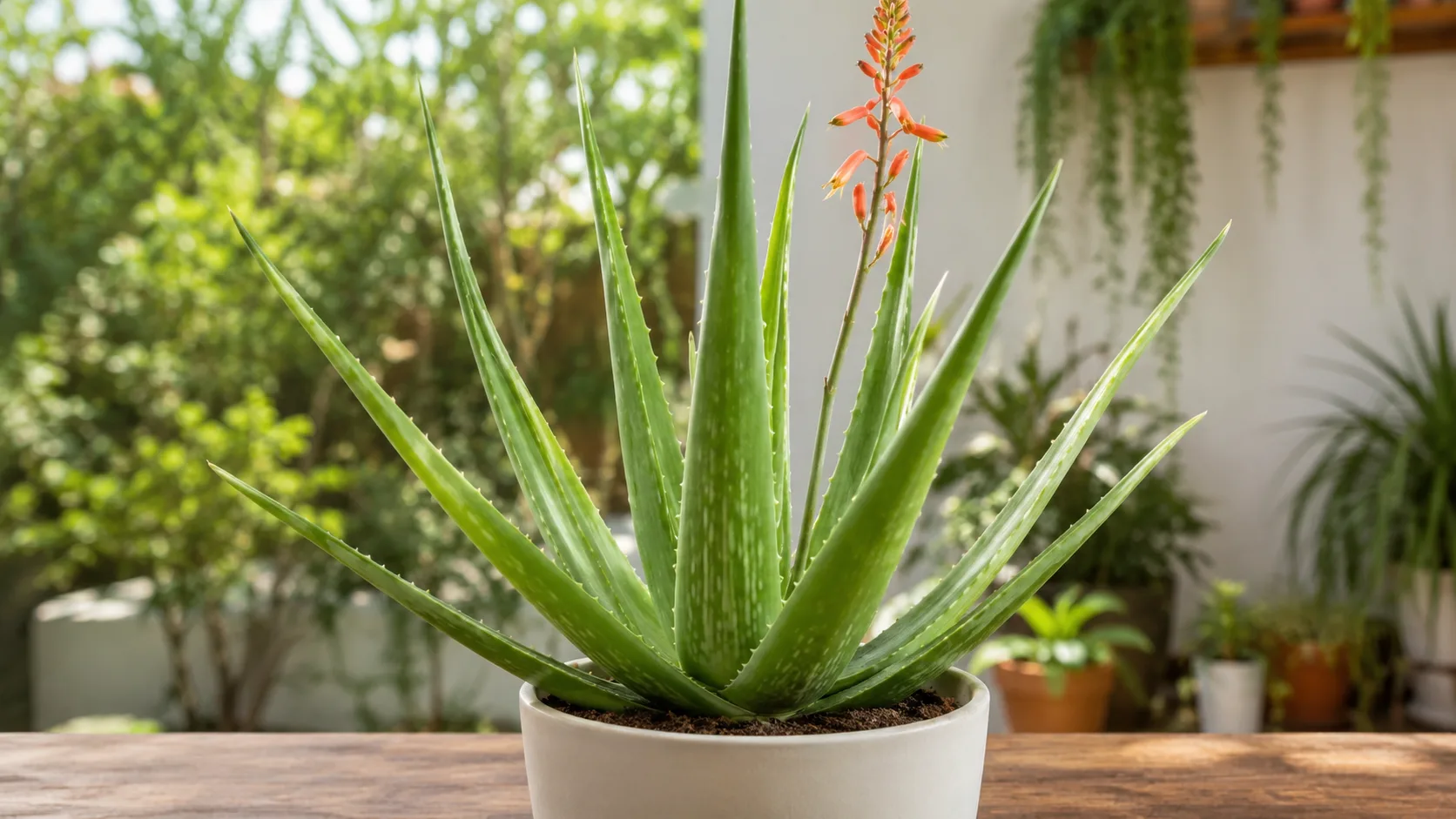
Aloe Vera Soil Mix: Best Gritty Cactus Mix and What to Buy
Aloe Vera Soil Mix: Best Gritty Cactus Mix and What to Buy
If you’ve ever watched a healthy aloe vera slowly turn into a mushy, translucent mess at the base, the soil almost certainly had something to do with it. Aloe vera (Aloe barbadensis) is a desert native that stores water in its leaves for weeks at a time, so it tolerates drought far better than it tolerates a wet root zone. The right soil mix isn’t a luxury; it’s the entire reason Aloe Vera overview survives indoors. Get the mix right, and the rest of the care (light, water, fertilizer) becomes almost boring. Get it wrong, and no amount of careful watering will save it.
This guide walks through exactly what an aloe vera needs from its soil, why the standard bag of potting mix is the wrong tool, which components to use, how to build a reliable DIY recipe, which pre-made cactus mixes are actually worth buying, and how to avoid the most common drainage mistakes.
What aloe vera actually needs from its soil
Aloe vera needs three things from its root zone, in roughly this order of importance: fast drainage, plenty of air, and a slightly acidic to neutral pH. If those three are in place, the plant will grow steadily, push out pups, and rarely complain. If even one is off, the plant will limp along until a watering mishap finishes the job.
Fast drainage means water should flow through the pot and out the bottom within seconds, not minutes. The mix should not stay soggy for hours after a thorough watering. A useful home test: after watering until water runs out the drainage hole, lift the pot. It should feel noticeably lighter within a day or two, and the top inch should be dry to the touch within 2 to 4 days in most indoor conditions.
Plenty of air means the mix should be loose and gritty, not dense. Aloe roots are not designed to push through peat-heavy, compacted medium. They evolved to grow in rocky, sandy, mineral-rich soil with air pockets between particles. A loose mix lets oxygen reach the roots and lets carbon dioxide move out, both of which the plant needs to keep its cells functioning.
The pH sweet spot is 6.0 to 7.0, slightly acidic to neutral. In that range, the macronutrients and micronutrients an aloe needs (calcium, magnesium, phosphorus, iron, manganese) remain chemically available for root uptake. If the pH drifts too high (alkaline) or too low (acidic), certain nutrients become locked out even when they’re physically present in the soil, and the plant shows deficiency symptoms despite “good” care.
The desert-native context that changes the equation
Aloe vera is native to the Arabian Peninsula and has naturalized in tropical and subtropical regions around the world, but its evolutionary baseline is hot, dry, rocky, mineral-heavy soil with infrequent rainfall. Its fleshy leaves are not decorative; they’re reservoirs, carrying weeks of water internally so the plant can ride out extended drought. The Royal Botanic Gardens, Kew Plants of the World Online entry describes the species as a “succulent perennial” that “grows primarily in the desert or dry shrubland biome.”
This context is the entire reason standard indoor potting soil fails. Standard mixes are engineered for tropical houseplants that evolved in moisture-rich, organic-rich forest floors. Those mixes hold water for days, which is exactly what a pothos or peace lily wants, and exactly what an aloe vera cannot survive. Matching the substrate to the plant’s natural habitat is the simplest way to avoid the cascade of problems that starts with a damp root zone.
The pH range aloe vera actually prefers
Most university and botanical sources converge on a pH of 6.0 to 7.0 for aloe vera. The Missouri Botanical Garden Plant Finder notes that aloe vera “is easily grown in sandy well-drained commercial potting loams,” which is shorthand for a pH in that slightly-acidic-to-neutral range with sharp drainage. Kellogg Garden Organics goes further and recommends hovering around 6.0 specifically, warning that more alkaline soil can cause problems for succulents.
If you want to be precise, a basic soil pH meter or a strip test will tell you where your mix sits. Most pre-made cactus mixes already fall in the 5.5 to 7.0 range because that’s where their ingredients naturally land. The bigger concern is that peat-heavy mixes drift more acidic over time as the peat breaks down, which is one more reason to avoid moisture-control blends in an aloe pot.
Why regular potting soil is the wrong tool
Standard indoor potting soil is the most common reason indoor aloe plants die. That’s not a guess; it’s the conclusion multiple sources arrive at, and it matches what every experienced succulent grower has seen on their own shelves. Recent industry estimates cited by The Cactus Outlet suggest that root rot on Aloe Vera, driven primarily by overwatering on Aloe Vera and water-retentive soil, is responsible for up to 40% of indoor aloe deaths. Other sources, looking at succulent mortality in general, place the figure closer to 35% to 50%.
The problem is structural. All-purpose potting mix is built around peat moss, compost, and fine forest products, which act like tiny sponges. They soak up water, hold onto it for days, and stay damp long after the plant has had its fill. For an aloe vera, that environment is hostile. Roots designed to breathe in rocky desert soil are forced to sit in wet, low-oxygen mix. Cells weaken, and opportunistic pathogens move in.
The “moisture control” variants are worse. They’re engineered with water-retentive polymers and coir that hold even more moisture for even longer. The Cactus Outlet explicitly flags them as a “major red flag” for aloe, listing them as a very poor choice compared to a properly gritty cactus mix. Anything labeled “moisture control,” “moisture retaining,” or “for tropicals” should stay far away from an aloe pot.
What actually happens when aloe roots sit in moisture
When an aloe’s roots sit in saturated soil, two things happen at once. First, the water displaces the air in the pore spaces between soil particles, and the roots begin to suffocate. Healthy root cells need oxygen to function, and a waterlogged mix delivers almost none. Second, the weakened root tissue becomes an easy target for soil-borne pathogens that thrive in wet conditions.
The visible symptoms appear gradually and then suddenly. The leaves may still look plump, because the plant is doing its job and storing water internally even as the roots fail. The base of the plant may feel slightly soft at the soil line. Lower leaves start to come away with the gentlest touch. The plant looks fine on a Tuesday and unsalvageable by Friday. That’s the typical trajectory of overwatered aloe, and almost every case traces back to the soil staying wet for too long.
Root rot pathogens that thrive in wet mix
Root rot isn’t a single disease; it’s a category of infections caused by several soil-borne organisms, primarily the oomycetes (water moulds) Pythium and Phytophthora, and the true fungi Fusarium and Rhizoctonia. These organisms are already present in most potting mixes at low levels. They only become lethal when the mix stays wet long enough for them to multiply. A well-draining substrate keeps their populations in check; a soggy one lets them explode.
Pythium in particular is the most common cause of root rot in container-grown succulents, and it preferentially attacks fine, juvenile root tissue. The outer cortex of infected roots peels off easily, leaving a darker vascular strand behind. The lesson is preventive, not curative: by the time the rot is visible above the soil line, the root system has usually been compromised for weeks. The mix is the prevention.
What “gritty” actually means
When succulent growers say “gritty mix,” they don’t mean sandpaper. They mean a substrate dominated by coarse, mineral particles roughly ¼ inch (6 mm) in size, with enough organic matter to hold a little moisture and feed the plant, and enough air space between particles to keep the root zone oxygenated.
A gritty mix has three properties worth knowing:
- High drainage rate. Water poured into a gritty mix flows through and out in seconds. It does not pool on top, it does not run down the sides of the root ball, and it does not stay trapped in the lower third of the pot.
- Fast dry-down. The mix should feel dry to the touch a few days after a thorough watering, even in a humid home. If it stays damp for a week, it isn’t gritty enough.
- Stable structure. The particles don’t break down quickly into fine dust. Mineral components like pumice, perlite, crushed granite, and calcined clay hold their shape for years. Organic components like pine bark and coco coir break down over 18 to 24 months, which is why a refresh eventually becomes necessary.
Particle size and the squeeze test
The single most important variable in a succulent mix is particle size, not the precise recipe. Bonsai Jack’s gritty mix and several university extension recipes all converge on roughly ¼ inch (6 mm) particles because that size is large enough to leave permanent air gaps in the substrate and small enough to make good root contact.
A simple home check: moisten a handful of the finished mix and squeeze it firmly in your fist. When you open your hand, the mix should fall apart almost immediately. If it holds a tight ball, the mix is too fine, too peat-heavy, or both. If it crumbles into a gritty pile with visible particles, the texture is right. The University of Minnesota Extension recommends this same squeeze test as a quick home calibration for cactus and succulent mixes.
The core components of a good aloe vera soil mix
A good aloe vera mix is a combination of mineral drainage material, a small amount of organic matter, and (sometimes) a slow-release nutrient source. Each component has a job. None of them is optional in the right proportions.
Coarse sand, perlite, and pumice
These are the workhorses of an aloe mix, and understanding the difference between them matters more than picking a “best” one.
Coarse sand adds weight, drainage, and the gritty texture that mimics desert soil. The key word is coarse. You want horticultural sand or builder’s sand with visible particles around ¼ inch. Never use fine play sand, sandbox sand, or beach sand. Fine sand compacts between the larger soil particles and actually worsens drainage. Beach sand also carries salt that damages roots. Coarse sand typically makes up 20% to 30% of a DIY mix.
Perlite is the lightweight, white, volcanic-glass material you see in most commercial potting mixes. It holds a small amount of moisture in its porous structure but mostly creates air pockets. It is cheap, widely available, and effective. The downsides: it is so light that it floats to the surface of the pot when you water, and it crushes into powder over a few years, slowly degrading the mix. For most home growers, those are minor issues. Perlite usually makes up 30% to 50% of a DIY mix.
Pumice is heavier, more porous, and more durable than perlite. It traps moisture in its internal pores without feeling wet to the touch, and it stays in place when you water. It costs more than perlite but lasts much longer in the pot. Many experienced growers prefer pumice specifically for aloe and other succulents, and some pre-made cactus mixes (Bonsai Jack’s gritty mix, for example) lean heavily on calcined clay and pumice for that reason.
Cactus potting mix as a base
A pre-made cactus or succulent potting mix is the easiest starting point. Brands like Miracle-Gro Cactus, Palm & Citrus, Espoma Organic Cactus Mix, Hoffman Organic Cactus and Succulent Soil Mix, and Black Gold Cactus Mix are all widely available and reasonably priced. They already contain a blend of organic matter and drainage material, and they save you from sourcing each component yourself.
The catch: most bagged cactus mixes are still not gritty enough to use on their own for an aloe vera. They are formulated to work for a wide range of succulents, which means they retain slightly more moisture than a true desert grower wants. The fix is to amend a bagged mix with 30% to 50% extra perlite or pumice by volume, which brings the drainage up to the level an aloe needs without losing the convenience of a pre-made base.
Optional organic matter: coco coir, pine bark, compost
Organic matter isn’t a dirty word in an aloe mix; it’s just a smaller portion of the total. The classic “gritty mix” of equal parts pine bark fines, calcined clay (Turface or Bonsai Block), and crushed granite contains about a third organic material (the pine bark) and two-thirds mineral, and it has been used successfully on countless high-value cacti and succulents for decades.
Coco coir can be used in small amounts (under 20% of the mix by volume) to add a touch of moisture retention in dry indoor air, especially for growers in arid climates who find pure-grit mixes too thirsty. Pine bark fines add structure, slow-release organic matter, and documented suppressive effects against Pythium and Phytophthora at around 20% of the mix, according to UC IPM and Cornell research. Compost or worm castings can supply a small nutrient charge, but only in modest amounts; an aloe in rich, compost-heavy soil grows soft and leggy.
The rule of thumb is simple: at least 50% mineral material by volume, and ideally closer to 60% to 70% for a true desert grower like aloe. Anything below half mineral and you’re back in moisture-retentive territory.
Perlite vs pumice: which to pick
Both work. Neither is wrong. But they behave differently enough that the choice is worth a moment of thought, especially if you repot often or grow in a humid environment.
| Property | Perlite | Pumice | |
|---|---|---|---|
| Weight | Very light | Heavier, stays in place | |
| Porosity | Moderate | High, traps water in internal pores | |
| Cost | Cheap and widely available | More expensive, less common in big-box stores | |
| Durability | Crushes into powder over a few years | Stable, lasts much longer in the pot | |
| Top-dress behavior | Floats to the surface when watered | Stays put | |
| Best for | Budget mixes, short-term plantings, indoor beginners | Long-term plantings, high-value plants, humid climates |
If you’re starting out and want the simplest, cheapest path, perlite is the right call. If you’ve struggled with perlite floating to the top, or if you want a mix that holds its structure for years without refreshing, pumice is the upgrade. Many growers use both, swapping one for the other at a 1:1 ratio based on what their local garden center stocks.
The 1:1:1 desert mix recipe
The most reliable DIY aloe mix is also the simplest: 1 part potting soil, 1 part coarse horticultural sand, 1 part perlite or pumice. This 1:1:1 ratio is recommended by multiple independent sources, including a Blooming Expert analysis citing the University of Minnesota Extension’s recommendation that cactus soil contain at least 50% coarse, inorganic material. The New York Botanical Garden sets the functional benchmark that cactus soil should drain completely in under a minute; a 1:1:1 mix does exactly that.
To mix it, combine all three ingredients in a bucket and work them together by hand until evenly blended. The finished mix should feel gritty, light, and crumbly. Run the squeeze test: a moistened handful should fall apart the moment you open your hand. If it holds a ball, add more perlite or pumice until it passes.
What you use as the “1 part” doesn’t matter as much as the ratio. A solo cup works for a small batch, a 1-gallon nursery pot works for a bigger batch. As long as the proportions are equal, the mix will behave correctly.
Scaled for a single 6-inch pot
For one 6-inch terracotta pot (roughly 1.5 quarts of usable volume), measure out:
- 1.5 cups of standard potting soil (not moisture control)
- 1.5 cups of coarse horticultural or builder’s sand
- 1.5 cups of perlite or ¼-inch pumice
That’s it. Mix thoroughly in a small bucket, fill the pot, plant the aloe, and wait three to five days before the first watering to let any disturbed roots callus over.
Variations for humid, dry, low-light, and outdoor conditions
The 1:1:1 mix is a strong default, but it can be tuned to the conditions in your home and the light your plant receives.
Humid climate or low-airflow home: Push the mineral ratio higher, to 2 parts perlite or pumice, 1 part sand, 1 part potting soil. The extra inorganic content makes the mix dry down faster, which matters when ambient humidity slows evaporation.
Dry climate or hot, sunny window: Keep the 1:1:1 ratio but consider adding 2 tablespoons of coco coir per quart of mix to hold a touch more moisture, so the plant doesn’t need watering every few days.
Low-light indoor spot (no direct sun, just bright indirect): Increase the pumice or perlite share to 50% of the mix by volume. Lower light means slower photosynthesis, slower water use, and a longer dry-down time. A grittier mix compensates.
Outdoor pot in Aloe Vera light guide (USDA Zones 9–11): Use the 1:1:1 mix as-is, but be aware that pots in direct sun dry much faster than indoor pots, especially in terracotta. Watering frequency will go up.
Pre-made mixes worth buying
Pre-made cactus mixes are an excellent option for growers who don’t want to source individual components. The trick is picking the right one and knowing which to amend.
| Pre-made mix | Key ingredients | Drainage rating | Best for | Watch-outs | |
|---|---|---|---|---|---|
| Bonsai Jack 111 Gritty Mix | Pine coir, calcined clay (Bonsai Block), Monto Clay; pH 5.5 | Superior | High-value plants, humid climates, growers who’ve lost plants to rot | More expensive; needs more frequent watering | |
| Espoma Organic Cactus Mix | Sphagnum peat moss, perlite, limestone, Myco-tone mycorrhizae | Very good | Organic-focused growers, indoor aloes | Slightly more moisture-retentive; amend in humid homes | |
| Hoffman Organic Cactus & Succulent Mix | Sphagnum peat moss, sand, perlite, reed sedge peat, limestone | Excellent | Beginners, indoor aloes, set-and-forget use | May still need extra perlite in humid climates | |
| Miracle-Gro Cactus, Palm & Citrus | Processed forest products, sphagnum peat, sand, perlite, fertilizer | Good | Budget-conscious, casual growers, big-box convenience | Retains more moisture; amend with 30% to 50% extra perlite | |
| Black Gold Cactus Mix | Pumice, perlite, sand, forest products, peat | Very good | Outdoor aloes, multiple-plant collections | Can compact over time; refresh annually | |
| Back to the Roots Succulents & Cacti Mix | Canadian sphagnum, reed sedge peat, perlite, sand, limestone, mycorrhizae | Very good | Indoor beginners, container collections | Designed for containers; not ideal for in-ground use |
Top pick for most people: A bagged Hoffman or Espoma cactus mix, amended with 30% extra pumice or perlite by volume, is the sweet spot of price, availability, and performance for an indoor aloe.
Top pick for rot-prone setups: Bonsai Jack 111 Gritty Mix, used as-is. It is the most expensive option per pound, but its inorganic composition means it will never break down into sludge, never compact, and never retain excess water. It is the closest off-the-shelf equivalent to professional bonsai soil.
How to read the bag
The ingredient list on a cactus mix tells you almost everything you need to know. Look for perlite, pumice, calcined clay, sand, crushed granite, or pine bark in the first few ingredients. These are the drainage components. Look for peat moss, coco coir, compost, or forest products further down the list. These are the organic matter that holds moisture. A good aloe-ready mix has more of the first group and less of the second.
If the first ingredient on the bag is sphagnum peat moss or “composted forest products,” the mix is going to be on the moisture-retentive side, and you should plan to amend it with extra perlite or pumice before potting your aloe. If perlite, pumice, or sand is the first ingredient, the mix is already on the gritty side and may be usable as-is for an experienced grower.
Pot choice and the drainage-layer myth
Soil is half of the drainage equation; the pot is the other half. No mix, no matter how gritty, can save a plant in a pot that holds water at the bottom.
Choose a porous pot. Unglazed terracotta is the classic choice for an aloe because the clay walls wick moisture out of the root zone, helping the mix dry down faster. Glazed ceramic and plastic pots work too, but they hold moisture longer, so the mix needs to be grittier to compensate.
Always use a drainage hole. This is non-negotiable. A pot without a drainage hole traps water in the lower third of the substrate, and the root zone stays wet long enough to invite rot. Cachepots and decorative outer pots are fine as long as the inner pot drains and you empty any standing water that collects in the outer pot after watering.
Match the pot size to the root ball. An aloe in a pot that’s far too large holds wet mix in the unused space around the roots. The rule of thumb is a pot roughly 1 to 2 inches wider in diameter than the root ball. A snug pot dries down faster, which is exactly what an aloe wants.
The drainage-layer myth
For decades, gardening books have recommended putting a layer of gravel, broken pot shards, or pebbles at the bottom of a pot “for drainage.” This is a myth, and the science has been clear on it for years. Linda Chalker-Scott, Ph.D., Extension Horticulturist and Associate Professor at Washington State University, summarized the research in a widely cited extension publication: adding coarse material beneath finer soil actually hinders drainage, not improves it.
The reason is called a “perched water table.” When fine soil sits above coarser material, water does not move easily from the fine layer into the coarse layer. The fine soil has to become fully saturated before water crosses the boundary, which means the bottom of the root zone stays wetter for longer than it would in a uniform mix. Studies cited by the WSU Extension fact sheet on container drainage found that soil with gravel underneath actually retained more moisture than soil without it. The Oregon State University Extension service and Iowa State University have reached the same conclusion.
The fix is straightforward: fill the entire pot with your gritty mix, no gravel layer. The mix itself provides the drainage. If you need to reduce the volume of soil in a very large pot, use lightweight, inert fillers like empty, sealed plastic bottles in the bottom, not gravel.
When to refresh the mix
Even a great mix breaks down over time. The organic component decomposes into finer particles, the air spaces slowly fill in, and the drainage rate of the substrate gradually drops. For a typical DIY mix with 30% to 50% organic content, a refresh every 18 to 24 months is a good rule of thumb. A pure mineral gritty mix like Bonsai Jack lasts much longer but still benefits from a refresh every 3 to 4 years as dust and root debris accumulate.
Signs that the mix needs refreshing, regardless of calendar:
- Water sits on the surface for more than a few seconds after pouring
- The mix takes noticeably longer to dry than it used to
- The pot feels heavier than it should after a normal dry period
- The surface of the mix has crusted over or pulled away from the pot edges
- The plant has been in the same pot for more than 2 years
The best time to refresh is at the start of the active growing season (spring through early summer) when the plant is best able to recover from any root disturbance. Skip Aloe Vera repotting guide a stressed or wilting plant unless the soil is clearly the problem.
Common mistakes to avoid
Most aloe problems trace back to a handful of recurring mistakes. Skipping them is half the work.
Using moisture-control potting mix. It is engineered to do the opposite of what an aloe needs. Replace it with a cactus or gritty mix, or amend it heavily with perlite or pumice.
Planting in a pot without a drainage hole. Water has nowhere to go, and the lower root zone stays saturated. Always use a pot with at least one drainage hole.
Adding a gravel layer at the bottom of the pot. It does not help drainage; it makes it worse by creating a perched water table. Skip it entirely.
Using fine play sand, beach sand, or sandbox sand. Fine sand compacts and clogs drainage. Use only coarse horticultural sand or builder’s sand with visible ¼-inch particles.
Watering on a fixed schedule. A weekly routine works for tropical houseplants and is lethal for aloe. Water only when the mix has dried out, then water thoroughly until it runs out the drainage hole.
Burying the crown too deep. The base of the aloe rosette should sit at or just above the soil surface. Buried crowns stay wet and rot.
Forgetting that organic matter breaks down. A 1:1:1 mix is great on day one and gradually becomes less gritty as the peat and pine bark decompose. Plan to refresh every 18 to 24 months.
Confusing plump leaves with healthy roots. An overwatered aloe can keep its leaves plump for weeks while the roots fail underneath. Plumpness is not a health signal; rather, firm attachment to a firm base is.
Conclusion
The single biggest decision you’ll make for your aloe vera is the soil it lives in. Get the mix right, and the plant becomes nearly self-sufficient, asking for water only when its pot has dried out and otherwise tolerating a missed watering or a vacation week with no complaint. Get it wrong, and no amount of careful light placement, fertilizer schedule, or watering discipline will keep it alive.
A gritty, fast-draining cactus or succulent mix with a slightly acidic to neutral pH, at least 50% mineral content, and a ¼-inch average particle size is the foundation. Whether you buy a bagged mix (Bonsai Jack for the most demanding cases, Hoffman or Espoma amended with extra perlite for everyday use) or mix your own 1:1:1 of potting soil, coarse sand, and perlite or pumice, the underlying principles are the same: drainage in seconds, dry-down in days, and air around the roots at all times. Skip the gravel layer, use a porous pot with a drainage hole, refresh the mix every couple of years, and your aloe will reward you with years of low-maintenance growth.
When to use this page vs other Aloe Vera guides
- Aloe Vera overview - Start here for whole-plant context before deep-diving this topic.
- Aloe Vera problems hub - Jump to symptom-specific fix guides when this care topic does not resolve the issue.
- Root Rot on Aloe Vera - Escalate here when soil adjustments are not enough.
- Mold on Soil on Aloe Vera - Escalate here when soil adjustments are not enough.