Aloe Vera Light Needs: Indoor Placement Guide
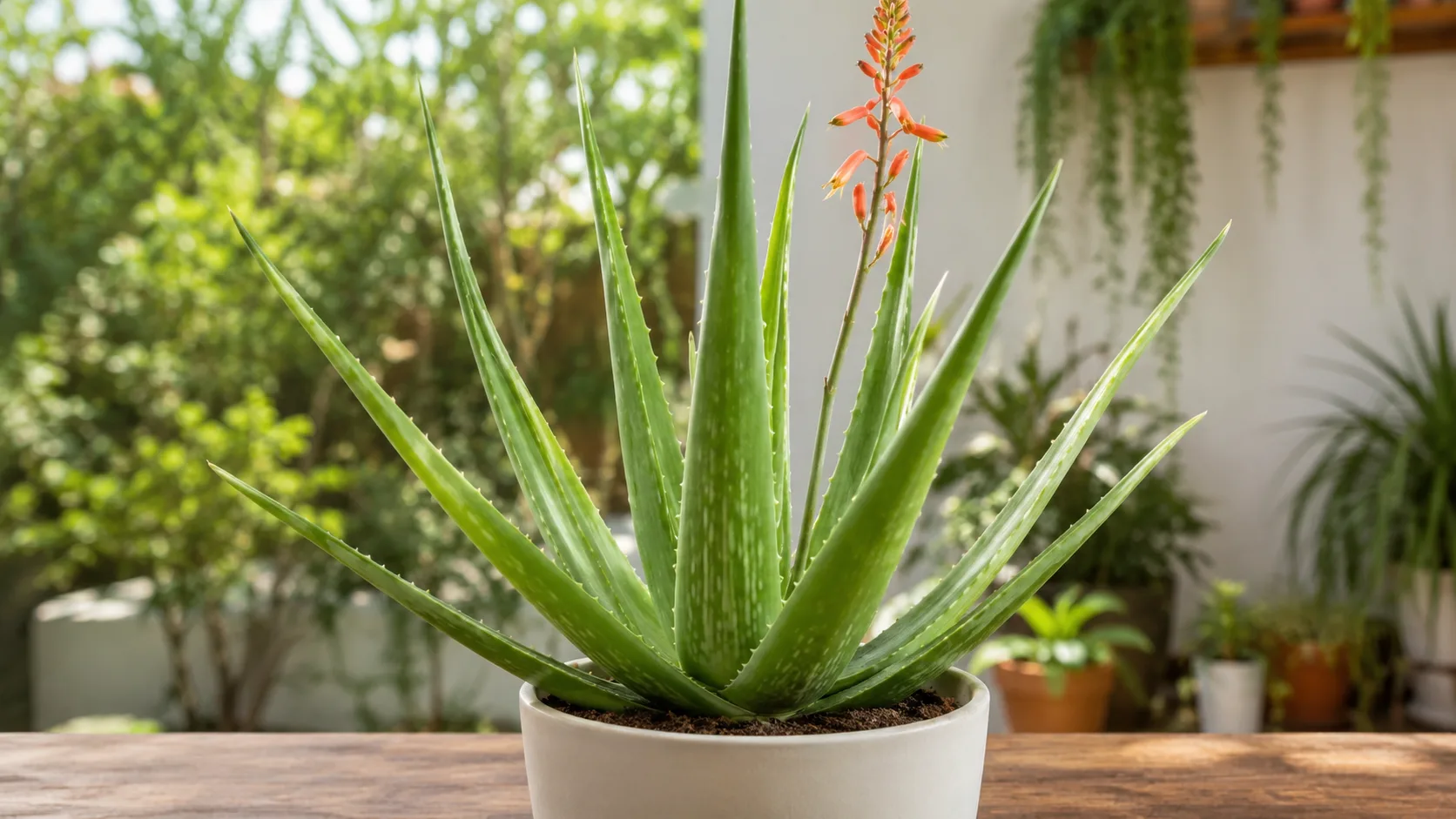
Aloe Vera Light Needs: Indoor Placement Guide
Aloe Vera Light Needs: Indoor Placement Guide
Aloe vera is one of the most forgiving houseplants on the planet, and that is exactly the problem. Because it tolerates dim rooms for months without dying, many people assume it is happy there - until the rosette goes pale, the stem starts stretching, and the leaves bend at odd angles. Light is the single biggest lever you control, and getting it right changes everything about how the plant looks, drinks, and holds its shape.
This guide covers the full picture: how many hours aloe vera actually needs, which window to put it in, how to read every common warning sign on the leaves, how to move the plant outdoors for summer without burning it, and how to set up a grow light when no window will do.
How Much Light Aloe Vera Actually Needs Each Day
Aloe vera is a succulent native to the Arabian Peninsula - one of the sunniest regions on Earth. In its natural habitat, it grows in open, dry areas with strong, direct sun for most of the day. Indoors, that translates to a clear target: at least six hours of bright light every day, with a strong preference for direct sun during the gentler parts of the day.
Penn State Extension recommends placing aloe “near sunny windows so they can receive full sun to bright indirect light” and notes that plants “will grow best, maintain their color, and flower when grown in full to partial sun.” The Missouri Botanical Garden’s Plant Finder entry for Aloe vera describes the plant as easily grown in “sandy well-drained commercial potting loams” in Zones 10 to 12. The North Carolina Extension Gardener Plant Toolbox is more direct on light: “Most varieties need at least 6 hours of sun and grow best in full sun or very bright, indirect light.” The practical indoor target is bright direct to bright indirect light for roughly six to eight hours a day, with some direct morning sun if you can offer it.
The 6-Hour Minimum and the Direct vs. Indirect Distinction
Six hours is the threshold below which most indoor aloes start to decline. A plant that gets only three or four hours of bright light will usually survive for a season or two, but the new growth it pushes out will be thin, pale, and elongated. It will lean toward the window. It will not have the firm, upright architecture that makes aloe vera look like a healthy rosette.
If you can give the plant six to eight hours of strong, direct or near-direct light, the growth it puts out will be visibly different: tighter, thicker, deeper green, and structurally sound. That difference is the easiest light meter you will ever have.
“Bright direct” means the sun’s rays are landing on the leaves without anything filtering them. “Bright indirect” means the same overall brightness, but the light is bounced off walls, ceilings, or a sheer curtain before it hits the foliage. Aloe vera is one of the few houseplants that genuinely enjoys both. Direct morning sun is ideal because it is bright enough to drive strong, compact growth without the heat load of midday rays. Bright indirect light is the safe indoor default for most of the day. The combination - direct morning sun, then bright indirect for the rest of the day - is what an east-facing window delivers naturally, which is why east windows are the most forgiving choice for aloe.
Best Indoor Placement: Windows, Walls, and Room Layout
If you remember nothing else, remember this: the brightest room is not the same as the brightest spot. A plant placed in the middle of a bright room is getting a fraction of the light that the windowsill is getting. Aloe vera wants the windowsill, or within a foot or two of it.
The Window Scorecard: North, East, South, and West
Different windows deliver very different light profiles. The table below summarizes how each direction works for aloe vera in the Northern Hemisphere. If you live in the Southern Hemisphere, flip north and south. The Royal Horticultural Society’s light-loving houseplant profile advises placing aloe “near a south or west-facing window where they can receive plenty of light without being exposed to harsh direct sunlight, which can cause their leaves to brown.”
| Window direction | Light profile | Suitability for aloe vera | |
|---|---|---|---|
| South-facing | Strong direct sun most of the day, hottest in summer | Excellent in winter; can scorch in summer unless diffused | |
| West-facing | Hot, intense direct sun in the afternoon | Good in winter; risky in summer, often needs a sheer curtain | |
| East-facing | Gentle direct sun in the morning, then bright indirect | The easiest, most forgiving indoor spot year-round | |
| North-facing | Bright indirect at best, often quite dim | Survival only; expect pale, leggy growth over time |
A south-facing window is a strong choice in winter when the sun is weaker and lower in the sky. In summer, the same south window can overheat the leaves, especially if the pot sits against hot glass. If you go with south, set the plant back a foot or two from the pane, or filter the light with a sheer curtain during the strongest hours.
East is the default recommendation in most indoor succulent guides for a reason. The morning sun is bright enough to drive real, compact growth, and by the time the harsh afternoon rays arrive, the plant is already in bright indirect light. West works in cooler climates and during winter, but watch for leaf curl and bronzing in late summer afternoons.
A north-facing window is the toughest setup for aloe vera. The plant will not die quickly, but over months it will almost certainly etiolate, lose its compact form, and become paler. If north is your only option, plan on supplementing with a grow light for several hours each day.
How Far From the Glass Should Aloe Vera Sit?
Light intensity drops off dramatically with distance. The succulent care literature and PPFD measurements both agree: even a few feet back from a window can cut the usable light the plant receives by 50% or more. Aim to keep the pot within about 12 inches (30 cm) of the glass, on the sill itself or on a small stand right next to it.
Two practical exceptions: in summer, when the glass can heat up to over 50°C (122°F) in direct sun, pull the pot back a few inches so the leaves are not literally touching the pane. And if the sill gets cold drafts at night in winter, move the pot back an inch or two to avoid thermal shock on the leaves closest to the glass.
Rotating, Cleaning, and Other Habits That Change Real Light
Aloe vera leans toward its light source. If you never rotate the pot, the rosette will gradually tip toward the window, and the side away from the light will lose its tight shape. A quarter turn every week or two keeps the rosette symmetrical and forces new growth on the shaded side to stay compact.
Dust on the leaves also matters more than most people realize. A thick layer of household dust can block a meaningful percentage of the light reaching the chlorophyll. Wipe the leaves gently with a damp cloth every few weeks. Skip leaf shine products - they can clog the pores and leave a film that is worse than the dust.
Can Aloe Vera Get Too Much Sun Indoors?
Yes, even indoors. Glass magnifies light intensity, especially in south- and west-facing windows during summer afternoons, and a plant that was perfectly happy at six hours of direct sun in March can scorch in June at the same spot.
The most common indoor cause of aloe sunburn is moving a plant that has been growing in a dim spot straight into a sunny window. Indoor light intensity is typically one-tenth to one-twentieth the strength of direct outdoor sun, so a plant that has adapted to dim indoor conditions has leaves that are not prepared for even a sunny windowsill in midsummer. Move the plant gradually, watch the leaves, and back off if you see damage.
Stress Color vs. Sunburn: A Comparison Worth Memorizing
This is the single most useful distinction in aloe care. Both stress color and sunburn can turn the leaves reddish, orange, or brown, but they mean very different things. UC Master Gardeners of Contra Costa County explain that “anthocyanins produce red, purple, or blue hues, while carotenoids create yellow and orange tones. These pigments act as natural sunscreens, protecting the plants from excessive sunlight and UV radiation” and appear in response to light, drought, or temperature stress.
| Signal | What it looks like | What it means | Reversible? | |
|---|---|---|---|---|
| Stress color | Even reddish, orange, or bronze tint across the whole leaf; tissue is firm, not papery | The plant is upregulating protective pigments (anthocyanins and carotenoids) in response to brighter light | Yes, usually fades back to green over weeks as the plant adjusts | |
| Sunburn | Dry, papery, bleached or silvery-white patches; often on the sun-facing side; can be crisp to the touch | The leaf cells have been killed by light intensity that exceeded what the plant could process | No, that tissue is permanently damaged and will not turn green again |
NC State Extension’s Plant Toolbox entry for aloe lists its cultural light range as “Full sun (6 or more hours of direct sunlight a day)” to “Partial Shade (Direct sunlight only part of the day, 2-6 hours)” - the problem is almost never sunlight itself, it is the speed of the transition. A plant that gradually acclimates to stronger light will color up nicely without burning. A plant that gets blasted with sudden intensity can lose patches of leaf in a single afternoon.
How to Treat an Indoor Sun-Stressed Aloe
If you see stress color (the even, reversible tint), your plant is telling you it is adapting. Do not move it. Keep the watering steady, give it time, and the new growth that emerges from the center will be deeper green and more compact.
If you see sunburn (the dry, papery patches), the damage is permanent on those leaves but the plant itself can recover. Move it a few feet back from the window or add a sheer curtain. Do not cut off the damaged leaves right away - they still photosynthesize and support the plant. Trim them only when they are fully brown and crispy, or when the plant has clearly outgrown them with new growth.
Signs Aloe Vera Is Not Getting Enough Light
Aloe vera is unusually honest about light problems. It does not just slow down - it visibly changes shape, color, and posture. The signs are easy to read once you know what to look for.
Etiolation and the overwatering on Aloe Vera Trap
Etiolation is the technical name for the stretching response that happens when a plant cannot photosynthesize at a useful rate and starts reaching for more light. The rosette loses its tight, upright form. The stem elongates. The leaves get thinner, paler, and more widely spaced. The whole plant leans toward the brightest source it can find.
Succulent care literature is consistent on the cause: aloe vera needs at least four to six hours of direct or bright indirect light per day, and a spot more than a few feet from any window usually fails to meet that threshold. The plant responds by stretching - and stretched tissue is structurally weaker, more vulnerable to overwatering damage, and more prone to pests. Penn State Extension similarly notes that “the lack of light will make the plant leggy” and South Dakota State Extension restates the same point for aloe specifically.
The bad news: stretched growth does not shrink back. Once a section of stem has elongated, it stays that way. The good news: if you fix the light, the new growth emerging from the center of the rosette will be compact, upright, and properly colored. A quarter turn of the pot every week or two will help the new growth come in symmetrically.
If the plant has stretched badly and you want a compact shape immediately, the standard succulent technique is to behead the rosette: cut the top off below the lowest healthy leaves, let the cut callus over for several days, then replant it in fresh, well-draining cactus mix. The remaining stump will usually push out new offsets.
A dim plant drinks slowly. The same watering routine that worked next to a bright window will keep the soil wet for too long in a darker spot, and aloe vera’s roots are quick to rot in cold, damp soil. If your aloe is in a low-light location, the answer is almost never to water on the same schedule as a sun-grown plant - it is to water less often, after the soil has dried completely to the bottom of the pot.
This is the most under-appreciated light problem: a thirsty-looking plant in a dim corner is usually sitting in soil that is too wet, not too dry. Before you water, stick a finger an inch or two into the soil or pick up the pot to feel its weight. A dry pot feels light. A wet pot feels heavy and cool.
Hardening Off Aloe Vera for Outdoor Sun
Many indoor succulent growers move their aloe outside for the summer, where the light is dramatically stronger and the plant often grows faster and develops a richer color. The catch is that indoor-grown leaves are not prepared for outdoor sun intensity. A plant that goes straight from a living-room windowsill to a sunny patio can develop sunburn patches within hours.
The standard technique is called “hardening off”: a gradual increase in direct sun exposure over one to two weeks. The same approach that gardeners use for vegetable seedlings works for aloe, with a slightly sun-loving twist.
A 10-Day Acclimation Schedule You Can Reuse Every Spring
Use this schedule as a starting point. Adjust it if your plant shows stress at any point - pull it back into shade and slow down.
- Days 1–2: Place the plant outdoors in a fully shaded spot (under a tree, on a covered porch, or behind a taller plant) for 1–2 hours in the morning. Bring it back inside for the rest of the day.
- Days 3–4: Move it to a spot with bright, dappled light for 2–3 hours, including 30–60 minutes of gentle morning sun. Continue to bring it inside during midday and afternoon.
- Days 5–6: Increase outdoor time to 4–5 hours, with 1–2 hours of direct morning sun. Avoid any direct sun between 11 a.m. and 3 p.m.
- Days 7–8: Extend to 6–8 hours outdoors, including 2–3 hours of direct sun. In cooler climates you can start introducing late afternoon sun. In hot climates, keep afternoon shade.
- Days 9–10: The plant should be able to handle full outdoor conditions in its permanent summer position, including several hours of direct sun. Watch for any signs of stress and back off if needed.
During the schedule, water a little more frequently than you were indoors - wind and stronger light dry the pot faster - but never let the pot sit in water or get caught in heavy rain. Aloe vera does not respond well to wet feet, even in summer.
The other key rule: bring the plant back indoors well before your first frost warning. Aloe is not frost-tolerant. Penn State Extension’s houseplant guidance puts the minimum winter temperature around 4–10°C (40–50°F), and a hard frost will damage or kill exposed leaves.
Seasonal Light Changes: Winter, Summer, and Moving Between Them
Indoor light is not constant. The same south-facing window delivers very different light in December and June, and the right placement strategy shifts with the season.
Winter Drops in Daylight and What to Do About Them
In winter, day length shortens, the sun sits lower in the sky, and indoor light intensity can drop by 50% or more compared with summer. The same spot that was perfect in July can become marginal in January. The most common winter sign that an aloe is light-starved is sudden stretching or leaning toward the window after a long period of stable growth.
Three practical moves for winter:
- Move the plant closer to the brightest window you have, ideally a south-facing one. Winter sun is gentle enough that direct exposure through glass rarely burns.
- Reduce watering. With less light, the plant uses less energy and dries out more slowly. A wet, cool, dim combination is the fastest path to root rot on Aloe Vera.
- Consider a grow light if your brightest window still gives the plant less than four hours of direct or strong indirect light. A simple full-spectrum LED on a 12-hour timer can keep the plant in steady growth through the darkest months.
Summer Heat, Afternoon Sun, and When to Add Shade
Summer is when aloe vera is happiest in terms of total light, but it is also when the most common light mistake happens: leaving the plant in a hot, west-facing window in midsummer. The afternoon sun in July and August can be intense enough to scorch leaves even through a windowpane.
The simple rule is to watch the plant. If you see reddish-bronze stress color developing evenly across the leaves, that is fine - the plant is adapting. If you see dry, papery, or bleached patches, that is sunburn, and you need to add shade. A sheer curtain, a move of two to three feet back from the window, or a temporary relocation to an east-facing wall will fix it.
Outdoor summer growers in hot inland climates (the desert Southwest, Mediterranean regions, much of India and the Middle East) often provide afternoon shade from about 1 p.m. onward. Morning sun plus dappled afternoon light is the ideal pattern for these locations.
Grow Lights for Aloe Vera: Setup, Distance, and Daily Hours
If no window in your home can deliver six hours of strong light - a common situation in basement apartments, interior offices, and rooms with small north-facing windows - a grow light is the cleanest fix. Modern full-spectrum LEDs make this easier than it used to be.
What Specs Actually Matter (Kelvin, PPFD, Spectrum)
Three specifications actually matter for aloe vera. Ignore the marketing around “sunlight mimicry” and focus on these.
- Color temperature of 6,000–7,500 K. This is the cool, white-blue range that keeps succulents compact. Warmer “soft white” bulbs below about 4,000 K will produce leggy growth even at high intensity.
- PPFD of 200–400 µmol/m²/s at the leaf surface. PPFD (photosynthetic photon flux density) measures the light the plant can actually use for photosynthesis. Aloe performs best in the 200–400 range; below 200 it will eventually etiolate. A basic lux meter cannot tell you PPFD - for an accurate reading you need a PAR meter, but you can get a useful approximation by aiming for a setup that the manufacturer rates for “high-light succulents.”
- Full-spectrum or heavy blue output. Blue light in the 400–500 nm range is what prevents stretching. Red light (around 660 nm) is useful for flowering and biomass, but a light that is heavy in red and short on blue will produce tall, floppy growth in aloe.
For most home growers, a small full-spectrum LED panel or bulb is enough. Aim for about 20 watts of LED power per square foot of growing area, mounted 6–12 inches above the plant. LEDs run cool, which means you can position them close to the canopy without cooking the leaves - a real advantage over older fluorescent T5 or HID systems.
Run the light for 12–16 hours a day, ideally on a timer so the plant gets a consistent day-night cycle. Aloe vera still needs a real dark period of 8–10 hours to rest.
How to Tell If Your Grow Light Setup Is Working
Use the plant, not the spec sheet, as the final judge. The signs of a good grow light setup are the same signs you would look for in a good window: compact, upright rosette; deep green or blue-green leaves; firm, thick texture; new growth emerging from the center without stretching.
If the plant is still etiolating under your grow light, three things are usually wrong: the light is too far away, the daily duration is too short, or the spectrum is too warm (too much red, not enough blue). Move the light closer in 2-inch increments, increase the timer duration by an hour or two, and confirm the bulb is in the 6,000–7,500 K range. If the leaves are suddenly bleached or showing crispy patches, the light is too close or too intense - pull it back a few inches.
Common Light Mistakes and How to Recover From Them
A few light mistakes come up over and over. Recognizing them early saves the plant.
- Putting aloe in a north-facing window and expecting it to thrive. It will survive, but it will not look like a healthy aloe. Add a grow light or move it to a brighter window.
- Moving a dim-grown plant straight into a south-facing window in summer. The leaves will scorch. Always harden off across at least a week.
- Leaving a plant on a west windowsill through July afternoons. The afternoon heat load can bake the leaves against the glass. Add a sheer curtain or move the pot back a foot.
- Watering on the same schedule after moving the plant to a brighter spot. Brighter light means faster water use. Check the soil more often for the first few weeks.
- Using a warm-white “soft” bulb as the only light source. Aloe will stretch under it. Switch to a full-spectrum or daylight bulb in the 6,000–7,500 K range.
- Ignoring the dust on the leaves. A thick layer of dust blocks light and weakens growth. Wipe the leaves every few weeks with a damp cloth.
Quick Reference: Aloe Vera Light Do’s and Don’ts
| Do | Don’t | |
|---|---|---|
| Give at least 6 hours of bright direct or strong indirect light daily | Rely on a north-facing window as the only light source | |
| Use an east-facing window as the default indoor placement | Put a dim-grown plant directly into a south-facing window in summer | |
| Acclimate the plant gradually when moving outdoors | Move the plant outside for a full day of sun on day one | |
| Filter intense afternoon sun with a sheer curtain | Leave a plant against hot west glass through July afternoons | |
| Watch for stress color (reversible) vs sunburn (permanent) | Cut off sunburned leaves before the plant has recovered | |
| Use a full-spectrum LED in the 6,000–7,500 K range if supplementing | Rely on warm-white household bulbs as a primary light source | |
| Rotate the pot a quarter turn every week or two | Let one side of the rosette do all the light capture | |
| Reduce watering when light is low | Keep the same Aloe Vera watering guide when moving to a dimmer spot |
Conclusion
Light is the foundation of aloe vera care. Get it right and almost everything else - watering, growth rate, color, shape, even the plant’s resistance to rot - becomes easier. Get it wrong and no amount of perfect watering or fertilizer will compensate.
The short version: give aloe vera at least six hours of bright light a day, ideally with some direct morning sun, in the brightest window you can offer - south or west in winter, east as a year-round default, north only with a grow light. Read the leaves for honest feedback: stretched and pale means more light, even reddish-bronze is fine and reversible, dry and papery patches mean you need to dial it back. Acclimate gradually whenever you change the plant’s exposure, and use a full-spectrum LED if no window will do the job. With the right light, the plant will tell you it is happy by producing tight, firm, deeply colored new growth from the center of the rosette, and that is the only signal that matters.
When to use this page vs other Aloe Vera guides
- Aloe Vera overview - Start here for whole-plant context before deep-diving this topic.
- Aloe Vera problems hub - Jump to symptom-specific fix guides when this care topic does not resolve the issue.
- Not Enough Light on Aloe Vera - Escalate here when light adjustments are not enough.
- Leggy Growth on Aloe Vera - Escalate here when light adjustments are not enough.
Related Aloe Vera guides
- Aloe Vera overview
- Aloe Vera watering
- Aloe Vera soil
- Aloe Vera propagation
- Aloe Vera fertilizer
- Aloe Vera repotting
- Not Enough Light on Aloe Vera
- Leggy Growth on Aloe Vera
- Aloe Vera problems
Related tool
Try the Plant Problem Diagnosis Tool with aloe-vera pre-selected to estimate needs for your setup.